AP Biology Statistics Review 2013!
AP BIO EQUATIONS AND FORMULAS REVIEW SHEET #1 Formulas:
Mode = value that occurs most frequently in a data set
Median = middle value that separates the greater and lesser halves of a data set Mean = sum of all data points divided by the number of data points
Range = value obtained by subtracting the smallest observation (sample minimum) from the greatest (sample maximum)
One of the lab groups collected the following data for the heights (in cm) of their Wisconsin Fast Plants: 5.4 7.2 4.9 9.3 7.2 8.1 8.5 5.4 7.8 10.2
Find the mode, median, mean, and range. Show your work where necessary Mode:____________
Median:___________ Mean:____________ Range:____________
Find the standard deviation by filling in the following table.
Heights (x) Mean (x ) xx (xx)2 Interpret the standard deviation in the context of the problem.
Formulas: Chi Square
e e o 2 2 ( )
o = observed individuals with observed genotype
e = expected individuals with observed genotype
Degrees of freedom equals the number of distinct possible outcomes minus one
Degrees of Freedom
p 1 2 3 4 5 6 7 8
0.05 3.84 5.99 7.82 9.49 11.07 12.59 14.07 15.51 0.01 6.64 9.32 11.34 13.28 15.09 16.81 18.48 20.09
Example problem:
Wisconsin Fast Plants have two very distinctive visible traits (stems and leaves). Each plant will either have a purple (P) or green (p) stem and also have either have green (G) or yellow (g) leaves. Suppose that we cross a dihybrid heterozygous plant with another plant that is homozygous purple stem and heterozygous for the leaf trait. Make a Punnett square to figure out the expected ratios for the phenotypes of the offspring.
Suppose a class observed that there were 234 plants that were purple stem/green leaves and 42 that were purple stem/yellow leaves. Does this provide good evidence against the predicted phenotype ratio?
Using your understanding of genetics, what might be one reason why the class got these results?
p2 + 2pq + q2 = 1 p = frequency of the dominant allele in a population
p + q = 1 q = frequency of the recessive allele in a population
Example problem:
For people, being right handed (R) is the dominant trait over being left handed (r). Suppose there is a sample of 20 people that reveals the following genotypes:
(RR) (Rr) (RR) (Rr) (rr) (Rr) (RR) (RR) (Rr) (RR) (Rr) (rr) (Rr) (Rr) (RR) (RR) (Rr) (RR) (rr) (Rr)
a. What percentage of the people are right handed? Left handed?
b. Find p and q and interpret each in the context of the problem.
Now suppose that we took another sample of 10 people. This time we only know their phenotypes. (Right) (Left) (Right) (Right) (Right)
(Right) (Right) (Right) (Left) (Right) c. What percentage of the people are right handed? Left handed?
c. Can you find p and q exactly? Why?
d. Estimate p and q and interpret each in the context of the problem.
e. Estimate how many of the right handed people are homozygous and how many are heterozygous.
p2 + 2pq + q2 = 1 p = frequency of the dominant allele in a population
p + q = 1 q = frequency of the recessive allele in a population
Example problem:
In 1990 the East Kentwood High School student body was made up of 90% right handed students. Being right handed (R) is the dominant trait over being left handed (r).
a. What is p and q for the population of 1990 East Kentwood High School students. Interpret each.
b. Find the percent of the student body in 1990 that are homozygous right handed, heterozygous right handed, and left handed.
Fast forward to today at East Kentwood. Mr. V. took a random sample of 100 East Kentwood students today and found that 18 of them were left handed.
c. What are the new p and q values? How do they compare with the values from 1990?
There are many reasons why this apparent change could have occurred. Come up with an East Kentwood example for each:
Large Sample Size:
Random Mating:
Mutations:
Gene Flow:
Natural Selection:
Rate Population Growth Exponential Growth Logistic Growth
dY = amount of change B = birth rate D = death rate N = population size K = carrying capacity rmax = maximum per capita growth rate of population
Notes
= population growth rate
Example 1:
There are 300 falcons living in a certain forest at the beginning of 2013. Suppose that every year there are 50 falcons born and 30 falcons that die.
a. What is the population growth rate (include units)? Interpret the value.
b. What is the per capita growth rate of the falcons over a year? Interpret the value.
c. Fill in the table and the construct a graph.
d. Find the average rate of change for the falcon population from 2013 to 2018 (include units). Interpret the value.
Example 2:
Kentwood, Michigan had a population of 49,000 in the year 2013. The infrastructure of the city allows for a carrying capacity of 60,000 people. rmax = .9 for Kentwood.
b. What will be the population growth rate for 2013 (include units)?
c. What will be the population size at the start of 2014.
d. Fill in the following table. Then graph year vs. population size.
Year Population size Population growth rate 2013
2014 2015 2016 2017
e. What happened to the population size over the years? What happened to the population growth rate over the years?
f. Explain your answer from part (e) using what you know about carrying capacity.
20
30
40
graph showing the effect of Temp on Rx rate
2. The following table reports the rates of metabolism of a species at a series of ambient temperatures:
Temperature (ºC)
Rate of Metabolism (lO2g-1h-1.)
15 10
20 13.42
30 21.22
(a) Calculate the Q10 values for each temperature interval.
(10/(T2T1))
Q
10
{
R
2/
R
1}
(b) Within which temperature interval (15-20 or 20-30) is the rate of metabolism most sensitive to temperature change?
(c) For this species, would a Q10 calculated for 15 to 30 ºC be as useful as several for smaller temperature ranges? Calculate that Q10 as part of your answer.
3. The reaction rate for a certain process at 14 ºC is 15 units / time. (a) What would be the reaction rate at 20 ºC if the Q10 = 1?
Surviving C
1V
1= C
2V
2C1 = original concentration of the solution, before it gets watered down or diluted.
C2 = final concentration of the solution, after dilution.
V1 = volume about to be diluted
V2 = final volume after dilution
By drawing the "X" through the equal sign and filling in the formula with letters of a size permitted by the borders of the "X", it reminds you that :
It makes sense because to dilute, we add water. This increases the volume but lowers concentration. Examples by Type:
1. Easiest: Joe has a 2 g/L solution. He dilutes it and creates 3 L of a 1 g/L solution. How much of the original solution did he dilute?
2. A little trickier: Joe has 20 L of a 2 g/L solution. He diluted it, and created 3 L of a 1 g/L solution. How did he make such a solution?
3. Trickier too: Joe has 20 L of a 2 g/L solution. To this solution he adds 30 L. What is the final concentration of the solution?
pH Reminder: pH = -log (H+ )
Which is more acidic? (H+ ) of 1.0 x 10⁻⁸ or 1.0 x 10⁻¹²
Which is more basic? (H+ ) of 1.0 x 10⁻⁶ or 1.0 x 10⁻³
Stomach acid has a pH of about 1-2. What would the H+ concentration be around?
[H3O+] or [H+] scientific notation pH 0.1
0.00000001 0.0000000001 0.00000000001
As [H+] gets smaller, scientific notation exponents get ________________, and pH goes __________
As [H+] gets larger, scientific notation exponents get ________________, and pH goes __________
Surface Area to Volume and Water Potential Review
1) Cells throughout the world have variable shapes and sizes. Because of this, and because structure is designed around function, certain shapes are optimal for certain processes.
Analyze the following cells (units not to scale), and determine the following… Cell 1 (spherical) where the radius is 3 mm
Cell 2 (flat and rectangular) where the height is 0.5mm, length is 4mm, width is 2mm A) What is the surface area to volume ratio of both cells?
How to calculate Surface Area?
Surface area How to calculate Volume?
Volume Surface area to Volume Ratio Cell 1
Cell 2
B) Conclusion: Compare the ratios and explain why one cell would be more efficient than another.
C) Are you made of lots of large cells or lots of small cells? Why? How do you actually grow in height?
Graph these data to the right of the table. From your graph, label where the cells were hypotonic and the solution was hypertonic, and vice versa. Determine the apparent molar concentration (osmolarity) of the potato core cells.
Looking at the water potential equation,
Pressure potential is always (positive/negative), while solute potential is always (positive/negative). When Solution potential goes down (gets more negative), water potential ____________________ When Pressure potential goes down (gets smaller), water potential ____________________ When would the pressure in a cell rise? (Under what conditions?)
What would happen to the solute potential when Concentration is increased (justify with equation)? WHY?
What would happen to the solute potential when Temperature is increased (justify with equation)? WHY?
What would happen to the solute potential when the dissolved substance is glucose vs. salt (justify with equation)? WHY?
Why is water potential important for plants? What are they lacking?
Predict what would happen to animal cells placed in 0.0M and 1.0M concentration solutions. Molarity of
Sucrose in Beaker
Percent Change in Mass
0.0 M 18.0
0.2 5.0
0.4 -8.0
0.6 -16.0
0.8 -23.5
ΔG = ΔH - T ΔS
What is Entropy? = a measurement of ______________________________ When ΔS is positive this means there is __________________________ When ΔS is negative this means there is __________________________
What is ΔH? = a measurement of __________________________
When ΔH is positive this means the reaction is __________________________ When ΔH is negative this means the reaction is __________________________
What is Gibbs Free energy? = a measurement of ___________________________ When ΔG is positive this means the reaction will happen _________________________ When ΔG is negative this means the reaction will happen _________________________
ΔG (Joules)
ΔH (Joules)
T (Kelvin)
ΔS (J/K)
1000 300 5
1100 300 5
1200 300 5
1300 300 5
1400 300 5
1500 300 5
1600 300 5
1700 300 5
1800 300 5
1900 300 5
What happens to
ΔG
whenΔH
goes down ? WHY?ΔG
ΔH
T
ΔS
1700 300 5
1700 310 5
1700 320 5
1700 330 5
1700 340 5
1700 350 5
1700 360 5
1700 370 5
1700 380 5
1700 390 5
What happens to
ΔG
whenT
goes up ? WHY?What happens to
ΔG
whenT
goes down ? WHY?ΔG
ΔH
T
ΔS
7500 300 5
7500 300 10
7500 300 15
7500 300 20
7500 300 25
7500 300 30
7500 300 35
7500 300 40
7500 300 45
7500 300 50
What happens to
ΔG
whenΔS
goes down ? WHY?Biochemical free energies are usually given as standard free energies of hydrolysis. For example, the hydrolysis of glucose-6-phosphate:
has ΔG° = -4.0 kcal/mole (-16.5 kJ/mole) under standard conditions. Therefore, the opposite reaction, the phosphorylation of glucose, is unfavored. However, the phosphorylation of glucose occurs readily in the cell, catalyzed by the enzyme hexokinase:
The other half of the phosphorylation reaction is the hydrolysis of ATP to yield ADP and inorganic phosphate (Pi):
under standard conditions has ΔG° = -7.3 kcal/mole (-31 kJ/mole).
The standard free energy change of the reaction can be determined by adding the two free energies of reaction:
Note that the reaction as written is unfavored; its free energy change is positive. Another way of stating this is that the reaction is endergonic, that is, the reaction involves a gain of free energy.
The two reactions are summed:
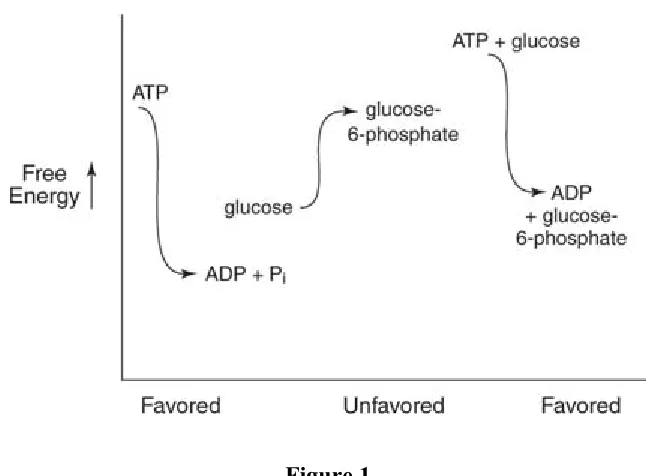
This is a simple example of energetic coupling, where an unfavorable reaction is driven by a favorable one, as shown in Figure 1 .
Figure 1
Coupling doesn't occur all by itself. In this example, if this experiment were set up so that the ATP would have to be hydrolyzed in one tube and the glucose phosphorylated in another, no coupling would be possible.
Coupling can occur only when the partial reactions are part of a larger system. In this example, coupling occurs because both partial reactions are carried out by the enzyme hexokinase. In other cases, coupling can involve membrane transport, transfer of electrons by a common intermediate, or other processes. Another way of stating this principle is that coupled reactions must have some component in common.
The “orderliness” of your body is not favored by free energy. Explain (in terms of free energy and disorder) why you need to perform digestion?
Explain why plant cells need light to build sugar (in terms of energy).
Primary Productivity –
The rate at which organic materials are stored
6CO
2+ 6H
2O → C
6H
12O
6+ 6O
2One can determine Primary Productivity by measuring dissolved oxygen in the water (as it is hard to measure it in the air)
Conversion Factors:
1 ml of O2 = .536 mg of Carbon assimilated
To convert: ppm O2 = mg O2/L
mg O2/L x 0.698 = ml O2/L
ml O2/L x 0.536 = mg carbon fixed/L
Fill in the table and Graph Net and Gross Productivity vs % of light
Using your data table, what seems to be the trend as the % of light decreases? WHY?
Using your data table, what seems to be the trend as the % of light increases? WHY?
Where would you say this organism is using as much energy as they are making? WHY?
Using your table and graph, explain why most of the time there are bigger plants on land than in the sea? Explain this in terms of evolution