QUALITY AND CHEMICAL COMPOSITION OF ORGANIC AND NON-ORGANIC VETIVER OIL
Asep Kadarohman
1, Ratnaningsih Eko S.
1, Gebi Dwiyanti
1,
Lela Lailatul K.
1,*, Ede Kadarusman
2, and Ahmad Nur F.
2 1Department of Chemistry Education, Faculty of Mathematics and Sciences Education, Indonesia University of Education, Bandung, Jl. Dr. Setiabudhi No. 229 Bandung 40154 West Java, Indonesia
2
UKM of Vetiver Oil in Samarang Garut, Jl. Raya Kamojang Samarang Garut 44161 West Java, Indonesia
Received June 15, 2013; Accepted January 3, 2014
ABSTRACT
Vetiver oil (Vetiveria zizanoides) has been used as perfume materials, cosmetics, fragrance soaps, anti-inflammation, repellent, and insecticidal agents. Organic vetiver oil has higher economical value than non-organic vetiver oil and it has been regarded to be able to compete in the global market. Therefore, studies have been carried out using 1 hectare of land and the first generation of organic vetiver oil has produced 0.57% of yield, greater than non-organic (0.50%). The quality of organic and non-organic vetiver oil was analyzed by Indonesian Standard (SNI) parameter, pesticide residue test, chemical composition by GC/MS, and the appearance of vetiver root. In general, the result of organic and non-organic vetiver oil has fulfilled the national standard; the quality of organic vetiver oil was better than non-organic one. Physically, the appearance of organic vetiver root was better than non-organic vetiver root; organic vetiver root was denser, more appealing, and did not have any black spots. The pesticide residue of organic vetiver oil was lower than non-organic vetiver oil. Based on SNI test, vetiverol (oxygen compounds) in organic vetiver oil was higher than non-organic vetiver oil.
Keywords:Vetiveria zizanoides; organic vetiver oil; vetiverol
ABSTRAK
Minyak akar wangi (Vetiveria zizanoides) merupakan bahan parfum, kosmetik, fragran, anti-inflamasi, penolak serangga dan insektisida. Minyak akar wangi organik mempunyai nilai jual yang lebih tinggi dibandingkan dengan minyak akar wangi non-organik. Untuk itu, telah dilakukan penelitian terhadap sistem penanaman akar wangi organik dan analisis kualitas minyak akar wangi organik dibandingkan dengan non-organik. Penanaman akar wangi organik dilakukan pada lahan seluas 1 hektar. Minyak akar wangi diperoleh melalui distilasi uap tanaman akar wangi. Perbandingan kualitas minyak akar wangi organik dan non-organik dianalisis dengan GC/MS, tes residu pestisida dan uji SNI. Hasil penelitian menunjukkan yield minyak akar wangi organik 0,57% sedangkan non-organik umumnya kurang dari 0,5%. Kandungan pestisida minyak akar wangi organik lebih rendah dari non-organik. Secara umum, minyak akar wangi organik memenuhi standar SNI dan memiliki kandungan vetiverol lebih besar dibandingkan minyak akar wangi non-organik.
Kata Kunci:Vetiveria zizanoides; minyak akar wangi organik; vetiverol
INTRODUCTION
Indonesia is the second largest country in the world after Haiti as vetiver oil exporter and the first exporting country after the earthquake in Haiti in 2010. Vetiver root is an annual plant and usually planted with vegetables as intercropping plant such as cabbage, potato, and peanut.
Essential oil, which is also defined as essence, volatile oil, etheric oil or aetheroleum, is a complex mixture of volatile which is regarded as a biosynthesis constituent of plants [1]. The characteristic aroma is resulted from a variety of complex chemical compounds.
The term essential oil is concomitant to fragrance or perfumes because these fragrances are oily in nature and they represent the essence or the active constituents of the plants. They are called volatile or ethereal oils as they evaporate when they exposed to air at ordinary temperatures. Essential oils are highly concentrated, low volume, high value products [2].
[5-16]. Vetiver oil is one of the most important raw materials in aromatic product especially perfumery both as a fixative and fragrance ingredient [17].
Furthermore, many people are aware of the importance of a healthy life, sustainable land and environment and also promoting the increasing demand of organic product including organic essential oil (aromatic) product. The rate of increase in world demand of organic products is currently accounted for 10-20% per year with the price of organic production of approximately 20-70%, higher than conventional products (non-organic).
The government has long declared "Go Organic Indonesia 2010" and in 2002 had issued guidelines for organic farming by removing the reference to the perpetrator in the form of organic SNI 01-6729-2002 on Organic Food System. However, the current development of organic essential oils in Indonesia has not been optimized.
Currently, organic essential oil products market are more globalized, thus more effort and attention from the manufacturer are required. The market of organic products in the world is still dominated by America and Europe, while countries in Asia and other regions accounted for only about 3%. Along with the increasing global trade, the qualities of essential oil product, such as vetiver oil, are also becoming more important to access export markets.
Therefore, to remain competitive in world markets and to increase the price of vetiver oil, replacing conventional (non-organic) vetiver oil production to organic vetiver oil is needed. The export value of Indonesian essential oils has been moving away from the increasingly volatile world oil imports, which means that the market share in Indonesia has become smaller, for example in 2010 Indonesia's market share is only 1.7%. This suggests that the Indonesia volatile oil market opportunities in international markets are still wide open and the rate of increase in exports of Indonesia volatile oil should be improved. Besides market availability, price of organic essential oil product, including organic vetiver oil, is 20-70% higher than non-organic product.
In Indonesia, the development of organic essential oil products, especially organic vetiver oil, was implemented in Samarang Garut, as the production center of vetiver oil [18]. Vetiver root planting, which used organic fertilizer from dung of goat and cow, produced the first generation of organic vetiver oil. The quality and quantity of the first generation of organic vetiver oil production had been studied and compared with non-organic vetiver oil. It was produced from vetiver root which its plantation used chemical fertilizer and pesticide.
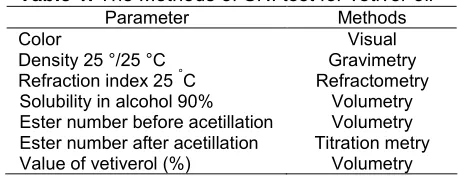
Table 1.The Methods of SNI test for vetiver oil
Parameter Methods
Color Visual
Density 25 °/25 °C Gravimetry
Refraction index 25°C Refractometry Solubility in alcohol 90% Volumetry Ester number before acetillation Volumetry Ester number after acetillation Titration metry Value of vetiverol (%) Volumetry
This study included determination and evaluation of yield, Indonesian standard (SNI) parameter, pesticide residue, and chemical composition.
EXPERIMENTAL SECTION
Materials
Planting materials: Organic and non-organic vetiver root were obtained from UKM Pulus Wangi Nusantara, which was located in Samarang, Garut, West Java.
Organic vetiver oil was obtained from vetiver root which was planted using organic fertilizer from dung of goat or cow and isolated from other land.
Non-organic vetiver oil was obtained from vetiver root which was planted by farmers using chemical fertilizer and pesticide.
Instrumentation
The instruments used were a set of tools for steam distillation process, SNI test, pesticide residue test, and GC/MS spectrometer. The Indonesian Standard (SNI) test of vetiver oil was determined in Laboratory of Balai Penelitian Tanaman Obat dan Aromatik(Balittro) Bogor using several methods (Table 1), which were pesticide residue test by GC spectrometry in Chemical Residue Laboratory in Bogor, analysis and identification of chemical composition of vetiver oil by GC/MS in Instrument Laboratory, Department of Chemistry Education, Faculty of Mathematics and Sciences Education, Indonesia University of Education, Bandung.
Procedure
The steam distillation process
The samples (dried vetiver roots) were loaded into steam distillation kettle. The steam distillation process was 20 h with 2 atmospheres pressured for premium quality and 12 h with 5 atmospheres pressured for regular quality.
Yield was calculated using the following equation:
100% Total of vetiver oil produced
Table2.The SNI regulation and SNI test of organic and non-organic vetiver oil
Parameter Organic Non-organic Regulation
Color Brown brown yellow – brown to red
Density 25 °/25 °C 0.9853 0.9866 0.980 – 1.003
Refraction index 25°C 1.5305 1.5310 1.520 – 1.530
Solubility in alcohol 90% Soluble, limpidly 1:2 Soluble, limpidly 1:2 1:1 limpidly, after end
Ester number before acetillation 5.51 13.50 5 – 26
Ester number after acetillation 118.52 112.39 100 – 150
Value of vetiverol (%) 48.71 42.41 Minimum 50
Fig 1.Steam distillation process of vetiver oil Fig 2.Premium quality of vetiver oil
Fig 3.Regular quality of vetiver oil Fig 4.Organic and non-organic vetiver root
Analysis and identification of chemical composition of vetiver oil by GC/MS spectrometry
In this study, we used Shimadzu QP-2010 S Mass Spectrometer model with EI mode operating at 70 eV under the following conditions: RTX-5 column (30 m length x 0.25 mm ID). Helium Carrier Gas (36 mL/min). Linear velocity, Pressure, and Split Ratio were 27.3 cm/sec, 22.0 kPa, 153.0, respectively. The injector temperature was 310 °C, column temperature was programmed at 80 °C with 10 °C/min and increased to 310 °C, 0.55 mL/min of samples were injected (split mode) in the column for 25 min. The components were identified based on library by WILEY7 and NIST08.LIB.
Examined parameters and data analysis
Parameters, which were examined in this study, included yield, SNI parameter, pesticide residue, analysis and identification of chemical composition by GC/MS.
Determination of concentration (v/v) for each component was confirmed using an internal standard (chlorobenzene 10%) from Merck and added to samples using digital micropipette Sibata Digipet 2508-100.
Concentration of each component which was calculated by the following equation:
X
X IS
IS A
C xC
A
CX : Concentration of sample (v/v)
CIS: Concentration of internal standard (v/v)
AX : Peak area of sample
AIS: Peak area of internal standard
RESULT AND DISCUSSION
Production and Quality of Organic and Non-organic Vetiver Oil
Table 3.Pesticide residue test of organic and non-organic vetiver oil
Concentration of Residue (µl/ml)
No. Analysis
Organic Non-organic
Limit Detection
(µl/ml) ORGANOCHLORINE
Α-BHC - - 0.0021
Γ-BHC (Lindan) - - 0.0015
Aldrine - - 0.0014
Heptachlorine 0.014 0.028 0.0018
Dieldrine 0.004 0.008 0.0022
DDT - - 0.0019
Endrine - - 0.0017
I.
Endosulfane - - 0.0020
II. ORGANOPHOSPHATE
Diazinone - - 0.0023
Fenitrotione - 0.005 0.0022
Metidatione - - 0.0020
Malatione - - 0.0022
Chlorpyrifos 0.004 0.005 0.0023
Paratione - - 0.0023
Profenophose - - 0.0017
Dimetoate - - 0.0023
III. CARBAMATE
Carbofuran - - 0.0137
MIPC - - 0.0149
BPMC - - 0.0143
Fig 5.Chromatogram GC of organic vetiver oil
quality (Fig. 3). The results of vetiver oil distillation were 32.7 kg for premium quality and 12.7 kg for regular quality that were resulted from 8,019 kg dried vetiver root.
The quality of organic and non-organic vetiver oil was determined based on the yield, SNI test, pesticides
residue, analysis and identification of chemical compounds.
Table 4.Chemical composition of organic vetiver oil by GC/MS analysis
Peak Molecule Formula Name Mol Weight % Concentration (v/v) SI
3 C15H24 1,2,4-Metheno-1H-indene 204 0.19 92
4 C15H24 alpha-Ylangene 204 0,15 84
5 C15H26 alpha-Cedrane 206 0.11 92
7 C15H24 alpha-Chamigrene 204 0.14 94
8 C15H26O alpha-Cedrol 206 0.43 89
9 C15H24 Calarene 204 0.47 88
10 C15H24 (+)-Epi-bicyclosesquiphellandrene 204 0.30 91
11 C15H24 Aristolene 204 0.46 91
12 C15H24 1,4-Methano-1H-indene 202 1.39 85
13 C15H24 Khusimene 204 2.38 83
14 C12H18O L-Proline, 1 glycyl 178 1.17 84
15 C15H22 8,9-dehydro-Neoisolongifolene 202 0.57 79
16 C15H24 alpa-Amorphene 204 2.09 96
18 C15H22 Aromadendrene, dehydro- 202 4.29 80
19 C15H24O alpha-Santalol 220 1.04 75
20 C15H24 delta-Cadinene 204 1.85 90
21 C15H22 Isolongifolene, dehydro 202 0.68 79
22 C15H24 Gamma-Elemene 204 0.50 80
23 C15H24 Alpha-Gurjunene 204 1.89 89
24 C15H22 aromedenedradiene 202 1.45 86
Peak Molecule Formula Name Mol Weight % Concentration (v/v) SI
25 C15H24 10s,11s-Himachala-3(12),4-diene 204 0.80 92
26 C15H20 alpha-Calacorene 200 0.40 84
27 C15H24 gamma-Himachalene 204 0.45 81
28 C15H22 Cycloisolongifolene 202 5.89 86
31 C15H22 Cycloisolongifolene, 9,10-dehydro 202 1.13 82
32 C15H26O Torreyol 222 0.28 88
35 C15H22O Selina-6-en-4-ol 222 0.68 84
36 C15H22O 2,2,7,7-tetramethyltricyclo
[6.2.1.0(1,6)]undec-4-en-3-one
218 0.42 80
38 C15H24O Longifolenaldehyde 220 1.54 81
39 C15H22O Valerenal 218 0.91 84
40 C15H24O 1,4-1,7-ditrans-acorenone 220 0.15 77
41 C21H34O2 Androstan-17-one 318 0.24 80
43 C15H24 (-)-Caryophyllene-(11) 204 0.24 84
44 C15H24 Cadinene 204 0.22 86
45 C15H24 Caryophyllene 204 0.13 85
46 C15H22O Nootkatone 218 0.61 74
47 C15H22O Valerenal 218 0.52 80
49 C15H22O Isovalerenal 218 0.68 85
50 C15H22O Zierone 218 2.00 77
Note: The components were identified based on library by WILEY7 and NIST08.LIB.
appealing, and did not have any black spots (Fig. 4). SNI test and SNI regulation of vetiver oil are shown in Table 2. Generally, organic and non-organic vetiver oil fulfilled a national standard, although the content vetiverol of vetiver oil did not meet with SNI regulation. However, the vetiverol of organic vetiver oil was still higher than non-organic vetiver oil (48.71% compared to 42.41%).
Pesticide residues on organic vetiver oil were less than non-organic vetiver oil (Table 3). According to Table 3, the pesticide residues detected in organic and non-organic vetiver oil were organochlorine and organophosphate groups. The detected organochlorine groups were heptachlorine and dieldrine; with the
concentration of 0.014 and 0.004 µL/mL of organic vetiver oil, 0.028 and 0.008 µl/ml of non-organic vetiver oil. The detected organophosphate group was chlorfiriphose with the concentration of 0.004 µL/mL of organic vetiver oil and 0.005 µL/mL of non-organic vetiver oil. Moreover, non-organic vetiver oil contained 0.005 µL/mL fenitrotione. The results were smaller than other agriculture products (SNI Number 7313:2008).
Chemical Composition of Organic and Non-organic Vetiver Oil
Table 5.Chemical composition of non-organic vetiver oil by GC/MS analysis
Peak Molecule Formula Name Mol Weight % Concentration (v/v) SI
3 C16H24O
5-methyl-2-(1-methyl-1-phenylethyl) Cyclohexanol
232 0.14 87
5 C15H24 alpha-Copaene 204 0.11 86
6 C14H22 3,5,7-trimethyl-undecatetraene 190 0.18 83
7 C15H26 alpha-Cedrene 206 0.22 91
11 C15H24 alpa-Chamigrene 204 0.15 94
12 C15H26O alpha-Cedrol 222 0.29 89
13 C15H24 (+)-Calarene 204 0.38 84
16 C15H24 Isolongifolene 204 1.34 82
17 C15H24 1,4-Methana-1H-indene 204 1.64 85
18 C15H24 Khusimene 204 2.46 84
20 C15H18O
3-methyl-5-ethyl-4-propylidene-cyclohex-2-ene-1-one
178 0.83 84
21 C15H22 8,9-dehydro-neoisolongifolene 202 0.66 79
22 C15H24 alpha-Amorphene 204 2.09 95
24 C15H24 Cadinene 204 4.13 82
26 C15H24 delta-Cadinene 204 1.52 90
28 C15H24 gamma-Elemene 204 0.32 81
29 C15H24 alpha-Gurjunene 204 1.53 89
Peak Molecule Formula Name Mol Weight % Concentration (v/v) SI
30 C15H22 Aromadendrene, dehydro 202 3.00 86
32 C15H24 gamma-Selinene 205 0.69 90
33 C13H16 Calacorene 172 0.58 87
34 C17H26O2 (Z)-Valerenyl acetate 262 0.42 78
35 C15H22 Cycloisolongifolene 202 5.11 86
36 C15H22 Isolongifolene, 4,5-dehydro 202 2.54 85
39 C15H24 gamma-Himachalene 204 0.26 84
40 C15H22 Neoisolongifolene 202 1.43 79
42 C15H24 Caryophyllene 204 0.18 75
44 C15H24O 1,4-1,7-ditrans-acorenone 220 0.17 84
45 C15H22O Valerenal 218 0.81 84
46 C15H24O Longifolenaldehyde 220 0.33 81
47 C15H22O Longiverbenone 218 0.30 79
48 C15H24 Cedrene-V6 204 0.92 81
49 C15H24 delta-Selinene 204 0.26 86
50 C15H22O2 Isokhusenic acid 234 0.94 73
51 C15H22O2 Isocurcumenol 234 1.57 68
53 C15H22O Aristolene 218 0.61 81
54 C15H22O Zierone 218 1.99 77
Note: The components were identified based on library by WILEY7 and NIST08.LIB.
widely used gas chromatography/mass spectrometry (GC/MS) [21-40]. The chromatograms GC of organic and non-organic vetiver oil are shown in Fig. 3 and 4, whereas the chemical compositions of organic and non-organic vetiver oil are shown in Table 4 and 5.
According to Table 4, organic vetiver oil indicated 50 components with the following main components; cyclo-isolongifolene (5.89%), aromadendrene, dehydro (4.29%), khusimene (2.38%), alpha-amorphene (2.09%), and zierone (2.00%). There were 54 components of non-organic vetiver oil; with the following major components; cyclo-isolongifolene (5.11%), cadinene (4.13%), aromadendrene-dehydro (3.00%), isolongifolene, 4,5-dehydro (2.54%), khusimene (2.46%), and alpha-amorphene (2.09%) (Table 5).
CONCLUSION
In general, the results of organic and non-organic vetiver oil fulfilled SNI parameter and the quality of organic was better than non-organic vetiver oil. The major components of vetiver oil were cyclo-isolongifolene, aromadendrene-dehydro, khusimene, alpha-amorphene.
ACKNOWLEDGEMENT
Fig 6.Chromatogram GC of non-organic vetiver oil
contract number 166/SP2H/KPM/DIT.LITABMAS/III/ 2012, March 6th, 2012.
REFERENCES
1. Bassolé, I.H.N., and Juliani, H.R., 2012, Molecules, 17 (4), 3989–4006.
2. Joy, P.P., Thomas, J., Mathew, S., Jose, G., and Joseph, J., 2001, Tropical Holticulture, 2 (ed. Bose, T.K., Kabir, J., Das, P., and Joy, P.P.), 633–733. 3. Sievers, A.F., 1928,Tech. Bull., 16, 6–16.
4. Lawrence, B.M.,“The Isolation of Aromatic Materials from Natural Plant Products” in A Manual on the Essential Oil Industry, ed. Silva, K.T.D., UNIDO, Vienna, 1995, 57–154.
5. Dewick, P.M., 2002, Medicinal Natural Products: A Biosynthetic Approach, 2nd ed., John Wiley&Sons Ltd, Baffins Lane, Chichester, 172–185.
6. Chomchalow, N., 2001,Tech. Bull., 1, 7–9.
7. Bauer, K., Garbe, D., and Surburg, H., 2001, Common Fragrance and Flavor Materials: Preparation, Properties, and Uses, 2nd ed., Wiley-VCH, Weinheim, 168–170.
8. Henderson, G., Heumann, D.O., Laine, R.A., Maistrello, L., Zhu, B.C., and Chen, F., 2005,United States Patent 6906108, B2. 1–13, 12 claims, 4 drawing sheets.
9. Jain, S.C., Nowicki, S., Eisner, T., and Meinwald, J., 1982,Tetrahedron Lett., 23 (45), 4639–4642.
10. Maistrello, L., Henderson, G., and Laine, R.A., 2001, J. Econ. Entomol., 94 (6), 1532–1537.
11. Raja, M., and William, S.J., 2008, Int. J. Integr. Biol., 2 (1), 62–64.
12. Tarigan, N., 2006,Buletin Teknik Pertanian, 11 (1), 1–4.
13. Zhu, B.C.R., Henderson, G., Chen, F., Fei, H., and Laine, R.A., 2004, J. Chem. Ecol., 27 (8), 1617– 1625.
14. Zhu, B.C.R., Henderson, G., Adams, R.P., Mao, L., Yu, Y., and Laine, R.A., 2003, J. Sociobiology, 42 (3), 623–637.
15. Aarthi, N., and Murugan, K., 2010,J. Biopest., 3 (1 Special Issue), 199–204.
16. Pripdeevech, P., Wongpornchai, S., and Promsiri, A., 2006,Molecules, 11 (10), 817–826.
17. Koul, O., Walia, S., and Dhaliwal, G.S., 2008, J. Biopestic. Int., 4 (1), 63–84.
18. Kadarohman, A., Sardjono, R.E., Dwiyanti, G., Khumaisah, L.L., Kadarusman, E., and Fathorudin, A.N., 2012,AGRIVITA J. Agric. Sci., 34 (1), 60–66. 19. Sell, C., 2006,The Chemistry of Fragrances: From
Perfumer to Consumer, 2nd ed, The Royal Society of Chemistry, Cambridge, 24–51.
20. Shibamoto, T., 1984, “Applications of high-resolution capillary columns on flavor and fragrance analysis”, in Analysis of Volatiles: Methods-Applications,P. Schreirer (ed.), Walter de Gruyter, New York, 233–251.
21. Douglas, M., Heyes, J., and Smallfield, B., 2005, Herbs, Spices, and Essential Oils, Vienna, Rome, Austria and Italy: UNIDO and FAO.
Principles and Techniques, T.E. Acree and R. Teranishi (ed.), American Chemical Society, Washington DC, 169–225.
23. Takeoka, G., Ebeler, S., and Jennings, W., 1985, “Capillary gas chromatographic analysis of volatile flavor compounds”, in Characterization and Measurement of Flavor Compounds, D.D. Bills, and C.J. Mussinan (ed.), American Chemical Society, Washington DC, 95–109.
24. Busch, K.L., and Kroha, K.J., 1985, “Tandem mass spectrometry applied to the characterization of flavor compounds”, in Characterization and Measurement of Flavor Compounds, D.D. Bills, and C.J. Mussinan (ed.), American Chemical Society, Washington DC, 121–138.
25. Gilbert, J., 1987, “Applications of Mass Spectrometry” in Food Science, Elsevier Applied Science, New York, 41–43.
26. Soković, M.D., Vukojević, J., Marin, P.D., Brkić, D.D., Vajs, V., and Griensven, L.J.L.D., 2009, Molecules, 14 (1), 238–249.
27. Soković, M., Marin, P.D., Brkić, D., and Griensven L.J.L.D, 2007, Food (Global Science Books), 1 (1), 1–7.
28. Tonzibo, Z.F., Florence, A.B., Bedi, G., and Chalchat, J.C., 2009,Eur. J. Sci. Res., 38 (4), 566– 571.
29. Amhamdi, H., Aouinti, F., Wathelet, J.P., and Elbachiri, A., 2009,Rec. Nat. Prod., 3 (2), 90–95.
30. Chamorro, E.R., Ballerini, G., Sequeira, A.F., Velasco, G.A., and Zalazar, M.F., 2008,J. Argent. Chem. Soc., 96 (1-2), 80–86.
31. Bajpai, V.K., Rahman, A., and Kang, S.C., 2008, Int. J. Food Microbiol., 125 (2), 117–122.
32. Bhuiyan, Md.N.I., Begum, J., and Sultana, M., 2009,Bangladesh J. Pharmacol., 4 (2), 150–153. 33. Moghtader, M., 2009, Am.-Eurasian J. Agric.
Environ. Sci., 5 (6), 843–846.
34. Noudogbessi, J.P., Yedomonhan, P., Sohounhloue, D.C.K, Chalchat, J.C., and Figueredo, G., 2009,Rec. Nat. Prod., 2 (2), 33–38. 35. Afoulous, S., Ferhout, H., Raoelison, E.G.,
Valentin, A., Moukarzel, B., Couderc, F., and Bouajila, J., 2011,Molecules, 16 (10), 8273–8291. 36. Sonibare, O.O., and Olakunle, K., 2008, Afr. J.
Biotechnol., 7 (14), 2462–2464.
37. Marzoug, H.N.B., Romdhane, M., Lebrihi, A., Mathieu, F., Couderc, F., Abderraba, M., Khouja, M.L., and Bouajila, J., 2011, Molecules, 16 (2), 1695–1709.
38. Koba, K., Poutouli, P.W., Raynaud, C., Chaumont, J.P., and Sanda, K., 2009, Bangladesh J. Pharmacol, 4, 1–8.
39. Noudogbessi, J.P., Natta, A.K., Avlessi, F., Sohounhloue, D.C.K., Figueredo, G., and Chalchat, J.C., 2011,Aust. J. Basic Appl. Sci., 5 (2), 34–40. 40. Derwich, E., Benziane, Z., and Boukir, A., 2010,