Creatine Phosphokinase and Visual Analogue Scale as Indicators for
Muscle Injury in Untrained Bodybuilders
Suresh Shanmugam,¹ Reni Farenia,² Nina Tristina³
1Faculty of Medicine Universitas Padjadjaran, 2Department of Physiology Faculty of Medicine Universitas Padjadjaran, 3Department of Clinical Pathology Faculty of Medicine Universitas
Padjadjaran/Dr. Hasan Sadikin General Hospital Bandung
Abstract
Background: Skeletal muscle is a vital tissue in the human body to enable breathing, walking and performing several sports activities. However, this muscle is persistently injured throughout every sports session. Some exercises demand a muscle injury occurrence in order to build a stronger muscle through an adaptation process namely bodybuilding exercise. Importantly, every muscle injury should occur within a physiological range which can be identified by several biomarkers as well as pain scale. The aim of this study was to identify changes on the level of Creatine phosphokinase (CPK) and Visual analogue scale (VAS) between pre and post training sessions and the correlation between these two indicators.
Methods: This was an observational analytical cross sectional comparison study which was conducted in October 2012 and the subjects were adult untrained bodybuilders at the Jatinangor fitness center. The data was obtained by measuring serum CPK and marked VAS. The data were analyzed by t-test, Wilcoxon’s test and Spearman’s correlation.
Results: Both CPK and VAS increased significantly by 296 U/L and 19.9 mm respectively. There was a strong positive significant correlation between VAS and CPK (p=0.01, r = 0.711).
Conclusion: The healthy untrained bodybuilders chosen in this study experienced a mild (<2000 U/L) muscle injury throughout the training sessions with general increased CPK levels and VAS measurement.
[AMJ.2015;2(1):147–52]
Keywords: Infra orbital foramen, palpation technique, superfacial marking technique
Correspondence: Suresh Shanmugam, Faculty of Medicine, Universitas Padjadjaran, Jalan Raya Bandung-Sumedang Km.21, Jatinangor, Sumedang, Indonesia, Phone: +628170208187 Email : [email protected]
Introduction
Skeletal muscle is vital tissue in the human body as its function is to enable the body to perform various activities including sports. However, this muscle is persistently injured throughout every exercise session which requires high force eccentric and concentric contractions
and this is even magnified in an unaccustomed exercise. Thus, muscle injury is initiated with
physical disruption of muscle components involving in generating and transmitting force1.
There are many impacts on skeletal
muscle during strenuous exercises including disruption of sarcomeres, cytoskeleton component, injury to muscle cell membrane and impairment of excitation contraction coupling process which eventually cause the
loss of muscle ability to produce sufficient
force. Besides that, there will be increase in
resting intracellular calcium level, presence
of inflammatory reaction which causes
breakdown of muscle content comprising of
cell proteins and enzymes2.
However, the injured skeletal muscle will return to normal condition through repairing process if the injury occurs within physiological range. Bodybuilding exercise is a type of exercise that demands muscle injury occurrence through resistance training in order to build stronger muscle by adapting to increasing training intensity.2
The adaptation process is very important
in untrained bodybuilders or the beginners, as this period is imperative in giving appropriate precursor for the occurrence of muscle adaptation. In the acute phase of adaptation which occurs during exercise and immediately after the end of exercise it causes muscle soreness as well as increased serum level of
no clear consensus regarding the exact level of biomarkers level in determining overtraining status in untrained bodybuilders.3
Creatine phosphokinase (CPK) enzyme
is able to breakdown creatine by consuming
adenosine triphosphate (ATP) to form
phosphocreatine which gives high energy to skeletal muscle aiding in producing greater
force. Besides that, this enzyme is often used
as serum biomarker for detecting muscle injury with high sensitivity, and its ability to
stay in circulation for 24 hours to 48 hours
compare to other biomarkers.4 The normal
level of CPK is <200 U/L but the elevation
of CPK is considered normal in exercise,
however it can be further classified into mild (<2000 U/L), moderate (2000-10,000 U/L) and severe (>10,000 U/L). No studies so far
have established a normal range following an exercise period but the risk of kidney injury
occurs when the level of CPK is above 6000 U/L.5 The evaluation of muscle soreness
that becomes prominent after exercise can be performed using the visual analogue scale (VAS) which is helpful in assessing pain intensity by marking on a vertical line of 10 cm line with both clearly marked edges.6
Based on these, this research was conducted to evaluate the level of CPK and VAS value before and after bodybuilding exercise
in untrained bodybuilders as well as to find
correlation between CPK and VAS in untrained bodybuilders.
Methods
The research was approved by the Health Research Ethic Committee of Faculty of
Medicine, Universitas Padjadjaran. Inform consent was obtained from 12 male untrained
bodybuilders aged 17 20 years old. The
bodybuilders were chosen with the criteria
of minimum 8 hours training per week
during one month and the attendance was taken throughout their training sessions. All the subjects were refrained to participate in any strenuous activity 24 hours prior to measurement as well as history of simvastatin drug intake and alcohol consumption prior to measurement. Besides that, the subjects
who participated in this study were free of supplement usage during one month. An appropriate and experienced lab assistant was chosen for withdrawing blood samples. Venous blood samples (3 cc) from brachial vein were obtained before and after
bodybuilding exercise. The subjects underwent
1.5 hours training using maximum repetition (1RM) technique for 3 sets comprises 5 kg,10
kg, 12 kg until failure with minimum of 8 repetitions in each set. The subjects underwent
training involving bench press, lateral raises,
chest flyes, shoulder press, upright rows, leg curl, leg extension, leg press, pull-down, and
crunches.
The blood samples were analyzed on
the same day of collection and the samples
were stored at -20ºc until analysis using a spectrophotometer. The marked line by the
subjects in VAS was measured using a ruler in millimeter (mm). Both blood samples for the CPK examination and VAS measurement were taken 30 minutes before exercise and at 24 hours after exercise to measure pre and post measurements, respectively. Besides that, heart rate (HR) and blood pressure (BP) were also taken before and after exercise period.
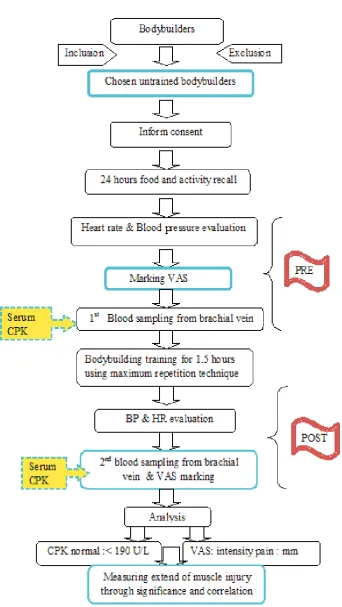
The flow of research is depicted in Figure 1. The data were analyzed by Shapirowilk’s test, Wilcoxon’s test, t-test, and Spearman’s
correlation statistical test between variables.
Results
The data on CPK and BP were not normally distributed (p<0.05) whereas HR and VAS were normally distributed with p>0.05. Thus, data on CPK and BP were analyzed using Wilcoxon’s test (non-parametric) and VAS and HR using t-test (parametric). The median for pre CPK was 281 U/L, that was increased up to 577 U/L in post CPK (p=0.003). The result on the CPK data is shown in Table 1.
The mean for VAS increased significantly (p<<0.001) from 31.7 mm in pre to 51.6 mm in post exercise. The difference of VAS value between pre and post exercise was 19.9 mm and is shown in Table 2.
In addition, Table 3 shows that the HR increased significantly about 39 beats/min
Table 1 Result of Wilcoxon’s test Pre-Post CPK for n=12
CPK (U/L) Median Min Max Range Z p-value
Pre(30minutes) 281 143 6812 6669 2,981 0.003
or 36.4% (p<0.001) from pre to post exercise. Table 4 shows data on BP revealed the systole increased from pre to post (p=0.034) whereas diastole increased about 5 mm/Hg (p=0.009).
The correlation between CPK and VAS
revealed that it was positively correlated in
untrained body builders (r-value;-0.711; with strong correlation: p-value=0.01).
Discussions
CPK is often used as marker to indicate muscle damage in athletes and most effective tools in evaluating sports performance.7 Based on the CPK data, there were only 2 out of 12
untrained bodybuilders who had normal (<190 U/L) during pre-training period measurement with 143 U/L and 159 U/L respectively. Though all the subjects had been chosen based
on exclusion criteria, yet the CPK value before training sessions failed to return to normal level. However, this situation is considered normal for an individual who participates in resistance training comprises eccentric and concentric movements. Besides that CPK elevation is still considered physiologic if the subjects never complain of renal failure symptoms such as decrease urine output or color changes as well as the CPK upper limit is
less than 10,000 U/L.8
There was only 1 subject in this study who
had the highest pre training CPK level with
6812 U/L. All the 12 subjects had significantly
elevated CPK levels during post training
measurements and mostly under mild (<2000 U/L) elevation except one subject who was under severe level of 34,090 U/L. Though
1 subject had high pre training CPK and had severe elevated CPK post training, yet complains regarding renal failure symptoms was not encountered because kidney failure would not develop only based on CPK level
because co-morbid situation such as sepsis,
dehydration, and acidosis could contribute to this situation.9
Majority of the subjects in this study had developed some point of adaptation to training with proven mildly elevated CPK level and adaptation period usually occurred within
4 to 10 days in the first week of training. The level of CPK in untrained bodybuilders
is highly dependent on the period of rest between training sessions as this will reduce
the lymphatic transport and release of enzyme from muscle fibers. Besides period of rest,
there are other factors such as intensity, training volume, hydration, and clearance level of CPK from blood systems.
The elevation of CPK in this study was
within physiological limit because all the subjects underwent training sessions
without difficulties that debilitate them.
Physiologically, each training will damage skeletal muscle at the level of sarcolemma and Z disks when the loading is higher than muscle ability.4,10 Therefore, subjects with the highest level of CPK indirectly also indicate the lower muscle adaptation level, usually adaptation occurs with more recruitment of sarcomeres
Table 2 Result of t-test for pre and post VAS for n=12
HR
(beats/min) DeviationStandard Min Max Mean(X) Range t p-value
Pre ± 23.7 2.0 80.0 31.7 78.0 4,834 <0.001
(30minutes)
Post ±18.7 19.0 93.0 51.6 74.0
(24 hours)
Table 3 Result of Paired t-test for Pre and Post Heart Rate (HR) for n=12
HR
(beats/min) DeviationStandard Min Max Mean(X) Range t p-value
Pre ±6 62 80 68 18 11,710 <0.001
(10minutes)
Post ±13 90 132 107 42
and signaling molecules.10 The adaptation to training can be obtained easily by increasing endurance training than strength training in early period as this will give good precursor for muscle development with appropriate
amount of pro-inflammatory factors.10
Almost all the untrained bodybuilders who underwent training exhibited some changes in VAS though it was rather subjective compared
to CPK. The soreness experienced by the
subjects following training is due to presence
of inflammatory mediators.11 The VAS data showed average pain intensity increased from 31.71 mm to 51.75 mm post exercise. In pre training, some subjects showed to have
lesser pain (<10mm) though some even had the highest level of pain with 80 mm. This is
because the adaptation process and improper
technique influence the soreness experienced
by the subjects.11
The strong positive significant correlation
existence between CPK and VAS has been
proven in this study. The subjects with the
highest pre and post CPK level had shown to
have the highest VAS. The possible explanation
is damage which occurs at sarcomere mainly
at contractile filaments and Z fibers causes
excitation coupling dysfunctions and ends in loss of calcium homeostasis within skeletal muscle.12,13 Eventually, this whole process initiates an autogenic process that results in
elevated white blood cells and inflammatory mediators. These factors are able to damage
the plasma lemma, endomysium, epimysium and perimysium which cause outpouring
of muscle enzymes into circulation from
proteolytic activity.1, 13 Moreover, the substance released from an autogenic process are able to give stimulation to free nerve ending around
muscle cells itself. Therefore, the untrained
bodybuilders who are still in an early period of bodybuilding exercise experience higher level of soreness and this highlights the importance for higher intensity of soreness in untrained bodybuilders to be evaluated for serum CPK level to measure severity of muscle damage.14
Some subjects who exhibit small increase l of CPK and VAS may have undergone great
adaptation. The reason for adaptation lies
in the level of reactive oxygen species (ROS) produced of which higher level of ROS may give negative effect to muscle adaptation process however this are areas still being studied.12, 13.
The HR and BP both had increased significantly from pre to post training . The aim of taking these parameters was to
evaluate the intensity level of training given in
this study. The light intensity training which
was suggested for untrained bodybuilders
would increase the heart rate about 60–70%.
However, in this study the increase was in a lower range suggesting heart rate arose
mainly due to variety of subject’s adaptation
level and period of rest between each set.
The BP increased in this study was due to the
need to supply the muscle with enough blood throughout training and bodybuilding training increases peripheral resistance by muscle force compression to peripheral arteriole.15
In conclusion, there was a significant
increase in CPK level and VAS from pre to post bodybuilding training in untrained
bodybuilders. There was also a strong positive significant correlation between CPK and VAS
in untrained bodybuilders.
Based on this study, it is highly suggested to use these indicators to monitor and evaluate
the progress of bodybuilders in fitness centers. Besides that, the usage of VAS as first
line indicator followed by CPK as second line
indicator in fitness centers will help to identify the effectiveness of fitness programs provided
as well as help in identifying overtraining status among bodybuilders. If the CPK level is
above 10,000 U/L it is better to stop physical
activity for some period of time as this level suggests the subject is at the verge of developing overtraining status.
References
1. Crameri RM, Aagaard P, Qvortrup K,
Langberg H, Olesen J, Kjaer M. Myofibre
damage in human skeletal muscle: effects of electrical stimulation versus voluntary
Table 4 Result of Wilcoxon’s test on BP for pre and post (n=12)
BP(mm/Hg) Median Minimum Maximum Range Z p-value
Pre Systole 120 110 130 20 2.212 0.034
Post systole 120 115 130 15
Pre diastole 80 70 90 20 2.598 0.009
contraction. J Physiol. 2007;583(1):365– 80.
2. Clarkson PM, Hubal MJ. Exercise-induced muscle damage in humans. Am J Phys Med
Rehabil. 2002;81(11):S52–69.
3. Bloomer RJ. The role of nutritional supplements in the prevention and
treatment of resistance exercise-induced
skeletal muscle injury. J Sports Med.
2007;37(6):519–32.
4. Totsuka M, Nakaji S, Suzuki K, Sugawara K, Sato K. Break point of serum creatine kinase release after endurance exercise. J
Appl Physiol. 2002, 2002;93(4):1280-6.
5. Kenny J-E. Creatine kinase: how much
is too much? Clinical Correlations, The New York University Langone Online
Journal of Medicine. 2010. (Cited 2012 December 12) Available from: http://
www.clinicalcorrelations.org/?p=6560. 6. Fusco A, Foglia A, Musarra F. The shoulder
in sport: management, rehabilitation, and prevention. 1st ed. Philadelphia:Churchill
Livingstone Elsevier. 2008.
7. Brancaccio P, Maffulli N, Limongelli FM. Creatine kinase monitoring in
sport medicine. Br Med Bull 2007;81– 82(1):209–30.
8. Morandi L, Angelini C, Prelle A, Pini A,
Grassi B, Bernardi G, et al. High plasma creatine kinase: review of the literature
and proposal for a diagnostic algorithm. J
Neurol Sci. 2006;27(5):303–11.
9. Paul GL, DeLany JP, Snook JT, Seifert JG, Kirby TE. Serum and urinary markers of
skeletal muscle tissue damage after weight
lifting exercise. Eur J Appl Physiol Occup Physiol. 1989;58(7):786–90.
10. Tidball JG. Inflammatory processes in muscle injury and repair. Am J Physiol,
2005;288(2):R345–53.
11. Baird MF, Graham SM, Baker JS, Bickerstaff
GF. Creatine-kinase- and exercise-related
muscle damage implications for muscle
performance and recovery. J Nutr Metab. 2012;2012:960363.
12. Aoi W, Naito Y, Takanami Y, Kawai Y, Sakuma K, Ichikawa H, et al. Oxidative
stress and delayed-onset muscle damage
after exercise. Free Radic Biol Med.
2004;37(4):480–7.
13. Allen DG, Lamb GD, Westerblad H. Skeletal muscle fatigue: cellular mechanisms.
Physiol Rev. 2008;88(1):287–332.
14. Barbieri E, Sestili P. Reactive oxygen species in skeletal muscle signaling. J
Signal Transduct. 2012;2012:982794
15. Pickett TC, Lewis RJ, Cash TF. Men, muscles, and body image: comparisons of competitive bodybuilders, weight trainers, and athletically active controls. Br J Sports