• Tidak ada hasil yang ditemukan

Directory UMM :Data Elmu:jurnal:P:Postharvest Biology and Technology:Vol20.Issue2.Sep2000:

N/A
N/A
Protected

Academic year: 2017

Membagikan "Directory UMM :Data Elmu:jurnal:P:Postharvest Biology and Technology:Vol20.Issue2.Sep2000:"

Copied!
10
0
0

Teks penuh

(1)

Comparison of reflectance, interactance and transmission

modes of visible-near infrared spectroscopy for measuring

internal properties of kiwifruit (

Actinidia chinensis

)

P.N. Schaare *, D.G. Fraser

Technnology De6elopment Group,HortResearch,Pri6ate Bag3123,Hamilton,New Zealand Received 18 November 1999; accepted 6 June 2000

Abstract

Three modes of visible-near infrared spectroscopic measurement (reflectance, interactance and transmission) were compared for their ability to non-destructively estimate harvest soluble solids content (SSC), density and internal flesh colour of the yellow-fleshed kiwifruit Actinidia chinensis. Interactance mode spectra provided the most accurate estimates of SSC, density and flesh colour. SSC was predicted with a standard error of prediction (SEP) of 90.80° Brix and with correlation coefficientR2of 0.93. Whole-fruit densities were predicted with an SEP of 93.6 kg m−3

and with anR2of 0.74. Internal flesh hue angle was predicted with an SEP of 91.6° and with anR2of 0.82. © 2000

Elsevier Science B.V. All rights reserved.

Keywords:NIR; Non-destructive test; Kiwifruit; Fruit quality; Soluble-solids content; Density; Flesh colour

www.elsevier.com/locate/postharvbio

1. Introduction

Near infrared spectroscopy has been shown to provide rapid and non-destructive measurements of internal properties such as soluble solids con-centration (SSC) and dry matter for many fruits and vegetables (Dull et al., 1989; Kawano et al., 1992; Bellon et al., 1993; Kawano et al., 1993; Kawano, 1994; Abbott et al., 1997), including kiwifruit (Jordan et al., 1997; McGlone and Kawano, 1998). However, application of the tech-nique varies. Some workers use reflectance mode,

where the field of view of the light detector in-cludes parts of the fruit surface directly illumi-nated by the source (Mowat and Poole, 1997). Others use transmission mode, where the fruit surface viewed by the detector is diametrically opposite to the illuminated surface (Kawano et al., 1993; Miyamoto and Yoshinobu, 1995; Greensil and Newman, 1999). Others use interac-tance mode, where the field of view of the detector is separated from the illuminated surface by a light seal in contact with the fruit surface (Dull et al., 1989; McGlone and Kawano, 1998; Osborne et al., 1998).

The relative merits of each of the different modes of near infrared spectroscopy have become

* Tel.: +64-7-8584760; fax:+64-7-8584705. E-mail address:[email protected] (P.N. Schaare).

(2)

of commercial importance with the application of the technique to on-line grading of fruit for inter-nal qualities (Miyamoto et al., 1997; Schmilovitch et al., 1997; Greensil and Newman, 1999). Reflec-tance mode measurements are the easiest to ob-tain because they require no contact with the fruit and light levels are relatively high. However, cali-brations may be susceptible to variations in su-perficial or surface properties of the fruit. Transmission mode measurements may also be made without contacting the fruit and may be less susceptible to surface properties and better for detecting internal disorders than reflectance mode measurements. However, the amount of light pen-etrating the fruit is often very small, making it difficult to obtain accurate transmission measure-ments at grading line speeds, particularly in con-ditions of high ambient light levels. Interactance mode provides a compromise between reflection and transmission modes in each of these charac-teristics, but obtaining a light seal may be prob-lematic at the high conveyor speeds used in modern fruit grading systems.

Despite these uncertainties there have been few studies that directly compare the merits of the different measurement modes. This study aims to quantify the relative accuracy of each mode for estimating properties of the yellow-fleshed ki-wifruitActinidia chinensis.

We compare the accuracy of the different spec-troscopic modes in estimating the harvest-time soluble solids content (SSC), density and flesh hue

of Actinidia chinensis. Harvest-time SSC is an

indicator of fruit maturity, as the SSC ofActinidia rises as starch reserves in the berry are converted to sugars during maturation. Flesh hue is an important quality parameter for Actinidia chinen

-sis as its unique golden colour at maturity is a

primary factor in the appeal of the fruit to the consumer, but fruit harvested too soon retain their immature green flesh colour. Harvest-time density of the common kiwifruit cultivar ‘Hay-ward’ (Actinidia deliciosa) is correlated with solu-ble solids content of fully ripened fruit (Asami et al., 1988), which is used by the New Zealand kiwifruit industry as an indicator of maturity. Harvest-time density may provide an indicator of maturity forActinidia chinensis and, while such a

relationship has not been verified, density mea-surements were included in this experiment for interest.

2. Method

Fruit for this study were obtained from four orchards spread through the Northland, Waikato and Bay of Plenty regions of the North Island of New Zealand. Fifty fruit were harvested weekly

from each orchard for a period from :4 weeks

preceding to 1 week following normal harvest. Fruit were hand-picked from random locations on vines, transported to the laboratory and stored at room temperature before assessment the following day. Transmission, interactance and reflectance spectra were collected from over 1000 fruit over a 7 week period. For most fruit single reflectance, transmission and interactance spectra were mea-sured from random positions on the circumfer-ence. All fruit were also assessed immediately after spectrum collections for SSC, density and flesh hue. For a subset of 50 fruit a second spectrum was recorded from random positions on the circumference, and density, SSC and hue mea-surements were replicated.

The apparatus used for reflectance measure-ments is shown in schematic form in Fig. 1(a). For reflectance measurements fruit were illumi-nated by a single 50 W tungsten filament lamp powered by a DC regulated supply. The detector was a solid state spectrometer (Zeiss MMS-1 Spectrometer, Carl Zeiss Jena Gmbh, Jena, Ger-many) that uses a silicon photodiode array. Light

entered the spectrometer through a 500 mm

di-ameter optical fibre bundle. The spectrometer provided 15-bit intensity measurements at 256 wavelengths from 300 to 1100 nm with 3.3 nm

resolution and :10 nm bandwidth. The

accep-tance angle of the optical fibre was 11.5°, so that

at the working distance of :45 mm from the

fruit surface the field of view was a circle of 18 mm diameter. A block of white

polytetraflu-roethylene (PTFE) measuring 80 mm2

×40 mm

(3)

spec-trum and a dark specspec-trum (obtained by blocking the aperture to the optical fibre) were recorded. The integration period for reflectance spectra was 15 ms.

Fig. 1(b) depicts the apparatus used to measure transmission spectra. A constant voltage 230 VAC regulator powered a 650 W tungsten

halo-gen lamp. Fruit were positioned in a 46×34 mm

ovoid hole in a black foam (Skellerup Starthene, Skellerup Industries Ltd., Christchurch, New Zealand) light seal over the lamp. The high power of the lamp required the lamp to be turned on from a standby ‘warm’ state for only a few sec-onds before each measurement to avoid overheat-ing the light seal and fruit. Reference spectra were

obtained by measuring transmission spectra

through an 80 mm2×52 mm thick PTFE block.

Reference and dark spectra were recorded before assessing the 50 fruit batch from each orchard. Integration periods for transmission spectra were varied between 1000 ms at the beginning and 100 ms at the end of the experiment as fruit became increasingly transparent with advancing maturity. The same spectrometer was used for both trans-mission and reflection measurements.

The configuration for measurement of interac-tance spectra is shown in Fig. 1(c). Fruit were placed on a rubber seal and illuminated from below by a single 12 V, 50 W, tungsten – halogen lamp powered by a regulated DC supply. The interactance system used an identical spectrometer to that used for the reflection and transmission

measurements. Light passing through the fruit and emerging inside the light seal was reflected onto the entrance aperture of the fibre by a 45° mirror. The acceptance angle of the optical fibre is

11.5°, so that at a distance of :18 mm from the

fruit surface the field of view was a circle of 7 mm diameter. The reference body for interactance

measurements was an 80 mm2×40 mm thick

block of white PTFE shaded by a hood of 10 mm-thick black PTFE. The white reference sur-face was placed against the light seal shown in Fig. 1(c) to make a reference measurement. The spectrometer integration period for interactance spectra was 100 ms.

After reflectance, transmission and interactance spectra had been obtained, fruit density was mea-sured using a buoyancy method. Flesh hue angle was measured by removing two 1 mm slices of skin from a random position on the fruit equator and measuring the colour co-ordinates of the

exposed section of flesh, :10×15 mm, with a

colour meter (Minolta Color Meter CR200, Mi-nolta Co. Ltd., Osaka, Japan ). Finally, the SSC of each fruit was measured. 10 mm-thick caps were sliced from both stem and calyx ends of the fruit, the °Brix of juice squeezed from each end cap was measured using a refractometer (Palette PR-100 Digital Refractometer, Atago Co Ltd., Tokyo, Japan ) and the two readings were aver-aged to give an SSC estimate for the entire fruit. The repeatability of SSC, density and hue angle measurements was measured in one batch of 50

(4)

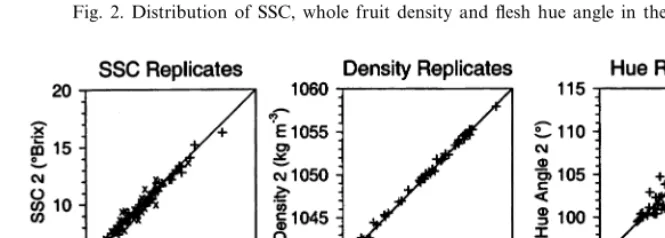
Fig. 2. Distribution of SSC, whole fruit density and flesh hue angle in the sample.

Fig. 3. Replicate measurements within fruit of SSC (from the stem (+) and calyx (×) ends of the fruit), whole fruit density and flesh hue angle.

fruit. SSC repeatability was assessed by bisecting the stem end and calyx end slices and making separate measurements of the SSC of the halves of each slice. Fruit density measurements were also repeated on this sample of fruit, and replicate flesh hue colour measurements were taken from opposite sides of the fruit.

3. Results

Fruit SSC ranged from approximately 5°Brix early in the season to 17°Brix for mature fruit. Fig. 2(a) shows the distribution of SSC for all fruit in the experiment. The bimodal distribution of SSC results from the relatively static sugar levels at early harvests and the subsequently rapid transition from low to high values during fruit ripening. Whole-fruit densities ranged from 1025

to 1063 kg m−3as shown in Fig. 2(b). Flesh hue

angle varied from 118° (mid-green) on immature fruit down to 97° (greenish yellow) for mature fruit.

The repeatability of SSC, density and hue angle measurements was measured in 50 fruit. Fig. 3 demonstrates that the replicate measurements of both SSC and density showed good repeatability, although a small bias is evident in the repeated density measurements. However, repeatability in flesh hue angle measurements was comparatively poor.

(5)

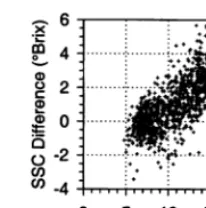
Fig. 4. The difference in SSC between the stem and calyx ends of the fruit, as a function of the average SSC.

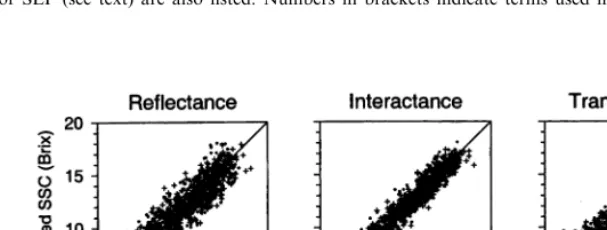
tion algorithms were: Classical Least Squares (CLS), Inverse Least Squares (ILS), Principle Component Regression (PCR) and Partial Least Squares (PLS). PCR and PLS were applied using 2, 4, 6, 8, 10, 15, 20, 30 and 40 terms. The resulting 240 calibrations for each spectral mode (reflectance, interactance and transmission) were ranked by SEP and their bias and SEP were compared following the method of Fearn (1996). Table 2 lists the calibration algorithm with the lowest SEP (the ‘best’ algorithm) for each spectral mode along with the algorithms that had bias and SEP not significantly greater than the best al-gorithm. Where two or more algorithms differed only by the number of PLS or PCR terms used, only that with lowest SEP is listed. Fig. 6 shows the best calibrations between actual and predicted SSC values for each spectral mode.

The method of Fearn (1996) was also used to compare best SSC calibrations between spectral modes. The best interactance mode calibration had a significantly lower SEP (PB0.05) than the transmission mode calibration, which was signifi-cantly better in turn than the best reflectance calibration.

Calibrations for whole fruit density were derived following the same procedures as used for deriving SSC calibrations. Table 3 presents the optimal calibration algorithms and results deter-mined for each of the spectral acquisition modes for density, and Fig. 7 shows the relationship between actual and predicted density values calcu-lated from each of the calibrations described in Table 3. Again, interactance spectra provided a Fig. 5 shows typical transmission, interactance

and reflectance spectra. The greatest variation in spectra was observed in transmittance mode, where mean intensity increased as fruit ripened. For analysis, spectra were truncated where the estimated signal to noise ratio dropped below unity. Thus reflectance spectra ranged from 450 to 1100 nm, interactance spectra from 520 to 1100 nm and transmission spectra from 690 to 1080 nm.

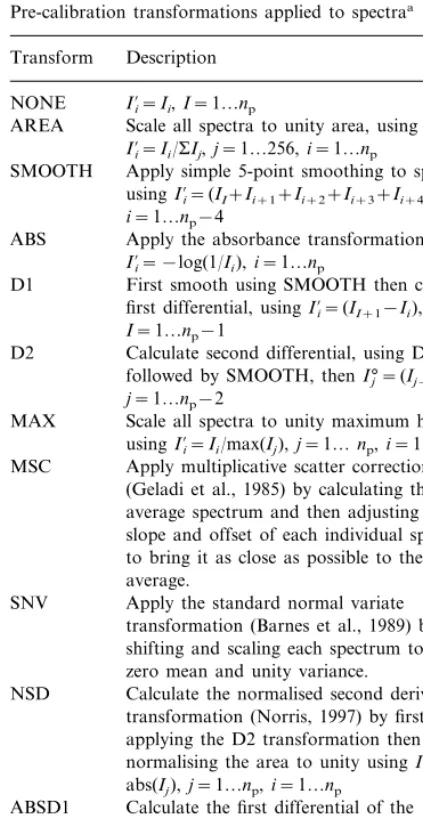
A systematic analysis of the standard error of prediction (SEP) (Fearn, 1996) was used to select an optimal calibration procedure for estimating SSC. Calibrations were calculated using the Mat-lab Chemometrics Toolbox (MatMat-lab, The Math-Works Inc, Natick, MA). The data set was divided randomly into calibration and prediction

sets of :500 samples each. Spectra were

nor-malised using the PTFE references. Twelve spec-trum pre-processing transformations, listed in Table 1, were combined with four computation algorithms to generate calibrations. The

(6)

Table 1

Pre-calibration transformations applied to spectraa

Transform Description

Ii%=Ii,I=1…np NONE

AREA Scale all spectra to unity area, using Ii%=Ii/SIj,j=1…256,i=1…np

Apply simple 5-point smoothing to spectra SMOOTH

usingIi%=(II+Ii+1+Ii+2+Ii+3+Ii+4)/5, i=1…np−4

ABS Apply the absorbance transformation, Ii%= −log(1/Ii),i=1…np

First smooth using SMOOTH then calculate D1

first differential, usingIi%=(II+1−Ii), I=1…np−1

Calculate second differential, using D1 D2

followed by SMOOTH, thenIj°=(Ij+1−Ij), j=1…np−2

Scale all spectra to unity maximum height, MAX

usingIi%=Ii/max(Ij),j=1…np,i=1…np Apply multiplicative scatter correction MSC

(Geladi et al., 1985) by calculating the average spectrum and then adjusting the slope and offset of each individual spectrum to bring it as close as possible to the average.

SNV Apply the standard normal variate transformation (Barnes et al., 1989) by shifting and scaling each spectrum to have zero mean and unity variance.

Calculate the normalised second derivative NSD

transformation (Norris, 1997) by first applying the D2 transformation then normalising the area to unity usingIi%=Ii/S abs(Ij),j=1…np,i=1…np

Calculate the first differential of the ABSD1

absorbance spectrum by applying first the ABS then the D1 transform.

ABSD2 Calculate the second differential of the absorbance spectrum by applying first the ABS then the D2 transform.

an

pis the number of data points in the spectrum.

those from transmission and reflectance spectra, which were not significantly different.

4. Discussion

The spectra in Fig. 5 demonstrate the differ-ences between the spectral modes. Interactance spectra have general characteristics intermediate between reflectance and transmission spectra. The most apparent difference between reflection and transmission is the spectral range — reflected light could be detected across the range of our spectrometer, while transmitted light was limited to a range of 700 – 950 nm. Also apparent is the wide range in amplitude of the transmission spec-tra. Over the 1350 fruit tested, the transmission maximum varied by a factor of 188, from a minimum with large immature fruit to a maxi-mum with small, ripe fruit. The predominant fea-tures in the reflectance spectra are the strong absorption troughs at 680 and 970 nm attributed to chlorophyll and water, respectively. Distinct absorption features are evident in the transmis-sion spectra at 730 and 830 nm. It appears that the peak transmission wavelength for interactance spectra, around 760 nm, may differ from the peak for reflectance and interactance spectra, which occurs at 820 nm, but the vertical scale for inter-actance spectra has not been corrected for instru-ment response.

While all spectral modes produced good predic-tions of SSC, density and flesh hue inA.chinensis, interactance mode produced the best models in each case. It might be expected that transmission mode, because it is less affected by surface proper-ties than reflectance and interactance modes, should have provided the best estimates of fruit internal properties. Interactance mode may be viewed as intermediary between reflectance and transmission modes in terms of the relative contri-butions of surface and internal properties to mea-sured spectra and so one might expect the accuracy of interactance calibrations to also be intermediate between those of reflection and transmission calibrations. However, in transmis-sion mode the amount of light penetrating the fruit was very small and resulted in a reduced

calibration with a significantly lower SEP (PB

0.05) than transmission spectra, with reflectance mode providing the least accurate calibration.

(7)

signal to noise ratio for transmission spectra com-pared to those obtained for interactance and reflectance modes. The use of more intense light sources or a more sensitive spectrometer may have increased signal to noise levels and improved transmission mode calibrations.

While the contribution of errors in calibration

data to the final SEP is difficult to estimate, the data presented in Fig. 4 suggest that the high SSC gradient along the fruit may contribute signifi-cantly to the SEP of the SSC calibrations listed in Table 2. When the average SSC was 15°Brix the average difference in SSC between the two end caps was 2.6°Brix. Using the average SSC to

Table 2

Optimal algorithms and calibration results for estimating soluble solids content ofA.chinensisa

Spectral acquisition mode Optimal calibration algorithm(s) Calibration results

R2

P SEP (°Brix)

0.86

NSD:PLS(30), D2:PLS(30), Smooth:PLS(30), D1:PLS(40) 1.18 Reflectance

0.93

Interactance NSD:PLS(20), NSD:PCR(40), Area:PLS(30) 0.80

NSD:PLS(10), NSD:PCR(20) 0.89

Transmission 1.01.

aAlgorithms providing the lowest SEP are shown in bold typeface, and those that could not be distinguished from the best on the basis of Bias or SEP (see text) are also listed. Numbers in brackets indicate terms used in PLS or PCR.

Fig. 6. Comparison of predicted to actual SSC content for the three different spectral modes. Calibration samples are indicated by + and validation data by . Some vertical axis labels have been omitted for clarity.

Table 3

Optimal calibrations for predicting whole fruit density ofA.chinensisa

Optimal calibration algorithm(s)

Spectral acquisition mode Calibration results

R2

P SEP (kg m− 3)

4.5 0.59

MSC:PLS(20), Area:PLS(20) Reflectance

Area:PLS(30), Max:PLS(30),Max:PLS(30), Area:PCR(40), MSC:PCR(40) 3.6

Interactance 0.74

0.55

Area:PLS(15), Area:PCR(30) 4.8 Transmission

(8)

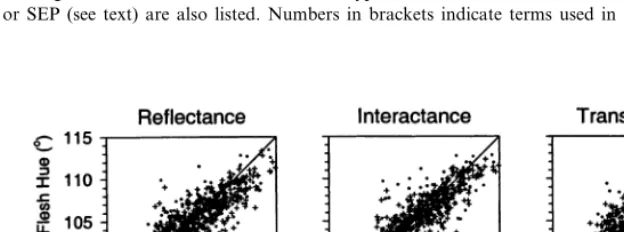
Fig. 7. Comparison of predicted to actual whole fruit density for the three different spectral modes. Calibration samples are indicated by +and validation data by . Some vertical axis labels have been omitted for clarity.

Table 4

Optimal calibrations for predicting flesh hue angle ofA.chinensisa

Spectral acquisition mode Optimal calibration algorithm(s) Calibration results

R2

P SEP (Degrees)

0.76

Reflectance SNV:PLS(30),MSC:PLS(30),Area:PLS(30), Max:PLS(30) 1.88 Interactance Max:PLS(30),Area:PLS(30), MSC:PLS(30), SNV:PLS(20) 0.82 1.63

0.74

Area:PLS(8) 1.95

Transmission

aAlgorithms providing the lowest SEP are shown in bold typeface, and those that could not be distinguished from the best on the basis of Bias or SEP (see text) are also listed. Numbers in brackets indicate terms used in PLS.

Fig. 8. Comparison of predicted to actual flesh hue angle for the three different spectral modes. Calibration samples are indicated by+ and validation data by . Some vertical axis labels have been omitted for clarity.

estimate the SSC at the equator of the fruit as-sumes that the gradient of SSC along the fruit is linear and that spectral measurements were taken at the exact midpoint of the fruit, and in practice both assumptions are only approximate.

The SEP of 0.80°Brix obtained for the

interac-tance calibration of SSC may seem high compared to those reported by others working with kiwifruit (e.g. 0.39 – 0.47°Brix by McGlone and Kawano, 1998). However, these data were derived using

Actinidia deliciosa and over a smaller range of

(9)

The corresponding values ofR2

P reported by

Mc-Glone and Kawano are lower (0.90 – 0.85) than the value we found (0.93).

The SEP for the flesh hue angle calibrations, listed in Table 4, were between 1.6 and 2.0°. The replicate flesh hue angle measurements presented in Fig. 3(c) suggest that within-fruit variability in calibration measurements of hue angle is approxi-mately 1.3°, suggesting that errors in the calibra-tion data may comprise a significant component of the SEP.

The ‘comet-like’ distributions for hue angle cal-ibrations shown in Fig. 8 result from the combi-nation of a relatively high number of mature fruit with low hue angle, evident in Fig. 2, and calibra-tion errors which increase with hue angle, shown in Fig. 3(c). The reflectance mode calibration for hue angle, graphed in Fig. 8, shows a clear linear trend, suggesting the need for further, non-linear, spectral pre-processing.

5. Conclusion

This study compared the relative accuracy of reflectance, transmission and interactance modes of NIR spectroscopy for estimating SSC, density and flesh hue ofActinidia chinensis, and evaluated the optimal method for deriving the calibration. Good calibrations were obtained in every case, supporting the use of NIR spectroscopy for the rapid and non-destructive evaluation of fruit in-ternal qualities. In each case the most accurate results were obtained using interactance mode, followed by transmission mode, and in general reflectance was least accurate. PLS proved to be the most robust algorithm of those tested for generating calibration models.

Acknowledgements

This work was funded by Kiwifruit New Zealand and by the New Zealand Foundation for Research, Science and Technology. Thanks to our colleagues Bob Jordan and Andrew McGlone in the Technology Development Group for many

helpful discussions and to Alan Harris, Annette Richardson and Philip Martin for their assistance.

References

Abbott, J., Lu, R., Upchurch, B., Stroshine, R., 1997. Tech-nologies for nondestructive quality evaluation. Hort. Rev. 20, 1 – 120.

Asami, I., Tanaka, Y., Aoki, M., 1988. Studies on the quality evaluation of kiwifruit. (I) Chemical composition and a non-destructive quality evaluation method for kiwifruit. Res. Bul. Aichi ken Agr. Res. Ctr. 20, 309 – 316. Barnes, R.J, Dhanoa, M.S., Lister, S.J., 1989. Standard

nor-mal variate transformation and de-trending of near-in-frared diffuse reflectance spectra. Appl. Spectrosc. 43, 772 – 777.

Bellon, V., Vigneau, J.L., Leclercq, M., 1993. Feasibility and performances of a new, multiplexed, fast and low-cost spectrometer for the on-line measurement of sugars in fruit. Appl. Spectrosc. 47, 1079 – 1083.

Dull, G.G., Birth, G.S., Smittle, D.A., et al., 1989. Near infrared analysis of soluble solids in intact cantaloupe. J. Food Sci. 54, 393 – 395.

Fearn, T., 1996. Comparing standard deviations. NIR News 7 (5), 5 – 6.

Geladi, P., MacDougall, D., Martens, H., 1985. Linearization and scatter correction for near-infrared reflectance spectra of meat. Appl. Spectrosc. 39, 491 – 500.

Greensil, C.V., Newman, D.S., 1999. An investigation into the determination of the maturity of pawpaws (Carica papaya) from NIR transmission spectra. J. Near Infrared Spec-trosc. 7, 109 – 116.

Jordan, R.B., Osborne, S.D., Kunnemeyer, R., Seelye, R.J., 1997. Harvest time prediction of eating time properties of kiwifruit using NIR transmission, Proceedings of the Sens. Nondestr. Sens. Test. Int. Conf., Northeast Reg. Agric. Eng. Serv., Ithaca, New York, pp. 101 – 110.

Kawano, S., 1994. Present condition of nondestructive quality evaluation of fruits and vegetables in Japan. Jpn. Agric. Res. Q 28, 212 – 216.

Kawano, S., Watanabe, H., Iwamoto, M., 1992. Determina-tion of sugar content in intact peaches by near infrared spectroscopy with fiber optics in interactance mode. J. Jpn. Soc. Hort. Sci. 61, 445 – 451.

Kawano, S., Fujiwara, T., Iwamoto, M., 1993. Nondestructive determination of sugar content in Satsuma mandarin using near infrared (NIR) transmittance. J. Jpn. Soc. Hort. Sci. 62, 470 – 645.

McGlone, V.A., Kawano, S., 1998. Firmness, dry-matter and soluble-solids assessment of postharvest kiwifruit by NIR spectroscopy. Postharvest Biol. Technol. 13, 131 – 141. Miyamoto, K., Yoshinobu, K., 1995. Non-destructive

(10)

Miyamoto, K., Kuwauchi, M., Fukuda, T., 1997. Classifica-tion of high acid fruits by partial least squares using the near infrared transmittance spectra of intact satsuma man-darins. J. Near Infrared Spectrosc. 6, 267 – 271.

Mowat, A.D., Poole, P.R., 1997. Use of visible-near infrared diffuse reflectance spectroscopy to discriminate between kiwifruit with properties altered by preharvest treatments. J. Near Infrared Spectrosc. 5, 113 – 122.

Norris, K.H., Workman, J. Jr, 1997. NIR News 8 (4), 7.

Osborne, S.D., Jordan, R.B., Kunnemeyer, R., 1998. Using near infrared (NIR) light to estimate the soluble solids and dry matter content of kiwifruit. Acta Hort. 464, 109 – 114. Schmilovitch, Z., Ben-Zvi, R., Hoffman, A., Bernstein, Z., Egozi, H., Alchanatis, V., 1997. System and method for pre-harvested maturity determination of fresh dates by near infrared spectrometery, Proceedings of the Sens. Non-destr. Sens. Test. Int. Conf., Northeast Reg. Agric. Eng. Serv., Ithaca, New York, pp. 111 – 121.

Gambar

Fig. 1. The apparatus used for measuring (a) reflectance; (b) transmittance; and (c) interactance spectra of kiwifruit, showing (i) thelight source; (ii) fruit; (iii) fibre bundle aperture; (iv) black foam holder; (v) light seal; (vi) condensing lens; (vii) glass top; and (viii)mirror.
Fig. 2. Distribution of SSC, whole fruit density and flesh hue angle in the sample.
Table 2 lists the calibration algorithm with the
Table 1
+3

Referensi

Dokumen terkait

repens was included among the defoliated species (Fig. Relative to the control, shoot mass at the ®nal harvest was lower in those defoliation treatments, which included T. 3a), and

Erratum to ªSuitability of the anthrone-sulfuric acid reagent for determining water soluble carbohydrates in soil water extractsº. [Soil Biology & Biochemistry 32 (5)

We hypoth- esised that soluble dung derived carbon would be (rapidly) leached into the upper layers of the soil, and that the natural abundance 13 C tracer technique would..

Brazilian bare soil exhibit di€erent spatial variability for each day of measurement and such models are similar to the ones of soil properties studied. Also, the results indicate

Scatter plots of nodule number determinations by hand or by di€erent scanning procedures (Pouch Ð nodules counted in the pouch scan, Paper Ð nodules counted in the pouch scan with

The increase in respiration rate by M1 apricots treated with MCP was delayed 8 days, therefore at 9 days after MCP treatment when apricot volatile production was measured, respira-

DM of kiwifruit before ( ) and after ( ) ripening, plotted against initial density and showing the respective re- gression lines. Orchard 1 comprises the lower 16 data points. 3),

Effect of sucrose pulsing and cold storage on vase life of flowers and leaves, flower opening after harvest and time to negative weight change for E.. Different superscripts