Securing land
rights and
safeguarding
the earth
A Global Call to Action
on Indigenous and
COMMON
Written by Fred Pearce, writer and journalist
Cover and chapter illustrations kindly provided by Abel Rodríguez and Tropenbos International (Annual Cycle of the Flooded Rainforest. Tropenbos International Colombia’s Archive).
Abel Rodríguez is an elder of the Nonuya people, an indigenous group from the mid Caquetá River in Colombia. He is an outstanding botanist and artist and has a vast knowledge and understanding of the Amazonian ecosystem. Abel has been part of the local research programme of Tropenbos International Colombia for many years. He began in the 1980s as a guide for researchers, where he had the opportunity to explain multiple aspects of the local lora to the scientists. For the last two decades Abel has put his knowledge on paper through drawings and produced detailed studies on the variety of reeds and lianas, palm trees, timber and non-timber trees and cultivated plants in the Amazon forest.
Design by Lucy Peers
Citation: Oxfam, International Land Coalition, Rights and Resources Initiative. 2016. Common Ground. Securing Land Rights and Safeguarding the Earth. Oxford: Oxfam.
Published by Oxfam GB for Oxfam International, International Land Coalition and Rights and Resources Initiative under ISBN 978-0-85598-676-6 in March 2016.
Oxfam GB, Oxfam House, John Smith Drive, Cowley, Oxford, OX4 2JY, UK.
March 2016
Securing land rights and
safeguarding the earth
A Global Call to Action on Indigenous
and Community Land Rights
Acknowledgements
This report is the product of a wide collaboration.
The publishers acknowledge the contribution of the following members of the Steering Group of the Global Call to Action on Indigenous and Community Land Rights: Joan Carling, Joji Cariño, Kysseline Cherestal, Rachael Knight, Ruth Meinzen-Dick, Fred Nelson, Samuel Nguifo, Sabine Pallas, Duncan Pruett, Richard Smith, Philippine Sutz, Peter Veit, Tony La Viña and Liz Alden Wily.
The publishers also thank the following people for their feedback or input:
Oscar Ayala, Stefania Battistelli, Frank Boeren, Marena Brinkhurst, Stephanie Burgos, Julia Cabello, Chloe Christman, Ross Clarke, Ilona Coyle, Nadia Daar, Rashmini Desilva, Jenna Di Paolo Colley, Gustavo Ferroni, Judith Fischer, Laura Fukumoto, Kate Geary, Claire Godfrey, Tim Gore, Emily Greenspan, Tom Griiths, Renée Hagen, Robeliza Halip, Shona Hawkes, Simon Hernandez-Arthur, Hugo Hooijer, Marita Hutjes, Gawain Kripke, Steven Lawry, Peter Lewis, Asisah Man, Luca Miggiano, Nicolas Mombrial,
Bart Monnens, Everlyne Nairesiae, Maria Ojanen, Gaynor Paradza, Annaka Peterson, Vladimir Pinto, Ed Pomfret, Jagdeesh Rao Puppala, Katie Reyter, Bernice See, Michael Taylor, Carolina Thiede, Helen Tugendhat, Monique Van Zijl, Jitske Varkevisser, Stefan Verwer, Ashley Von Anrep, Emma Wadley, Rebecca Wangari, Andy White, and Pubudini Wickramaratne.
The publishers thank the Organization for the Promotion of Kui Culture for their contribution and the World Resources Institute and LandMark for the use of their maps.
Any mistakes in the report remain the sole responsibility of the author and publishers.
The development of this report was managed by Luca Miggiano, with the support of Renée Hagen.
The information in this publication is correct at the time of going to press.
This work is licensed under a Creative Commons Attribution License CC BY 4.0.
The views here are not necessarily shared by the agencies that have generously supported this work, and do not constitute oicial positions of the International Land Coalition or its members, or the Rights and Resources Initiative and its Partners.
If you would like further information, or to sign up to the Global Call to Action on Indigenous and Community Land Rights, please visit www.landrightsnow.org.
About
The International Land Coalition (ILC) is a global alliance of civil society and
intergovernmental organizations working together to put people at the centre of land governance. The shared goal of ILC’s 207 members is to realize land governance for and with people at the country level, responding to the needs and protecting the rights of the women, men and communities who live on and from the land.
For more information, please visit www.landcoalition.org.
Oxfam is an international confederation of 20 organizations networked together
in more than 90 countries as part of a global movement for change, to build a future free from the injustice of poverty.
For more information, please visit www.oxfam.org.
The Rights and Resources Initiative (RRI) is a global coalition of 13 partners and
more than 150 international, regional, and community organizations advancing forest tenure, policy and market reforms. RRI leverages the strategic collaboration and investment of its partners and collaborators around the world by working together on research, advocacy and convening strategic actors to catalyse change on the ground. RRI is coordinated by the Rights and Resources Group, a non-proit organization based in Washington, D.C.
Contents
Acronyms 6
Summary 7 Foreword 8
A COLLECTIVE VOICE THAT MUST BE HEARD NOW
10WHY INDIGENOUS AND COMMUNITY LAND RIGHTS MATTER
14FOR EVERYONE
For rights and development 15
Forests 16
Pastures 21
The corporate risk of insecure tenure 24
More triumph than tragedy in the commons 25
PROGRESS OR RETREAT? WHAT IS HAPPENING ON THE GROUND
26The gap that must be closed 28
Policy reform 30
Courts respond to community pressure 31
Women demand their land 33
Securing community land rights through grassroots legal empowerment 36
WHAT DO WE NEED TO CHANGE?
40From law to action 41
A Global Call to Action on Indigenous and Community Land Rights 43
Annex I 47
Endnotes 48
Figures
Figure 1: Carbon storage and indigenous territories in Brazil 19
Figure 2:Comunidades Agrarias and Ejidos in Mexico 23
Figure 3: Recognition of indigenous and community lands, Africa 28
Figure 4: Securing community land rights through grassroots legal empowerment 37
Figure 5: Land facts 39
Figure 6: Land recognized as owned by indigenous peoples and local communities 43
Boxes
Box 1: What are indigenous and community lands? 12
Box 2: Cambodia 20
Box 3: Guatemala’s community forests 20
Box 4: Mongolia leads the way 22
Box 5: Reviving Spanish pastures 22
Box 6: A supply chain revolution? 25
Box 7: Land grabs 30
Box 8: Cameroon 32
Box 9: Blood on the soil 34
Box 10: Indian rights on a knife edge 35
Box 11: Paraguay 38
Acronyms
ACOFOP Asociación de Comunidades Forestales de Petén (Association of
Forest Communities of Petén)
AGARBALE Asociación de Ganadería Extensiva de la Reserva de la Biosfera
de los Ancares Leoneses (Reserve Association for Extensive Livestock Farming)
AMAN Aliansi Masyarakat Adat Nusantara (Indigenous Peoples Alliance
of the Archipelago)
COICA Coordinadora de las Organizaciones Indígenas de la Cuenca
Amazónica (Coordinator of Indigenous Organizations of the Amazon River Basin)
DRC Democratic Republic of Congo
IFPRI International Food Policy Research Institute
ILC International Land Coalition
IUCN International Union for Conservation of Nature
LAO PDR Lao People’s Democratic Republic
NGO Non-governmental organization
PARL People’s Alliance for Right to Land
REDD Reduced emissions from deforestation and forest degradation
RRI Rights and Resources Initiative
UNDRIP United Nations Declaration on the Rights of Indigenous Peoples
UNEP United Nations Environment Programme
WRI World Resources Institute
Summary
Up to 2.5 billion people depend on indigenous and community lands, which make up over 50 percent of the land on the planet; they legally own just one-ifth. The remaining ive billion hectares remain unprotected and vulnerable to land grabs from more powerful entities like governments and corporations. There is growing evidence of the vital role played by full legal ownership of land by indigenous peoples and local communities in preserving cultural diversity and in combating poverty and hunger, political instability and climate change. The importance of protecting and expanding indigenous and community ownership of land has been a key element in the negotiations of the Sustainable Development Goals and the Paris Agreement on climate change, and is central to their successful implementation. This report launches a Global Call to Action on Indigenous and Community Land Rights, backed by more than 300 organizations all over the world. It is a manifesto of solidarity with the ongoing struggles of indigenous peoples and local communities seeking to secure their land rights once and for all.
These lands are
our livelihoods.
From these
lands we were
able to harvest
resources. The
land belonged
to us, the water
belonged to us.
From this, we
were able to live.
When we had
common land we
felt free.
Mansa Ram,
Foreword
Insecure land rights are a global crisis – for the millions of indigenous peoples and local communities who risk losing their lands and livelihoods, and for humanity as a whole, undermining our ability to confront climate change, food insecurity, poverty and political instability, and to protect the diversity of life, culture and language that brings beauty and meaning to all of our lives.
Although there has been progress in many countries, commitments to respect the rights of indigenous peoples and local communities often remain empty promises. Forest, water, rangeland and mineral resources continue to be the primary target of rapidly expanding investments and ‘development’ projects that displace indigenous peoples and local communities. Women in particular sufer from the insecurity of these rights, and are still far from enjoying an equal role to men in shaping community governance and national policies. The growing number of people killed for defending their land is a stark reminder of the huge challenge, and unspeakable violence, faced by many around the world who are displaced or denied a voice in the decisions afecting their lands – and their lives.
New analysis shows that despite a history of customary use and ownership
of over 50 percent of the world’s land area, the world’s indigenous peoples and local communities – up to 2.5 billion women and men – possess ownership rights to just one-ifth of the land that is rightfully theirs.
This catastrophic gap in recognition explains much of the disenfranchisement, poverty, human rights violations and conlict found across the world. It is why we are issuing a global call to action: an unprecedented mobilization of the millions of indigenous peoples and local communities, governments, international organizations, corporate and other private sector actors, civil society, social movements, research and other institutions, and citizens across the world to secure and respect the land rights of indigenous peoples and local communities.
Securing those land rights is essential to achieving a just and equitable world. From health to education, participation to peace, growth to cultural diversity and gender justice, proper recognition of the land rights of indigenous peoples and local communities is fundamental to achieving any truly sustainable development in a habitable climate.
Together, we can and must support the land struggles of communities. Only in this way can they realize their fundamental human rights.
Join us in this journey at www.landrightsnow.org.
Sincerely,
Liz Alden Wily, Independent tenure expert
Katia Araujo, Director of Programs, Huairou Commission
Joji Cariño, Executive Director, Forest Peoples Programme
Joan Carling, Executive Director, Asian Indigenous Peoples Pact
Richard Chase Smith, Executive Director, Instituto del Bien Común, Member
of Red Amazónica de Información Socioambiental (RAISG) and LandMark
Myrna Cunningham, President, Centro para la Autonomia y el Desarrollo de los Pueblos Indigenas
Rachael Knight, Director of the Community Land Protection Program, Namati
Ruth Meinzen-Dick, Senior Research Fellow, International Food Policy Research
Institute (IFPRI) and Collective Action and Property Rights (CAPRi) Program
Fred Nelson, Executive Director, Maliasili Initiatives
Michael Ochieng Odhiambo, Independent tenure expert
Sabine Pallas, Women’s Land Rights and Gender Justice Programme Oicer,
Secretariat of the International Land Coalition
Duncan Pruett, Senior Land Rights Advisor, Oxfam
Ghan Shyam Pandey, Coordinator, Global Alliance of Community Forestry
Vicky Tauli-Corpuz, United Nations Special Rapporteur on the Rights of
Indigenous Peoples
Peter Veit, Director, Land and Resource Rights Initiative, World Resources Institute
Andy White, Coordinator, Rights and Resources Initiative
On behalf of the Steering Group of the Global Call to Action on Indigenous and Community Land Rights
A COLLECTIVE
‘These forests are our life, but they are being taken
from us. Outsiders have a financial view of the land.
They see it as money. We see it as life. We have to win...
for the future of our people.’
Nicholas Fredericks,Wapichan people, Guyana
A voice is being heard with increasing force around the world. It is the voice of women and men from the forests, of those who herd their livestock across open rangelands, and of millions of smallholders. They want their rights to their traditional lands recognized and restored. And they need the rest of the world to listen.
Securing the land rights of indigenous peoples and local communities is critical, not just for the people themselves, but also for creating more equitable and prosperous societies and for tackling environmental priorities.
The voices of people and communities on land rights was heard ever more strongly in 2015: during negotiations on the Sustainable Development Goals in New York, where ‘ownership and control of land’ emerged as a key target; and again during climate negotiations for the Paris Agreement, which declared that the ‘knowledge, technologies, practices and eforts of local communities and indigenous peoples’ was vital in ighting climate change.
These traditional lands are in crisis. Less than one-ifth of them are currently under community ownership.1 Increasingly in recent years, governments, mining companies, speculators, agribusinesses and powerful local elites have been appropriating forests, pastures, shores and other community-owned resources from their rightful owners.
Now is the time to right this wrong. Secure community land rights are the source of food, medicines and construction materials, as well as wealth, welfare, culture, identity, community cohesion and spirituality for up to 2.5 billion people.2 Land grabs are fuelling conlicts in dozens of countries3 – conlicts in which communities who assert their rights are frequently subject to violence and the assassination of their leaders.4
This is unjust, and, as this report explores, it matters for everyone.
It matters for nations, because indigenous and community land rights are a precondition for sustainable development. Their recognition makes nations more stable, reduces risks for investment in economic development and spreads the beneits from natural resources more widely and fairly.5
Land matters globally. Because the forests, pastures and other lands traditionally owned by indigenous peoples and local communities are a global resource. The vital planetary services they provide – whether for ighting climate change, protecting biodiversity or maintaining natural resources – are usually best secured under the stewardship of traditional owners.6
To many people, the idea of community lands is archaic. They are seen as barriers to progress and environmental protection, doomed to disappear. But this is wrong; there is no contradiction between a healthy economy and the recognition of land rights.
A COLLECTIVE VOICE THAT MUST BE HEARD NOW
The struggle
for a stable
climate and the
restoration of
our global life
support systems
cannot succeed
without secure
indigenous
and community
land rights.
Stephanie Brancaforte,
Box 1: What are indigenous and community lands?
7Indigenous and community lands are lands used, managed or governed collectively, under
community-based governance. This governance is often based on longstanding traditions deining, distributing and regulating rights to land, individually or collectively, and is usually referred to as customary or indigenous land tenure. Community lands are owned and managed by a variety of women and men, usually farmers, pastoralists, hunter-gatherers, isher-folk and others using resources such as forests, water bodies and pastures as a common resource. But they are not static. Every generation adjusts how they use the land to meet new needs and aspirations. Indigenous and community lands are as important to the future as to the past.
In fact, they are indivisible. In an increasingly crowded world, the task of protecting them is urgent.
This report is a global call to action for securing indigenous and community lands – in law and in practice. We make this call to demand social justice, and as a pragmatic
approach to sharing and efectively managing our planet’s resources. Our initial target is to double the area of land recognized as owned or controlled by indigenous peoples and local communities by 2020. This would not represent a full recognition of customary land rights, but it would be a start.
A COLLECTIVE VOICE THAT MUST BE HEARD NOW
Men from Kayarakhet village in India walk around their 340 hectares of forest land, protecting it from those trying to steal resources (2015). If caught, those stealing will be fined for breaking community law. Photo: ILC/Jason Taylor
A COLLECTIVE VOICE THAT MUST BE HEARD NOW
Terms used in this report also include:
‘Indigenous peoples’,which is a common denominator for more than 5,000 distinct
peoples who identify themselves as indigenous peoples. Indigenous peoples are descended from populations who inhabited a given country or region before the time of colonisation or establishment of state boundaries. Their relationship with their lands and territories is of special importance for their cultures and spiritual values. Indigenous peoples enjoy distinct rights under international human rights law (ILO Convention No. 169, and the United Nations
Declaration on the Rights of Indigenous Peoples).8 Yet their rights to lands and territories are often denied.
‘Local communities’, which here refers to all land-dependent communities. While communities
vary in size, identity, internal equity and land-use systems, they all share strong connections to their lands, and distribute rights according to norms which they themselves devise. ‘Local communities’ are referred to in international agreements such as the Convention on Biological Diversity and the 2015 Paris Agreement on climate change.
‘Commons’,which are lands that communities maintain as their shared property. As such, they
can be considered the heart of indigenous and community lands. Some indigenous peoples and local communities use all their land as shared property. Others do not, and allocate lands to individuals and families within the community; however, the community exercises jurisdiction over the entire lands, which are held and managed collectively. Lands for grazing and wildlife, forests and woodlands, mountaintops, sacred sites, lakes and rivers are usually retained as shared property. These lands are the most vulnerable to land grabbing.
‘Customary tenure’, which refers to the rules and norms which communities devise and uphold to regulate how their lands are acquired, owned, used and transferred. Many rules and norms are tested over generations (hence ‘traditions’ or ‘customs’).
‘Customary law’, which refers to norms which have force within the community. When national legislation recognizes that customary law has force, the rules also become part of statutory law.9
‘Community-based tenure’,which refers to situations in which the right to own or manage land
is held at the community level.10 It includes tenure regimes that are expressly based on customary law and tenure regimes where the statutory basis for the shared ownership of natural resources is not based in customary law. As such, this term encompasses a wider range of situations than those deined by ‘indigenous and community lands’, and includes more recent regimes, such as forestry collectives in China, which do not derive exclusively from customs. From an analytical point of view, this is the most appropriate way to track a wide range of communities from diferent jurisdictions, relecting a variety of political, cultural and historical contexts. The emphasis of this report,
however, is on the rights of peoples and communities that have a strong customary connection
with their lands.
‘Land rights’,which refers to the rights of people to land, either individually or collectively. These
WHY INDIGENOUS
AND COMMUNITY
For rights and development
The case for recognizing, securing and strengthening the land rights of indigenous peoples and local communities is fundamentally a matter of human rights.11 It is their land.
This is particularly true for indigenous peoples, for whom international law recognizes the human right to access and control their customary land. This right is enshrined in the 2007 UN Declaration on the Rights of Indigenous Peoples (UNDRIP), which stresses that the collective right ‘to the lands, territories and resources which they have traditionally owned, occupied or otherwise used or acquired... constitute(s) the minimum standards for the survival, dignity and well-being of the indigenous peoples of the world’.
UNDRIP adds that ‘no relocation shall take place without the free, prior and informed consent of the indigenous peoples concerned’.12 This principle is now increasingly regarded as applying more generally to local communities. It is enshrined in several corporate pledges of social responsibility, as well as UN social safeguards, such as the forest provisions of the UN climate programme.
Such rights need to be upheld irmly and universally in their own terms. But it is becoming equally clear that recognizing traditional lands has a wider beneit to society and to the health of the planet. Moreover, insecure and undocumented land rights are a major threat to stability, cohesion, development and ecological health in large areas of the world.13
A precondition for development
Secure land rights are a precondition for development. They increase incomes and resilience, and advance a range of social beneits, from education to health and food security, for the communities which beneit from them.14
Moreover, the beneits extend beyond those communities. Nations that recognize and enforce land rights achieve greater and fairer economic growth – a beneit made more sustainable because secure land rights help to deliver environmental protection.15
WHY INDIGENOUS AND COMMUNITY LAND RIGHTS MATTER FOR EVERYONE
Secure land rights also ill stomachs. A detailed analysis of its 2012 Global Hunger Index by the International Food Policy Research Institute (IFPRI) found that land rights correlate well with an absence of hunger. Most recent land grabs have been in countries with a hunger ranking of ‘alarming’ or ‘serious’, the analysis found. They include
Cambodia, Lao PDR and Liberia.16
A frequent charge against collective ownership of pastures and forests is that it locks people into poverty. In reality, community tenure – either through collective rights or individual rights under community jurisdiction – is often much more productive than national statistics suggest. This is partly because national statistics typically only count cash sales or income that is taxed.
Around half of rural households in India derive part of their income from resources on common or state lands often oicially categorized as wastelands.17 For example, millions of rural Indians live by harvesting wild bamboo. Community lands may also have huge value for tourism. But national statistics rarely capture this.18
Insecure land rights hold back economic activity
The World Bank reported in 2013 that economic growth in Africa is being held back by poor land governance. It said, ‘90 percent of Africa’s rural land is undocumented […] making it highly vulnerable to land grabbing and expropriation.’ It linked this directly to the continent’s high poverty rates, in which almost half the population lives on less than $1.25 a day.19
‘African countries and their communities could efectively end land grabs, grow signiicantly more food across the region, and transform their development prospects if they can modernize the complex government procedures that govern land ownership and management,’ the Bank concluded. Modernization, it said, required not the removal of rights from communities but the ‘documentation of communal lands [...] recognizing customary land rights [and] regularizing tenure rights on public land’.21
This is about more than modernization. It is about power and rights. What is clear is that insecure land rights are bad for communities and for economies, generating conlicts that make investment risky and real human development impossible.22
Forests
Brazil’s indigenous peoples, who include groups such as the Yanomami and Kayapo, now have their own legally recognized lands. Since 1980, the Brazilian government has approved more than 300 territories where indigenous peoples have the right to exclude soy farmers, ranchers, gold miners and other outsiders, and to use their forests for their own needs. These territories now cover one-ifth of the Brazilian Amazon, though many indigenous claims outside the Amazon remain pending.23
This is good for the people and good for the forests.24 Over the past 15 years, deforestation rates in these territories have been less than one-tenth of those in the rest of the Brazilian Amazon.25 The territories ‘appear particularly efective at curbing high deforestation pressure relative to [...] strictly protected areas’, concluded one recent study. These territories are also said to outperform state-protected areas.26
90%
of Africa’s
rural land is
undocumented
[…] making it
highly vulnerable
to land grabbing
and expropriation.
The World Bank20
WHY INDIGENOUS AND COMMUNITY LAND RIGHTS MATTER FOR EVERYONE
From Brazil and elsewhere, evidence is mounting that where they have secure tenure, communities and indigenous peoples are often the most capable custodians of the planet’s natural capital.27 A review of 130 local studies in 14 countries, conducted jointly by the Rights and Resources Initiative (RRI) and the World Resources Institute (WRI), found that community-run forests sufer less deforestation and store more carbon than other forests.28 Another international study found that state-protected areas are deforested on average four times faster than neighbouring community forests.29
This evidence contradicts decades of conservation thinking, which long held that forest communities were widely responsible for deforestation through shifting cultivation. Research now shows that under most circumstances, forests swiftly regrow after cultivators move on.30 Indeed, the most pristine forest in the tropics has regrown following such cultivation.31
The evidence also contradicts decades of conservation practice in which governments, often at the urging of environmental groups, have removed indigenous peoples and local communities from forests in the name of environmental protection. The scale of this dispossession – and the resulting hunger and poverty – remains undocumented, but has undoubtedly afected millions of women and men.32
Around 15 percent of the land area of the planet is now ‘protected’ through state law.33 About half of the areas so protected in the past 40 years overlap with the traditional territories of indigenous peoples, while many more impinge on areas claimed by other rural communities.34 The Convention on Biological Diversity says that governments should ‘protect and encourage customary use of biological resources in accordance with traditional cultural practices that are compatible with conservation and sustainable uses practices’.35
WHY INDIGENOUS AND COMMUNITY LAND RIGHTS MATTER FOR EVERYONE
A child plays at a logging compound in Turubu Bay, East Sepik Province, Papua New Guinea (2013). Photo: Vlad Sokhin
If you want
to stop
deforestation,
give legal
rights to
communities.
Andrew Steer,
As the Director of the WRI, Andrew Steer, put it, ‘If you want to stop deforestation, give legal rights to communities.’36 Yet, according to the UN Environment Programme (UNEP), less than a quarter of the world’s national parks have any form of community management.37
Fighting climate change
The ecological beneits provided by forests are well known. They are carbon stores,38 watershed managers, weather moderators and repositories of biodiversity.39 However, outsiders have only recently appreciated that communities are best at conserving forests.
This is now gaining attention, and was particularly important during the climate negotiations in late 2015. The resulting Paris Agreement refers to the rights of indigenous peoples and local communities, and recognizes ‘the need to strengthen knowledge, technologies, practices and eforts of local communities and indigenous peoples related to addressing and responding to climate change’.40
In Paris, many of the national emissions pledges made reference to the potential of forests as carbon sinks, but few mentioned the importance of community management in their successful protection, or set strategies for local land control as a means of mitigating climate change.
The agreement includes further support for a programme known as Reduced Emissions from Forests and Forest Degradation (REDD), under which forests are protected as carbon sinks. This could be good for communities with secure land tenure, which may be able to make money from the carbon sequestration capacity of their forests. But the risk is that such schemes are sidelining forest communities, especially in countries where legal systems do not currently protect indigenous and community land rights.41
As argued by the Coordinator of the Indigenous Organizations of the Amazon River Basin (COICA), schemes to protect forests as carbon sinks must recognize customary land rights and the need for communities to own and proit from their carbon assets.42
WHY INDIGENOUS AND COMMUNITY LAND RIGHTS MATTER FOR EVERYONE
WHY INDIGENOUS AND COMMUNITY LAND RIGHTS MATTER FOR EVERYONE
Figure 1: Carbon storage and indigenous territories in Brazil
Locations of indigenous territories in the Amazon region of Brazil relative to total (aboveground and belowground) biomass carbon density in tonnes C/ha. Data sources: FUNAI (2014) and Saatchi, et al. (2011).43 Downloaded from: http://www.funai.gov.br/index.php/shape 15 May 2014.
Total carbon density (tonnes C/ha)
High: 298 Low: 0
Indigenous territories Capital
WHY INDIGENOUS AND COMMUNITY LAND RIGHTS MATTER FOR EVERYONE
Box 3: Guatemala’s community forests
Twenty-ive years ago, Guatemala created the Maya Biosphere Reserve to protect the largest remaining tropical rainforest in Central America. Among the reserve’s planners, some wanted to create zones within the reserve where local communities could carry out small-scale commercial logging, while others demanded total protection.
In the end, a dozen community logging zones were created, while the reserve’s core areas had full national park protection. Since then, much to the surprise of conservationists, the two main parks, the Laguna del Tigre and Sierra del Lacandón, have sufered massive damage from invading cattle herds. But deforestation in the community logging zones has happened at only one-twentieth of the rate at which it has taken place in the two parks. Why? Juan Giron, the Deputy Director of the Asociación de Comunidades Forestales de Petén (ACOFOP), a group representing the communities, says it is obvious: ‘The forest is an economic asset to the people. Land rights lead us to take better care of these resources,’ he argues.45 On current trends, 40 percent of the Maya Biosphere Reserve will be stripped of forests by 2050, and most of what survives will be in community-run areas.46
Box 2: Cambodia
The Kui people of the Prame commune in Cambodia, close to the border with Thailand, rely a great deal on their female spiritual leader, Yaek Chaeng. She is the representative of their animist spiritual world, and is a strong force in maintaining their unity. Yaek Chaeng regularly visits their sacred sites, including their spirit forests known as Rolumtung, where important rites are performed. So when two Chinese sugarcane planting companies were granted land concessions across 18,000 hectares that encroached on the collective territory of three Kui villages in 2011, the people turned to her.
Women are pillars of Kui society. As well as acting as priests, they manage the forests, gathering food, irewood, honey and resin, their main source of income. Yaek Chaeng has been central to the eforts of the 2,700 members of the commune to challenge the sugarcane companies, in courts and on the land. She guided them as they camped out at the concession site, coniscated bulldozers and arrested drivers; she also helped build a support group among NGOs and indigenous organizations.
The commune’s case is that their village is legally recognized, and the government has no right to hand out their land without their free, prior and informed consent. They are demanding that their claim to collective land title be expedited.44
Pastures
While forests and their inhabitants have many advocates, few of the famous make the case for the world’s estimated 200 million pastoralists: the Dine (or Navajo) sheep herders of New Mexico, the livestock herding communities of East Africa, the camel minders of the Middle East, the yak herders of the Himalayas and many others.47 The rangelands they manage cover a quarter of the world’s land surface.48
Pastoralists have been widely accused of being economically ineicient and turning their ‘over-grazed’ pastures into deserts. When agribusinesses show up with their fences and ploughs, governments often welcome them.49 But these presumptions are not based on evidence and are usually very wide of the mark.50 From the valleys of Eastern Africa to the cerrado grasslands of Brazil, some of the biggest land grabs have been for pastures.
Both development analysts and environmentalists are starting to conclude that nomadic herders are supreme environmental adaptors, moving their animals across the land and seeking out green pastures and water sources in inhospitable terrain. They use the landscape in the most sustainable way.
UNEP spent many years criticizing pastoralists for making deserts. But now it says that ‘pastoralism is one of the most sustainable food systems on the planet [...] between two and 10 times more productive per unit of land than the capital-intensive alternatives that have been put forward’.52
Rangelands are also a major global resource. As managed by pastoralists, they regulate watersheds, conserve biodiversity and control bush ires.53 Pastoral herds can successfully coexist with wildlife, including the mega-fauna that tourists lock to see.54 In northern Tanzania, for instance, the value to safari tourism of pastoralists’ land has been put at more than $80m a year.55
Pastoralism
is one of the
most sustainable
food systems
on the planet.
UNEP51
A Maasai pastoralist takes his cattle home after a trip to the water point near the village of Pusanki in Narok County, Kenya (2015). Photo: Kelley Lynch
Box 5: Reviving Spanish pastures
In the 1980s, pastoralism was regarded as a threat to conservation in the Ancares Leoneses Biosphere Reserve in the mountains of northern Spain. But as the cattle herds were removed, the soil eroded, biodiversity was lost and, with woodlands spreading at the expense of other vegetation, ire became a growing hazard. The solution was obvious: bring back the pastoralists. A herders’ association, Reserve Association for Extensive Livestock Farming (AGARBALE), has formed to reinstate extensive livestock grazing. It has set up an organic label for locally produced meat, which is sold to tourists. A sustainably managed landscape has been restored.60
WHY INDIGENOUS AND COMMUNITY LAND RIGHTS MATTER FOR EVERYONE
Box 4: Mongolia leads the way
After decades of state control over its vast rangelands, followed by a period of privatization, Mongolia is now devolving public pastures to community managers and reviving the traditional ways. The result has been a reduction in soil degradation and an increase of up to 50 percent in the incomes of participating communities.
Semi-nomadic pastoralist communities make up one-ifth of Mongolia’s population. They had long since ceased to control their own land. But now they are organizing themselves into legal entities and contracting with the government to manage the rangelands. The agreements recognize customary boundaries and traditional land management.
Communities have exclusive access to their pastures in winter and spring, when the risks of over-grazing are greatest. But the pastures are open to all in summer and autumn. In efect, traditional methods have been revived in a post-communist state.59
The soils of rangelands, says UNEP, annually sequester around a billion tonnes of carbon. Yet this capacity is under serious threat. ‘Up to 70 percent of dryland soil carbon can be lost through conversion to agricultural use,’ states a 2015 report by UNEP and the International Union for Conservation of Nature (IUCN).56
Governments often ignore the economic virtues of pastoralism because many of its products – meat, milk, hides, fruits, honey and medicines – do not pass through oicial markets.57 But UNEP now says the best way to protect pastures, carbon sinks and the livelihoods of the practitioners of pastoralism, is to ‘strengthen [their] property rights and governance over rangeland resources’.58
WHY INDIGENOUS AND COMMUNITY LAND RIGHTS MATTER FOR EVERYONE
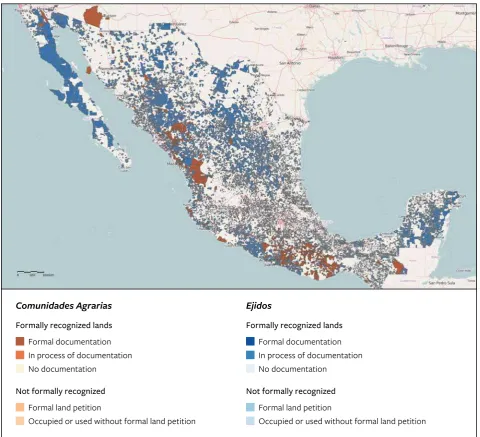
Figure 2:
Comunidades Agrarias
and
Ejidos
in Mexico
Comunidades Agrarias
Formally recognized lands
Formal documentation In process of documentation No documentation
Not formally recognized
Formal land petition
Occupied or used without formal land petition
Ejidos
Formally recognized lands
Formal documentation In process of documentation No documentation
Not formally recognized
Formal land petition
Occupied or used without formal land petition
Note: Collectively held lands in Mexico include lands held by indigenous peoples (Comunidades Agrarias), which predate colonization, and lands held more generally by rural communities (Ejidos) including in some
instances indigenous peoples. Some collectively held lands in Mexico have yet to be mapped and formally recognized by the state. Data source: RAN (2015).61 Map retrieved on 06 January 2016, from LandMark:
WHY INDIGENOUS AND COMMUNITY LAND RIGHTS MATTER FOR EVERYONE
The corporate risk of insecure tenure
Conlicts over the control of land pose signiicant risks to businesses trying to occupy that land and exploit its resources. TMP Systems, an investment consultancy, has found that businesses frequently stumble unwittingly into land conlicts, or are driven to take risks by impatient investors. Even giant projects on land occupied by tens of thousands of people may be approved by executives without the locals knowing about it until the bulldozers appear.62
As disputes escalate, operational costs can soar, proits are eaten up by government forces and private armies providing security, and some up-and-running operations have had to be abandoned with losses running into billions of dollars. ‘The risk posed to investors by disputes with local populations is widespread, materially signiicant and growing’, the analysts conclude.63
There are many examples of such land conlicts:
• After a 10-year struggle, the London-based metals giant Vedanta gave up its battle to mine bauxite valued at $2bn, which lay beneath the sacred territory of the Dongria Kondh indigenous people in eastern India. The company had failed to consult the people, who blockaded roads and rail lines and brought the project to a halt. In 2013, India’s Supreme Court ruled that mining contravened the country’s Forest Rights Act, the government withdrew the company’s right of access to the land, investors pulled out and the company’s credit rating plunged.64
• A review by First Peoples Worldwide found that 30 percent of oil and gas production by US companies, and 40 percent of mining output, is sourced on or near indigenous peoples’ lands.65
• Land conlicts account for nearly half of the total inancial risks faced by a sample of mining projects examined by the University of Queensland’s Centre for Social Responsibility in Mining.66 Half of the projects were met by blockades by locals and 30 percent were eventually abandoned.
Some people think disputes over land should be addressed by speeding up land acquisition processes and limiting the legal powers of redress for local groups. But others realize that by inlaming disputes, such actions can make investments more risky, not less so. As noted by the Interlaken Group, an ad hoc group from civil society and business which includes representatives of Nestlé and the International Finance Corporation, ‘Companies that understand the risks posed by insecure land rights and engage host communities can secure a competitive advantage.’67
Legality is not the only issue, of course. There are fundamental issues of imbalances of power and entrenched discrimination that have to be addressed if secure land rights are to be achieved. But TMP Systems makes clear that investors can reduce their risks by requiring developers to carry out greater due diligence concerning land-based investments, and by conducting business with respect for indigenous and community land and resource rights.68
WHY INDIGENOUS AND COMMUNITY LAND RIGHTS MATTER FOR EVERYONE
Box 6: A supply chain revolution?
NGO campaigns such as Oxfam’s Behind the Brands have alerted consumers to the social and environmental footprint of the goods they buy.69 Partly as a result, many manufacturers of food and beverages are trying to ensure that they and their suppliers respect land rights when sourcing commodities.
Coca-Cola responded to the Behind the Brands challenges on its sugar supply chains by committing to zero tolerance of land grabs.70 PepsiCo has since also committed to ‘zero-tolerance for [...] land displacements of any legitimate land tenure holders [...] whether based on indigenous rights, custom, informality, or occupation, regardless of whether the right is currently protected by law or formally recorded’.71 But there is a long way to go to put these commitments into practice.
More triumph than tragedy
in the commons
Many environmentalists accept the idea of the ‘tragedy of the commons’ set out in 1968 by American ecologist Garrett Hardin.72 He argued that collectively owned resources or ‘commons’ will be overused and destroyed because no individual has an interest in protecting them for the long term, while everyone has an incentive to grab what they can before the others wreck it. The conclusion of this pessimistic analysis was that collective ownership doesn’t work and the commons should be privatized or nationalized.73
But Hardin’s proposition has been widely challenged,74 most notably by American political economist Elinor Ostrom,75 who won the Nobel Prize for economics in 2010.76 From a lifetime’s analysis of real-life commonly owned lands and resources – including Swiss Alpine pastures, the forests of Nepal, and Indonesian and American ishing grounds – she emerged an optimist.77 Ostrom argued that communities can and do successfully manage vital commonly owned resources, but one of the important conditions for success was the right to defend the resources from outsiders.
PROGRESS
OR RETREAT?
A profound transformation of land ownership is underway in Indonesia. The country has begun to unravel the nationalization of its extensive rainforests carried out half a century ago under President Suharto. In 2013, following an action brought by the Indigenous Peoples’ Alliance of the Archipelago (AMAN), the country’s Constitutional Court annulled the government’s ownership of customary forest areas and ruled that ‘members of customary societies have the right to [...] use the land to fulil their personal and family needs’.78
Supported by the administration of President Joko Widodo – which has promised to integrate the community mapping of the forest areas of some 32,000 villages into state maps – and The National Human Rights Commission, which is documenting resource-rights abuses, the ruling could eventually lead to the resumption of community control over around 40 million hectares of forest lands.80 That is more than one-ifth of the land area of one of the world’s largest and most populous countries.
There is pushback, however: during 2015 the government announced plans to speed up land procurement for its extensive infrastructure projects, including roads, dams and railways, many of them in forest lands.81
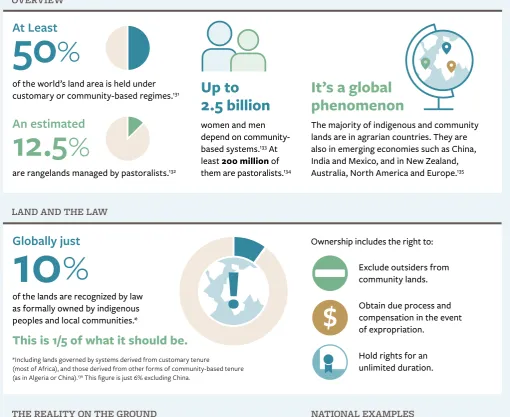
While the claims of customary land users, including indigenous peoples, cover more than 50 percent of the world’s land area, legal recognition of ownership is restricted to just 10 percent.82 Almost 80 percent of this land is in China, Brazil, Australia, Mexico and Canada. And even in these countries, the situation on the ground may be worse than it appears. In Australia, although areas are subject to indigenous ownership or control, native title law has, in practice, extinguished common law rights for many indigenous peoples. Communities that the government and earlier colonial authorities forcibly removed from their lands have been required to show a continuous connection to the land they claim.83 In China, community-based tenure regimes often arise from the collectivization of land in the 1950s, rather than from customary tenure.84 Throughout the world, much of the land ceded by governments is in remote or extreme environments – such as deserts or steep mountainous areas. Most importantly, in many cases, it can still be allocated to the corporate sector through long-term concessions.85
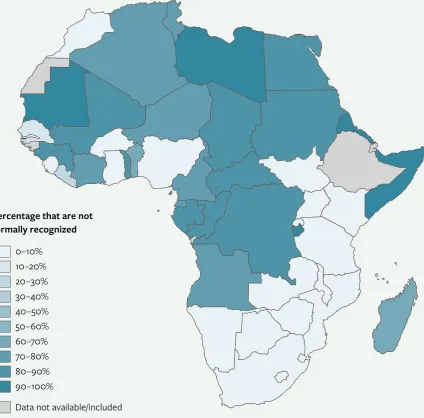
The gap between customary rights and legal title is largest in sub-Saharan Africa. Here, as Liz Alden Wily, a political economist who specializes in land rights issues, puts it, ‘African rural communities consider themselves to be the traditional owners of not just their house plots and farms, but also the forests, pastures and other naturally collective resources which fall within their domains.’86 Yet only three percent of land is legally recognized as owned by indigenous peoples or local communities.87
Even when recognized, those rights often fall short of efective control over the land.88 Owners may be prevented from harvesting forest resources for commercial purposes, or conducting shifting cultivation or hunting. When land rights are enforced, it is often not clariied how rights are distributed within the community and whether decision making involves wide participation. All this can make land rights weaker.
PROGRESS OR RETREAT? WHAT IS HAPPENING ON THE GROUND
While the claims
of customary
land users cover
more than 50%
of the world’s
land area, legal
recognition of
ownership is
restricted to just
10
%
.
The gap that must be closed
Most land in Africa is claimed and managed by indigenous
peoples and local communities. But most governments do
not recognize the rights of these customary land owners.
This is a recipe for rights abuses, poverty and land grabs.
[image:30.595.65.490.320.738.2]This map shows the estimated area of land held or used by indigenous peoples and local communities that is not formally recognized by the government as a percentage of the country’s total land area. Please note that formal recognition does not translate necessarily into practice. Lack of enforcement and power reduce communities’ ability to secure their land rights. In Kenya, for example, the Constitution extensively recognizes community land rights, but a community land law still needs to be enacted to provide adequate protection to communities.
Figure 3: Recognition of indigenous and community lands, Africa
Percentage that are not formally recognized
Source: The map was adapted from: F. Dubertret and L. Alden Wily. 2015. Percentage of indigenous and community lands. Data ile from Landmark: The Global Platform of Indigenous and Community Lands. Available at www.landmarkmap.org.
0–10% 10–20% 20–30% 30–40% 40–50% 50–60% 60–70% 70–80% 80–90% 90–100%
Data not available/included
PROGRESS OR RETREAT? WHAT IS HAPPENING ON THE GROUND
Indigenous and community lands (% of total land)
Formally recognized Not formally recognized
Data from Landmark: The Global Platform of Indigenous and Community Lands. Available at
Policy reform
Change is in the air. Since 2002, the proportion of forests in low- and middle-income countries where forest communities have statutory title has risen from 21 percent to 31 percent.89 In countries such as Brazil, Indonesia and India, communities are being helped with the often complex formal procedures that are required by governments to secure title. Some countries in sub-Saharan Africa, such as Mozambique and Liberia, also have projects for actively promoting community land titling.90
These changes may be bellwethers for reform elsewhere, but it is too soon to be sure. There is evidence that, globally, reform is slowing. The rate at which communities gained secure tenure of forest lands between 2008 and 2013 was only one-ifth the rate between 2002 and 2008.91 In Peru, some 20 million hectares of customary land await formal recognition.92
One cause of this may be the power of vested interests keen to proit from the corporate land rush that followed the 2007–2008 world food price shock (See Box 7).
Box 7: Land grabs
Since the 2007–2008 world food price crisis, there has been a rush by agribusiness to grab land and secure higher proits.93 There are no comprehensive data on the extent of this land grabbing. One database run by an independent partnership, the Land Matrix, has documented more than 1,000 large land acquisitions completed on 39 million hectares of land – an area larger than Germany.94 Some individual acquisitions involve hundreds of thousands of hectares. In the majority of cases, the land involved was already owned, occupied and used by local communities and indigenous peoples. African nations, where land tenure is most insecure, have been the main target.
The impact of land grabbing is worse for those with less secure tenure rights, especially women.95 In the Philippines, for example, in the village of Tanagan, in Batangas, when all the village’s mangrove forests were occupied by shrimp farms owned by just one investor, women were hit hardest, as they were most reliant on common resources.96 But as elsewhere in the Philippines, women demonstrated their collective resolve and strength by ighting back and establishing well-managed production areas on the coast.97
PROGRESS OR RETREAT? WHAT IS HAPPENING ON THE GROUND
Courts respond to community pressure
In the face of corporate land grabs, land rights movements have often found an ally in courts. There have been several cases in Latin America:
• In Colombia in 2014, following action brought by the Embera Katio people, a local court ordered 11 mining companies to vacate 50,000 hectares in the country’s northwest, annulling titles granted by the government and reinstating the rights of the traditional owners who had been forced from the land by armed groups.98
• The Supreme Court of Belize ruled as unlawful licences granted to an oil company to drill in the Sarstoon-Temash National Park, a rainforest with 40 villages housing Mayans and Garifuna people of African descent. It found that the communities, which had taken the company to court, had not given their consent.99
• In Paraguay, in three separate rulings, the land rights of indigenous communities have been upheld by the Inter-American Court of Human Rights, which told the state to reinstate lands taken from communities in the Chaco region. To date, the country has failed to implement these rulings in full. In only two cases has the government acquired land for the afected communities, which still face obstacles in resettling their land.100
Activists are inding that court rulings are not always implemented. They may be ignored, or new laws may be passed which nullify the rulings.
Where legal advances are made, there is frequent pushback from commercial and political interests. In Mexico, a new national energy policy asserts that oil exploration is a ‘social interest’ that can override surface land rights.101 In Brazil, the national legislature has sought to reverse indigenous land rights and the government continues to construct hydroelectric dams despite opposition from the inhabitants of the land to be looded.102
Governments can be of two minds. For instance, in 2014 the government of Democratic Republic of Congo (DRC) won international praise for recognizing the customary rights of individual rural communities to up to 50,000 hectares of forest.103 But in 2015 it created a new category of logging concessions that will open to loggers the forests of all communities without established statutory land rights.104
Clearly there is a battle going on between commercial interests and human rights, in which communities must constantly assert their rights. They will sometimes ind allies: in the courts, from progressive leaders and reformers, and in the international community. The lesson is that indigenous peoples and local communities can successfully defend their lands. But it is rarely easy.
Box 8: Cameroon
Activism works. In 2013, Cameroonian lawyer Samuel Nguifo led a civil-society campaign against plans by a New York investment company, Herakles Farms, to establish an oil-palm plantation on 73,000 hectares of rainforest and agricultural land in the southwest of Cameroon. In 2009, the company claimed to have received from the Cameroon government a 99-year lease on land that had been under the traditional ownership of some 50,000 people from local communities. Among them were the Oroko and Bakossi, who had already lost land to plantations and protected areas, including the Korup National Park.105
‘When communities saw their customary land rights threatened, they solicited support. The advocacy campaigns by the NGO coalition raised awareness at local, national and international levels,’ says Nguifo, who founded and directs the Centre for Environment and Development, a local NGO. In 2013, Greenpeace made the dispute headline news round the world.106 By the end of that year, the original lease had been annulled and the concession area reduced to 20,000 hectares on a short-term lease.107
However, the campaign is not over, says Nguifo. Some local communities have still lost land, and have mapped encroachments onto land that remains theirs. ‘This development can easily lead to future conlicts,’ he warns.
Meanwhile, Nguifo is campaigning for reform of Cameroon’s land law. ‘I would like policy makers to clearly see the link between communities’ land rights and the well-being of rural people,’ he says. To succeed in Africa, economic growth must be ‘rooted in robust communities’. And that means protecting land rights that are the core of cultural identity.
Far from being a barrier to economic growth, as some politicians argue, Nguifo maintains that ‘recognizing and protecting communities’ land rights is in fact the most eicient way of ensuring inclusive economic growth.’ Any other route will lead to growing inequalities and conlict.
PROGRESS OR RETREAT? WHAT IS HAPPENING ON THE GROUND
An oil-palm nursery in a Herakles Farms concession area in Cameroon (2012). After pressure from national and international NGOs, the original large-scale lease was annulled and the concession area reduced. Photo: Alex Yallop/Greenpeace
Women demand their land
When the Sri Lankan military took over their lands to establish a tourist resort, it was the women of Paanama, in the country’s eastern coast, who took a stand against them.108 ‘We had to join together and win this ight to get justice not only for ourselves, but for our children and the generations who passed land to us,’ says Rathnamali Kariyawasam, who grows rice and processes ish from the lagoon close by.
‘We organized as a group,’ explains Kariyawasam. ‘Women climbed on the roof of the village cooperative building near the main road and refused to retreat until the authorities responded to us.’ She and dozens of other women from the 350 families evicted from their lands took their case to the capital, Colombo. They iled court cases and petitioned the National Human Rights Commission. They linked up with other groups defending their territories against government land grabbing for other tourist developments, through the People’s Alliance for Right to Land (PARL).109
In early 2015, a newly elected government ordered the return of most of the land. However, almost a year later, local oicials had not acted on the order. The police took out a court order preventing them returning. But the women are not backing down. The issues for rural women and their land rights are simple. Women depend on the common lands – the forests, grazing areas, water bodies – for their economic survival, and that of their families. In forest communities, women generate more than half of their income from forests, compared with one-third for men.110 Yet their roles and rights are rarely recognized; their voices too often go unheard when a decision is made.111
So, while a call for the recognition of community land rights will help women, it is also important that the rights of women within communities are asserted. That means ensuring that women sit on all bodies that control land, whether statutory or customary, and that the right mechanisms exist within those bodies so women can exercise their leadership. It also means raising awareness among male leaders in communities, and training local administrations and police about their role in enforcing and protecting women’s land tenure security.
PROGRESS OR RETREAT? WHAT IS HAPPENING ON THE GROUND
Land grabs
are not
gender-neutral.
Victoria Tauli-Corpuz,
UN Special Rapporteur on the Rights of Indigenous Peoples
In many customary systems of land governance, women’s rights are distinguished from those of men. These systems can bolster the voices of women, but may also sideline them. This becomes more acute where land controlled by communities grows increasingly scarce.
Often, women under customary tenure regimes have a double ight: like many women worldwide, they are battling to be treated as equals while also defending their customary land rights to protect their communities and identity.
Indigenous women and those from local communities share a history of struggles and activism – speaking out in defence of collective land rights, cultural identity and social change as part of the global movement for women’s liberation.112
In August 2015, a report from the UN Special Rapporteur on the Rights of Indigenous Peoples, Victoria Tauli-Corpuz, herself an indigenous activist, noted that the increased vulnerability of customary rights have further discriminated against women. ‘Land grabs are not gender neutral,’ she said, since they result in ‘indigenous women losing their traditional livelihoods, such as food gathering, agricultural production and herding [...] Some indigenous communities whose land rights are threatened have further subjugated the rights of women, [which] have been considered “external values” or “Western values” and therefore divisive to the indigenous struggle.’113
Box 9: Blood on the soil
The NGO Global Witness has catalogued a rising tide of murders of land rights activists and environmentalists, with almost 1,000 documented deaths since 2002. Brazil, Honduras, the Philippines and Peru have been the most dangerous countries in this regard, it reports.114
In October 2014, four community leaders from Saweto in Peru’s eastern Amazon, who had opposed the presence of illegal loggers on their land, were murdered in the forest. Edwin Chota and the others had been requesting title to their traditional lands since 1993, without success. In the aftermath of the killings, the Peruvian government issued the title deed but continues to resist other claims in the area.115
Land insecurity triggers wider conlicts. A study of civil conlicts around the world since 1990, from Guatemala to Afghanistan, found that disputed land rights were at the heart of most of them.116 In the Darfur region of Sudan, disruption of traditional land tenure systems has triggered conlict between herders and private farmers.117 In such situations, peace can only be restored by the fair resolution of land disputes.
PROGRESS OR RETREAT? WHAT IS HAPPENING ON THE GROUND
Box 10: Indian rights on a knife edge
‘It is our independence day,’ said Petra Kanhara, an elder of Loyendi, on the day the village won community rights over 20 mountains, full of forests. ‘Now, the forests are rightfully ours.’118
Under India’s 2006 Forest Rights Act, forests became a community rather than a state asset. Villages with forest dwellers – about a quarter of all villages – are now entitled to a legally enforceable community forest, and access to government funds for forest management. Nobody can take land from communities in tribal areas without their approval. Airming the law’s interpretation in 2013, India’s Supreme Court called the rights an ‘imperishable endowment’.119
This could transform India, where around half of rural households depend on community or common lands for part of their livelihoods.120 If fully implemented, the law could enshrine control for 150 million men and women over up to half of the country’s forests, which are concentrated in India’s most impoverished areas, such as the state of Odisha. It would be the largest ever land reform in India and among the largest in the world.121
Implementation is now taking place in some areas. In Kandhamal district in Odisha, oicials collaborating with the NGO Vasundhara have developed mapping processes to help communities claim their forests. The test case was Loyendi. There, the Kondh tribe had been attempting to reclaim forests where they had legally cut bamboo until the state took the land 50 years ago and gave bamboo rights to local paper mills.122
But the government appears conlicted between human rights and a narrowly commercial agenda. For it has also announced plans to privatize large parts of its forest estate.123 And even a decade after the law came into force, many state administrations tasked with organizing the handover are stonewalling the process.124
Securing community land rights through
grassroots legal empowerment
‘We know our borders; we know our resources; we know
our rules, and they are written down for everyone to
see; people are attending meetings and we feel stronger
together. Now it is easy for us to organize and ask the
government for things we want.’
Community member, Jowein, Liberia
Even where national laws formally recognize the land rights of indigenous peoples and local communities, they may still lack security on the ground. Communities often have to complete a long process to obtain a title or a certiicate over their land. Namati, an NGO that works with grassroots legal advocates, has identiied a ive-part process for communities to strengthen their tenure security.125
Governance is at the heart of the protection of indigenous and community land rights. Providing a community with documentation for its land rights without ensuring intra-community mechanisms to hold leaders accountable may, in some instances, enable land grabbing.
Community members in Okeng, Uganda use participatory mapping to identify their communal grazing lands on satellite imagery (2015). Photo: Marena Brinkhurst/Namati
Harmonize boundaries
and document lands
Make community maps of lands and resources.
Negotiate boundaries and resolve conlicts. Mark and record boundaries.
Strengthen community
governance
Record, debate, and revise rules about land.
Adjust rules to avoid conlicts with national laws. Make a zoning plan and enforcement mechanisms for implementation.
Create a local land governance body.
Lay the groundwork
Define social and geographic dimensions of ‘community’.
Create a shared community vision for the future.
Select and train community mobilizers and representatives.
Illustrate the importance of shared land and resources by supporting the
community to estimate their economic, social, environmental and spiritual value.
Pursue legal recognition
If desired, complete legal procedures to formally document and register
community lands (if national law supports it).
Prepare to prosper
Revisit the community vision and translate it into a clear action plan.
Connect with livelihoods support programmes. Work to regenerate and sustain local ecosystems.
Support communities to prepare strategies for interactions with potential
[image:39.595.62.535.71.755.2]investors, including deciding whether or not to share their lands.
Figure 4: Securing community land rights through grassroots legal empowerment
Box 11: Paraguay
‘We sometimes secretly tried to get through the barbed wire to get at our traditional sources of food. We lived like slaves, with no freedom. What was ours now belonged to strangers,’ remembers Leonardo González, a leader of the Sawhoyamaxa
community of Enxet people in the remote Chaco region of Paraguay.126
But after 23 years of legal battles, active organizing and advocacy to get their land back, their struggle is almost over. The government, which over decades had overseen the takeover of the territories of indigenous peoples by cattle ranchers and other agribusinesses, has in this case relented. In 2014 it inally passed a law that took 14,404 hectares from a German-owned cattle-raising business and returned it to the 160 dispossessed families of the Sawhoyamaxa community. ‘This gives us life, and allows us to have contact once again with our forests and our traditional medicines,’ says González.127
After decades during which the proud hunters and gatherers had been forced to become labourers on cattle ranches and to live in shacks by the road, they could legally return to their land. However, many died as a result of their living conditions during their exile, says González.
The government’s change of heart followed a ruling in 2006 by the Inter-American Court of Human Rights. After the Sawhoyamaxa community had spent 10 years exhausting all domestic administrative and legislative recourse to no avail, they took their case to the Inter-American system for protection of human rights in 2001, with the help of a local NGO, Tierraviva.128 But even after the binding Inter-American Court ruling, it took eight more years of eforts by the community, including mobilizing domestic and international support and taking direct action to occupy their land, before they were given tenure security by law in June 2014.
‘This demonstrates that Paraguayan justice is starting to compensate [Paraguay’s] historic debt to indigenous peoples, whose rights have always been violated,’ says Eriberto Ayala, another Enxet leader.129
Nevertheless, this hard-won victory for the Sawhoyamaxa people is not complete, as the cattle business continues to use the domestic courts to delay the granting of formal title to the community. The long but successful struggle of the Sawhoyamaxa to recover their land, however, brings hope to many communities facing conlicts over land in Paraguay, where justice is often delayed as powerful landowners and agribusiness companies seek to manipulate the judicial system to their beneit.130
PROGRESS OR RETREAT? WHAT IS HAPPENING ON THE GROUND
The difference between what is written in law
and what happens in practice is enormous,
[image:41.595.50.561.87.504.2]even when land rights are formally recognized.
Figure 5:
Land facts
Peru
Peruvian indigenous peoples control more than one-third of Peru’s land area. However, the national Indigenous Federation of the Peruvian Amazon estimates that an additional 20 million hectares are eligible for formal recognition.139
Indonesia
Approximately 0.2% of Indonesia’s land is currently recognized as community-owned or controlled. By contrast, an estimated 40 million hectares are proposed for recognition by the Indonesian Constitutional Court in favour of communities’ forest tenure rights.140
Canada
In Canada, 7% of the country is owned by indigenous peoples and local communities, but much of the land is located in sparsely populated tundra and taiga ecosystems.141