Seminar Liga Ilmu Serantau 2015 (LIS 2015)
Decision Support System of Recruitment
using Simple Additive Weighting Method
Yeni Rokhayati1 , Rolly Hidayat2, Sartikha3
1,2,3Department of Informatics Engineering, Politeknik Negeri Batam [email protected], [email protected], [email protected]
ABSTRACT. Assisting the human resources department to choose easily and quickly the suitable employee among of so many candidates, a decision support system is needed. The decision support system is designed with unified modeling language (UML) and developed using PHP programming and database MySQL. This system uses a simple additive weighting (SAW) method which considering four criterias; those are written test, interview test, work experience, and age. The user enter the name and the data of applicants, and then the system will display a graph which describe the score of each applicant. The applicant with the higher score will be selected as suitable and competent employee.
KEYWORDS: [decision support system; ranking; recruitment; SAW method]
1 INTRODUCTION
Batam is one of industrial area in Indonesia that is near from Malaysia and Singapore. Since the increase of minimum salary in Batam, many companies would not hold their employees to be permanent, that is because the company will spend more money for their salary. Therefore, many companies prefer to discharge the old employess and recruit the new more often than before. In the recruitment processes, there will be always so many applicants, which have almost similar competence, with the result that the human resources department feel hard to select some of them.
Recruitment is a series of activities and look for job applicants with motivation, abilities, skills, and knowledge needed to cover the shortfall identified in the planning of employees (Henry Simamora, 1997). In order to help the human resources department to choose easily and quickly the suitable employee among of so many candidates, a decision support system is needed.
Simple additive weigting (SAW) is one of methods often used in making decision based on some criterias. It uses a simple calculation to score and then rank all of the candidates. The concept of this method is finding the weighted sum of the rating performance of each candidates based on all criterias (Fishburn, 1967). The criterias using in this decision making are the usually used by the companies to choose their operators, that are written test, interview test, work experience, and age.
This web-based system is developed using PHP 5 programming which is object oriented, so that the Unified Modeling Language (UML) is suitable for the design of this system. As for the accompanying of PHP 5 programming, MySQL database is used.
2 SIMPLE ADDITIVE WEIGHTING METHOD
Simple additive weighting (SAW) method is finding the weighted sum of the rating performance of each candidates based on all criterias. The steps of this method are:
1) Decide all criterias which influence the decision making.
2) Set the weight of each criteria based on the importance to the decision making. The sum of all the weight should be 1.
3) Make the function of each criteria, where the value range from 0 to 1. 4) Arrange a normalization matrix which describe all the values of the criteria. 5) Multiply each criteria’s value with the weight.
6) Sum the values of each candidate which have multiplied by the weight.
7) Rank all the candidates. The candidate with the higher score will be ranked to the top.
The system recruitment is done after administrative process, therefore the criterias considered are written test, interview test, work experience, and age.
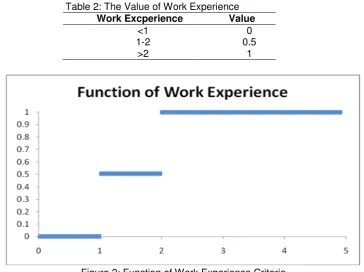
Table 2 shows the value of work experience and then the function is described in the Figure 2. This criteria divided into three group, that are if the work experience less than 1 year, 1 – 2 year, and more than 2 year.
Table 2: The Value of Work Experience
Work Excperience Value
<1 0
1-2 0.5
>2 1
Figure 2: Function of Work Experience Criteria
The Figure 3 below describes the function of age criteria. If the age lower than 17 and higher than 26, the value will be 0; while if the age is 20 to 22, it is valued by 1. The complete function can be calculated using the following equation 2.
Figure 3: Function of Age Criteria
After deciding all criterias and the function, the next step is setting the weight of each criteria as shown in Table 3 below.
Table 3: Weight of Criterias
Criteria Weight
Written Test (C1) 0.325 Interview Test (C2) 0.325 Work Experience (C3) 0.25
Age (C4) 0.1
The following example is the decision making that calculated manually. Ten candidates are considered. The data of each candidate has shown in Table 4 below.
Table 4: Data of Candidates
Candidate Written Test
(C1)
Interview Test (C2)
Work Experience (C3)
Age (C4)
Rani 80 Good 6 22
Yuli 70 Good 1 20
Desi 80 Enough 3 23
Beni 65 Bad 2 20
Agus 50 Good 3 18
Table 5: Ranking of Candidates
Candidate C1 C2 C3 C4 Sum Ranking
0.325 0.325 0.25 0.1
Rani 0.6 0.75 1 1.00 0.7888 1 Yuli 0.4 0.75 0.5 1.00 0.5988 5 Desi 0.6 0.5 1 0.75 0.6825 3 Beni 0.3 0.25 0.5 1.00 0.4038 9 Agus 0 0.75 1 0.33 0.5271 7 Surya 0.8 1 0 0.67 0.6517 4 Dewi 0.9 0.75 0.5 1.00 0.7613 2 Mery 0.5 0.5 1 0.00 0.5750 6 Suzana 0.2 0.75 0.5 0.00 0.4338 8 Kino 0.3 0.25 0.5 0.25 0.3288 10
If the company needs 3 employees, then the candidates should be reccomended are Rani, Dewi, and Desi.
3 DECISION SUPPORT SYSTEM
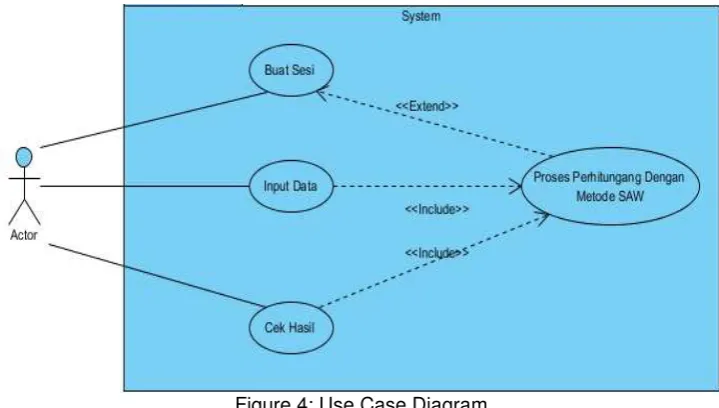
The functional requirements of the system described in the use case diagram below. The user of this system is staf of human resources department.
Figure 4: Use Case Diagram
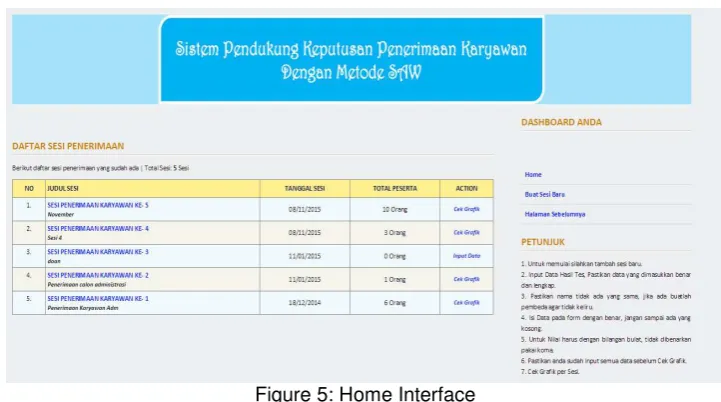
Figure 5: Home Interface
The home interface shows all the recruitment sessions, and the dashboard on the right consist of all menus and the instruction of using.
Figure 6: Form of Input Data
After the data of all candidates has been input, the user of the system can see the result in a bar chart graphic as shown in Figure 8 below. The candidate with higher bar has the higher score, that mean he/she will be reccomended as the employee.
Figure 8: Graph of Result
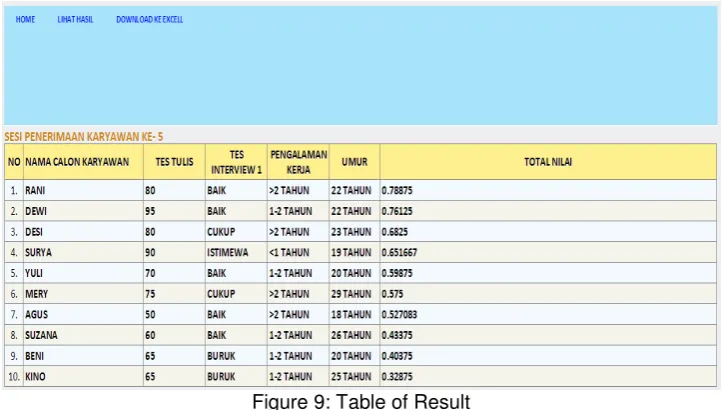
Beside using graph, the result can be seen in a table too. The table completely show us each score of the candidates as seen in the Figure 9 below.
Figure 9: Table of Result
4 CONCLUSION
A decision support system has been designed and developed. The system assist the staff of human resources department to make a decision in choosing some candidates to be employed. The result in this system which is the implementation of simple additive weighting calculation are displayed both in a graph and a complete table. The candidate with a higher score will be considered as the employee. For further development of this system, it would be better if the criterias used are more than 4, because it can make the decision wisely.
Beside it, input the candidates data will be easier if the user doesn’t input one by one, but it
REFERENCES
Fishburn, P.C. (1967). Additive Utilities with Incomplete Product Set: Applications to Priorities and Assignments. Operastions Research Society of America (ORSA), Baltimore, MD, U.S.A.
Fitri, R., & Sari, W.S. (2013). Sistem Pendukung Keputusan Pemilihan Jurusan Tingkat Lanjut dengan Metode SAW (Unpublished Diploma’s Thesis). Politeknik Negeri Batam.
Kadir, A. (2008). Belajar Database Menggunakan MySQL. Yogyakarta: Andi Publisher.
Saaty, T.L. (1993). Pengambilan Keputusan Bagi Para Pemimpin Proses Hirarki Analitik untuk Pengambilan Keputusan Dalam Situasi Yang Kompleks. Jakarta: Pustaka Binama Pressido.
Saaty, T.L. (2001). Decision Making For Leaders (4th ed). University of Pittsburgh: RWS Publication.
Sakur, S.B. (2010). PHP 5 Pemograman Berorientasi Object. Yogyakarta: Andi Publisher.