TUGAS TRANSLATE JURNAL
ProQuest
The experience of Egyptian male student
nurses during attending maternity nursing
clinical course
Eswi, Abeer; El Sayed, Yousria. Nurse Education in Practice11.2 (Mar 2011): 93-8.
---
Pengalaman siswa perawat laki-laki di Mesir
selama mengamati keperawatan
persalinan klinis
---
Perjemah:
SARWIDI
NIM: G0A015099
PROGRAM DIPLOMA III KEPERAWATAN
FAKULTAS ILMU KEPERAWATAN DAN KESEHATAN
HASIL TRANSLATE
Judul:
Pengalaman siswa perawat laki-laki di Mesir selama mengamati keperawatan
persalinan klinis
Abstrak
Tujuan dari penelitian ini adalah untuk mengeksplorasi pengalaman belajar
dari Mesir siswa perawat laki-laki selama menghadiri keperawatan bersalin klinis
di Kairo Rumah Sakit Bersalin University.
Sebuah desain deskriptif dipergunakan untuk mengumpulkan data yang
diperlukan untuk menjawab pertanyaan penelitian; baik data kuantitatif dan
kualitatif dikumpulkan dengan menggunakan skala wawancara semi terstruktur.
Sebanyak 60 siswa yang baru saja selesai klinik bersalin saja di perguruan tinggi
Keperawatan, Universitas Kairo direkrut untuk penelitian.
sangat penting. Akhirnya, siswa laki-laki harus berorientasi dan didorong untuk
mengidentifikasi dengan teladan dari dokter kandungan laki-laki.
Naskah Lengkap
Pengenalan dan kajian literatur
Jumlah laki-laki memasuki profesi keperawatan telah meningkat di seluruh dunia,
sebagai konsekuensi dari langkah untuk lebih profesi gender yang seimbang,
perdebatan memiliki pun terjadi atas bagaimana intim perawatan harus dilakukan
ketika ini memerlukan perawat laki-laki secara fisik dekat dengan perempuan klien
Madoka et al. (2006).
Meskipun
perubahan
konstan
bahwa
perawatan
kesehatan
dampak,
ketidakseimbangan jenis kelamin profesi keperawatan tetap konstan (Villeneuve,
1994). Ini dapat dikaitkan dengan alasan sejarah dan sosial. Misalnya, setelah
Nightingale pindah untuk memodernisasi keperawatan, pria sengaja dikeluarkan
dari memasuki profesi (Evans, 2004; Mackintosh, 1997). Hal itu diyakini oleh
Florence Nightingale yang menyusui adalah perpanjangan alami dari wanita dan
ibu. Dia percaya bahwa semua perempuan dan laki-laki perawat tidak mampu
menjadi perawat dan dengan demikian tidak diperbolehkan untuk mendaftar di
keperawatan pendidikan / pelatihan (Nightingale, 1859).
Ada bukti, bagaimanapun, bahwa ada peningkatan jumlah orang yang memasuki
profesi keperawatan. Misalnya, di Irlandia, pada tahun 2005, ada 2.826 orang di
register aktif sebagai perawat umum dibandingkan dengan 1.541 di tahun 2002.
Namun, perempuan membuat hampir 96% dari tenaga kerja keperawatan umum
(An Dewan Altranias, 2006).
Di Amerika Serikat, pengalaman kebidanan untuk perawat laki-laki telah diterima
sejak tahun 1960. Hal ini dimungkinkan karena Liga Nasional untuk Keperawatan,
yang melaporkan bahwa kurikulum keperawatan dasar seharusnya tidak memiliki
diferensiasi untuk pria dan wanita (McKenna, 1991).
untuk pria yang bekerja di profesi yang didominasi perempuan (Evans, 2004;
Bartfay dan Bartfay, 2007;. Crigge et al, 2007) Masalah yang diajukan untuk peran
ketegangan ini mencakup bahwa semua orang di keperawatan adalah "gay" atau
menyimpang seksual, tidak mampu merawat, (Evans, 2004;. Mackintosh, 1997,
Yang et al, 2004).
Sebuah penelitian deskriptif dilakukan oleh Sherrod (1991) untuk menguji tingkat
peran ketegangan yang dialami di daerah kandungan oleh laki-laki dan sarjana
muda keperawatan perempuan siswa dan dinilai apakah peran noda lebih besar
untuk siswa laki-laki, hasil penelitian menunjukkan perbedaan yang signifikan
statistik (p = 0,01) dalam peran noda antara laki-laki dan perawat mahasiswi seperti
itu ketegangan peran yang lebih besar untuk laki-laki daripada perempuan.
Kesulitan yang dihadapi oleh mahasiswa keperawatan laki-laki di daerah
kandungan mungkin terkait dengan stereotip sosial.
Morin et al. (1999) melakukan penelitian deskriptif-fokus etnografi, dalam
penelitian ini, fokusnya adalah pada faktor-faktor yang mempengaruhi
pengambilan keputusan perempuan mengenai tugas siswa laki-laki di salah satu
rumah sakit komunitas kecil mengidentifikasi. Contoh kenyamanan purposive dari
32 wanita yang melahirkan bayi yang normal diwawancarai tentang bagaimana
mereka akan merasa atau merasa jika seorang mahasiswa keperawatan laki-laki
memeriksa mereka, terutama dalam pemulihan dan postpartum pengaturan.
Kira-kira, setengah dari wanita menggambarkan ide dirawat oleh perawat laki-laki
sebagai "tidak nyaman." Banyak peserta percaya bahwa izin harus diperoleh
sebelum ditugaskan untuk mahasiswa keperawatan laki-laki.
Sebuah studi fenomenologis dilakukan oleh (Patterson dan Morin, 2002) untuk
menilai pengalaman 8 siswa perawat laki-laki yang telah menyelesaikan rotasi anak
ibu mereka. Tiga tema yang muncul: prakonsepsi tentang rotasi anak ibu, abadi
pengalaman klinis dan bertahan rotasi klinis. Siswa mulai rotasi mereka dengan
perasaan campur aduk kecemasan, ketakutan, dan takut ditolak. Ibu menyusui anak
dipandang oleh siswa laki-laki sebagai domain wanita, di mana mereka
pengunjung. Mahasiswa melakukan tindakan pencegahan khusus saat melakukan
penilaian postpartum.
bahwa staf kebidanan yang dingin dan bermusuhan selama penempatan dan
mahasiswa laki-laki dibuat merasa tidak nyaman selama penempatan, banyak siswa
laki-laki tidak diperbolehkan untuk berpartisipasi dalam berbagai intervensi peduli
selama penempatan obstetrik (Keogh dan Olynn, 2007)
LAMPIRAN : NASKAH ASLI
The experience of Egyptian male student
nurses during attending maternity nursing
clinical course
Eswi, Abeer; El Sayed, Yousria. Nurse Education in Practice11.2 (Mar 2011): 93-8.
1. Full text
2. Full text - PDF
3. Abstract/Details
4. References 20
Turn on hit highlighting for speaking browsers by selecting the Enter button Hide highlighting
Abstract
TranslateAbstractThe aim of this study was to explore the learning experience of Egyptian male student nurses during attendingmaternity nursing clinical course at Cairo University Maternity Hospital.
A descriptive design was utilized for collecting the data that are necessary to answer the research question; both quantitative and qualitative data were collected using a semi- structured interview scale. A total of 60 students who just finished the
clinic maternity course in college of Nursing, Cairo University were recruited for the study.
procedures were assessment of the newborn, attending cesarean section and
providing mother classes for mother in both antenatal clinic and postpartum unit, 53% of the students reported that the women were dealing with them with restrictions, while (25%) reported that women refused to deal with them during labor, 50% described their experience in maternity nursing clinical course as useful, while (18%) described it as interesting and (39%) described it as very embarrassing for male student nurses.
Among the suggestions made by students to modify their clinical experience were: 1) substituting clinical training by the skill lab for male students and also adding clinical experience in andrology that refers to the medical specialty that deals with male health, particularly relating to the problems of the male reproductive system and urological problems (76%); 2) teaming with a female student during the clinical area (50%).
Based on the study findings, re-planning of some of the clinical rotations of Maternity
Nursing to include substitute clinical experience for the male student should be
considered. Furthermore, developing strategies to change male student's attitude toward child- bearing experience and fatherhood is crucial. Finally, male students should be oriented to and encouraged to identify with role model of male
obstetricians.
Full Text
TranslateFull text
Turn on search term navigation
Course grade
No %
F (<60%)
1
1.7
D (60%-<65%) 6
10
C (65 %-< 75%) 31 51.7
A (>85%)
2
3.3
Total
60 100
Table 1 - Distribution of students according to academic achievement.
Topics
No %
a) Comprehensiveness of theoretical contents
43 71.7
b) Learning how to deal with high risk pregnant mothers
37 61.6
c) Gaining skills of caring for mother in labor and delivery 8
13.4
Table 2 - Satisfying aspects of studying maternity nursing as reported by male students.
Responses are not mutually exclusive.
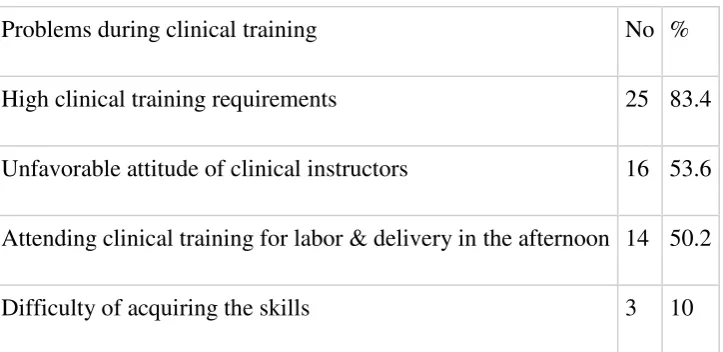
Problems during clinical training
No %
High clinical training requirements
25 83.4
Unfavorable attitude of clinical instructors
16 53.6
Attending clinical training for labor & delivery in the afternoon 14 50.2
Difficulty of acquiring the skills
3
10
Table 3 - Distribution of students in relation to Problems faced during clinical training.
Responses are not mutually exclusive.
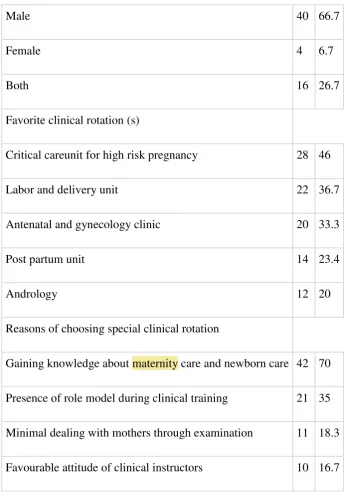
Item
No %
Male
40 66.7
Female
4
6.7
Both
16 26.7
Favorite clinical rotation (s)
Critical careunit for high risk pregnancy
28 46
Labor and delivery unit
22 36.7
Antenatal and gynecology clinic
20 33.3
Post partum unit
14 23.4
Andrology
12 20
Reasons of choosing special clinical rotation
Gaining knowledge about maternity care and newborn care 42 70
Presence of role model during clinical training
21 35
Minimal dealing with mothers through examination
11 18.3
Favourable attitude of clinical instructors
10 16.7
Table 4 - Distribution of students in relation to their preference of patient's gender and their favorite clinical rotations.
Responses are not mutually exclusive.
Stressors
N %
Nothing
10 16.7
Attitude of some clinical instructors
7 11.7
Rejection and un-cooperation of some mothers 7 15.7
Midterm exams during clinical training
4 6.7
Table 5 - Clinical training stressors as perceived by students.
Responses are not mutually exclusive.
Mothers' attitude toward male student nurse N %
Normal
13 21.7
Dealing with restriction
32 53.3
Refuse to receive care by male student nurse 15 25
Table 6 - Students' perceptions of mothers' attitude toward male student nurse.
Item
No %
The most embarrassing procedures
[black square] Abdominal examination
29 48.3
[black square] Breast examination
23 38.3
[black square] Examination of episiotomy
10 16.7
[black square] Perineal care
3
5
The most embarrassing topic in mother class
[black square] Breast feeding
28 46.7
[black square] Dangerous sings during pregnancy
16 26.6
[black square] Minor discomfort during puerperium 16 26.6
[black square] Vaginal infection
9
15
[black square] Nothing
13 21
Table 7 - Frequency distribution of the study sample in relation to the most
embarrassing procedures they faced during the clinical training and their suggestions (n = 60).
Responses are not mutually exclusive.
Students' description of the clinical training in maternity nursing No %
Very effective
30 50
Interesting
11 18.3
Very embarrassing for the male student nurse
18 39
Boring
3
5
Table 8 - Frequency distribution of the study sample in relation to their description of the clinical training inmaternity nursing.
Responses are not mutually exclusive.
Students' suggestions
No %
Maternity training should be for female only
14 23.3
Working mutually with female students
30 50
Table 9 - Students' suggestions toward the clinical training of maternity nursing.
Responses are not mutually exclusive.
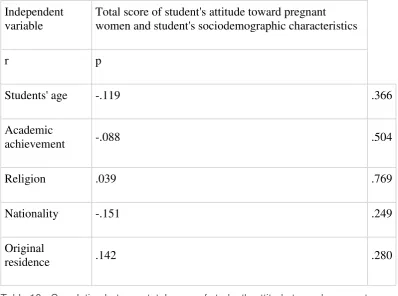
Independent
variable
Total score of student's attitude toward pregnant
women and student's sociodemographic characteristics
r
p
Students' age
-.119
.366
Academic
achievement
-.088
.504
Religion
.039
.769
Nationality
-.151
.249
Original
residence
.142
.280
Table 10 - Correlation between total score of student's attitude toward pregnant women and students' sociodemographic characteristic.
Significance level at p < .05.
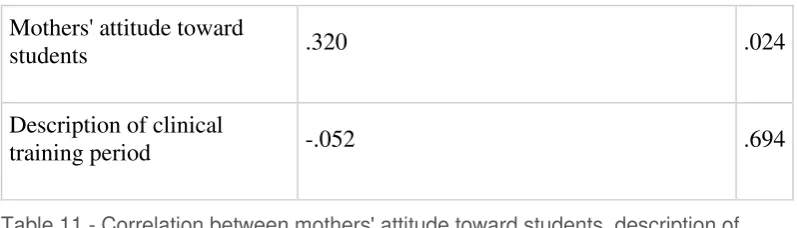
Independent variable
Total score of student's attitude toward
pregnant women scale
r
p
Mothers' attitude toward
students
.320
.024
Description of clinical
training period
-.052
.694
Table 11 - Correlation between mothers' attitude toward students, description of clinical training period, and patient's sex preferences in relation to the total score of student's attitude toward pregnant women.
Introduction and review of literature
The number of men entering the nursing profession has increased worldwide, as a consequence of the move to a more gender-balanced profession, debates have ensued over how intimate care should be performed when this requires male nurses to be physically close to women clients Madoka et al. (2006).
Despite the constant changes that impact health care, the sex imbalance
of nursing profession remains constant (Villeneuve, 1994). This can be attributed to
both historical and social rationale. For instance, after Nightingale moved to modernize nursing, men were purposefully excluded from entering the profession (Evans, 2004; Mackintosh, 1997). It was believed by Florence Nightingale
that nursing was a natural extension of women and motherhood. She believed that all women were nurses and men were not capable of being nurses and thus were not allowed to enroll in nursing education/training (Nightingale, 1859).
There is evidence, however, that there is an increase in the number of men entering
the nursing profession. For example, in Ireland, in 2005, there were 2826 men on the
active register as general nurses compared with 1541 in the year 2002. However, women make up almost 96% of the general nursing workforce (An Board Altranias, 2006).
The social context of men entering the profession of nursing has evolved from this historical context and is now seen as the major deterrent for men to enter the profession. The issue revolves around the perceptions of role strain for men working in a female dominated profession (Evans, 2004; Bartfay and Bartfay, 2007; Crigge et al., 2007) Issues that are put forth for this role strain include that all men
in nursing are "gay" or sexual deviants, are incapable of caring, (Evans, 2004; Mackintosh, 1997, Yang et al., 2004).
A descriptive study was conducted by Sherrod (1991) to examine the degree of role strain experienced in the obstetrical area by male and female
baccalaureate nursing students and assessed whether role stain was greater for the male students, results of the study indicated a statistical significant difference ( p =
.01) in role stain between male and female student nurse as it was greater role strain for male than female. Difficulties encountered by male nursing students in the
obstetrical area may be related to social stereotypes.
Morin et al. (1999) conducted a descriptive-research focused ethnography, in this study, the focus was on identifying factors that influenced women's decision making regarding male students assignments in one small community hospital. A purposive convenience sample of 32 women who give birth to normal newborn were
interviewed about how they would feel or had felt if a male nursing student examined them, particularly in the recovery and postpartum setting. Approximately, half of the women described the idea of being cared for by a male nurse as "uncomfortable." Many participants believed that their permission should be obtained before being assigned to a male nursing student.
A phenomenological study was conducted by (Patterson and Morin, 2002) to assess the experience of 8 male student nurses who had completed their maternal child rotation. Three themes were emerged: preconception about the maternal child rotation, enduring the clinical experience and surviving the clinical rotation. Students began their rotation with mixed feelings as anxiety, apprehension, and fear of
A study conducted to examine the prevalence and perceived importance of gender-based barriers duringnursing education programs of men. The participants in the study were posted in obstetric ward, they reported that midwifery staff were cold and hostile during the placement and male student were made to feel uncomfortable during the placement, many male students were not allowed to participate in the full range of caring interventions during obstetric placement (Keogh and Olynn, 2007)
Although most western countries have men working in nursing jobs, they usually constitute a minority. Men have been part of nursing since before Florence Nightingale established modern nursing, and the numbers of male students are increasing each year (Streubert, 1994). Still, more efforts must be made to ensure improved educational opportunities for male nursing students. Though efforts to reduce discrimination are becoming evident in educational communities, scattered research has been published to explore student's perception of their learning
experience in areas where men are to provide care to female clients. So, the current study aims at exploring the male student nurses' experience of the
clinical maternity course. This might contribute to a better understanding of male nurse experience when working with women clients within health care system where they often feel excluded.
Aim of the study
The current study aims at exploring the learning experience of Egyptian male student nurses during attendingmaternity nursing clinical course at Cairo
University Maternity Hospital.
Research questions
1. What is the learning experience of male nurse students during attending the clinical maternity nursingcourse?
2. What are the factors perceived by male students as affecting their learning experience of clinical maternity nursing course?
3. What kind of stressors do male students face during their attending the clinical maternity nursing course?
A descriptive design was used to answer the research questions under study, this design matched the aim of the study that intended to explore the subjects experience as lived by them.
* Both quantitative and qualitative data collection tools were used.
* Quantative data included a questionnaire that is filled in by the students.
* Qualitative data in which all the students were interviewed about their experience and perception of factors that affect their experience in maternity clinical training.
The questionnaire included 50 items related to student's sociodemographic
characteristics; their evaluation of the course experience; their feelings and attitudes toward maternity nursing study course, problems they faced during their attending of the clinical practice of the course; the amount and type of stressors as well as the favourable and gratifying experiences.
A total of 60 undergraduate male students who were enrolled in the BSN program at Cairo university' Faculty ofNursing and who just finished their clinical practice
in maternity Nursing course were recruited for this study. A written consent was
obtained from the students after they were informed about the nature and objectives of the study and after being assured that the data were to be confidential.
Data analysis
Statistical analyses were conducted using statistical analysis software SPSS version 12. Descriptive statistics including frequency distribution and measures of central tendency were calculated for all through descriptive. Qualitative data were analysed by content analysis where the most repetitive themes were identified and listed.
Human rights
Approval was secured. No further approval to conduct the study was mandated by University authorities.
Results
Sociodemographic characteristics
Age, (65%) of students had a range of age between 18 and 20 years and 35% of them had a range of age from 21 to 23. Mean age was 21.7 ± 1.32.
Original residence, (76.7%) of the students were from rural areas compared with (23.3%) were from urban areas. They all graduated from public high schools in their districts, none of the students was married.
Academic achievement and learning satisfaction
Students' academic achievement was not normally distributed, 10% had (D); 51.7% had (C) grade; 33.3% had (B) grade; 3.3% had (A) grade; and 1.7% had (F) since that more than fifty percent had grade (C). (Table 1)
The most satisfying aspects of studying maternity nursing as reported by the students were: comprehensiveness of theoretical contents (71.7%); learning how to deal with high risk pregnant mothers (61.6%); and gaining skills of caring for mother in labor and delivery (13.4%) (Table 2)
Common problems reported by the students during clinical training
As for the problems reported by the students, (83%) indicated that the high clinical training requirements were one of the major problems they faced during their training. The unfavorable/non supportive attitude of the clinical instructors was the second problem as reported by (53.6%.). Attending clinical training in the afternoon
especially labor and delivery was reported by (50.2%) as a third problem, while the difficulty of acquiring the skills of maternity nursing was reported by (10%) of students as the fourth problem. (Table 3)
Stressors during clinical training
As for stressors during clinical training (66.7%) of the students reported heavy clinical area requirements as most stressful; (15.7%) reported rejection and un-cooperation of some mothers as stressful; ( most of thenursing skills in the clinical training tend to be feminine such as episiotomy care, abdominal examination, even communication with mothers, all these issues were reported by the male nurses students as restrictions)while (11.7%) reported the unfavorable attitude of some clinical
instructors as stressful; and (6.7%) reported the mid-term examinations during days of clinical training as stressful as well. Only (16.7%) of students reported no stress. (Table 5)
Perception of mothers' attitude toward male student nurse
As shown in Table 6 below, more than half of the students (53.3%) reported that mothers were dealing with them with restrictions wile (25%) reported that mothers refused to receive care by male student nurse.
Student's training attitude toward mothers during their clinical training
None of the study sample had a rejecting attitude toward pregnant women. Majority of the study sample (85%) had a neutral attitude toward dealing with the pregnant woman as compared to only 15% who reported an accepting attitude.
Students' Psychological experience ranged from positive to negative feelings behaviors. Among the positive feelings were: feeling like gaining a lot of skills
(83.3%); feeling very happy when watching the birth process (61.7%); and feeling like crying while watching the birth process. Negative feelings involved being
embarrassed (68.3%); being afraid to cause problems to mother (66.7%); having shaky hands while dealing with pregnant mothers (35%); and feeling very anxious and afraid to ask questions (56.6%), (38.4%) of students reported that they tried to escape from the clinical rotation. (Table 7)
mainly related to imagining causing harm to mothers and being scared to observe the process of labor that made them feeling to cry. Anxiety was related to having
observed mothers while suffering labor pains, having to perform procedures with shaky hands, and to be self-contained while feeling very uncomfortable.
Embarrassment was related to observing mothers breast feed their babies, observing vaginal examinations, and having to instruct mothers about self-hygiene and family planning.
As shown in Table 8 the most embarrassing procedure that is experienced by the students is performing abdominal examination (48.3%), breast examination,
examination of episiotomy, perineal care (38.3%), (16.7%), (5%) respectively. Also, the most embarrassing topic provided during the mother class is breast feeding (46.7%).
Positive aspects of more clinical training
Study results also revealed that the most interesting skills as reported by the students are; estimation of the expected date of delivery and calculation of gestational age (57.6%) and assessment and care of the newborn (45%), attending cesarean section delivery (30%), providing mother classes as well (15%).
As shown in Table 9, (50%) described the clinical training of maternity nursing as very effective, (18.3%) as interesting, while (39%) described it as very embarrassing for the male student nurse, only (5%) described the clinical training of maternity
nursing course as boring.
As shown in Table 10,(76.7) of the students suggested that labor and delivery training should be provided in the skill lab instead of the maternity hospital, (23.3%) suggested that maternity nursing clinical training should belong females only,
However, (50%) suggested that each student should work mutually with the assigned female student for the same case.
As for the relationship between sociodemographic characteristics of the students and their attitude toward pregnant women and care, there was no statistical significant correlation between, students' age, academic achievement, religion, nationality, and original residence and the student's attitude toward pregnant women r = -.119, -.088,
There was no statistical significant correlation between the students experience during the clinical training period and the total score of student's attitude toward pregnant women care scale, when r = -.052 at p = .694. Meanwhile, there is
statistical significant correlation between total score of student's attitude toward pregnant women scale, patient's sex preferences, and mothers' attitude toward students when r = .260, .320 at p = .045, .024, respectively.
Discussion
The aim of the present study was to examine the Egyptian male student nurses' learning experience of clinicalmaternity nursing course. The questions of how was the clinical experience perceived by the students, what were the stressors they faced and the factors that affected their experience were all investigated.
Results indicated that the clinical experience of maternity nursing was academically satisfying yet stressful for the participants. More than half of the students (66.7%) preferred to deal with male rather than female patients. Eighty three percent of students decided not to attend regularly in order to escape from dealing with pregnant women; 85% wanted to cry when watched the process of labor and delivery; and 68% felt very embarrassed.
While these findings might be related to the rural background of the majority of students in the study sample (76.7%), it has also been supported in the literature among issues of male nurses providing care to women patients. Madoka et.al.(2006) pointed out that there is still argument over the perception of intimate care provided by male nurses to women clients specially those procedures that require physical closeness.
Kelly et al. (1996) reported that those male students who are engaged
in nursing studies reported psychological stress. Fears of being perceived as gay or
being feminine are negative perceptions in male students. Another aspect of stress recourse comes from nursing course pressure, some students considered dropping out because of pressure from nursing course.
scores, most of them having to take make-up exams, also, male students were frequently absent from nursing courses.
As for Egyptian male students nurse, societal image of nursing as profession is considered one of the major reasons that put the male student under stress and lead to the sense of inferiority and embarrassment.
Moreover, students experienced high restrictions when dealing with mothers (53.3%); they were being rejected as male care givers (25%) and they faced lack of patient's cooperation (15.7%).Yaling et al. (2007) reported that role strain in
male nursing students was significantly higher than that in female nursing students when compared role strain between male and female nurse students, especially in terms of role incongruity.
Study findings were also similar to that reported by Wang et al. (2010) as the participants of the study felt that patients trust physicians more than nurses in the hospital. Patients didn't trust male students when receiving care from them; they prefer female nurses to give them procedures. In Egypt, in which the majority are Muslims, this might be more complicated in the case of women patients in Obstetric and Gynecology wards compared to those in medical or surgical wards, women considered male obstetricians as a trusted one, having more experience while, male students nurses are still young, not mature enough, might have inner feelings that could affect care provided by them.
This was evidence in the study when students preferred rotations in units similar to medical care such as high risk pregnancy unit to labor and delivery room or antenatal and gynecology clinics (46% vs. 36.7% and 33.3% respectively).
perceived importance of gender-based barriers during nursing education programs of men. Participants who were posted in the obstetric wards reported that midwifery staff was cold and hostile during the placement, and many male students were made to feel uncomfortable, also many of them were not allowed to participate in the full range of caring interventions.
Wang et al. (2010) reported that male students encountered social pressure. It is still not widely socially acceptable for men to enter the nursing profession in China.
Liang et al. (2004) reported that the main barriers for male nurses were social values, relatives and friends laughing, and family's resistance. The stereotypes tie nursing to femininity and thus discourage men from becoming nurses.
Conclusions and recommendations
Egyptian male students nurse were facing more stressors than others, their experience was less satisfactory which is common in all programs even in western societies as for example. China. Cultural differences may be one of the contributing factors. Residence of the students could be one of the factors that contribute to their stressful experience. The main sources of stress were; rejection and incorporation of women to receive care by student male nurse as they have definite thoughts about male student nurses caring for them, clinical training requirements, attitude of clinical instructors and difficult dealing with some of maternity nursing skills. Pregnant women appear to have made their decisions about medical student participation by balancing personal needs with a sense of responsibility to help in the education of others. This study highlights the challenges experienced by male student nurse
in maternity nursing. It proposes strategies for nursingeducators to improve the
educational experience for male nursing students in maternity nursing clinical training. This study has important implications for nursing educators in helping male student's nurses to overcome such stressors during maternity nursing clinical practice.
about receiving care by male nursing student is critical (Morin et al., 1999). Also, patients should be provided with an option to accept or refuse being assigned to a male nursing student. Furthermore, developing strategies to change male student's attitude toward child- bearing experience and fatherhood is crucial. Finally, male students should be oriented to and encouraged to identify with role model of male obstetricians. Re- planning of some of the clinical rotations of maternity nursing to include substitute clinical experience for the male student should be considered.
Acknowledgements
My gratitude and appreciation to our male students in faculty of Nursing, Cairo University, for helping us to accomplish such study that reflects their real experience
in maternity nursing, being patiet and honest in reflecting their opinion.
References
An Board Altranias: Registration Statistics . 2006. [accessed 29.11.06.] Context Link
Bartfay WJ, Bartfay E: Candian view of men in nursing . Men in Nursing 2 (2): 32-37, 2007.
Crigger NJ, Roy L, alusha C: Do we discriminate? . Men in Nursing 2 (5): 26-31, 2007.
Evans J: Men nurses: a historical and feminist perspective . Journal of Advanced Nursing 47 (3): 321-328, 2004.
Kelly NR, Shoemaker M, Steele T: The experience of being a male student nurse . Journal of Nursing Education 35 170-174, 1996.
Keogh B, Olynn C: Male nurses experiences of gender barriers: Irish and American perspectives . Journal of Nurse Educators 32 (6): 256-259, 2007.
Liang Y, Xiao D, Cai Y, Yang Q: Survey of demands of male nurses in hospital . Nanfang Journal of Nursing 11 12-13, 2004.
Madoka N, Rose C, Dianne W: Male nurses' experiences of providing intimate care for women clients . Journal of Advanced Nursing 55 (5): 559-567, 2006.
McKenna HP: The developments and trends in relation to men practicing midwifery: a review of the literature . Journal of Advanced Nursing 16 480-489, 1991.
Morin KH, Patterson BJ, Kurtz B, Brzowski B: Mothers' responses to care given by male nursing students during and after birth . Image: Journal of Nursing Scholarship 31 83-87, 1999.
Nicum R, Karoo R: Expectations and opinions of pregnant women about medical students being involved in care at the time of delivery . Medical Education 32 (3): 320-324, 1998.
Nightingale F: Notes on Nursing: What it is and What it is Not . London: Harrison and Sons, 1859.
O'Lynn CE: Gender-based barriers to students in nursing education programs: prevalence and perceived importance . Journal of Nursing Education 43 229-236, 2004.
Patterson BJ, Morin KH: Perception of the maternal student nurse experience . Journal of Nurse Education 41 (6): 266-272, 2002.
Sherrod RA: Obstetrical role strain for male nursing student . Western Journal
of Nursing Research 13 49-502, 1991.
Streubert HJ: Male nursing student's perception of clinical experience . Nurse Educator 19 (5): 28-32, 1994.
Villeneuve M: Recruiting and retaining men in nursing: a review of the literature . Journal of Professional Nurse 10 (4): 217-228, 1994.
Yaling T, Chen Jing-Zu, Tu Hsiu-C, Wei Tsai: Role strain of different
gender nursing students in obstetrics practice: a comparative Study . Journal
Yang CI, Gau ML, Shiau SJ, Hu WH, Shih FJ: Professional career development for male nurses . Journal of Advanced Nursing 48 (6): 642-650, 2004.