SPATIAL VISUALIZATION AND SPATIAL ORIENTATION
TASKS TO SUPPORT THE DEVELOPMENT OF STUDENTS’
SPATIAL ABILITY
A THESIS
Submitted in Partial Fulfillment of the Requirement for the Degree of Master of Science (M.Sc)
in
International Master Program on Mathematics Education (IMPoME) Faculty of Teacher Training and Education Sriwijaya University (In collaboration between Sriwijaya University and Utrecht University)
By
Dwi Afrini Risma NIM. 20112812009
FACULTY OF TEACHER TRAINING AND EDUCATION
SRIWIJAYA UNIVERSITY
ii
APPROVAL PAGES
Research Title : Spatial visualization and spatial orientation tasks to support the development of students’ spatial ability
Students name : Dwi Afrini Risma Students Number : 20112812009
Study Program : Mathematics Education
Approved by:
Supervisor I, Supervisor II,
Dr. Ratu Ilma Indra Putri, M.Si Dr. Yusuf Hartono
Dean of Faculty of Teacher Training Head of
and Education Mathematics Education Department,
Drs. Sofendi, Dip.ELTA, M.A.,Ph.D. Prof. Dr. Zulkardi, M.I.Komp., M.Sc. NIP. 196009071987031002 NIP 19610420 198603 1 002
iii
SPATIAL VISUALIZATION AND SPATIAL ORIENTATION TASKS TO
SUPPORT THE DEVELOPMENT OF STUDENTS’ SPATIAL ABILITY
A THESIS
Submitted in Partial Fulfillment of the Requirements for the Degree of Master of Science (M.Sc)
in
International Master Program on Mathematics Education (IMPoME) Graduate School Sriwijaya University
(In Collaboration between Sriwijaya University and Utrecht University)
By:
Dwi Afrini Risma NIM 20112812009
Approved by Examination Committee Signature Dr. Ratu Ilma Indra Putri, M.Si.
iv PREFACE
We realise that it is not easy to organize ideas and thinking on writing especially in an academic writing such as a thesis. Thanks to Allah Almighty, the master of the universe, without His blessing, we cannot finish this study and write this thesis.
With the limited abilities, it is hardly possible to finish this study and finish this thesis without all the support and good cooperation from all people. Therefore, it is not an exaggeration to author express gratitude to:
1. Prof. Dr. Zulkardi, M.I.Komp, M.Sc, as the Chairman of Mathematics Education course for facilitating the learning process.
2. Dr. Ratu Ilma Indra Putri, M.Si and Dr. Yusuf Hartono, the Sriwijaya University Supervising Committee, who have provided guidance to the author.
3. Mieke J. Abels, Dolly van Eerde and Maarten Dolk, the Utrecht University Supervising Committee he who have provided guidance to the author.
4. All lectures of Mathematics Education course of Sriwijaya and all the academic staff.
5. All lectures of Utrecht University and staff who provide the guidance and motivate the author in finishing this study.
6. Dikti and Neso Nuffic for providing our study finance.
7. My beloved parents H. Rusman. Is and Hj. Mardiah, M.Pd for all the prays, support in both moral and material.
8. My beloved brother and sister, Sesra Risma and Jumiatri Risma, for all the support and motivations.
9. Mr and Mrs. Muhammad for all the support and taking care of me.
10.My guardian angel, Muhamad Said who always be by my side, support, and motivate me.
11.Mrs. Toman Siregar, S.Pd,The headmastef of SD Negeri 117 Palembang; Mrs Fatmawati; S.Pd; Mrs. Yusnizar, S.Pd; and all teachers of SD Negeri 117 Palembang for all the support and cooperation.
Finally, we hope that this thesis can contribute to support the development of students’ spatial ability and the research on this domain, and to improve the qualitiy of Indonesian education.
Palembang, June 2013
v
Spatial Visualisation and Spatial Orientation Task to Support the
Development of Students’ Spatial Ability
Abstract
Many studies have proven the importance of spatial ability for students; both for their educational or occupational success and for their everyday competence. Skills such as estimating, geometry, measurement, map-reading and simple drawing are some of the mathematics ideas behind this topic. Therefore, the development of students’ spatial ability can no longer be ignored. Yet, in Indonesia the research on the domain of spatial ability and the development of students’ spatial ability is still lack of attention. Some exercise such as spatial visualisation and spatial orientation task may support the development of students’ spatial ability. In order to support the development of students’ spatial ability, in present study we design 5 lessons that is combining the spatial visualisation and spatial orientation tasks. This study is also aimed to develop a local instructional theory in this domain. Consequently, design research is chosen as an appropriate approach for achieving the research aim. In addition, Pendidikan Matematika Realistik Indonesia (PMRI) which was adapted from Realistic Mathematics Education (RME) was deliberately chosen as the approach in the teaching-learning process in the classroom. To conjecture what will happen in the classroom, the Hypothetical Leaning Trajectory was designed which consists of mathematical goals, starting points, mathematical activities, and the hypothetical paths of students’ thinking. Our hypothesis is that through the series of activities students can develop their spatial ability. Thus, we address the following research question: How can spatial orientation and spatial visualisation support the development of students’ spatial ability?
vi
Spatial Visualisation and Spatial Orientation Task to Support the
Development of Students’ Spatial Ability
Abstrak
Banyak penelitian telah membuktikan pentingnya kemampuan spasial bagi siswa, baik untuk kesuksesan pendidikan dan di dunia pekerjaan, maupun untuk kompetensi sehari-hari. Keterampilan seperti penaksiran, geometri, pengukuran, membaca peta, dan menggambar sederhana merupakan ide matematika di balik topik ini. Oleh karena itu, perkembangan kemampuan spasial siswa tidak boleh diabaikan. Namun. Penelitian di bidang ini, dan pengembangan kemampuan spasial siswa di Indonesia, masih kurang diperhatikan. Dengan memberikan beberapa latihan seperti latihan visualisasi spasial dan orientasi spasial, kita dapat membantu perkembangan kemampuan spasial siswa. Guna membantu perkembangan kemampuan spasial siswa, pada studi ini kami merancang 5 pembelajaran yang mengombinasikan latihan visualisasi spasial dan orientasi spasial. Studi ini juga bertujuan untuk mengembangkan teori pembelajaran lokal (local instructional theory) di bidang ini. Oleh karena itu, desain riset dipilih sebagai pendekatan yang tepat untuk mencapai tujuan penelitian. Selain itu, Pendidikan Matematika realistik Indonesia (PMRI) yang diadaptasi dari Realistic Mathematics Education (RME) sengaja dipilih sebagai pendekatan dalam proses belajar-mengajar di kelas. Untuk memspekuliasikan apa yang akan terjadi di kelas, dirancang hipotesis lintasan belajar yang terdiri dari tujuan pembelajaran, pengetahuan awal siswa, aktivitas matematika, dan hipotesis lintasan pemikiran siswa. Hipotesis kami adalah bahwa melalui serangkaian kegiatan siswa dapat mengembangkan kemampuan spasial mereka. Dengan demikian, kita merumuskan pertanyaan penelitian sebagai berikut: Bagaimana pemberian latihan orientasi spasial dan visualisasi spasial mendukung pengembangan kemampuan spasial siswa?
vii
Spatial Visualisation and Spatial Orientation Task to Support the
Development of Students’ Spatial Ability
SUMMARY
Spatial ability is an important skill that student need to have. Educators need to recognize that acquiring a range of spatial skills is important for all pupils or students; both for their educational or occupational success and for their everyday competence. Skills such as estimating, geometry, measurement, map-reading and simple drawing are some of the mathematics ideas behind this topic. Considering the importance of this aspect, the development of students’ spatial ability can no longer be ignored. In order to support the development of students’ spatial ability, in present study we design a learning activities sequence that is combining the spatial visualisation and spatial orientation tasks.
This present study is aimed to develop a local instructional theory to support the development of students’ spatial ability. Consequently, design research is chosen as an appropriate approach for achieving the research aim. In addition, Pendidikan Matematika Realistik Indonesia (PMRI) which was adapted from Realistic Mathematics Education (RME) was deliberately chosen as the approach in the teaching-learning process in the classroom. To conjecture what will happen in the classroom, the Hypothetical Leaning Trajectory HLT) was designed which consists of mathematical goals, starting points, mathematical activities, and the hypothetical paths of students’ thinking. Our hypothesis is that trough the series of activities students can develop their spatial ability; to be more précised the strategy used by students in solving spatial problem will be developed. Thus, we address the following research question: How can spatial orientation and spatial visualisation support the development of students’ spatial ability?
This research was conducted in two cycles, namely pilot experiment and teaching experiment. This research involved 3 students in pilot experiment, 39 students in teaching experiment, and a teacher of 3th grade of SD Negeri 117 Palembang, Indonesia. After the 6 activities in the first cycle, activities and materials were refined in order to improve the HLT. We eliminated the first activity in the preliminary experiment which did not really support the students in the following activity. Consequently, in the teaching experiment, we only had a series of 5 activities. The data were collected during the first cycle was video recording, students’ works, classroom observation, field notes, and evaluation with the teacher.
viii
then make the representative drawing of the island from different side view, 2) Locating the picture: finding the viewpoint from which a picture was taken or matching the pictures of the miniature of the island that are portrayed from different perspective, 3) Exploring the wall: students construct and explore the structure of the objects made of bricks and identify its drawing from different views, 4) The Adventure In The Cube Houses: the students identify block structured from different view, and 5) Finding the treasure: the students construct the block building from some pictures of block building taken from different views.
In this research we found that: 1) for students in this age, Finding the Best Place to Build the Control Station (observing the island) can promote the development of students’ ability in reading 2-dimensional representation of 3-dimensional object. After experiencing this activity, the students are able to reasoning the drawing of miniature of the island by considering the position of the objects; left and right. 2) When the students were constructing the miniature of the island for the first activity, the students were considering the position of the objects showed by the side views pictures. 3) Once the students know the top view of miniature of the island, the students did not need to see the side views pictures in locating the position of the objects while they were constructing the miniature for the second activity. 4) Some students drew one of the objects in the miniature from the top view; it indicates that students in that age already develop their sense of top view of an object. 5) Soon when students experience the Exploring the structure of the wall, they started to develop their navigation idea such as front, left, right, back, and top. 6) The strategy used by the students in indicating the top view of the objects was gradually progressed; in the first time, they really need to see the object from the top, once they get the idea of the top view, to draw the top view of the object they just see the object from the bird eye view. 7) The last two activities; namely the adventure in the cube house and finding the treasure help the students in reading, interpreting, and reasoning two dimensional drawing.
ix
Spatial Visualisation and Spatial Orientation Task to Support the
Development of Students’ Spatial Ability
RINGKASAN
Kemampuan spasial merupakan keterampilan yang harus dimiliki oleh siswa. Pendidik harus menyadari bahwa memiliki berbagai keterampilan spasial penting bagi semua siswa atau pelajar, baik untuk keberhasilan pendidikan atau pekerjaan mereka dan kompetensi mereka sehari-hari. Keterampilan seperti penaksiran, geometri, pengukuran, membaca peta, dan menggambar sederhana merupakan ide matematika di balik topik ini. Mengingat pentingnya aspek ini, perkembangan kemampuan spasial siwa tidak boleh diabaikan. Guna membantu perkembangan kemampuan spasial siswa, pada studi ini kami merancang serangkaian aktivitas pembelajaran yang mengombinasikan latihan visualisasi spasial dan orientasi spasial.
Studi ini bertujuan untuk mengembangkan Teori Pembelajaran Lokal (Local Instructional Theory) di bidang ini dan untuk mendukung perkembangan kemampuan spasial siswa. Oleh karena itu, Desain Riset dipilih sebagai pendekatan yang tepat untuk mencapai tujuan penelitian. Selanjutnya, Pendidikan Matematika realistik Indonesia (PMRI) yang diadaptasi dari Realistic Mathematics Education (RME) sengaja dipilih sebagai pendekatan dalam proses belajar-mengajar di kelas. Untuk memspekuliasikan apa yang akan terjadi di kelas, dirancang Hipotesis Lintasan Belajar atau Hypothetical Learning Trajectory (HLT)yang terdiri dari tujuan pembelajaran, pengetahuan awal siswa, aktivitas matematika, dan hipotesis lintasan pemikiran siswa. Hipotesis kami adalah bahwa melalui serangkaian kegiatan siswa dapat mengembangkan kemampuan spasial mereka. Dengan demikian, kami merumuskan pertanyaan penelitian sebagai berikut: Bagaimana pemberian latihan orientasi spasial dan visualisasi spasial mendukung pengembangan kemampuan spasial siswa?
Penelitian ini dilaksanakan pada dua siklus, yakni studi pendahuluan dan eksperimen mengajar. Penelitian ini melibatkan 3 siswa pada studi pendahuluan, 39 siswa pada studi percobaan dan seorang guru kelas 3 SD Negeri 117 Palembang, Indonesia pada eksperimen mengajar. Setelah 6 aktivitas pembelajaran diujicobakan pada siklus pertama, aktivitas dan materi pembelajaran disempurnakan guna meningkatkan HLT. Aktivitas pertama yang digunakan pada studi pendahuluan dieliminasi karena tidak terlalu mendukung siswa pada aktivitas pembelajar selanjutnya. Akibatnya, pada ekperimen mengajar, hanya terdapat 5 aktivitas pembelajaran saja. Data yang diperoleh dari siklus pertama adalah rekaman video, hasil kerja siswa, observasi kelas, catatan lapangan, dan evaluasi dengan guru.
x
rumah kubus, and 6) Mencari harta karun. Karena adanya beberapa perbaikan pada HLT, fase pembelajaran pada siklus dua diubah menjadi sebagai berikut 1) Menemukan yang paling tepat untuk mendirikan pos penjagaan: siswa mengeksplorasi dan mengobservasi miniatur pulau dari arah yang berbeda kemudian mengambarkan tampak samping dari pulau tersebut dari arah tertentu, 2) Menempatkan gambar: menemukan titik pandang dari mana sebuah gambar diambil atau pencocokan gambar miniatur pulau yang diambil dari perspektif yang berbeda, 3) Mengeksplorasi bentuk dinding: siswa membuat dan mengeksplorasi struktur dinding yang terbuat dari batu bata dan mengidentifikasi gambarnya dari arah yang berbeda, 4) Pertualangan di rumah kubus: Siswa mengindentifikasi struktur kubus-kubus dari arah yang berbeda, dan 5) Mencari harta karun: Siswa menyusun rumah kubus dari gambar tampak samping dan tampak atas dari rumah kubus tersebut.
Pada riset ini ditemukan bahwa: 1) Untuk siswa di usia ini, aktivitas Menemukan tempat yang paling tepat untuk mendirikan pos penjagaan (mengobservasi pulau) dapat mendukung perkembangan kemampuan spasial siswa dalam membaca gambar representasi 2-dimensi dari benda 3-dimensi. Setelah mengalami aktivitas ini, siswa mampu menalar dan memberikan alasan terhadap gambar miniature pulau dengan mempertimbangkan posisi kanan dan kiri benda. 2) Pada saat siswa sedang membuat miniature pulau, siswa mempertimbangkan posisi kiri dan kanan yang ditunjukkan oleh objek. 3) Setelah siswa mengetahui tampak atas miniatur pulau, para siswa tidak perlu melihat gambar tampak samping dalam menemukan posisi benda saat mereka sedang membangun miniatur untuk kegiatan kedua. 4) Beberapa siswa menggambar salah satu objek dalam miniatur dari tampak atas, hal ini menunjukkan bahwa siswa di usia yang sudah mulai mengembangkan ide tampak atas suatu benda 5) ketika siswa melakukan aktivitas Menjelajahi struktur dinding, siswa mulai mengembangkan ide navigasi mereka seperti depan, kiri, kanan, belakang, dan atas. 6) Strategi yang digunakan oleh siswa dalam mengindikasikan tampak atas dari benda-benda secara bertahap berkembang, pertama kali, siswa benar-benar perlu melihat objek dari atas, setelah mereka mendapatkan ide tampak atas, untuk menggambar tampak atas objek siswa hanya melihat objek dari pandangan mata burung. 7) Dua kegiatan terakhir, yaitu petualangan di rumah kubus dan mencari harta Karun membantu siswa dalam membaca, menafsirkan, dan penalaran gambar dua dimensi.
xi
CHAPTER II: BACKGROUND AND RESEARCH QUESTION ... 4
2.1.Spatial Ability ... 4
2.2.Realistic Mathematics Education (RME) ... 7
2.3.The Crucial Role of Teacher ... 10
2.4.Spatial Ability in Indonesian Curriculum ... 12
2.5.The Present Study ... 12
CHAPTER III: METHODOLOGY ... 14
3.1.Research Approach ... 14
3.2.Data Collection ... 16
3.2.1. Preparation Phase ... 17
3.2.2. Preliminary Teaching Experiment (First Cycle) ... 18
3.2.3. Teaching Experiment (Second Cycle) ... 18
3.2.4. Pre-Assessment and Post-Test ... 19
3.2.5. Validity and Reliability... 20
3.3.Data Analysis ... 20
3.3.1. Pre-Test ... 20
3.3.2. Preliminary Teaching Experiment (First Cycle) ... 21
3.3.3. Teaching Experiment (Second Cycle) ... 22
3.3.4. Post-Test ... 22
3.3.5. Validity and Reliability... 23
CHAPTER IV: HYPOTHETICAL LEARNING TRAJECTORY ... 24
4.1.Lesson 1: Playing Tungkupan ... 24
4.2.Lesson 2: Finding the Best Place to Build the Control Station ... 27
4.3.Lesson 3: Locating the Pictures ... 30
4.4.Lesson 4: Exploring the Wall ... 33
4.5.Lesson 5: The Adventure in the Cube Houses ... 37
4.6.Lesson 6: Finding the Treasure... 40
CHAPTER V: TESTING HYPOTHETICAL LEARNING TRAJECTORY.. 45
xii
5.2.Analysis on the First Cycle of Hypothetical Learning Trajectory
Implementation ... 46
5.2.1.Pre-Assessment ... 47
5.2.2.Preliminary Experiment ... 54
5.2.2.1. Lesson 1: Playing Tungkupan ... 54
5.2.2.2. Lesson 2: Finding the Best Place to Build the Control Station ... 57
5.2.2.3. Lesson 3: Locating the Pictures ... 60
5.2.2.4. Lesson 4: Exploring the Wall ... 64
5.2.2.5. Lesson 5: The Adventure in the Cube Houses ... 67
5.2.2.6. Lesson 6: Finding the Treasure ... 71
5.2.3. Post-Test ... 74
5.3.The Concluding Remarks of the Preliminary Experiment ... 79
5.4.The Improvement of Hypothetical Learning Trajectory ... 80
5.5.The Refined Hypothetical Learning Trajectory ... 83
5.5.1. Lesson 1: Finding the Best Place to Build the Control Station ... 83
5.5.2. Lesson 2: Locating the Pictures ... 88
5.5.3. Lesson 3: Exploring the Wall... 91
5.5.4. Lesson 4: The Adventure in the Cube Houses ... 99
5.5.5. Lesson 5: Finding the Treasure ... 103
5.6.Analysis on the Second Cycle of Hypothetical Learning Trajectory Implementation ... 111
5.6.1. Pre-Assessment ... 111
5.6.2. Teaching Experiment ... 112
5.6.2.1. Lesson 1: Finding the Best Place to Build the Control Station ... 112
5.6.2.2. Lesson 2: Locating the Pictures ... 120
5.6.2.3. Lesson 3: Exploring the Wall ... 126
5.6.2.4. Lesson 4: The Adventure in the Cube Houses ... 138
5.6.2.5. Lesson 5: Finding the Treasure ... 145
5.6.3. Post Test ... 150
CHAPTER VI: CONCLUSION AND SUGGESTION ... 152
6.1.Conclusion ... 152
6.2.Reflection on the Important Issues ... 153
6.2.1. Realistic Mathematics Education ... 154
6.2.2. Classroom Discussion... 155
6.2.3. The Role of Teacher ... 155
6.3.Suggestion ... 156
6.4.1.Realistic Mathematics Education ... 156
6.4.2.Developing Students’ Spatial Ability ... 157
6.4.3.Further Studies... 157
REFERENCES ... 158
xiii
LIST OF TABLE
Table 5.1. Timeline of Research ... 45
Table 5.2 Table of student’s answers on pre-test ... 54
Table 5.3. Table of student’s answers on post-test ... 78
Table 5.4. Table of Conjecture Students’ Drawing ... 86
Table 5.5. Table of Comparison between Conjecture of HLT and ALT in Lesson 1... 118
Table 5.6. Table of Comparison between Conjecture of HLT and ALT in Lesson 2... 124
Table 5.7. Table of Comparison between Conjecture of HLT and ALT in Lesson 3... 132
Table 5.8. Table of Comparison between Conjecture of HLT and ALT in Lesson 4... 142
xiv
Figure 5.1. The students are observing the blocks ... 55
Figure 5.2. The students is observing the island with the spyglass ... 57
Figure 5.3. The students’ drawings ... 58 location of the objects on the miniature... 116
Figure 5.22. The pictures of the students’ task in lesson 2 ... 121
Figure 5.23. The pictures of the wall which are taken from different view 127 Figure 5.24. Alycia drawing on problem 2 ... 129
xv
Figure 5.26. Students’ drawing in the discussion ... 140
Figure 5.27. Students construction on the first cube house ... 145
Figure 5.28. The third problem of lesson 5 ... 146
1 CHAPTER I
INTRODUCTION
Spatial ability is an important skill that student need to have (Delice et al., 2009; Revina et al., 2010; Yue, 2006; Walker et al., 2011). As Smith (1992) suggested, educators need to recognize that acquiring a range of spatial skills is important for all pupils or students; both for their educational or occupational success and for their everyday competence. Skills such as estimating, map-reading and simple drawing are some of the mathematics ideas behind this topic (Smith, 1992). To be successful in subjects such as geometry, volume, and measurement students are required to have a good spatial ability. This topic is also one of the competences that are tested in PISA 2003 (PISA framework, 2003). Students possibly also know that this skill is needed in occupations such as architect, dentistry, engineer, and is also needed in subjects such as mathematics, physics, and geography.
2
(Revina et al., 2010). Because the system of our education is more centred on verbal and numerical ability, development of students’ ability in this skill is still in
lack of attention (Smith, 1992). In addition, there is limited research on how the design of learning activities affects the development of students’ spatial abilities.
A recent study focused on this topic is the research conducted by Revina et al. (2010).
Revina et al. (2010) in her study with participants from 5th grades of primary education in Palembang Indonesia used the building block activities to help students grasp the idea of volume measurement by unitary conceptual understanding. In this study, she developed a learning activity in which the small cubes are used as the unit for constructing bigger cubes and blocks. Since this study is limited to grasping the idea of volume measurement, in her study the students only went through the idea of spatial visualization of two regular three dimensional objects, namely cubes and blocks. Even though this research finding claimed that it does help students to develop students’ conceptual understanding
of volume measurement, it does not fully facilitate the development of students’ spatial ability. In addition, it was more centred on spatial visualisation tasks. In fact, there are some other important components of spatial skills that also play a big role in developing students’ spatial ability, namely spatial orientation and
spatial rotation.
3
mathematical education in Indonesian school. Pendidikan Matematika Realistik Indonesia (PMRI) or Indonesian Realistic Mathemathic Education is one of the approaches that can be used. This study is one of the efforts to the mathematical education in Indonesian school in general, and particularly to support the development of students’ spatial ability.
Since the aim of this study is to help students in 3rd grades of elementary school to develop their spatial ability, we formulate the general research question as: How can spatial visualisation and spatial orientation tasks support the development of students’ spatial ability?
4 CHAPTER II
BACKGROUND AND RESEARCH QUESTION
2.1. Spatial ability
Spatial ability is defined and evaluated in many ways in the literature. Carol (1993) stated that spatial ability has to do with how individuals deal with material presented in space or more specifically, with a collection of abilities involving imagining, perceiving, remembering, and transforming objects or forms or routes in the real world or through representations of the real world, as in a paper-and-pencil or computer test (Carol, 1993 in Kylllon & Gluck 2003). Hegarty & Waller (2005) and Kozhevnikov, Motes & Hegarty (2007) considered spatial ability as a form of mental activity that enables individuals to create spatial images and to manipulate them in solving various practical and theoretical problems (Pittalis & Christou, 2010).
Lohman (1988, 2000) indicated that spatial ability is composed of 3 separate abilities. These factors contribute the same importance to students’ spatial
abilities. He defined these three factors as follows:
1. Spatial visualisation is the ability to comprehend imaginary movement in a three-dimensional space or the ability to manipulate objects in the imagination
2. Spatial orientation is the ability of students to remain unconfused by the changing orientation, in which a spatial configuration may be represented. 3. Spatial relation is defined as the ability to mentally rotate a spatial object as a
5
Researchers have found that spatial ability relates to achievement in math, even though in some cases the researchers’ findings show inconsistency. Friedman
(1995) found that spatial ability and math skills have little correlation. He found that verbal ability was a stronger predictor for math achievement than the spatial ability. He also found that spatial mathematics ability correlation is stronger among female than male learners. Hanaffin and Scout (1998) found a nonsignificant association between spatial ability and achievement and recommended a further research in this area.
Hanaffin, Truxaw, Vermilion, & Liu (2008) investigated the effect of students’ spatial ability and type of instructional research. Their finding support
the Rhode & Thompson (2007) finding, namely spatial ability in young adults predicted general cognitive abilities.
Pitta-Pantazi & Christou (2010) investigated the relation of students’ spatial and object visualisation with their creative and practical abilities in three-dimensional geometry. The result suggested that preferences and experiences in spatial visualisation significantly related to students’ practical abilities in three
-dimensional arrays of cubes. Pittalis & Christou (2010) did a research that involved students in grade 5 to 9. The research finding claimed that spatial abilities constitute a strong predictor of students’ performance in the four types of
reasoning in 3D geometry. This research’s findings suggested that an improvement of students’ spatial abilities might result in an improvement of their
6
Many researchers supported the statement that spatial ability is important to the development of mathematical thinking. Holzinger & Swineford (1946) claimed that spatial ability is closely related to academic achievement, particularly to success in math and geometry. Hegarty & Waller (2005) claimed that in general spatial ability together with intelligence and visual perception is required to develop mathematical thinking. Hegarty & Waller (2005) supported that spatial abilities are important for both constructing and comprehending abstract spatial representations in mathematical problem solving.
Regarding to these facts, developing students ‘spatial ability is a must.
Smith (1992) pointed out that spatial ability can no longer be dismissed as a narrow aspect of intelligence, that is only important for certain manual or practical occupations. Indeed, spatial ability needs to be recognised as a fundamental part of intellectual functioning. Unfortunately, there is still limited research about this domain in Indonesia (Revina et al., 2010). Because the system of our education is more centred on verbal and numerical ability, development of students’ ability in
this skill is still in lack of attention (Smith, 1992). In addition, there is limited research on how the design of learning activities affects the development of students’ spatial abilities. A recent study focused on this topic is the research
conducted by Revina et al. (2010).
7
visualization of two regular three-dimensional objects, namely cubes and blocks. Even though this research finding claimed that it does help students to develop their conceptual understanding of volume measurement, it does not fully facilitate the development of students’ spatial ability in much broader understanding. In
addition, the research was more centred on spatial visualisation tasks. In fact, there are some other important components of spatial skills that also play a big role in developing students’ spatial ability, namely spatial orientation and spatial
rotation.
Considering the importance of this domain and in order to fill the gap, a study based on RME principles is designed. In this study we use the combination of two components of spatial ability, namely spatial visualisation and spatial orientation. These two components are integrated into some tasks to support the development of students’ spatial ability.
2.2. Realistic Mathematics Education (RME)
In this study we will use the Pendidikan Matematika Realistik Indonesia (PMRI) as an approach of the learning activity. PMRI is an approach in learning mathematics that is adapted from the Realistic Mathematic Education (RME). RME is developed based on the idea “mathematics as a human activity” (Freudenthal, 1991). In the process of doing mathematics, Freudenthal (1991) emphasizes that the students should be allowed and encouraged to invent their own idea and their own strategies (Revina et al, 2011).
8
1. The use of context in phenomenological exploration
In this design, students will work under one big context namely “we are the
pirates”, in which students will act as pirates. Therefore, they will do some
activities that address them to be a “real” pirate. We set this learning activity in
certain situation to engage them with the series of activities that they are going to work with. The context does not only help to engage the students but also make the learning activities become more interesting and meaningful for them. We expect that by using this context, the students will come up with the navigational term such as left, right, front, and back. At the same time, the context also supports the observation and exploration activities.
2. The Emergent modelling
Models are representations of relationships that mathematicians have constructed over time as they have reflected on how one thing can be changed into another and as they have generalized ideas, strategies, and representations across contexts (Fosnot & Dolk, 2001). The idea of model of and model for is developed in chapter numbers and algebra. In geometry, the idea of modelling is still an issue which is still being discussed. Thus, instead of defining as model, we define the objects used in the learning activities as tools or media.
3. The use of students’ contribution and creation
9
idea of using navigational term may not explicitly mention by the students. Thus, we provide some bridging questions for teacher to solve this problem.
4. Students’ interactivity
The patterns of the interaction set in our design can be described as follows: By working in group, students will not only interact with the material but in at the same time they also interact with their partner. Students also have a chance to individually investigate every problem given. In the discussion session, students work together with the teacher to construct the same understanding. So, the teacher has a role as a facilitator of the students’ learning activities and discussion by giving questions in order to stimulate their thinking. By playing a role as the discussion facilitator, the teacher also has to deal with the material.
5. Intertwining
The activities designed have strands not only within the mathematics but also the other subjects such as geography and social science. Spatial visualization and spatial orientation tasks are some important foundations in learning geometry. This design also has something to do with students understanding in grasping the concept of angle and volume measurement (see Revina et al, 2011). One of the activities in this design is orientating the pictures on the map. To be able to do this, students should understand how to read a map. Reading maps is a skill that students learn in geography.
Teacher
10
2.3. The Crucial Role of the teacher
Learning is a process that cannot be observed since it is happen in the brain. However, we can see the result of learning process by observing the progress of strategies used by the students. To make sure that the students do learn something during the learning activity, teacher plays important roles on it namely as the facilitator of learning activity. We will describe some important roles of teacher in the sequences of learning activities designed on this study as follows.
1. Guiding the process of learning activities
Not only as the one who start the learning activity by informing the students about what will they learn today, what is the goal of today’s activity, and end the
learning activity, a teacher also has another important roles i.e. to make sure that the learning process can be proceed. Teacher should make sure that the learning process flows as what it should be done.
2. Presenting the problem
11
3. Leading the discussion
In the whole series activities designed, we give space for students to have the discussion. We expect that the discussion will not only occur between teacher and the students but also among the students. Teacher is the one who leads the discussion by posing some question, raising a problem, or commenting on students works.
4. Encouraging every student to be actively participated
Each student has different characters. Some of them can easily speak their ideas while some others are little bit shy. Teacher can encourage those silent students to speak up their ideas by pointing them. Saying “Where is A, I do not hear your
voice today. What is your opinion about it?”, asking those students to repeat what their friend just says, or asking how their opinion about someone opinion, why they agree or disagree; would be some acts that can be done. To anticipate the bossy students or different level of students’ understanding, a teacher can encourage them to work as a team work by stating “Everybody has different level
understanding, ideas, and strategies. However, you can learn something from your friends’ ideas or strategies. The more strategies you know, the more options you can choose”.
5. Devil’s advocate
Sometime in discussion, teachers can also play dumb or give incorrect answers or arguments. Some students tend to change their answer if the teacher asks them to repeat their answer. Some other will get confused when the teacher disagree with their argument. This is one of the ways to test that the students’ understanding.
12
understanding it may lead the students to a misconception or misunderstanding. Thus, a teacher should emphasise the correct answer in the end of the discussion. 2.4. Spatial ability in Indonesian Curriculum
So far, there is no specific competence for developing students’ spatial ability in
Indonesian national curriculum. However, recently in the mathematics textbooks for children in the first and second grade that are published by Pendidikan Matematika Realistik Indonesia (PMRI) foundation, some tasks related to this topic are presented. It indicates that this is an important topic that we should concern about.
2.5. The Present Study
Based on (Clement & Sarama, 2009), 9 years old students have developed their ability in orientating and differentiating the left side and the right side. This ability is the important skill needed to work with the tasks that is designed in this study. Therefore, we decide to involve 9 years old students as the target group of this study. Furthermore, the material designed in this study is needed to support them in learning one of chapter in geometry namely space geometry and volume measurement. Those two concepts will be learnt in the higher grade. So, we expect that this design will scaffold them in grasping those two concepts.
In general, the previous study done by Lohman (1999) claimed that the three important components of spatial ability, namely spatial visualization, spatial orientation, and spatial relation, have the same importance in developing students’
13
study will integrate two factors of spatial ability, namely spatial visualisation and spatial orientation. We hypothesise that the spatial orientation and spatial visualisation tasks can support students’ spatial ability.
Therefore, the study in this report addresses a general question:
14 CHAPTER III
METHODOLOGY
3.1. Research Approach
This study is aimed to provide an empirically grounded theory about how mathematical instruction works in the domain of spatial ability. This study is aiming at designing and studying innovate lesson designs. This study is not aimed to test theories but is it is rather to discover ways to improve mathematics education and contribute to developing local instruction theories, more specific on developing students’ spatial abilities. To be precise, the purpose of this study is to support the development of students’ spatial abilities of 3rd
grade of SD Negeri 117 Palembang. Considering the basic aims of this study, the design research is considered as the relevant approach to use.
As a concrete definition on what is design research regarding to this study, we will discuss three phases of conducting design research as described by Gravemeijer & Cobb (2006) as follows.
Phase One: The Preparing for the Experiment
The preparation classroom experiment is started by defining the mathematical learning goal. In this study, we aim to support the development of students’
spatial ability by letting them experience working on spatial visualization and spatial orientation. In order to have relevant and systematic learning sequences, we design instructional activities including the conjecture of students’ strategies
15
spatial ability. A literature study will also be done to give supporting theory on both developing the HLT and also in analyzing the pre-test result.
Phase Two: Experimenting in the Classroom
This phase is about conducting the design experiment. In this study, we will do two cycles. The first cycle will be done in small group of students. This cycle is a kind of piloting project in which we will try out the HLT in a group of three students. This piloting group will experience all six lessons designed for which the researcher will act as the teacher. With this small group of students, we will test the instructional activities designed from the previous phase and make the validity on the conjecture and the hypothesis made. The HLT probably will be improved or revised in the end of this cycle. The content of HLT is also probably preserved; it depends on how the result found in the first cycle. The improved HLT will be implemented in the second cycle period. In second cycle, we will work with larger number of students. The students will experience six activities in which they will have some classroom discussion.
16
Phase Three: Conducting Retrospective Analysis
One of the primary aims is typically to contribute to the development of a local instruction theory; other goals may concern more encompassing issues, or ontological innovations (Gravemeijer & Cobb, 2006). In this phase, we will analyze all data collected during the classroom experiment phase. We will compare all the conjecture made with the real students’ reaction. How it remains
difference and the same will also being analyzed. By doing the analysis, we aim to find the answer for the research question we have. The product of this phase is not only the description about how we can support the development of students’
spatial activity, but also to develop a more effective instructional activity on developing the students’ spatial ability.
3.2. Data Collection
In this study, we use four different methods of data collection; written test, classroom observation, interview and teaching experiment. Thus, the data that will be analyzed are students’ works, interview, field notes and videotaped
observation. The methods chosen are relevant with the research questions we addressed. Since the aim of this study is to get a clear description on how we can support students’ development of spatial ability, then the data collected in this
study will also be analyzed qualitatively. The data will be collected in Sekolah Dasar (SD) Negeri 117 Palembang during the preparation phase, pre-test, preliminary teaching experiment, teaching experiment, and post test.
Target Group
17
Negeri 117 Palembang. Three of the pupils are involved in the first cycle; meanwhile the other 39 pupils are involved in the second cycle. Those 39 pupils are grouped into small group consisting of three or four pupils. Each group consists of high achiever pupils, medium achiever pupils, and low achiever pupils. 3.2.1.Preparation Phase
During this period, we will conduct a classroom observation, pre-test and an interview with the teacher. First explanation about the classroom observation and interview will be described. The pre-test will be explained in the Pre-test and Post-test section.
Classroom Observation
Before conducting the teaching experiment, the observations will be done to know on the teaching and learning atmosphere in the classroom. We also want to know the teaching approach used by teacher. We believe that the social norms and sociomathematical norms that exist in the classroom influence how students learn mathematics. Considering the importance of those aspects, we use a list of important aspects on for observation to make sure that we get all information that we need, such as the interaction between teacher and the pupils, the interaction among students, how the reaction of students when they are dealing with the materials, etc. To make sure that there is no important thing that we skipped, we also make a video registration. Thus, the data we will collect from the observation will be field notes and a video registration.
Interview
18
interested to know how her/his knowledge about PMRI. By knowing her/his experience in teaching the mathematical activity, we want to get insight about her/his understanding on spatial ability and the importance of spatial ability in mathematics. We also want to know how the teaching approach that she/he do when teaching the materials related to students’ spatial ability. The interview is also an effort done to verify our findings during the observation. The interview will be audio-taped.
3.2.2.Preliminary Teaching Experiment (First Cycle)
A week after the interview, we conducted a preliminary teaching phase. In this phase, we will work with a small groups consisted of 3 pupils. Those six pupils are different students that are also in the same grade of the target group. In this phase, the learning activities will be brought by the researcher. The general aim of this first cycle is to get insight about how the design can be understood by the students, and to identify which activities promote students learning. Thus, this phase is an important phase to improve the design. All the data collected during this small experiment, such as videotaping, students works, and field note, will be analyzed to improve the design.
3.2.3.Teaching Experiment (Second Cycle)
Considering the importance of spatial ability, we design a series of learning activities to support students’ spatial ability development. The series of activities,
19
by teacher, meanwhile the researcher will be the observer. While observing, the researcher will also conduct a small interview with the students in order to make an inventory of pupils’ solution procedures, and to clarify pupils’ way of thinking
and strategies. All teaching experiments session will be videotaped, and all students’ works will be gathered to be analyzed to answer the research questions
posed.
3.2.4.Pre-Assessment and Post-Test
In order to get insight into students’ current understanding and awareness of
spatial ability we conduct a pre-assessment after the observation in preparation phase. The pre-assessment also help us to revise the design. In both pre and post-test, we will present some problems related to spatial visualization task and spatial orientation tasks. Basically, we use different task on the pre-assessment and post-test. Since the aim of the pre-assessment is to know students prior knowledge, the task is more focus on assessing students’ ability in orientating the left side and the
right side. For the post-test, the focus is on assessing what students have developed after experiencing the series of activities. However, there is also a task that is used in both pre-assessment and post-test.
All the students involved in second cycle activity will take both pre-assessment and post-test; meanwhile the students who involved in first cycle will only take pre-test. At the end of second cycle phase, we conduct a post-test. The general aim of the post-test is to measure to what extend the spatial visualization and spatial orientation activity support students’ spatial ability development by
20
3.2.5.Validity and reliability
As mentioned in the HLT, each lesson brings different essential goal as we expected, however its main aim is to support pupils’ development of spatial ability. Thus, we will analyze the result qualitatively. We contribute to the reliability of the data collection by making a video registration and presenting the tractability of our research in the HLT section. The video registrations contribute to the internal reliability of the present study, and the tractability of this study contributes to external reliability. The reliability of this design research is accomplished in qualitative way. Since we will use three different methods, it enables us to do data triangulation. The data triangulation involves different sources: the written test, field note, interview, the pupils work, and videotaping.
The problems presented in the written test have been validated by some expert and have been used in the similar study. The HLT and the instruments used in this study have been also being discussed with some experts in mathematics education. These facts contribute to the validity of the data.
3.3.Data Analysis
3.3.1.Pre-Assessment
21
spatial orientation and sense of direction. In conclusion, the results of the pre-test help us to determine students’ current knowledge and the starting point in the
HLT.
3.3.2.Preliminary Teaching Experiment (First Cycle)
During the preliminary teaching experiment, we conduct pre-test, post-test, classroom observation, and interview. The video registration of classroom observation will be analyzed by watching the whole part of the video. The interesting and important fragment of the video such as when the students come up with interesting strategy, idea, or when the design fails to help the students will be selected. The selected fragment will be transcribed and used to test the conjectures of HLT.
While conducting the classroom observation, we will make some notes. This note is considered as one of the important data collection, since our awareness of the possibilities of losing certain important moment due to the limitation of video recorder. We consider the field note as the complementary data of classroom observation. Thus, we will analyze it together with the videotaped of the classroom activities.
22
3.3.3.Teaching Experiment (Second Cycle)
During the teaching experiment, we also conduct pre-test, post-test, classroom observation, and interview. In the second cycle we will do teaching experiment in a bigger scale, namely whole students in the classroom.
The classroom observation will be more focus on the focused group. The video registration of classroom observation will be analyzed by watching the whole part of the video. The video registration of each lesson will be examined to get an overview of the lesson. Then the analyses are focused on the focused group. The interesting and important fragment of the video such as when the students come up with interesting strategy, idea, when an unexpected solution or strategy occurs, or when the design fails to help the students, will be selected. The selected fragment will be transcribed and used to test the conjectures of HLT.
The teacher interview is also aimed to clarify our interpretation and to avoid personal subjectivity. In the end of teaching experiment, we will also conduct a small interview with the focused group to do further observation and to get more detailed information on the development of students’ spatial ability.
Written work of the students will be analysed as additional data when testing the conjectures. During the analyses discussions with colleagues and supervisors can support the validity and reliability of the data analysis. The result of analysis will be used to draw the conclusion, to answer the research question, and to revise the original HLT.
3.3.4.Post-Test
23
as the pre-test, the result of post-test both in first cycle and second cycle will be analyzed in both qualitative and quantitative way. The quantitative analysis will be done by indentifying the number of wrong answers and correct answers. The qualitative analysis will be done by analyzing each answer given. The result of post-test and pre-test will be compared to measure the development of students’ spatial ability after experiencing learning in this series of activities.
3.3.5.Validity and Reliability
The fact that we use different method allows us to have different kind of data. The result of all the data analysis will be triangulated to get a clear description on our research question. By doing the data triangulation, we also want to get more valid description on our hypothesis. The data triangulation together with the testing of the conjectures of the HLT with the data enables us to determine the internal validity. We also consider about the external validity of the analysis by present the analysis in such a way that others can find out if and how they can adjust the HLT to their own local setting.
The reliability of the data analysis is contributed by two aspects namely the track ability and the inter subjectivity. The clear description of how the researcher works on this study so that people can easily follow the process constitutes the track ability aspect. The transparency of the data analysis contributes to the external reliability. Moreover, a cross interpretation with colleagues and supervisors is needed to fulfil the inter subjectivity aspect. It is done to avoid the researcher’s own point view or subjectivity toward the interpretation of the data
24 CHAPTER IV
HYPOTHETICAL LEARNING TRAJECTORY
The aim of this study is to contribute to the development of a local instruction theory for spatial ability. In achieving this aim, the instructional activities are designed to facilitate the development od students’ spatial ability. To fully
facilitate and scaffold the development, we design a series of learning activities. The key aspects of the mathematical activities designed are described in Hypothetical Learning Trajectory (HLT). The key aspects that are intended are the mathematical goals of students, the mathematical learning activities, and the hypotheses about the process of students’ thinking and learning.
The main goal of the activities designed is to supports the development of students’ spatial visualization and spatial orientation. In this chapter, we elaborate
the HLT that will be used in the present study. It contains sequence of six activities in three weeks period of teaching that is designed to reach the aim of this study. This HLT will be implemented in the third grade of primary school in Indonesia. In each lesson, we will describe the starting point of the students, the learning goals, the mathematical activity, and the conjectures of students’
thinking.
4.1. Lesson 1: Playing Tungkupan
Starting point
Students have sense of direction
Students can differentiate left and right
25
Learning goal
To let students experience and feel what is the sight seeing
As a scaffolding for the second activity
Description the mathematical activity
The aim of this activity is to give insight to the students for the next activity in which students will find the best place to observe the island. In this activity, students will play hide and seek. However, to make sure that we reach the goal of the activity, the game is modified. Students will play this game in group of 12 – 13 students. So, it will be about two or three big groups. The role of the game will be described as follow:
There will be two groups who play the game; the observer and the player. The player team will hide in the playground meanwhile the observer will observe the playground form outside of the playground. Each observer should observe the playground and make a note about who they can see or they cannot see from their standing position. The playground will look like the following picture
.
Figure 4.1. The set of the playground
26
Introduction to the context that students will work with during the whole series
of activities
Introduction to today’s activity
Students playing in the playground
Classroom discussion
Summary of today activity and closing
Teacher’s role
Teacher has important role in this activity. She/he should make sure that students understand the problem and know what they should do. Nevertheless, teacher also has important role as the facilitator of classroom discussion. Teacher is the one who control the plot of the discussion by posing some important questions such as:
Who can you see from your position?
Why you cannot see your friends from this position? How so? Hidden by
what? Do you think that the other position can see it?
Which position those allow you to see more students in the playground?
Who is the student that is in the unbeneficial position?
Do you agree with your friends’ answer?
Why do you agree or disagree with your friends’ answer?
Conjecture of students’ reaction
27
position, such as students who observing in a will claim that he/she can see 2, meanwhile the other observer who observe in the same position will claim that he he/she can see 2.
4.2. Lesson 2: Finding the best place to build a control station
Starting Point
Students have sense of direction such as left, right
Students are familiar with the term such as left, right, top, front, back.
Students know the different between 3D object and 2D figure
Learning Goal
Main goal: develop students spatial visualization awareness Sub goal:
represent three dimensional shapes in two dimensional drawings
interpret, recognize, and communicate about two dimensional drawings or
pictures of three-dimensional objects
identify objects from different view
Mathematical Activity
Students investigate the side views of the island. Description of activity and teacher’s role
28
from the bird eye view. Teacher also should let student notice that they will make a note that will be read by the other pirates. Thus, they have to make a clear and concise documentary, in order to let any pirates can also understand it. The following picture is the picture of miniature of the island that students will work with.
After finishing their work, students will have a walking gallery. Students are allowed to walk around and see another group work. After that they have to go back to their own group and reflect on what they have done. The learning activities continued by the discussion. Teacher may start the discussion by asking about students responses to their own work and the other groups’ works. Teacher
may discuss about the remarkable student’s works and because the goal of this
activity is to let students draw the different point, thus there should be interesting to discuss the drawing. If none of the students make a draw, then teacher can discuss about what the students did. Teacher may start the discussion about students’ strategy, ask the question about what they did, and how they did it, why they did in that way, and then ask the other students to think about the work, and discuss whether it is acceptable correct or not.
29
Figure 4.2. The picture of miniature of the island Conjecture of Students’ reaction
There will be variation on students work, such as some of them will make note, some of them will make a draw. Some students will make a note such as:
There are 3 things in the island, 2 towers and one part of broken wall. The tower
next to the other tower and then the broken wall is next to the second tower.
Those three building are arranged as follow
- Tower-tower-wall (because they see it from the front) - Wall-tower-tower (because they see it from the back)
They make clear description about how the tower cannot be seen fully because
of it covered by the broken wall, etc. Some students will make draw such as:
30
They claim that they make the draw just from one side of view by ignoring the
fact how exactly the side view (how those three object seen from side view), but they represent it as three dimensional object by drawing the part of the object that cannot be seen from the some view
They draw only from some point of view such as front, left and right. They
claim that the draw of front and back view will be the same.
They draw only two side view namely back and left, or the other combination
such as front and left, front and right, and back and right because they assume that the drawing will be the same.
Students draw two dimensional representation of the island from the side view
4.3. Lesson 3: Locating the Pictures
Starting Point
Students have sense of direction
Students aware that a 3D object may have different side views
Students know the different between 3D object and 2D figure
Students are familiar with map
Learning Goal
Main goal: To develop students’ spatial orientation awareness
Sub goal:
interpret, recognize, and communicate about two dimensional drawings or
pictures of three-dimensional objects
develop students spatial visualisation and spatial orientation awareness
Locating pictures of an objects taken from side views on the top view given
31
make connections between different views of the same objects
solve problems using the spatial awareness they have developed
Figure 4.3. The picture of students’ task Description of activity and teacher’s role
In this activity, students will work in spatial orientation activity, in which they will locate the pictures on the map. We design this task in order to develop students’ spatial orientation. The pictures are about how the island viewed from
different point of its side view. The goal of this activity is to introduce student to the term “top view” by letting them to work with a map on an island. On the map,
32
working period, teacher has to keep on eye with all of group, make sure that they did not share their answer to the other group.
After they solve the problem, one of the groups will present their work. Teacher can ask whether there are some groups that have different answer. The group with different answer may also present their work in front of class. And then teacher can start the discussion on how their answers are the same, and then discuss about the differences. Teacher may ask about how they find their answer or to be more specific: how they locate the picture, why they did it, what strategy they use, etc. If all of the groups have the same answer, the teacher may start the discussion by asking those each group to tell about their strategy to solve one different problem. Teacher may ask to another group whether they have different strategy, and ask about the possibility that the other pictures are being located on that position. In the end of discussion, teacher then shows the miniatur of the island and confirms whether their answer is correct or not. By showing them the miniature of the island, then teacher can introduce the map as the top view of the island.
Conjecture of Students’ reaction
33
4.4. Lesson 4: Exploring the Wall
Starting point
Students are familiar with term side views
Students are familiar with term top view
Students aware that an 3D object may have different side views
Students aware about the top view of a 3D object
Learning goal
Main goal: Introduce the term front view, left view, back view, and right view. Sub goal:
interpret, recognize, and communicate about two dimensional drawings or
pictures of three-dimensional objects
develop students spatial visualisation and spatial orientation awareness
solve problems using the spatial awareness they have developed
make connections between different views of the same objects
Description of mathematical activity and teacher’s role
After letting the students experience exploring the island from different views, in this activity, students will be focused on a specific object. Students will observe the wall that is used in the second and third activity. We propose to use this object is because the wall have exactly four side views. By doing so, it will be easier for students to get the idea of front view, left view, back view, right view, and top view.
34
the teacher introduces the term side views and present all of the side view of the wall.
Figure 4.4. The bird eye view picture of the wall
Figure 4.5. The front view picture of the wall
Figure 4.6. The top view picture of the wall
35
Figure 4.8. The left view picture of the wall
Figure 4.9. The back view picture of the wall
After students are familiar with the term, teacher may show the picture of the wall in part A of the students worksheet. Teacher can ask the students to construct the first wall showed in their worksheet. The teacher then asks students to draw the front view of the wall. For the drawing of the wall from left view and the right view will be left as an exercise for students. The tasks (part B) will be done together with their group. During the working period, teacher may walk around and observing students strategy. The following picture is the first task that students should solve.
36
Some students may have difficulty in interpreting the pictures showed in part B. Teacher may suggest them to ask with their own groups or to the other group.
The learning activity will be continued by the discussion. Teacher has an important role not only as the facilitator of the discussion but also someone who pose the important question. Teacher may ask some important questions such as:
Why do you draw the left and the right view of the wall in such way?
Will the wall have the same view if we see it from the left side and the right
side?
How about the front and the back?
The discussion then continued to part C, in which students have to construct the wall from the top view given. Finally, the students will draw the side views of the wall they have constructed.
Conjecture of students’ reaction
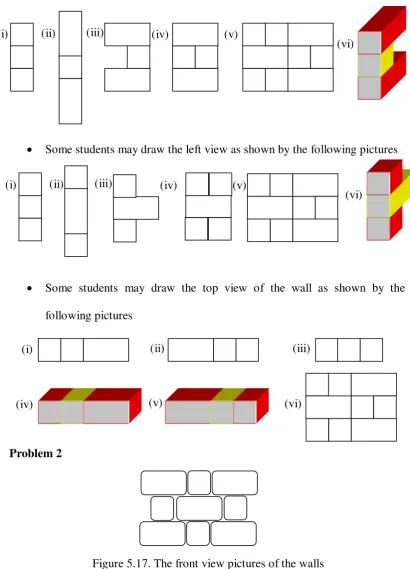
The following pictures are some possible drawing given by students when they are asked to draw the left view of the first wall.
(i) (ii) (iii) (iv) (v)