IMPROVING STUDENTS’ VOCABULARY MASTERY USING LEBAH INTERACTIVE MULTIMEDIA
(A Classroom Action Research at the Fifth Grade of SDN 2 Sendang in the Academic Year of 2014/2015)
THESIS
Written as a Partial Fulfillment of the Requirements to Obtain the Degree of
English Education
By
Moh Afif Setiawan S891302029
ENGLISH EDUCATION DEPARTMENTOF GRADUATE SCHOOL
FACULTY OF TEACHER TRAINING AND EDUCATION
SEBELAS MARET UNIVERSITY
SURAKARTA
ABSTRACT
Moh Afif Setiawan, S 891302029, Improving Students’ Vocabulary Using Lebah Interactive Multimedia (a Classroom Action Research at the Fifth Grade of SDN 2 Sendang in the Academic Year of 2014/2015). A Thesis, Master Program in English Education, Sebelas Maret University, Surakarta.
The objectives of the research are to find out how I use Lebah Interactive
Multimedia to improve students’ vocabulary of the fifth grade of SDN 2 Sendang
Jepara and to find out Lebah Interactive Multimedia as media can solve unconducive class condition in SDN 2 Jepara. Problem encountered in this research was the low
students’ vocabulary mastery and the unconducive class condition at the fifth grade of
SDN 2 Sendang Jepara.
The subjects of the research was the fifth grade students of SDN 2 Sendang Jepara.The research was carried out at SDN 2 Sendang Jepara located on Sendang village, Kalinyamatan Jepara From May to June 2015. In this study, I used classroom action research method. I carried out three cycles in the research and carried out four steps namely planning the action, implementing the action, observing and monitoring the action and reflecting the action. Each cycle was the continum steps from the implementation of the previous cycle.There were two types of data in this action research, quantitative and qualitative data. The quantitative data was the score of test. Meanwhile, qualitative data was the information of teaching and learning process gotten from interviews, questionnaires, field notes, and observations.
The result of the research showed that the improvement of students’ mean
score for each cycle. For instance, the mean score of students’ vocabulary mastery in
the pre-test was 52, cycle 1 was 62, cycle 2 was 66, and cycle 3 was 73 assessed by four indicators of vocabulary mastery which were meaning, pronouncing, spelling and the using of the words. To sum up, Lebah Interactive Multimedia can be used to
improve students’ vocabulary mastery and make students attentive, enthuastic, and
active in the class. This condition makes the class conducive. It is ideal condition for
learning environment to improve students’ vocabulary.
MOTTO
“Man Jadda Wa Jadda”
(Barang siapa yang bersungguh sungguh akan mendapatkannya)
“The formulas of a success are hard word and never give up
(Formula dari kesuksesan adalah kerja keras dan tidak pernah
DEDICATION
This Thesis is especially dedicated for: My Beloved Parents: Ayah Sudarji, S.Pd. and IbuSri Mulyani R, S.Pd.
ACKNOWLEDGEMENT
I would like to thank God Allah SWT because of His Blessing and Mercy I can finish writing my thesis. There are also many people who have helped me finishing this research. Therefore, I would like to express my respect and deepest thanks to:
1. The Dean of Educational and Teaching Faculty, Prof. Dr. JokoNurkamto, M.Pd., for opportunity and permission to write this thesis.
2. The Head of Master Program in English Education, Dr. Ngadiso, M.Pd., for his permission to write this thesis.
3. My Beloved Consultants, Prof. Dr. JokoNurkamto, M.Pd., and Dr. Sumardi, M.Hum, for their guidance to conduct this thesis.
4. The Headmaster of SDN 2 Sendang Jepara, Salamun,S.Pd., for permission to collect data.
5. My Students of SDN 2 Sendang Jepara for their cooperative works and helps. I always expect criticism and suggestion from the readers in order to make improvement for my thesis because this is still far from being perfect. However, I hope that this thesis is able to be useful for other researchers, teachers, and especially students.
Surakarta,
TABLE OF CONTENT
CHAPTER II REVIEW OF RELATED LITERATURE A. Theoretical Description ... 1. The Nature of Vocabulary ...9
a. Definition of Vocabulary ...9
b. The types of Vocabulary ...10
c. Teaching Vocabulary ...11
2. Teaching English for Young Learner ... 16
a. Definition of Young Learner ...17
b. Characteristic of Young Learner ...17
3. Teaching Media ...18
a. Definition of media ...19
b. The kinds of Media ...19
4. The Concept of Interactive Multimedia ...20
a. Lebah Interactive Multimedia ...21
b. Teaching Vocabulary by Using Lebah Intearactive Multimedia ... 28 B. Classroom Condition ... 32
C. Review of Related Study ...33
D. Rationale ...36
E. Action Hypothesis ...36
CHAPTER III RESEARCH METHODOLOGY A. Place of the Research ...38
C. The Subject Of the Research ...40
D. Research Method ...41
E. Techniques of Collecting Data ...43
F. Techniques of Analyzing Data ...45
CHAPTER IV RESEARCH FINDINGS AND DISCUSSION A. Situation Prior to the Research ...47
B. Implementation of the Research ...50
1. Cycle I ...50
a. Planning the Action ...50
b. Implementing the Action ... 50
c. Observing and Monitoring the Action ... 56
d. Reflecting the Action ... 59
2. Cycle II ... 62
a. Re-planning the Action ... 62
b. Implementing the Action ... 62
c. Observing and Monitoring the Action ... 68
d. Reflecting the Action ... 71
3. Cycle III ... 74
a. Re-planning the Action ... 74
b. Implementing the Action ... 75
c. Observing and Monitoring the Action ... 81
d. Reflecting the Action ... 83
C. Research Findings ... 87
D. Discussion ... 87
CHAPTER V CONCLUSION, IMPLICATION AND SUGGESTION 92 A. Conclusion ... 92
B. Implication ... 93
LIST OF TABLES
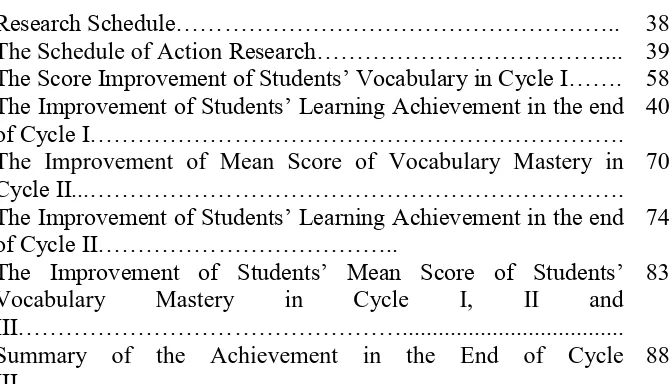
Table 3.1: Research Schedule……….. 38 Table 3.2: The Schedule of Action Research………... 39 Table 4.2: The Score Improvement of Students’ Vocabulary in Cycle I……. 58 Table 4.3: The Improvement of Students’ Learning Achievement in the end
of Cycle I………. 40
Table 4.4: The Improvement of Mean Score of Vocabulary Mastery in
Cycle II...………. 70
Table 4.5: The Improvement of Students’ Learning Achievement in the end
of Cycle II……….. 74
Table 4.6: The Improvement of Students’ Mean Score of Students’ Vocabulary Mastery in Cycle I, II and
III………...
83
Table 4.7: Summary of the Achievement in the End of Cycle
LIST OF APPENDICES
Appendix 1 Interview Questions (Pre-research) ... 100
Appendix 2 Lesson Plan of Cycle 1 ... 110
Appendix 3 Lesson Plan of Cycle 2 ... 134
Appendix 4 Lesson Plan of Cycle 3 ... 159
Appendix 5 Field Note Sample ... 189
Appendix 6 Pre-test Score of Vocabulary Mastery ... 201
Appendix 7 Post-test Score of Vocabuylary Mastery of Cycle 1 ... 202
Appendix 8 Post-test Score of Vocabulary Mastery of Cycle 2 ... 203
Appendix 9 Post-test Score of Vocabulary Mastery of Cycle 3 ... 204