Open Geospatial Consortium
Approval Date:2012-09-25
Publication Date: 2013-01-17
External identifier of this OGC® document:http://www.opengis.net/doc/dp/netcdf-uncertainty
Reference number of this document: OGC 11-163
Category: Public Discussion Paper
Editors:Lorenzo Bigagli, StefanoNativi
NetCDF Uncertainty Conventions (NetCDF-U)
Copyright © 2013 Open Geospatial Consortium.
To obtain additional rights of use, visit http://www.opengeospatial.org/legal/.
Warning
This document is not an OGC Standard. This document is an OGC Discussion Paper and is not an official position of the OGC membership. The document is distributed for review and comment. The document is subject to change without notice and may not be referred to as an OGC Standard.
Document type: OGC® Discussion Paper Document subtype: NA
OGC 11-163
License Agreement
Permission is hereby granted by the Open Geospatial Consortium, ("Licensor"), free of charge and subject to the terms set forth below, to any person obtaining a copy of this Intellectual Property and any associated documentation, to deal in the Intellectual Property without restriction (except as set forth below), including without limitation the rights to implement, use, copy, modify, merge, publish, distribute, and/or sublicense copies of the Intellectual Property, and to permit persons to whom the Intellectual Property is furnished to do so, provided that all copyright notices on the intellectual property are retained intact and that each person to whom the Intellectual Property is furnished agrees to the terms of this Agreement.
If you modify the Intellectual Property, all copies of the modified Intellectual Property must include, in addition to the above copyright notice, a notice that the Intellectual Property includes modifications that have not been approved or adopted by LICENSOR.
THIS LICENSE IS A COPYRIGHT LICENSE ONLY, AND DOES NOT CONVEY ANY RIGHTS UNDER ANY PATENTS THAT MAY BE IN FORCE ANYWHERE IN THE WORLD.
THE INTELLECTUAL PROPERTY IS PROVIDED "AS IS", WITHOUT WARRANTY OF ANY KIND, EXPRESS OR IMPLIED, INCLUDING BUT NOT LIMITED TO THE WARRANTIES OF MERCHANTABILITY, FITNESS FOR A PARTICULAR PURPOSE, AND NONINFRINGEMENT OF THIRD PARTY RIGHTS. THE COPYRIGHT HOLDER OR HOLDERS INCLUDED IN THIS NOTICE DO NOT WARRANT THAT THE FUNCTIONS CONTAINED IN THE INTELLECTUAL PROPERTY WILL MEET YOUR REQUIREMENTS OR THAT THE OPERATION OF THE INTELLECTUAL PROPERTY WILL BE
UNINTERRUPTED OR ERROR FREE. ANY USE OF THE INTELLECTUAL PROPERTY SHALL BE MADE ENTIRELY AT THE USER’S OWN RISK. IN NO EVENT SHALL THE COPYRIGHT HOLDER OR ANY CONTRIBUTOR OF
INTELLECTUAL PROPERTY RIGHTS TO THE INTELLECTUAL PROPERTY BE LIABLE FOR ANY CLAIM, OR ANY DIRECT, SPECIAL, INDIRECT OR CONSEQUENTIAL DAMAGES, OR ANY DAMAGES WHATSOEVER RESULTING FROM ANY ALLEGED INFRINGEMENT OR ANY LOSS OF USE, DATA OR PROFITS, WHETHER IN AN ACTION OF CONTRACT, NEGLIGENCE OR UNDER ANY OTHER LEGAL THEORY, ARISING OUT OF OR IN CONNECTION WITH THE IMPLEMENTATION, USE, COMMERCIALIZATION OR PERFORMANCE OF THIS INTELLECTUAL PROPERTY.
This license is effective until terminated. You may terminate it at any time by destroying the Intellectual Property together with all copies in any form. The license will also terminate if you fail to comply with any term or condition of this Agreement. Except as provided in the following sentence, no such termination of this license shall require the termination of any third party end-user sublicense to the Intellectual Property which is in force as of the date of notice of such termination. In addition, should the Intellectual Property, or the operation of the Intellectual Property, infringe, or in LICENSOR’s sole opinion be likely to infringe, any patent, copyright, trademark or other right of a third party, you agree that LICENSOR, in its sole discretion, may terminate this license without any compensation or liability to you, your licensees or any other party. You agree upon termination of any kind to destroy or cause to be destroyed the Intellectual Property together with all copies in any form, whether held by you or by any third party.
OGC 11-163
Copyright © 2013 Open Geospatial Consortium. iii
Contents
Pagei. Abstract ... iv
ii. Keywords ... iv
iii. Preface ... iv
iv. Document contributor contact points ... iv
v. Revision history ... iv
vi. Future work ... v
Foreword ... vi
Introduction ... vi
1 Scope ... 1
2 Normative references ... 1
3 Terms and definitions ... 2
4 Conventions ... 2
4.1 Abbreviated terms ... 2
4.2 UML notation ... 2
5 Compatibility with NetCDF-CF ... 3
6 NetCDF Uncertainty Conventions ... 4
6.1 Rationale ... 4
6.2 Global provisions ... 4
6.2.1 Identification of Conventions ... 4
6.2.2 Primary and ancillary variables ... 4
6.3 Uncertain concepts ... 5
6.3.1 Concept parameters ... 7
6.3.2 Concepts without values ... 7
6.4 Encoding of Samples ... 8
6.5 Encoding of Summary Statistics ... 9
6.6 Encoding of Distributions ... 10
Bibliography ... 12
Figures
Page Figure 1 – NetCDF-CF 1.5 data model (source: [1]) ... 3OGC 11-163
i.
Abstract
This Discussion Paperproposes a set of conventions for managing uncertainty information within the netCDF3 data model and format: the NetCDF Uncertainty Conventions (NetCDF-U).
ii.
Keywords
ogcdoc, netcdf, uncertainty, uncertml
iii.
Preface
Suggested additions, changes, and comments on this document are welcome and encouraged. Such suggestions may be submitted by email message or by making suggested changes in an edited copy of this document.
The changes made in this document version, relative to the previous version, are tracked by Microsoft Word, and can be viewed if desired. If you choose to submit suggested changes by editing this document, please first accept all the current changes, and then make your suggested changes with change tracking on.
iv.
Document contributor contact points
All questions regarding this document should be directed to the editor or the contributors:
Name Organization
Lorenzo Bigagli National Research Council of Italy
Stefano Nativi National Research Council of Italy
v.
Revision history
Date Release Editor Primary clauses modified
Description
10/11/2011 1.0 Lorenzo Bigagli, Stefano Nativi
all Initial draft for general review; based onaprevious draft presented and discussed at the September 2011 OGC TC Meeting and an UncertWeb Technical Report [2]
OGC 11-163
Copyright © 2013 Open Geospatial Consortium. v
vi.
Future work
The netCDF standard is evolving from version 3 (netCDF3) to version 4 (netCDF4) that adopts an abstract Common Data Model (CDM) to be implemented in different
encodings (e.g. netCDF and ncML). This transition affects the possible ways to accommodate uncertainty, including what proposed in this document.
OGC 11-163
Foreword
The intended use of the conventions proposed in this document is to qualify the uncertainty related to geospatial data encoded in the netCDF3 format. Hence, this document may relate to other OGC standards that make use of the netCDF3 data format, in particular the netCDFEncoding Format Extension of theWeb Coverage Service Interface standard (under discussion).
The work presented in this document does not cancel or replace other OGC documents. This work was partially supported by the UncertWeb project1,that has received funding
from the European Community's Seventh Framework Programme (FP7/2007-2013) under grant agreement n° [248488].
Attention is drawn to the possibility that some of the elements of this document may be the subject of patent rights. The Open Geospatial Consortium shall not be held
responsible for identifying any or all such patent rights.
Recipients of this draft document are requested to submit, with their comments,
notification of any relevant patent claims or other intellectual property rights of which they may be aware that might be infringed by any implementation of the standard set forth in this document, and to provide supporting documentation.
OGC 11-163
Copyright © 2013 Open Geospatial Consortium. vii
Introduction
As discussed in [4], from a theoretical perspective, it can be said that no dataset is a perfect representation of the reality it purports to represent.
Inevitably errors, arising from the observation process, including the sensor system and subsequent processing, differences in scales of phenomena and the spatial support of the observation mechanism as well as a lack of knowledge about the detailed conversion between the measured quantity and the target variable means that in principle all data should be treated as uncertain.
The most natural representation of an uncertain quantity is in terms of random variables (or fields / functions for spatially and temporally distributed variables), with a
probabilistic approach.
However, it must be acknowledged that almost all existing data resources are not treated in this way. Most datasets come simply as a series of values, often without any
uncertainty information. If there is uncertainty information, then this is typically contained within the metadata, in a data quality element. This is typically a global (dataset wide) representation of uncertainty, often derived through some form of validation process. Typically, it is a statistical measure of spread, for example the standard deviation of the residuals (data set measured minus ‘true’ value).
The introduction of a mechanism by which such descriptions of uncertainty can be integrated into existing geospatialapplications is considered a practical step towards a more accurate modeling of our uncertain understanding of any natural process.
This document proposes a linked data approach forthe widely used netCDF format. To encode uncertainty information in a netCDF dataset, it is possible to consider at least the following approaches:
1. To define a netCDF convention to specify uncertainty-related concepts in a netCDF file, enabling the representation of uncertain quantities, as well as values known with a given uncertainty;
2. Linked netCDF: to adopt the Semantic Web linked data approach, expressing the
uncertainty in an XML document according to the UncertML model, which is then linked to netCDF-CF attributes and variables using inbound or outbound XLink references. This approach is valuable for re-use of data sets since
OGC 11-163
OGC® Discussion Paper OGC 11-163
Copyright © 2013 Open Geospatial Consortium. 1
OGC
®NetCDF-U Discussion Paper
1 Scope
This OGC® document introduces a set of conventions and mechanisms that extend and qualify the netCDF3 data model and format to model uncertain information: the NetCDF Uncertainty Conventions (NetCDF-U).
Given the generality and flexibility of the netCDF data model, conventions on naming, semantics and data structure have been adopted by several community of practice, as a means of improving data interoperability. Some of the existing conventions may include specific provisions on uncertain elements and concepts, but, to our knowledge, no general convention on the encoding of uncertainty has been proposed, to date, what is the scope of this document.
This OGC™ document is applicable to data encoded in the netCDF3 format, with possible limitations, depending on conflicting conventions to which a given netCDF dataset may be compliant, in addition to NetCDF-U (in general, a netCDF may be compliant with more than one convention).
The NetCDF-U Conventions are designed to be fully compatible with the netCDF
Climate and Forecast Conventions, the de-facto standard for a large amount of data in the Fluid Earth Science community.
2 Normative references
The following normative documents contain provisions that, through reference in this text, constitute provisions of this document. For dated references, subsequent
amendments to, or revisions of, any of these publications do not apply. For undated references, the latest edition of the normative document referred to applies.
B. Eaton, et al., NetCDF Climate and Forecast (CF) Metadata Conventions, version 1.5, 25 October 2010.
IETF RFC 3986, Uniform Resource Identifier (URI): Generic Syntax.
OGC 10-090r3,Network Common Data Form (NetCDF) Core Encoding Standard version 1.0.
3 Terms and definitions
For the purposes of this standard, the definitions specified in Clause 4 of the OWS Common Implementation Specification [OGC 05-008] shall apply.
4 Conventions
4.1 Abbreviated terms
Most of the abbreviated terms listed in Subclause 5.1 of the OWS Common Implementation Specification [OGC 05-008] apply to this document. 4.2 UML notation
Copyright © 2013 Open Geospatial Consortium. 3
5 Compatibility with NetCDF-CF
An important constraint for NetCDF-U is to preserve compatibility with the NetCDF Climate and Forecast Conventions (NetCDF-CF) [Eaton 2010], whose data model is represented below.
Figure 1 – NetCDF-CF 1.5 data model (source: [1])
Data variables may be associated to variables representing their uncertainty via the ancillary_variables attribute;
Data variables representing uncertainty may be expressed via modifiers of the quantity standard name attribute (actually, only the standard_error modifier is relevant to the present context);
Common statistical operators are expressed via the cell_methods attribute, e.g. mean, standard deviation, variance;
Where possible, the above mechanisms are leveraged by NetCDF-U, e.g. using the same attributes name with compatible semantics.
6 NetCDF Uncertainty Conventions
This section describes the proposed NetCDF Uncertainty Conventions (NetCDF-U) for capturing uncertainty in netCDF-encoded data.
NetCDF files compliant with these conventions may be indicated as “netCDF-U files” in the following.
6.1 Rationale
These conventions have the following rationale:
Compatibility with netCDF-CF Conventions 1.5;
Human-readability of conforming datasets structure;
Minimal difference between certain/agnostic and uncertain representations of data (e.g. with respect to dataset structure).
6.2 Global provisions
6.2.1 Identification of Conventions
NetCDF-U files shall declare the global attribute Conventions2 with the string value
“UW-1.0” (see the example in the next section).
6.2.2 Primary and ancillary variables
A netCDF file typically contains several variables. Some of these may depend on others, i.e. contain ancillary information referred to or qualifying concepts encoded by other variables (e.g., netCDF-CF introduces the concepts of coordinate variable, boundary variable, flag variable.)
Copyright © 2013 Open Geospatial Consortium. 5 Similarly to netCDF-CF, netCDF-U variables may declare an ancillary_variables
attribute for expressing dependency relationships among variables.
Dually, netCDF-U files may declare a primary_variables global attribute, whose value is a white-separated list of variable identifiers.
The intended use of the primary_variables attribute is to support applications in directly accessing their presumable data of interest, particularly since netCDF-U files are likely to contain a large number of ancillary variables, as in the example below.
netcdfbiotemperature { // global attributes:
:Conventions = "CF-1.5 UW-1.0";
:primary_variables = "biotemperature";
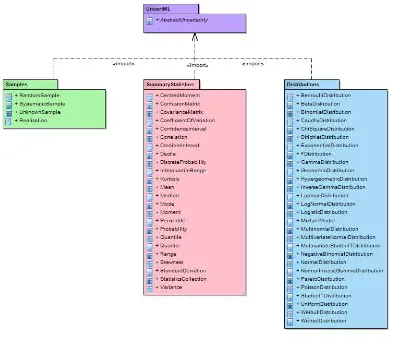
To this end, a netCDF variable referring to uncertain concepts shall declare a ref attribute, whose value is a list of space-separated URIs of UncertML 2.0 dictionary entries (see the conceptual model in Figure 2).
Figure 2 – UncertML 2.0 conceptual model
For the sake of generality, we allow for multiple URIs: this could support the expression of compound UncertML concepts (although this use-case is probably not so relevant, within the current version of the UncertMLdictionary).
Besides, anticipating a general support to semantic annotations in netCDF, an uncertain variable may also declare a rel attribute, whose value is a list of space-separated
Copyright © 2013 Open Geospatial Consortium. 7 An uncertainty-related URI shall be resolvable to appropriate human-readable
documentation of the respective dictionary concept. The syntax and semantics of the URI should be compliant to [IETF 3986].
6.3.1 Concept parameters
The typical concept in the UncertML 2.0 dictionary is parameterized, with parameters of disparate types, from single scalar values to complex structures.
A complex parameter shall be encoded in a separate variable, to be declared in the ancillary_variables attribute of the referring concept variable, and annotated with the concept URI and the parameter name as a fragment part3, as in the following example:
variables:
float prob_greater_than_limit(Lat=163, Lon=240); prob_greater_than_limit:ref =
"http://www.uncertml.org/statistics/probability";
prob_greater_than_limit:ancillary_variables = "limits"; float limits(Lat=163, Lon=240);
limits:ref = "http://www.uncertml.org/statistics/probability#gt";
For space optimization, a scalar parameter may be encoded as a variable attribute with the corresponding name, as in the following example:
variables:
float second_order_moment(Lat=163, Lon=240);
second_order_moment:ref = "http://www.uncertml.org/statistics/moment"; second_order_moment:order = "2";
6.3.2 Concepts without values
Since the current implementation of the netCDF library seems to allocate space for variables as soon as they are defined (even when no data have been written), concepts whose values are irrelevant or undefined (e.g. distributions characterized by parameters only) may be encoded as scalar variables, for the sake of space optimization.
3Note that the semantics of the fragment part should be compliant to [IETF 3986]. In
In this case, the information about the intended shape of the variable shall be preserved in the attribute shape, as in the example below:
doublebiotemperature;
biotemperature:ref = "http://www.uncertml.org/distributions/normal"; biotemperature:shape = “latlon”;
biotemperature:ancillary_variables =
"biotemperature_meanbiotemperature_variance";
6.4 Encoding of Samples
A sample is defined as a set of realizations. Hence, it shall be encoded as a concept without values (§6.3.2) annotated with the related concept URI, linked to data variables corresponding to its related realizations by means of the ancillary_variables attribute, as in the example below.
netcdf file:/Users/bigagli/Downloads/biotemperature_randomSamples.nc {
biotemperature:missing_value = -999.0; // double biotemperature:shape = “latlon”;
biotemperature:units = "degC";
biotemperature:ref = "http://www.uncertml.org/samples/random"; biotemperature:ancillary_variables = "realisation1 realisation2"; doublelon(lon=240);
lon:units = "degrees_east"; doublelat(lat=163);
lat:units = "degrees_north";
double realisation1(lat=163, lon=240);
realisation1:missing_value = -999.0; // double realisation1:units = "degC";
realisation1:ref = "http://www.uncertml.org/samples/realisation"; realisation1:ID = "#12345";
double realisation2(lat=163, lon=240);
realisation2:missing_value = -999.0; // double realisation2:units = "degC";
realisation2:ref = "http://www.uncertml.org/samples/realisation"; realisation2:ID = "#12346";
:Conventions = "CF-1.5 UW-1.0";
Copyright © 2013 Open Geospatial Consortium. 9 For reducing the number of variables, especially when the single realizations have the same attributes, the sample variable may group all the realizations, indexing them along an extra additional dimension. In this case, the dimension variable corresponding to the additional dimension shall be annotated as a realization, as in the example below:
netcdf file:/Users/bigagli/Downloads/biotemperature_randomSamples.nc { biotemperature:missing_value = -999.0; // double
biotemperature:shape = “latlon”;
:Conventions = "CF-1.5 UW-1.0";
:primary_variables = "biotemperature"; }
6.5 Encoding of Summary Statistics
A summary statistics shall be encoded as a data variable annotated with the related concept URI. Summary statistics referring to the same stochastic variable shall be
declared in the ancillary_variables attribute of a data variable annotated with the concept URI of a statistics collection, which may be declared in the primary_variables global attribute, as in the example below:
netcdfbiotemperature { // global attributes:
:Conventions = "CF-1.5 UW-1.0";
lon:standard_name = "longitude";
6.6 Encoding of Distributions
A distribution shall be encoded as a concept without values (§6.3.2) annotated with the related concept URI, linked to data variables corresponding to its parameters, which shall be declared in its ancillary_variables attribute. The distribution data variable may be declared in the primary_variables global attribute, as in the example below:
netcdfbiotemperature { // global attributes:
:Conventions = "CF-1.5 UW-1.0";
Copyright © 2013 Open Geospatial Consortium. 11
doublebiotemperature();
biotemperature:units = "degC";
biotemperature:ancillary_variables =
"biotemperature_meanbiotemperature_variance"; biotemperature:shape = “latlon”;
Bibliography
[1] B. Domenico and S. Nativi, OGC CF-netCDF Data Model extension specification v. 2.0 draft specification, June 2011.
[2] UncertWeb Consortium. Technical Report – NetCDF Uncertainty Conventions (NetCDF-U), version 1.0, 21 September 2011.
[3] UncertWeb Consortium. UncertML best practice proposal. Deliverable D1.2, 2011.
![Figure 1 – NetCDF-CF 1.5 data model (source: [1])](https://thumb-ap.123doks.com/thumbv2/123dok/3210271.1394011/11.612.96.531.166.614/figure-netcdf-cf-data-model-source.webp)