THE EFFECT OF CROSSWORD PUZZLE ON STUDENTS’ LEARNING
OUTCOME AND ACADEMIC ENGLISH MASTERY
Dina Kharida*dan Syarifuddin
Pendidikan Biologi Program Pascasarjana UNIMED,Jalan Willem Iskandar Psr.V, Medan Estate, 20221
ABSTRACT
The objectives of this study were to find out whetherCrossword puzzles
significantly affect: (1) students’ learning outcome(2) students’ ability in answering
question based on Bloom’s taxonomy of cognitive domainand (3) students’ academic
English mastery. This quasi experiment was carried out on two classes of Grade eleven
students in SMA Negeri 1 Medan. These two classes were randomly assigned based on
the cluster random. The data for students’ learning outcome was derived from multiple
choices test, while essay test was also given to students to measure their academic
English mastery.When the data was normally distributed, independent t-test is employed
for data analysis, while Mann Whitney U-test is used when the data were not normally
distributed.Students who were assigned with Crossword puzzle (90, 67 ± 7, 14) have
significantly higher learning outcome than those who were given with regular assignment
83, 81 ± 6, 129, (t = 3, 430; P = 0,001).Students also have significantly higher score in C4
to C6 of Bloom Taxonomy when compared to students who did regular assignments, C4
(U = 449; P = 0,000), C5 (U = 374; P =0,002), C6 (U = 315; P = 0,039).While Students’
academic English Mastery was better in three aspects (writing, spelling, and vocabulary
use) compared to students who were given with regular assignments.
Keywords: Crossword Puzzle, Learning Outcome, Academic English
INTRODUCTION
It is fundamental to understand that in order to success in school, a student must
at least know how to understand, read, speak, and write the language use in classroom.
Biology texts were often found to consist of long - complex sentences and it usually
contains many technical terms in describing its concepts, principles and theories, and it
brings more susceptible to reading difficulty than other natural sciences [1]. Many
technical terms were derived from Latin and Greek words which were unfamiliar to
students. The information presented may be abstract and unrelated to the students’
everyday activities or life experience. The events or topics being described to the
meanings [2]. As biology is descriptive in nature, students need to have sufficient
language proficiency to constitute meaning of biological concepts [3]. The presence and
mastery of English as a medium of science instruction will bring the impact on student’s
acquisition of science content knowledge. The foundation of this factor was Cummins [4]
work on cognitive academic language proficiency, which relates both cognitive and
linguistic processes to academic success of students [5].
According to Cummins [4], there were two levels of language proficiency, which
relates both cognitive and linguistic process to the academic success of students: the
basic interpersonal communication skill (BICS) and the cognitive academic language
proficiency (CALP). CALP is the type of language proficiency that needed to read book, to
participate in dialogue and debate, and to provide written response to test. Students who
have not yet developed CALP were in disadvantage on learning science or other
academic subject matter [5]. Students with limited English proficiency seemed to have a
weaker knowledge of science and this inevitably affected their achievement test scores in
science [6]. Students in bilingual class may have two different problems at the same time.
Not only materials being taught were dense and closely packed with less time to construct
clear meaning, there are also problems in understanding English text. When 24 RSBI
(Rintisan Sekolah Bertaraf Internasional, a bilingual school), students’ were directed to
read biological text and answer 7 biological question written in English, 37% were able to
correctly answer 4 questions, 8, 3% were able to answer 3 questions, 1, 2 % of them were
able to answer 2 question, and 41, 60% were answering incorrectly to all of 7 questions
being asked. Students have to pay attention for cognitive language proficiency.
Fortunately, there were various techniques that can be used to overcome problems in
learning for biological topics on Bilingual class.
Academic word knowledge has the potential to increase academic text for all
students. Games and activities were effective when used as approaches for building
academic word knowledge [7]. Word games were an excellent way to make students read
the textbook chapters as they seek to find the answers. Depending on the choice of clues,
this active learning activity can foster simple recall, comprehension, or problem solving [8].
Preparation of students Comprehensive Assessment Test in Science can be such an
overwhelming task. The review materials give teachers a quick awareness that there is
too much information involving multiple areas that student have to master in order to be
success on examination [9].It is evident that the key to answering many of the multiple
choice questions is being able to understand the language used in the questions. That
vocabulary is a key factor become apparent. If students are able to master the
terminology, they were more likely to analyze questions and formulate correct responses
Puzzles were helpful to review, summarize, practice, find out gaps in knowledge,
and develop new relationships among concepts (Davis: 2009). Word puzzle had been
also used as a review tools prior to exam, improving students’ learning as well as motivate
them to a better preparation and generally to become more interested in the subject [10].
Crossword solving involves several useful skills for example excess of vocabulary,
reasoning, spelling, and word skills. If someone plays any crossword puzzle, they must
be able to identify and understand the terms being used. This often involves acquiring
new terminology and brings students to intentionally interest in attending the meaning
behind new terminology. It can also involve making differentiations between similar
words. A crossword also requires exact spelling, which for students may mean practicing
dictionary skills. Other important skills required for completing these puzzles include
making inferences, evaluating choices, and drawing conclusions [11]. It is a novel tool,
especially for group learning, generating much interest and interaction within the group
and also between educators and learners. A well planned crossword puzzle is likely to test
higher levels of cognition as compared to many other types of assessments tools
[12].Challenging learning activities in form of word puzzle will be able to maintain student’s
logical operation. In which Piaget said that learning to perform logical operation is
acquired largely through an interaction with problems calling for those operations [13].
METHOD
Research was done at SMA Negeri 1 Medan Jalan Teuku Cik Ditiro No. 1 Medan,
on second semester of academic year 2011/2012, from January to June 2012. The
population of this research was Grade Eleven Science Program, consists of 224 students,
which divided into eight parallel classes. Each class consists of approximately 28
students. Grade eleven science students’ were RSBI students, in which they use bilingual
books. Students show equal ability on pretest (Figure. 1) in which statistical analysis
revealed that students’ beginning ability was not significantly different. Based on the result
of pretest, two classes were taken as research samples which determined randomly using
cluster random sampling technique. By using this sampling technique, XI- IPA 1 was
selected to be the experiment group, assigned with Crossword Puzzle, and XI- IPA 2 was
selected to be the control group, assigned with regular tasks. Crossword puzzle will be
used as evaluation tools during 6 sessions of Human Reproductive System for Grade
Eleven Science Program. The crossword puzzle is generated using word puzzle generator
software, the Crossword Forge 5.5.5. The word questions on crossword puzzle were
constructed accurately based on the key words signifying around essential concepts, facts
assignments (multiple choice and essay test) in accordance to learning materials being
used in experiment group.
The Instruments for data collection were cognitive tests, in which both multiple
choices and essay tests were used. Levels of competence measured were based on
Blooms’ taxonomy of cognitive domain. Normality tests were used to determine whether a
data set is well-modeled by a normal distribution or not. Statistical test of resulted data
were done by using SPPS 19 and Mystat 12.
RESULT AND DISCUSSION
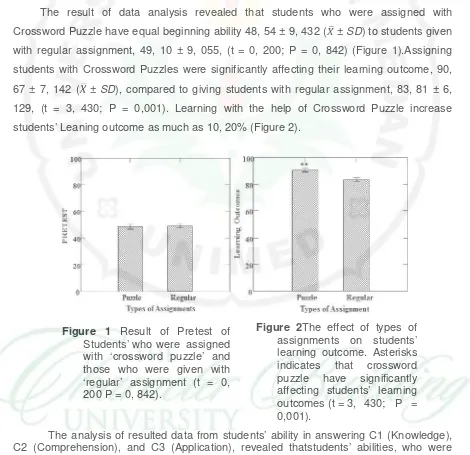
The result of data analysis revealed that students who were assigned with
Crossword Puzzle have equal beginning ability 48, 54 ± 9, 432 ( ±SD) to students given
with regular assignment, 49, 10 ± 9, 055, (t = 0, 200; P = 0, 842) (Figure 1).Assigning
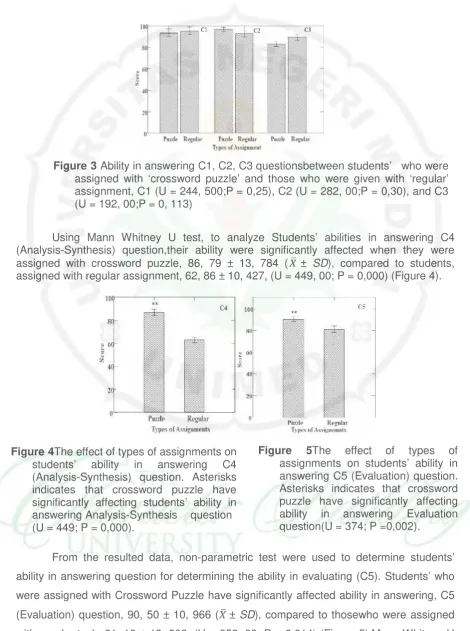
students with Crossword Puzzles were significantly affecting their learning outcome, 90,
67 ± 7, 142 ( ±SD), compared to giving students with regular assignment, 83, 81 ± 6,
129, (t = 3, 430; P = 0,001). Learning with the help of Crossword Puzzle increase
students’ Leaning outcome as much as 10, 20% (Figure 2).
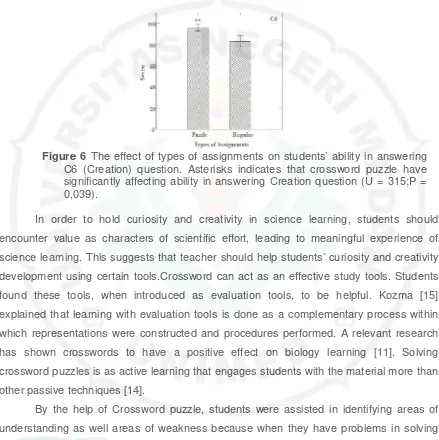
The analysis of resulted data from students’ ability in answering C1 (Knowledge), C2 (Comprehension), and C3 (Application), revealed thatstudents’ abilities, who were assigned with crossword puzzle, is not significantly affected by puzzle, compare to the ability in answering C1-C3 question of those who were assigned with regular assignments. The ability in answering question which require knowledge (C1), using nonparametric test, revealed that U = 244, 500; P = 0, 754, Comprehension (C2) U = 282, 000; P = 0, 304, Application (C3), U = 192, 000; P = 0, 113 (Figure 3).
Figure 1 Result of Pretest of Students’ who were assigned with ‘crossword puzzle’ and those who were given with ‘regular’ assignment (t = 0, 200 P = 0, 842).
Using Mann Whitney U test, to analyze Students’ abilities in answering C4 (Analysis-Synthesis) question,their ability were significantly affected when they were assigned with crossword puzzle, 86, 79 ± 13, 784 ( ± SD), compared to students, assigned with regular assignment, 62, 86 ± 10, 427, (U = 449, 00; P = 0,000) (Figure 4).
From the resulted data, non-parametric test were used to determine students’
ability in answering question for determining the ability in evaluating (C5). Students’ who
were assigned with Crossword Puzzle have significantly affected ability in answering, C5
(Evaluation) question, 90, 50 ± 10, 966 ( ±SD), compared to thosewho were assigned
with regular task, 81, 10 ± 13, 906, (U = 352, 00; P = 0,014) (Figure 5).Mann Whitney U
test used to determine Students’ ability in answering, C6 (Creation) question, revealed
Figure 3Ability in answering C1, C2, C3 questionsbetween students’ who were assigned with ‘crossword puzzle’ and those who were given with ‘regular’ assignment, C1 (U = 244, 500;P = 0,25), C2 (U = 282, 00;P = 0,30), and C3 (U = 192, 00;P = 0, 113)
Figure 4The effect of types of assignments on students’ ability in answering C4 (Analysis-Synthesis) question. Asterisks indicates that crossword puzzle have significantly affecting students’ ability in answering Analysis-Synthesis question (U = 449; P = 0,000).
that, assigning students with Crossword have significantly affecting their ability in
answering C6 question, 95, 83 ± 14, 116 ( ±SD), compared to students assigned regular
assignment, 83, 333 ± 24, 152, (U = 315, 000; P = 0,039) (Figure 6).
In order to hold curiosity and creativity in science learning, students should
encounter value as characters of scientific effort, leading to meaningful experience of
science learning. This suggests that teacher should help students’ curiosity and creativity
development using certain tools.Crossword can act as an effective study tools. Students
found these tools, when introduced as evaluation tools, to be helpful. Kozma [15]
explained that learning with evaluation tools is done as a complementary process within
which representations were constructed and procedures performed. A relevant research
has shown crosswords to have a positive effect on biology learning [11]. Solving
crossword puzzles is as active learning that engages students with the material more than
other passive techniques [14].
By the help of Crossword puzzle, students were assisted in identifying areas of
understanding as well areas of weakness because when they have problems in solving
the key, they will begin ask various question, discussing possible answer with peers as
well as re-searching to find correct answer. When students introduced to word ‘symptom’
on sexual transmitted disease, students began analyzing the presence of bacterial and
viral agent leading to the recognition of scientific name of microorganism that causes it.
STDs on human body that cause changes on human genital tract were also discussed.
Even further discussion can lead STD causing destruction on human nervous system.
The effects of Crossword puzzle on cognitive domain were also recorded to be
higher than those who were assigned with regular assignments. Students introduced with
crossword puzzle were shown to have high percentage in correctly answer question in all
cognitive domains (knowledge, comprehension, application, analysis, synthesis,
evaluation, and creation). This study also shown that students’ learning outcome, for
those who were assigned with crossword puzzle tend to have higher percentage of
correctly answering question from C4 to C6, indicates that it helps students to actively
accommodate their high order thinking skill.
In case of writing ability, it is measured to see how good students implement what
they have learned through a written test. The written test can measure students’ different
style in accommodating their idea as they began transforming their knowledge, one of
scientific writing models convey a two different processes; knowledge telling and
knowledge transformation. This capability is supported also by learning evaluation tools
that better engage students and support activity with the comfortable learning atmosphere
[16]. Furthermore, students who have high writing achievement were more easily
understand the subject matter presented and able to store it in long term memory.
On evaluating students’ writing ability, five components were used; logic and
organization, development of ideas, purpose, language, and mechanics. Students who
were assigned with Crossword Puzzle have higher writing abilities. The experimental
group show higher score after treatment, 74, 92 ± 8, 544 ( ±SD), compared with Control
Group, assigned with regular assignment, 67, 05 ± 6, 917, (t = 3, 096; P= 0,003). The
experimental group using crossword puzzle showed higher abilities in important aspect on
science writing such as logic-organization and development of ideas. For example when
they asked to answer question about estrogen deficiency, they start first in explaining
what estrogen is, its role, action, regulation, possible effect of lacking,and it possible
cause. They try to convey understanding even with some limitation in using words.
Grabe and Kaplan [18] explain their model of communicative competence applied
to writing that embraces listening, speaking, and reading. This model features the writer’s
ability to use writing as a communication activity and describes skills and processes
where the writer’s understanding of participants, setting, task, text and topic and
performance with textual output were integrated. By having the ability to write, student can
obtain a variety of information in relatively short time.
The analysis of result of students’ vocabulary use revealed that, students who
were assigned with Crossword Puzzle affected more when utilizing both biological and
non-scientific vocabularies, 63, 04 ± 15, 527 ( ±SD), compared with regular assignment,
53, 76 ± 12, 506, (t = 2, 422; P = 0,020. The result of analysis, using independent T-test,
based on resulted data of spelling ability, revealed that, students spelling ability for those
who were assigned with Crossword Puzzle have significantly affected by puzzle compared
to the ability of students’ assigned with regular assignments. The experimental group,
after treatment show average score, 66, 25 ± 14, 621 ( ± SD), compared to regular
assignment, 58, 33 ± 9, 982, (t = 2, 090; P = 0, 043) (Figure 8).Study found that a
multi-approach in vocabulary teaching was more effective than using a single multi-approach.
Crossword puzzles have been shown to be effective teaching tools of terminology,
definitions, spelling, and pairing key concepts with related names, resulting in greater
memorization of facts as explained by Crossman & Crossman, Childers [19]. Especially
for Biology in which the rate of new things discovered and understood were gone rapidly
and new materials is frequently added, lead to misunderstanding and learning problems.
By using Crossword Puzzle, students were directed to find out key words of the
clues that express the main idea. The key words introduced using Crossword puzzle will
help them understand the English text used in Biological topics. If they found unknown
words later on exam, students can skip the difficult words by continuing reading or
predicting the meaning and confirming it by means of the next word they have known. For
Human Reproductive System topics, crossword puzzle was created to include major
concepts.On written test student can include 45 biological terms of human reproductive
system (deficiency, estrogen, progesterone, menstrual cycle, essential, pregnancy,
diseases, genital, genital area, skin damage, period, menopause, hormone, ovum,
ovaries, fallopian tube, releases, secondary oocyte, mature follicle, fertilization, fertilized,
oviduct, fimbriae, sperm, ovulation, egg, ova, family planning, pills, birth control, device,
In words spelling, crossword puzzle will be helpful because of the need to spell
items correctly to complete the puzzle. Students cannot proceed to answering other key
words before finishing other words correctly. Later it will result in increased care in
studying as well, and when completed, can be used further as a helpful study device. After
treatment, some obstacle in measuring spelling abilities is that eventhough biological
words were introduced during teaching learning process; students tend to write down
words that they sure knew how to spell. The final result revealed that experimental group
show higher ability in spelling which means crossword puzzle were significantly affected
spelling abilities.
CONCLUSION
Students’ learning outcome, higher order thinking skill, writing abilities,
vocabulary use, and spelling abilities, are significantly affected by assigning them with
crossword puzzle compare to regular assignments.
ACKNOWLEDGEMENT
The gratitude goes to all those who have help the process of completing this
research. Special thanks are extended to Dra. Hj. Safrimi, M.Pd., headmistress of SMA
Negeri 1 Medan, Biology teacher of Grade Eleven, Dra. Guti Gratimah, M. Si, and to
grade X students’ of class 1 and 2, academic year 2011/2012, for their cooperation.
Figure8The effect of types of assignments on students’ vocabulary use. Asterisks indicates that crossword puzzle have significantly affecting students’ vocabulary use (t = 2, 119; P = 0,040).
REFERENCES
1. Richardson and Lock. 1995. The Readibilty of Selected A-Level Biology examination
Papers Biological Education, 27(3), 205-215
2. Torres and Zedler. 2002. The Effect of English Language Proficiency and Scientific Reasoning Skills on the Acquisition of Science Content Knowledge By Hispanic
English Language Learner and Native English Language Speaking Student, accessed
in January 2012
3. Cummin. 1984. Billingualism and Special Education: Issues in Assessment and
Pedagogy. Los Angeles: California Association for Bilingual Education
4. Torres. and Zedler. 2002. The Effect of English Language Proficiency and Scientific Reasoning Skills on the Acquisition of Science Content Knowledge By Hispanic
English Language Learner and Native English Language Speaking Student, accessed
in January 2012
5. Duran, Dhugan, and Wafer. 1998. Language Minority students in High School; The
Role of Language in Learning Biology Concept. John Willey and Soons, Inc, acess in
March 2012
6. Townsend. 2009. Building Academic Vocabulary in Afterschool Settings: Games for
Growth with Middle School English Language Learners, accessed in January 2012
7. Satashivam. 2002.Great Ideas In Teaching Biology, a Benjamin Cummins Publication
for Biology Instructor. The University of Texas Austin Pearson Edu, Vol:1 p:10
8. Nun, et.al,. 2012. Matering FCAT Science Content Through Games. Miami: Dade Conty Puclic School
9. Williams. 2007.A unique Strategy that Motivates Students Learning. Vol.2 accessed in January 2012
10. Davis, et al,. 2009.Reviewing for Exam: Do Crossword Puzzle help in the success of
Student Learning,Vol. 9
11. Sivagnanam, et al,. 2008. Crossword Puzzle: A Novel Teaching Learning Method
India: Department of Pharmacology, KAP Viswanatham Gov. Med. College Indian J
Pharmacology Vol 36 p:175-180
12. Travers.1982. Essentials of Learning, The New Cognitive Learning or Students of
Education.United States of America: Macmillan Publishing
13. Martinez and Parra. 2011. Active Learning: Creating Interactive Crossword Puzzleshttp://library.iated.org/view/MARTINEZ2011ACT.
14. Kozma. 1991.Learning With Media.University of Michigan, 61(2), 179-212
15. Putra. 2011. The effect of Instructional Approaches and Vocabulary Mastery on
Semester III Students’ Writing Achievement. English Applied Linguistic Study
Program Postgraduate School State University of Medan
16. Grabe, and Kaplan. 1996.Theory and Practive of Writing. Harlow: Longman Press 17. Chapman. 2009. Benjamin Bloom’s Taxonomy of Learning Domains - Cognitive,
Affective, Psychomotor Domains - design and evaluation toolkit for training and
learning. http://www.businessballs.com acessed in May 2012
18. Duran, Dhugan, and Wafer. 1998. Language Minority students in High School; The
Role of Language in Learning Biology Concept. John Willey and Soons, Inc, acess in
March 2012