AN ANALYSIS OF ENGLISH-INDONESIAN TRANSLATION OF CULTURALTERMS IN KHALED HOSSEINI’S NOVEL
“A THOUSAND SPLENDID SUNS”
THESIS
Submitted as A Partial Fulfillment of Requirement for the Sarjana Degree in English Department
Faculty of Letters and Fine Arts Sebelas Maret University
BY:
RAHMADI DANANG SUBAROTO C0303043
ENGLISH DEPARTMENT
FACULTY OF LETTERS AND FINE ARTS SEBELAS MARET UNIVERSITY
CHAPTER I INTRODUCTION
A. Research Background
Nowadays, there are many English books published in Indonesia. One of the books is novel. Sherlock Holmes, A Thousand Splendid Suns, and Harry Potter are the examples of English literary works published in this country. Basically, the majority of Indonesian readers prefer the novel translation to the original one, since they meet difficulties in understanding foreign languages well.
Translating fiction books or novels is not an easy work. There are many requirements that a translator should fulfill in order to be able to make a good and understandable translation. A translator of any text should have adequate knowledge about the source language and the target language. He/she should also have intimate acquiantance, have complete knowledge about source language and target language, have intimate acquaintance with the subject matter and have complete knowledge of translation theory (Nida, 1964). The understanding of source language and target language cultures are additional requirements for novel translators, since novel is very close to source language culture
applied by the translator and their effects toward the accuracy and acceptability of the translation. Below are the examples of cultural terms found in the novel “A Thousand Splendid Suns”.
1. - On the way there, Mariam saw herb shops and open-fronted cubby- holes where shoppers bought oranges and pears, books, shawls, even falcons. (2007, p. 37)
- Dalam perjalanan, Mariam melihat toko-toko obat, los-los terbuka
tempat orang membeli jeruk dan pir, buku, kerudung bahkan elang (2007, p. 49)
The example above is one cultural term in the sub of material/artifact. The translation can be considered inaccurate. It means that the message of cultural term in source text is accurately conveyed into the target text.
2. - He owned a cinema, which Mariam had never seen, but at her insistence Jalil had described it to her, and so she knew that façade was made of blue-and-tan terra-cotta tiles, that it had private balcony seats and a trellised ceiling. (2007, p.5)
The example above belongs to cultural term in the sub of Material/Artifact. The translator does not render the meaning into target language. It can be considered unacceptable. It means that the translation of the cultural term does not sound natural at all and has many influences from the source language.
Facing with those phenomena, the researcher is interested in analyzing cultural terms in “A Thousand Splendid Suns” novel. The data source of this
analysis is a novel entitled “A Thousand Splendid Suns” and its translation in the
same title by Berliani. M. Nugrahani.
B. Problem Statements
Based on the research background above, some problems statements are proposed as follows:
1. What types of cultural terms are found in “A Thousand Splendid Suns” novel?
2. What strategies are employed by the translator in translating the cultural terms in “A Thousand Splendid Suns “novel into Indonesian in the same title?
3. What is the impact of the strategies to the accuracy and acceptability of the cultural terms translation?
C. Research Objectives
Based on the formulation of the problems, the objectives below answer the problems, namely:
2. to find out the translation strategies employed by translator in the cultural term in “A Thousand Splendid Suns “novel.
3. to find the impact of the translation strategies to accuracy and acceptability the cultural terms translation in “A Thousand Splendid Suns” novel.
D. Research Limitation
In translation research, the researcher can analyze many problems which have something to do with assessing quality. To avoid deviation of research problems, the researcher only focuses the accuracy and acceptability of the translation result and the cultural terms which are found in Khaled Hosseini‟s novel “A Thousand Splendid Suns” and the Indonesian translation in the same title by Berliani M. Nugrahani
E. Research Benefits
It is expected that this study will be beneficial to: 1. Students and other researchers
This researcher is expected to be helpful for students of English Department and other researcher to increase their knowledge about translation of English cultural term.
2. Lecturers
3. Translators
This research can be used as and additional reference for translator in translating cultural terms.
F. Research Methodology
This research employs descriptive-qualitative method. Qualitative research is used since the data of this research are in the form of words and sentences. The method is used for describing the kinds of cultural terms found in the novel A Thousand Splendid Suns, the strategies applied by the translator, and the impacts of the strategies on the quality of translation in terms of accuracy and acceptability. The descriptive qualitative research covers three stages, they are; collecting data, analyzing data, and drawing conclusion. Further details explanation of research methodology will be given in Chapter III.
G. Thesis Organization
The thesis organization of this research is arranged as follows:
Translation Procedures, Definition and categorization of Cultural Term, Specific Problem in Finding Lexical Equivalences,
Alternatives in Cultural Translation, Translation Acceptability and Accuracy, Rules for Translating a Prose Text and Novel Review.
CHAPTER III : RESEARCH METHODOLOGY consisting of Research Method, Source of Data, Total Sampling Technique,
Method of Data Collection, Research Procedures, Method of Data Collection, and Technique of Data Analysis,
.
CHAPTER IV : DATA ANALYSIS
CHAPTER V : CONCLUSION AND SUGGESTION
CHAPTER II LITERATURE REVIEW
for translator in translating a prose text, translation accuracy and acceptability, and novel review.
A. Definition of Translation
There are several definitions of translation proposed by some experts. Newmark (1988, p.5) in his book states that “Translation is rendering the meaning
of a text into another language in the way that the author intended the text”.
In this definition, the main purpose of translating is changing the meaning of the text into another language in line with the author‟s idea.
In the other opinion, Larson (1984, p.2) defines that translation “is
basically a change of form. In translation the form of the source language is replaced by the form of receptor (target) language.
From the definition above, it can be concluded that the objective of translation is to transfer the message or intent from source language into the target language. The translator should reproduce the text in the target language (TL) in such a way that it does not like a translation, and the meaning of the source language (SL) can be understood by the target readers.
B. Translation Process
Translation Process is the steps which are done by the translator in translating a text. Nababan (1999, p.25-28) has a concept about translation process. They are:
The analysis of the source text is started with reading the text. The understanding of the text gives the conditions about linguistic elements and extra linguistic elements. Extra Linguistic element is related with socio-cultural of the text which can be separated from the language itself.
2. Transfer
In the transfer process, the analyzed material is transferred in the mind of the translator from language A (Source Language) to language B (Target
language). 3. Restructuring
In restructuring process, the transferred material is structured in order to make the final message fully acceptable in the receptor language. Such a set of related procedures may be presented in the diagram below:
Process of Translation by Suryawinata (in Nababan, 1999: 25-28)
Source content content target Language meaning, meaning, language Text
message message text
Understanding
Evaluation and revision
Based on the diagram, it can be summarized that in the first step that the translator has to do in translating a text is analyzing the source language (SL) text. Secondly, he/she transfers the text into the target language. Finally, he/she should restructure the concept of the target language (TL) in order to make the final decision natural and acceptable for the target readers.
C. Definition and Categorization of Cultural Term
complex whole which includes, knowledge, belief, art, moral, law, customs, and other capabilities and a habit acquired by man as a member of society.
In this definition, culture covers knowledge, belief, art, moral, law, customs, and other capabilities and habit acquired by human being in their society.
The translator is also called a cultural mediator. The idea of a translator as a mediating agent however is not new, since many translation experts often use this term in their opinion. R. Taft (in Katan, 1999, p.12) defines the role of cultural mediator as follow:
“A cultural mediator is a person who facilitates communication, understanding and action between persons or groups who differ with respect to language and culture. The role of mediator is performed by interpreting the expressions, intensions, percepting, and expectations of each cultural group to the other, that is, by establishing and balancing the communication between them. In order to serve as a link in this sense, the mediator must be able to participate to some extent in both cultures.”
From the definition above, it can be concluded that culture is the way of life as an evidence of intellectual development in human society that uses a particular language to express. Moreover, the cultural term is a term expressing the way of life as an evidence of intellectual development in human society.
In the relation to language as one of cultural factors, a translator who is closely concerned with language is consequently affected by culture. It means that the translator interprets the message of a text based on his/her own cultural background.
1. Ecology
Ecology is the relationship between human beings and the environment. Ecology features include: animals, plants, local winds, mountains, and plains. The countries in the world may have the same or different ecology features. This depends on the geographical location of those countries. It leads to be problematic when translating the ecology features that do not exist in the target language. Examples: finches, chrysanthemums, cypress, etc.
2. Material Culture / Artifacts
An Artifact always becomes a characteristic of its own culture. These include: foods, clothes, housing, transport, and communications. For examples: mosque ( masjid ), church ( gereja ).
3. Social Culture
Social Culture includes work and leisure. For examples: servant, martyr, surfing, etc.
4. Organizations, customs, ideas (political, social, religious, artistic).
Translating these features becomes a problem for translators because a country has its own terms, different with others.
5. Gesture and Habits are often described in „non-cultural‟ language. There are some gestures or habits which occur in some cultures and not in others.
For each translation procedure, there are some specific problems of finding lexical equivalents. According to Larson (1984, p.48) there are five factors of translation errors on lexical level when a word is translated into the target language, namely: (1) key words (2) symbolic words (3) word combination (4) false friend (5) implicit and explicit components of meaning.
1. Key words
Key words are words which are used over and over in the text and crucial to the theme or topic under the discussion. Key words are most often words, which represent an essential or a basic concept of the text. The translator should give a special attention in finding the adequate lexical equivalence of the key words. If the key words are not translated in such a way to communicate the meaning clearly, the point of the whole text may be lost.
2. Symbolic words
Symbolic words are key words which get symbolic value. They come to carry a figurative or a metaphorical meanings as well as the basic meaning of the words As stated by Newmark:
“In imaginative writing all key words acquire symbolical value, and become potential metaphors grounded in the culture. Like key word in technology, they are suddenly forced to bear figurative meaning” (1988, p.57).
sentence which has figurative meaning (metaphor). „Jantung’ (heart) is a symbol of a character which always moves blood in the body. If the key word has symbolic value like ‘jantung’, the translator must render with the word which has the same metaphorical meaning in TL.
3. Word combination and false literal translation
Word combination is group of words which functions in the same way as a single word. Word combination is also called an idiom. The translator must be careful in translating word combination because the meaning of a combination as a whole cannot always be determined by the meaning of the individual constituent‟s parts. Sometimes a translator may also settle for literal translation
of a word combination because she/he does not know that there is more idiomatic form. Hence, when the translator makes a mistake in translating words combination, it will also result false perception. For example, the Indonesian word ‘kuli tinta’ is a word in idiomatic form. A translator must understand its meaning in the source language (SL), so that she/he can transfer the meaning of the idiomatic form into target language (TL).
4. False friend
„ambisi’ has a negative effect. While the word ‘ambition’ in English has a positive meaning. This phenomenon is called a false friend.
5. Implicit and explicit meaning
The translator must identify the implicit and explicit meaning of the sentence. If the sentence has an explicit meaning in the source language (SL), it should be made explicitly in the target language (TL).
In translating a text, translator may face situation that the target language has no direct equivalent for a word which occurs in the source text. This situation is called non-equivalence at word level. The type and level of difficulty posed can vary tremendously depending on the nature of non-equivalence. Different kinds of non-equivalence require different strategies, some very straight forward, others more involved and difficult to be handled. Baker (1992, p.21) proposed some common types of non-equivalent at word level, namely:
1. Culture-specific concepts
The concept of source language is totally unknown in the target culture. This concept can be in the form of both abstract and concrete. The word has some thing to do with a religious, belief, social custom, or even a type of food. An example of English culture concept which is difficult to translate into other languages is thanksgiving. This is English American concept which is difficult to understand by people for other cultures since thanksgiving is a cultural event which occurs only in United States.
The source language concept is easily understood in the target culture, but simply not lexicalized or there is no direct target language to express it. For example, the word standard (an adjective word which means ordinary, as in standard range of product). Standard is a concept easy to be understood in the other languages, but it is difficult to directly translated. Translators or people use the word in their language as a loan word.
3. The source-language is semantically complex
It means that a single morpheme can be expressed by a more complex set of meaning than a whole sentence. It becomes a translation problem, since the translator should explain the word in the target language in a long sentence or more. An example of such semantically complex word is facade. Facade means a part of the building which is located in front of the building, it functions as a shield of the building. The translator has to make an explanation following that word in order to make it clearer for the target reader in Indonesia.
does not has this distinction. The translator must read the context of the situation of the text.
5. The target language lacks a super ordinate
Baker (1992, p.22) states “The target language may have specific words
(hyponyms) but no general word (super ordinate) to head the semantic field.” It means that the general word in the source text is hard to be translated into the general word in the target text. It has to be translated into the specific word in the target text. For example, a Moslem who has expertise of Islamic knowledge in English is called Moslem scholar. In Indonesia, Moslem scholar term has many expressions of its hyponyms (Cendikiawan Muslim, Ulama, Ustadz, Mubaligh, Kyai), but it is difficult to find the equivalent term for it. The translator should render Moslem scholar into the more specific word in Indonesian, the closest meaning with the context of the source text.
6. The target language lacks of specific term (hyponyms)
way in translating those words is using the hyponym and giving an explanation for it.
7. Difference in physical or interpersonal perspective
Baker (1992, p.23) states “Physical perspective has something to do with where things or people are in relation to one another or to a place, as expressed in pair words such as come/go, take/bring, arrive/depart, and so on,. Physical or interpersonal perspective may also include the participants in the discourse (tenor).” It means that a physical perspective in one
language can be more important than it is in others or it may have certain meaning than it is in others. For example, kissing right or left cheek in western countries is usual, when a person meets his/her friends (opposite gender). But it is not usual in Indonesia, it is considered impolite.
8. Differences in expressive meaning
A word may have the same proportional (true meaning) both in the source language and in the target language, but it may have different expressive meaning. This is often the case with items which relate to sensitive issues such as religion, politics, and sex. For example English has cohabitation as a term of living together between a man and a woman without any institutional engagement of marriage. Cohabitation is not a pejorative word in English. On the other hand, the equivalent expression in Indonesian, kumpul kebo, is considered as a pejorative word (less expressive meaning).
The source language and the target language may have differences in form, such as in certain suffixes, prefixes, reduplication forms, etc. Certain suffixes and prefixes which convey propositional and other types of meaning in English often have no direct equivalent in other languages. For example, there are many English couplets such as employers/employee, trainer/trainee, and payer/payee. Indonesian does not have those forms. Therefore, it recommends to translate those words into majikan/karyawan, pelatih/pemain, pembeli/penjual.
10.Differences in frequency and purpose of using specific forms
Baker (1992, p.25) states “when a particular form does have a ready
equivalent in the target language, there may be a different in the frequency with which it is used or the purpose for which it is used”. For instance, the word who has already had equivalent siapa in Indonesian, but when who is used in adjective clause, the translation should be yang.
11.The use of loan words in the source text
The use of loan words in the source text also becomes a problem in translation. It is used when there is no equivalent in the target language. For instance, in Britain, US or other western countries, high school students usually hold a farewell dancing party called prom night. In Indonesia there is no an event like that, so the translator keeps to use the source text.
The translator has to solve the problem in translating lexical equivalent in cultural translation. Soemarno (1988, p. 75) suggests three alternatives in translating those problems, namely (1) translating the idea of source language lexicon (2) changing the lexicon with its equivalents in the target language (3) using the lexicon in source language and adding a note.
1. Translating the idea of source language (SL) lexicon
Translating the idea of source language (SL) strategy is used when there is no exact equivalent in the target language (TL) paraphrase. The translator may unpack the meaning of the source item and translate the idea of that lexicon in his/her own words.
For example:
- He wakes up when the sky is still dark - Dia bangun saat shubuh
The translator renders still dark by translating the idea about it in the TL text. The words still dark which means early morning, is changed into shubuh (Moslem early morning prayer that is known well by Indonesian people). 2. Changing the lexicon with its equivalent in target language (TL).
concept with that they can identify and become familiar with them. For example:
- Then the rugs were folded, the guns loaded, and the mountain fired on Kabul, and Kabul fired back at the mountains, as Laila and the rest of city as
helpless as Santiago watching sharks take bites out of his prize fish. - Lalu, sajadah kembali dilipat, senjata kembali diangkat,dan pegunungan kembali menyerang Kabul dan Kabul menyerang balik pegunungan, dan Laila beserta seluruh penduduk kota menyaksikan Santiago tua yang tak berdaya melihat hiu-hiu memperebutkan ikan kebanggaanya.
The translator renders rug by changing the lexicon with its equivalent in TL. Sajadah is the closest equivalent of this term. For Moslems especially in Indonesia, sajadah is very popular as a praying mat.
3. Using the lexicon in Source Language and adding note
Using the lexicon in source language is common in dealing with translating lexicon from a different culture. The translator uses the lexicon in the source language (SL) with an explanation in the forms of a glossary, a footnote. It is very useful when the lexicon is repeated several times in the text. For example: - Renowned curator Jacques Sauniere staggered through the vaulted
archway of the museum‟s Grand Gallery
- Kurator terkenal Jacques Sauniere menatap jauh melintasi salasar berongga Galeri Agung Meseum Louvre.
The translator renders curator by changing the lexicon and adding footnote, since curator is not a familiar word in Indonesia and it is repeated several times in the novel.
A long with the problems which may occur above, Baker (1992, p.36) also proposes the strategies to be used in dealing with various types of non-equivalence, namely:
1. Translation by a more general word (super ordinate)
Baker (1992, p.26) says, “This is commonest strategy for dealing with
many types of non equivalence, particularly in the area of propositional meaning.” The translator translates a specific word in the source language into a general word in the target language. It is because there is no specific word for that word in the target language. For example:
- All the crews will stay in the motel. - Semua awak akan menginap di hotel.
Motel is a hotel for motorist people. Indonesia has not specific term for that word, the translator renders motel into hotel, the general word for changing motel.
2. Translation by a more neutral/less expressive word
This strategy is related with expressive meaning at word level. The translator renders a word in the source language into a word in the target language which has the propositional meaning but they have different expressive meaning. For instance:
-Mereka belum menikah, tapi mereka kumpul kebo
The word cohabitation is rendered into kumpul kebo. They have the same propositional meaning, but the expressive meaning is different. Cohabitation is more expressive in English than kumpul kebo in Indonesian.
3. Translation by cultural substitution
In this strategy, translator replaces a cultural specific item or expression with a target language item which dos not have the same propositional meaning but is likely to have a similar impact for the target reader. This helps the target readers identify such kind of source language item. For example:
- Adam‟s family held a party for their second child.
- Keluarga Adam mengadakan syukuran untuk kelahiran putra kedua mereka.
Party is rendered into syukuran (grateful occasion to God) since Indonesian people usually do not make a party for celebration but it is as a way for giving a grateful to God.
4. Translation using a loan word plus explanation
Baker (1992, p.34) states, “this strategy is particularly common in dealing
- The albino drew a pistol from his coat and aimed the barrel through the bars, directly at the painter.
- Si albino, manusia berkulit putih, mencabut pistol dari jasnya, dam membidikkan moncongnya melewati jeruji, langsung kepada sang pelukis. The word albino is still used in the target language. The translator adds the explanation of the word “manusia berkulit putih” which means a man with
skin (albino).
5. Translation by paraphrase using a related word
Baker (1992, p.37) says, “This strategy tends to be used when the concept expressed by the source item is lexicalized in the target language but in a different form.” The translator can make paraphrase using a related words
when the source language is lexicalized in the target language but should be in the different form. For instance:
- the king roles wisely.
- Penguasa negara itu memrintah dengan bijaksana.
King is rendered into phrase “penguasa negara” since it is still related
with the source language but in the different form. 6. Translation using unrelated word
If the cultural concept of the source language can be lexicalized in the target language, the translator can render it by making a phrase with the unrelated word. For example:
- Adam's family held a barbeque party for their new child.
Indonesian culture has no concept of barbeque party when a family get a new child, so the translator renders it into acara syukuran. This phrase is commonly used by Indonesian.
7. Translation by omission
“This strategy may sound rather drastic, but in fact it does no harm to omit
translating a word or expression in some context” (Baker, 1992, p.41). For
example:
- He owned a cinema, which Mariam had never seen, but at her insistence Jalil had described it to her, and so he knew that façade was made of blue and tan terracotta tiles , that it had private balcony seats and treiseled ceiling.
- Dia memiliki sebuah gedung bioskop, yang tidak pernah dilihat oleh Mariam, Jalil menggambarkan tempat itu ketika Mariam mendesaknya dan karena itulah Mariam mengetahui tentang tembikar cokelatnya, balkon-balkon pribadinya dan langit-langitnya yang terbuat dari jalinan kayu. Façade does not have equivalent in Indonesian. This word is omitted in the target language since the translator considers that it is not important to be translated.
8. Translation by illustration
Baker (1992, p.42) states, “This is a useful option if the word which lacks
- This icon is formally known as the blade, and it represents aggression and manhood.
- Ikon ini resmi dikenal sebagai bilah pedang, dan itu mewakili agresi dan dunia lelaki. ▲
Blade is the point of a sword. Besides translating blade into bilah pedang, the translator adds a picture of blade to convey the readers what the form of a blade.
G. Rules for Translator in Translating a Prose text
Belloc (in Basnett) proposes six general rules for the translator in translating a prose text, namely:
1. The translator should not “plod on”, word-by-word or sentence by sentence, but should always „block out‟ his work. By „block out‟, the
translator should consider the works as an integral unit and translate in sections, asking himself “before each what the whole sense is she/he has to
change.
2. The translator should render idiom by idiom and idiom by their nature demand translation into another form from that of original.”
3. The translator must render „intension by intension‟, bearing in mind that „the intension of the phrase or it may e more emphatic‟. By „intension‟,
4. Belloc warns against les faux amix, those words or structure that may appear to correspond in both source language (SL) and target language (TL), but actually it goes reversely, e.g. demander- to ask, translated wrongly as to demand.
5. The translator is advised to „transmute boldly‟ and Belloc suggests that the essence of translating is “the resurrection of a weird thing in a native
body”.
6. The translator should never embellish. (1980, p.12)
From the six principals above, Belloc wants to give stress for the translator in translating a prose text. A translator should look at the text as one structural unit. Belloc also considers that styles and sentence structures are also important in translating a pros text. She/he has a right to add or decrease the words in the source text so that the product will be suitable with idiomatic rules in the source language (SL). It can be concluded that the important aspects in translating a prose text are the meaning and then the style.
H. Translation Accuracy and Acceptability
intention. Once a translation work is done, a translator has to be sure that the result has fulfilled the requirements of qualified translation.
There are many features regarding requirements of qualified translation. Larson (1984, p.529) asserts three main points in testing a translation, namely accuracy, clarity, and naturalness. The accuracy is about the meaning or message of source text that should be fully transferred into the target text without any omission. The clarity means that the translation should be communicative to the people using it. The naturalness means that the translation should not only be accurate and communicative but also be natural in the receptor. The composition of the translation should be natural and original in the receptor language.
Accuracy is one of the aspects of translation quality assessment. The word accuracy can be defined as 'the state of being correct or exact and without error, especially as a result of careful effort' (Oxford Advanced Learner's Dictionary, 1995, p.9). Dealing accuracy, Shuttleworth and Cowie state that:
Accuracy is a term used in translation evaluation to refer to the extent to which a translation matches its original. While it is usually refers to preservation of the information content of ST to TT, with an accurate translation being generally literal rather than free, its actual meaning in the content of a given translation must depend on the type of equivalence. (1997, p.3).
The quotation above refers to the matching point between the ST and the original. It points out on the preservation of information content of ST in TT.
Acceptability of a text refers to the natural “feel” of the translation. A
translation which leans toward acceptability can thus be thought as fulfilling the requirement of “reading as an original” written in target language rather than that of “reading as the original” (Shuttleworth and Cowie, 1997, p. 2-3).
A translator should be able to produce translation which is natural according to the target language system and culture. Larson suggests naturalness test to see if the form of the translation is natural and the style appropriate (1984, p.542)
J. Novel Review
The novel "A Thousand Splendid Suns" had been published firstly in the US in 2007 by Riverhead Books. The story is set in Afghanistan. "A Thousand Splendid Suns" is a breathtaking story sets against the volatile events in Afghanistan‟s last thirty years-from the Soviet invasions to the reign of The Taliban to post-Taliban rebuilding-that puts the violence, fear, hope, and faith of this country in intimate, human terms. It is a tale of two generations of characters brought strongly jarringly together by sweep of war, where personal lives-the struggle to survive, raise a family, find happiness-are inextricable from history playing out around them.
RESEARCH METHODOLOGY
A. Research Method
This research employs a descriptive qualitative method and applies single embedded case study. It means that the researcher focuses on one case and the conclusion focuses on that case. In a qualitative research, the quality of data is more important than the quantity. It does not include any calculation or enumeration. The research describes the existing phenomenon (in this case the translation of cultural term). Creswell (1998, p.15) states that:
“Qualitative research is an inquiry process of understanding based on distinct methodological traditions of inquiry that explore a social or human problem. The researcher builds a complex, holistic picture, analyzes words, reports detail views of informants, and conducts the study in natural setting”
This research uses this method since the data are in the form of words which have meaning rather than numbers. Sutopo states that in a qualitative research, “the data collected are in the form of words, sentences, or pictures which have meaning rather than numbers or frequencies” (2002, p.35).
In a descriptive research, the researcher only describes the object without any intention to draw conclusion in general (Hadi, 1983).
From the definition above, it can be concluded that a descriptive method studies or identifies data to solve the problems based on an accurate and adequate description.
B. Source of Data
Data source is the object from which the data are selected for the research. Data source has an important role in giving information needed by the researcher. The data of the research were taken from two sources; the documents and the informants.
1. Document
Document is a written data source. The data sources of this research are the novel entitled A Thousand Splendid Suns and the translation version in Indonesian in the same title. “A Thousand Splendid Suns” was written by Khaled Hosseini and first published in 2007 by River Head Books, a division Pinguin Group, Inc, New York, and Indonesian version was published in 2007 by Qanita, Bandung.
The researcher took the data source from that novel because of the following reasons:
2. Informant
The other data sources are informants or the raters who rate the accuracy and acceptability of the cultural terms translation. They have significant role to check the accuracy and acceptability. They are selected on the basis of the following criteria:
1. the informant should master both English and Indonesian. 2. the informant must graduate from English Department. 3. the informant should have knowledge of translation.
4. the informant should have practical experience in translation. 5. the informant should be willing to take a part in this study.
The data of this study are the sentences containing the cultural terms and their translation and the result or the score that are given by the raters, concerning with accuracy and acceptability of the translation to each datum.
C. Total Sampling Technique
In this research, the researcher employs total sampling technique. It means that the researcher takes all 109 data of cultural terms can be found in the novel.
D. Research Procedure
Research Procedures are the stages of activities done by the researcher in implementing his investigation. The procedures that are applied in this research as follows:
1. Reading the original text and Indonesian version.
translation.
The data used in this research are the cultural terms and their translation. 3. Giving number and code to each datum. For example:
01/SATSS.13/TASS.20
01 : the number of the taken data
STASS : the first cultural term is taken from the source text in A Thousand Splendid Suns page 13
TTASS : the second cultural term is taken from the target text A Thousand Splendid Suns in page 20
4. Making a list of data in the form of questionnaire and finding three rates who are capable in assessing the accuracy of the data.
5. Collecting the scores given by the raters.
6. Classifying the data based on the types of cultural terms. 7. Classifying the data based on the translation strategies.
8. Classifying the data based on the accuracy acceptability given by the raters. 9. Making statistical calculation of the classified data in accordance with the strategies of each classification and presenting it in the form of table. 10. Discussing the finding by relating them to the theoretical context of the study.
E. Method of Data Collection
There are two data in this research, the first data and the second data. The first data is collected by selecting all the cultural terms in A thousand Splendid Suns and their Indonesian translation.
The second data are collected from the raters that rate the accuracy and acceptability in content of the translation of cultural terms. The raters are given a questionnaire containing the first data and asked to give the score on the accuracy and the acceptability of the translation. The research provides the raters with scales to measure the accuracy and acceptability of the translation. It is based on the scale 1 to 4 and 1 to 3 as explained as follows:
Accuracy rating instrument:
Score Category Description
4 Accurate
The message of the cultural term in the source text is accurately conveyed into the target text and no rewriting is needed
3 Less Accurate
The message of the cultural term in the source text is accurately conveyed into the target text of cultural term, but some rewriting and some changing are needed
2 Not Accurate
The message of the cultural term in the source text is not accurately conveyed to target text. There are some reductions or deviations of meaning in the translation
1 Not Very Accurate
Acceptability rating instrument:
Scale Category Description
3 Acceptable
The translation of the cultural term is natural, does not sound like a translation work and compatible with Indonesian language
2 Less Acceptable
The translation of the cultural term is less natural, sounds like a translation work and is still influenced by English language or culture.
1 Not acceptable
The translation of the cultural term does not sound natural at all and have many influences of English language or culture.
In addition to determine whether the translations of those cultural term are accurate and acceptable or not, the researcher also examines the strategies used by the translator in translating the cultural terms in “A Thousand Splendid Suns”.
F. Technique of Data Analysis
In analyzing data, the researcher uses these following procedures: 1. analyzing the cultural terms in the novel and their Indonesian translation. 2. the level of accuracy of the translation is determined by the raters. They rate
the accuracy of the translation by filling in the questionnaire. 3. the classified datum is coded as follows:
A.1
A indicating that the datum belongs to classification A
5. drawing conclusion of the result analysis.
AN ANALYSIS OF ENGLISH-INDONESIAN TRANSLATION OF CULTURALTERMS IN KHALED HOSSEINI’S NOVEL
“A THOUSAND SPLENDID SUNS”
THESIS
Submitted as A Partial Fulfillment of Requirement for the Sarjana Degree in English Department
Faculty of Letters and Fine Arts Sebelas Maret University
BY:
RAHMADI DANANG SUBAROTO C0303043
ENGLISH DEPARTMENT
FACULTY OF LETTERS AND FINE ARTS SEBELAS MARET UNIVERSITY
2009 CHAPTER IV
DATA ANALYSIS
The analysis in this chapter is divided into three parts. The first is the types of cultural terms, the second is the analysis of translation strategies employed by the translator and the last is the accuracy and the acceptability of the cultural terms translation.
A. Types of Cultural Terms
In analyzing the types of cultural terms, the researcher bases the classification on the theory proposed by Newmark (1988, p.85). Based on the analysis, there are four types of cultural terms found in this novel. They are ecology, social culture, material culture/artifacts and organizations, customs, ideas (political, social, religious, artistic). Each of the categories is explained in detail in the following part.
1. Ecology
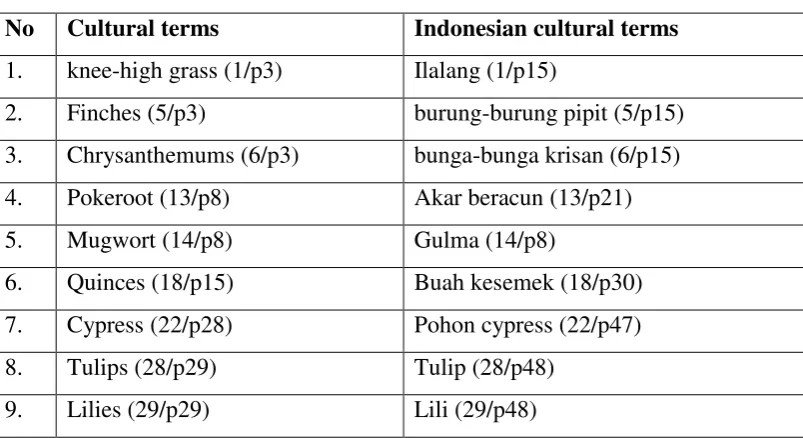
Table 1
No Cultural terms Indonesian cultural terms 1. knee-high grass (1/p3) Ilalang (1/p15)
2. Finches (5/p3) burung-burung pipit (5/p15) 3. Chrysanthemums (6/p3) bunga-bunga krisan (6/p15) 4. Pokeroot (13/p8) Akar beracun (13/p21)
5. Mugwort (14/p8) Gulma (14/p8)
6. Quinces (18/p15) Buah kesemek (18/p30) 7. Cypress (22/p28) Pohon cypress (22/p47)
8. Tulips (28/p29) Tulip (28/p48)
9. Lilies (29/p29) Lili (29/p48)
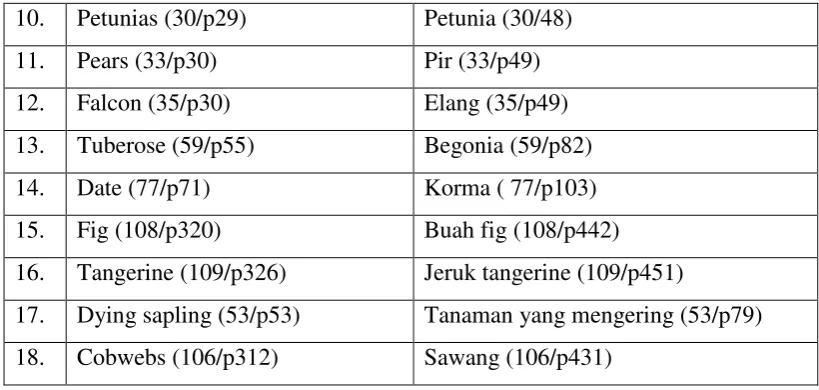
10. Petunias (30/p29) Petunia (30/48)
11. Pears (33/p30) Pir (33/p49)
12. Falcon (35/p30) Elang (35/p49)
13. Tuberose (59/p55) Begonia (59/p82)
14. Date (77/p71) Korma ( 77/p103)
15. Fig (108/p320) Buah fig (108/p442)
16. Tangerine (109/p326) Jeruk tangerine (109/p451)
17. Dying sapling (53/p53) Tanaman yang mengering (53/p79) 18. Cobwebs (106/p312) Sawang (106/p431)
2. Social Culture
Table 2
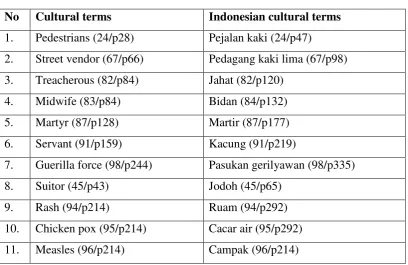
No Cultural terms Indonesian cultural terms 1. Pedestrians (24/p28) Pejalan kaki (24/p47)
2. Street vendor (67/p66) Pedagang kaki lima (67/p98) 3. Treacherous (82/p84) Jahat (82/p120)
4. Midwife (83/p84) Bidan (84/p132)
5. Martyr (87/p128) Martir (87/p177)
6. Servant (91/p159) Kacung (91/p219)
7. Guerilla force (98/p244) Pasukan gerilyawan (98/p335)
8. Suitor (45/p43) Jodoh (45/p65)
9. Rash (94/p214) Ruam (94/p292)
10. Chicken pox (95/p214) Cacar air (95/p292) 11. Measles (96/p214) Campak (96/p214)
3. Material culture/artifacts
An Artifact always becomes a characteristic of its own culture. These include: foods, clothes, housing, transport, and communications, for examples: mosque ( masjid ), church ( gereja ). This is the most dominant type in the data (69,74% of all data). There are 76 data in this type. The data which are included in material culture or artifacts are presented in the following table:
Table 3
No Cultural terms Indonesian cultural terms 1. Chinese tea set (2/p3) set cangkir porselen China (2/p15) 2. Porcelain (3/p3) cangkir porselen (3/p15)
3. Pot‟s spout (4/p3) mulut teko (4/p15)
4. Minarets (7/p4) kubah-kubah (4/p17)
6. terra-cotta tiles (9/p5) tembikar cokelatnya (9/p18)
7. Balcony (10/p5) Balkon-balkon (10/p18)
8. trellised ceiling (11/p5) langit-langitnya yang terbuat dari jalinan kayu (11/p18)
9. Carpet (12/p6) Permadani (12/p18)
10. a veiled green gown (15/p9) gaun bercadar hijau (15/p23)
11. sun-dried bricks (16/p10) batu bata yang dikeringkan (16/p24) 12. Chicken coop (17/p10) Kandang ayam (17/p24)
13. Minarets (19/p27) Kubah-kubah (19/p45)
14. Carts (20/p27) Gerobak (20/p45)
15. Mules (21/p27) Bagal (21/p45)
16. Boulevards (23/p28) Bulevar (23/p47) 17. Pebble path (25/p29) Jalan kerikil (25/p47) 18. Marble horses (26/p29) kuda-kuda pualam (26/p48) 19. Paper ship (27/p29) Kapal-kapalan kertas (27/48)
20. Shawls (34/p30) Kerudung (34/p49)
21. carpet-covered wooden platforms (37/p30)
lantai kayu berlapis permadani (37/p49)
22. marble bases statues (39/p36) dudukan-dudukan patung pualam (39/p57)
23. Tapestries (40/p36) hiasan kain (40/p57)
24. Tray (42/p37) Baki (42/p59)
25. Suits (43/p38) Setelan (43/p59)
26. Wooden cabinet (44/p43) lemari kayu berpintu kaca (44/p65) 27. Cigarette (46/p47) Rokok (46/p71)
28. Cologne (47/p47) Kolonye (47/p71)
29. Gold bands (48/p49) Cincin emas (48/p71) 30. Suitcase (50/p50) Koper (50/p75)
33. Cane-seat chair (56/p56) Kursi kayu (56/p79) 34. Folding chairs (57/p57) Kursi lipat (57/p79)
35. Black cast-iron stove (58/p53) tungku pemanas ruangan dari besi tempa hitam (58/p79)
36. Fitting drawer (60/p56) Laci-laci (69/p85)
37. Wooden spatula (61/p56) Spatula-spatula kayu (61/p85) 38. Colander (62/p56) Saringan (62/p85)
39. Loafers (63/p57) Sepatu pantofel (63/p86) 40. Headpiece (64/p65) Kerudung (64/p96)
41. Mesh screen (65/p65) Lubang-lubang kasa (65/p96) 42. Crushed pistachio (68/p66) pistachio cincang (68p98) 43. rice noodles (69/p66) bola-bola tepung beras (69/p98)
44 Dagger (70/p67) Belati (70/p98)
45 Rifle (71/p67) Senapan (71/p98)
46 Relic (72/p67) Relic (72/p98)
47 Pendant (78/p73) Bandul (78/p105)
48 Crushed Cardamom (79/p74) serbuk kardamunggu (79/p107) 49 Accordion (84/p97) Akordeon (84/p137)
50 Pamphlets (85/p105) pamflet-pamflet (85/p154) 51 Landmine (86/p109) Ranjau darat (86/p154) 52 Caravans (88/p133) karavan-karavan (88/p183) 53 Polka dots (89/p144) Polkadot (89/p200)
54 Rug (90/p157) Sajadah (90/p215)
55 Medal (93/p193) Tanda jasa (93/p264)
56 Silhouette (97p243) Siluet (97/p334) 57 Skullcap (101/p281) Kopiah (101/p387)
58 Jade (102/p282) Giok (102/p388)
59 Mosque (66/p65) Masjid (66/p96)
60 Boulevard (23/p28) Bulevar (23/p47)
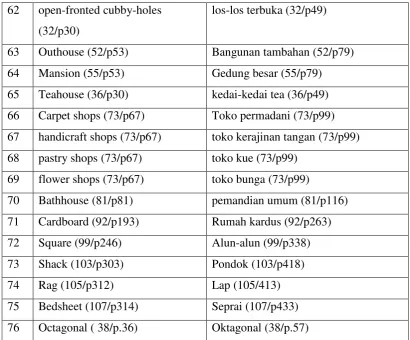
62 open-fronted cubby-holes (32/p30)
los-los terbuka (32/p49)
63 Outhouse (52/p53) Bangunan tambahan (52/p79)
64 Mansion (55/p53) Gedung besar (55/p79)
65 Teahouse (36/p30) kedai-kedai tea (36/p49) 66 Carpet shops (73/p67) Toko permadani (73/p99) 67 handicraft shops (73/p67) toko kerajinan tangan (73/p99) 68 pastry shops (73/p67) toko kue (73/p99)
69 flower shops (73/p67) toko bunga (73/p99)
70 Bathhouse (81/p81) pemandian umum (81/p116) 71 Cardboard (92/p193) Rumah kardus (92/p263)
72 Square (99/p246) Alun-alun (99/p338)
73 Shack (103/p303) Pondok (103/p418)
74 Rag (105/p312) Lap (105/413)
75 Bedsheet (107/p314) Seprai (107/p433) 76 Octagonal ( 38/p.36) Oktagonal (38/p.57)
4. Organizations, custom, ideas, (political, social, religious, artistic)
Organizations, customs, ideas are in the field of political, social, religious, and artistic. There are only 4 data in this type (3,66% of all data), they can be seen in this following table:
Table 4
No Cultural terms Indonesian cultural terms
1. Contract (49/p49) Surat nikah (49/p74) 2. Idolatry (100/p278) Berhala (100/p384)
3. Tattoo (41/p37) Tato (41/p59)
B. Strategies in Translating Cultural Terms
In producing a good translation, the translator should choose the proper strategy. In this study, there are seven strategies employed by the translator. Those are:
1. Translation by changing the lexicon with its equivalence in TL. 2. Literal Translation
3. Translation by paraphrase using unrelated word 4. Translation by more general word (superordinate). 5. Translation by more neutral/less expressive word. 6. Translation by Cultural substitutions.
7. Translation by loan word or loan word plus explanation. 8. Translation by omission.
The detailed explanation about each strategy is presented in the following part: 2.1. Changing the lexicon with its equivalence in TL
The translator replaces the cultural terms by changing the SL term with its equivalence in TL. The benefit using this strategy is giving the readers of target language (TL) a concept with that they can identify and become familiar. There are 59 data (54%) which are translated using this strategy as exemplified below:
Example 1:
ST: The lake had snatched him from Rasheed, swallowed him up, just as a whale had swallowed the boy‟s namesake prophet in Koran. (p.77)
TT: Danau telah merenggut anak itu dari Rasheed, menelannya, tepat seperti kisah dalam Al-Quran, ketika paus menelan seorang nabi dengan nama yang sama. (p.111)
Indonesian, a prophet is a chosen person of God to receive his messages (KBBI Online). Nabi is the proper term for translating prophet. It has the same concept as prophet.
Example 2:
ST: And at iftar, when the sun dipped in the west and the cannon fired from the Shir Darwaza Mountain, the city broke its fast, and so did Mariam, with bread and a date, tasting for the first time in her fifteen years the sweetness of sharing in a communal experience. (p.71)
TT: Dan pada saat iftar, ketika matahari tenggelam di ufuk barat dan meriam ditembakkan dari Gunung Shir Darwaza, seluruh penjuru kota pun berbuka, begitu pula Mariam, dengan sekerat roti dan sebutir korma, untuk pertama kalinya dalam lima belas tahun merasakan berbagai pengalaman bersama. (p.103)
In the example of ST above, one cultural term is found, that is date. It is translated into korma in the Indonesian text. According to Webster Dictionary Online date means sweet edible fruit of the date palm with a single long woody seed. Date is translated into korma which has the same meaning or its equivalence in Indonesian, a fruit with a single long woody seed, especially come from Arabic countries. It means that the translation strategy used by the translator is changing the lexicon with its equivalence in TL as the source term does.
ST: Jalil told her story of Queen Gauhar Shad, who had raised the famous minarets as her loving ode to Herat back in the fifteenth century. (p.4)
TT: Jalil mengisahkan Ratu Gauhar Shad, yang pada abad kelima belas mendirikan kubah-kubah termasyurnya sebagai pembuktian cinta pada Herat. (p.17)
The English cultural term minaret according to Wikipedia, a free encyclopedia, means distinctive architectural features of Islamic mosques. Minarets are generally tall spires with onion-shaped crowns, usually either free standing or much taller than any surrounding support structure. On the example above, the translator translates the term by giving the equivalent meaning in Indonesian. In order to make it acceptable and understandable, the translator renders it into kubah. Kubah is a part of architecture with a half shape or conical shape and placed in the highest part of a building.
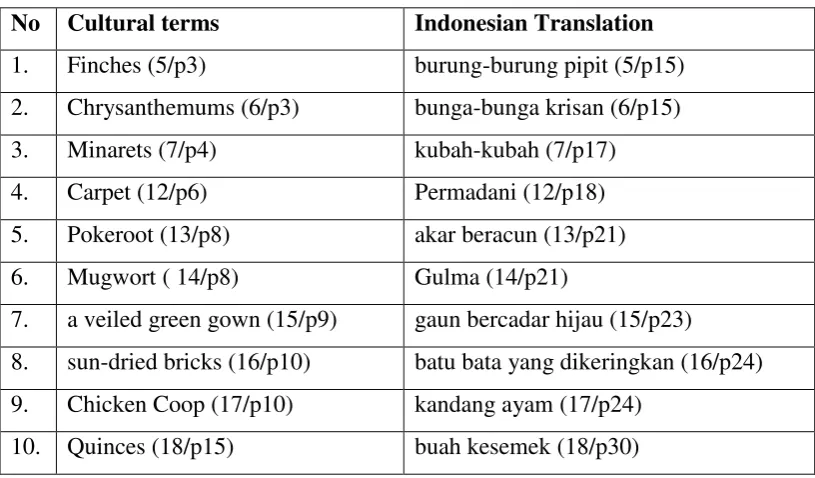
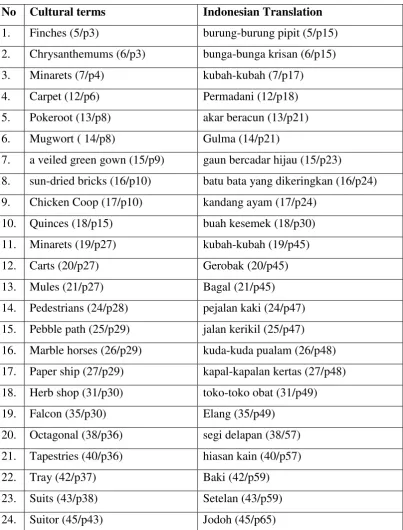
Table 2.1: Data Translation by changing the lexicon with its equivalence in TL:
No Cultural terms Indonesian Translation
1. Finches (5/p3) burung-burung pipit (5/p15) 2. Chrysanthemums (6/p3) bunga-bunga krisan (6/p15)
3. Minarets (7/p4) kubah-kubah (7/p17)
4. Carpet (12/p6) Permadani (12/p18)
5. Pokeroot (13/p8) akar beracun (13/p21)
6. Mugwort ( 14/p8) Gulma (14/p21)
7. a veiled green gown (15/p9) gaun bercadar hijau (15/p23)
8. sun-dried bricks (16/p10) batu bata yang dikeringkan (16/p24) 9. Chicken Coop (17/p10) kandang ayam (17/p24)
11. Minarets (19/p27) kubah-kubah (19/p45)
12. Carts (20/p27) Gerobak (20/p45)
13. Mules (21/p27) Bagal (21/p45) 14. Pedestrians (24/p28) pejalan kaki (24/p47) 15. Pebble path (25/p29) jalan kerikil (25/p47) 16. Marble horses (26/p29) kuda-kuda pualam (26/p48) 17. Paper ship (27/p29) kapal-kapalan kertas (27/p48) 18. Herb shop (31/p30) toko-toko obat (31/p49)
19. Falcon (35/p30) Elang (35/p49)
20. Octagonal (38/p36) segi delapan (38/57) 21. Tapestries (40/p36) hiasan kain (40/p57)
22. Tray (42/p37) Baki (42/p59)
23. Suits (43/p38) Setelan (43/p59)
24. Suitor (45/p43) Jodoh (45/p65)
25. Cigarette (46/p47) Rokok (46/p71) 26. Gold bands (48/p49) cincin emas (48/p74) 27. Suitcase ( 50/p50) Koper (50/p75)
28. Hydraulic doors (51/p51) pintu hidrolik (51/p76) 29. hand pump (53/p53) pompa air tangan (53/p79) 30. Mansion (55/p53) Gedung besar (55/p79) 31. folding chairs (57/p53) kursi lipat (57/p79) 32. Tuberose (59/p55) Begonia (59/p82) 33. fitting drawers (60/p56) laci-laci (60/p85)
34. Wooden spatula (61/p56) Spatula-spatula kayu (61/85) 35. Colander (62/p56) Saringan (62/85)
36. Mosque (66/p65) Masjid (66/p96)
37. Street vendor (67/p66) Pedaganf kaki lima (67/p98)
38. Dagger (70/p67) Belati (70/p98)
39. Rifle (71/p67) Senapan (71/p98)
41. Handicraft shops (74/p67) Toko kerajinan tangan (74/p99)
45. Crushed Cardamom (79/p74) serbuk kardamunggu (79/p107)
46. Prophet (80/p77) Nabi (80/p111)
47. Treacherous (82/p84) Jahat (82/p120) 48. Midwife (83/p92) Bidan (83/p132) 49. Land mine (86/p109) Ranjau darat (86/p154)
50. Medal (93/193) Tanda jasa (93/p264)
51. Rash (94/p214) Ruam (94/p292)
52. Chicken pox (95/p214) Cacar air (95/p292) 53. Measles (96/p214) Campak (96/p292)
54. Guerilla force (98/p244) pasukan gerilyawan (98/p335) 55. Idolatry (100/p278) Berhala (100/p384)
56. Shack (103/p303) Pondok (103/p418)
57. Rag (105/p312) Lap (105/p413)
58. Cobwebs (106/p312) Sawang (106/p413) 59. Bedsheet (107/p314) Seprai (107/p433)
2.2Literal translation
The translator renders the cultural term by literal translation. There are 3 data (2.5%) which are translated using this strategy, as can bee seen in the following example.
TT: Mariam saw an outhouse on the right, in a side yard, and on the left, a well with a hand pump, a row of dying sapling. (p.53)
ST: Mariam melihat sebuah bangunan tambahan di sebelah kanan, di halaman samping, dan di sebelah kiri, terdapat sebuah sumur dengan pompa air tangan serta sederet tanaman yang mengering. (p.79)
The meaning of English cultural term dying sapling according to Webster Dictionary Online is dying young tree. On the example above, the translator changes the term by literal translation in Indonesian and tries to make it acceptable and understandable by the readers. In order to get that aims, the translator translates it into tanaman yang mengering. The back translation of it as „drying tree‟ show that the translator employs this strategy, since there is
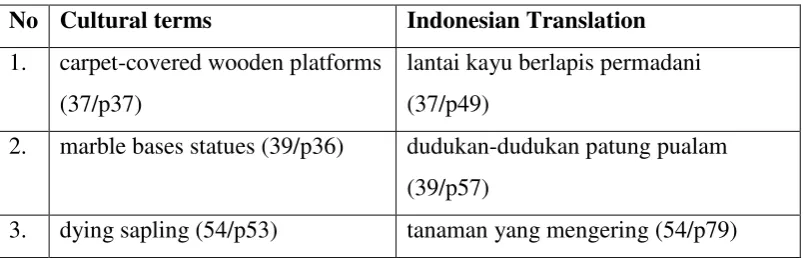
no exact term in Indonesian for rendering young tree. Table 2.2 Data translated by literal translation
No Cultural terms Indonesian Translation 1. carpet-covered wooden platforms
(37/p37)
lantai kayu berlapis permadani (37/p49)
2. marble bases statues (39/p36) dudukan-dudukan patung pualam (39/p57)
3. dying sapling (54/p53) tanaman yang mengering (54/p79)
2.3 Translation by paraphrase using unrelated word
The translator renders the cultural term by paraphrase using unrelated word. There are 6 data (5%) which are translated using this strategy. The examples as follows: Example 1:
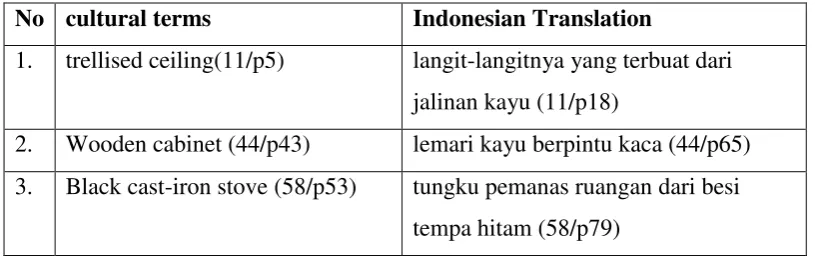
TT: Bersandar pada dinding di dekat jendela adalah sebuah lemari kayu berpintu kaca. (p.65)
The translation strategy used by the translator in translating wooden cabinet is paraphrase using unrelated word. It is based on the fact that the translator makes paraphrase after he translated wooden cabinet into lemari kayu berpintu kaca, which means a wooden cabinet with glass door frame. According to Webster Dictionary Online, wooden cabinet means a piece of furniture resembling a cupboard with doors and shelves and drawers; for storage or display, made from wood, without glass door frame. The translator adds the words ‘berpintu kaca’ to make the translation acceptable and more understandable.
Example 2:
ST: There was a table, two cane-seat chair, two folding chairs, and, in the corner, a black cast-iron stove. (p.53)
TT: Selain sebuah sofa, di sana juga terdapat sebuah meja, dua kursi kayu, dua kursi lipat, dan di sudut ruangan, sebuah tungku pemanas ruangan dari besi tempa hitam. (p.79)
According to Webster Online Dictionary, the English cultural term of Black cast-iron stove is a stove which is made by black iron formed by a mold. It means that it hot liquid metal is poured into a mold or cast. While the Indonesian translation of this term uses the word „besi tempa‟ which means
of the English term into Indonesian by changing the lexicon paraphrase using unrelated word.
Table 2.3 Data translated by paraphrase using unrelated word No cultural terms Indonesian Translation
1. trellised ceiling(11/p5) langit-langitnya yang terbuat dari jalinan kayu (11/p18)
2. Wooden cabinet (44/p43) lemari kayu berpintu kaca (44/p65) 3. Black cast-iron stove (58/p53) tungku pemanas ruangan dari besi
tempa hitam (58/p79)
2.4Translation by more general word (superordinate)
The translator renders the meaning by using more general word in order to be acceptable for the target readers. There is only one datum (0,9%) which is translated using this strategy. The datum is:
ST: There was a table, two cane-seat chair, two folding chairs, and, in the corner, a black, cast-iron stove. (p.53)
TT: Selain sebuah sofa, di sana juga terdapat sebuah meja, dua kursi kayu, dua kursi lipat, dan di sudut ruangan, sebuah tungku pemanas ruangan dari besi tempa hitam. (p.79)
In the example above cane is replaced by kayu (wood). According to Webster Dictionary Online, cane is a strong slender often flexible stem as of bamboos, reeds, rattans, or sugar cane. In Indonesia, people call it as rotan, a kind of special wood which so flexible. So, cane is considered as the hyponym of kayu (wood).
This strategy relates to expressive meaning at word level. The translator renders a word in source language into a word in the target language which has the propositional meaning but they have different expressive meaning. There is only one datum (0,9%) which is translated using this strategy. That is:
ST: If not for the Mujahideen, we‟d still be the Soviets‟ servants, remember?
(p.159)
TT: Jika bukan karena mujahidin, kita masih akan tetap menjadi kacung Soviet, ingat? (p. 219)
According to Webster Dictionary Online, servant is a person working in the service of another (especially in the household). Kacung in Indonesia has the same meaning with servant. But servant and kacung have different expressive meaning. Servant has more expressive meaning than kacung in Indonesian, which is usually considered as a servant who does a rough job. It accordance with the context of situation in the novel, in which Afghanistan was ever occupied in the past by Soviet.
2.6 Translation by Cultural Substitutions
In this strategy, translator replaces a cultural specific item or expression with a target language item which dos not have the same propositional meaning but is likely to have a similar impact for the target reader. This helps the target readers identify such kind of source language item. There are 20 data (18 %) which is translated by this strategy. For example are:
ST: “All that remains now is the signing of the contract,” the mullah said.
(p.49)
TT: “Yang harus dilakukan sekarang tinggal penandatanganan surat nikah,”
ujar mullah. (p.74)
Contract is a binding agreement between two or more persons that is enforceable by law (Webster Dictionary Online). To transfer the meaning into target text, the translator uses translation by cultural substitutions strategy. In the context of situation in the novel, contract is used in marriage agreement. While in Indonesian a legal certificate for a marriage which shows a spouse marriage formally is surat nikah. So in the target text, the translator renders with its cultural substitution, surat nikah, a marriage certificate letter which is formally used in Indonesia.
Example 2:
ST: Mariam saw her first of the Taliban later that day, at Pashtunistan Square, with Rasheed, Laila, and Aziza. (p. 246)
TT: Siang itu, di Alun-alun Pastunistan bersama Rasheed, Laila, and Aziza, untuk pertama kalinya, Mariam melihat Taliban. (p.338)
Example3:
ST: The padded headpiece felt tight and heavy on her skull, and it was strange seeing the world through a mesh screen. (p.65)
TT: Kerudung yang berlapis tebal terasa ketat dan berat diatas tempurung kepalanya, dan sangat aneh rasanya melihat dunia dari balik lubang-lubang kasa. (p.96)
In the example above, the translator applies translation by cultural substitution in rendering the meaning into Indonesian as the meaning of cultural terms headpiece into kerudung. The cultural term headpiece, as state in the Webster Online Dictionary, means a protective helmet for the head. In the context of situation in the novel, headpiece is a special veil used by Afghanistan Moslem woman in their strict rules of dressing in religious understanding or they usually call it as burqa. In Indonesian culture, a garment that covers the head is called kerudung. This means that the translator employs translation by cultural substitution.
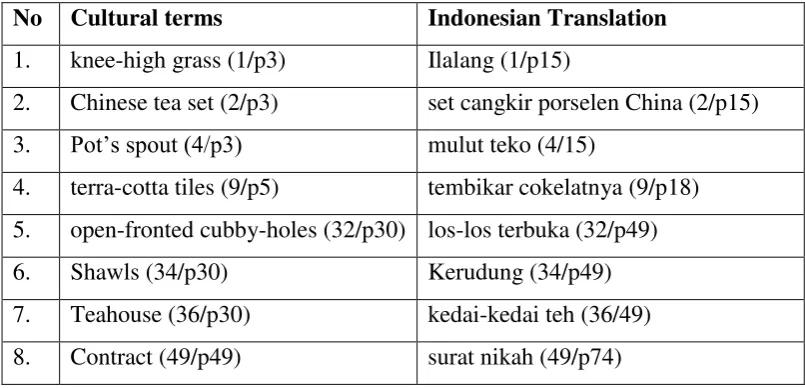
Table 2.3 Data translated by Cultural substitutions
No Cultural terms Indonesian Translation
1. knee-high grass (1/p3) Ilalang (1/p15)
2. Chinese tea set (2/p3) set cangkir porselen China (2/p15) 3. Pot‟s spout (4/p3) mulut teko (4/15)
4. terra-cotta tiles (9/p5) tembikar cokelatnya (9/p18) 5. open-fronted cubby-holes (32/p30) los-los terbuka (32/p49)
6. Shawls (34/p30) Kerudung (34/p49)
9. Outhouse (52/p53) bangunan tambahan (52/p790 10. Loafers (63/p57) sepatu pantofel (63/p86) 11. Headpiece (64/p65) Kerudung (64/p96)
12. mesh screen (65/p65) Lubang-lubang kasa (65/p96)
13. Pendant (78/p73) Bandul (78/105)
14. Bathhouse (81/p81) pemandian umum (81/116)
15. Rug (90/p157) Sajadah (90/215)
16. Square (99/p246) alun-alun (99p335) 17. Skullcap (101/p281) Kopiah (101/p387)
18. Jade (102/p282) Giok (102/p388)
19. Cardboard (92/p103) Rumah kardus (92/263)
20. rice noodles (69/p66) Bola-bola tepung beras (69/p98)
2.7 Translation by loan word or loan word plus explanation.
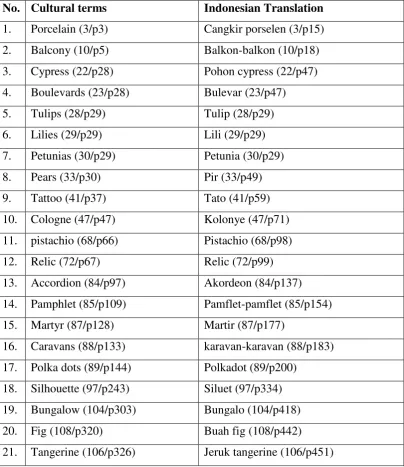
In this strategy, the translator keeps the source language since it is difficult to find the equal word in the target text. The using of loan word and its explanation gives benefit when the word is repeated several times in the text. There are 21 data (19%) which are translated using this strategy. The examples can be seen in the following discussion:
Example 1:
TT: Mariam berjalan di tengah keributan dan sesaknya bulevar yang diapit pohon cypress, diantara para pejalan kaki, pengendara sepeda, gari yang ditarik oleh bagal, dan tidak seorangpun melemparinya dengan batu. (p.47) According to Webster Dictionary Online, boulevard is a wide street or thoroughfare. The translator adopts boulevard into bulevar. She might consider that the word is difficult to be translated. So that, it does not sound natural in the target language, since it is not common word used in Indonesia. Example 2:
ST: Cigarette smoke and thick, sweet cologne, not faint like Jalil‟s. (p.47) TT: Aroma asap rokok dan kolonye yang tajam dan manis, sangat berbeda jauh jika dibandingkan dengan aroma Jalil yang berkesan lembut. (p.71) Cologne is a perfumed liquid made of essential oils and alcohol (Webster online Dictionary). The translator adopts cologne into kolonye, since this term widely used in many fragrance brands in Indonesia.
Example 3:
ST: Rasheed stopped to look at an engraved silver dagger in one shop, an in another, at an old rifle that shopkeeper assured Rasheed was a relic the first war against the British. (p.67)