Biopsychosocial Factors Associated with Mental Retardation in
Children Aged 6-17 Years in Tulungagung District, East Java
Yani Ikawati1,2), Yulia Lanti Retno Dewi 3), Rita Benya Adriani4)
1) Midwifery Academy PGRI Kediri, East Java
2)Masters Program in Public Health, Universitas Sebelas Maret 3)Department of Nutrition, Faculty of Medicine, Universitas Sebelas Maret
4) School ofHealth Polytechnics Surakarta
ABSTRACT
Background: According to WHO, 15% of the world population, or 785 million people, suffer men-tal or physical disorders. Menmen-tal retardation is a serious problem socially and medically. Menmen-tal re-tardation affects child development in various forms: physical, self-care, communication, social, emotional, and mental. The objective of this study was to determine biopsychosocial factors associ-ated with mental retardation in children aged 6-17 years.
Subjects and Method: This was a observational analytic study with case control design. It was conducted at Kauman and Tulungangung community health centers in Tulungangung District, Ea-st Java, from April to May, 2017. A sample of 100 parents of children aged 6 to 17 years old were se-lected for this study by fixed disease sampling, consisting of 25 parents of children with mental retardation and 75 parents of children without mental retardation. Children with mental retardati-on were identified and sampled at a disability special school in Tulungagung, East Java. The depen-dent variable was mental retardation. The independepen-dent variables were prenatal history, perinatal history, maternal stress during pregnancy, maternal education, and family income. The data were collected by a pre-tested questionnaire. Maternal stress was measured by Holmes and Rahe stress scale. The data were analyzed by path analysis.
Results: Mental retardation was directly associated with prenatal history (b= 1.17; 95% CI= 0.65 to 2.27; p= 0.038), perinatal history (b= 1.41; 95% CI= 0.87 to 2.73; p= 0.037), and maternal stress during pregnancy (b= 1.84; 95% CI = 0.59 to 3.09; p= 0.004). Prenatal history was associated with maternal education (b= -1.16; 95% CI= -2.17 to -0.15; p= 0.025) and maternal stress during pregn-ancy (b= 1.48; 95% CI= 0.43 to 2.54; p= 0.006). maternal stress during pregnpregn-ancy was associated with maternal education (b= -1.65; 95% CI= 2.62 to -0.69; p=0.001) and family income (b=-1.35; 95% CI= 2.29 to -0.41; p=0.005). Family income was associated with maternal education (b= 1.70; 95% CI= 0.82 to 2.57; p<0.001).
Conclusion: Mental retardation is directly associated with prenatal history, perinatal history, and maternal stress during pregnancy.
Keywords: mental retardation, biopsychosocial factors, children
Correspondence:
Yani Ikawati. Masters Program in Public Health, Sebelas Maret University, Jl. Ir. Sutami 36 A, Su-rakarta, Central Java. Email: [email protected]. Mobile: +6285655730050.
BACKGROUND
Mental Retardation (RM) is a major public health problem in the society. People with mental retardation are a small part of the population. Mental retardation is a serious problem both in terms of social and in the field of medicine because it can affect
child-ren's development in various forms, namely physical aspects, self-care, communication, socializing and mental emotional impact that will affect their health but mental reta-rdation can be overcome if detected earlier (Handayani, 2015).
cognitive dysfunction and lack of adapta-bility which occurs more in the age before 18 years with an Intelligence Quotient (IQ) score below 70 (Santrock, 2010).
According to the World Health Orga-nization (WHO), 15% of the world's popula-tion or 785 million people experience men-tal and physical disorders. Data from the American Psychiatric Accreditation (APA), about 1-3% of the American population are mentally retarded in the neighborhood. St-udies conducted in Pakistan and India show that the incidence of severe mental retarda-tion ranges from 12-24/ 1,000, while in Ba-ngladesh, it is around 5.9/ 1,000 childbir-ths. Other studies in the Netherlands repor-ted that based on the population meta-anal-ysis revealed a prevalence of RM 1% with a division of 85% of all cases being mild RM, Moderate RM 10% and RM weight/ very heavy 5% (Iqbal, 2014). In Asia, there are about 3% of the population (33.3 million people) who are mentally retarded. In Indo-nesia, based on data from the Ministry of National Education (DEPDIKNAS) in 2009, there were 4,253 children of mental retardation found in all extraordinary scho-ols (Norhidayah et al., 2013).
According to Ahmad (2014), children with mental disabilities (children with men-tal retardation) in East Java Province who were accommodated in SLB - C in 2013/-2014 totaled 6,633 people or 61.21% of all children with special needs in East Java, totaling 10,836 children with intellectual disabilities. It consists of mild mental illne-ss of 3,994 people (36.86%), mental retard-ation- moderate 2,639 people (24.35%) and mental retardation- severe 4,203 people (38.79%).
The causes of mental retardation incl-ude problems during pregnancy (malnutri-tion, alcohol, infectious disease), problems in childbirth (difficulty in childbirth, distur-bing umbilical cord twisting), problems in
the first year of life (brain infection, prolon-ged yellow, seizures uncontrolled, acciden-ts, malnutrition), problems in parenting (lack of stimulation, child abuse, neglect) and genetic factors. The number of people with mental retardation is currently estima-ted to have reached 2-3% of the total popu-lation. When viewed from the total popula-tion of Indonesia, people with mental retar-dation are around 962,011 people.
Psychological factors can affect the incidence of mental retardation in children. A mother with a very high level of stress du-ring pregnancy is the most common cause of mental retardation, Down's syndrome or other syndromes, depending on the mecha-nism that causes the risk of birth of a child with mental retardation in a family (Norhidayah, 2013).
In Tulungagung, from 9 Special Schools (SLB) both public and private, SLB C Negeri Tulungagung is an SLB which has the biggest students from the category of mentally disabled in which this school has 95 mentally disabled students (Center for Education Data and Statistics-Culture Ministry of Education and Culture, 2016).
The purpose of this study is to analyze the effect of psychosocial factors on mental retardation in children aged 6-17 years in Tulungagung, East Java.
SUBJECTS AND METHOD 1. Study Design
This was a case control study conducted in Kauman and Tulungagung Health Centers, Tulungagung, East Java, from April to May 2017.
2. Population and Sampling
A sample of 100 children consisting of two study subjects namely case study subje-cts and control study subjesubje-cts.
a. Case study subjects were parents of children aged 6-17 years who experienc-ed mental retardation basexperienc-ed on student data in SLB in the Tulungagung Regen-cy, East Java Province by fulfilling the inclusion criteria, namely:
1) Parents of children aged 6-17 years who experienced mental retardation in SLB in the Tulungagung Regency Area regis-tered in the student data at school. 2) Having complete medical records, for
example KIA books that can show mate-rnal and child health history in the past (prenatal, perinatal).
3) Willing to be the subject of study.
b. The subjects of the control study were parents of children aged 6-17 years who did not experience mental retardation based on students’ data in SLB in Tulu-ngagung Regency, East Java Province by fulfilling the inclusion criteria, name-ly:
1) Parents of children aged 6-17 years who did not experience mental retardation in Tulungagung Regency.
2) Having complete medical records, for example KIA books that can show mate-rnal and child health history in the past (prenatal and perinatal).
The sampling technique used is fixed disease sampling that is selecting samples based on disease status, ie those which are diseased or not diseased, while subject ex-posure status varies according to the disea-se status of the subject (Murti, 2013). 3.Study Variable
There are six variables in this study consist-ing of dependent and independent variabl-es. The dependent variable is the incidence of mental retardation in children aged 6-17 years. The independent variables are prena-tal history, perinaprena-tal history, stresses on the mother during pregnancy, mother's educat-ion level and family income.
4.Operational Definition
Operational definitions of prenatal history are processes during pregnancy that affect the incidence of mental retardation in chil-dren aged 6-17 years, such as the elderly age of mothers, mothers who consume alco-hol, pregnant women who smoke, DM in pregnant women, maternal hypertension, maternal epilepsy and maternal asthma.
Perinatal history is the process of childbirth that affects the incidence of men-tal retardation in children aged 6-17 years (prolonged labor, labor with forceps / vacu-um extraction, shoulder dystocia, site abno-rmalities).
Stresses in the mother during pregn-ancy is a state of feeling disturbed or inner in the life of a pregnant woman, causing di-sruption during pregnancy which can affect the incidence of mental retardation in chil-dren aged 6-17 years.
The mother's education level is the la-st level of formal education that has been taken by mothers of children aged 6-17 yea-rs based on the latest diploma they have (both parents of children aged 6-17 years who experience mental retardation or not).
Family income is an income that is
Mental retardation is a condition with less intelligence or intelligence accompani-ed by raccompani-educaccompani-ed ability to adjust to children aged 6-17 years.
5.Study Instruments
are negative and support for the occurrence of retardation mentally in children aged 6 to 17 years). The questionnaire used and is already based on the standard is Holmes and Rahe stress scale.
6.Data Analysis
The data were analyzed by path analysis. Path analysis is an analysis technique that is used to determine the effect of an exoge-nous variable on endogeexoge-nous variables that affect directly or indirectly. The magnitude of the effect of the independent variable (exogenous) on the dependent variable (endogenous) that can be seen from the path coefficient value, the greater the path coefficient, the greater the effect given by the variable. The steps of data analysis were done using path analysis, including model specifications, model identification, model suitability, parameter estimation, and model specifications.
RESULTS A.Univariate Analysis
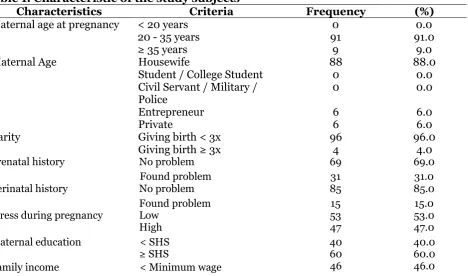
Table 1 shows that maternal age during pre-gnancy is mostly 20-35 years old, for about
91 study subjects (91.0%). Most of them did not work for about 88 study subjects (88.0%). Most of the subjects of this study gave birth to their children <3 times amou-nting to 96 study subjects (96.0%).
The frequency distribution of univa-riate variables explaining the general description of each variable studied included prenatal history, perinatal history, stress on the mother during pregnancy, maternal education level and family income.
Mother without prenatal history were about 69 study subjects (69.0%) while the mother with no perinatal history problem were 85 study subjects (85.0%), most mothers, during pregnancy, experienced low stress for about 53 study subjects (53.0%). Mother's education level is mostly in the category of higher education (≥senior high school) which is 60 people (60.0%). The family income of most of Tulungagung Regency KUMK is 54 people (54%).
Table 1. Characteristic of the study subjects
Characteristics Criteria Frequency (%)
Maternal age at pregnancy < 20 years 0 0.0
20 - 35 years 91 91.0
≥ 35 years 9 9.0
Maternal Age Housewife 88 88.0
Student / College Student 0 0.0
Civil Servant / Military / Police
0 0.0
Entrepreneur 6 6.0
Private 6 6.0
Parity Giving birth < 3x 96 96.0
Giving birth ≥ 3x 4 4.0
Prenatal history No problem 69 69.0
Found problem 31 31.0
Perinatal history No problem 85 85.0
Found problem 15 15.0
Stress during pregnancy Low 53 53.0
High 47 47.0
Maternal education < SHS 40 40.0
≥ SHS 60 60.0
≥ Minimum wage 54 54.0
B.Bivariate Analysis
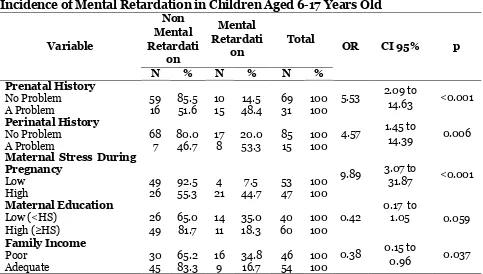
Table 2 showed that prenatal history, perinatal history, stress in the mother during pregnancy, maternal education
level, family income affect the incidence of mental retardation in children aged 6-17 years.
Table 2. Bivariate Analysis of the Effect of Independent Variables on the Incidence of Mental Retardation in Children Aged 6-17 Years Old
Variable
Maternal Stress During
Pregnancy 9.89 3.07 to
Approximately 48.4% of mothers who have children aged 6-17 years who experi-ence mental retardation show a problem in their prenatal history while 85.5% of moth-ers who have children aged 6-17 years who are not mentally retarded have no problems with their prenatal history.
The results of the analysis with Chi Square test showed that mothers who experience problems in prenatal history had a possibility of 5.53 times causing mental retardation children in children aged 6-17 years (OR= 5.53; 95% CI= 2.09 to 14.63; p<0.001).
About 53.3% of mothers who have children aged 6-17 years who experience mental retardation show a problem in their perinatal history while 80.0% of mothers have children aged 6-17 years who do not
experience mental retardation show no pro-blem in their prenatal history.
The results of the analysis with Chi Square test showed that mothers who experienced problems with perinatal history had a probability of 4.57 times causing children with mental retardation in children aged 6-17 years (OR= 4.57; 95% CI= 1.45 to 14.37; p= 0.006).
Approximately 44.7% of mothers who have children aged 6-17 years who experi-ence mental retardation show high stress during pregnancy while 92.5% of mothers who have children aged 6-17 years who are not mentally retarded do not experience hi-gh stress during pregnancy.
had a possibility of 3.25 times causing me-ntal retardation children at the age of 6-17 years (OR= 3.25; 95% CI = 1.17 to 9.05; p = 0.020).
About 35.0% of low-educated mothers (<High School) have 6-17 years old children who experienced mental retardation while 81.7% of highly-educated mothers (≥High School) have 6-17 years old children who did not experience mental retardation.
The results of the analysis with Chi Square test showed that mothers with high level of education (≥High School) have the likelihood to caused their children to have mental retardation at the age of 6-17 years old by 0.42 time (OR= 0.42; 95% CI=0.17 to 1.05; p= 0.059).
About 34.08% of mothers with lack of family income(<MW) have 6-17 years old children who experienced mental retarda-tion while 83.3% of mothers with high family income (≥MW) have 6-17 years old children who did not experience mental retardation.
The results of the analysis with Chi Square test showed that mothers with high family income (≥MW) have the likelihood to caused their children to have mental
retardation at the age of 6-17 years old by 0.38 time (OR= 0.38; 95% CI= 0.15 to 0.96; p= 0.037).
C.Multivariate Analysis
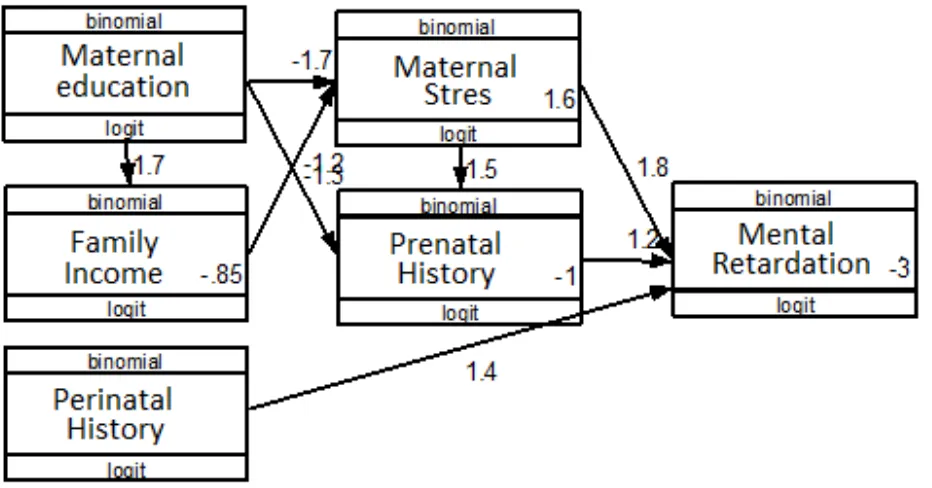
Table 3 showed that mental retardation was affected by prenatal history, perinatal history, and maternal stress during pregnancy.
Mothers who have problems with their prenatal history were 1.17 times more likely to increase the occurrence of mental retardation in children aged 6-17 years old (b= 1.17; 95% CI= 0.65 to 2.27; p= 0.038). A problem in prenatal history was affected by maternal education and maternal stress during pregnancy.
Figure 1. Structural Model with Path Coefficient Estimation
Table 3. Path Analysis Results of the Effect of Independent Variables on the Incid-ence of Mental Retardation Among 6-17 Years Old Children
Dependent Variable Independent Variable b
95% CI
P Lower
Limit
Upper Limit Direct Effect
Mental Retardation Prenatal History 1.17 0.65 2.27 0.038 Perinatal History 1.41 0.87 2.73 0.037 Maternal Stress During
Pregnancy
1.84 0.59 3.09
0.004
Indirect Effect Maternal Stress During Pregnancy
Maternal Education -1.65 -2.62 -0.69 0.001
Family Income -1.35 -2.29 -0.41 0.005
Family Income Maternal Education 1.70 0.82 2.57 <0.001 Prenatal History Maternal Education -1.16 -2.17 -0.15 0.025
Maternal Stress During
Pregnancy 1.48 0.43 2.54 0.006
Log Likelihood = -208.25
A problem in perinatal history has greater logodd to increase the incidence of mental retardation among 6-17 years old children by 1.41 times (b= 1.41; 95% CI= 0.87 to 2.73; p= 0.037).
High maternal stress during pregnan-cy have 1.84 times greater logodd to increa-se the occurrence of mental retardation am-ong 6-17 years old children (b=1.84; 95%
high maternal stress during pregnancy (b=-1.35; 95% CI= -2.29 to -0.41; p= 0.005).
Adequate family income was affected by maternal educational level. Highly-edu-cated mothers have greater logodd to was an effect of prenatal history on the inc-idence of mental retardation in 6-17 years old children in the area of Tulungagung Di-strict, East Java.
This study was supported by a a study done by Katiyar and Gupta (2014), which showed that there was an effect of prenatal history on the incidence of mental retardat-ion among children in Varanasi. Maternal age at pregnancy, excessive use of nicotine and alcohol during pregnancy were the ma-jor causes of mental retardation. A problem in prenatal can lead to prematurity and LB-W, and these factors can be one of the caus-es of mental retardation. Based on the stu-dy above, it was expected that a well-plann-ed pregnancy planning, regular pregnancy check-ups, fulfillment of good nutrition and environment, and avoidance of accidents or trauma during pregnancy were needed. Ea-rly identification and screening on pregnant women was also very necessary in this pro-blem (Katiyar and Gupta, 2014).
A study by Huang et al., (2016) also mentioned that from the 16 potential risk factors analyzed, ten prenatal factors (old maternal age, maternal skin race, low mate-rnal education, third or greater parity, pre-gnant women who consumed alcohol, preg-nant women who smoke, diabetes mellitus in mothers, hypertension in mothers, epile-psy, and asthma) affected the incidence of mental retardation.
According to Salmiah (2010), the cau-ses of mental retardation were infection and drug abuse during pregnancy. The infe-ction that usually occurred was rubella, wh-ich can lead to brain damage. Maternal dis-ease could also lead to mental retardation, such as syphilis, cytomegalovirus, and gen-ital herpes. Medications used by the mot-hers during pregnancy could affect the ba-by's health through the placenta. Some of them can cause physical disability and seve-re mental seve-retardation. Childseve-ren with mot-hers who drink alcohols during pregnancy could cause the baby to have fetal syndrome and it was the most obvious cases of mental retardation cause. Labor complications, su-ch as lack of oxygen or head injury, brain infections (encephalitis and meningitis), and exposed to toxins (lead-containing pai-nt) have the potential to cause mental reta-rdation.
Based on the descriptions above, the writers concluded that a problem in prena-tal history could increase the incidence of mental retardation among 6-17 years old children. This was because the prenatal pe-riod was a critical pepe-riod so that the effect of maternal body conditions would support the development of innate nature. Good and bad characters would later influence the pattern of future development.
2.The Effect of Perinatal History on Mental Retardation
The results of this study showed that there was an effect of perinatal history in increas-ing the incidence of mental retardation am-ong 6-17 years old children in the area of Tulungagung District, East Java.
complications in perinatal stage (OR=0.45; 95% CI= 0.15 to 1.40; p= 0.168). According to Maramis (2005), at the time of the birth process (perinatal) the baby's head could experience pressure, so that it could lead to the bleeding in the brain and it was also due to the lack of oxygen which then caused the degeneration of brain cortex cells which would lead to mental retardation.
Based on the descriptions above, the writers concluded that a problem in perin-atal history could increase the incidence of mental retardation among 6-17 years old children. This was because the perinatal pe-riod was a time of the labor process when the fetus, placenta, and membrane was out of the uterus through the birth canal with the help or by its own strength so that the maternal role during the labor was very necessary, because the effect of maternal body conditions would support the progress and success in labor.
3.The Effect of Maternal Stress During Pregnancy on Mental Retardation
The results of this study showed that there was an effect of maternal stress during pre-gnancy in increasing the incidence of ment-al retardation among 6-17 years old childr-en in the area of Tulungagung District, Ea-st Java.
Maternal stress during pregnancy was affected by maternal educational level, a high level of education could reduce maternal stress during pregnancy. Maternal stress during pregnancy was also affected by family income. An adequate family income would reduce maternal stress during pregnancy.
The result of this study was supported by a study done by Norhidayah (2013) whi-ch showed that a mother who suffered extremely high stress during pregnancy was the most common cause of mental retarda-tion which depend on the mechanism of the
cause of babies who were born with mental retardation. Psychosocial stress was comm-on and at a high level which related to mot-hers who gave bad contribution to pregnan-cy products in the form of congenital defe-cts and psychiatric disorders (Supariasa et al., 2016). Good stress management would help in reducing the impacts of stress. Stre-ss which was ignored would changed the body's natural stress management system. When pregnant women feel anxious, their body would produce stress hormones that could affect the fetus, namely epinephrine and norepinephrine which have an effect on raising blood pressure and reducing oxygen supply to the uterus. Some of the stress dangers which were not managed properly for maternal and fetal health include neurodevelopment could lead to abnormali-ties in the formation process of the fetal br-ain. Therefore, it could trigger behavioral problems in the growth of the babies in the future (Servili et al., 2010).
needs, and at the same time, it also affected the physical and psychological condition of the body. While micronutrient deficiencies which accompanied by stress oxidative wo-uld cause DNA damage. The small amount of family income or dependency on the fa-mily's social economy could lead to stress (inner pressure) and unpleasant conditions during pregnancy so that it would lead to mental retardation in children aged 6-17 years old (Ali, 2014).
A different result of the study was shown by Rini (2007) which stated that th-ere was no effect between maternal psych-osocial stress with the incidence of mental retardation. According to the data obtained from 41 patients with mental retardation, there were 10 mothers who suffered from psychosocial stress during pregnancy.
Based on the descriptions above, the writers concluded that the incidence of me-ntal retardation among 6-17 years old child-ren was affected by pchild-renatal history, perin-atal history, and maternal stress during pregnancy. Prenatal history was affected by maternal education and maternal stress du-ring pregnancy. Maternal stress dudu-ring pre-gnancy was affected by maternal education and family income. Family income was affe-cted by maternal education.
REFERENCES
Ahmad I (2014). Model Bimbingan Beha-vioral untuk Mengembangkan Kete-rampilan Sosial Anak Tunagrahita. Bandung: Universitas Pendidikan In-donesia.
Ali J (2014). Kemiskinan, Status Gizi, dan Stres Kerja dari Ibu Hamil Pekerja In-formal. Makasar: Universitas Hasanu-ddin.
Handayani ATW (2015). Status Gizi Pada Penderita Retardasi Mental. Jember :
Fakultas Kedokteran Gigi Universitas Jember.
Huang J, Zhu T, Gu Y, Mu D (2016). Pre-natal, Perinatal and Neonatal Risk Factors for Intellectual Disability : A Systemic Review and Meta-Analysis. Journal.pone.0153655.
Katiyar J, Gupta K (2014). Prenatal and Postnatal Risk Factors for Mental Retardation among Children in Vara-nasi. Stud Home Com Sci, 8(2-3): 101-107.
Maramis WF (2009). Catatan Ilmu Kedok-teran Jiwa Edisi 2. Surabaya: Airlang-ga University Press.
_____ (2005). Ilmu Kedokteran Jiwa. Surabaya: Airlangga University Press. Murti B (2013). Desain dan Ukuran Sampel
untuk Penelitian Kuantitatif dan Kua-litatif di Bidang Kesehatan. Yogya-karta: Gajah Mada University Press. Norhidayah W, Siti, Husein, Achyar N
(2013). Gambaran Kejadian Kecemas-an pada Ibu Penderita Retardasi Men-tal Sindromik di SLB-C Banjarmasin. Journal Berkala Kedokteran, 9(1). Nurochim E, Indarto D, Prayitno A (2016).
Association between Maternal Age at Pregnancy, Socioeconomic Status, Physical Environment, Prenatal, Peri-natal, Postnatal History, and the Risk of Mental Retardation. Journal of Ma-ternal and Child Health (2016), 1(2): 119-130. Surakarta: Sebelas Maret University.
Pusat Data dan Statistik Pendidikan – Kebudayaan Kementerian Pendidikan dan Kebudayaan (2016). http://seko-lah.data.kemdikbud.go.id/ [Diakses tanggal 29 Januari 2017].
Salmiah S (2010). Retardasi Mental. Me-dan: Fakultas Kedokteran Gigi Uni-versitas Sumatera Utara.
Santrock JW (2010). Psikologi Pendidikan edisi kedua. Jakarta : Kencana.
Servili C, Medhin G, Hanlon C, Tomlinson M, Worku B, Baheretibeb Y, Dewey
M, Alem A, Prince M (2010). Mater-nal common mental disorders and in-fant development in Ethiopia: the P-MaMiE Birth Cohort. BMC Public Health. 2010; 10: 693.