Work –Family Conflict in Dual-Earner Couples:
Within-Individual and Crossover Effects of Work and Family
LESLIE B. HAMMER
Portland State University
ELIZABETH ALLEN
Oregon Health Sciences University
AND
TENORAD. GRIGSBY
Portland State University
Three hundred ninety-nine dual-earner couples participated in a field study examin-ing the effects of work and family variables on work – family conflict. The effects of own (i.e., within-individual) and partners’ (crossover effects) work and family involvement, career salience, perceived flexibility of work schedule, and partners’ work – family conflict on individuals’ work – family conflict were examined. Results indicated significant relationships between the study variables and individuals’ work – family conflict, consistent with previous research. Furthermore, and of most interest to the present study, partners’ work – family conflict accounted for a significant amount of variance in both males’ and females’ work – family conflict. Post hoc exploratory analyses further revealed that crossover effects accounted for a significant amount of variance in work – family conflict over and above the within-individual effects, sug-gesting that future research on work – family conflict use the couple as the unit of analysis. q1997 Academic Press
The nature of the work force is changing in terms of gender, race, and age (Offermann & Gowing, 1990; Zedeck & Mosier, 1990). Seventy percent of women between the ages of 25 and 44 with children under the age of 18,
The authors thank Margaret Neal, Donald Truxillo, and the anonymous reviewers for comments on earlier versions of this paper. We also thank Wesley Brenner and Robert Fountain for assistance with data analyses. This study was partially funded by a faculty development grant from Portland State University. Address correspondence and reprint requests to Leslie Hammer, Ph.D., Department of Psychology, Portland State University, Portland, OR 97207-0751.
185
and 75% of all women between the ages of 25 and 54 were in the labor force in 1994 (U.S. Bureau of Labor Statistics, 1995). Likewise, in 1993, 53% of working women were in full-time jobs, year-round (U. S. Bureau of Labor Statistics, 1995). As women’s participation in the work force continues to increase, so does the number of dual-earner couples.
Zedeck (1992) argued for more research on the effects of work and family involvement in dual-earner couples. One outcome of involvement in work and family roles associated with being in a dual-earner couple is work – family conflict (WFC): a form of interrole conflict arising from participation in both work and family roles (Greenhaus & Beutell, 1985). Developing a better understanding of WFC is important to organizations as well as to employees because conflict, as a source of stress, is associated with negative conse-quences both on and off the job (e.g., Bedian, Burke, & Moffett, 1988; Parasuraman, Greenhaus, & Granrose, 1992; Rice, Frone, & McFarlin, 1992; Sekaran, 1983; Thomas & Ganster, 1995; Williams & Alliger, 1994).
Although the relationship between work and nonwork activities has been recognized for over 100 years (Wilensky, 1960), Lambert (1990) suggests that current theories of work and family linkages (i.e., spillover, segmentation, and compensation) are inadequately conceptualized, primarily focusing on the individual as the unit of analysis (e.g., within-individual relationships), as opposed to the couple (e.g., crossover effects of work and family to a spouse/partner). Studying the couple as the unit of analysis allows the exami-nation of crossover effects of the stress of one spouse affecting the stress of the other spouse (Greenhaus, Parasuraman, Granrose, Rabinowitz, & Beutell, 1989; Parasuraman et al., 1992; Westman & Etzion, 1995). The transmission of stress to spouses (i.e., crossover effects) has received relatively little re-search attention (Jones & Fletcher, 1993). Thus, the main purpose of the present study was to examine the crossover effects of work and family vari-ables on WFC in dual-earner couples.
WFC and Within-Individual Effects
Work salience. Work salience has been defined as a function of both work involvement and career priority (Greenhaus et al., 1989). Although work involvement is a measure of an individual’s psychological responses to his or her work (Lodahl and Kejner, 1965), high levels of work involvement are expected to be positively related to the actual behavioral investment in work activities (Greenhaus & Beutell, 1985). Tests of numerous WFC models have demonstrated a positive relationship between work involvement and WFC (e.g., Duxbury & Higgins, 1991; Frone & Rice, 1987; Frone et al., 1992). The second aspect of work salience is the relative priority individuals place on their career compared to their partners’ career (Greenhaus et al., 1989). Greenhaus et al. (1989) found that career priority was positively related to WFC for women, but not related to WFC for men.
Perceived work schedule flexibility. Perceived work schedule flexibility refers to an individual’s subjective assessment that his or her work schedule provides the flexibility needed to handle family responsibilities, regardless of the type of schedule (Grigsby & Hammer, 1994). It has been suggested that perceptions of flexibility may mediate the relationship between the type of work schedule and WFC (Christensen & Staines, 1990; Pierce, Newstrom, Dunham, & Barber, 1989). Similarly, perceived work schedule inflexibility was a significant predictor of strain-based WFC for males in the Greenhaus et al. (1989) study.
Family involvement. Yogev and Brett (1985) defined family involvement as the degree to which individuals identify with their family, the relative importance of the family to individuals’ self-image and self-concept, and individuals’ commitment to their family. Greenhaus and Kopelman (1981) found a positive relationship between family involvement and family conflict, while Duxbury and Higgins (1991) found a positive relationship between family involvement and WFC, a relationship that was stronger for males than for females.
Work and Family among Dual-Earner/Dual-Career Couples
which both members are employed (one or both members may hold jobs, as opposed to, careers) and maintain a family life, while dual-career implies a degree of psychological commitment to, and perhaps developmental progres-sion in, the work role.
Many complexities exist for these couples, ranging from multiple role overload to role-cycling over the stages of life (Sekaran, 1986). Involvement in work and family roles differs across dual-earner/dual-career couples de-pending on the degree of traditional gender role expectations, which further affects how each member of the couple responds to various work and family demands (Pleck, 1985). As Mederer (1993) found, women in dual-earner couples who performed a significant amount of the housework compared to their husbands had lower perceptions of fairness of labor allocation and higher conflict than women who shared in the allocation of housework with their husbands. Furthermore, Karambayya and Reilly (1992) found that women in dual-earner couples restructured their work activities around their family responsibilities more than their husbands did, consistent with traditional gen-der role expectations.
In an attempt to provide a better understanding of work and family issues, Yogev and Brett (1985) proposed a typology of single and dual-career couples based on the assumption that the work and family involvement of one spouse was related to the work and family involvement of the other spouse. They argued that most research on work and family has occurred at the individual level of analysis, which ‘‘assumes that the work and family role behavior of a married individual is unaffected by the work and family role behavior of his or her spouse’’ (p. 755, 1985). Likewise, Gupta and Jenkins (1985) proposed a framework that emphasizes the ‘‘interactions of work and family roles within and between the partners of a dual-career couple’’ (p. 144) and how these interactions lead to stress. According to this framework, three sources of stress (work, family, interrole) originate from each partner’s own roles, referred to as intraindividual role stressors. These are analogous to within-individual factors in the present study. These three sources of stress are also proposed to originate from the interaction between individuals’ roles and their partners’ roles, referred to as interindividual stressors (i.e., interindividual work role stressors, interindividual family role stressors, and interindividual interrole stressors). The interindividual stressors are analogous to crossover effects in the present study. Examining the crossover effects of stressors using the couple as the unit of analysis may increase our understanding of the complexi-ties of multiple roles in dual-earner couples.
Crossover Effects in Dual-Earner Couples
burnout may create an additional source of stress, thus leading to the other spouse’s burnout. The authors conclude that studies of organizational stress should take a family systems perspective by considering how spouses affect individuals’ stress at work.
The only studies of crossover effects in the WFC literature have been conducted by Greenhaus, Parasuraman, and colleagues (i.e., Greenhaus et al., 1989; Parasuraman et al., 1992). Greenhaus et al. (1989) suggested that high work salience of one partner would be related to greater family pressures for the other partner, resulting in greater WFC among partners in dual-career couples. Using a matched set of 119 couples, moderated regression analyses indicated that the effects of interactions between each partner’s work salience (i.e., operationalized as job involvement and career priority) on WFC were not significant for women. However, there was a significant interaction of both partners’ job involvement on men’s level of time-based WFC and an interaction of both partners’ career priority on men’s level of strain-based conflict. More specifically, men’s time-based conflict was lowest when both partners had high job involvement and men’s strain-based conflict was highest when both partners placed higher priority on their own career than on their partner’s career.
Using the data from the 119 dual-career couples in the Greenhaus et al. (1989) study, Parasuraman et al. (1992) examined the effects of role stressors and WFC on spouses’/partners’ family satisfaction. The results indicated that although males’ work and family stressors and WFC did not affect their spouses’ family satisfaction, females’ family role stressors did have a signifi-cant negative relationship with their spouses’ family satisfaction, thus demon-strating crossover effects in predictors of family satisfaction.
Karambayya and Reilly (1992) found positive correlations between males’ stress and females’ work involvement in a sample of 39 couples. They also found that those couples with corresponding high levels of family involvement and low levels of work involvement had low levels of stress. Regression analyses failed to find significant crossover effects, which could have been due to the small sample size (Karambayya & Reilly, 1992). In a sample of 110 working couples, Jones and Fletcher (1993) found significant crossover effects of men’s job demands on women’s psychological health but found no effects of women’s job demands on men’s psychological health. This finding is contrary to earlier research that demonstrated a negative relationship be-tween a wife’s employment status and a husband’s stress on the job (Burke, 1988; Greenhaus & Kopelman, 1981; Staines, Pottick, & Fudge, 1986).
Hypotheses
Consistent with previous research on WFC and within-individual effects (e.g., Duxbury & Higgins, 1991; Frone & Rice, 1987; Frone et al., 1992; Greenhaus et al., 1989) it is expected that there will be a significant positive relationship between work salience and WFC (H1). It is also expected that there will be a significant negative relationship between perceived work sched-ule flexibility and WFC (H2). In addition, it is expected that there will be a significant positive relationship between family involvement and WFC (H3). Based on the research and theory of crossover effects (e.g., Greenhaus et al., 1989; Gupta & Jenkins, 1985; Jones & Fletcher, 1993; Parasuraman et al., 1992; Westman & Etzion, 1995), the following four hypotheses are of central interest to the present study. It is expected that there will be a signifi-cant positive relationship between one’s work salience and one’s partner’s level of WFC (H4). It is also expected that there will be a significant negative relationship between an individual’s level of perceived flexibility and his or her partner’s level of WFC (H5). Because fewer demands may be placed on individuals with partners who are primarily responsible for their family needs, those individuals may have more time to spend in their work role. Thus, there will be a significant negative relationship between one’s family involvement and one’s partner’s level of WFC, such that individuals who are highly in-volved in their family will have partners who experience lower levels of WFC than individuals with low levels of family involvement (H6). The last hypothesis states that there will be a significant positive relationship between an individual’s level of WFC and his or her partner’s level of WFC (H7).
METHOD
Participants
The present study was conducted as part of a larger research project on work and family issues. A random sample of 2000 bank employees in the Pacific Northwest and their spouses/partners was surveyed. Responses were received from 999 (50%) bank employees and 486 spouses/partners. Selection criteria for the present study included couples who (a) had both partners working greater than or equal to 20 hours a week, (b) shared a common residence, and (c) were heterosexual. These selection criteria are similar to other studies on WFC and dual-career/dual-earner couples (e.g., Greenhaus et al., 1989). Based on these selection criteria the present study consisted of 399 dual-earner couples (N Å 798), consistent with Gilbert and Rachlin’s (1987) definition of dual-earner couple.
of the respondents were Asian, 2% (nÅ15) were Hispanic, 1% (nÅ7) was African American, .5% (nÅ 5) was Native American, and 2.5% (n Å 20) were ‘‘Other.’’ Fifty-five percent (nÅ220) of the couples had children living at home. Of those, over half had more than one child living at home. The average age of the youngest (or only) child living at home was 9, and the average age of the oldest child living at home was 12.
Job classifications of the bank employees were as follows: 13% were at the Vice President level or above, 51% held exempt positions below the Vice President level (e.g., managerial, professional, technical, administrative), and 36% held nonexempt positions (e.g., clerical, customer service representative). The job classifications of the partners were as follows: 34% professional, 17% blue-collar, 17% managerial, 11% technical, 6% administrative, 5% clerical, and 10% ‘‘other.’’ Based on these classifications, approximately 42% of the women classified their jobs as nonprofessional (i.e., clerical, blue-collar, or other), while 28% of the men classified their jobs as nonprofessional, further supporting the idea that the present sample consisted primarily of dual-earner couples, rather than dual-career couples (Gilbert & Rachlin, 1987). Furthermore, the average number of hours worked per week by male respon-dents was 46, compared to 41 for females. The responrespon-dents worked an average of 9 years in their present job.
Survey Instrument
A composite survey questionnaire was administered to assess sociodemo-graphic information, WFC, work salience, perceived work schedule flexibility, and family involvement for each participant. Identical data for employees and partners were collected for all research variables used in the study except job classification, which was bank-specific.
Sociodemographic data. Data on age, sex, ethnicity, marital status, number of children, age of youngest and oldest child, job classification, and hours worked per week were collected.
reliability of this scale in the present study, a fourth item was added from the Lodahl and Kejner (1965) job involvement scale (i.e., ‘‘I live, eat, and breathe my work’’). The resulting internal consistency reliability of the mea-sure in this study wasaÅ.69.
The second measure of work salience was one item from Greenhaus et al. (1989) that assessed career priority (i.e., the relative priority of a person’s career compared to his or her spouse’s career). Responses were coded such that 1Å‘‘My partner’s career has a much higher priority than my career,’’ 2Å‘‘My partner’s career has somewhat of a higher priority than my career,’’ 3Å ‘‘My career has the same priority as my partner’s career,’’ 4 Å ‘‘My career has somewhat of a higher priority than my partner’s career,’’ and 5Å ‘‘My career has a much higher priority than my partner’s career.’’ Therefore, high scores on both work involvement and career priority indicated high perceived work salience.
Perceived work schedule flexibility. Perceived work schedule flexibility was operationally defined as the degree of flexibility one perceives in his or her work schedule to handle family/personal responsibilities. Respondents were asked ‘‘How much flexibility do you have in your work schedule to handle family/personal responsibilities?’’ Responses were made along a 1 to 4 scale and coded such that 1Åno flexibility to 4Å a lot of flexibility.
Family involvement. Family involvement was measured using the four items from the work involvement scale, replacing the word ‘‘work’’ with ‘‘family.’’ Thus, a high score indicated a high level of perceived family involvement (a Å.70 in the present study).
Procedure
Participants who were employed by the bank were given two copies of the survey packets (delivered through interoffice mail) in separate envelopes with matching codes for each member of the couple. Survey respondents were instructed to complete the survey independently either at work or at home and to return it in a sealed envelope to the researchers. Participation in the study was entirely voluntary and assurances of anonymity were maintained. A cover letter that explained the voluntary nature of the study was signed by the executive vice president of human resources and the first author of the paper.
RESULTS
Descriptive Statistics
TABLE 1
Means, Standard Deviations, and Coefficient Alpha Reliability Estimates for Study Variables by Sex
Female Male
Variable Rangea
M SD M SD a
Work – family conflict 1 – 5 2.73 .65 2.61 .57** .89
Work involvement 1 – 5 2.43 .69 2.45 .74 .69
Family involvement 1 – 5 3.66 .74 3.83 .63** .70 Career priority 1 – 5 2.55 1.08 3.47 1.04**
Perceived flexibility 1 – 4 2.93 .75 3.07 .77*
aHigher scores indicate higher levels of the construct.
* p£.01; **p£.001, indicating significant differences between females and males.
significant differences between males and females on work involvement. Males’ career priority scores were significantly higher than were females’, indicating that males placed greater priority on their own careers than females placed on their own careers. Males perceived significantly greater flexibility in their schedule to manage family responsibilities than did females. Table 2 contains the within-individual and crossover intercorrelations among the study variables.
Tests of Hypotheses
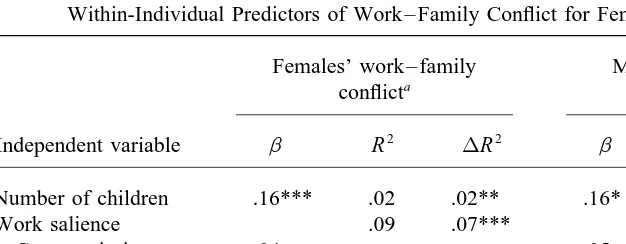
Hierarchical multiple regression analyses were used to test the hypotheses. Four regression models were computed: (1) the prediction of own WFC for females, (2) the prediction of own WFC for males, (3) the prediction of female partners’ WFC, and (4) the prediction of male partners’ WFC. In each analysis, the total number of children living at home was entered in the first block as a control variable, because this variable has been shown to be a significant predictor of WFC in previous research (e.g., Goff et al., 1990; Holahan & Gilbert, 1979). In the next block, the work salience measures of career priority and work involvement were entered. Perceived work schedule flexibility was entered in the third block, followed by family involvement in the fourth block, and WFC in the last block (when predicting partners’ WFC). Within-individual effects. Table 3 depicts the results for the prediction of WFC from females’ and males’ own work and family variables. All reported betas are from the full regression model. The control variable, number of children, accounted for a significant amount of variance in WFC for both females and males (i.e., 2 and 3%, respectively). Hypothesis 1 predicted that there would be a significant positive relationship between work salience and WFC. Examination of theDR2
HAMMER,
ALLEN,
AND
GRIGSBY
TABLE 2
Within-Individual and Crossover Pearson Correlation Coefficients for Study Variables
Variable 1 2 3 4 5 6 7 8 9 10
1. Work – family conflict for females .22** .13** .06 0.25** .23** .00 .05 0.05 0.09
2. Work involvement for females 0.24** .21** 0.02 .01 .13** 0.03 0.11* .07
3. Family involvement for females 0.16** .02 .10* 0.05 .17* .13** 0.01
4. Career priority for females 0.05 0.15** 0.11* .12* 0.61** 0.06
5. Perceived flexibility for females .01 .04 .08 .03 .10*
6. Work – family conflict for males .19** .04 .14** 0.17**
7. Work involvement for males 0.24** .24** .11*
8. Family involvment for males 0.16** 0.11*
9. Career priority for males .08
10. Perceived flexibility for males
TABLE 3
Within-Individual Predictors of Work – Family Conflict for Females and Males
Females’ work – family Males’ work – family
conflicta conflictb
Independent variable b R2
DR2
b R2
DR2
Number of children .16*** .02 .02** .16* .03 .03***
Work salience .09 .07*** .08 .05***
Career priority .04 .05
Work involvement .28*** .21***
Perceived flexibility 0.24*** .14 .05*** 0.16*** .11 .03*** Family involvement .18*** .17 .03*** 0.07 .12 .00
aR
Å.41, F(5, 389)Å15.69, põ.001.
bR
Å.34, F(5, 391)Å10.26, põ.001. *p£.05; **p£.01; ***p£.001.
and accounted for 5% of the variance (põ.001) in males’ WFC. Furthermore, for both men and women, thebvalues for career priority were not significant, while thebvalues for work involvement were significant (bÅ.28, põ.001 for females;bÅ.21, põ.001 for males), indicating that higher levels of work involvement were related to higher levels of WFC. Therefore, Hypothesis 1 was supported, primarily due to the work involvement measure.
Hypothesis 2 predicted that there would be significant negative relationship between perceived work schedule flexibility and WFC. Perceived work sched-ule flexibility accounted for 5% of the variance (b Å 0.24, p õ .001) in females’ WFC, while accounting for 3% of the variance (b Å 0.16, p õ .001) in males’ WFC. Therefore, Hypothesis 2 was supported, indicating that higher levels of perceived work schedule flexibility were related to lower levels of WFC.
Hypothesis 3 predicted that there would be a significant positive relation-ship between family involvement and WFC. Examination of theDR2
revealed a significant amount of variance accounted for by family involvement in WFC for females, but not for males. Specifically, family involvement for females accounted for 3% of the variance (b Å.18, p õ .001) in WFC, indicating that higher levels of family involvement were related to higher levels of WFC. Therefore, Hypothesis 3 was only partially supported.
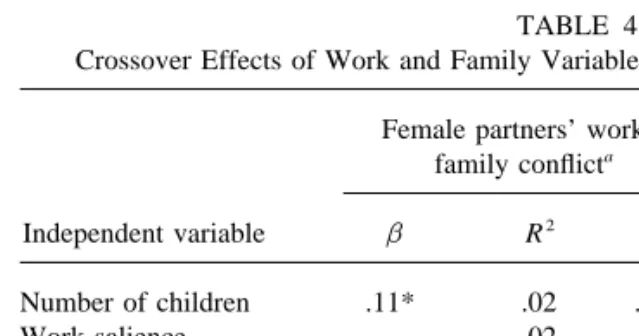
TABLE 4
Crossover Effects of Work and Family Variables on Partners’ Work – Family Conflict
Female partners’ work – Male partners’ work – family conflicta family conflictb
Independent variable b R2
DR2
b R2
DR2
Number of children .11* .02 .02** .12* .03 .03***
Work salience .02 .00 .05 .02*
Career priority 0.07 0.15**
Work involvement 0.01 .01
Perceived flexibility 0.04 .03 .00 .05 .05 .00
Family involvement 0.01 .03 .00 .04 .06 .01
Work – family
conflict .22*** .07 .04*** .24*** .11 .05***
aR
Å.27, F(6, 390)Å5.18, põ.001.
bR
Å.33, F(6, 388)Å7.67, põ.001. *p£.05; **p£.01; ***p£.001.
Hypothesis 4, that there would be significant positive relationship between an individual’s work salience and their partner’s level of WFC, failed to reveal significant effects for males’ work salience on females’ WFC; however, a significant amount of variance was accounted for by females’ work salience on males’ WFC (DR2
Å2%, põ.05). Furthermore, thebfor career priority was significant (bÅ 0.15, põ.01), while thebfor work involvement was not significant. This indicates that males’ WFC was higher when females placed greater priority on their partners’ career compared to their own career, contrary to what was expected.
Perceived flexibility was not significantly related to partners’ level of WFC for females or males (Hypothesis 5), nor did family involvement account for a significant amount of variance in partners’ level of WFC (Hypothesis 6). Therefore, neither Hypothesis 5 or 6 was supported.
DISCUSSION
Within-Individual Effects
The finding that work salience, specifically work involvement, accounted for a significant amount of variance in WFC for both males and females supports previous research on the relationship between work involvement and WFC (e.g., Frone & Rice, 1987; Greenhaus et al., 1989). It has been suggested that people with high levels of psychological involvement in their work role may be more preoccupied with their work and, hence, may devote an excessive amount of energy to their work role at the expense of their family role, resulting in WFC (Greenhaus et al., 1989). Furthermore, the career priority measure did not affect males’ or females’ WFC. This finding is contrary to findings by Greenhaus et al. that career priority was positively related to females’ WFC. This is surprising, considering that females in the present study had slightly higher levels of career priority and similar levels of WFC, compared to the females in the Greenhaus et al. study. Problems with the measure of career priority, as mentioned under limitations, may have contrib-uted to the discrepant results.
The finding that perceived work schedule flexibility accounts for a signifi-cant amount of variance in WFC is consistent with research on perceived control and perceived flexibility (e.g., Duxbury, Higgins, & Lee, 1994; Pierce et al., 1989; Thomas & Ganster, 1995). This study suggests that perceived control over work schedule reduces WFC, consistent with suggestions by Pierce et al. (1989). Factors that contribute to this perception are not clearly understood, however. Thus, further research is needed on the construct of perceived work schedule flexibility and on the broader construct of flexibility in the work place.
The finding that family involvement accounted for a significant amount of variance in WFC for females but not for males is partially consistent with previous research and theory that has indicated a positive relationship between family involvement and WFC for both genders (Greenhaus & Beutell, 1985; Greenhaus & Kopelman, 1981). The present study’s findings are especially interesting in light of the mean levels of work and family involvement for males and females. The mean level of family involvement for males was significantly higher than the mean family involvement for females (i.e., 3.83 and 3.66, respectively), while the mean level of work involvement was not significantly different between males and females (i.e., 2.45 and 2.43, respec-tively).
Hochschild (1989) demonstrated that husbands of working wives do not spend significantly more time in family work compared to husbands of nonworking wives. Mederer (1993) further discussed the difficulties in measuring family work by distinguishing task accomplishment from the orchestration, or man-agement, of the household. Although men are participating more in the task accomplishment aspect, they do not seem to be taking on much of the overall management responsibilities (Hochschild, 1989; Mederer, 1993).
The amount of time one spends in a particular role and the amount of psychological commitment to a role are influenced by a number of factors including traditional gender role expectations (Duxbury & Higgins, 1991; Gutek et al., 1991; Hochschild, 1989; Pleck, 1977, 1985). The men in this study may be participating in family tasks, contrary to traditional gender role expectations, and, in turn, perceive that they are highly involved in the family because their role participation is more salient to them (Gutek et al., 1991; Pleck, 1977). Furthermore, the women in this study may be doing most of the family tasks and family management, but because the tasks are more consistent with traditional role expectations, they may not report levels of involvement in the family role that are comparable to that of their male partners (Gutek et al., 1991). The study’s findings of greater perceived WFC for females compared to that for males suggest that the women are having more difficulty in juggling the multiple demands of work and family than are their male partners, consistent with previous research on WFC (Gutek et al., 1991; Hochschild, 1989). Some suggest that higher levels of WFC correspond to greater amounts of time devoted to the work and family roles (Greenhaus & Beutell, 1985; Gutek et al., 1991). This rational view (Gutek et al.) would support the present findings that although men reported higher psychological involvement in the family role, women may have been spending more time in the family role, while spending approximately the same amount of time in the work role (i.e., 41 vs. 46 average hours per week for females and males, respectively), resulting in higher WFC and lower family involvement, compared to that for men.
Finally, the finding of greater perceived work schedule flexibility for men compared to women is puzzling, and contrary to previous research (Greenhaus et al., 1989). Future studies on dual-earner couples’ need for, use of, and perceptions of family supportive programs in the work place are needed. Crossover Effects
The most notable contribution of the present study was the examination of the effects of males’ and females’ work and family variables on their partners’ WFC. Consistent with theory and research, it was expected that a partner’s degree of involvement in work and family activities, and a partner’s level of WFC would affect the amount of stress, or WFC, the other partner experiences (Parasuraman et al., 1992; Yogev & Brett, 1985).
family involvement did not have significant effects on females’ WFC, fe-males’ work salience was a significant predictor of fe-males’ WFC. Fefe-males’ perceived flexibility of work schedule and family involvement were not sig-nificant predictors of males’ WFC, however. Specifically, WFC was higher for males when their female partners placed more priority on the male part-ners’ career than on their own career. Perhaps for males, knowing that their career was given priority over their partners’ career caused increased pressure to perform in that career. Furthermore, these same males indicated having higher levels of family involvement than did the females. It should be noted, however, that the amount of variance accounted for in males’ WFC by fe-males’ career priority (i.e., 2%), although statistically significant, may not be practically significant.
The most interesting findings of the present study were those of WFC having strong crossover effects for both males and females, indicating that an individual’s level of WFC was a significant predictor of their partner’s level of WFC. In fact, partners’ WFC accounted for more variance in WFC than did the other crossover effects studied (i.e., work salience, perceived work schedule flexibility, and family involvement). Furthermore, these results demonstrated that for males, crossover effects from their partners’ work and family variables accounted for almost as much variance in WFC as did the within-individual effects (i.e., 11 and 12%, respectively). For females, cross-over effects from their partners’ work and family variables accounted for 7% of the variance in WFC, compared to 17% of the variance in WFC accounted for by within-individual effects. These crossover findings are both statistically and practically significant, considering that much of the research on WFC has only focused on within-individual effects.
Post hoc exploratory analyses demonstrated that crossover effects added explanatory variance in partners’ WFC above and beyond the within-individ-ual effects. In fact, the additional variance explained (i.e., 5% in males’ WFC and 4% in females’ WFC) suggests that even studies with a primary focus on within-individual predictors of WFC can be enhanced by studying the crossover effects. These results further strengthen the argument that research-ers should examine the crossover effects of work and family variables within the family system to better understand the factors that contribute to WFC. Limitations and Future Research
family lives were the very people who could not take the time to be inter-viewed. If this were the case, it would suggest that our results would be weakened due to restricted variance in the study variables.
Furthermore, all respondents were either bank employees or in a relation-ship with a bank employee. Thus, generalizations to other groups of employees in various careers may be limited. This is consistent with research findings of occupational differences in the relationship between role stressors and WFC (Bacharach & Bamberger, 1992). Additionally, couples who participated in the study were all male/female couples whose average age was 41, and 92% of the couples were Caucasian. Similar investigations with culturally diverse couples, including gay and lesbian couples (e.g., Shachar & Gilbert, 1983), are needed.
It should also be noted that the present findings are specific to dual-earner couples similar to the ones who participated in the study. These couples worked an average of 41 (females) and 46 (males) hours per week and held a mixture of professional and nonprofessional jobs. They also spent an average of 9 years in these jobs. These findings would suggest that there was a combination of dual-career and dual-earner couples in the sample. Therefore, we chose to use the more generic descriptor of earner rather than dual-career. Future research should include measures such as career commitment and occupational level to enhance understanding of the differences between the dual-earner and dual-career couples (e.g., Gilbert & Rachlin, 1987).
There are also limitations due to the reliance on self-report, subjective, cross-sectional data. Future research should use methods such as experience sampling (Williams & Alliger, 1994) to better understand the dynamics of WFC within dual-earner couples. Further, the differences in subjective mea-sures of work and family involvement and objective meamea-sures of such involve-ment are important to consider. For example, in the present study although men reported higher perceived family involvement compared to women, re-search has demonstrated that the actual amount of time that women spend on family-related tasks is far greater than the time that men spend on such tasks (e.g., Dancer & Gilbert, 1993; Hochschild, 1989; Pleck, 1985). Thus, higher scores on such measures reflect the perception of greater involvement, not necessarily the actual behavioral commitment of the respondents. Further-more, the measure of career priority may be a function of traditional gender role expectations about which career should be given priority in a relationship. This measure assesses the relative priority of one’s career compared to his or her partner’s career, and thus may not be comparable across respondents or samples.
WFC by crossover effects of work and family variables. Furthermore, previ-ous research has found that such factors as work stressors and task characteris-tics (e.g., Greenhaus et al., 1989) and family role stressors (Frone et al., 1992) are significant predictors of individual WFC. In addition, future studies should obtain information on the allocation of resources, such as the amount of outside help a couple has with dependent care and housework, as well as information on child care responsibilities, and elder and disabled care respon-sibilities. Social support from the family, as well as organizational support factors, should be examined when studying crossover effects on WFC.
Therefore, future research should seek to understand additional factors that account for a significant amount of variance in the crossover effects of part-ners’ work and family variables on individuals’ WFC using the couple as the unit of analysis. These studies should use longitudinal designs with both objective (including task accomplishment and household management; Hochschild, 1989; Mederer, 1993) and subjective measures that are common to both partners in dual-earner couples.
CONCLUSION
The present study examined the within-individual and crossover effects of work and family variables and WFC among dual-earner couples. Results from analyses on within-individual effects of work and family variables on WFC were, for the most part, consistent with previous research. Results from analy-ses on crossover effects of work and family variables on a partner’s level of WFC were the main focus of the present study and extend research and understanding in the area of WFC and dual-earner couples.
Organizations need to deal more effectively with the ever-changing work force by attempting to understand and anticipate adjustments needed in work roles, family roles, and organizational structures that support workers’ abilities to adapt to these changes. Social and political changes in organizations should also include attention to dual-earner couples who carry their own specific set of needs. Those companies that make adjustments to their policies and allow workers more flexibility in their work and family roles may enable a culture to develop that is more supportive of the majority of the workers who are now in dual-earner relationships.
REFERENCES
Bacharach, S., & Bamberger, P. (1992). Causal models of role stressor antecedents and conse-quences: The importance of occupational differences. Journal of Vocational Behavior, 41, 13 – 34.
Bedian, A. G., Burke, B. G., & Moffett, R. G. (1988). Outcomes of work – family conflict among married male and female professionals. Journal of Management, 14, 475 – 491.
Burke, R. J. (1988). Some antecedents and consequences of work – family conflict. Journal of
Social Behavior and Personality, 3, 287 – 302.
Christensen, K. E., & Staines, G. L. (1990). Flextime: viable solution to work/family conflict?
Dancer, L. S., & Gilbert, L. A. (1993). Spouses’ family work participation and its relation to wives’ occupational level. Sex Roles, 28, 127 – 145.
Duxbury, L. E., & Higgins, C. A. (1991). Gender differences in work – family conflict. Journal
of Applied Psychology, 76, 60 – 74.
Duxbury, L., Higgins, C., & Lee, C. (1994). Work – family conflict: A comparison by gender, family type, and perceived control. Journal of Family Issues, 15, 449 – 466.
Frone, M. R., & Rice, R. W., (1987). Work – family conflict: The effect of job and family involve-ment. Journal of Occupational Behavior, 8, 45 – 53.
Frone, M. R., Russell, M., & Cooper, M. L. (1992). Antecedents and outcomes of work – family conflict: Testing a model of the work – family interface. Journal of Applied Psychology, 77, 65 – 78.
Gilbert, L. A., & Rachlin, V. (1987). Mental health and psychological functioning of dual-career families. The Counseling Psychologist, 15, 7 – 49.
Goff, S. J., Mount, M. K., & Jamison, R. L. (1990). Employer supported child care, work/family conflict, and absenteeism: A field study. Personnel Psychology, 43, 793 – 809.
Greenhaus, J. H., & Beutell, N. J. (1985). Sources of conflict between work and family roles.
Academy of Management Review, 10, 76 – 88.
Greenhaus, J. H., & Kopelman, R. E. (1981). Conflict between work and nonwork roles: Implica-tions for the career planning process. Human Resource Planning, 4, 1 – 10.
Greenhaus, J. H., Parasuraman, S., Granrose, C. S., Rabinowitz, S., & Beutell, N. J. (1989). Sources of work – family conflict among two-career couples. Journal of Vocational Behavior,
34, 133 – 153.
Grigsby, T., & Hammer, L. B. (April, 1994). The effects of the number of hours worked, type
of work schedule, and perceived flexibility of work schedule on work – family conflict. Paper
presented at the Society for Industrial/Organizational Psychology Conference, Nashville, TN.
Gupta, N., & Jenkins, G. D. (1985). Dual-career couples: Stress, stressors, strain, and strategies. In T. A. Beehr & R. S. Bhagat (Eds.), Human stress and cognition in organizations: An
integrated perspective (pp. 141 – 175). New York: Wiley – Interscience.
Gutek, B. A., Searle, S., & Klepa, L. (1991). Rational versus gender role explanations for work – family conflict. Journal of Applied Psychology, 76, 560 – 568.
Holahan, C. K., & Gilbert, L. A. (1979). Conflict between major life roles: Women and men in dual career couples. Human Relations, 32, 451 – 467.
Hochschild, A. (1989). The second shift. New York: Avon Books.
Jones, F., & Fletcher, B. C. (1993). An empirical study of occupational stress transmission in working couples. Human Relations, 46, 881 – 903.
Karambayya, R., & Reilly, A. H. (1992). Dual earner couples: Attitudes and actions in restructur-ing work for family. Journal of Organizational Behavior, 13, 585 – 601.
Kopelman, R., Greenhaus, J. H., & Connolly, T. F. (1983). A model of work, family, and interrole conflict: A construct validation study. Organizational Behavior and Human Performance,
32, 198 – 215.
Lambert, S. (1990). Processes linking work and family: A critical review and research agenda.
Human Relations, 43, 239 – 257.
Lodahl, T. M., & Kejner, N. (1965). The definition and measurement of job involvement. Journal
of Applied Psychology, 49, 24 – 33.
Loerch, K. J., Russell, J. E. A., & Rush, M. C. (1989). The relationships among family domain variables and work – family conflict for men and women. Journal of Vocational Behavior,
35, 288 – 308.
Mederer, H. J. (1993). Division of labor in two-earner homes: Task accomplishment versus household management as critical variables in perceptions about family work. Journal of
Offermann, L., & Gowing, M. (1990). Organizations of the future: Changes and challenges.
American Psychologist, 45, 95 – 108.
Parasuraman, S., Greenhaus, J. H., & Granrose, C. S. (1992). Role stressors, social support, and well-being among two-career couples. Journal of Organizational Behavior, 13, 339 – 356. Pierce, J. L., Newstrom, J. W., Dunham, R. B., & Barber, A. E. (1989). Alternative work
sched-ules. Boston: Allyn and Bacon.
Pleck, J. H. (1977). The work – family role system. Social Problems, 24, 417 – 425. Pleck, J. H. (1985). Working wives/working husbands. Newberry Park, CA: Sage.
Quinn, R., & Staines, G. (1979). The 1977 quality of employment survey. Ann Arbor: Univ. of Michigan, Survey Research Center.
Rapoport, R., & Rapoport, R. N. (1971). Dual-career families. London: Penguin.
Rice, R. W., Frone, M. R., & McFarlin, D. B. (1992). Work – nonwork conflict and the perceived quality of life. Journal of Organizational Behavior, 13, 155 – 168.
Sekaran, U. (1983). Factors influencing the quality of life in dual-career families. Journal of
Occupational Psychology, 56, 161 – 174.
Sekaran, U. (1986). Dual-career families. San Francisco: Jossey-Bass.
Shachar, S. A., & Gilbert, L. A. (1983). Working lesbians: Role conflicts and coping strategies.
Psychology of Women Quarterly, 7, 244 – 256.
Staines, G. L., Pottick, K. J., & Fudge, D. A. (1986). Wives’ employment and husbands’ attitudes toward work and life. Journal of Applied Psychology, 71, 118 – 128.
Swanson, J. L. (1992). Vocational behavior, 1989 – 1991: Life-span career development and reciprocal interaction of work and nonwork. Journal of Vocational Behavior, 41, 101 – 161. Thomas, L. T., & Ganster, D. C. (1995). Impact of family-supportive work variables on work – family conflict and strain: A control perspective. Journal of Applied Psychology, 80, 6 – 15. U. S. Bureau of Labor Statistics. (1995). Women in the workforce: An overview. Washington,
DC: Government Printing Office.
Watkins, C. E., & Subich, L. M. (1995). Annual review, 1992 – 1994: Career development, recip-rocal work/non-work interaction, and women’s workforce participation. Journal of
Voca-tional Behavior, 47, 109 – 163.
Westman, M., & Etzion, D. (1995). Crossover of stress, strain and resources from one spouse to another. Journal of Organizational Behavior, 16, 169 – 181.
Wilensky, H. L. (1960). Work, careers, and social integration. International Social Science
Jour-nal, 12, 543 – 560.
Williams, K. J., & Alliger, G. M. (1994). Role stressors, mood spillover, and perceptions of work – family conflict in employed parents. Academy of Management Journal, 37, 837 – 868. Yogev, S., & Brett, J. (1985). Patterns of work and family involvement among single- and
dual-earner couples. Journal of Applied Psychology, 70, 754 – 768.
Zedeck, S. (1992). Introduction: Exploring the domain of work and family concerns. In Zedeck (Ed.) Work, families, and organizations. San Francisco: Jossey-Bass.
Zedeck, S., & Mosier, K. (1990). Work in the family and employing organization. American
Psychologist, 45, 240 – 251.