UNIVERSITI TEKNIKAL MALAYSIA MELAKA
DEVELOPMENT OF PORTABLE CERAMIC GAS SENSOR
This report submitted in accordance with requirement of the Universiti Teknikal Malaysia Melaka (UTeM) for the Bachelor Degree of Manufacturing Engineering
(Engineering Materials) with Honours.
by
NURHAFIZA BINTI FADZIL
B050810326
i
ABSTRAK
Pengesan gas karbon monoksida daripada motorsikal telah digunakan pada zink oksida, pencantuman zink oksida/kuprum oksida, dan lapis zink oksida/kuprum oksida. Bahan tersebut dihancurkan dengan menggunakan lesung batu pestle dan ditapis dengan
menggunakan penapis bersaiz 40µm. Saiz zarah bagi serbuk zink oksida dan kuprum oksida ditentukan dengan menggunakan mesin analisa zarah. Kesemua sampel dihasilkan didalam bentuk pil dengan menggunakan mesin uniaxial dry pressing pada
tekanan 2 tan/cm³dan mesin cold isostatically pressing pada tekanan 28427.4 psi dan
dipanaskan pada suhu 800°C selama 3 jam. Sampel lapisan zink oksida/kuprum oksida pula dihasilkan dengan mengenakan tekanan berturut-turut pada serbuk zink oksida dan kuprum oksida didalam acuan dan dipanaskan pada suhu 800°C pada selama 3 jam. Sampel itu ditambah dengan pengikat seperti glycerol dan stearic acid untuk
menguatkan lagi green body. Semasa pemanasan dilakukan, bahan pengikat tadi di bakar
keluar pada suhu 295°C untuk glycerol dan 388°C untuk stearic acid selama 30 minit
dengan kadar pemanasan sebanyak 2°C/minit. Pengaruh daripada pemanasan dikaji dengan menggunakan SEM dan XRD. Respon daripada gas karbon monoksida diukur
ii
ABSTRACT
iii
DEDICATION
To my beloved parents for their boundless love and repeated encouragement
To my family members
iv
ACKNOWLEDGEMENT
Firstly, I would like to express my sincere gratitude to my supervisor, Dr.Jariah Binti Mohamed Juoi for their guidance, support, comments, and discussions. With their help, this research work has improved tremendously.
My appreciation also goes to the material lab technicians, Encik Sarman, Encik Azhar, Encik Hairul, and also Encik Safarizal for providing me with the necessary equipment to help in this final year project.
v
2.2 Ceramic for Electronics 10
2.3 Ceramic Gas Sensors 12
2.3.1 Semiconductor Gas Sensor 16
2.3.2 Heterocontact Ceramic Sensor 17
2.4 Hazardous Gas of Carbon Monoxide 18
2.5 Ceramic Fabrication Process 20
2.5.1 Forming of Ceramics 20
2.5.2 Additives and Ceramic Forming 22
2.5.2.1 Binder Removal 24
vi
2.6 Material Characterization 26
2.6.1 Morphological Characterization 26
3. CHAPTER 3 30
3.1 Introduction 30
3.2 Raw Materials 32
3.3 Experimental Methods 33
3.3.1 Fabrication of ZnO and CuO 33
3.3.2 Fabrication of Layered ZnO-CuO 35
3.3.2.1 Pressureless of layered ZnO and CuO 35
3.3.2.2 Cold Isostatically Pressure of layered ZnO and CuO 36
3.3.3 Preparation of electrical circuit 37
3.3.3.1 Revolution per minute 39
3.4 Characterization Method 40
3.4.1 X-Ray Diffraction (XRD) 41
3.4.2 Scanning Electron Microscope 41
3.4.2.1 Sample preparation 42
4. CHAPTER 4 43
4.1 Raw Material Characterization 43
4.1.1 Result for Particle Size 43
4.2.3 Discussion of Sample Preparation 48
4.2.3.1 Single ZnO / CuO 48
4.2.3.2 Layered ZnO/CuO 48
vii
4.3.1 Result for XRD Characterization of ZnO 49 4.3.2 Result for XRD Characterization of CuO 50
4.3.3 Discussion of XRD Characterization 50
4.4 SEM Characterization of Sintered ZnO and CuO 51 4.4.1 Result for SEM Characterization of Sintered ZnO and CuO 51 4.4.2 The effect of Sintering for ZnO and CuO pellet 52
4.5 Response of Carbon Monoxide, CO gas 52
4.5.1 Response of ZnO to CO gas 53
4.5.2 Response of ZnO/CuO heterocontact 53
4.5.3 Discussion of response to CO gas 54
4.5.3.1 ZnO sample 54
4.5.3.2 ZnO/CuO heterocontact sample 54
5. CHAPTER 5 55
5.1 Conclusions 55
5.2 Suggestions 56
REFERENCES 57
APPENDICES A Gantt Chart
viii
LIST OF TABLES
1.1 Global Environment Problems and Related Substances 1
2.1 Application of Advanced Ceramics Classified by Function 6 2.2 Ceramic Materials and their Applications 10 2.3 Example of applications for gas sensors and electronic noses 13 2.4 Types of solid state gas sensors with the corresponding physical change 15
used as gas detection principle (Capone et al, 2003)
2.5 Feed Materials and Shapes of the Green Body for the Common 22 Ceramic Forming Methods
2.6 Sintering Processes for Some Ceramic Compositions 25
3.1 Chemical properties of Zinc Oxide and Copper Oxide 32 3.2 Chemical properties of Glycerol and Stearic Acid 33 3.3 Lower rpm of motorcycle and higher rpm of motorcycle 39
4.1 ZnO and ZnO/CuO heterocontact sample in air 52
4.2 Result for ZnO sample 53
ix
LIST OF FIGURES
2.1 Range of electronic (right-hand side) and ionic (left-hand side) 11 conductivities in fi~' cm^1 exhibited by ceramics and some of their uses 2.2 Ceramic sensors: Properties, Materials and Functions 14 2.3 AutoCAD drawing of the sensor structure, with an interdigitated 19
electrode area of 1.10mm x 0.99 mm, and two electrode contacts located at opposite (Xu.C.J, et.al, 2009)
2.4 Granule and pore size change during compaction process 21 (J.S. Reed, 1995)
2.5a Micrographs of unmodified 27
2.5b Micrographs of CuO-modified (for 15 min) 27
2.5c CuO-modified (for 60 min) samples 27
2.6a SEM micrographs of the fractured surface of ZS2 28 2.6b SEM micrographs of the fractured surface of ZS2A1 28 2.6c SEM micrographs of the fractured surface of ZS2C1 28 2.7a SEM micrograph of the ground faces of the dense zinc oxide 29 2.7b SEM micrograph of the ground faces of the dense copper oxide 29 2.7c SEM micrograph of the ground faces of the porous zinc oxide 29 2.7d SEM micrograph of the ground faces of the porous copper oxide 29
3.1 Process Flow Chart for ceramic sensor 31
3.2 Zinc Oxide, Copper Oxide and Stearic Acid 32 3.3 Process flow for fabrication of ZnO and CuO 34
3.4 Sintering process for ZnO and CuO 35
3.5 Flow chart for preparation of layered ZnO-CuO 36
3.6 Sintering process for layered ZnO-CuO 37
3.7a Schematic diagram for the I-V and the CO gas sensitivity 38 measurement of single-phase ZnO pellets
x
measurement of layered- type ZnO-CuO pellets.
3.8 Sanwa Digital Multimeter Model CD771 38
3.9a Equipment that have been used for measured rpm at motorcycle 40 - HT-4100 Digital Tachometer
3.9b Tape that used to stick at magnetic coil motorcycle to make the 40 reading of rpm
3.10 Process flow for sample preparation before SEM 42
4.1 Range of particle size for ZnO 44
4.2 Range of particle size for CuO 44
4.3a Layered ZnO-CuO pellet for CIP fully crack to small size 47 4.3b Layered ZnO-CuO pellet that crack in the middle 47 4.3c Zinc Oxide and Copper Oxide pellet for single phase 47
4.3d Layered ZnO-CuO before sintering 47
4.4 Diameter for each sample before sintered 47 4.5 XRD patterns of sintered ZnO ceramic at 800°C 49 4.6 XRD patterns of sintered CuO ceramic at 800°C 50 4.7a SEM micrograph for sintered ZnO - surface of sintered ZnO samples 51 4.7b SEM micrograph for sintered ZnO - cross-section in sintered ZnO 51
samples
4.7c SEM micrograph for sintered CuO - surface of sintered CuO samples 51 4.7d SEM micrograph for sintered CuO - cross-sectional in sintered CuO 51
xi
PLZT - Polarized Lead Zirconium Titanate ppb - part per billion
ppm - part per million
xii
SEM - Scanning Electron Microscope SiC - Silicon Carbide
Si3N4 - Silicon Nitride
SnO2 - Tin Dioxide
SOx - Sulfur Dioxide SrTiO3 - Strontium Titanate
ThO2 - Thorianite
TiO2 - Titanium Dioxide
TiC - Titanium Carbide UO2 - Uranium Dioxide
V2O5 - Vanadium (V) Oxide
XRD - X-Ray Diffractor Y2O3 - Yttrium Oxide
ZnO - Zinc Oxide ZrO2 - Zirconium Oxide
°C - Celsius
µm - Micrometer
1
CHAPTER 1
INTRODUCTION
1.1 Background of Study
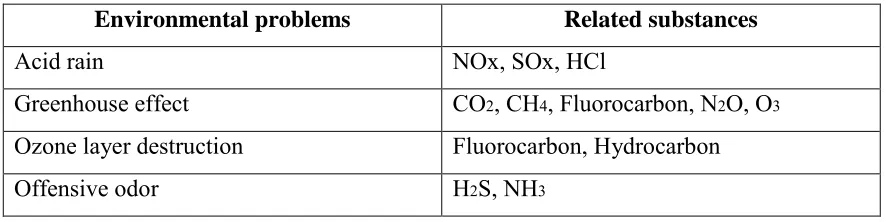
In recent year, world awareness on environmental problems continues to increase. The continuous release to the atmosphere of chemical pollutants, originating mainly from combustion processes, is the main cause of the deterioration of environmental quality. The development of new methods to air monitor polluted gases in the air is of primary concern for the knowledge of the extension of the environmental deterioration. Measurements of gas concentration in air are being carried out mostly by analytical instruments, which are precise, but also very costly. They often cannot be placed on-site and need long periods for data acquisitions. Table 1 shows the global environmental problems such as acid rain, the green house effect, and ozone layer destruction
Table 1.1 : Global Environment Problems and Related Substances Environmental problems Related substances
Acid rain NOx, SOx, HCl
Greenhouse effect CO2, CH4, Fluorocarbon, N2O, O3
Ozone layer destruction Fluorocarbon, Hydrocarbon
Offensive odor H2S, NH3
2
dioxide, and many more. With growing the population that the more reliant on automobiles, chemicals, and other potentially hazardous substances, air pollutants can cause major health problems to your health. Some obvious causes of air pollution maybe came from car, but there are many not so obvious products that may use every day that are potentially damaging to healthcare (Fitzpatrick, 2006).
Nowadays, many types of sensors have been developed such as mechanical and electromechanical sensors, thermal sensors, magnetic sensors, radiation sensors, electro analytical sensors, smart sensors, and the latest biosensors. All these sensors are used based on their type. In addition, it also used to detect environmental pollution such as air pollution, noise pollution, light pollution, soil pollution, visual pollution, radioactive contamination and also water pollution.
In this research, function of ceramic sensor is to detect carbon monoxide (CO) gases that are the one of hazardous gases in Malaysia. The type of ceramic material that used for this research is Zinc Oxide (ZnO) and Copper Oxide (CuO). The sensors are going to be produced using powder processing method, sintering, electrical, and testing using XRD and SEM.
1.2 Problem Statement
The detection of hazardous gases is a common need in industrial and domestic environments. The term “hazardous” includes both toxic and combustible gases. Many applications, such as home safety, do not require an exhaustive analysis of the gas, but an alarm level detection (Mandayo, etc al, 2002)
3
gas is harmful when breathed because it displaces oxygen in the blood and deprives the heart, brain, and other vital organs of oxygen. Large amounts of CO can overcome in minutes without warning-causing to lose consciousness and suffocate. According to Occupational Safety and Health Administration (2002), besides tightness across the chest, initial symptoms of CO poisoning may include headache, fatigue, dizziness, drowsiness, or nausea. Sudden chest pain may occur in people with angina. During prolonged or high exposures, symptoms may worsen and include vomiting, confusion, and collapse in addition to loss of consciousness and muscle weakness. Symptoms vary widely from person to person. CO poisoning may occur sooner in those most susceptible: young children, elderly people, people with lung or heart disease, people at high altitudes, or those who already have elevated CO blood levels, such as smokers. Also, CO poisoning poses a special risk to fetuses.
1.3 Objectives of Study
The main aim of this research is to develop ceramic gas sensor using compacted of ceramic oxide. This objective is focus on:
i. To produce ceramic oxide gas sensor.
ii. To characterize of the sintered ceramic oxide.
iii. To compare the ZnO/CuO heterocontact sensor with layered ZnO-CuO ceramic sensor.
1.4 Scope of Study
4
1.5 Importance of Research
5
CHAPTER 2
LITERATURE REVIEW
This chapter discuss on related study based on the previous research conducted by other researchers on development of ceramic sensors. The literature review mainly focused on the theory of ceramic materials and the process of the ceramic sensors.
2.1 Ceramic Materials
6
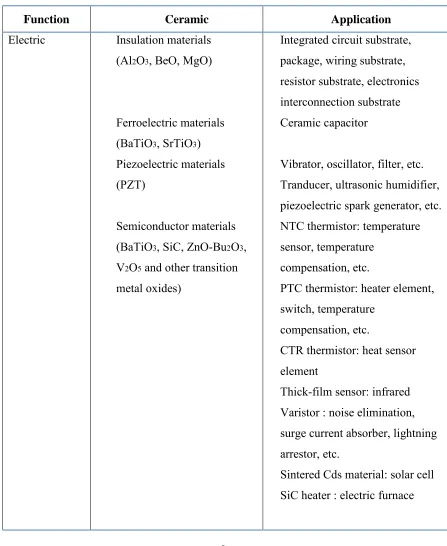
illustrates some of the applications for advanced ceramics. These applications use the wide range of properties exhibited by ceramics. The functions of ceramics products are dependent on their chemical composition and microstructure, which determines their properties (Carter and Norton, 2007).
Table 2.1 : Application of Advanced Ceramics Classified by Function (Rahaman, M.N, 2003)
Function Ceramic Application
Electric Insulation materials
7
8
Artificial toot root, bone and joint.
Nuclear fuels Cladding materials Shielding materials