Performance-aware Load Balancing for Multiclusters
∗
Ligang He, Stephen A. Jarvis, David Bacigalupo, Daniel P. Spooner and Graham R. Nudd
Department of Computer Science, University of Warwick Coventry, CV4 7AL, United Kingdom
Abstract. In a multicluster architecture, where jobs can be submitted through each constituent cluster, the job arrival rates in individual clusters may be un-even and the load therefore needs to be balanced among clusters. In this paper we investigate load balancing for two types of jobs, namely non-QoS and
QoS-demanding jobs and as a result, two performance-specific load balancing
strate-gies (called ORT and OMR) are developed. The ORT strategy is used to obtain the optimised mean response time for non-QoS jobs and the OMR strategy is used to achieve the optimised mean miss rate for QoS-demanding jobs. The ORT and OMR strategies are mathematically modelled combining queuing network theory to establish sets of optimisation equations. Numerical solutions are developed to solve these optimisation equations, and a so called fair
work-load level is determined for each cluster. When the current workwork-load in a cluster
reaches this pre-calculated fair workload level, the jobs subsequently submitted to the cluster are transferred to other clusters for execution. The effectiveness of both strategies is demonstrated through theoretical analysis and experimental verification. The results show that the proposed load balancing mechanisms bring about considerable performance gains for both job types, while the job transfer frequency among clusters is considerably reduced. This has a number of advantages, in particular in the case where scheduling jobs to remote re-sources involves the transfer of large executable and data files.
1. Introduction
As grid technologies gain in popularity, separate clusters are increasingly being inter-connected to create multicluster computing architectures for the processing of scien-tific and commercial applications [1][2][5]. These constituent clusters may be located within a single organization or across different geographical sites [3][6]. Load balanc-ing across such architectures is recognised as a key research issue. If users located at different administrative domains submit jobs through domain-specific portals, there may be different submission patterns. Without intervention, this may lead to an un-balanced workload distribution among different domains; and the overall performance may be compromised.
Performance requirements are likely to vary depending on the job type. When the jobs have associated QoS demands (which we call QoS-demanding jobs or QDJs), performance is usually used to measure the extent of QoS-demand compliance; when jobs have no associated QoS demands (which we call non-QoS jobs or NQJs), a common performance criteria is to reduce the mean response time [9][12]. An exam-ple of the QoS is job slack [10][14]. The QoS of a job is satisfied if the job' waiting time (in the system) is less than its slack [15]; otherwise, the QoS is failed. Mean miss rate captures the aggregate slack failure and is therefore used as a performance metric to measure the proportion of jobs whose QoS demands fail.
In this paper, load balancing techniques are addressed for both QoS-demanding jobs (QDJs) and non-QoS demanding jobs (NQJs) to improve the job type-specific performance requirements in a multicluster. Two multicluster load balancing strate-gies, Optimised mean Response Time (ORT) and Optimised mean Miss Rate (OMR), are developed. The aim of ORT is to achieve optimised mean response time for NQJ workloads and the aim of OMR is to achieve the optimised mean miss rate for QDJ workloads. The ORT and OMR strategies are mathematically modelled combining queuing network theory to establish sets of optimisation equations. Numerical solu-tions are developed to solve the optimisation equation sets and determine a fair work-load level for each cluster. When the current workwork-load in a cluster reaches the pre-calculated fair workload level, the jobs subsequently submitted to the cluster are transferred to remote less-loaded clusters for execution.
There are a number of established workload allocation techniques in parallel and distributed systems [12][9]. A static workload allocation strategy is investigated in [12] to achieve the optimised mean response time; this strategy is specifically limited to a single cluster environment. Workload allocation techniques for multiclusters are addressed in [9] where it is assumed that the multicluster has a central entry point for the receipt of submitted jobs. In this paper, we assume that jobs can be submitted through each local cluster, and therefore the further problems brought about by the uneven submission patterns of jobs at the clusters also needs to be considered.
The problem of uneven job arrival patterns in different resources is addressed in a number of load balancing techniques [8][13]. A load balancing mechanism is pre-sented in [8] for multi-domain environments. The mechanism identifies the least loaded computer among all domains and when a job is submitted to the system it is scheduled on that computer, whichever domain the job is actually submitted to. Hence, a job has to be transferred to a remote domain if the local domain does not contain the current least loaded computer.
In this paper however, a fair workload level is calculated for each cluster. Only when the current workload in a cluster exceeds its specified fair workload, does the cluster transfer the newly submitted job to a remote cluster. Although the load balanc-ing technique presented in this paper may not achieve the best possible response time for a specific job, theoretical analysis and experimental studies show that considerable performance gains are still achieved in terms of the jobs' mean response time. More-over, the job transfer frequency among clusters is dramatically reduced. This is desir-able when jobs require the transfer of large executdesir-able and data files.
that for NQJs, except that a fair workload level for each cluster is otherwise calculated to obtain the optimised mean miss rate for the QDJs.
The rest of the paper is organized as follows. The system and workload model is discussed in Section 2. Section 3 presents the load balancing techniques for NQJs and QDJs in multiclusters. The performance of these techniques is evaluated in Section 4. Section 5 concludes the paper.
2. System and workload model
Job submission
Processing computers Local Schedulers
Waiting queues
…
… …
Agent MUSCLE
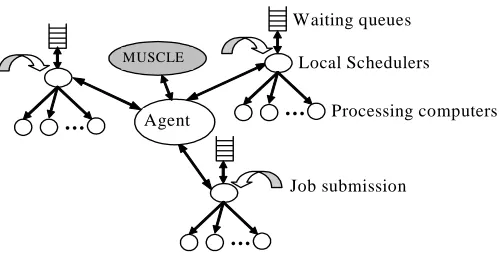
Fig. 1. The multicluster architecture
The multicluster architecture assumed in this paper is shown in Fig.1. The system consists of n different clusters, where each cluster comprises a set of homogeneous computers. Cluster i (1≤i≤n) is modelled using an M/M/mi queue, where mi is the number of computers in cluster i. Jobs can be submitted through each local cluster, where they are queued for scheduling. The clusters in the multicluster are intercon-nected through an agent system [7], which is able to monitor the job submission in each cluster and determine the mean arrival rate of the jobs submitted to the entire multicluster. The mean arrival rate is utilized by the multicluster workload manager (which we call MUSCLE) to calculate the fair workload level for each cluster through the ORT and OMR strategies (for NQJs and QDJs, respectively).
3. Load Balancing Techniques
Suppose that the mean arrival rate of the jobs submitted to the multicluster is λ. The overall performance of the job execution depends on the workload distribution among the clusters. The fair workload level for each cluster, measured by the mean number of jobs in its waiting queue, is determined in this section. The approaches for NQJs and QDJs differ as they have different performance requirements.
3.1 ORT (Optimised mean Response Time) strategies for NQJs
The ORT strategy aims to optimise the mean response time of the NQJs in the multi-cluster. The response time of a job is defined as the time from when the job arrives at the system until it is completed. The following analysis first establishes the tion equations for the mean response time, then a numerical solution to the optimisa-tion equaoptimisa-tions is developed and the fair workload level is determined.
The response time of a job is its waiting time in the queue plus its execution time. Hence, the average response time of the jobs in cluster i, denoted as Ri, can be com-puted using Eq.1, where Wi is the mean waiting time of the jobs in cluster i and ui is the service rate of the computers in cluster i.
i According to queueing theory [11], the mean waiting time of jobs, , is computed using Eq.2, where ρ
i
W
i is the utilization of cluster i and W0i is the mean remaining exe-cution time of the jobs in service when a new job arrives.
i
The formula for W0i is given in Eq.3 [4], where Pmi is the probability that the sys-tem has no less than mi jobs.
Using Eqns.1-5, the formula for Ri, in terms of αi, is derived and is shown in Eq.6.
Thus, the mean response time of the incoming jobs over these n clusters, denoted by R, can be computed - see Eq.7.
Hence, in order to achieve the optimal mean response time of the job stream in the multicluster, the aim is to find a workload allocation {α1, α2…,αn} that minimizes
that cluster i does not become saturated). This is a constrained-minimum problem and according to the Lagrange multiplier theorem, solving this problem is equivalent to solving the following equation set.
⎪ to Eq.9 by solving the partial differential equations in Eq.8.b.
⎪ however, we identify a property of Eq.9.b that enables us to develop a numerical solu-tion. The property is shown in Theorem 1 (the proof is omitted). Based on this prop-erty, we develop a numerical solution to solve Eq.9 and therefore derive the optimised workload allocation {α1, α2…,αn}. The numerical solution is shown in Algorithm 1.
Algorithm 1 Computation of workload allocation among
clusters for optimised mean response time
1. Let lower and upper limits of the mean response time be v_lower and v_upper;
2. while (v_lower≤v_upper)
5. if (v_mid<
0
| )
( =
∂∂ i i i i
Rα α
α )
6. αi=0;
7. else if (v_mid>
λ
i iu
m )
8. v_upper=v_mid; 9. continue;
10. while (α_lower≤α_upper)
11. α_mid=(α_lower+α_upper)/2; 12. v_cur=
mid i i
i i
R )| _ ( α α α
α =
∂∂ ;
13. if (the difference between v_cur and
v_mid is less than v_valve)
14. αi=α_mid;
15. if (v_cur is less than v_mid) 16. α_lower=α_mid;
17. else
18. α_upper=a_mid; 19. end for
20. α_sum=
∑
;21. if (the difference between α_sum and 1 is less than α_valve)
22. the current set of α
=
n
i i
1
α
i (1≤i≤n) is the
cor-rect workload allocation;
23. else if (α_sum is less than 1) 24. v_lower= v_mid;
25. else
26. v_upper= v_mid; 27. end while
Since a binary search technique is used to search for v and αi in their respective search spaces [v_lower, v_upper] and [α_lower, α_upper], the time complexity of Algorithm 1 is O(nlogkvlogkα), where kα and kv are the number of elements in the search space of v and αi, which equal
ϕ
lower v upper
v_ − _ and
γα
α_upper− _lower,
respectively (ϕ and γ represent the precision in the calculation). Since ϕ and γ are pre-defined constants, the time complexity is linear with the number of clusters, that is n.
The feasibility and effectiveness of Algorithm 1 are shown in Theorem 2.
Theorem 2. The workload allocation strategy {α1, α2…,αn} computed by Algo-rithm 1 minimizes the average response time of the incoming job stream in a multi-cluster system of n multi-clusters.
i i
i W
N =λα × (10)
⎡Ni⎤ is regarded as the fair workload level for cluster i. When the current number of jobs in the waiting queue of cluster i is less than ⎡Ni⎤, the arriving jobs are scheduled locally; otherwise, the local scheduler of cluster i transfers the arriving jobs to the supporting agent system where they are further dispatched to the cluster with the least load (defined by Eq.11) among those clusters whose current number of jobs in the waiting queue is less than its fair workload level (if such a cluster does not exist, the jobs are scheduled to the cluster with the least load among all clusters).
i
3.2 OMR (Optimised mean Miss Rate) strategy for QDJs
The QoS of a QDJ fails if its waiting time is greater than its slack. The performance criterion for evaluating the scheduling of QDJs differs from that for NQJs in that it typically aims to minimize the fraction of jobs that miss their QoS, termed the miss rate. In this subsection, a workload allocation strategy called OMR is developed, whose aim is to optimise the mean miss rate of the submitted QDJs in the multiclus-ter. Every QDJ has some slack that follows a uniform distribution. Its probability den-sity function S(x) is given in Eq.12, where su and sl are the upper and lower limits of the slack, respectively.
l in queuing theory [11], in an M/M/mi queue the probability distribution function of the job waiting time, Pw(x) (which means that the probability that the job waiting time is less than x), is given by Eq.13 [11], where ρi and Pmi are the same variables as those
Applying Eq.12 and Eq.13 and solving the integral, Eq.14 becomes Eq.15, where the workload fraction αi for cluster i is the only unknown variable.
The mean miss rate (denoted by MR) of the QDJs over these n clusters can be computed using Eq.16.
∑
= ×Similar to the case of minimizing the mean response time, this is a constrained-minimum problem. This requires identifying a workload allocation that minimizes MR in Eq.16 subject to 1 and 0≤α
m . This is equivalent to solving the
following equation set.
⎪
In the previous subsection, we state that the numerical solution to Eq.9 is based on the property that ( k k)
k
Rα
α
∂∂ is a monotonically increasing function of αk. Theorem 3 is
introduced to establish the case that ( k k) k
MR α
α ×
∂∂ in Eq.17 also monotonically
in-creases over αk. The proof of the theorem is omitted for brevity. With this property, a numerical solution is also developed to solve Eq.17. The solving algorithm is similar to that found in Algorithm 1 and the proof of the algorithms effectiveness is similar to Theorem 2. Hence, they are omitted in the paper.
Theorem 3 ( k k) k
MR α
α ×
∂∂ is a monotonically increasing function of αk.
As in the case of NQJs, the mean number of jobs in the waiting queue of cluster i (i.e. Ni) can be obtained using Eq.10. The fair workload level for cluster i for QDJs can be subsequently determined. If the current number of jobs in the waiting queue of cluster i is greater than ⎡Ni⎤, then the arriving jobs are transferred to the cluster with the least miss rate among those clusters whose number of jobs in the waiting queue is less than its fair workload level (if such clusters do not exist, the jobs are scheduled to the cluster with the least miss rate among all clusters).
4. Experimental Evaluation
the initiation period, allowing the system to achieve a steady state, and the run of the last 100,000 jobs is considered the ending period. Statistical data are collected from the middle 300,000 jobs. The job size follows an exponential distribution. The mean size of the incoming jobs is set to be the inverse of the average of the speeds of all processing computers multiplied by the average of the number of computers in each cluster, that is,
(sec) 1 1
2
∑
∑
= =n
i i
n
i ui m
n
Based on the mean job size, the job arrival rate at which the system becomes satu-rated, can be computed. The incoming workload levels in the experiments are meas-ured using the percentage of the saturated arrival rate.
An intuitive load balancing strategy, the weighted strategy [12][9], takes into ac-count the heterogeneity of the clusters' performance. In this strategy, the workload fraction αi allocated to cluster i (1≤i≤n) is proportional to its processing capability, miui. Hence, αi is computed as Eq.18.
∑
== n
i i i i i i
u m u m
1
α (18)
Consequently, under the weighted strategy the corresponding fair workload level for each cluster can be determined using Eq.10.
The Multi-domain Load Balancing mechanism (MLB) of [8], which is based on a dynamic least load algorithm, can be used as the ideal bound of the mean response time obtained by the ORT strategy. Using this approach the arriving jobs are sched-uled on the computer with the least load. Hence a job is transferred to a remote do-main while the local dodo-main does not contain the least loaded computer. In the load balancing mechanism presented in this paper, the job transfer frequency among clus-ters can be dramatically reduced so as to improve the scheduling cost. Similarly, a dynamic least miss-rate (DLM) strategy is used as the upper bound of the mean miss rate of QDJs in the multicluster. The DLM strategy schedules newly arriving QDJs to the cluster with the least miss rate.
These five load balancing strategies (ORT, OMR, Weighted, MLB and DLM) are evaluated in these experiments. The performance metrics used in the experiments in-clude the mean response time (for NQJs) and the mean miss rate (for QDJs). Each point in the performance curves are plotted as the average result of 5 independent runs of the job streams with different initialisation random numbers.
4.1 Workload
Table 1. System setting in Figure 2
Cluster 1 Cluster 2 Cluster 3 Cluster 4
mi 3 5 7 9
50 70 90 110 130 150
0.1 0.2 0.3 0.4 0.5 0.6 0.7 0.8 0.9 workload
M
ean res
pons
e
ti
m
e
MLB ORT Weighted OMR
0 10 20 30 40 50 60 70 80 90 100
0.1 0.2 0.3 0.4 0.5 0.6 0.7 0.8 0.9 workload
Mean m
is
s r
ate DLM OMR Weighted ORT
(a) (b)
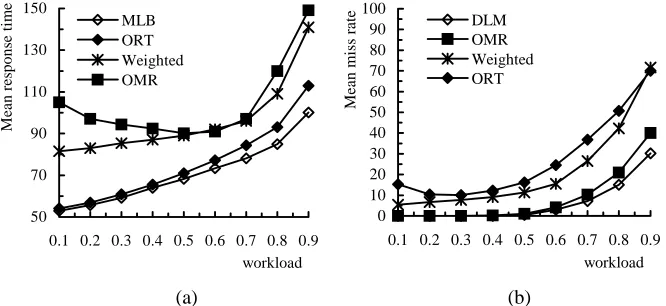
Fig. 2. Impact of the incoming workload levels on a) mean response time and b) mean miss rate
Fig.2.a and Fig.2.b show the impact of the incoming workload levels on the mean re-sponse time and the mean miss rate of the incoming jobs under these load balancing strategies. The multicluster in this experiment consists of 4 clusters whose configura-tions are listed in Table 1. For QDJs, the job slacks follow a uniform distribution in the range [0, 30]. In order to gain insight into the difference of the load balancing be-haviours between OMR and ORT, the ORT strategy is also used to balance QDJs, and OMR is used to balance NQJs.
It can be observed from Fig.2.a that the ORT strategy performs significantly better than the weighted strategy in terms of the mean response time. Furthermore, the per-formance difference increases as the workload decreases. This trend can be explained as follows. The weighted strategy allocates the same fraction of workload to a cluster even if the workload varies. However, the waiting time accounts for a lower propor-tion of the response time as the workload decreases. Hence, in order to reduce the re-sponse time, a higher proportion of the incoming workload should be allocated to the cluster with the greater ui (the number of computers mi in each cluster has less im-pact). The ORT strategy is able to satisfy this allocation requirement. Fig.2.b shows the impact of the incoming workload on the mean miss rate. It can be observed that the OMR strategy outperforms the weighted strategy at all incoming workload levels.
In Fig.2.a, although the MLB outperforms ORT, the performance difference is small, especially when the workload is low. A similar pattern can be observed be-tween the DLM and OMR strategies. This suggests that applying the ORT and OMR schemes will achieve competitive performance with relatively low cost, especially when the system load is low.
4.2 Computer speed
40 60 80 100 120 140 160 180
[21, 1]
[18, 2]
[15, 3]
[12, 4]
[9, 5] [6, 6]
speed difference
M
ea
n
re
sp
on
se
t
im
e
MLB
ORT
Weighted
2 4 6 8 10
[21, 1] [18, 2] [15, 3] [12, 4] [9, 5] [6, 6] speed difference
Mean m
is
s r
ate DLM
OMR Weighted
(a) (b)
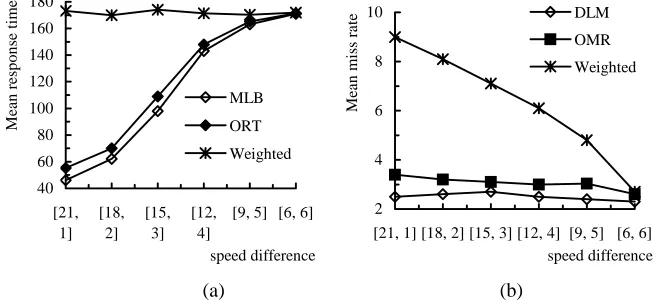
Fig. 3. The impact of speed difference on a) the mean response time and b) the mean miss rate; the arrival rate is 50% of the saturated arrival rate
Fig.3 demonstrates the impact of the difference of computer speed. Here the multi-cluster consists of 4 multi-clusters and the number of computers in each multi-cluster is set to be 4. The speed of the computers in cluster 1 varies from 21 to 6 with a decrement of 3, while the speed of all computers in the other three clusters increases from 1 to 6 with an increment of 1. Thus, the multicluster ranges from a highly heterogeneous system to a homogeneous system, while the average speed of all computers remains constant (i.e., 6). The slack of the QDJs follows a uniform distribution in [0, 10].
Fig.3.a shows the impact of the difference of computer speed on the mean response time. It can be observed in this figure that the mean response time decreases signifi-cantly under the ORT strategy as the speed difference increases, while it remains ap-proximately the same under the weighted strategy. This is because as the speed differ-ence increases, despite the average computer speed remaining constant, a higher pro-portion of the workload is allocated to cluster 1 under the ORT strategy (higher than
), while the weighted strategy does not make full use of the computing
power of cluster 1. This suggests that under the ORT strategy, the speed difference among the clusters is a critical factor for the mean response time.
∑
=n i miui
u m1 1/ 1
5. Conclusion
Two load balancing strategies (ORT and OMR) for multicluster architectures are pro-posed that deal with different types of jobs. The ORT strategy can optimize the mean response time of NQJs, while the OMR strategy can optimize the mean miss rate of QDJs. The effectiveness of these proposed load balancing strategies is demonstrated through theoretical analysis. The proposed strategies are also evaluated through ex-tensive experimental studies. The results show that the ORT and OMR strategies can achieve considerable performance gain with relatively low overhead.
References
[1] O. Aumage, “Heterogeneous multi-cluster networking with the Madeleine III,”
Interna-tional Parallel and Distributed Processing Symposium (IPDPS 2002), 2002.
[2] S. Banen, A.I.D. Bucur, and D.H.J. Epema, “A Measurement-Based Simulation Study of Processor Co-Allocation in Multicluster Systems,” Ninth Workshop on Job Scheduling
Strategies for Parallel Processing, D.G. Feitelson, L. Rudolph and U. Schwiegelshohn
(eds), 2003.
[3] M. Barreto, R. Avila, and P. Navaux, “The MultiCluster model to the integrated use of mul-tiple workstation clusters,” Proc. of the 3rd Workshop on Personal Computer-based
Net-works of Workstations, 2000, pp. 71–80.
[4] G. Bolch, Performance Modeling of Computer Systems, 2002.
[5] A.I.D. Bucur and D.H.J. Epema, “The maximal utilization of processor co-allocation in multicluster Systems,” Int'l Parallel and Distributed Processing Symp. (IPDPS 2003), 2003, pp. 60-69.
[6] R. Buyya and M. Baker, “Emerging Technologies for Multicluster/Grid Computing,”
Pro-ceedings of the 2001 IEEE International Conference on Cluster Computing, 2001.
[7] J. Cao, D. J. Kerbyson, and G. R. Nudd, “Performance Evaluation of an Agent-Based Re-source Management Infrastructure for Grid Computing,” Proceedings of 1st IEEE/ACM
In-ternational Symposium on Cluster Computing and the Grid (CCGrid'01), 2001.
[8] S.T. Chanson, W. Deng, C. Hui, X. Tang, M. To, “Multidomain Load Balancing,” 2000
In-ternational Conf. on Network Protocols, Japan, 2000.
[9] L. He, S.A. Jarvis, D.P. Spooner, G.R. Nudd, “Optimising static workload allocation in multiclusters,” Proceedings of 18th IEEE International Parallel and Distributed Processing
Symposium (IPDPS'04), 2004.
[10] B. Kao and H. Garcia-Molina, “Scheduling soft real-time jobs over dual non-real-time servers,” IEEE Trans. on Parallel and Distributed Systems, 7(1): 56-68, 1996.
[11] L. Kleinrock, Queueing system, John Wiley & Sons, 1975.
[12] X.Y. Tang, S.T. Chanson, “Optimizing static job scheduling in a network of heterogeneous computers,” the 29th International Conference on Parallel Processing, 2000.
[13] M. Wu, “On Runtime Parallel Scheduling for Processor Load Balancing,” IEEE
Transac-tion on Parallel and Distributed Systems, 8(2): pp.173-186, Feb. 1997.
[14] W. Zhu, “Scheduling soft real-time tasks on cluster,” In proc. of 1999 Annual Australian
Parallel and Real-Time Conference, 1999.
[15] W. Zhu and B. Fleisch, “Performance evaluation of soft real-time scheduling on a multi-computer cluster,” The 20th International Conference on Distributed Computing Systems