Decoding Royal Conspiracies
Continuum US, 80 Maiden Lane, Suite 704, New York, NY 10038
www.continuumbooks.com
Copyright © Ian Mortimer, 2010
All rights reserved. No part of this publication may be reproduced or transmitted in any form or by any means, electronic or mechanical, including
photocopying, recording or any information storage or retrieval system, without prior permission from the publishers.
First published 2010
British Library Cataloguing- in- Publication Data
A catalogue record for this book is available from the British Library. ISBN 978–1847–06589–6
Acknowledgements vii Abbreviations ix
Introduction xv
1 Objectivity and information: a methodological introduction 1 2 Sermons of sodomy: a reconsideration of Edward II’s
sodomitical reputation 45
3 Th e death of Edward II in Berkeley Castle 61
4 Twelve angry scholars: reactions to ‘Th e death of Edward II’ 109
5 Th e plot of the earl of Kent, 1328–30 153
6 Edward III, his father and the Fieschi 175
7 Edward III and the moneylenders 235
8 Richard II and the succession to the Crown 259 9 Th e rules governing succession to the Crown, 1199–1399 279 10 Regnal legitimacy and the concept of the royal pretender 305
11 Concluding remarks 343
Full titles of works cited in the notes 347
I am very grateful to Ben Hayes at Continuum for commissioning and editing this book and to my agent, Jim Gill, who gave advice at the outset. Th anks are due too to the following specialists. To all those who commented on my fi rst foray into historiography, ‘What isn’t history?’, which was a catalyst to much of the thinking in ‘Objectivity and information’, namely Professor Mark Ormrod, Dr Margaret Pelling, Dr Simon Dixon, Dr Jonathan Barry, Professor Adrian Wilson and Dr Gary Gibbs. I would also like to thank Dr Barry and Professor Wilson who read and commented on draft s of ‘Objectivity and information’ itself, and Professor Pauline Staff ord, who kindly allowed me to include an extended quotation from one of her essays.
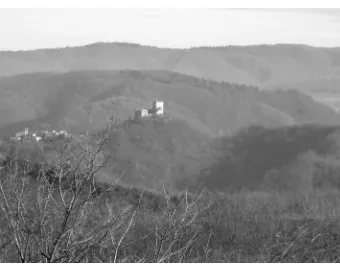
With regard to the specifi c themed essays, I am very grateful to all those at the Edward II colloquium at the University of Nottingham in 2004, especially Dr Gwilym Dodd (who invited me) and Professor Ormrod (for his encouraging response to ‘Sermons of sodomy’, which I wrote in reply to his own piece at that event). In addition I would like to thank Dr Paul Dryburgh for commenting on draft s of ‘Th e death of Edward II in Berkeley Castle’, and also for his advice on my translation of the Melton Letter. My gratitude is due also to Elizabeth Danbury for giving me a photocopy of the Melton letter; to Kathryn Warner for advice on ‘Twelve angry scholars’ and the earl of Kent’s plot; to Professor Chris Given- Wilson for details about the source material for John de Gales; to Christine Faunch and the Library of the University of Exeter for archiving the peer- review comments which are discussed in ‘Twelve angry scholars’. Special thanks are due to John Earle, Susan Earle and Paul and Arabella Lizioli for advice on Sant’Alberto di Butrio, Oramala and the Oltrepo, as well as the Malaspina and the Val di Magra. Finally, I would like to record my gratitude to the anonymous referees who commented positively on ‘Th e death of Edward II’ and ‘Richard II and the succession’.
No doubt she wishes as much as I do that Edward II really had been murdered in Berkeley Castle in 1327 – it would have saved me an awful lot of bother and many late nights. Instead I have had to work against a tide of negative and poorly thought- out criticism. Th roughout everything she has supported me and been hugely encouraging, magisterially judicious in her advice, and loving.
AEC Adrian R. Bell, Chris Brooks and Tony K. Moore (eds), Accounts of the English Crown with Italian Merchant Societies, 1272–1345, List and Index Society 331 (2009) ‘Afterlife’ R. M. Haines, ‘Edwardus Redivivus: the “afterlife” of
Edward of Carnarvon’, TBGAS, 114 (1996), 65–86 Anonimalle W. R. Childs, J. Taylor (eds), Anonimalle Chronicle,
Yorkshire Archaeological Society, Record Series 147 (1991)
Battilana Natale Battilana, Genealogie delle famiglie nobili de Genova (Genoa, 1825; repr., Bologna, 1971)
BCM Berkeley Castle Muniments
BJRL Bulletin of the John Rylands Library BL Th e British Library, London
Brut F. W. D. Brie (ed.), Th e Brut or the Chronicles of England, Early English Text Society, Old Series 131 and 136 (1906–8)
‘Captivity’ T. F. Tout, ‘Th e captivity and death of Edward of Carnarvon’, Bulletin of the John Rylands Library, 6 (1921), 69–114 Carr E. H. Carr, What is History? (1961; Pelican Books edn,
1964)
CChR Calendar of the Charter Rolls Preserved in the Public Record Offi ce, 1226–1516 (6 vols, 1903–27)
CCR Calendar of the Close Rolls Preserved in the Public Record Office, Henry III, Edward I, Edward II, Edward III, Richard II, Henry IV and Henry V (51 vols, 1892–1938) CCW Calendar of Chancery Warrants Preserved in the Public
Record Offi ce, 1244–1326 (1927)
CFR Calendar of the Fine Rolls Preserved in the Public Record Offi ce, Edward I, Edward II and Edward III 1327–1347 (5 vols, 1911–15)
Chronicles William Stubbs (ed.), Chronicles of the Reigns of Edward I and Edward II (2 vols, 1882–3)
CMR Calendar of Memoranda Rolls (Exchequer) Preserved in the Public Record Offi ce, Michaelmas 1326–Michaelmas 1327 (1968)
CP G. E. Cokayne, revised by V. Gibbs, H. A. Doubleday, D. Warrand, Lord Howard de Walden and Peter Hammond (eds), Th e Complete Peerage of England, Scotland, Ireland, Great Britain and the United Kingdom Extant, Extinct or Dormant (14 vols, 1910–98)
CPMR A. H. Th omas (ed.), Calendar of Plea and Memoranda Rolls 1323–1364 (Cambridge, 1926)
CPR Calendar of the Patent Rolls Preserved in the Public Record Offi ce, Henry III, Edward I, Edward II, Edward III, Richard II, Henry IV and Henry V (43 vols, 1893–1916) Creton J. Webb (ed.), ‘Metrical history’, Archaeologia, 20 (1824),
13–239
DBI Dizonario biografi co degli Italiani (72 vols, 1960–) ‘DEII’ Ian Mortimer, ‘Th e death of Edward II in Berkeley Castle’,
EHR, 120 (2005), 1175–214
‘Documents’ Stuart Moore, ‘Documents relating to the death and burial of King Edward II’, Archaeologia, l (1887), 215–26 EHR Th e English Historical Review
‘Entail’ Michael Bennett, ‘Edward III’s entail and the succession to the Crown, 1376–1471’, EHR, 113 (1998), 580–609 EUL Th e University of Exeter Library, Exeter
Eulogium F. S. Haydon (ed.), Eulogium Historiarum sive Temporis (3 vols, 1858–63)
Falconieri Tommaso di Carpegna Falconieri, Th e Man Who Believed He Was King of France: A True Medieval Tale (Chicago, 2008)
Fears Ian Mortimer, Th e Fears of Henry IV (2007)
Foedera (Rec. Comm.) Adam Clarke, J. Caley, J. Bayley, F. Holbrooke and J. W. Clarke (eds), Foedera, conventiones, litterae, etc., or Rymer’s Foedera 1066–1383 (6 vols, 1816–30)
Foedera (Rymer) Th omas Rymer (ed.), Foedera, conventiones, literae, et cujuscunque generis acta publica (20 vols, 1704–35) ‘Foundations’ Adrian Wilson, ‘Foundations of an integrated
historiography’ in Wilson (ed.), Rethinking Social History (Manchester, 1993), 293–335
French Chronicle C. J. Aungier, Th e French Chronicle of London, Camden OS 28 (1844)
Grandison F. C. Hingeston- Randolph (ed.), Th e Register of Bishop Grandison, Bishop of Exeter (3 vols, 1894–9)
Gransden Antonia Gransden, Historical Writing in England: c1307 to the Early Sixteenth Century (1982)
Greatest Traitor Ian Mortimer, Th e Greatest Traitor: Th e Life of Sir Roger Mortimer, 1st Earl of March, Ruler of England 1327–1330 (2003)
Hemingburgh H. C. Hamilton (ed.), Chronicon Domini Walteri de Hemingburgh, English Historical Society (2 vols, 1848–9) Historia Anglicana H. T. Riley (ed.), Th omae Walsingham Historia Anglicana
(2 vols, 1863–4)
HKW R. Allen Brown, H. M. Colvin and A. J. Taylor, Th e History of the King’s Works: Th e Middle Ages (2 vols, 1963)
Issues Frederick Devon (ed.), Issues of the Exchequer (1837) JMH Th e Journal of Medieval History
Knighton J. R. Lumby (ed.), Chronicon Henrici Knighton (2 vols, 1889–95)
Kuhn Thomas Kuhn, The Structure of Scientific Revolutions (Chicago, 3rd edn, 1996)
Lanercost Herbert Maxwell, Th e Chronicle of Lanercost (Glasgow, 1913)
Le Baker E. M. Th ompson (ed.), Chronicon Galfridi le Baker de Swynebroke (Oxford, 1889)
Lunt William E. Lunt, Financial Relations of the Papacy 1327–1534 (Cambridge, Massachusetts, 1962)
Melsa E. A. Bond, Chronica Monasterii de Melsa (3 vols, 1866–8) Murimuth E. M. Thompson (ed.), Adae Murimuth Continuatio
Chronicarum (1889)
Northern Registers J. Raine (ed.), Historical Papers and Letters from the Northern Registers (1873)
Norwell Mary Lyon, Bryce Lyon and Henry S. Lucas (eds), Th e Wardrobe Book of William Norwell (Brussels, 1983) ODNB Oxford Dictionary of National Biography (online edn,
2004–)
Perfect King Ian Mortimer, Th e Perfect King: Th e Life of Edward III (2006)
Polychronicon J. R. Lumby (ed.), Polychronicon Ranulphi Higden monachi Cestrensis, vol. 8 (1882)
PROME Chris Given- Wilson (ed.), Th e Parliamentary Rolls of Medieval England (CD edn, 2004)
Raccolta Praghese Zdeňka Hledíková (ed.), Raccolta Praghese di Scritti di Luca Fieschi (Prague, 1985)
Rec. Comm. Record Commission
Re- thinking History Keith Jenkins, Re- thinking History (new edn, 2003) Royal Wills J. Nichols, A Collection of All the Wills Now Known to be
Extant of the Kings and Queens of England (1780)
RP J. Strachey et al. (eds), Rotuli Parliamentorum (6 vols, 1767–77)
Sapori Armando Sapori, I Libri dei Comercio dei Peruzzi (Milan, 1934)
Scalachronica Sir Herbert Maxwell (ed.), Scalachronica: Th e Reigns of Edward I, Edward II and Edward III as Recorded by Sir Th omas Gray (Glasgow, 1907, repr. 2000)
‘Scam’ R. M. Haines, ‘Roger Mortimer’s scam’, TBGAS, 126 (2008), 139–56
Th e St Albans Chronicle: Th e Chronica Maiora of Th omas Walsingham. Volume 1: 1376–1394 (Oxford, 2003) ‘Sumptuous apparel’ R. M. Haines, ‘Sumptuous apparel for a royal prisoner:
Archbishop Melton’s Letter, 14 February 1330’, EHR, 124 (2009), 885–94
Super- companies Edwin Hunt, Medieval Super- companies (Cambridge, 1994)
Syllabus T. D. Hardy, Syllabus of Rymer’s Foedera (3 vols, 1869–85) TBGAS Th e Bristol and Gloucestershire Archaeological Society THES Times Higher Education Supplement
TNA Th e National Archives, London
‘Trouble’ Paul Strohm, ‘Th e trouble with Richard: the reburial of Richard II and Lancastrian symbolic strategy’, Speculum, 71 (1996), 87–111
‘Uncertain death’ J. S. Hamilton, ‘Th e uncertain death of Edward II?’, History Compass, 6, 5 (2008), 1264–78
Usk Chris Given- Wilson (ed.), Th e Chronicle of Adam Usk (Oxford, 1997)
Westminster L. C. Hector and Barbara Harvey, The Westminster Chronicle 1381–1394 (Oxford, 1982)
‘Where is Edward II?’ G. P. Cuttino and T. W. Lyman, ‘Where is Edward II?’, Speculum, 53 (1978), 522–43
Wolff Robert Lee Wolff , ‘Baldwin of Flanders and Hainaut. First Latin Emperor of Constantinople: his life, death and resurrection, 1172–1225’, Speculum 27 (1952), 281–322 Writing David Bates, Julia Crick and Sarah Hamilton (eds), Writing
Th is book has two purposes. One is to answer some diffi cult questions relating to some important events in the fourteenth century of a covert or conspiratorial nature, and to explore their implications. Th e other is to consider whether a philosophy of history that is sensitive to doubt and the theoretical work of postmodernists and critical theorists can, through a process of rigorous analysis, produce instances of historical certainty. In other words, can any of our answers to the ‘diffi cult questions’ ever be more than a matter of opinion?
fi rst theme of this book (the specifi c questions) have led naturally to the second (the theoretical stance).
Th e fi rst scholarly essay that I published on a medieval theme was ‘Th e death of Edward II’, which appeared in EHR in December 2005. Th is pioneered an information- based approach to the past, which has subsequently proved invaluable in other contexts. It has the potential to answer fundamental questions about the nature of history that previously have proved diffi cult. Importantly, it works at both a theoretical and a practical level. Not only can we apply it to a large number of specifi c questions, it also leads to a broader philosophical question: if an information- based argument can be employed to show that Edward II was not killed in Berkeley Castle in 1327 and Richard II was certainly murdered in Pontefract Castle in 1400, can the same information- based methods be used to justify historical research in general? In short, through the process of achieving a point of certainty historically, can we achieve a point of certainty for history itself?
For many academics, this question is best ignored. Many people take the view that history has received its ‘defence’ in Richard J. Evans’s thought- provoking book, In Defence of History, and the less historians inspect his arguments for cracks the better. However, I do not fi nd any theoretical line in that book that allows a historian to prove aspects of the past, and especially not in a controversial context. Pro- history arguments still rely on emphasizing professional historians’ expertise, judgement and authority, and the general reliability of the evidence. Such arguments work on the assumption that although a historian might be wrong in a few details here and there (because a tiny proportion of his or her source material was fraudulent, incomplete or inexact), most of the time, the evidence is reliable. But for the specialist in medieval intrigue, such generalizations are weak. We cannot simply work on the assumption that most of the evidence is correct – especially when it is patently obvious that most of it is no longer extant, and even more so when the traditional interpretation gives rise to many inconsistencies. Hence the need for the information- based approach that underpins much of this book.
Grail of historical methodology – not least because it does away with the need for the historian’s judgement and answers the critics of the historian’s authority by showing the reasons for that authority, not just claiming it. Very simply, by treating information about the past in the same way that one treats information about contemporary society, information- science processes may be employed in both developing and testing a historical hypothesis.
Objectivity and information:
a methodological introduction
To what extent can historians claim to know any aspect of the past with certainty? Th e question is important for two main reasons. First and most obviously, it is fundamental to the intellectual standing of the profession as a whole, and historians’ ability to speak about the past individually. Secondly, the professional awareness that historical certainty is deeply problematic has itself conditioned the way that history has developed and is currently taught. Long before postmodernism and critical theory codifi ed various means to criticize the authority of the historian, historians were themselves pulling apart each other’s work at a practical level. Th e nineteenth and twentieth centuries saw some bitter intellectual feuds.1 Even those who were not criticized by their contemporaries wrote with a growing awareness that much of their work would be discarded by future generations, and might one day even be scorned as founded in ignorance and naivety.2 We might say that, over the course of the twentieth century, historians came to accept the idea that the future is not only the greatest undermining epistemological force in history writing but that it always will be, and that consequently its power to revise any historical understanding is absolute. It follows that no historical interpretation has actual substance, or inherent correctness, but rather is the same as a physical theory in that it is, in the words of Stephen Hawking,
always provisional, in the sense that it is only a hypothesis: you can never prove it. No matter how many times the results of experiments agree with some theory you can never be sure that the next time the result will not contradict the theory. On the other hand you can disprove a theory by fi nding even a single observation that disagrees with the predictions of the theory.3
and very little research into remote periods of time has any real meaning, except in relation to us ourselves, our contemporaries and our careers.
Given this long heritage of criticizing and denigrating historical knowledge on a practical as well as a theoretical level, it is ironic that it was postmodernism that caused history to retreat intellectually. Th e postmodern position was above all a theoretical stance, held for the most part by non- historians and directed mainly at the straw man of ‘the historian’, not practising writers’ actual work. It might have been expected that historians’ own considerations of the actual limitations of historical practice would have been given greater weight. It was not diffi cult to see the limited epistemological trust one could have in postmodernism; its principal strength was its ability to criticize.4 But many historians ran scared of the extra- mural challenge, and ignored or avoided postmodernism altogether. Th ose who did not tended to argue against it from an unrefl exive position, refusing to moderate their views and allowing the agenda to be set by history’s critics. Defences of history ironically served to undermine the discipline further by drawing public attention to the criticisms of postmodernists and responding to the specifi c criticisms, as if somehow the entire critical stance could be undermined by a tit- for- tat discussion in which the initiative lay wholly with the critics. Most of all, the epistemological basis of the profession was not supported by an authoritative voice at a theoretical level. What history needed in the 1990s was not a ‘defence’ in the form of a critique of postmodernism but a coherent programme of explanation and elucidation which re- grounded history in the study of the past: a philosophical counter- movement supporting history which was not confi ned to the pages of History and Th eory but embraced the majority of practising historians and the public.5 Needless to say, it did not get one.
lasting response. It thus became easy for critics to declare that history within academic institutions was an arcane ritual, in which academics ‘fetishised documents’ and created ‘fi ctive’ accounts of the past ‘at the pleasure of the historian’.6
Looking back from the vantage point of 2010, the elevation of postmodernism to a special height of critical authority seems disproportionate. Th ere is no doubt that history suff ered a huge intellectual battering in the 1980s and 1990s, and many criticisms of supposed historical practices were justifi able (regardless of whether historians actually followed them or not). But with respect to the larger and more important question of whether we can say anything with certainty about the past, postmodernism may be seen as just one subset of a large number of critiques of historical methodologies, most of them devised by historians themselves. Th ey all were – and still are – methodological challenges, not insurmountable barriers. Epistemological progress remains possible and desirable.
Th ere is thus a double importance to what we might call ‘the certainty question’. First, there is the ‘supply- side’ of history – the need to re- establish history’s reputation as an authoritative intellectual discipline. As Justin Champion has said, ‘anxieties about the epistemological foundations of our discipline . . . have meant we have retreated into the increasingly dark corners of the academic community, publishing research in exclusive, recondite and expensive journals and monographs.’7 One cannot help but feel that scholarly historians should try to do better, to overcome such anxieties and meet such challenges in the open, even if academic structures make it very diffi cult for them retrospectively to develop epistemological underpinnings of value systems which they take for granted.
such doubt is both reasonable and understandable in professional terms. One may compare it to an engineer’s failure to build a bridge over a chasm: his view that it is impossible to span the chasm may well be professionally correct; but the result is still the lack of a bridge. An unresolved historical doubt is both an intellectual cul- de- sac in its own right and a failure to provide a hypothesis which others may criticize or build on. For even an erroneous conclusion allows further experimentation, as the error can be subjected to further analysis, just as physical theories can be put to the test. But most of all, a failure to defi ne the limits of certainty, and to explore the extremes of what may be considered ‘certain’, equates to a failure to determine the limits of one’s own confi dence, which in turn does nothing to inspire confi dence in a reader. If we have only doubts about the historical past, how then can we fulfi l our roles as historians? Why should any critical reader trust a historian who does not know the limits of his or her own material, and by implication, has a limited grasp of how to make the most of it? Conversely, why should anyone trust a historian who expresses doubts for the sake of academic caution, or who blithely states that he or she is ‘unconvinced’ by an argument? Such a response might be shorthand for knowing an argument is wrong on the basis of specialist knowledge and superior insight, but equally it could be an excuse for personal bias or inferior insight, prejudice, idleness or even a simple failure of understanding.
THE IDEA OF AN INTEGRATED HISTORIOGRAPHY
In discussing Collingwood’s seminal 1946 study, Th e Idea of History, E. H. Carr paraphrased Collingwood’s philosophy of history as ‘concerned “neither with the past by itself ” nor with “the historian’s thought about it by itself ”, but with “the two things in their mutual relations”’.11 Carr’s line is interesting, for through it we can see how he developed Collingwood’s idea to come out with his own, more succinct version. History, as he saw it, ‘is a continuous process of interaction between the historian and his facts, an unending dialogue between the past and the present’.12 Th is theme of dialogue across the ages was in turn lift ed by E. P. Th ompson in presenting his notion of the ‘dialogue between concept and evidence’ in his essay ‘Th e poverty of theory’. Th e dialogue across the ages is thus a common theme running through twentieth- century writing on the means to achieve knowledge about the past.
Th ompson’s ‘dialogue of concept and evidence’ was the starting point for Adrian Wilson’s oft en- overlooked essay, ‘Foundations of an integrated historiography’, published in 1993.13 Th e exact question which Wilson sought to address was ‘can the discipline of history – whether social or otherwise – lay any claim to generating a reliable knowledge?’ Wilson sought to explain what Th ompson might have meant by his otherwise unexplored notion of ‘the dialogue between concept and evidence’. On the concept side of the ‘dialogue’, Wilson highlighted the importance of ‘concept criticism’, this being the constant correction of what we think about the past as we undertake research. Th rough adjusting our ideas, refl ecting on the genealogy of our ideas, and examining ourselves to see whether our ideas are sound, concept criticism causes us to re- evaluate our position. At the same time we assume what Wilson describes as one of three ‘hermeneutic stances’ or methods of interpreting the evidence.
1. Th e fi rst hermeneutic stance is the oldest, ‘scissors- and- paste’ history (as Collingwood and Carr describe it), in which a historian selects the evidence and uses it as he or she sees fi t. In this method, the documents are treated as authorities. Th e drawback is obvious: they only allow us to see what the primary- source authors wanted us to see.
them. For many years it seemed to Collingwood to permit scientifi c history. Th e drawback, as Collingwood later realized, is that it tends to collapse into the fi rst hermeneutic stance. Th e process of trying to extract the truth from the evidence presupposes that the truth is within the documents in the fi rst place. Both stances amount to ‘winnowing out the false residue’ and using the remainder.
3. Wilson’s third hermeneutic stance is to regard the documents as eff ects. In order to understand them, we must investigate their genesis, how they came to be created. As Wilson states, ‘the move from source- criticism to the study of document genesis is only practised with diffi culty, has seldom been advocated explicitly, and has proved deeply resistant to theorisation.’14 However, it is this third hermeneutic stance which is the key in determining certainty, and which will be developed further in this chapter.
Unfortunately Wilson’s work attracted little attention outside the academic circle which read his book, Rethinking Social History. It off ers a platform on which writers may build their own theoretical constructs justifying their own methodologies. For as Wilson observed, critics of history have tended to presume that ‘the historian’ adopts only the fi rst and second hermeneutic stances.15 It is only in moving away from these, towards the third – understanding document genesis – that historians ascend the ‘gradient of rigour’ and pass beyond the form of history that is prone to criticism.16 From any historical point of view, understanding how a document was made is hugely signifi cant, for ‘the society we are studying generated the documents we are using. In investigating the genesis of the documents we are thus investigating that society.’17 Th e implications are that every enquiry into the meaning of a text entails an examination of the creation of the text, its bias, its representativeness, its role, why it was created and by whom, the agency which initiated the process and other aspects of its creation. What otherwise is simply a text becomes a multi- layered descriptive process, an encoded event in itself, full of metadata. Th is in turn aff ects the historian’s concept criticism, forcing the historian to refi ne it, so Th ompson’s ‘dialogue of concept and evidence’ can be seen to produce historical readings which are both socially aware with regard to the past and refl exive with regard to the present.
of the ecclesiastical courts. Th ere we would fi nd plenty of evidence. However, as Wilson points out,
a neighbourly quarrel could only get into the court through some process of co- operation or collusion, or coincidence between the quarrel itself and the activities and interests of the mediating authorities . . . Should we overlook this, and seek to use diocesan court records as transparent windows upon ‘the occasions of neighbourly quarrel’, our research procedure would consist simply of extracting the chosen cases from the documents.18
To avoid this weakness, Wilson suggests that, in order to consider instances of neighbourly quarrels properly, ‘the historian has to take account of the ways cases came into court and the procedures by which they were recorded’. Th us all the ecclesiastical offi cers must also be considered, as with the minister and churchwardens and any other mediating authorities who might have helped bring the case to court. Th e roles performed by these offi cers become part of the object under study, thereby widening the objective scope of the enquiry. In this way we can say certain things about neighbourly quarrels as before, and we can also describe the fi lters and conditions placed upon the quarrels which resulted in some giving rise to the texts.
of a specifi c event. No degree of studying the circumstances and creation of Walsingham’s chronicle can determine whether Sir John Arundel and his men actually raped eighty nuns in the autumn of 1379, abducted them from their convent, and threw them overboard during a storm off the coast of Ireland.21 Th e story is highly unlikely but that in itself does not mean it is false. Walsingham clearly believed it, and, although no nunnery near Southampton had so many nuns, there is circumstantial evidence for some form of atrocity committed by Arundel’s men in the area at the time.22 Th e point is that, when it comes to specifi c events, and especially medieval intrigue, the third hermeneutic stance, or ‘document genesis’, is not enough.
Th e foregoing passages suggest that, while it is possible to say some things which are ‘certain’ with regard to social and cultural history – e.g. there was a massive rise in the purchase of medicine on behalf of the terminally ill in Kent between 1570 and 1720 – the certainty of ‘the event’ in narrative history remains problematic. We are methodologically hardly any nearer ascertaining the truth of an event than our Victorian forebears were. Indeed, we are probably further from it, for we have more sophisticated means of criticizing those who attempt to assert something is a ‘historical fact’. Th is is not always due to postmodernism; sometimes it is simply advanced historical methodology. And even the most reliable, propaganda- free documents may succumb to this form of criticism. As Chris Given- Wilson has shown, the appearance of the name of a magnate as a witness in the Charter Rolls does not prove that he was present on the given day, as normally supposed.23 A study of document genesis only reveals why we cannot rely on the Charter Rolls as irrefutable evidence of a man’s attendance at court on the said day. Th e student who wishes to know whether the magnate was actually there or not has a more diffi cult path to tread.
BIOGRAPHY AND OBJECTIVITY
the understanding of motive and intention’.25 Only through biography can we determine why something happened and why something else did not happen, and so why the event took place as it did.
In the twentieth century biography was widely seen as an intellectually weak discipline. K. B. McFarlane declared that medieval biography was ‘an impossibility’. As he saw it, a biography should describe the inner life of the individual as well as the outer life. ‘Th e historian cannot honestly write biographical history; his province is rather the growth of social organisations, of civilisation, of ideas’.26 J. H. Plumb lamented this view in 1956, but as late as 1987 a contributor to the THES could still declare that biography ‘is despised by the hard and practised by the soft in one discipline aft er another’.27 Only at the end of the twentieth century did the value of biography come to be widely recognized as an important tool in determining what happened in the past, and moreover, why it happened.28
Th e change in biography’s fortunes was most clearly brought to light in a conference at the University of Exeter in July 2003, entitled ‘Th e Limits of Medieval Biography’. At this conference, a large number of leading medievalists professed their faith in the biographical approach and later published their reasons in Writing Medieval Biography (2006). As the editors stated in the introduction, biography ‘off ers insights which no other genre, no other analytical tool, can do’.29 In Janet Nelson’s words,
I take life- writing to involve trying as hard as possible, even if that means sailing close to the imaginative wind, and certainly into the eye of the speculative storm, to make the acquaintance of my subject as a person, to guess plausibly, if no more, at what made him tick – as Frank Barlow did with Becket . . .30
Similarly the keynote speaker, Pauline Stafford, put forward a trenchant vindication of biography as a methodological tool, especially where it involved breaking down the life into a study of structures and roles.
of studying the individual: because it is only in an individual life that all these roles and structures are lived out. Structures and roles in that sense do not determine and write the individual, they become eff ective through the individual, and through the uniqueness of each life. And it is in that uniqueness that their possibilities, ambiguities and contradictions become apparent. Biography may not only be desirable, the human face of the past, but one of the most important historical genres, making clear the room for choice, however limited, that is also a motor of historical change.31
By deliberately attempting to understand an individual, especially in respect to the ‘structures and roles’ in which he or she operated, we can aspire to a new objective position from which to describe historical events.
perhaps stopping him from travelling on the crusade). It is only when we view things from Henry’s point of view that we get the full picture. Richard had failed to act positively in a manner respectful of his cousin’s status. Th e evidence for the rift lies in the absence of references to gift s from Richard to Henry, and this does not emerge from a critical view of the texts themselves but only from seeing those texts from a biographical standpoint. Richard showered substantial gift s on his friends but he never gave Henry anything of real value – he never gave him the keepership of a castle or a forest, for example, or a wardship – and he never entrusted him with any diplomatic position, even though he was a fellow Knight of the Garter, and, according to Edward III’s entail, second- in- line to the throne.34 Th e two men spent very little time together as grown men, and almost all the time they did spend together was in the pacifying company of Henry’s father, John of Gaunt (who had sworn an oath in 1376 to protect Richard II as king). In this light, the evidence for friendship – the gift s of the breastplate and the dukedom – may be reconsidered. When we realize that the breastplate had formerly belonged to one of Richard’s closest friends, Lord Beauchamp of Kidderminster, executed at Henry’s instigation (he being one of the Lords Appellant), the gift of the dead man’s breastplate to the killer assumes the nature of a threat, not a sign of reconciliation.35 As for the dukedom, according to Henry’s own testimony in January 1398, there had been a plot by several of Richard’s friends to murder him immediately aft er his creation.36 Whether we read the dukedom as a reward to Henry for standing by and letting his fellow Lords Appellant be arrested, or as bait to lure him to his death, we cannot regard this as evidence of friendship. In this way it can be seen that, by focusing sympathetically on one man in order to understand his motives and actions, we encounter a diff erent set of questions and meanings from those raised by the pursuit of a single statement of ‘objective truth’ about the two men in the traditional manner.
objectivity were possible, then everyone who achieved it, and who consulted the same evidence, would come to the same conclusions about the past.38 However, given the same evidence, historians invariably come to diff erent conclusions, depending on their respective characters, intelligence, learning and experiences. In his Defence of History, Richard J. Evans admitted as much, concluding that ‘through the sources we use, and the methods with which we handle them, we can, if we are very careful and thorough, approach a reconstruction of past reality that may be partial and provisional, and certainly will not be objective, but is nevertheless true’.39 Historians simply cannot escape their own cultural values, education, prejudices, language and temperament in order to view and express something with complete impartiality or total objectivity.
Despite this, the idea of ‘objective truth’ continues to exercise a potent force.40 Even if we admit that we cannot achieve the whole truth, it is still necessary to pursue objectivity, for only by so doing can the historian demonstrate that he/ she is deliberately eschewing subjectivity, and minimizing the problem that his own personality and preferences inevitably condition his/her reading of the evidence. But this view stems from the idea that, in history as well as philosophy, objectivity and subjectivity are opposites, the former an external point of view and the latter an internal one. Th is is questionable for two reasons. First, and most obviously, there are varying forms of objectivity. We can shift our view on any aspect of the past – for example, from the purely biographical to the general. Th e second reason is no less important. In history, objectivity is not the opposite of subjectivity. History is not about the past; it is about the human past. Th e history of a hitherto- unknown, uninhabited desert island is not within the orbit of the historian but is the subject of the natural historian, the geologist and the botanist. History as studied by historians is about people, and is only about inanimate objects and animals so far as they relate to people. Th erefore the opposite of traditional historical objectivity – the ‘god’s- eye view’ of the past – is not subjectivity but sympathy.41
writing about the fourteenth century in a London college in the late 1950s. Th at name might mean you give the book some value- related description, e.g. ‘reliable’ or ‘outdated’. Overall, the objective description is informed by your experiences, your subjective knowledge. As Wilson and Ashplant put it, ‘what any human observer “sees” is a function not simply of the object(s) that observer is observing, but also of the observer’s own categories, assumptions, values, expectations, hypotheses, preconceptions, purposes, intents, attitudes.’42 Now replace the book with a man. You might describe him equally objectively, his facial features, stature and height. Your own subjective experiences will again inform the description, probably causing you to use the same language and to interpret the expressions on the man’s face as happy or sad, threatening or welcoming. Th ere will still be an appropriate mixture of objective perception and subjective experience in the description. But if you try to describe what the man himself sees and feels, you are moving towards a position of sympathy. Imagine that he has just been hurt in some way. Th rough describing his grimace of pain, and the way he is holding his bleeding leg, you are likely to describe your perception of how he feels. Th is is still not subjectivity; you are not describing the way that you feel. Nor are you describing the way that people feel in general. You have simply shift ed to a more interpretative form of objectivity (your perception of a man’s appearance and then his discomfort). In so doing you have moved from the impersonal to the personal, but the personal element does not directly relate to you, it relates to the man.
Obviously, in describing the Middle Ages, which are by defi nition outside the self, objectivity is unavoidable. Contrary to the implication in Evans’s statement above, objectivity is not rendered ‘unattainable’ by the existence of subjective factors – no more than subjectivity is rendered unattainable by the existence of the exterior world. Th e historian exists in relation to the world at large, and thus his or her objectivity co- exists with his or her subjectivity. But this does not render them mutually dependent. Subjective knowledge is necessary to achieve an objective understanding of why a human acts the way he does; for instance, that a crying man is not happy; or that with only one seeing eye he cannot judge distance so well. We might say that objectivity may be considered a spectrum ranging from the personal (or sympathetic), through the impartial, to the impersonal. Obviously each band of the spectrum shades into the others somewhat, but they may roughly be characterized as follows.
historians measuring changes in the general landscape, for example changes in the sea level over the last fi ve hundred years. It should be noted that even this most impersonal form of objectivity is not devoid of investigative and authorial subjectivity, which includes choice of dates and regions under examination, the language of expression, accuracy, skills of analysis and above all else, awareness of an audience for the fi nal written conclusions. 2. Next we might identify the quantitative analysis of individuals, for instance
changes in longevity in a given parish. Th is is more sympathetic, and less impersonal, because we cannot undertake the study without recognizing the subjects as people. Similar subjective considerations apply as above. For instance, researchers coming across evidence of a one- hundred- and- ten- year- old man would be inclined to discount his longevity on account of their preconceptions about extreme age.
3. More sympathetic (but still on the impersonal side of the spectrum) is the historian writing an overview of a large number of people over a certain period of time: a text which involves individuals and explains the movements of the society in which they live but which does not directly seek to sympathize with any one of them (for example, Th e New Oxford History of England). Again, a degree of sympathy is inevitable.
4. More sympathetic is the study of a group of people who all have something in common, studied collectively in an attempt to understand that common feature – women in fourteenth- century England, for example, or the dying. 5. A more sympathetic band still is the traditional historical study of an individual, for example a study of a medieval magnate. Such books – history books about individuals – are bound to be more sympathetic than history books about a nation, being defi ned in relation to an individual life and thus requiring the author to address changes and stages in that subject’s life by reference to his or her own experience and the experiences of acquaintances. 6. The second- to- last band is the sympathetic biography. This seeks to
7. Pseudo- autobiography, in which the historian deliberately plays the role of ‘being’ a historical person, in order to try and understand his or her actions as fully as possible.
As we move through the spectrum, diff erent forms of subjectivity become more or less relevant. It does not automatically follow that the greater the sympathetic input, the greater the subjective element. One can write sympathetic history without it being laden with subjective inferences. How Henry IV may reasonably have expected his cousin Richard II to have treated him in the 1390s is a good example. If Richard was rewarding all his other cousins with lavish presents, for Henry to be the only one who received nothing at all singles him out in a distinctive way, especially given the context of their relationship. Th e sympathetic reading of the evidence here does not depend on a subjective stance on the part of the historian, it is evident from a direct comparison of the way Richard treated Henry in relation to the way he treated his other royal kin.
To recapitulate, there are three key postulations here which need to be borne in mind. First, as widely accepted, objective description devoid of subjectivity is impossible: the two are as interwoven as sight and recognition. Secondly, histobjectivity is not a static point – a ‘god’s eye view’ – but a spectrum of objective bands, ranging from the sympathetic through to the impersonal. Th irdly, as subjective factors are present in all of these objective bands, there is no intrinsic reason to prefer an impartial objectivity over a sympathetic one (or vice versa) in reading events. We cannot say that one is right and another wrong. In diff erent contexts, each may be more revealing than all the others. Collectively these bands constitute a range of historical tools.
OBJECTIVE INCONSISTENCIES
could adopt a narrow- focus perspective, attending mainly to one man’s actions and outlook as perceived by his contemporaries. Th e third option is to take a deliberately sympathetic view of one of them, maintaining a consistent partiality in order to try to understand his actions and outlook from his own point of view. If we choose the wide- angled perspective, a payment in a 1398 account for a bezoar stone is simply evidence of a belief in the power of bezoar stones in that year (a bezoar stone being a supposedly magical object which, when dipped in a goblet of wine, neutralizes any poison). Employing the narrow- focus perspective, the fact that the payment for this bezoar stone was made by Henry of Lancaster suggests that he believed in the power of such stones. Employing the sympathetic perspective, the payment may be used as evidence that the crisis of 1397–9 caused Henry of Lancaster to fear he might be poisoned. Th e ways in which we use any piece of evidence vary according to the position we assume within the objectivity spectrum.
While the example of the bezoar stone is simple and without great consequences (in that it is not historically problematic), other examples are more signifi cant. If we consider the events of 1330 as impartially as possible, with a wide- focus perspective, there is nothing intrinsically wrong with the fact that the earl of Kent was executed for trying to rescue his half- brother, Edward II, from Corfe Castle. It might appear that he was gullible to believe the man was alive but only if he himself had good reason to believe that the man was dead. However, if we narrow our focus on the earl, we fi nd that he did indeed have good reason to believe Edward II was dead: he had attended his funeral at Gloucester in December 1327. It follows that either he discovered that the man was not dead – or he was ‘gullible’ in the extreme. Th is gullibility is a striking contrast to the responsible character and judgement of a man who was placed in sole command of military operations in Gascony during the War of Saint- Sardos, and was entrusted (in preference to his elder brother) to negotiate the marriage of the king’s eldest son, and was supported in his attempt to rescue Edward II by Archbishop Melton of York and others. An explanation which works easily in the impersonal, wide- angled view of history ceases to work close up. It is revealed as an objective inconsistency.
a pyramid, and insisting that what he sees before him is only a triangle, and that there is no other way of describing the shape, because he refuses to shift from what he believes is the only point from which he may appreciate the ‘objective truth’ of the object he sees. It needs to be said that a few leading historians had begun to embrace multi- dimensional views of the past before the end of the last century but they were mostly social historians, and their multi- dimensional approaches were based on a series of cultural viewpoints. When political historians presented multiple viewpoints on the past they did so through describing the positions of contemporary commentators – separate chroniclers, for instance – thereby assuming one of Wilson’s fi rst two hermeneutic stances. Th e value of variable objectivity – achievable through correlations of biography, multiple biography, prosopography, political microstudy and general political history – is that it shows how historians can themselves obtain a multi- dimensional view of the past for individual events, as well as cultural roles.
Before going further it needs to be stressed that objective inconsistencies are not the same as confl icts of evidence. Confl icts of evidence can be dealt with by prioritizing one piece of evidence over the other (as in source criticism). Historians do this all the time; every medievalist is familiar with texts containing details that could not possibly be true, and thus are certainly mistakes made by their compilers. In many cases it is possible to identify and eliminate the mistakes: the result is that the ‘bad evidence’ or mistake is laid aside. With objective inconsistencies it is not possible to discard evidence in this way, for it is not necessarily ‘a mistake’ on the part of the compiler or copyist. In such cases laying aside a single piece of evidence is to fall into the trap of selecting the evidence (a point regarded as bad practice by followers of Elton as much as their postmodern critics). But more importantly, discarding evidence does not resolve the inconsistency. A confl ict of evidence is simply a disjuncture between two or more pieces of evidence; an objective inconsistency is two irreconcilable but well- founded interpretations, each based on considerable evidence.
then that perception implies that at least one of the two compared objective explanations of an event is fl awed.
The principle of objective inconsistencies carries with it an important methodological spin- off . It demands that circumstantial evidence be considered and explained, in addition to the direct evidence. Traditionally, it is not bad practice to regard circumstantial evidence as less important, as it cannot contribute to certainty or ‘proof ’. Be that as it may, the point of variable objectivity is to see how various objectivities can be used to test the integrity of a complete description of an event. Hence the details arising from that event acquire a new signifi cance: they cannot be simply discarded because they too need to be correlated with each of the alternatives. Indeed, in terms of testing for objective consistency it becomes almost impossible to distinguish between direct and circumstantial evidence. For example, in investigating whether Richard II declared that the Mortimers were the heirs to the throne in the parliament of 1385, it is a circumstantial detail that John of Gaunt and Richard dined together at the end of that parliament. Th at the Lancastrian heir remained on good terms with the king suggests Richard had not just insulted him publicly by denigrating his claim to the throne and elevating the earl of March to the position of heir apparent. Conversely there is circumstantial evidence that the earl of March was elevated in this way in the story that Roger Mortimer pressed his claim to the throne personally in 1394, during a parliament. Traditionally, one would make a decision and prioritize one view over the other, discarding the alternative as ‘without foundation’ (precisely as R. R. Davies did in his article on Roger Mortimer for the Oxford Dictionary of National Biography). However, when presented as an objective inconsistency, in which each possibility must be considered, all the evidence (circumstantial and direct) needs to be considered in relation to the actual event, not just a historical explanation of it. Circumstantial evidence might not amount to proof but it still demands explanation, especially if it seems to clash with other evidence, creating its own inconsistency.
the objective in trying to determine past motives. Attempting to do so does not necessarily amount to bad history – in fact, quite the opposite is true – but it does preclude certainty, for the subjective element will always be open to question. Returning to the problem of the earl of Kent in 1330, we cannot presume that the man was ‘gullible’ or ‘stupid’ (as T. F. Tout stated) or in any other way misled. To do so is to read the evidence having already made up our minds as to how to resolve the objective inconsistency at the heart of the problem. Conversely we cannot simply assume that, because the earl of Kent believed his half- brother was still alive in 1330, that he was correct. Th is is tantamount to setting all the evidence for the king’s death aside without explanation. Readings of character and motive do not amount to evidence. In such cases, a more sophisticated methodology is necessary.
RETURNING TO FIRST PRINCIPLES
Scientifi c Revolutions, established fi gures within any knowledge- based profession sometimes defend their old paradigms against revisions – and even against proof – for personal reasons.44 To enter into a scholarly debate with the approach that, in order to assess the evidence with an open mind we must fi rst set aside our colleagues’ fi ndings, is to invite accusations of disrespect.
If we do manage to set aside accretions of meanings and interpretation, we are left with a pile of contemporary and near- contemporary evidence, and cultural and geographic frameworks within which the events are supposed to have occurred. Even these things are open to criticism. With regard to evidence, why choose some documents and not others? Why trust any textual meaning? With regard to geography, how do we know how the terrain has changed? Similarly, a cultural framework to the past implies historical preconceptions which themselves might be wrongly applied in a particular instance. Th e concept that common law inheritance was the legal method of passing on an estate might lead the historian to believe that this was the legally correct way of passing on the Crown in 1399. But as Chapter 9 shows, the common law did not apply.
Process of the Renunciation of King Richard’, and that this roll dates to 1399 (a date which could be scientifi cally checked). Regardless of how sanitized it is as an account of Richard II’s deposition, it is an archival certainty that it is a text of that antiquity.
Th e ideas in the previous passage are adumbrated in various responses to postmodernism. In the words of the authors of Telling the Truth about History,
history is never independent of the potsherds and written edicts that remain from past reality, for their very existence demands explanation. Th e past cannot impose its truths upon the historian, but because the past is constantly generating its own material remains, it can and does constrain those who seek to fi nd out what once took place.46
Th ese ‘potsherds and written edicts’ are not just moral ‘constraints’ they are also archaeological and archival certainties. As such they are, in some respects, absolute, for all archaeological and archival certainties imply historical certainties by their very creation. Th ese may be only the most basic antiquarian certainties – e.g. that the Bayeux Tapestry depicts an eleventh- century battle, that the Mary Rose contained cannon as well as bows and arrows, that the ‘Record and Process’ tells a story about Richard II – but they are nonetheless important. We cannot ignore them; they are not selections applied to the past but survivals from it, and as such they are immovable markers on the central axis of time. As such, they go some way to reverse the theoretical contention that ‘we are free to conceive history as we please’.47 As I have expressed it elsewhere,
Th e central axis of time provides a chronometric framework for representing the past not as a pure theoretical discourse but as a series of archaeological and archival certainties, all of which imply a range of historical certainties, on which we may build a theoretical discourse. We may question when Queen Victoria actually died, but one cannot do so without reference to the historical certainty that her death was publicly reported on the 23 January 1901 as having occurred the previous day, and the lack of evidence for any alternative date is equally certain. No amount of theory can obviate the need to account for both aspects of these complementary arguments. Th us the principle of archaeological certainties may be used to refute Jenkins’s dictum that ‘the gap between the past and history . . . is such that no amount of epistemological eff ort can bridge it’. Quite simply, Jenkins’s view is too absolute, and prone to the same objections which apply to claims that a history book is comprehensive or defi nitive.48
cultural interpretation, and to relate them only to the central axis of time and the spatial layout within which they were created. It is to eradicate potential conceptual weaknesses by eradicating the conceptual element altogether and focusing on what exists, as if all historical items were solely antiquarian relics. It is only when we have reduced our knowledge of the past to this level, and reduced our subjective input to the level of reading and translating the relics (documents), that we may start to rebuild our concept of history by evaluating their veracity.
EMPIRICAL PROBLEMS
Two empirical problems arise from the previous passages. Th e fi rst is that even preserved items change their form over time, as David Lowenthal pointed out in Th e Past is a Foreign Country. We cannot arrest change, the most we can do is try to divert it. A castle might be crumbling, and a heritage organization might step in to stop its decay, but in so doing they shore it up, and introduce barriers and alter its appearance. Rather than being covered in ivy it becomes covered in signs saying ‘Do not climb on the walls’. Th is is no nearer its original form than the decaying pile. It is the same with historical texts. We might argue that the archival certainty of a medieval chronicle – say a French Brut – is impervious to the sort of changes mentioned above. However, as theorists working in the wake of Ferdinand de Saussure’s Course in General Linguistics (1916) pointed out, we can break up the representations of historical reality contained in that chronicle into the atoms of ‘signifi ed’ and ‘signifi ers’ and the relationship between the two changes over time. Words come to mean diff erent things; phrases come to have diff erent connotations. When we read of the Prophecy of the Six Kings, for example, it is very diffi cult for us to know what the chronicler meant by these things, whether they were intended to convey dynastic challenges, warnings to those in political authority, or moral guidance.
chronicles and literary texts) guarantee a more reliable account of the past. Even though we might be certain that a medieval inquisition post mortem was issued on a specifi c date, and its enrolment means that we have a contemporary copy of the text, it still does not follow for certain that the named subject was dead (as the case of Th omas of Woodstock reveals, discussed in Chapter 10). Even medieval kings told lies. Hence the ‘constraints’ posed by the ‘potsherds and written edicts’ described by the authors of Telling the Truth about History do not necessarily lead us to historical certainty, for the archival certainties represented by the ‘edicts’ allow us to conclude only that they were issued, not that they were issued in good faith.
This leaves us with the second empirical problem, misinformation and disinformation. Given the statements in the previous paragraph, this particularly applies to those archival certainties that are not relatively defi ned, and which we might wish to argue are ‘absolutely certain’, such as the reports of specifi c actions by identifi able people on particular days. Such actions lie at the very core of narrative history. If we cannot be ‘certain’ about non- relatively defi ned aspects of the past, as recorded in contemporary documents, then we cannot be ‘certain’ about anything, and ultimately narrative history is entirely a matter of trust and is not grounded in past reality but only in the writings of those who wished to preserve one view of it. Hence this is the key area for discussion in the rest of this chapter.
THE PARADOX OF PRIMARY SOURCES
In assessing the veracity of archival certainties, it is essential to understand that it is not ‘the evidence’ that we need to verify – all evidence is ‘true’ in the sense that it proceeds from the past – it is the veracity of the information contained within that evidence. Th us, when considering a contemporary chronicle which states that Richard II starved himself to death in Pontefract Castle, we need to be aware that the single question ‘is this evidence reliable?’ implies several questions relating to information.51 Did Richard II die in Pontefract? Did he die of starvation? Did he himself instigate that process of starvation? Did he maintain it to the end? Was the death directly attributable to malnutrition and dehydration? Who is the author of this chronicle, when was he writing, why was he writing, and did he have a personal reason not to repeat the information about this event exactly as he heard it? And most important of all, from whom did the chronicler obtain his information?
that we cannot ‘get closer’ to a historical event than the sum of the evidence at our disposal. Or, to put it another way, there is a widespread acceptance that the ‘mists of time’ obscure the linkages of event, event- description and event- documentation, so it is permissible to make a number of presumptions about these linkages precisely because they are obscured by these timely fogs.
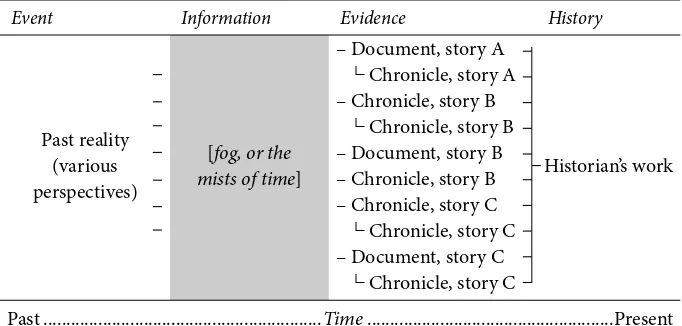
As a result of this inability to see the linkages through the fog, historians tend to view any single fact contained in a piece of evidence as a static piece of information, to be verifi ed by either (1) its internal credibility or (2) its external relationship with some other data (both of these being aspects of source criticism). When we take any particular fact and use it in a narrative, we might present it as reliable, or questionable, or perhaps doubtful, or even wrong, but we refer to it as a fact and describe it in relation to the evidence (e.g. ‘As Adam Usk states . . .’). It is immutable: if a source for the Battle of Shrewsbury says that Hotspur’s supporters cried ‘Henry Percy King!’ at the moment they saw a knight struck down wearing Henry IV’s armour, we may trust the evidence or we may doubt it, or we may use it with a caveat, but we cannot change the wording of the exclamation (except as a bona fi de translation). As a result, even if historians consider absolutely all the evidence at their disposal, they have to discard evidence that confl icts with their chosen narrative even if they have no better reason for doing so than simply the inability to make it fi t. In Figure 1.1, a historian who believes story C will discard the evidence for story A and story B.
Event Information Evidence History
Past reality (various perspectives)
[fog, or the mists of time]
– Document, story A Chronicle, story A – Chronicle, story B
Chronicle, story B – Document, story B – Chronicle, story B – Chronicle, story C
Chronicle, story C – Document, story C
Chronicle, story C
Historian’s work
Past ...Time ...Present
Historian’s work Th is may or may not be justifi able on historical grounds; either way the process depends on the historian’s judgement, and that is prone to error.
Th is highlights a paradox in the way historians handle evidence and present it to readers. In the above model, relevant facts are selected from the evidence, and treated as immutable. Th is is paradoxical because, in history, the facts may have already been changed – before they were written down. Evidence is not normally the start of a process of information dissemination; it is created at a later point in the life cycle of the information (to paraphrase the archival concept of ‘the life cycle of the document’). Information has an existence before the creation of the evidence in which it will eventually fi nd its immutable form. But, in some cases, much of the ‘fog’ which allows us to take evidence at face value can be swept away, and we can start to reconstruct how information passed from the ‘event’ to the writer of the evidence.
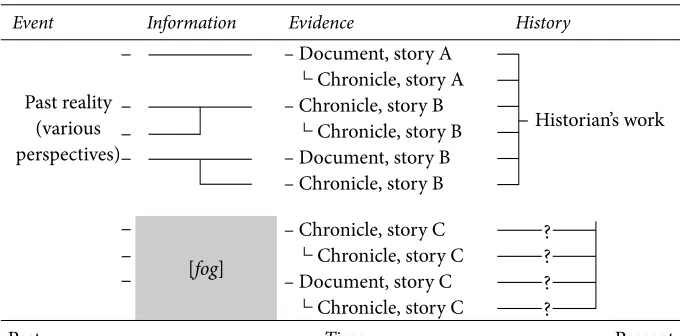
In Figure 1.2, the benefi t of studying information linkages is shown. Unable to fi nd a good information stream for story C, it is considered merely as a possibility and held in abeyance while the others are tested. Th e inconsistency of story A and story B is resolved by fi nding two independent information streams for story B which correlate, showing that the apparently reliable story A was probably created in bad faith, despite the traceable source of the information.
Just as Wilson’s third hermeneutic stance encourages historians to study documents in the context of their creation, so too we may study information in
Event Information Evidence History
Past reality (various perspectives)
– Document, story A Chronicle, story A – Chronicle, story B
Chronicle, story B – Document, story B – Chronicle, story B
[fog]
– Chronicle, story C Chronicle, story C – Document, story C
Chronicle, story C
Past ...Time ...Present
the context of its genesis and genealogy – its prehistory before its embodiment in a document. In some cases we can penetrate the fog. We can use the knowledge that any possibly correct information underlying a primary source is the end- product of an information network or stream extending back to the creation of the information, and, through its originator, back to the event itself. In order to understand how archival certainties relate to past events – how they refl ect events in space- time – we must overcome the paradoxical element inherent in the use of primary sources and examine the relationship between a primary source and the event. We must regard evidence not as a primary source with some unchallengeable ‘primary’ status but simply as a container in which pre- existing information was stored and transmitted to us in the present.
THE INFORMATION- BASED APPROACH
Physicists using special relativity refer to objects in space- time using a series of four coordinates: three dimensions and time. For historical purposes we might add additional time elements, relating to the dates when something was created and when it ceased to exist, or when creation started and terminated. We might describe the creation of a document, say the fi nal volumes of Domesday Book, at a series of coordinates between the date when writing commenced and the series of coordinates of the place and time it was completed. Th is followed on from the creation of preliminary draft s of the work (such as Exon Domesday) at diff erent coordinates in space- time at an earlier date. Th is process of document genesis may be conjectured all the way back to the tours around the country undertaken by those who actually gathered the information. Th ese tours too have unique coordinates in space- time. Moreover those coordinates are real – in theory we could defi ne them precisely, if we had suffi cient data. Th us Domesday Book represents a network of information links in space- time connecting a preliminary stage of events (questioning, informing, writing, travelling), with a more concentrated second stage (draft ing) and a third stage (writing the fi nished volumes). Aft er that, the network of information links contracts to a single path through space- time, dependent on the physical location of the volumes over the centuries, until they are copied, edited, corrected and published, and the network of information links begins to expand again.
sophisticated way than in Figures 1.1 and 1.2 in the previous section:
1. In the initial stage – in the witnessing of an event or the hearing of a pronouncement, for example – there were witnesses. Each witness forms a view on what he or she has seen or heard, and commits it to memory, and articulates it to one or more person(s) in the next stage.
2. There may be some intermediaries in the process of circulating the information, who have been informed as to what has been said or done, and who memorize what they have heard and repeat it, or a version of it, to those in the next stage.
3. Th e writer may be informed by the witness (from stage 1) directly, or he might be informed indirectly by an intermediary (from stage 2). Either way, the writer will also need to recall what he has heard, in order to write it down. 4. Th e writer’s words may be copied, with or without changes (including
translation), in later copyists’ work.
5. Th e historian reads the fi nal text incorporating the information.
Th e above model may be varied in many ways. A witness might be both a writer and a copyist himself. Th ere may be many hundreds of intermediaries, and the writer might speak to just one or many of them. Th e whole process may be a written one, from witness to eventual writer. Many years and large distances may pass between stages, memory performing the important (albeit problematic) function of data storage. Th e important thing to remember is that, as information is disseminated, time passes. One cannot write down what happened before it has happened, not without breaking the integrity of the fl ow of information. Stage 1 must occur before stage 2 can take place, and so on. If a clerk writes about an event before it has happened, he is not recording the event itself but the anticipation of that event. Just as archaeological and archival certainties derive their ‘certainty’ from their fi xed positions on the axis of time, so the stages of the above model depend on chronological consistency. As all existence is moving forward through time, we could say it is a physical law that information dissemination must take place in a sequence of chronological stages.
information (regardless of whether it was true or not) was incorporated in a text written at a specifi c date or over a specifi c period of time, and so was known to the writer at or before that time. Underlying each piece of information is at least one – and probably many – networks of information in space- time, each consisting of articulations, reports, viewpoints and impressions, collectively linking witnesses of the event and the author of the documentary evidence. Th ese networks may thus be said to embody both information genesis (the original articulation of reports) and information genealogy (the transfer of such reports). Finally, we must consider information integrity (whether the information contained within a document is resistant to mutation and alteration).
Obviously the problem of information mutation means that the theory is most useful in discussing the accuracy of a single detail which is not relatively defi ned, so its integrity may be verifi ed. Th e theory is, for example, far more useful for assessing whether reports of a man’s death are trustworthy than reports of his emotional aff airs. Reports of a death permit a series of hypotheses, all of which may be tested and either found true or false. Whichever we are trying to test, ‘death = true’ or ‘life = true’, can be reconfi gured in terms of the other, ‘death = false’ and ‘life = false’. If we may disprove something on information grounds, it follows that we may prove its opposite true. For anyone involved in the task of making defi nite pronouncements about specifi c events in the past, this provides a means by which we can be more accurate about subjects which have hitherto been left to historians’ personal impressions or statements of fact based simply on the grounds of perceived motive (a subjective inference).
To recapitulate: this information- based method incorporates key areas in which specifi c enquiry might be pursued in order to ascertain the veracity of a piece of information.
1. Information Genesis: one may question whether the original report was articulated in good faith;
2. Information Genealogy: one may question the connectedness or integrity of the entire chain or network of reports, linking the event and the evidence, including whether the initial articulators of a report were actually witnesses of the event;