Testing Momentum and Contrarian Strategies In The Malaysia Stock Exchange
Tafdil Husni* Zamri Ahmad**
* Author Correspondence
Tafdil Husni is a lecturer at Faculty of Economics, Andalas University, Padang, Indonesia. E-mail: [email protected]
International contact: Faculty of Economics Andalas University Padang
Kampus Limau Manih Padang 25163
INDONESIA Tel: 62-751-71088 Fax: 62-751-71089
** Dr. Zamri Ahmad is a lecturer at the School of Management, Universiti Sains Malaysia. E-mail: [email protected]
International contact:
School of Management Universiti Sains Malaysia 11800 Minden, Pulau Penang
MALAYSIA
Tel: 60-4-6533888 ext 3953 Fax: 60-4-6577448
Testing Momentum and Contrarian Strategies In The Malaysia Stock Exchange
Abstract
The study investigates whether or not the profitability of momentum and contrarian strategies work in the Malaysian stock exchange (formerly Kuala Lumpur Stock Exchange / KLSE). By using daily data for the period 1988 through 2002 and following the strategy quite similar to Jegadeesh and Titman (1993), we find that only one strategy, 3-month ranking, 3-month testing period, has statistically significant abnormal returns for momentum strategies. If we construct shorter ranking and test periods, we found that the momentum payoff still work for 2-month ranking and 2 month testing strategy. Whereas, the contrarian strategy appears to work for 1-month ranking, 1-month testing period. Both results are statistically significant at 5% level. The study also reveals that the profitability of momentum and contrarian strategies still exist after the inclusion of transaction cost. These findings are in line with prior studies, which found that the profitability of momentum is achievable in medium term, whereas contrarian strategy works in short term.
Introduction
There are now growing empirical evidence of profitability contrarian and momentum strategies. For example, Ahmet and Nurset (1999) examine abnormal profits of long- term contrarian strategies in the stock markets of seven non-US industrialized countries. Rosita et al. (1995) investigate abnormal profit of short-term contrarian strategies in Japan stock market. The same result also found by Hameed and Ting (2000) in the Malaysia stock markets. Rouwenhorst (1999) investigate the profitability of momentum strategies in six (out of 20) emerging equity markets. Hameed and Yuanto (1999) find that a momentum strategy yields small but statistically significant profits in six Asian stock markets. Schiereck et al. (1999) examine profitability of momentum and contrarian strategies in the Germany equity market.
These works on contrarian and momentum effect, stand in stark contrast to well-accepted doctrine of the efficient market hypothesis. Under the null hypothesis of weak-form market efficiency, the perweak-formance of portfolios of stocks should be independent of past returns. However, some researches have shown that assets returns do exhibit some form of positive autocorrelation in the medium; but mean-revert over short and longer horizons (Poterba & Summer, 1988; Lehman, 1990; Daniel, Hirshleifer & Subrahmanyam, 1998).
However given the characteristics of emerging capital markets, namely thin trading, low liquidity, possibly less informed and rational investors, and having low correlation with other emerging markets and developed market, one would expect more return predictability in these markets (Harvey, 1995). He also concludes that emerging markets are less efficient than developed markets and that higher returns and lower risk can be obtained by incorporating emerging market stocks in investors’ portfolios.
Based on the above scenario, it is therefore reasonable to believe that prices of stocks traded in the Malaysian stock market as an emerging market, may not fully reflect their true value. Hence, some degree of predictability should be possible.
Literature Review
Many studies have documented the long-term and short-term contrarian strategies, for the UK, the US and other countries as well. One of the most important early test of study is by DeBondt and Thaler (1985) in US. They based on research in experimental psychology suggesting that most people overreact to unexpected and dramatic events, and tested whether the same thing occurs in the stock market. Their study points out that portfolio of prior extreme “losers” dramatically outperform prior extreme “winners” even if the latter are more risky. In other words, the work of DeBondt and Thaler find a long-horizon return reversal. Overreaction phenomenon in the financial market, who observed by DeBond and Thaler; 1985, can be explained by the finding in psychology reported by Kahneman and Tversky (1973) that people tend to make prediction using behavioral heuristic known as representativeness rather than Bayes’ rule. This finding in psychology infers that investors in stock market overreact and make extreme prediction based on extrapolation of recent trends.
Profit generated by contrarian strategies are seen not only in the US market, but also in stock markets across the continent i.e.; UK, Spanish, Canada, and Australian; see Clare and Thomas (1995), Forner and Joaquin (2003), Mun et al (1999), and Gaunt (2000) etc.
dividends) of all 33 constituent stocks in the HIS in Hong Kong from January 1980 to December 1993, and finds that the losers portfolio, on average, outperform the winner portfolio by 9.9% 1 year after the formation period. Ahmad and Hussain (2001) investigate overreaction in Malaysian (KLSE) returns during 1986-96, and also observe several factors which have been linked with the overreaction effect: firm size, time-varying risk, and seasonalities with regard to Chinese New Year Effect. They find that the result is consistent with the overreaction hypothesis that stocks in the best /worst performing decile experience a reversal of fortune in the following three years.
Some evidences of overreaction are also documented in the short term. For example, Howe (1986) using daily stocks returns data from the University of Chicago’s CRSP tape, which were converted to weekly data, finds that the evidence is strongly consistent with the overreaction hypothesis. Specifically, stocks that experience large positive returns (good news) performed poorly in the 50-week period following that event, with returns averaging about 30 % below the market. Zarowin (1989) examine evidence regarding the existence of stock market overreaction in the short-run. He ranks common stocks according to their performance during a given month, and find that in subsequent month a portfolio the past month’s losers outperforms a portfolio of the past month’s winners by 2.5 per cent., regardless of which group is smaller.
Using the weekly share price data were obtained from datastream for 47 individual shares registered on the Kuala Lumpur Stock Exchange over the period January 1990 to December 1994, Arifin and Power (1996) find that some evidence of short-run overreaction in share price, particularly in firs two weeks after portfolio formation date. The trading strategy of buying a portfolio of underperforming shares and selling a portfolio of outperforming shares earns a significant profit.
Bowman and Iverson (1998) examine the behavior of stock prices in New Zealand after a large weekly change in price and found that the stock market significantly overreact, especially in the case of price declines and significant reversal is confined to the following week They observed the result is affected by risk, size, seasonal and bid-ask bounce.
Schnusenberg and Madura (2001) investigate the short-term over-or underraction of six U.S. stock market indexes:The Dow, the S&P 500, the Nasdaq, NYSE, the Russel, and the Wilshire 5000 index. They find evidence of a one-day stock market underreaction to highly positive and negative news release using two methods to predict returns for these indexes on the following day. Over a sixty-day interval, they reveal strong evidence of a stock market underreaction for winner but an overreaction for losers.
Subsequent studies of contrarian strategies have sought explanations for return reversal. The followings are some of the explanation put forward in the literature: (i) overreaction (DeBondt and Thaler 1985, 1987); (ii) change in risk (Chan 1988, Ball and Kothari 1989); (iii) seasonality effects (Chopra, Lakanishok & Ritter 1992); (iv) the size effect (Zarowin 1990, Clare & Thomas 1995, Dissainake 1997); market-microstructure biases (Conrad and Kaul 1993); and (v) behavioral aspects (Barberis, Shleifer and Vishny 1998, Daniel and Titman 2001).
1.49% per month. They document that past winners on average continue to outperform past losers, so that there was momentum in stock prices.
The evidence of momentum in stock prices over the medium terms is well accepted and supported for the developed market in the US. For instance, see Chan, Jegadeesh and Lakonishik (1996, 1999), Maskowit and Grinblat (1999), Hong and Stein (1999), O’Neal (2000), Lewellen (2002), Chordia and Shivakumar (2002), Cooper et al (2004) etc. Similar result are found on other stock markets Outside the US as well; see for example, Schiereck, Debondt, and Weber (1999), Rouwenshort (1998, 1999), Liu et al (1999), Chan, Hameed and Tong (2000), Glaser and Weber (2001), Demir et al. (2004), etc. However, these papers do not cover the same period of time and the methodologies used to detect momentum are not uniformed.
From the previous studies of momentum, the source of the profit and the interpretation of the evidence are also widely debated. The behaviorist argues that momentum profits provide strong evidence of market inefficiency, and are due to stock prices’ under-reaction to information, investors’ herding behavior, etc. On the other hand, market efficiency supporters argue that either risk (cross-sectional and/or time-varying expected returns) is the main source of momentum profits or that abnormal return is a product of data mining.
Data and Methodology
Daily prices are obtained from Pusat Komputer Professional, a company based in Pahang, Malaysia. Adjustment is made to take account into of stock split, rights, and dividend. We choose daily prices instead of weekly and monthly prices as they can capture the dynamic of price behavior. All companies selected for analysis are from the main board and the period covered in January 1988 to December 2002. The numbers of companies will increase every year as we add new companies in the sample as they get listed.
To analyze the profitability of price momentum strategies and contrarian, we employ the methodology used by Jegadesh and Titman (1993). We consider ranking periods of r = 3, 6, 9 and 12 months and subsequent holding periods of h = 3, 6, 9 and 12 months, giving a total of 16 r x h momentum strategies and then we continue to examine in short term of 2 and 1 months. Unlike Jegadeesh and Titman’s study, where portfolios involve overlapping periods, this study examines non-overlapping periods. This modification can at least reduce the bias arising form double counting resulting from the use of overlapping periods. In addition, Pan and Hsueh (2001) find that the International momentum effect appears to disappear when the analysis is conducted using non overlapping data. So, they conclude that the result is simply an empirical illusion due to the use of overlapping data.
The profits of momentum and contrarian strategies are calculated for the returns on buy-and hold method for both winner and loser portfolios which stocks are ranked based on their returns over the past 1, 2 and 3, 6, 9 and 12 months, labeled here as the ranking period (RP). Stocks are divided into 10 equal-weighted portfolios. P1 represents the loser portfolio with the lowest returns, and P10 represents the winner portfolio with the highest returns. We prefer buy-hold returns instead of cumulative abnormal returns because they accurately reflect the actual return that investors receive from their investment, see Barber and Lyon (1997), Kothari and Warner (1997).
Daily returns (R), and buy and hold abnormal returns (BHAR) are calculated using equations 1, 2, 3 and 4, respectively.
/ 1
jt jtjt LnP P
where, preferable for theoretical and empirical reasons. Theoretically, they are analytically more tractable when linking together sub period returns to form returns over longer interval (simply add up the sub-period returns). Empirically, they are more likely to be normally distributed, and they conform to the assumptions of standard statistical techniques (Strong, 1992). In addition, the use of logarithmic returns is common in contrarian and momentum literature.
Then, buy and hold abnormal return, BHAR, are calculated as follows:
In the following 1, 3, 6, 9 and 12 months, described here as the test period (TP), the BHAR for all stocks in the winner and loser portfolios are calculated. The mean of these BHAR represent the cumulative buy and hold abnormal return for an equal weighted portfolio and is measured as
where WBHAR is the cumulative buy and hold abnormal return of the winner portfolio,
BHAR
L is the cumulative buy and hold abnormal return of the loser portfolio, and N is
This procedure is replicated for each non-overlapping periods. The cumulative buy and hold abnormal return of the loser and winner portfolios are then averaged across all test periods:
portfolios,
W
BHAR is the average cumulative buy and hold abnormal return of winnerportfolios; and M is the number test period.
The final step of the trading rule is to determine the difference between returns on the average cumulative buy and hold abnormal return of winner portfolios and the loser portfolios that will generate significant abnormal profit.
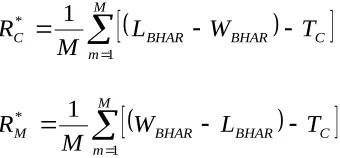
If the contrarian strategy works, assuming zero transaction cost, then the study will find that past loser portfolios outperform past winner portfolios in the test period:
BHAR BHAR
C L W
R _ _
If the momentum strategy works, assuming zero transaction cost, then the study will find that past winner portfolios outperform past loser portfolios in the test period:
BHAR
R is the after transaction cost of contrarian return, * M
R is the after transaction
of momentum return, and TC is the transaction cost.
Then, a t-test will also be used to determine whether the difference is statistically different from zero.
Results
Table 1 shows the average returns of winners and losers in the rank periods and also the average returns of winner minus loser (W-L) portfolio for the r x h strategies.
In the test period, we find that there are 3 out of 16 trading strategies where momentum returns are positive. All of them come from 3-month ranking. However, only one of them appears to be significant at 5 % level, 3-month ranking and 3-month testing.
Scanning through the table in the test period, we find that the highest profit is for 3-month ranking periods, 3-month holding periods (3x3). It shows that the performances of past winners remain better in the future periods and the performance of past losers continues under-perform in the next periods. It means that the average difference between P10 (top- winner) and P1 (top-loser) portfolio returns during the 15-year period is 0.0466, which is statistically different from zero at 5%, level, as well as their performance is above the market.
Table 1
Returns of Momentum Strategy
Rank Period (r) Test Period (h)
R Portfolio Return Strategy Portfolio Obser vation
The underreaction hypothesis suggests that the strategy of buying the winners portfolio and selling the losers portfolio can earn profits. This is what table 1 shows i.e. the mean difference between winner and losers portfolio in the test periods. If we look at the rest of strategies (beyond 3-month ranking) that gives the result of momentum are negative. It finds that contrary to the hypothesis, the results generally show otherwise. However, as indicated by the t-statistics, these negative abnormal returns are not significant. Therefore, a strategy of buying the winner and selling the losers will not give investor any profit. In fact, this strategy will lose investor money.
Table 2.
Profitability of contrarian and momentum strategies Ranking
This table presents for contrarian and momentum portfolio strategies in the Malaysian stock market from January 1988 to October 2002. At the end of month, all stocks are sorted in ascending order based on their ranking (r) period returns into ten relative strength decile portfolios. Stocks in the bottom 10 percent of past returns are assigned as the loser portfolio (L) and the top 10 percent as the winner portfolio (W). These portfolios are equally weighted at ranking and then held for (h) subsequent months. The table reports average h month holding period returns (return) over the sample period and t statistics. The t-statistics for W-L indicate whether the returns from momentum strategy of buying past winner and selling past loser are significantly different from zero. Meanwhile, L-W indicate whether the returns from contrarian strategy of buying past loser and selling past winner. An asterisk * indicates that the t-value is significant at 5% level.
abnormal return a 1.40 % one-month. This means that there is the overreaction phenomenon in the stocks. The overreaction suggests contrarian strategy, which is long positions in past worst performing, stocks (losers) and short positions in past best performing stocks (winner) can yield abnormal returns.
Table 3 displays the returns of contrarian and momentum categories before and after transaction costs. Contrarian strategy still records a positive profit after the inclusion of transaction cost of 0.15 %. For the 1x1 strategy, the profit per month is significant at the 5 % level. The result reveals that even with the inclusion of transaction cost, the contrarian strategy still remain profitable.
For momentum strategies, i.e., the 2x2 and the 3x3, the profits calculated for each of these strategies after the inclusion of 0.15 % transaction cost still produce positive return of 1.9 % and 4.5 % respectively, but significantly different from zero at the 10 % level. There is indication that the inclusion of transaction cost on momentum strategy make the profits less pronounced, but do not eliminate it.
Table 3
Returns before and after transaction cost of contrarian and momentum strategies
Investment ** Significant at 10 % level
addition, the study also finds that some securities do not trade in a given some interval is in P2 to P9). Based on these reasons, contrarian and momentum profits in this study are not affected severely by the thin trading effect.
Our result is in line with previous studies, which found that the momentum strategy is in medium term and contrarian strategy in short-term.(Glaser and Weber, 2001; Hameed and Yuanto, 1999; Condrad et al, 1997 ; Bowmen and Iverson, 1998; etc).
Conclusion
The evidence of this study shows that momentum strategies are profitable in the medium term (two and three months) which suggest that past winners will perform better in the next period, while past losers will perform worse in the future period. Therefore, a trading strategy that buys the past winners and sells the past losers would provide significant abnormal returns in the future. Meanwhile, contrarian strategy is profitable in short term period (one month), which assumes just opposite behavior from stock returns, and therefore recommends buying the past losers and selling the past winners.
The success of momentum and contrarian investment strategies above is a direct test of the weak form efficient market hypothesis and it could give a serious challenge to efficient market hypothesis. These strategies may imply that the markets are not efficient as future price are predictable. The weak form efficiency reveals that an investor cannot use past security price information to consistently earn a portfolio return in excess of returns that is in proper proportion with the portfolio risk.
The debate on the source of the profit and the interpretation of momentum and contrarian are still ongoing. One of theories that explain momentum and contrarian effect is behavioral or non-risk based. Another theory is advanced by market efficient supporter who argue that risk is the main source of momentum and contrarian profits. The others possible explanations for momentum and contrarian strategies are size effect, market-microstructure, etc. In order to investigate what factors drive and the magnitude of momentum and contrarian strategies, further research can look into these two possibilities i.e. non-risk based such as size, book-to market and turnover and risk based, etc.
Ahmad, Zamri and Simon Hussain (2001) KLSE Long Run Overreaction and the Chinese New Year Effect. Journal of Business Finance and Accounting, 28 (1&2), p.63-105.
Arifin, Noraini Mohd and David M. Power (1996) Some Evidence on Short-run Market Overreaction for The Kuala Lumpur Stock Exchange. Capital Market Review, 4 (1), p. 21-32.
Ball, R., and Kothari, S.P (1989) Non-Stationary Expected Returns: Implication For Test Markets Efficiency And Serial Correlation In Return. Journal of Financial Economics, 25, p. 25-74.
Barberis, Nicholas, A.Shleifer, and Robert W. Vishny (1998) A Model of Investor Sentiment. Journal of Financial Economics, 49, p.307-343.
Bowman, R.G. and Iverson D. (1998) Short-Run Overreaction In The New Zealand Stock Market. Pacific-Basin Finance Journal, 6 (5), p. 475-491.
Chan, K.C. (1988) On the Contrarian Investment Strategy. Journal of Business, 61, p.147-163.
Chan, Kalok., Alaudeen Hameed, and Wilson Tong (2000) Profitability of Momentum Strategies in the International Equity Markets. Journal of Financial and Quantitative Analysis, 35, p.153-172.
Chan, Louis K.C., Narashiman Jegadeesh, and Josef Lakonishok (1996) Momentum Startegies. Journal of Finance, 51, p.1681-1713.
Chan, Louis K.C., Narashiman Jegadeesh, and Josef Lakonishok (1999) The Profitability of Momentum Strategies. Financial Analyst Journal, 55 (November/December), p. 80-90.
Chopra, N., J. Lakonishok and J. Ritter (1992) Measuring Abnormal Performance: Do Stocks Overreact?. Journal of Financial Economics, 31, p. 235-268.
Chordia, T., and L. Shivakumar,(2002) Momentum, Business Cycle, and Time-Varying Expected Returns. Journal of Finance, 57(2), p. 985-103.
Clare, A. and S. Thomas (1995) The Overreaction Hypothesis and the UK Stock Market. Journal of Business Finance and Accounting, 22 (7), p.961-973
Conrad, J. and G. Kaul (1993) Long-term Overreaction or Bias in Computed Returns. Journal of Finance, 48, p.39-63.
Cooper, Michael., and Roberto C. Gutierez Jr, and, Allaudeen Hameed (2004) Market States and Momentum. Journal of Finance, 59, p.1345-1364
Daniel, Kent., and Shereidan Titman (2001) Market Reaction To Tangible And Intangible
Information. Available from world wide web:
http://www.kent.kellog.nwu.edu/papers/dt4.pdf
DeBondt and R.H. Thaler (1985) Does the Stock Market Overreact?. Journal of Finance, 40, p.793-808.
DeBondt and R.H. Thaler (1987) Further Evidence Of Investor Overreaction And Stock Market Seasonality. Journal of Finance, 42, p.557-81.
Demir, Isabella., Jay Muthuswamy, & Terry Walter (2004). Momentum return in Australia equities: the influences of size, risk, liquidity and return computation. Pasific-Basin Finance Journal, 12, 2, 143-158.
Dissainake, G. (1997) Do Stock Market Investors Overreact?. Journal of Business Finance and Accounting, 24(1), p.29-49.
Fama, E.F., and Kenneth R.French (1988) Permanent and Temporary Components of Stock Prices. Journal of Political Economy, 96, p.246-273.
Fama, E.F., and Kenneth R.French (1996) Multifactor Explanations of Asset Pricing Anomalies. Journal of Finance, 51, p.55-84
Forner, Carlos and Joaquin Marhunda (2003). Contrarian and Momentum Strategies in the Spanish Stock Market. European Financial Management, 9(1), 67-68.
Gaunt, Clive (2000) Overreaction in the Australian Equity Market: 1974-1997. Pacific-Basin Finance Journal, 8, p.375-398.
Glaser, Markus., Martin Weber (2001) Momentum and Turnover: Evidence from the German Stock Market, Universitat Mannheim, Working paper (www.google.com)
Hameed, Alaudeen, and Kusnadi Yuanto (1999), ‘Momentum Strategies: Evidence from the Pacific Basin Stock, National University of Singapore, working paper (www.ssrn.com)
Hameed, Allaudeen, and Serena Ting (2000) Trading Volume and Short-Horizon Contrarian Profits: Evidence From the Malaysian Market. Pacific-Basin Finance Journal , 8, p.67-84
Hong, Harisson, and Jeremy C. Stein (1999) A unified Theory of Underreaction, Momentum Trading and Overreaction in Assets Market. Journal of Finance,54, p.2143-2184.
Howe, J.S, (1986) Evidence on Stock Market Overreaction. Financial Analyst Journal, July-August, p.74-77.
Jegadeesh, and Sheridan Titman (1993) Returns to Buying Winners and Selling Losers: Implication for Stock Market Efficiency. Journal of Finance, 48, p.65-91.
Kahneman, D. and A. Tversky (1973) On the Psychology of Prediction. Psychological Review, 80, p.237-51.
Kwok-Wah Fung, Alexander (1999) Overreaction in the Hong Kong Stock Market. Global Finance Journal 10 (2), p. 223-230.
Lakonishok, Josef., Andrei Shleifer, and R.W. Vishny (1994) Contrarian Investment, Extrapolation, and Risk. Journal of Finance, 49, p.1541-1578.
Lewellen, Jonathan (2002) Momentum and Autocorrelation in Stock Returns. Review of Financial Studies, 15, p.533-563.
Liu, Weimen, Norman Strong, and Xinzhong Xu (1999) The Profitability of Momentum Investing. Journal of Business Finance and Accounting, 26(9&10), p.1043-1091.
Lo Andrew and MacKinlay (1990) When are Contrarian Profits Due to Stock Market Overreaction. Review of Financial Studies 3, p.175-205.
Moskowitz, T.J. and Mark Grinblatt (1999) Do Industries Explain Momentum?. Journal of Finance, 54(4), p. 1249-1290.
Mun, Johnatan C., Geraldo M. Vasconcellos. And Richard Kish (2000) The contrarian / Overreaction Hypothesis an analysis of the US and Canadian Stock Market. Global Finance Journal, 11(1-2), p.53-72.
O’Neal, Edward S. (2000) Industry Momentum and Sector Mutual Funds. Financial Analysts Journal, July/August, p.37-49.
Pan, Ming-Shiun., & L. Paul Hsueh. (2001) International Momentum Effect: A Reappraisal of Empirical Evidence. Shippensburg University, Working Paper. (www.ssrn.com)
Rouwenhorst G., (1998) International Momentum Strategies. Journal of Finance 53, p.267-284.
Rouwenhorst G. (1999) Local return Factors and Turnover in emerging Stock market. Journal of Finance 55, p.1439-1464.
Schiereck, Dirk, Werner DeBondt, and Martin Weber (1999) Contrarian and Momentum Strategies in Germany. Financial Analyst Journal, 54(4), August, p.104-116.
Schnusenbarg, Oliver, and Jeff Madura (2001) Do U.S. Stock Market Indexes Over-Or Underreact?. The Journal of Financial Research, XXIV(2), p.179-204.
Zarowin, P (1989) Short-run Market Overreaction: Size and Seasonalitiy Effects. The Journal of Portfolio Management, Spring, p.26-29.