J.Food Pharm.Sci. 2 (2014) 52-56
Avalaible online at www. jfoodpharmsci.com
Research Article
The Antiradical Activity of Insoluble Water Suji (
Pleomele angustifolia
N.E.
Brown) Leaf Extract and Its Application as Natural Colorant in Bread
product
Wahyu Jokopriyambodo
1,2*, Sudarsono
2and Abdul Rohman
31BalaiBesarPenelitiandanPengembanganTanamanObatdanObatTradisional,Jl. Raya Lawu No. 11 Tawangmangu,
Karanganyar, Jawa Tengah, Indonesia
2Department of Pharmaceutical Biology, Faculty of Pharmacy, Gadjah Mada University, Yogyakarta 55282, Indonesia
3Department of Pharmaceutical Chemistry, Faculty of Pharmacy, Gadjah Mada University, Yogyakarta 55282, Indonesia
ARTICLE INFO ABSTRACT
Received 12/12/2013
Received in revised form 10/02/2014 Accepted 10/02/2014
Available online 11/06/2014
1. Introduction
The use of food additives in food products including the food colorants is an emerging issue, especially in health aspect. The appearance of the food, especially its color is important factor affecting the attractiveness of consumers to consume. Hence, the food colorants become so important in the production of food. Food colorants can be classified as synthetic and natural. Synthetic colorants have been widely used in the food
industry due to its effectiveness (Amalia et al., 2013). However, the application of synthetic colorants for the food or beverages can cause toxic and carcinogenic effects. As a consequence, some food scientists try to use natural colorants in order to hinder the negative effects of synthetic colorants (Chengaiah et al., 2010).
Natural coloring agents are derived from naturally occurring sources such as plants, animal and minerals. The current preference for naturally derived colorants is due to their healthfulness and excellent performance Currently, there are some synthetic colouring agents present in food products. The synthetic colouring agents are supposed to give deleterious effect to human health; therefore, natural coloring agents derived from plant is continuously explored to replace the synthetic ones. Suji (Pleomele
angustifolia) leaf is one of the potential plant to be used as natural coloring
agents. The aim of this study is to explore the natural colour potency and antiradical activity of insoluble water extract of suji leaf from three different regions. Furthermore, green components obtained from suji leaf extract (SLE) was used for coloring food product (bread product), and bread added with extract was subjected to preference test, namely color and taste preferences by trained panelist. The result showed that region and maturity level affect the intensity of green components obtained from SLE. The highest level of green components (2.57 %) among three regions evaluated was observed from Jumantono. The water insoluble extract of suji leaf can also make coloring effects toward bread and exhibits low radical scavenging against 2,2-diphenyl-1-picrylhidrazyl. The preference test against color and taste of bread added with synthetic coloring agents and mixed with SLE showed that the coloured bread is less preferred than that without coloring agent.
Keywords: suji leaf; coloring agents; 2,2-diphenyl-1-picrylhidrazyl; preference test.
(Hernandez-Ceruelos et al., 2002; Chengaiah et al., 2010). Some plants which have been successfully used as natural colorants and its biological activities are turmeric (yellow in color) having antioxidant activity (Kalpravidh
et al., 2010) and anti-inflammatory activity
(Skrzypezac-Jankun et al., 2000), Caesalpinia sappan bark produced red color and had hepatoprotective activity (Srilakshmi
et al., 2010), roselle extract in a model system of a drink
(Duangmal et al., 2008), and Black Rice Bran in Yogurt (Nontasan et al., 2010). From literature review, there are more 20 plants used as natural colorants (Chengaiah et been correlated with benefit effects to human health; as a consequence, some food producers can still advertise many chlorophyll-containing products, mostly in dietary supplements and juices. The advertisement may be supported by the chemical similarity between chlorophyll and the prosthetic group (heme) of hemoglobin which are responsible for protecting the human body from several diseases (Tumolo and Lanfer-Marquez, 2012).
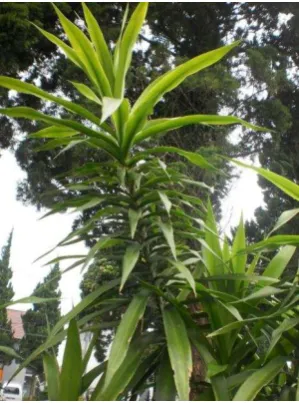
Fig 1. The suji leave (Pleomelleangustifolia (Roxb.) N.E.Br.
Chlorophyll is natural compound derived from leaf and is suspected to posses antioxidant activity due to the conjugated double bond present in chlorophyll. Therefore in this study, we evaluate the antioxidant activity of suji leaf extracted using 2,2-diphenyl-1-pycrilhydrazil (DPPH) radical scavenging test. Furthermore, the extract obtained was also used as natural colorant in food model (bread products), and bread added with suji leaf extract was tested by panelist.
2. Materials and Methods
Suji leaf was obtained from three different regions in Central java, namely Jumantoto, Tawangmangu and
Mateseh. Botanical identification was performed in the Laboratory of Pharmaceutical Biology, Faculty of Pharmacy, Gadjah Mada University, Yogyakarta, Indonesia. 2,2-diphenyl-1-pycrilhydrazil (DPPH) radical was obtained from Sigma (Alldrich, USA). The other chemicals and solvents used were of analytical grade, unless if they are specified.
2.1. Extraction of Suji leaf
An approximately of each 100 g of leaf from three different region was added with 800 mL of water, blended for 2 min using commercial blender and filtered. The residue was then blended using 800 mL of water, obtained was further subjected to several tests including antiradical activity.
2.2. Determination of color intensity of Suji leaf extract
The color intensity of suji leaf extract (SLE) obtained during extract preparation was measured as follows: A- 200.0 mg of SLE was accurately weighed using calibrated analytical balance, added with 10 mL methanol and stand for 5 minute, shaken vigorously for 2 x 5 minute, and centrifuged for 10 minute. The filtrated was scanned using UV-vis spectrophotometer at λ – 700 nm using methanol as blank. The λmax of SLE was determined.
2.3. Antioxidant activity of Suji leaf extract
2.4. Preparation of bread
Bread is used as food model to be added with SLE as natural coloring agent. The preparation of bread is as follows: A-0.5 kg of egg was added with 0.5 kg sucrose and salt. The mixture was vigorously shaken, added with 0.5 kg flour, sodium bicarbonate and vanilla. The mixture was allowed to stand up for 30 minute. A-50 mL of bread dough was added with 0.3 g of SLE and or synrhetic coloring agent. The bread dough was further taken for steaming for 10 minute. The bread formed was evaluated for its antiradical activity against 2,2-diphenyl-1-pycrilhydrazil (DPPH).
2.5. Preference test
Bread with and without addition of SLE and or synthetic coloring agent was further taken for preference test. The bread was given to 20 panelists to be evaluated for its colour and taste. The scoring for without coloring agent, bread with SLE of 2 g/4 kg and 4 g/kg flour, and bread added with fresh juice of suji extract) was scored, and the score obtained was analyzed using analysis of variance (ANOVA).
3. Results and Discussion 3.1. Characteristic of suji leaf
Suji leaf was obtained from three different regions, namely Jumantono, Matesih and Tawangmangu (all are in Central java Province) having bit different characteristics. Table 1 showed stomata index and land characteristic analysis. The aim of stomata index is to investigate leaf development in relation to light intensity. According to Reid et al. (2003), the climate change and CO2 concentration affect the index and density of stomata. The highest stomata index was observed in SLE coming from Tawangmangu; however, this difference is not statistically significant (P > 0.05).
Table 1. The characteristics of suji leaf used during the study.
The origin of
The different letter indicated the different result
3.2. Extraction of Suji leaf
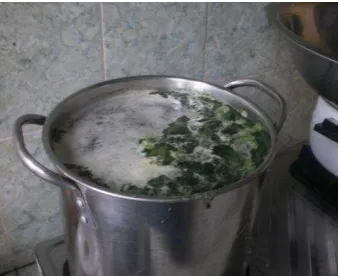
The suji leaf was extracted with water with the aid of heating. The main component exploited during extraction is chlorophyll. Basically, chlorophyll is more soluble in organic solvent such as chloroform and hexane; however, due to safety reason for being used in food product, the water was chosen as extracting solvent. The chlorophyll is insoluble in water, therefore, the coagulant (insoluble SLE) appears in the top of water during extraction is removed and used for further study (Figure 2). The coagulant was taken and dried on conventional oven at 70oC (for 12 hour).
Figure 2. The coagulant (insoluble suji leaf extract) appears in the top of water during suji leave extraction with water as extracting solvent. It contains chlorophyll.
Table 2. The levels of suji leaf extract from three different regions (Tawangmangu, Mateseh and Jumantoro) and with different maturity
Region
Maturity Tawangmangu Mateseh Jumantono Matture 2.37 (b)* 2.57 (b) 2.40 (b) Immature 1.47(a)* 1.13 (a) 1.30 (a)
*the different letter indicated the significant difference at level of P 0.05.
Table 2 showed the concentration of SLE from three regions. The highest level of extract was observed in mature SLE from Tawangmangu. The mature leaf contains more chlorophyll than immature one. The development of chlorophyll in mature leaf occurs more completely than that in immature one.
3.3. UV-vis spectra of Suji leaf extract
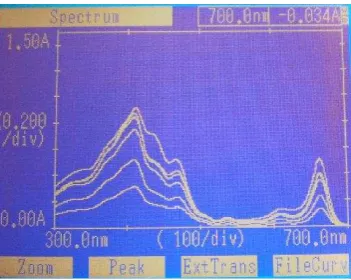
The suji leaf extracts (SLEs) were subjected to UV-vis spectra measurement. All extracts revealed the similar UV-vis spectra profile. Thi UV-vis spectra of SLE correspond to UV-vis spectra of chlorophyll. The maximum wavelength is observed at 410 nm and 660 nm, respectively as shown in Figure 3. The extract also contains several peaks with low intensity, indicating the presence of other components in that extract. This
component can occur from degradation products of chlorophyll during extraction.
Table 3. The absorbance average of suji leaf extract in methanol (0.02 gram/10 mL) at 410 nm.
Region
Maturity Mateseh Tawangmangu Jumantono Immature 0.403 (a) 0.488 (a) 0.769 (b) Mature 0.780 (b) 0.826 (b,c) 0.995 (c )
*the different letter indicated the significant difference at level of P 0.05.
The mature extract showed the higher intensity than the immature one, especially at wavelength of 410 nm. This indicated that the mature extract yield more green color component than that in immature one. Table 3 showed the absorbance average of suji leaf extract in methanol at wavelength of 410 nm with same concentration.
Fig3. The UV-vis spectra of insoluble water suji leaf extract in methanol.
3.4. The antiradical activity of Suji leaf extract and that in bread
The antiradical activity of SLE and bread added with SLE was evaluated using synthetic radical 2,2-diphenyl-1-picrylhidrazyl (DPPH). The method is based on the
reduction of methanolic-DPPH solution because of the presence of antioxidant substances present in SLE having hydrogen donating groups to form non radical DPPH-H form (Paixao et al., 2007).
Table 4. The IC50 values of suji leaf extract from three different
regions (Tawangmangu, Mateseh and Jumantoro) and with different maturity.
Region Maturity
Nilai IC50
Mateseh Tawangmangu Jumantono
Immature 1.61% 1.65% 1.41%
Mature 1.15% 1.19% 1.25%
The parameter used to evaluate radical scavenging activity of SLE is IC50 value, defined as the concentration of SLE required for 50% scavenging of DPPH radical in certain time period. The smaller IC50 value, the higher radical scavenging activity (Maisuthisaku et al., 2007). The IC50 values of SLE were shown in Table 4. All extracts yielded high IC50 indicating the weak radical scavenging, especially if compared with IC50 of vitamin C (2.7 ppm) (Rohman et al., 2010). As a consequence, the bread added with SLE has very weak antiradical capacity. This study indicated that SLE is not good component used for antiradical in food product.
3.5. Preference test
After being used as coloring agent in food product (bread), the preference test was taken. Bread with and without addition of natural coloring agents from SLE and from synthetic ones (tartrazine and brilliant blue) as well fresh juice of suji leaf was given to panelist for preference evaluation. Table 5 showed the result of preference test from 20 panelists.
The panelist did not know the composition of coloring agent during preference test. The preference test against color and taste of bread added with synthetic coloring agents and mixed with SLE showed that the colored bread is less preferred than that without coloring agent.
Table 5. The preference level for bread added with coloring agents.
Preference
Coloring agents The color score* The taste score*
Without coloring agent 3.45 ± 1.19 a.b 3.65 ±1.04 b.c Suji leave extract ( 2 g/kg flour) 3.25 ± 0.97 a.b 3.1 ±0.85 a.b Suji leave extract ( 2 g/kg flour) 2.7 ± 1.13 a 2.75 ± 0.85 a Synthetic coloring agent with high intensity 3.25 ± 0.79 a.b 3.5 ± 0.69 a.b.c Synthetic coloring agent with low intensity 3.75 ± 0.91 b 3.5 ± 1.10 a.b.c Fresh juice of suji leave 3.6 ± 1.05 b 3.8 ± 1.01 b.c
*the different letter indicated the significant difference at level of P 0.05. The score is based on: Score 1= very dislike; Score 2 = dislike; Score 3 = neutral; Score 4= like; and Score 5= very like
4. Conclusion
Suji (Pleomele angustifolia) leaf from three different regions (Jumantono, Matesih and Tawangmangu) and with different maturity level has been exploited as natural coloring agents. The region and maturity level affect the intensity of green components (chlorophyll) obtained from suji leaf extract (SLE). The highest level of
Reference
Amelia, F.; Afnani, G.N.; Musfiroh, A.; Fikriyani, A.N.; Ucche, S.; and Murrukmihadi, M. Extraction and Stability Test of Anthocyanin from Buni Fruits (Antidesma Bunius L) as an Alternative Natural and Safe Food Colorants. J. Food
Pharm. Sci. 2013. 1: 49-53.
Chengaiah, B.; Rao, K.M.; Kumar, K.M.; Alagusundaram, M.; and Chetty, C.M. Medicinal importance of natural dyes: A Review. Int. J. Pharm Tech Res. 2010. 2(1): 144-154.
Duangmal, K.; Saicheuaa, B.; and Sueeprasan, S. Colour evaluation of freeze-dried roselle extract as a natural food colorant in a model system of a drink. LWT-Food Sci.
Technol. 2008. 41: 1437–1445.
Hernandez-Ceruelos,A.; Madrigal-Bujaidar E; and deLa cruz C. Inhibitory effect of chamomile essential oil on the sister chromatid exchanges indused by daunorubicin and methyl methanesulfonate in mouse bone marrow. Toxic. Let.2002.135:103.
Kalpravidh, R.W.; Siritanaratkul, N.; Insain, P.; Charoensakdi, R.; Panichkul, N.; Hatairaktham, S.; Srichairatanakool, S.; Phisalaphong, C.; Rachmilewitz, E.; and Fucharoen, S. Improvement in oxidative stress and antioxidant
parameters in β-thalassemia/Hb E patients treated with
curcuminoids. Clin. Biochem. 2010. 43: 424-429.
Kikuzaki, H.; Hisamoto, M.; Hirose, K.; Akiyama, K.; and
Taniguchi, H., Antioxidant Isolated from Leaf Wax of Eucalyptus Leaves, J. Agric. Biol. Chem.2002.45: 735-739. Maisuthisakul, P.; Suttajit, M.; and Pongsawatmanit, R.
Assessment of phenolic content and free radical-scavenging capacity of some Thai indigenous plants. Food
Chem.2007. 100: 1409–1418.
Nontasana, S.; Moongngarma, A.; and Deeseenthum, S. Application of Functional Colorant Prepared from Black Rice Bran in Yogurt. APCBEE Procedia.2012. 2: 62 – 67. Paixao, N.; Perestrelo, R.; Marques, J.C.; and Camara, J.S.
Relationship between antioxidant capacity and total phenolic content of red, rose´ and white wines. Food
Chem.2007. 105: 204–214.
Prangdimurti, E., Muchtadi, D., Astawan, M. dan Zakaria, F.R. Aktivitas antioksidan ekstrak daun suji (Pleomele augustifolia N.E. brown). Jurnal teknologi dan Industri
Makanan. 2006. XVII(2): 79 – 86.
Reid, C.D.; H.Maherali; H.B. Jhonson; S.D. Smith. On The Relationship between Stomatal Characters and Atmospheric CO2. Geophysical Res. Lett. 30, American Geophysical Union. 2003.
Roosita, K.; Kusharto, M.; Sekiyama, M.; Fachrurozi, Y.; and Ohtsuka, R. Medicinal plants used by the villagers of a Sundanese community in West Java, Indonesia. J.
Ethnopharmacol. 2008. 115: 72–81.
Srilakhsmi, V.S.; Vijayan, P.; Raj, P.V.; Dhanaraj, S.A.; and Chandrashekhar, H.R. Hepatoprotective properties of Caesalpinia sappan Linn. Heartword on carbon tetrachloride induced toxicity. Ind. J. Exp. Biol. 2010. 48: 905 – 910.
Skrzypezac-Jankun, E.; McCabe, N.P.; Selman, S.H.; and Jankun, J. Curcumin inhibits lipoxygenase by binding to its central cavity: theoretical and X-ray evidence. Int. J. Mol. Med.
2000. 6: 521–526.
Tumolo, T. and Lanfer-Marquez, U.M. Copper chlorophyllin: A food colorant with bioactive properties?. Food Res. Int.
2012. 46: 451–459.