FACEBOOK AS A TOOL FOR LEARNING ENGLISH
AN ARTICLE
By:
EMALIA PAHLEVI
NIM F1022131042
ENGLISH EDUCATION STUDY PROGRAM
LANGUAGE AND ART EDUCATION DEPARTMENT
TEACHER TRAINING AND EDUCATION FACULTY
TANJUNGPURA UNIVERSITY PONTIANAK
FACEBOOK AS A TOOL FOR LEARNING ENGLISH
EmaliaPahlevi
PendidikanBahasaInggris FKIP Untan Pontianak Email:[email protected]
Abstract
This research aims to find out the students’ experiences in using Facebook (FB) as a tool for learning English. The subjects of this research were students’ of the sixth semester of English education study program at Tanjungpura University who are active users of Facebook. The data of this case study were derived from the questionnaire, interviews and online observation of the students’ activities on Facebook. The data showed that all of the students used Facebook as a tool for learning English through some features. The students learned English via Facebook by writing their English status, commenting or replying their friends’ status in English, giving a caption on the picture, and re-writing lyric of English word. In addition, the students’ by shared pages/links related to English materials, photos having English words on it, and English videos. The students also learned English by communicating in English through Facebook chatting and group features.
Key words: Facebook, Learning English
In this technology era, the social network is one of sites which people use to make connections, communication, and information shared between people wherever they are as long as they have internet sign. Recently, social network such as Facebook becomes most popular social network that many students of college use it to communicate each other, sharing the picture, information, and videos. In spite of being an entertainment, Facebook (FB) can be used as a tool for English learning. Facebook can help students experience English particularly those who trying use English in their social communication on Facebook.According to Crawford (2011), there are three ways which can be used by the students to learnEnglish through Facebook.
First, the students can connect to other English learners through joining groups and pages. It means the students can join many groups or pages on Facebook that are related to English learning. Such as EnglisBrnoCz group, that admin of the group post a lot of great links, tips, and video that will help the students in their English journey. It can be
concluded that by joining those groups or pages, the students can get much new knowledge about English as their foreign language easily and enjoyable. Second, the students can post their status about something interesting, funny, etc by using English on their own Facebook wall or timeline. Then, their other friends can respond back to them and they can have a conversation by giving comment on the comment box at the wall. Third, the students can connect and reconnect with English speaking friends. Because the extent of Facebook is very large that is around the world, the students can make friends not only from their places but also from many other countries including the friends who are English native speakers.
which is not only for communication but also for learning English.
Furthermore, E-learning is one of ways to learn or teach which use the electronic media, especially using the networking as a medium. E-learning provides facilities to the students’ in learning which it can be done in several ways, such as access more information of materials, download books that format PDF, etc. According to Bhatnagar (2016) E-learning is a computer-based educational tool or system that enables you to learn anywhere and anytime. Today e-learning is mostly delivered through the internet. Bhatnagar (2016) stated that E-learning offers the ability to share material in all kinds of formats such as video, slideshow, word documents and PDF, E-learning also offers an alternative that is faster, cheaper and potentially better. According to Holmes (2006), E-Learning offers new opportunities for both educators and learners to enrich their teaching and learning experiences, through virtual environments that support not just the delivery but also the exploration and application of information and the promotion of new knowledge.
Text-based communication is a popular category used. It is communications which use text as a media to interact with another people. Text-based communication is a common thing that happens in daily life when people try to communicate with another people through writing text. It means that they communicate through text or it can be called as text-based communication that has the same function as oral communication. Hampel and Hauck (2004) suggested that text-based communication produces a greater quantity of discussion related to course content. This text-based communication mostly happens in the social media, such as in e-mail, Twitter, SMS text message, Facebook, etc. Facebook is one of the social media that has many features to be used for communicating each other, such as chatting inbox, chatting in comment or make a status by Facebook wall. From this feature, students can communicate in English through writing and learn English, when students
communicate through writing English on Facebook, such as giving comment on their friends’ status or making English status. It means that they learn English, it’s because when they start to write in English, they will think hard to arrange the words and think the correct grammar. Meyer (2010) stated that text-based communication offers enough time for learners to think about their English grammar.
There are some advantages of using Facebook as a tool for learning English. First, Facebook as a tool for learning English can improve students writing. Shih (2011) found that students learn writing skills by reading their friends’ essays and by reading each others’ paragraphs. According to Shih (2011), students were provided opportunities to do many things on Facebook, such as improving their own grammar, sentence structure, content, an organization of writing, and vocabulary.
The second advantage of using Facebook as a tool for learning English can enhance online classroom interaction between student-student and lecture-student. Supported by Munoz and Towner (2009) Facebook also increase both teacher-student and student-student interaction in the form of web-based communications. The third advantage of using Facebook as a tool for learning English can enhance student’s motivation to learn English because with all of Facebook features the students will be more motivated to learn English that is appropriate with features that they like. Kabilan et al., (2010); Srirat (2014) stated that through interactions with Facebook friends, the students are able to build confidence, increase their motivation and had a positive attitude toward language learning.
2011; Yunus and Salehi, (2012) stated thatFacebook helps English language learners to learn new vocabulary by reading peers’ comments. Omar et al. (2012) found that one of features such as Facebook groups useful as it helped with their vocabulary and grammar.
The disadvantage of using Facebook as a tool for learning English is located on their writing Facebook. It because usually some students write status in Facebook using informal writing and abbreviations, for example: so excited to take a pic today. The word pic means picture, the use of informal writing and abbreviations in their writing becomes bad habit if they use in formal academic writing styles. Yunus et al (2012) stated that the usage of short forms and abbreviations does not create positive learning environment because the habit of using too much short form in writing may make students have the habit of using short forms even in the formal writing tasks.
METHOD
The method of this research was case study. Yin (2003, p. 13) stated that a case study is an empirical inquiry that investigates a contemporary phenomenon within its real-life context when the boundaries between phenomenon and contexts are not clearly evident and which multiple sources of evidence are used.
The data were collected through questionnaire, interviews and online observation of students’ activities when they use Facebook as a tool for learning English. The data revealed on the students’ experience in learning English through Facebook.
The subjects of this research consisted of students who were studying at semester six class A PPAPKAcademic Year 2016/2017 in English education study program ofTanjungpura University Pontianak. Since this research belongs to case study, the researcher used interviews as this main research instruments, and some screenshots of students’ activities when they use English on Facebook as supporting data.An interview wasa series of questions asked to individuals to obtain more specific
data of a person.According to Blessing (2009:271), the purpose of interviewing is “to collectthoughts, beliefs, opinions, etc., about past, present or future facts and events, with a focus on data that cannot be observed or was not captured in the past.”
Steps of analysis are: 1) Collecting the data. After doing the interview, the researcher transcribed the interview conversation recorded between the researcher and the participants. 2) Coding. In this step, the researcher identified or highlighted the important data related to the questions in interview. 3) Emerging themes. This step is done by combining related patterns into subthemes. 4) Reducing/deciding themes. In this stage, the researcher will conclude the analyzed through thematic analysis. From the thematic analysis, the researcher divided result into three main themes. The first theme was that informal learning on Facebook. The second theme was that learning writing on Facebook. The last theme was that learning communication on Facebook. From the threemain themes, the researcher separated them into specific themes that are explained below.
1. Informal Learning on Facebook
In Facebook, the students prefer to use it as a tool for informal learning English. It means the students learn something on Facebook related to English which is appropriate with what they like.
shared English links that can be an article, video, song lyric, event, news, and many other links as long as they are still in English (61%). In addition, they also indicated that sometimes they joined a certain English
group or gave a like on English page/book in informal learning English (63%). Based on the students’ activity in informal learning English, they indicated that they always learned new words in English (75%).
Table 1. Informal Learning on Facebook
Almost all of the students said that in their Facebook activities, they always used informal type in learning English through some features of Facebook. For example: when the students wrote an English status to express their feeling, sharing English pages, English videos, and photo which were related to English. In addition, some students also indicated that they used informal type when they communicated on Facebook using English with their friends or someone overseas, but another student indicated that they used informal and formal English depending on with whom they communicated to, if the students got communication with their lecturers they used the formal type of English.
Based on online observation that the researcher did, the researcher also found that the students in sixth semester learned
informal English through some features of Facebook. In informal English through features of Facebook, the students used page features to share English materials or something which was considered important. Then, the students also used Facebook wall features to upload a photo which had English word on it, videos about English (e.g.: BBC learning English, British Council Foundation, VOA learning English, etc), and share English links such as an article, video, song lyric, event, news, or share other links as long as they were still in English.
Figure 1 showed that the student 9 learned English by sharing pages of English materials. For example, she shared a link of how British and American are different. Unlike the student 9, the student 12 shared a link “learning English through stories post” which the stories showed how to use “can’t”.
Figure 1.Pages/Links Related in English Materials
No Statement Percentages
1. I upload a photo which has English words on it. 64% 2. I post video about English ( e.g. : BBC learning English, British
Council Foundation, VOA learning English, etc)
48%
3. I share links in English that can be an article, video, song lyric, event, news, and many other links as long as they are still in English.
61%
4. I join a certain English group or like English page/book. 63%
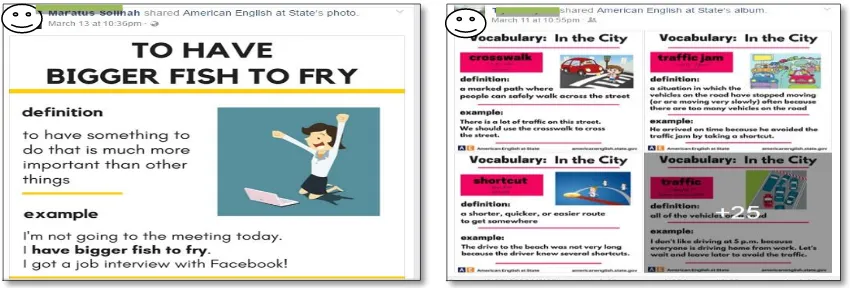
Figure 2 showed that the student 9 learned English by sharing a photo which had English words on it. For example, she shared a photo from “American English at state’s photo” it had the definition of bigger fish to fry. Then, the student 12 showed that she
shared a photo by “American English at state’s album” which the album mentioned vocabulary in the city.
Figure 2.Photos with Has English Words
As can be seen in figure 3, it showed that the student 2 learned English by sharing English videos. There are some videos that the students shared on their Facebook. For example, the student 2 shared a video of
Voice of America (VOA) which the video talked about news of America. Then, the student 9 also shared a video from “BBC Indonesian’s video” it was about news of Singapore’s life.
In the frequency of the surfing Facebook, it found from 18 students, 10 students (56%) admitted themselves that they were “often” using Facebook for learning English. In other categories, 6 students (33%)
put themselves in “sometimes” which was only twice in a week using Facebook for learning English. In addition, 2 students (11%) claimed that they were “always” learning English on Facebook.
2. Learning Writing on Facebook
Facebook which has many features can facilitate the students in learning English, especially in learning English writing. In learning English writing the students can practice their English writing through Facebook. In Facebook there are several activities that the students can do in learning English writing. For example, making an English status through Facebook wall, giving a comment on friend’s status and sending inbox or chat with their friends using English.
As can be seen from the percentage in Table 2, it indicated that the students
sometimes make an English status on their Facebook (60%), the result also showed that the students sometimes gave a comment on their friends’ status using English (55%). Not only that, the students stated that they sometimes sent an English inbox and chat with their friends on Facebook (58%). In addition, they also stated that when they wrote English on Facebook, they always think about their English grammar and how to make a correct sentence (76%).
By practicing English writing through Facebook, the students realized that it could enhance their confident (60%) and also it could improve their writing skill (66%).
Table 2. Learning Writing on Facebook
No Statement Percentages
1. I practice writing in English through status that I post on Facebook. 60%
2. I give comment on friends’ status in English. 55%
3. I send inbox or chat with friends in English. 58%
4. Practice my writing in Facebook enhances my confidence. 60%
5. By giving comment on friends’ status or chats with friends in English improve my writing skill.
66%
6. I think about my English grammar and how to make a correct sentence when I write a status or comment on friends’ status. 76%
Always 11%
Often "56% Sometimes
33%
Always
Often
Sometimes
Almost all students said that sometimes when they practiced their writing through posting a status, they expressed their writing which is appropriate with what they want. Writing through posting a status is like the students’ diary which sometimes the students write about something that happens in their life, posting a picture which is given a caption about the picture, writing status that makes others motivated, posting a quote in English, and posting lyric of English songs that figure out their feelings.
“I always post something that happens in my life to improve my English writing” (S1, Interview)
“Sometimes in Facebook wall, I post a picture that I give a caption about the picture” (S2, Interview)
“Status that sometimes I post in Facebook is about motivation or quotes that express my feelings” (S5, Interview)
“I post a status about friendship or something that I want to express in writing” (S7, Interview)
Based on an online observation that the researcher got, there were some activities that the students did in practicing their writing. First, the students used Facebook wall to make a status about something that happened in their life, even it was about a problem, happiness or sadness of theirs, they always expressed it in posting a status. Second, in practicing their writing, the students also used box comment. In box comment, the students gave a comment on friend’s status in English which other students also replied the comment in English.
Figure 5 showed that the student 2 practiced English writing by making an English status through Facebook wall. For example, when she was at Bengkayang city or Lemukutan Island, she expressed her experiences through posting an English status and sometimes she also wrote a status about the motivation of life. Unlike the student 2, the student 7 indicated that she expressed something that happened in her life especially in expressing her sad feelings through writing English status.
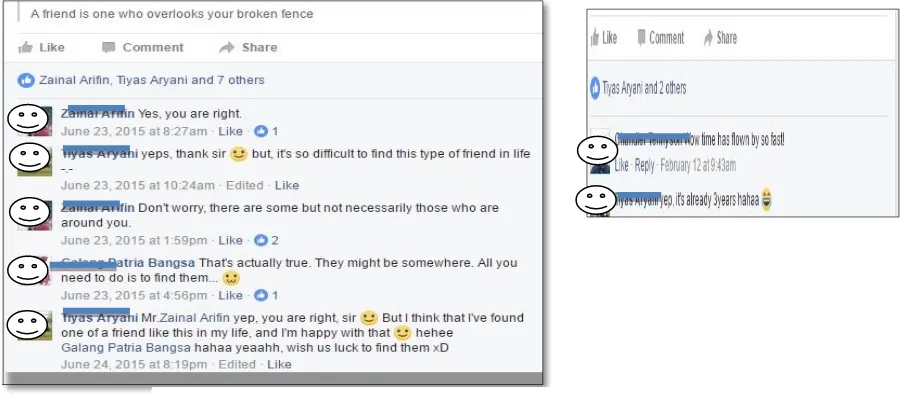
Figure 6 showed that the student 12 practiced her English writing by giving a comment or replying a comment in English through box comment. Sometimes she gave an English comment to her friends or
someone overseas and when the lecturer gave a comment on her status, she also replayed the lecturer’s comment using English to practice her English writing.
Figure 7 showed that the student 1 practiced her English writing by giving a caption on the picture. For example, she posted a picture which she wrote a status on
it to express her happy feeling when the lecturer cannot attend the class. Then, the student 13 also posted a picture which they gave a caption to describe the pictures.
Figure 7.Giving a Caption on the Picture
Figure 8 showed that student 2 practiced her English by re-writing a lyric of English song. For example, she wrote a status of her feelings through lyric of English song when
she was in the beach. Then, the students 11 also like to re-write a lyric of English song when she listened to the music.
Figure 8.Re-Writing Lyric of English Songs
3. Learning Communication on Facebook Learning communication on Facebook becomes the third finding which is experienced by the students of semester 6 class A PPAPK in English education study program. The students used Facebook as a tool for communication, especially in English communication. In English communication through Facebook, the students used the group feature and Facebook chatting which based on the features they get communication through writing. Communication through writing is called text-based communication.
As can be seen in Table 3, it indicated that the students sometimes used group features to communicate, share ideas by using English and also share English materials (58%). The result also indicated that the students sometimes in written communication used standard pronunciations
such as “nite” for “night”, “guyz” for “guys”, “luv” for “love”, “wanna” for want to (61%). Another, in written communication the students indicated that they rarely used all capitals for ‘shouting’ such as “I SAID NO,” and asterisks for emphasis such as “the *real* answer” (51%). In addition, the students indicated that sometimes they used abbreviations, such as b4/B4 (before), lol/LOL (laughing out loud), oic/OIC (Oh I see) in written communication (56%). Furthermore, the students also indicated that they sometimes used common shortenings such as ‘u’ (you), ‘i’ (I), ‘r’ (are), ‘thx’ (thanks), ‘pls’ (please), ‘tmr’ (tomorrow) in written communication (64%). Related to the students answer, they also indicated that written communication made them understand the meaning (68%).
Table 3. Learning Communication on Facebook
No Statement Percentage
1. I use group features to communicate, share ideas by using English and also share material of English.
58%
2. I use standard pronunciations such as “nite” for “night”, “guyz” for “guys”, “luv” for “love”, “wanna” for want to, 61% 3. I use all capitals for ‘shouting’ such as “I SAID NO,” and asterisks
for emphasis such as “the *real* answer” 51% 4. I use abbreviations, such as b4/B4 (before), lol/LOL (laughing out
loud), oic/OIC (Oh I see).
56%
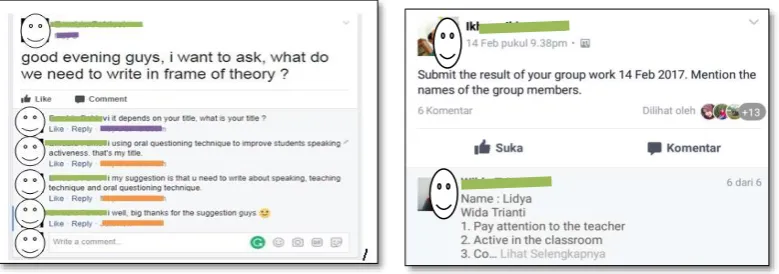
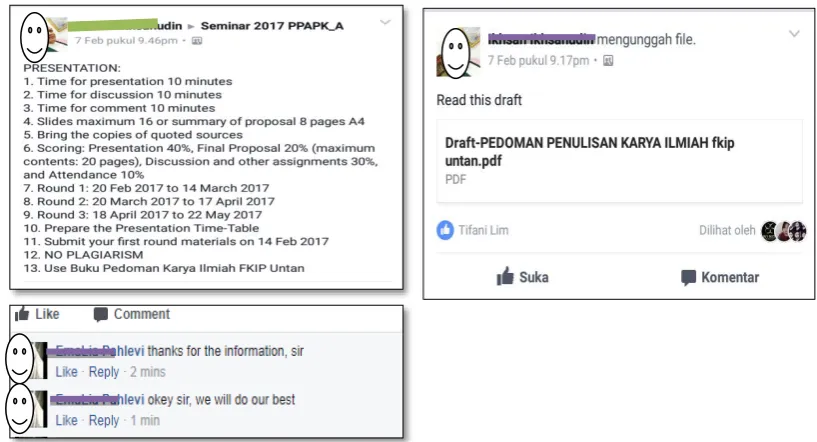
The interview data revealed that almost all the students used their English to communicate with the lecturer, overseas friends, senior or junior through Facebook. The students also mentioned that in communicating, they used group features and Facebook chatting. In group features, they had seminar PPAPK_2017 group that they used to communicate each other about the subject or materials that the students did not understand. In Facebook chatting, sometimes they talked in English with their friends about materials which they did not understand or the knowledge that other students did not know.
“Yes, I do. In the group of seminar, I used as a tool for communication with my friends and also my lecturer, if I got confused about the materials in the class I can directly send text in the group.” (S1, Interview)
“Yes, I do. In Facebook chatting, sometimes I talk in English with my friends whom we discussed about my feelings or my experience” (S3, Interview)
“Yes, I do. In this semester I have a group of seminar class which the group we used as a tool for communication between the students and the lecturer to talk about student’s presentation of seminar (S7, Interview) “Yes, I do. In group features sometimes I have communication with friends and also my lecturer which in the group we talk about
schedule of student’s presentation. In the group also the lecturer gave information if he cannot attend the class” (S12, Interview) “Yes, I do. In Facebook chatting, sometimes I used to talk with my friends in English which in the conversation we share idea about the knowledge that we get” (S14, Interview) “Yes, I do. I usually use Facebook chatting to communicate in English with my friends which we share our problems each other. (S16, Interview)
Figure 9.Communications through Group Facebook
Discussion
The findings were discussed in the light of the main research question of the present study which was; what are the students’ experiences in learning English through Facebook? It showed that based on students experiences Facebook can be used as a tool for learning English. Findings were discussed regarding the use of Facebook in learning English. The students claimed that in learning English on Facebook can be used through several ways. First, the students canuse Facebook wall features to post their writing about something that happens in their life by using English.Second, the students can use group features to get communication in English or to share the knowledge about English.Last, the students also get communication in English through Facebook chatting and replaying or comment on their friends’ status. It correctly said by Crawford (2011).
The students’ reported that in learning English through Facebook, they got new words in English when they saw their friends’ status in English or when they comment on each other..It is precisely described in Kabilan et al. (2010). in addition, the expert Shih (2011); Yunan&Salehi (2012) also already mentioned that Facebook helps English
language learners tolearn new vocabulary by reading peer’s comment.The students mentioned that before they practice their English writing through writing a status on Facebook wall or give a comment on their status friends’, they think about their Englishgrammar and how to make a correct sentence.It correctly said by Meyer (2010).In addition, the students also said that by practice their English writing on Facebook can improve their writing skill.Just as is cautioned against by research Shih (2011).
The findings discussed showing that the students and the lecturer use one of Facebook features namely group to get communication each other and share ideas by using English.Group which they use can increase their communication between student-student and student-lecturer. It is similar to existing research Munoz&Towner (2009).
CONCLUSION AND SUGGESTIONS Conclusion
a status in English, give a comment onfriends’ status, or share videos of English, etc.
The students revealed that something which they can learn in Facebook is learning English writing, because the students can practice their English writing easily through Facebook wall features.Then, students mentioned that they can learn in an informal way on Facebook which their activity in learning English is appropriate with what they like.
Suggestion
In learning English through Facebook, the students need to realize the importance of learning especially learning English as it isfor their sake and the students also need to realize Facebook which they use in daily life should be utilized as it is. The students should be active in order to get a good result of learning. By being an active student, they can utilize their Facebook to practice their English more in order to master English as a foreign language. Furthermore, the students need to be careful in sharing English material on Facebook because there is some information doesn’t have any correct resources.
REFERENCES
Bhatnagar, M., & Bhatnagar, P. (2016). Educational Benefits and Applications of E-learning. International Educational Journal , 58-63.
Blessing, L. T., & Chakrabarti, A. (2009). DRM, a Design Research Methodology. New York : Springer. Crawford. (2011). Three ways o use
Holmes, B., & Gardner, J. (2006). E-learning concept and practice. London: SAGE Publications.
Kabilan et al. (2010). Facebook: An online environment for learning of English in institutions of higher education. Iinternet and Higher Education . Meyer, B. (2010). Proceedings of the 4th
European Conference on Games Based Learning. UK: Academic &Yunus,M. M. (2012). ESL learners' interaction in an Online discussion via Facebook. Asian Social Science, 8 (11), 67-74.
Shih,R.C. (2011). Can Web 2.0 technology assist college students in learning English writing? Integrating Facebook and peer assessment with blended learning. Australasian Journal of Educational Technology, 27 (5), 829-845.
Srirat, K. (2014). Using Facebook Group to Facilitate Teaching English For Everyday Communication. WEI International Academic Conference Proceedings .
Yunus, M., Salehi, H., & Chenzi, C. (2012). Integrating social networking tools into ESL writing classroom: Strengths and weakness. English Language Teaching, 5 (8), 42-48. Yin, R. K. (2003). Case Study Research