University corporatisation
The effect on academic work-related attitudes
Aleksandra Pop-Vasileva, Kevin Baird and Bill Blair
Macquarie University, New South Wales, Australia
Abstract
Purpose– The purpose of this paper is to examine the work-related attitudes ( job satisfaction, job stress and the propensity to remain) of Australian academics and their association with organisational, institutional and demographic factors.
Design/methodology/approach– Data were collected by distributing a survey questionnaire to 750 academics, from 37 Australian universities.
Findings– The results indicate a moderately low level of job satisfaction, moderately high level of job stress, and high propensity to remain. The findings reveal that the organisational factors (management style, perceived organisational support, and the characteristics of the performance management system) exhibited the most significant association with academic work-related attitudes, with the only significant institutional factor, the declining ability of students, negatively impacting on job satisfaction and job stress. The findings revealed that work-related attitudes differ, based on discipline, with science academics found to be more stressed and less satisfied than accounting academics. Different organisational and institutional factors were associated with the work-related attitudes of academics from these two disciplines.
Practical implications– The findings will make university management aware of the work-related attitudes of staff, and the factors that are associated with such attitudes, thereby assisting management in developing management policies, and taking appropriate action to address the concerns of staff.
Originality/value– The study provides an initial comparison of the work-related attitudes ( job satisfaction, job stress, and propensity to remain) of Australian academics across the accounting and science disciplines. The study also provides an important insight into the association between specific organisational and institutional factors, with the work-related attitudes of Australian academics across both disciplines.
KeywordsJob satisfaction, Stress, Performance management systems, Academic staff, Retention, Australia
Paper typeResearch paper
1. Introduction
Numerous studies have emerged reporting a transformation in the higher education sector concurrent with new commercially oriented tendencies evident in public sector management (Anderson, 2006; MacGregoret al., 2006; Korunkaet al., 2003; Anderson et al., 2002; Neumann and Guthrie, 2002; NTEU, 2000; Coaldrake and Stedman, 1999; McInnis, 1999; Parkeret al., 1998; Tayloret al., 1998; Hood, 1995; NBEET, 1991). This process of transformation, known in the literature as the New Public Management (NPM), has been imported into the public sector from the private sector and is characterised by policy development and management geared towards efficiency and effectiveness, quality assurance, implementation of performance evaluations consisting of explicit targets, outputs and outcomes, and a focus on cost savings (Anderson, 2006; Parker and Gould, 1999).
The current issue and full text archive of this journal is available at
www.emeraldinsight.com/0951-3574.htm
qEmerald Group Publishing Limited 0951-3574
The transformations were initiated by significant cuts in government funding for universities as a part of the Dawkins[1] reforms in 1987 (MacGregor et al., 2006; Duckett, 2004; Winteret al., 2000; Coaldrake and Stedman, 1999; Marginson, 1997; Meek and Wood, 1997; Moses, 1996). The cuts in funding compelled universities to turn towards different sources of financing resulting in the adoption of a more commercial and entrepreneurial approach to university management (DEST, 2003; Winteret al., 2000; Marginson, 1997; Meek and Wood, 1997). In particular, there has been a substantial increase in full-fee paying students as a new means of financial support for universities while there has also been a tendency to open campuses in offshore locations and in major Australian capital cities (Carringtonet al., 2007; Duckett, 2004; Devos, 2003; Andersonet al., 2002; Saravanamuthu and Tinker, 2002; Meek and Wood, 1997). Accordingly, universities have opened their doors to a more diverse student body, differing in age, gender, educational background, and academic ability, with a substantial increase in the number of international students (DEETYA, 2007; Devos, 2003; DEST, 2003; Andersonet al., 2002; Neumann and Guthrie, 2002; NTEU, 2000; Meek and Wood, 1997).
These changes have resulted in higher student/staff ratios and greater teaching requirements and pressures (Parker, 2002). Additional pressure has been placed on universities to perform in order to receive the reduced government funding available. Specifically, since 1993 Quality Reviews have been conducted with government funding tied to teaching and research output, forcing universities to become increasingly competitive to obtain these resources (Mollis and Marginson, 2002; Taylor et al., 1998; Moses, 1996). In particular, pressure has been placed on the research production side of academic work exemplified in the phrase “publish or perish” ( James, 2008; Andersonet al., 2002; Gillespieet al., 2001; Tayloret al., 1998). Consequently, as a result of the corporatisation of universities, academics have felt overworked, pressured, demoralised and frustrated (Anderson, 2006; Andersonet al., 2002; NTEU, 2000; McInnis, 1999). There has been considerable evidence in the literature of increased levels of stress in academic work, declining levels of job satisfaction and concerns about the propensity of academic staff to remain in their current employment (hereafter propensity to remain) (McClenahanet al., 2007; Houstonet al., 2006; Noblet et al., 2006; Bellamyet al., 2003; Winefieldet al., 2003; Andersonet al., 2002; Gillespie et al., 2001; NTEU, 2000; McInnis, 1999).
This study attempts to provide an insight into the current academic working environment by examining the level of job satisfaction, job stress and the propensity of academics at 37 Australian universities[2] to remain in their current employment. The assessment of these work-related attitudes is seen as important “because of their intrinsic desirability to the individual employee (in the case of job satisfaction, for example) and because of their linkage to behavioural consequences desirable at an organisational level” (McKinnonet al., 2003, p. 26). In particular work-related attitudes are associated with behavioural consequences such as changes in the level and quality of performance, absenteeism and employee turnover rates (Schermerhornet al., 2008). The study also examines the association between three organisational factors (management style, performance management systems and perceived organisational support) and six institutional[3] factors (increasing student/staff ratios, declining academic ability of students, increased proportion of non-English speaking background students, poorly motivated students, poor preparation by students for
University
corporatisation
classes, and minimal class participation of students) with the levels of job satisfaction, job stress, and the propensity to remain.
Additionally, the study aims to assess the association between specific demographic factors (gender, age, qualification, academic position, discipline) with the work-related attitudes of Australian academics. The examination of these associations is exploratory and no formal hypotheses are developed. The findings will assist organisations by making them aware of the manner in which work-related attitudes differ based on the specific demographic characteristics of academics. Furthermore, the study will conduct an analysis of the association between organisational and institutional factors with work-related attitudes for academics with differing demographic characteristics.
In summary the three objectives of the study are to examine: (1) the work-related attitudes of Australian academics;
(2) the association between organisational and institutional factors, and work-related attitudes; and
(3) the influence of demographic factors on work-related attitudes.
The study will assist the management of university staff by providing an insight into the factors that influence the work-related attitudes of staff. It is intended that the findings will lead to improvements in management policies regarding the working conditions of academic staff by highlighting the areas in which university management need to take appropriate action to address the concerns of staff. It is essential that university management endeavors to take necessary actions to improve the work-related attitudes of academic staff, given evidence of the strong association between work-related attitudes and productivity, absenteeism, turnover rates and the morale of staff (Schermerhornet al., 2008).
The paper is organised as follows. Section 2 reviews the literature on work-related attitudes and discusses the association between specific organisational and institutional factors with work-related attitudes. Section 3 then discusses the method used for data collection. Section 4 provides the results of the data analysis and section 5 then provides a discussion of the results and the limitations and suggestions for future research.
2. Factors affecting the work-related attitudes of academics
Transformations in the academic environment have placed increased pressures on academics with growing concerns about the increased stress associated with academic work, decreases in job satisfaction, and an overall unfavourable outlook of academics towards their jobs (Anderson, 2006; Andersonet al., 2002; Allport, 2000; NTEU, 2000). A number of studies have emerged reporting increased levels of employee stress, dissatisfaction and declining levels of organisational commitment within the last two decades due to the commercialisation of the public sector (Mikkelsenet al., 2005; Noblet et al., 2006; Korunka et al., 2003; Gillespie et al., 2001). The following subsections outline the association between job satisfaction, job stress and the propensity to remain with specific organisational (management style, perceived organisational support, performance management system) and institutional factors (increasing student/staff ratios; declining academic ability of students; increasing proportion of non-English speaking students; and the poor preparation, participation and motivation of students).
AAAJ
24,4
2.1 Management style
Australian universities have been affected by the push for structural reforms in the public sector similar to those reported in the UK, Europe, and the USA (Frolich, 2005; Mikkelsenet al., 2005; Korunkaet al., 2003; Bottery, 1996; Hood, 1995). According to Hood (1995), the spirit of the reforms has been evident in respect to the corporatisation of the public sector and greater emphasis on the adoption of private sector styles of management practice. Specifically, these reforms have resulted in increased emphasis being placed on efficiency, effectiveness, accountability, the adoption of formal and explicit measurable standards, and greater emphasis on output controls (Hood, 1995). These reforms have resulted in a change in the management style in academia towards a more commercial like managerialist approach, termed New Public Management (Wattyet al., 2008; Houstonet al., 2006; Bellamy et al., 2003; Anderson et al., 2002; Patience, 1999; Moses, 1996).
Stiles (2004) distinguished between three styles of management (separatist, integrationist and hegemonist) in a university setting, termed academic identities. The separatist academic identity (low-managerialist) is viewed as cohesive and collegial, with strategic goals centred on promoting common values such as acquisition of knowledge for its own sake, basic peer-reviewed and disciplinary theory founded upon experience, reason and scientific universality, freedom of expression and working with colleagues. In contrast, the hegemonist academic identity (high managerialist) is dependent and subservient, where dominating values emphasise administrative effectiveness, career advancement, financial reward and customer orientation. Stiles (2004) identifies the characteristics of the hegemonist academic identity as closely linked to the NPM approach. The third, integrationist type of academic identity adopts different characteristics from the two extremes and is seen as more “contextually integrated and conflictual” since traditional values of collegiality and autonomy are not so widely shared (Stiles, 2004, p. 161).
While the separatist approach is supportive of traditional academic values, the hegemonist approach is guided by rational economic values, such as efficiency and effectiveness, and customer orientation (Stiles, 2004). The change of university management to this more corporate style is seen as a direct threat to academic freedom (Tayloret al., 1998). According to Tayloret al.(1998), in an environment dominated by the ideas of accountability and productivity (characteristics of the NPM approach), academic freedom is a contradictory concept, which has become a totemic symbol of academics’ resistance against managerialism. Moses (1996, p. 14) claims that the highly managerialist style means that “academics experience impingement on their autonomy and creative space through performance reviews, student evaluations, accreditation,
... and pressure to publish, plan, predict, and perform according to negotiated
standards”. Similarly, Simmons (2002, p. 91) sees this managerialist approach in academia as “unwarranted, unworkable and unacceptable ... an infringement of
academic freedom and an impediment to creativity and self-development”.
Hence, the NPM (high-managerialist) approach appears to restrict the flexibility and autonomy of academics, which according to Bellamy et al. (2003) are the most important reasons for becoming an academic. Accordingly, it is argued that the level of job satisfaction and the propensity to remain will be lower, while the level of job stress will be higher amongst academics subjected to a more hegemonist management style. Given that managerial styles vary at different hierarchical levels, this study will
University
corporatisation
examine the influence of management style at both the departmental and institutional levels.
H1a. Academics whose departmental management exhibits a more hegemonist approach will experience lower job satisfaction, have a lower propensity to remain and experience higher job stress.
H1b. Academics whose institutional management exhibits a more hegemonist approach will experience lower job satisfaction, have a lower propensity to remain and experience higher job stress.
2.2 Perceived organisational support
Perceived organisational support refers to the degree to which employees perceive their employer to be concerned with their wellbeing and to value their contributions to the organisation (Eisenberger et al., 1986). Previous findings have indicated that employees with highly-perceived organisational support report higher job satisfaction (Harriset al., 2007; Muse and Stamper, 2007; Allenet al., 2003). Similarly, Rhoades and Eisenberger (2002, p. 710) found that “employees with high perceived organisational support generally find their job more pleasurable, are in a better mood at work, and suffer fewer strain symptoms such as fatigue, burnout, anxiety, and headaches”. Hence, employees who receive higher levels of perceived organisational support will experience greater job satisfaction and less stress than those who experience lower levels of perceived organisational support (Stamper and Johlke, 2003).
Perceived organisational support has also been linked with lower levels of employee turnover (Maertz et al., 2007; Allen et al., 2003; Stamper and Johlke, 2003) with employees who perceive higher organisational support more likely to remain in their employment. Therefore, it is expected that higher perceived organisational support will lead to higher job satisfaction, a higher propensity to remain and lower job stress (Stamper and Johlke, 2003).
H2. The level of perceived organisational support will be positively related to the level of job satisfaction and propensity to remain and negatively related to the level of job stress of academics.
2.3 Performance management system
The changes in academic management style have been accompanied by changes in performance management systems (hereafter PMS) to emphasise corporate sector best practice with an inherent expectation of measurable outputs, responsiveness to stakeholders’ needs and greater accountability (Houston et al., 2006; Dunkin, 2003). This study examines the effect of three dimensions of the PMS on work-related attitudes: the effectiveness of the PMS, the link of performance to rewards, and the pressure that the PMS places on academics.
An effective PMS is expected to serve the main purposes of determining training and development needs, appraising past performance, aligning individual and organisational objectives, developing individual competencies, career planning, achieving salary increases and the assessment of future promotional prospects (Nankervis and Compton, 2006). Furnham (2004) suggests that an effective PMS should improve work performance, advise employees about work expectations, motivate employees, identify training needs, assist employees in setting career goals and
AAAJ
24,4
improve working relationships. The extent to which the PMS realises these purposes will determine the level of satisfaction of the employees subjected to it (Nankervis and Compton, 2006; Fletcher and Williams, 1996). Similarly, Gillespieet al.(2001) indicated that when academics find that performance evaluation is designed well, it helps to alleviate stress by improving communication, planning and role clarity. According to Huselid (1995), effective performance management has the potential to affect employee motivation by encouraging them to work harder and smarter, as well as influencing their propensity to remain by motivating them to stay in the organisation.
H3a. Academics subjected to a more effective PMS will exhibit higher job satisfaction and propensity to remain and lower job stress.
The importance of providing rewards in an academic environment is highlighted by Sizer et al. (1992) who propose that performance indicators, which are linked to rewards, should be used by governments for stimulating educational institutions. Similarly, Sutton and Brown (2008) emphasised the importance of incentives, such as research project and conference funding, and promotion in motivating the research performance of academics. Common approaches used to motivate employee effort and improve job satisfaction include the linking of performance appraisals with incentive compensation systems, the use of promotional systems that focus on employee merit, and other forms of incentives that align employee and shareholder’s interests (Huselid, 1995). Several studies have confirmed the assertion that performance that is linked to a form of reward will positively impact employee motivation (Helm, 2007; Ryneset al., 2005; Lawler, 2003). In addition, Trevoret al.(1997) found that the presence of salary growth or promotions resulted in lower turnover, while Gillespieet al.(2001) found that the absence of rewards and recognition for academics’ work resulted in increased levels of job stress.
H3b. Academics whose performance is linked to rewards to a greater extent will exhibit higher job satisfaction and propensity to remain and lower job stress.
There has been a rising concern about increased workloads and pressures in academia (Houstonet al., 2006; MacGregoret al., 2006; Nobletet al., 2006; Devos, 2003; Winter et al., 2000; Coaldrake and Stedman, 1999; Marginson, 1997; Meek and Wood, 1997). The changing demands of the academic job have been reflected in university, faculty and departmental plans and performance indicators, and incorporated in PMSs. Some examples of such indicators include student enrolment targets, the quality of teaching, student satisfaction ratings, the number of publications and citations, research rankings, the number of Higher Degree enrolments and completions, number of research collaborations, and the number of research grants (Australian National University, 2008; Deakin University, 2008; Melbourne University, 2008; Monash University, 2007; Macquarie University, 2004). The intensified pressure for exceptional performance in all areas of teaching, research and administration has resulted in declining levels of employee satisfaction (Bellamyet al., 2003; Andersonet al., 2002; NTEU, 2000; Coaldrake and Stedman, 1999), increased stress (Winefieldet al., 2003; Gillespie et al., 2001; Allport, 2000), and increased resignations and retirements (Andersonet al., 2002).
University
corporatisation
H3c. Academics experiencing increasing pressure to perform to a greater extent will exhibit lower job satisfaction and propensity to remain and higher job stress.
2.4 Institutional factors
Recent studies in the higher education sector have referred to the declining academic ability of students and increasing student/staff ratios (Chubb, 2007; Andersonet al., 2002; Tayloret al., 1998). In addition, McInnes and Hartley (2002) refer to an increasing disengagement and lack of motivation of students who find it necessary to engage in part-time or full-time employment to pay student tuition fees. Further, to ensure a steady financial inflow, universities have been supportive of the increasing trend of international student enrolments during the last two decades (DEST, 2003; Devos, 2003; Mollis and Marginson, 2002; Poole, 2001). This has resulted in a decline in English proficiency and created an increasingly difficult working atmosphere for academics (Devos, 2003). In particular, studies have implied that the poor English ability of students has represented a difficulty for class participation and writing at a higher academic level (DEST, 2003; Devos, 2003).
While an empirical examination of the association between such institutional factors and work-related attitudes has not been previously conducted, many studies have implied their negative effect on academics (Winefieldet al., 2003; Andersonet al., 2002; Gillespie et al., 2001; NTEU, 2000; Winter et al., 2000). Accordingly, it is hypothesised that job satisfaction and propensity to remain will be lower where these institutional factors are deteriorating to a greater extent, while the level of job stress will be greater.
H4. There will be a negative association between deteriorating institutional factors and the level of job satisfaction and propensity to remain and a positive association with the level of job stress.
3. Method
A survey questionnaire was distributed to 750 accounting and science (including natural and physical science) academics, from 37 Australian universities, identified from relevant web sites. The majority of previous studies in Australia (Bellamyet al., 2003; Winefield and Jarrett, 2001; Winteret al., 2000; Dua, 1994) or outside Australia (McClenahanet al., 2007; Tariset al., 2001; Doyle and Hind, 1998) have only focused on a single institution or discipline. While other studies have chosen a sample of up to 17 Australian universities (Winefield et al., 2003; Anderson et al., 2002; Gillespie et al., 2001; NTEU, 2000), the present study utilises a larger sample of academics, thereby providing a broader and more comprehensive coverage of the work-related attitudes of academic staff. Accounting and science academics were chosen due to the implied difference between these two disciplines in respect to the number and background of students[4], research output and culture, and the qualifications of staff (Birrel and Healy, 2008; DEST, 2008; Sinclair, 2004; DEST, 2003; Andersonet al., 1997; NBEET, 1991). In respect to research, Sinclair (2004) found that academics from the natural sciences were more productive, with an average of 65.51 publications compared to 28.56 in the social science area, which encompasses the accounting discipline. Sinclair (2004) also found that academics from the natural sciences were more collaborative and were awarded a higher number of competitive grants compared to academics from the
AAAJ
24,4
social sciences (Sinclair, 2004). The study contributes to the existing literature by providing a comparison of the work-related attitudes of academics from the two disciplines. Specifically, the study examines the extent to which the work-related attitudes of accounting and science academics differ and whether there are differences in the factors that influence the work-related attitudes across the two disciplines.
A total of 333 responses were received for a response rate of 44.4 per cent. The initial mail-out resulted in 264 returned questionnaires (35.2 per cent) with a further 69 (9.2 per cent) returned in the follow up mail-out. Non-response bias was assessed by comparing demographics (gender, age, qualification, position, and discipline), and independent and dependent values, between early and late respondents. No significant differences were found in any of the comparisons, indicating the absence of non-response bias.
Table I reveals that 59.2 per cent (40.8 per cent) of the respondents were male (female). Only three respondents (0.9 per cent) were younger than 25 years, with 56 per cent of the respondents aged 46 or more. The majority of the respondents (72.5 per cent) held a PhD and 11.3 per cent of the respondents were Associate Lecturers, 29.3 per cent Lecturers, 24.7 per cent Senior Lecturers, 19.2 per cent Associate Professors, and 15.5 per cent Professors[5]. Accounting academics comprised 48.3 per cent of the sample, while 51.7 per cent were science academics, with Table I showing no significant difference between the two disciplines in respect to gender and age of respondents.
Discipline Overall % Accounting % Science %
Demographic characteristics n¼333 n¼158 n¼169 Sig.
Gender
Male 59.2 54.4 63.1
Female 40.8 45.6 36.9 0.23
Age
Under 25 0.9 0
26-35 18.4 17.7 18.9
36-45 24.7 25.3 24.9
46-55 32.5 27.8 35.5
Over 55 23.5 27.2 20.7 0.22
Qualification
Undergraduate 2.7 0.04 0.01
Honours 6.1 12.0 0.01
Postgrad/Master’s 18.7 29.7 0.10
PhD 72.5 53.2 89.3 0.00
Academic position
Associate Lecturer 11.3 17.1 0.10
Lecturer 29.3 31.6 27.2
Senior Lecturer 24.7 19.6 28.4
Associate Professor 19.2 15.2 21.9
Professor 15.5 15.2 15.9 0.04
Notes:The number of responses (n) varies slightly owing to the fact that not all demographic items were completed by the respondents
Table I.
Demographic characteristics of respondents
University
corporatisation
However, Table I shows significant differences amongst accounting and science academics in respect to academic position, with a greater proportion of junior (senior) academics in accounting (science), and a higher proportion of science academics having PhD degrees.
3.1 Variable measurement
A five-point Likert scale was used for all variables, with anchors of “Strongly Disagree” and “Strongly Agree” unless otherwise stated. The study adopts an adapted version of Spector’s (1985) Job Satisfaction Survey incorporating one item to represent each of its nine dimensions (pay, promotion, supervision, fringe benefits, contingent rewards, operating conditions, co-workers, the nature of the work, and communication). Respondents were required to indicate the extent to which they agreed with the provided statements (see Appendix). Job satisfaction was scored as the sum of the nine items, ranging from 9 to 45 with higher (lower) scores indicating higher (lower) levels of job satisfaction.
The study utilised an adapted version of the Job Stress Survey (Spielberger and Reheiser, 1995) using the 16 items from the scale, which measured Job Pressures (see Appendix). The statements were utilised to emphasise the frequency of occurrence of the stressful aspects of a job based on the assumption that a high frequency would result in higher stress levels in the job. Respondents were required to indicate the extent to which they agreed with each statement. Job stress was scored as the sum of the 16 items, ranging from 16 to 80 with higher (lower) scores indicating higher (lower) levels of job stress.
Propensity to remain was measured based on the single statement provided by Ketchland and Strawser (1998): “It is highly likely that I will actively seek employment at another organisation within the next year”. Given the study makes a distinction between an academic leaving their particular institution and leaving the overall industry, respondents were required to consider two separate statements, “It is highly likely that I will seek employment at another university within the next year” and “It is highly likely that I will seek employment at an organisation other than a university within the next year”. Consequently, for the purpose of the data analysis, propensity to remain was treated as two separate variables, specifically, the propensity to remain in the institution and the propensity to remain in academia.
A self-developed measure was constructed for the management style using two opposing statements, which defined the basic characteristics of the separatist (low-managerialist) and hegemonist (high-managerialist) academic identities (see Appendix). The statements were developed based on the descriptions provided by Stiles (2004). The respondents were asked to rank the management style of their department/school and their institution with anchors ranging from 1¼ hegemonistto5¼separatist:
Perceived organisational support was measured using the six-item version of the original measure developed by Eisenbergeret al.(2001), with respondents required to indicate the extent to which they agreed with the six statements. Perceived organisational support was measured as the sum of the six items, ranging from 6 to 30 with higher (lower) scores indicating higher (lower) perceived organisational support. The three dimensions of the PMS were measured using self-developed measures based on the appropriate PMS literature. For instance, the measure utilised for the
AAAJ
24,4
effectiveness of the PMS was developed based on a review of the literature relating to features of an effective performance management system (Nankervis and Compton, 2006; Furnham, 2004; Lawler, 2003; Lonsdale, 1998; Fletcher and Williams, 1996). Respondents were required to indicate the extent to which they agreed that the PMS they were subject to was effective in achieving the six identified outcomes (see Appendix, a-f). In addition, respondents were required to indicate the extent to which their institutional PMS focused on six specific characteristics (see Appendix, g-l) with anchors of “Not at all” and “To a great extent”. The effectiveness of the PMS was scored as the sum of the twelve items, ranging from 12 to 60 with higher (lower) scores indicating greater (lower) effectiveness.
Prior literature on performance and rewards (Helm, 2007; Ryneset al., 2005; Lawler, 2003; Tietjen and Myers, 1998; Huselid, 1995) was used to develop two questions to examine whether the performance management system provided a link between performance evaluation and rewards. Specifically, respondents were asked to indicate the extent to which they believed that performance evaluations were linked to financial rewards (e.g. pay or bonuses) and non-financial rewards (e.g. recognition or awards for teaching or research), with anchors of “Not at all” and “To a great extent”.
With respect to the third dimension of the PMS, the literature review of the various types of pressures placed on academics (Andersonet al., 2002; Gillespieet al., 2001; Allport, 2000; Coaldrake and Stedman, 1999) resulted in respondents being asked to indicate the extent to which they agreed that their performance management system was placing increasing pressure on administration, teaching, research activities and the quality of teaching.
Finally, a self-developed measure was used to examine the institutional factors, and was constructed based on a review of the prior literature on academic working environments (Kinman and Jones, 2003; Andersonet al., 2002; Gillespieet al., 2001). Respondents were required to indicate the extent to which they believed that the six characteristics provided (see Appendix) applied to their institutions, with anchors of “Not at all” and “To a great extent”. Each of the six items were analysed separately in the data analysis section.
4. Results
Table II shows descriptive statistics for the independent and dependent variables. For the multi-item scales the actual range was comparable with the theoretical range and the Cronbach Alpha coefficients exceeded the 0.7 threshold generally considered acceptable for scale reliability (Nunnally, 1978). The mean value of the department management style was close to the middle of the scale (2.77) suggesting an integrationist management style, while the mean score of the institution management style was well below the middle of the scale indicating a tendency towards a more hegemonist management style.
The mean score of the effectiveness of the Performance Management System (PMS) is slightly below the middle of the range, which indicates that on average the respondents believe that the PMS within their institution does not possess the characteristics of an effective PMS. In respect to the link of performance to financial rewards the mean (2.29) lies on the lower end of the scale, which indicates that performance is not linked to financial rewards to a great extent while the mean score (2.95) of the link of performance to non-financial rewards is higher but also indicates a
University
corporatisation
Variables n Mean Std dev.
Minimum Maximum
Cronbach alpha Actual Theoretical Actual Theoretical
Organisational factors
Management style department 312 2.77 1.13 1 1 5 5 – Management style institution 311 2.14 1.02 1 1 5 5 – Effectiveness of the PMS 319 33.91 10.04 12 12 60 60 0.932 Link of performance to financial reward 312 2.29 1.33 1 1 5 5 – Link of performance to non-financial reward 312 2.95 1.09 1 1 5 5 – Increased pressure from the PMS 321 14.26 3.32 4 4 20 (20) 0.744 Perceived organisational support 331 16.82 5.49 6 6 30 30 0.897
Institutional factors
Increased student/staff ratios 322 3.94 1.11 1 1 5 5 – Declining academic ability of students 322 3.91 1.64 1 1 5 5 – Proportion of non-English background students 322 3.55 1.13 1 1 5 5 – Poorly motivated students 322 3.59 1.11 1 1 5 5 – Minimal participation of students in classes 322 3.46 1.12 1 1 5 5 – Poor preparation by students for classes 322 3.77 1.07 1 1 5 5 –
Dependent variables
Job satisfaction 310 26.64 6.16 12 9 45 45 0.742 Job stress 309 51.14 9.52 23 16 72 80 0.832 Propensity to remain in the institution 313 2.39 1.39 1 1 5 5 – Propensity to remain in academia 313 2.06 1.25 1 1 5 5 –
Note:The number of responses (n) varies owing to the fact that not all survey items were completed by the respondents
Table
II.
Descriptive
statistics
of
the
independent
and
dependent
variables
AAAJ
24,4
weak link between performance and non-financial rewards. Table II reveals that on average respondents feel that the PMS is placing increasing pressure on teaching, research, administration and the quality of teaching activities. It also shows that the mean score of perceived organisational support was below the middle of the scale, indicating that respondents believed they were experiencing a low level of organisational support.
All six items from the institutional factors demonstrated a high mean score (the lowest being 3.46). The results indicate that academics perceive that student/staff ratios have increased (mean of 3.94), there is a decline in the academic ability of students (mean of 3.90) and that students are generally demonstrating poor preparation for classes (mean of 3.76), and poor motivation (mean of 3.59). The respondents also indicated an increased proportion of non-English speaking background students (mean of 3.54), and that there is poor class participation by students (mean of 3.46).
4.1 The level of job satisfaction, job stress and the propensity to remain
Table II indicates that respondents demonstrate a moderately low level of job satisfaction (with a mean score of 26.64, slightly below the middle of the range), with 56.8 per cent of the respondents scoring below the average value of job satisfaction. Table III reveals that the areas of greatest dissatisfaction for academics were their workloads (mean score of 2.17) and communication in the workplace (mean score of 2.57). Alternatively, the items that contributed to a higher level of satisfaction were the nature of the work (mean score of 3.79), supervision (mean score of 3.43), and relationships with co-workers (mean score of 3.22).
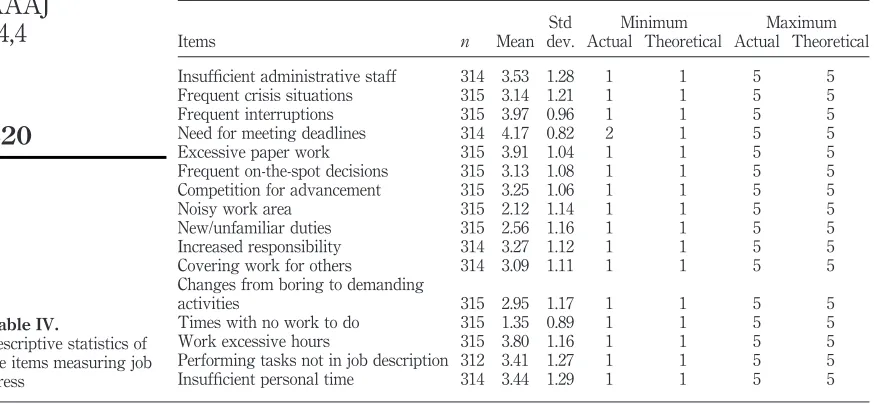
Table II reveals that the level of job stress was moderately high (mean score of 51.14 out of 80), with 61.5 per cent of the respondents scoring above the average value of job stress. As Table IV shows the items that contributed the most to job stress were the need for meeting deadlines (mean score of 4.17), frequent interruptions (mean score of 3.97), excessive paperwork (mean score of 3.91), and working excessive hours (mean score of 3.80).
The level of propensity to remain in the institution was relatively high (mean value of 2.39, slightly below the middle of the range) with 22.7 per cent of respondents indicating that they will actively seek employment at another institution within the following year, while the level of propensity to remain in academia was even higher (mean value of 2.06, below the middle of the range) with only 15.7 per cent of
Items n Mean Std dev.
Minimum Maximum Actual Theoretical Actual Theoretical
Pay 315 2.88 1.24 1 1 5 5
Promotion 312 2.95 1.22 1 1 5 5
Supervision 314 3.43 1.35 1 1 5 5
Fringe benefits 314 2.85 1.23 1 1 5 5
Co-workers 315 3.22 1.22 1 1 5 5
Nature of work (purpose) 315 3.79 1.20 1 1 5 5
Communication 315 2.57 1.12 1 1 5 5
Contingent rewards 315 2.76 1.12 1 1 5 5
Workload 315 2.17 1.07 1 1 5 5
Table III.
Descriptive statistics of the items measuring job satisfaction
University
corporatisation
respondents indicating that they will actively seek employment at an organisation other than a university within the following year.
4.2 The association between organisational and institutional factors with work-related attitudes
Hierarchical regression analysis was conducted to examine the relationship between the group of organisational factors and the group of institutional factors with the dependent variables ( job satisfaction, job stress and the propensity to remain). Accordingly, the seven variables (management style of the department, management style of the institution, effectiveness of the PMS, link of performance to financial rewards, link of performance to non-financial rewards, pressure from the PMS, and perceived organisational support) used to measure the three organisational factors (management style, PMS, and perceived organisational support) were all treated as one block. Similarly, the six institutional factors (increasing student/staff ratios, declining academic ability of students, increased proportion of non-English speaking background students, poorly motivated students, minimal class participation of students and poor preparation of students) were treated as another block in the analysis.
Table V reveals that when the block of organisational factors was entered first and the block of institutional factors was entered second, the organisational factors explained 0.57 ðp¼0:00Þ of the total variation in the level of job satisfaction, 0.19
ðp¼0:00Þof the total variation in the level of job stress, 0.21ðp¼0:00Þof the total
variation in the level of propensity to remain in the institution, and 0.19ðp¼0:00Þof
the total variation in the level of propensity to remain in academia. After considering the association between the organisational factors and the dependent variables, the unique contribution of the institutional factors was small and only significant in respect to the level of job stressð0:09;p¼0:00Þ:
Std Minimum Maximum Items n Mean dev. Actual Theoretical Actual Theoretical
Insufficient administrative staff 314 3.53 1.28 1 1 5 5 Frequent crisis situations 315 3.14 1.21 1 1 5 5 Frequent interruptions 315 3.97 0.96 1 1 5 5 Need for meeting deadlines 314 4.17 0.82 2 1 5 5
Excessive paper work 315 3.91 1.04 1 1 5 5
Frequent on-the-spot decisions 315 3.13 1.08 1 1 5 5 Competition for advancement 315 3.25 1.06 1 1 5 5
Noisy work area 315 2.12 1.14 1 1 5 5
New/unfamiliar duties 315 2.56 1.16 1 1 5 5 Increased responsibility 314 3.27 1.12 1 1 5 5 Covering work for others 314 3.09 1.11 1 1 5 5 Changes from boring to demanding
activities 315 2.95 1.17 1 1 5 5
Times with no work to do 315 1.35 0.89 1 1 5 5
Work excessive hours 315 3.80 1.16 1 1 5 5
Performing tasks not in job description 312 3.41 1.27 1 1 5 5 Insufficient personal time 314 3.44 1.29 1 1 5 5
Table IV.
Descriptive statistics of the items measuring job stress
AAAJ
24,4
Job satisfaction Job stress institution, PMS effectiveness, Link of performance to financial reward, Link of performance to non-financial reward, PMS pressure, Perceived organisational
support) 0.57 52.99 0.00 0.19 9.87 0.00 0.21 11.02 0.00 0.19 9.62 0.00 2 Institutional factors(student/staff ratio,
students’ academic ability, proportion of non-English speaking students, Students’ participation, Students’
motivation, Students’ preparation) 0.02 1.76 0.11 0.09 5.90 0.00 0.02 1.04 0.39 0.01 0.85 0.54
F-value 29.808 8.595 6.420 5.556
p-value 0.000 0.000 0.000 0.000
R2 0.582 0.288 0.230 0.205
Adjusted
R2 0.563 0.255 0.194 0.168
Alternatively, when the institutional factors were entered first and the block of organisational factors was entered second, Table VI reveals that both institutional and organisational factors were significant determinants of the levels of each of the dependent variables. Specifically, the institutional factors explained 0.17ðp¼0:00Þof
the variation in the level of job satisfaction, 0.21ðp¼0:00Þof the variation in the level
of job stress, 0.08ðp¼0:00Þof the variation in the level of propensity to remain in the
institution and 0.05ðp¼0:01Þof the variation in the level of propensity to remain in
academia. Hence, when the institutional factors are entered first, they are significantly associated with all four work-related attitudes, although the effect is not as strong as the organisational factors. The unique contribution of the organisational factors was strong, explaining an additional 0.42ðp¼0:00Þof the total variation in the level of job
satisfaction, 0.08 ðp¼0:00Þ of the total variation in the level of job stress, 0.15
ðp¼0:00Þof the total variation in the level of propensity to remain in the institution
and 0.15 ðp¼0:00Þ of the total variation in the level of propensity to remain in
academia.
Stepwise regression using backward deletion was then used to identify the specific organisational and institutional factors influencing work-related attitudes. The results are shown in Table VII. In respect to job satisfaction, the results reveal that the overall model was statistically significant ðF¼76:31;p¼0:00Þ with 56.9 per cent of the
variance in the level of job satisfaction explained by organisational and institutional factors. Three of the organisational factors were significantly and positively related to the level of job satisfaction (the effectiveness of the PMS withp¼0:00; the link of
performance to financial rewards withp¼0:04;and perceived organisational support
with p¼0:00Þ and one was significantly and negatively related (the increased
pressure from the PMS withp¼0:03Þ: One institutional factor (declining academic
ability of students with p¼0:00Þwas also significantly and negatively associated
with the level of job satisfaction. The results from the stepwise regression analysis provide support forH2andH3a, H3b,H3c, and partial support forH4in respect to job satisfaction.
With regard to job stress, the overall model was statistically significant (F¼24.73, p¼0.00) with anR2value of 0.256 indicating that 25.6 per cent of the variance in the level of job stress was explained by the organisational and institutional factors. Two organisational factors (effectiveness of the PMS with p¼0:00 and the link of
performance to financial reward with p¼0:01Þ were significantly and negatively
related to the level of job stress, while one organisational (the increased pressure from the PMS with p¼0:00Þ and one institutional factor (declining academic ability of
students with p¼0:00Þwere significantly and positively related to the level of job
stress of academics. These findings provide support for hypothesesH3a, H3b,H3cand partial support forH4, in respect to job stress.
Table VII also reveals that the overall models for both the propensity to remain in the institution ðF¼25:64p¼0:00Þ and in academia ðF¼30:23;p¼0:00Þ were
statistically significant with R2 values of 0.207 and 0.169 respectively. The results indicate that three of the organisational factors (management style of the department with p¼0:00; the effectiveness of the PMS with p¼0:04; and perceived
organisational support with p¼0:00Þ were significantly and negatively related to
the level of propensity to remain in the institution, with academics more likely to actively seek employment at another institution if their departmental management
AAAJ
24,4
Job satisfaction Job stress 1 Institutional factors(student/staff ratio,
students’ academic ability, proportion of non-English speaking students, Students’ participation, Students’
motivation, Students’ preparation) 0.17 9.51 0.00 0.21 12.27 0.00 0.08 4.38 0.00 0.05 2.75 0.01
2 Organisational factors(Management
style department, management style institution, PMS effectiveness, Link of performance to financial reward, Link of performance to non-financial reward, PMS pressure, Perceived organisational
support) 0.42 39.50 0.00 0.08 4.53 0.00 0.15 7.57 0.00 0.15 7.58 0.00
F- value 29.808 8.595 6.420 5.556
p-value 0.000 0.000 0.000 0.000
R2 0.582 0.288 0.230 0.205
Adjusted
R2 0.563 0.255 0.194 0.168
Job satisfaction Job stress
Propensity to remain in institution
Propensity to remain in academia Variables Coef. T-stat Sig. Coef. T-stat Sig. Coef. T-stat Sig. Coef. T-stat Sig. Organisational factors
Management style department 20.18 23.34 0.00
Management style institution
Effectiveness of the PMS 0.18 3.43 0.00 20.20 23.68 0.00 20.14 22.03 0.04 20.16 22.25 0.03
Link of performance to financial reward 0.09 2.11 0.04 20.14 22.64 0.01
Link of performance to non-financial reward
Increased pressure from PMS 20.09 22.14 0.03 0.17 3.14 0.00
Perceived organisational support 0.52 9.85 0.00 20.25 23.46 0.00 20.29 24.06 0.00
Institutional factors
Increasing student/staff ratios
Declining academic ability of students 20.12 22.96 0.00 0.28 5.19 0.00
Proportion of non-English speaking background students
Poorly motivated students
Minimal participation of students in classes Poor preparation by students for classes
F-value 76.31 24.73 25.64 30.23
p-value 0.00 0.00 0.00 0.00
R2 0.569 0.256 0.207 0.169
AdjustedR2 0.562 0.245 0.199 0.164
n 294 292 297 299
Table
VII.
Results
of
stepwise
regression
analysis
of
the
effect
of
organisational
and
institutional
factors
on
work-related
attitudes
AAAJ
24,4
style is more hegemonist, the PMS less effective and if there is lower perceived organisational support.
The results provide support forH1a, H2, andH3a, in respect to the propensity to remain in the institution. Two organisational factors (perceived organisational support withp¼0.00 and the effectiveness of the PMS withp¼0.03) were significantly and negatively associated with the level of the propensity to remain in academia. These findings provide support for hypothesesH2andH3ain respect to the propensity to remain in academia.
4.3 The association between demographic factors with work-related attitudes
An analysis of variance was conducted to examine the relationship between work-related attitudes and the demographic factors (gender, age, qualification, position and discipline). No significant association was found in respect to gender and qualification and while the age of the respondents was significant in respect to job stress, the post hoc tests did not confirm this result. Significant differences in work-related attitudes were found in respect to academic position and discipline. Academic position was only associated with the level of job satisfactionðp¼0:02Þ;
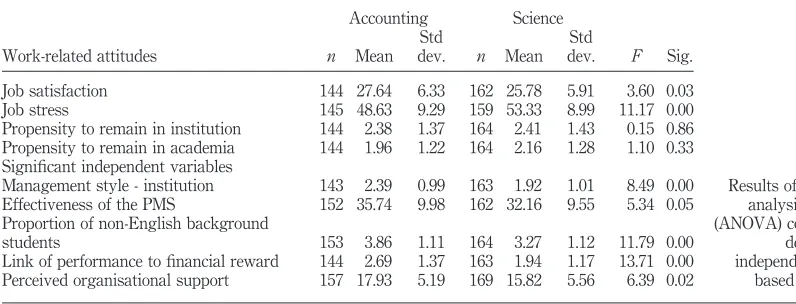
where more senior academics were found to be more satisfied. Table VIII reveals that discipline was found to be significantly associated with both job satisfaction (p¼0.03) and job stressðp¼0:00Þwith accounting academics more satisfied and less stressed
than their science colleagues. Further analysis of the individual items revealed that accounting academics were more satisfied than science academics in relation to pay ðp¼0:02Þ and recognition ðp¼0:01Þ: In relation to job stress science academics
indicated greater stress in 13 of the 17 items attributable to higher job stress. While the difference in the propensity to remain was not significant, the means indicate that academics from the science discipline were less likely to actively seek employment at another institution or outside academia. Given these findings further analysis of the divergences of the organisational and institutional factors across the two disciplines was undertaken.
Table VIII reveals the results in respect to the variables found to differ across the two disciplines. The findings reveal a more effective PMS, higher perceived organisational support, greater link of performance to financial rewards and higher
Accounting Science
Job satisfaction 144 27.64 6.33 162 25.78 5.91 3.60 0.03 Job stress 145 48.63 9.29 159 53.33 8.99 11.17 0.00 Propensity to remain in institution 144 2.38 1.37 164 2.41 1.43 0.15 0.86 Propensity to remain in academia 144 1.96 1.22 164 2.16 1.28 1.10 0.33 Significant independent variables
Management style - institution 143 2.39 0.99 163 1.92 1.01 8.49 0.00 Effectiveness of the PMS 152 35.74 9.98 162 32.16 9.55 5.34 0.05 Proportion of non-English background
students 153 3.86 1.11 164 3.27 1.12 11.79 0.00 Link of performance to financial reward 144 2.69 1.37 163 1.94 1.17 13.71 0.00 Perceived organisational support 157 17.93 5.19 169 15.82 5.56 6.39 0.02
Table VIII.
proportion of non-English speaking background students in the accounting discipline, and a more hegemonist management style in the science discipline. Given the observed differences in work-related attitudes, and organisational and institutional factors, the association between these factors for both the accounting and science disciplines is further explored in section 4.4.
4.4 Analysis of the factors influencing the work-related attitudes of accounting and science academics
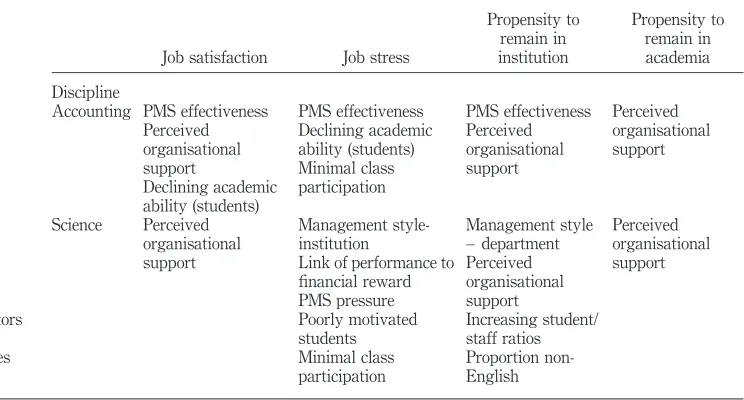
A stepwise regression analysis was performed to determine the factors influencing the work-related attitudes of accounting and science academics respectively. Table IX reveals the different organisational and institutional factors that were associated with the levels of job satisfaction, job stress and propensity to remain across the two disciplines, accounting and science.
The results reveal that the level of job satisfaction of both accounting and science academics was significantly related to the level of perceived organisational support. In addition, the level of job satisfaction of accounting academics was significantly associated with the effectiveness of the PMS and the declining academic ability of students.
The level of job stress of the accounting academics was significantly related to the effectiveness of the PMS, the declining academic ability of students, and minimal class participation. Alternatively, the level of job stress of science academics was significantly associated with the pressure from the PMS, the link of performance to financial rewards, the management style of the institution, minimal class participation, and the poor motivation of students.
Table IX reveals that perceived organisational support was strongly associated with the propensity to remain in the institution and the propensity to remain in academia for both disciplines. In addition, the effectiveness of the PMS was
significantly related to the propensity to remain in the institution for accounting academics. The level of propensity to remain in the institution of science academics was significantly associated with the departmental management style, increasing student/staff ratios, and an increasing proportion of non-English speaking background students. These results indicate that science academics are less likely to remain in their current institution if their departmental management exhibits a more hegemonist style, student/staff ratios are increasing and if there is an increasing proportion of students from non-English speaking backgrounds.
5. Conclusions and implications
The first objective of the study was to examine the level of job satisfaction, job stress and the propensity to remain of Australian academics. The results revealed that the level of job satisfaction was moderately low, with workloads and the level of communication in the workplace causing the most dissatisfaction. The findings in respect to workloads are consistent with Anderson (2006), Andersonet al.(2002) and NTEU (2000) who reported that increased workloads in respect to teaching, research and administration had an adverse effect on the satisfaction of academic staff. It is recommended that university management should provide a more reasonable and balanced academic workload, which would motivate academics but not overburden them. Academics’ dissatisfaction with the level of communication can be attributed to the adoption of a more hegemonistic management style within universities. In particular, as asserted by Parker (2002, p. 606) communications “tend increasingly to flow top-down within the university hierarchy, as decisions are increasingly formulated at top management levels and then passed down for comment or implementation to the ’line’ academics”. It is suggested that the various levels of management within the university should develop two-way communication channels which value academic inputs into addressing institutional challenges.
The level of job stress was moderately high with academics indicating that the frequent need to meet deadlines, frequent interruptions, excessive paperwork and work hours were the main drivers of the high stress levels. Given these factors are all linked to high academic workloads provides further support for the importance of university management in addressing excessive workload concerns. While the organisational behaviour literature suggests that excessive workloads can have a negative impact on turnover rates (Schermerhornet al., 2008) the propensity of academics to remain in their current employment was relatively high and even higher in regards to remaining in academia overall. These results indicate that in spite of the declining satisfaction and the increased stress levels, academics are still likely to remain in their academic employment. This finding is consistent with Bellamy et al. (2003), Anderson et al. (2002), NTEU (2000) and McInnis (1999). A possible explanation for this finding is that the academic job is seen more as a calling rather than an ordinary job and academics feel attached to the feeling of providing a form of community service. The fact that the nature of the work was the item that contributed the most to job satisfaction supports this claim.
The high propensity to remain may also be attributable to the difficulty or reluctance of academics to relocate to other institutions. Specifically, academics could find it more difficult to move to another institution or into another industry for several reasons. First, in respect to moving to another institution, academics have a limited
University
corporatisation
number of Australian employers to choose from (37 other universities), with the selection pool becoming even narrower if they are not willing to move interstate. Furthermore, in respect to leaving academia and moving to another industry, additional analysis revealed that older academics and those who had worked in their current department/school for longer had a higher propensity to remain in their current employment. With more than half (56 per cent) of the respondents being from the higher age groups (above 45), the findings indicate that the majority of academics may consider a career change a difficult step to make. Finally, academics may be unwilling to forgo the generous superannuation benefits that are associated with working in the tertiary education industry.
The fact that 15.7 per cent of staff indicated a willingness to seek employment outside academia poses a major concern for university management given the significant time needed to develop an academic career. University management cannot assume that the continuing deterioration of autonomy and flexibility in the work environment, frequently identified (Bellamyet al., 2003; Andersonet al., 2002; NTEU, 2000; McInnis, 1999) as the most valued intrinsic rewards associated with academia, will not have a more drastic affect on the propensity to remain in years to come. In addition this could pose a threat in respect to the recruitment of new staff that may choose to work in industry instead.
The second objective of the study was to examine the influence of organisational and institutional factors on work-related attitudes. The results reveal that all three organisational factors (management style, performance management systems and perceived organisational support) and one institutional factor (declining academic ability of students) had a significant effect on work-related attitudes. In respect to PMSs, three dimensions were significantly associated with work-related attitudes, with the most important factor being the effectiveness of the PMS, which was related to all three work-related attitudes. This finding highlights the importance for universities to design performance management systems that are effective in strengthening accountability, promoting improved performance, improving communication, providing an accurate assessment of performance and useful feedback to individuals, determining training and development needs, and enhancing motivation. It is suggested that management should consult with their employees as they attempt to redesign their PMS to meet these objectives. Importantly the criteria used to evaluate the performance of staff should consider academic values and not be restrictive in the recognition of alternative forms of publications.
In addition to the effectiveness of the PMS, the study also found that the pressure that the PMS places on academics and the extent to which the performance is linked to financial rewards were associated with the level of job satisfaction and job stress. Specifically, it was found that a PMS that places increased pressure on meeting teaching, research and administration targets results in lower job satisfaction, increased job stress levels and a lower propensity to remain. These findings indicate that university management is placing increasing pressure on all aspects of academic work with no recognition of the epistemological and sociological dimensions of disciplines. In addition, university management’s expectation of achieving excellence in research, teaching and administration fails to recognise that individual staff may excel in a specific area and hence university resources may be more effectively employed, by adopting a more flexible PMS. The findings in respect to the link of
AAAJ
24,4
performance to financial rewards indicate that university management needs to link academic performance evaluations to financial rewards (such as increased pay or bonuses) in order to ensure higher satisfaction and lower stress levels amongst academics.
Perceived organisational support was associated with higher levels of job satisfaction and a higher propensity to remain in the institution and in academia. These results suggest that university managers need to demonstrate consideration and support for academic staff if they wish to maximise their job satisfaction and increase the likelihood that they will remain in their current employment. Accordingly, university management needs to concentrate on recognizing staff contributions, considering their goals and values, providing administrative and research assistance when needed and generally demonstrating care for the wellbeing of academics.
While the third organisational factor – management style – was not associated with the level of job satisfaction and job stress, it was found to be significantly associated with the propensity of academics to remain in their institution. Importantly, it was found that academics are more likely to leave their institution within the next 12 months when their management fosters a more hegemonist management style. This finding is consistent with prior studies, which have emphasised the incongruence of the highly managerial hegemonist style in the academic setting (Dunkin, 2003; Parker, 2002; Tierney, 2001; Meek and Wood, 1997; Tayloret al., 1998; Moses, 1996). This management approach is considered to be an impingement on academic freedom and autonomy and thereby unsuitable in the academic environment (Smeenket al., 2006; Moses, 1996). Accordingly, university managers need to appreciate the distinct nature of the academic job and adopt a management style that considers its uniqueness. University top management needs to enable more autonomy at the departmental level so as to increase staff morale and allow a more balanced approach to workloads. In other words, a more separatist departmental management style, which nurtures the collegial nature of the academic job and does not restrict academic freedom, would be more appropriate and more likely to prevent academics from leaving their institution. With respect to the institutional factors, the declining academic ability of students was the only factor found to be significantly associated with the work-related attitudes ( job satisfaction and job stress) of academics. Academics have traditionally considered their jobs as geared towards production of knowledge for the sake of knowledge and expect to receive an intrinsic reward from that process (Stiles, 2004; Bellamyet al., 2003). Therefore, it is not surprising that they seem to be less satisfied when they perceive a decline in the academic ability of students, which renders their job of transferring knowledge considerably more difficult and diminishes their sense of achievement. Hence, management needs to consider academic working conditions and introduce processes that ensure adequate entry requirements instead of focusing on increasing student numbers and “on generating revenue through teaching program fees, research grants, contract consultancy and commercialisation of intellectual capital” (Parker, 2005, p. 389). Failure to do so will result in rendering the academic job of knowledge production and dissemination far more difficult, and consequently, will contribute to the dissatisfaction and increased stress of academic staff. At the same time, university management also needs to provide additional resources to students to allow them to develop their generic skills and graduate capabilities so as to meet the high standards required for academic progression.
University
corporatisation
The third objective of this study was to examine the influence of demographic factors on work-related attitudes. The results revealed that the work-related attitudes of academics differed based on their discipline, with academics from the accounting discipline more satisfied and less stressed than their colleagues from the science discipline. Given this difference, an additional exploratory analysis of the association between the organisational and institutional factors with work-related attitudes, was conducted for academics from the two disciplines. The analysis indicated that perceived organisational support was the only factor that influenced the job satisfaction of both accounting and science academics. In addition, for accounting academics, the effectiveness of the PMS was associated with a higher level of job satisfaction, and the declining academic ability of students was associated with lower levels of job satisfaction.
The analysis also indicated that the institutional factor, poorly motivated students, was associated with the level of job stress for science academics. A possible explanation here could be the fact that science faculties have lower entry requirements, which could be associated with lower student motivation levels (UAC, 2008). The extent to which performance is linked to financial rewards was another factor influencing the level of job stress of science academics. Accordingly, university management needs to implement incentive compensation schemes across all disciplines in an equitable and transparent manner. The increased pressure from the PMS, the hegemonist institutional management style and minimal participation by students in classes were other factors that were associated with higher job stress for science academics. These findings suggest that university management needs to respond to the increased pressures placed on these academics and adopt a less authoritative management approach.
With respect to accounting academics, the effectiveness of the PMS was associated with lower levels of job stress, while the declining academic ability of students and minimal participation by students in classes were associated with higher levels of job stress. Therefore, university management and departmental managers need to ensure that the PMS adequately addresses these concerns of staff. In addition the apparent decline in the ability of students and their engagement in the learning process indicates the need for universities to implement student academic support programs such as peer assisted learning (Dobbie and Joyce, 2008).
Interestingly, the propensity to remain in their current employment was relatively high and similar for the two groups of academics. In respect to the organisational factors, higher perceived organisational support was associated with a higher propensity to remain in the institution and in academia for both groups. The factors associated with a lower propensity to remain for science academics were the hegemonist management style, the higher proportion of non-English speaking background students and the increasing student/staff ratios. These findings provide university management with an insight into important factors that need to be addressed in a proactive and constructive way in order to enhance the likelihood of retaining staff in the accounting and science disciplines.
The study reveals that Australian academics are experiencing increasing levels of job stress and declining job satisfaction with excessive workloads appearing to be the major contributing factor. Despite these findings, the majority of the academics indicated that they are likely to remain in their current employment. This may be
AAAJ
24,4
attributed to their dedication to their vocation or alternatively it may be reflective of an industry in which the workforce is ageing and reluctant to change jobs, and in which there is limited opportunity for job movement. Hence, while academics are committed to their vocation, it is apparent that their job satisfaction and stress levels are being detrimentally affected by their working conditions. Given that all three organisational factors (management style, the PMS and perceived organisational support) were found to be associated with work-related attitudes, it is imperative that university management reassess their management policies so as to address these areas. Specifically, management needs to: provide additional support to academics; ensure an effective PMS is in place; link performance to financial rewards; alleviate the pressure placed on teaching, research and administrative activities; and adopt a more separatist management style at the departmental level. It is essential that university management endeavour to take appropriate action to improve the work-related attitudes of staff given the evidence of the strong association between work-related attitudes and productivity and the morale of staff (Schermerhornet al., 2008).
5.1 Limitations and suggestions for future research
The study is subject to the usual limitations of the survey methodology. In particular, the study cannot determine causal relationships between variables with the results considered solely as the association between variables. This study has also relied on self-reported data with all of the variables gathered from the same sample of respondents and is hence potentially subject to common method bias. Given that an alternative method was not feasible at the time of the study, we rely on Crampton and Wagner (1994) and Spector (1987) who argue that the problem of common method bias is likely to be overstated when dealing with self-reported and perceptual data. Nevertheless, future research could utilise alternative research methods to explore these issues.
With respect to the sample, the study focuses on academics from two disciplines (accounting and science), and hence, the results cannot be generalised to all Australian academics. In addition, while the current study did not distinguish between the “traditional” and more recently established universities, future studies could explore work-related attitudes based on institutional characteristics.
Furthermore, in the absence of established measures of the effectiveness of the PMS, the link of performance to rewards, and management styles, the study used self-developed measures for these factors. Reliability tests were performed confirming the reliability and unidimensionality of the measures. However, future research could test the reliability of the self-developed measures in a similar and/or different setting. Given the fact that this study analysed organisational and institutional factors, future studies could analyse the impact of other factors on job satisfaction, job stress and the propensity to remain. Future research could also extend this study by performing a comparison across multiple disciplines by using a larger sample. A longitudinal study, could also be considered as NPM, is increasingly adopted by university management in Australian universities.
Notes
1. John Dawkins was the Minister for Employment, Education and Training (1987-1991) within the Labor Government.