Ownership structure, innovation to firm value with the financing
decision as mediation
HMA Rasyid HS Umrie
1, Yuliani
21, 2
Sriwijaya University, Raya Palembang-Prabumulih Street KM 32, Inderalaya (Ogan Ilir), 30662, South Sumatera, Indonesia
A B S T R A C T
The purpose of this study is to obtain empirical evidence of the influence between the ownership structure and innovation on firm value, funding decisions as mediation of ownership structure and innovation influence on firm value. The populations of this study are all companies listed in Indonesia Stock Exchange. Sampling method used is purposive sampling technique, selected 17 companies based on the criteria. The unit of analysis of this study is a data pooling as many as 85 cases. Methods of data analysis using Structural Equation Modeling (SEM) in variance based. The findings of the study were the higher ownership structure does not contribute to the increase in firm value. The higher the innovation, firm value has increased. Rule of the financing deci-sions is not mediating the effect of ownership structure on firm value, while the fi-nancing decisions proved to be a partial mediation as the effect of innovation on firm value.
A R T I C L E I N F O
Article history: Received 5 July 2014 Revised 13 August 2014 Accepted 27 August 2014
JEL Classification: G11
Key words:
Ownership Structure, Innovation,
Financing Decisions, Firm Value.
DOI:
10.14414/jebav.14.1702008
A B S T R A K
Tujuan penelitian ini adalah untuk memperoleh bukti empiris mengenai pengaruh antara struktur kepemilikan dan inovasi terhadap nilai perusahaan, keputusan pen-danaan sebagai mediasi pengaruh struktur kepemilikan dan inovasi terhadap nilai perusahaan. Populasi penelitian ini adalah seluruh perusahaan yang tercatat di Bursa Efek Indonesia. Metode penarikan sampel dengan teknik purposive sampling. Ber-dasarkan kriteria terpilih 17 perusahaan. Unit analisis penelitian ini adalah pooling data sebanyak 85 kasus. Metode analisis data menggunakan Structural Equation Modelling (SEM) berbasis variance. Temuan penelitian adalah semakin tinggi struk-tur kepemilikan tidak memberikan kontribusi pada peningkatan nilai perusahaan. Semakin tinggi inovasi, maka nilai perusahaan mengalami peningkatan. Peran kepu-tusan pendanaan bukan mediasi pengaruh struktur kepemilikan terhadap nilai peru-sahaan, sedangkan keputusan pendanaan terbukti sebagai partial mediation sebagai pengaruh inovasi terhadap nilai perusahaan.
1. INTRODUCTION
The purpose of maximizing firm value does relate to the financial decision. Financial manager should determine those financial decisions such as financ-ing, investment and dividend. Normative purpose of the corporate firm will attempt to maximize the shareholders’ wealth by taking actions that increase the current value per share of existing stock of the firm (Ross et al. 2005:14). The firm’s price of the stock is the reflection of investors about the finan-cial condition of go public firm. Finanfinan-cial literature describe that the price of the stock become one of
the measurement for market ratio that view about how far the safety of the stockholders achieved. The raising of company’s growth can be seen through some determined factors of ownership structures as decision taker in Rapat Umum Pemegang Saham (RUPS) and the ability of the company in innovat-ing sustainability.
The structure of stock ownership of the firm is used to diminish the conflict among stockholders and managers (Shleifer & Vishny 1997; Yermack 1996). Jensen & Meckling (1976) developed the the-ory of ownership structure. The thethe-ory is based on
assumptions: rational principals, self-interested agents (opportunism), information asymmetries, and risk bearing. Concept of interest agents de-clared that the relationship of agency is as the con-tract mechanism between principals and agents. In so, the contract is made to minimize the cost of agency. Agency cost appears because there is the problem of agency. There are three types of agency problems. First, conflicts between managers and stockholders. Second, conflicts between stock-holder-manager and the donor of the loan. Third, conflicts between the majority of stockholders and the minority.
Empirical research about the influence of own-ership structure concerning the firm value has been conducted and the results are varied. The research of Leech & Leahy (1991); Slovin & Sushka (1993); Grosffeld (2006); Wahyudi & Pawestri (2006) found out the positive and significant influence of owner-ship structure toward firm value. On the other side, research by Prowse (1992); Thomsen (2004); Gros-feld(2006) and Vera & Francisco (2007) identified the negative influence of ownership structure to-ward firm value. Other researchers found out that ownership structure does not significantly influ-ence market performance (Lubis 2010).
The increasing of firm value is also determined by the investment decision. One of the important forms of investment in current competition is in-vestment in innovation. The condition of innova-tion in Indonesia nowadays is in concerned. In 2012-2013, Indonesia’s innovation rank, with 250 million people, placed the 38th position from 148
countries. While Malaysia, with 27 million people, placed 24th rank. The consequence is
competitive-ness index of Indonesia is in the 54th rank
(www.feforum.org).
The investigation of previous research about the influence of innovation toward the financial performance shows almost the same result as theo-retical prediction happened in objects of observa-tions in stock exchange for developed countries. Observations in stock exchange for developed countries are done by Hall (1993); Srinivasan et al. (2008), Sorescu & Spanjol (2008). Observations with Indonesia’s stock exchange as object are relatively rare. Sujono research (2010) with stock exchange of Indonesia as object concluded that the influence of innovation toward financial performance is signifi-cantly negative. Yuliani’s research (2013) concluded that the influence of innovation toward financial performance is significantly positive.
Another financial decision made by financial managers is funding decision. Each financial
deci-sion taken will influence other financial decideci-sion and so does affect the firm value (Fama & French 1998). The theory of capital structure started to be concerned since Modigliani & Miller (1958) ex-pressed the thesis that funding decision does not influence the firm value. The essence of capital structure theory by Modigliani & Miller (1958) stated that the economic value of firm asset fully determined by operating cash flow and not by the funding structure. If it is true, so why does the firm make debt? There were many capital structure the-ory appeared to answer that question. Capital structure theory that got many attentions is asym-metric information theory and signaling, pecking order theory and trade-off theory.
Empirical research about the influence of fund-ing decision toward the firm value does not indi-cate the consistent result of research yet as what Bernadi (2007) and Hasnawati (2005a; 2005b) con-clude that funding decision has significant and positive influence to the firm value. Yet, other re-searches like Sujoko (2007); Umrie et al. (2010); Yuliani (2011) summarize that funding decision does not have significant influence to the firm value. The financial experts used in many refer-ences of financial research such as Fama & French (1997) declared that debt give negative influence to the firm value. Discussion by Modigliani & Miller (1958) has given earlier result by some proportions indicted in the result of concluding that the capital structure does not influence firm value relevantly.
Based on the result of the research that is not yet consistent, innovation sometimes ignored in financial management research especially for em-pirical study in Indonesia motivate researcher to retest by operate the funding decision as mediation variable. The placement of funding decision as me-diation referred to Wahyudi & Pawestri (2006) that the effectiveness of ownership structure and inno-vation by looking at the funding decision raise the firm value. The research formulations are: 1) does the ownership structure give significant influence toward the firm value?; 2) does the innovation give significant influence toward the firm value?; 3) does funding decision significantly impact the firm value as mediation of ownership structure influ-ence?; and 4) does funding decision significantly impact the firm value as mediation of innovation influence?
owner-ship structure discussion in this research use per-spective based on the owners, where ownership structure is divided into managerial, institutional and public. Referred to managerial ownership theory stated by Jensen & Meckling (1976); 2) in-novation as one of the investment decision toward firm value explain capital expenditure and firm value. The basic theory is signaling theory ex-pressed by Ross (2005) that the prospect of com-pany’s growth will deliver the signal to the inves-tors and 3) funding decision as one of the financial decisions toward firm value. The basic theory is pecking order theory from Myers & Majluf (1977) about the sequence of funding. This theory ex-plained that to defray investment chance use in-ternal financial resource, if it is not enough, firm will print the debt, if it is not enough firm will publish the stock.
Practical benefits: 1) as the decision taker in the firm that the ownership structure is very important related to the firm management; 2) Issuers in the industrial scale in order to generate creativity for needed innovation, related to the amount of R&Ds that must be allocated; 3) managers, directors, commissioners in deciding investment of innova-tion that is willing to be done in order to obtain optimum rate of return and 4) this research can be the suggestion for mediation variable investors in each relationship of variables in case of upgrading firm value, which after all gain the description and information of firm’s performance that can be the manual to consider future discipline.
2. THEORETICAL FRAMEWORK AND HYPO-THESIS
Financial management is the science of how firms can keep survives in running the activities and still hold on to the stockholders’ safety and maxi-mum profit. The duty of financial managers is to make the decision as financial decision maker in the firm. The decisions occurred in the side of fi-nancial management describe that managers should be able to make the effective decision that the final long term purpose is for raising up the firm value. Ownership structure based on the owners’ status can be defined into managerial, institutional, and public. Innovation becomes the important factors in creating competitiveness of the firm and related to the amount of some fund-ing sacrificed by the company. Innovation comes up from the big amount of R&Ds costs and other costs like expertise cost, professional service cost, consultant cost. Funding decision become the de-terminant factors related to the ability of the firm
in funding the activities of innovation and made by decision maker.
Traditionally, financial experts will say that ownership structure of the firm is used to diminish the conflict among stockholders and managers (Yermack 1996; Shleifer & Visny 1997). The union of stockholders and managers sometimes cause the problems called agency problem. Agency problem comes for the influence of ownership structure. Some financial experts believe that ownership structure would influence the sustainability of the firm. For that, supervision is needed and makes the cost or called agency cost. The result of the empiri-cal research about the influence of ownership struc-ture of the firm is varied. Research conducted in countries which rely on the control based on the market mechanism shows the positive effect be-tween ownership structure and firm value (Slovin & Sushka 1993; Leech & Leahy 1991; Grosffeld 2006; Wahyudi & Pawestri 2006). On the other hand, research conducted in countries which focus more on the control of legal system mechanism by applying governance principal, shows the negative effect to the firm value (Prowse 1992; Vera & Fran-cisco 2007). Related to the condition of control in Indonesian stock exchange that directed to the market mechanism, it is expected that the increas-ing of concentration of ownership structure will upgrade the firm value. The hypothesis is:
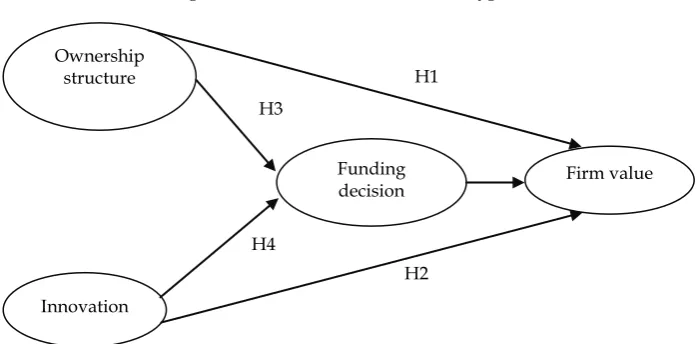
Hypothesis 1: The higher the ownership structure, the higher the firm value.
The development of technology is the heart of economic growth and investment in innovation is the main activator (Scherer 1999). The growth of innovation by the firm can make the financial per-formance grow, too. According to Resources Based View of the firm by Penrose (1959) company which has the unique resource will have the high per-formance. Innovation done by the firm needs that unique resource. The more innovations are created, the higher the value of the firm. Previous research saw that innovation give positive impact to the firm performance in stock exchange which classified into developed (Hall 1993; Srinivasan et al. 2008; Sorescu & Spanjol 2008). Stock exchange in Indone-sia as the emerging market is needed for investors to react positively toward the innovation activities so by the increasing of innovation can raise the per-formance of the firm. Based on this description, the second hypothesis is:
Hypothesis 2: The higher the innovation of the firm, the higher the firm value.
The essence of capital structure theory of Modi-gliani & Miller (1958) delivered that the economic value of firm asset fully determined by operating cash flow and not by the funding structure. Capital structure theory that got many attentions is asym-metric information theory and signaling, pecking order theory and trade-off theory. According to Jensen & Meckling (1976) the usage of debt de-creases the needs of external equity and raises the proportion of ownership structure. The overload usage of debt will also cause bankruptcy so it can turn down the intention of managers to add more ownership (Friend & Lang 1988).
Empirical study about the influence of owner-ship structure toward the firm value and funding decision toward firm value is not yet consistent. Study of Leech & Leahy (1991); Slovin & Sushka (1993); Grosffeld (2006); Wahyudi & Pawestri (2006) investigate the positive and significant influence of ownership structure toward the firm value. In con-trast, study by Prowse (1992); Thomsen (2004 2006); Grosfeld(2006) and Vera et al. (2007) discover the negative influence of ownership structure toward the firm value.
The influence of funding decision toward the firm value by Bernadi (2007) and Hasnawati (2005a; 2005b) concludes that the decision of funding give the significant and positive impact to the firm value. Yet, the study of Sujoko (2007); Umrie et al. (2011); Yuliani (2011) concludes the contrary result which is decision of funding does not influence significantly to the firm value. Based on the defini-tion above, the third hypothesis is:
Hypothesis 3: Funding decision play the role of influence of ownership structure mediation toward the firm value.
Innovation activities related to the problem of asymmetric information where the firm has more
information about the possibility of success and the project characteristics of investors or investors can-didates. Because of that, investor feel more difficult to distinguish high return project and low return project when investment project of R&D is in long term than in the short term one (Leland & Pyle 1977). It means, when the cost of R&D is published, the signal for investors is high return, and the prob-lems of asymmetric information decreased.
Empirical study of funding decision influence toward the firm value has been done by many fi-nancial experts, while innovation influence toward the firm value is very limited. Opler & Titman (1994) defined that R&D of the firm that has debt will suffer more than others in facing financial dis-tress. But Atanasof (2006) declare that for the in-cremental innovation activities there is the positive relationship between the debt and R&D program that will finally improve the firm value. Based on the explanation, the hypothesis is:
Hypothesis 4: Funding decision play the role of influence of innovation mediation toward the firm value.
Based on the above explanation of ownership structure influence, innovation toward the firm value with the funding decision as mediation, the conceptual framework and hypothesis can be made as seen in Figure 1.
3. RESEARCH METHOD Population and Samples
Population of this research is all the firms listed in Indonesian stock Exchange. Target of population in this research is all public firms in amount of 374 firms without bank or non bank (insurance, credit of agency, security). This reason is supported by Jensen & Meckling (1976): “highly regulated in-dustries such as public utility or bank will have Figure 1
Conceptual Framework and Research Hypothesis
Ownership structure
Innovation
Funding
decision Firm value H1
H2 H3
higher debt equity ratios for equivalent level of risk than the average non regulated firm”. The sampling method is purposive sampling and the criteria are:
1. Firms publish the audited financial report in 2008-2012. This is needed for early verification of data completion and the variable used. 2. Firms posted positive retained earning. If
re-tained earning is negative it means the firms do not have the additional capital from internal. 3. Firms have positive balance of equity to
pre-vent bias in counting ratio.
4. Firms explicitly declare the R&D, experts, and financial report cost. This criterion is used to know that firms have the account as the reflec-tion of innovareflec-tion activities.
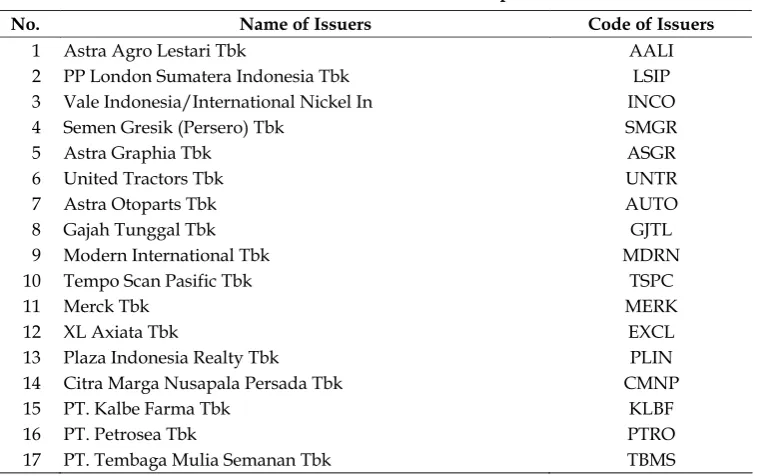
Based on the criteria above that secure the in-ternal validity, the samples are 17 firms (Table 1).
The list of the samples is provided in Table 2. Based on the criteria above, there 17 firms that fill the criteria. Analysis unit of this research is pooling data and the research period (t) = five years (2008-2012) and N= 17 firms and so there are 85 cases of investigation. Data used is secondary data sourced from financial report published by Indone-sian Stock Exchange, ICMD 2007-2012 or Annual Report in 2007-2012.
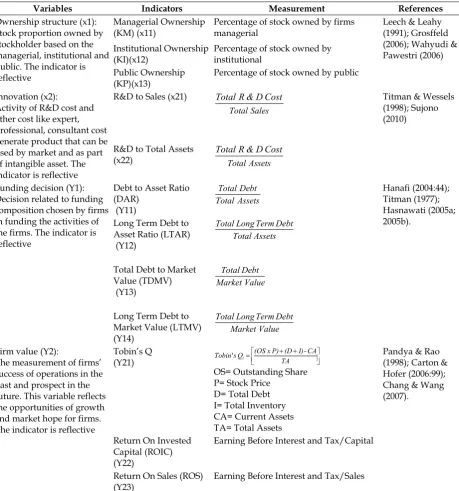
Operational Definition of Research Variables The operational of research variables is summa-rized in Table 3.
Analysis Technique Descriptive Statistic
In this research, there will be the average in statistic completed with the highest and the lowest value of Table 1
Criteria of Research Samples
No. Criteria Numbers
1. The amount of go public company beside Bank and Non bank 374 2. Excluded because of incomplete financial report (128) 246 3. Excluded because of negative EBIT (121) 125 4. Excluded because posted negative retained earning (54) 71 5.
6.
Excluded because of negative equity
Excluded because does not publish the cost of R&D, and experts explicitly
(22) 49 32 The amount of firm that fill the criteria 17
Table 2
The List of Firms as Research Samples
No. Name of Issuers Code of Issuers
1 Astra Agro Lestari Tbk AALI 2 PP London Sumatera Indonesia Tbk LSIP 3 Vale Indonesia/International Nickel In INCO 4 Semen Gresik (Persero) Tbk SMGR
5 Astra Graphia Tbk ASGR
6 United Tractors Tbk UNTR
7 Astra Otoparts Tbk AUTO
8 Gajah Tunggal Tbk GJTL
9 Modern International Tbk MDRN 10 Tempo Scan Pasific Tbk TSPC
11 Merck Tbk MERK
12 XL Axiata Tbk EXCL
13 Plaza Indonesia Realty Tbk PLIN 14 Citra Marga Nusapala Persada Tbk CMNP 15 PT. Kalbe Farma Tbk KLBF
16 PT. Petrosea Tbk PTRO
each indicator from ownership structure, innova-tion, funding decision and firm value.
Inferential Statistic
Inferential statistic in this research used causality of Structural Equation Model (SEM) with the basic of component or variance known as Partial Least Square (PLS). This research used SmartPLS soft-ware 2.0 versions. The reason of using PLS method is: (a) Involve multivariable, this research has more than one variables which are ownership structure, innovation, funding decision and firm value; (b)
Involve unobservable, where the variable analyzed is unobservable; (c) the model is recursive; (d) the relationship formed is causality tiered.
4. DATA ANALYSIS AND DISCUSSION Analysis of Descriptive Statistic
The analysis of descriptive statistic for go public firms in Indonesia Stock Exchange along 2008-2012 can be seen in the Table 4. In Table 4, it is seen that ownership structure has 24.26% mini-mum value, 99.80% maximini-mum value and 72.53% average with 15.95% standard deviation. Smaller Table 3
Operational Definition of Research Variables
Variables Indicators Measurement References
Managerial Ownership (KM) (x11)
Percentage of stock owned by firms managerial
Institutional Ownership (KI)(x12)
Percentage of stock owned by institutional
Ownership structure (x1): Stock proportion owned by stockholder based on the managerial, institutional and public. The indicator is
reflective Public Ownership (KP)(x13)
Percentage of stock owned by public
Leech & Leahy (1991); Grosffeld (2006); Wahyudi & Pawestri (2006)
R&D to Sales (x21)
Sales
Activity of R&D cost and other cost like expert, professional, consultant cost generate product that can be used by market and as part of intangible asset. The indicator is reflective
R&D to Total Assets
(x22) TotalAssets
Cost D & R Total
Titman & Wessels (1998); Sujono (2010)
Debt to Asset Ratio (DAR) Asset Ratio (LTAR) (Y12)
Total Debt to Market Value (TDMV)
Funding decision (Y1): Decision related to funding composition chosen by firms in funding the activities of the firms. The indicator is reflective
Long Term Debt to Market Value (LTMV) (Y14)
OS= Outstanding Share P= Stock Price
D= Total Debt I= Total Inventory CA= Current Assets TA= Total Assets Return On Invested
Capital (ROIC) (Y22)
Earning Before Interest and Tax/Capital Firm value (Y2):
The measurement of firms’ success of operations in the past and prospect in the future. This variable reflects the opportunities of growth and market hope for firms. The indicator is reflective
Return On Sales (ROS) (Y23)
Earning Before Interest and Tax/Sales
number of standard deviation than average re-flects that the data is distributed normally. Own-ership structure which operationally in this re-search is the stock proportion owned by stock-holder by managerial, institutional and public. Ownership structure related to the agency theory about the conflict between principal and agent. Principal is the stockholder and owner of the firm while agent is manager who organizes activities of the firm directly. Refer to Table 4 shown that 24.26% minimum value of ownership structure reflected to the ownership of managerial, institu-tional and public show that the proportion of firms ownership toward the decision taken for the sustainability of the firms relatively small. In the average, 72.53% for 85 data of observation in In-donesian Stock exchange has shown relative better value related to the expansion of data about the variable of ownership structure.
Descriptive statistic of innovation obtained based on Table 4 has 0.01% minimum value, 41.54% maximum value and 1.45% average with 5.56% standard deviation. This variable is re-flected by two indicators namely the comparison of R&D cost to sales, and total assets. 1.45% for averages indicates the small intention of firms in Indonesia Stock Exchange to allocate funding for innovation; moreover there is a firm in the sam-ple that allocates only 0.01% for innovation. Big-ger value of standard deviation than average means that 85 investigations have relative deep disperse. High standard deviation value shows that there is the significant variation of the data
toward innovation variable. Big discrepancy is because there is the sample of the firm who allo-cate only 0.01% for innovation while there is also the sample that make 50% allocation of funding for innovation. The amount spent for this innova-tion can be seen in financial report that graphs the account of current income statement report. It is shown in the account the cost of expert, con-sultant, professional service, and research and development.
Funding decision is related to the source of the fund spent for each investment decision in terms of achieving firm value and stockholder safety. Funding source consist of internal and ex-ternal, determination of funding source must be the important decision because the consequences is directly go to the management policy. Funding decision variable in this research is unobservable so it needs indicators. Four indicators are the re-flections that consist of comparison between debt and assets, comparison between long term debt and assets, comparison between debt and market value, and comparison between long term debt and market value.
Based on Table 4 can be seen that funding source has 5.4%minimumvalue, 467% maximum value and 155.04% average with 92.31%. The higher value of standard deviation shows that data about funding decision in samples is not normally dis-tributed. It is occurred because there is a bit huge difference in each firms in which the firms in opera-tional activities use small number in amount of 5.4% external but instead another firm make it Table 4
Descriptive Statistic of Research Variables (%)
Variables N Min Max Mean Std. Deviation
Ownership structure 85 24.26 99.80 72.53 15.95
Innovation 85 0.01 41.54 1.45 5.56
Funding decision 85 5.40 467.06 55.04 92.31 Firm value 85 -18.65 284.10 19.48 30.70
Source: Analyzed from secondary data.
Table 5
Result of Linear Assumption Test
Exogenous variables
Endogenous
variables Test Result (α=0.05) Sig. Decision
SK KP All model do not significant 0.132 Linier INO KP All model do not significant 0.336 Linier SK NP All model do not significant 0.615 Linier INO NP All model do not significant 0.703 Linier KP NP All model significant 0.033 Linier
467.06%. The difference make the average become bigger.
Firm value acts as the measurement of success of each firm. This research use Tobin’s Q, ROIC, and ROS reflective indicator. The lowest value is -18.65%, the highest is 284.10% and the average is 19.48% while standard deviation is 30.70%. Refer to the result of descriptive statistic standard deviation value is bigger than average means that data dis-perse relative widely. Shown the lowest and the highest value differ widely and make the abnormal data become possible. Almost all variables have relative high standard deviation compared to the average. In statistic it is not the problem because heterocedastity does not occur (data distributed normally). Central limit theorem stated that if the observation is big (above 30), so the data distrib-uted normal though standard deviation is bigger than average (mean).
Inferential Statistical Analysis Result: Partial Least Square
Linear Assumption Test
In order to know whether the form obtained exactly describe the relationship of each variable, it is cate-gorized into fit model. The test is by curve estima-tion method in software SPSS. The decisions of the relationship among the variables are linear or not use P=5%.The result for each variable offered in Table 5.
Table 5 show that all the model of relationship among each variable in structural linear model based on the significance level is smaller than 5% (p<0.05). So, linear assumption on this structural
model has been filled.
Goodness of Fit Model Test
Model in this research is fit if supported by empiri-cal data. Investigation of Goodness of Fit in struc-tural model which use PLS data analysis method is by value of predictive-relevance (Q2) counted based
on value of R2 in each endogenous variables. The
value of R for each variable can be seen in Table 6. Based on Table 6, it shows that Q2 value is 0.501 or 50.1%. It means the model used in this re-search can declare the firm value in amount of 50.1% and the rest 49.9% explained by another variable out of this research model.
Hypothesis Test
This research has four hypotheses consist of direct test and indirect test or using mediation variable. The result of each test graphed in below explana-tion.
Direct Test
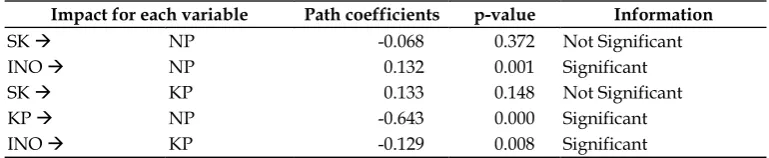
Direct test is made to know the influence of owner-ship structure toward the firm value and the direct impact of innovation toward the firm value. Basic of hypothesis decision said that p value 5%, when-ever p value is less than 5%, hypothesis is signifi-cant and so does whenever p value is more than 5%, and hypothesis is not significant. Direct impact test result stated in Table 7.
Table 7 indicates that direct impact of owner-ship structure toward the firm value is not signifi-cant with path coefficients is -0.068 and p-value is bigger than 0.05. Base on the test of direct impact, Table 6
Value of R Square Endogenous Variables
Endogenous Variables R Square
Funding decision 0.041
Firm value 0.480
Predictive-relevance (Q2) 0.501
Source: Analyzed from secondary data.
Table 7
Result of Direct Impact Test
Impact for each variable Path coefficients p-value Information
SK Æ NP -0.068 0.372 Not Significant INO Æ NP 0.132 0.001 Significant SK Æ KP 0.133 0.148 Not Significant KP Æ NP -0.643 0.000 Significant INO Æ KP -0.129 0.008 Significant
Information: SK: Struktur Kepemilikan (ownership structure) INO: Inovasi (innovation) KP: Keputusan Pendanaan (funding decision) NP: Nilai Perusahaan (firm value) Significant at p<5%
no significance of ownership structure toward the firm value make hypothesis 1 rejected (H1 re-jected). And then, direct impact of innovation to-ward the firm value is not significant with path coefficients is 0.132 and p-value is smaller than 0.05. Based on the test, means there is the signifi-cant and positive impact of innovation toward firm value and hypothesis 2 accepted (H2 ac-cepted).
Indirect test
Test of indirect influence or called test of mediation variable is settled to know that variable mediation in this research is funding decision. Investigation process toward the variable of funding decision in considering what kind of mediation it is whether it is partial mediation or complete mediation run in following steps:
Step 1 : Counting path coefficients by putting fund-ing decision variable in empirical model and the result is in Table 8.
Step 2 : Counting path coefficients without putting funding decision variable in empirical model and the result is in Table 9.
Based on Table 8 and 9, it can be learned that panel in first model obtained (a) not significant, (c)
not significant too and (d) significant and path coefficients (b)not significant so indirect impact of ownership structure mediation toward the firm value through funding decision is not mediation. The result shows (c) or (d) is not significant. This indirect impact means that funding decision is not as mediation of influence between ownership structure toward firm value and third hypothesis rejected (H3 rejected).
Indirect impact for panel in second model called funding decision as mediation of innovation
influence toward the firm value. Refer to Table 8 and 9 learned that (c), (d) is significant and (b) sig-nificant where path coefficients (a) smaller than path coefficients (b) so mediation for indirect in-fluence of innovation toward firm value through funding decision is partial mediation. Result shows that innovation can impact directly toward the firm value and also through funding decision. Related to this result, it can be stated that hy-pothesis of funding decision as mediation of inno-vation influence toward the firm value accepted (H4 accepted).
Discussion
The higher the ownership structure, the higher firm value
Based on the result of analysis of ownership struc-ture influence toward firm value, it was not signifi-cant. For instance, hypothesis said that the higher the ownership structure, the higher the firm value with the observation period 2008-2012 is not enough evidence to be accepted. The result shows that ownership structure reflected in public owner-ship as dominant indicator can not explain the va-riety of firm value growth in Indonesian Stock ex-change for 2008-2012.
Based on the model analysis of measurement shows that the variable of ownership structure re-flected in public ownership (<5%). On the other hand, indicator of firm value reflected more by Tobin’s Q (Table 9).Empirical fact shows 72.53% average of ownership structure while firm value average is 19.48%. It means, in average firms in Indonesia stock Exchange in the period of observa-tion is not in real contributing the growth of firm value.
This result is not yet consistent as compared to Table 8
Analysis Result of Mediation Test by Funding Decision Variable
Original Sample Estimate p-value Information
SK Æ NP (a) -0.068 0.898 Not significant SK Æ KP(c) 0.133 0.148 Not Significant KP Æ NP (d) -0.643 0.000 Significant INO Æ NP(a)
INO Æ KP(c) KP Æ NP(d)
0.132 -0.130 -0.643
0.001 0.008 0.000
Significant Significant Significant
Source: Analyzed from secondary data.
Table 9
Analysis Result of Mediation Test without Funding Decision Variable
Original sample estimate p-value Information
SK Æ NP (b) 0.171 0.179 Not significant INO Æ NP(b) 0.204 0.010 Significant
previous research. Previous research by Leech & Leahy (1991); Slovin & Sushka (1993); Grosffeld (2006); Wahyudi & Pawestri (2006) shows the posi-tive significant impact of ownership structure to-ward the firm value. As well as research by Prowse (1992); Thomsen (2004); Grosfeld(2006) and Vera & Francisco (2007) indicates the negative relationship of ownership structure toward firm value. The finding of this research is the same as research of Lubis (2010), where the influence of public owner-ship in ownerowner-ship structure is not significantly im-pact market performance. Market performance is the variable measurement with market base, this approach also used in this research where Tobin’s Q indicator is the measurement of market base. Lubis finding (2010) had clearly summarized that public ownership does not yet contribute to firm value growth.
The difference of this research and previous research known from the purpose of ownership structure and observed by the condition of market control in Indonesian Stock Exchange that lead to market mechanism and hope that the growth of ownership structure will raise the firm value as well. This conflict happened among stockholders and managers of the firm as the activator of the firm. Because of that, this conflict must be dimin-ished by uniting the interest of both sides. When it occurs, agency problem will appear. Researchers of finance believe that agency problem occur be-cause of ownership structure. For that, supervi-sion is needed and finally will float cost called agency cost.
The higher the innovation of firms, the higher the value of the firm
The analysis result of innovation influence toward firm value was found positive and significant. So, hypothesis stated that the higher innovation, the higher the firm value is accepted. The result indi-cates that higher innovation can rise up firm value in Indonesian stock Exchange. Refer to model analysis measurement shows that innovation re-flected by indicator of R&D cost toward sales and comparison of R&D cost toward total of assets. Empirical facts shows innovation average in Indo-nesian Stock Exchange along period of observa-tion 1.45% can raise 19.48% firm value. It means that R&D proportion in sample firm can raise firm value seen in Tobin’s Q.
Based on descriptive statistic (Table 4), it can be seen that in the period of observation lowest innovation of sample firm is 0.01% and the highest is 41.54% stated that firms in sample started to
take a deeper look in to some amount of cost needed to produced for research and develop-ment. Some firms make the expenditure by pub-lishing explicitly the cost of R&D in the form of payment for expert, consultant, and there are some firms that write down the R&D cost. Empiri-cal facts declare that 1.45% average of innovation can increase market reaction through Tobin’s Q value which is in average bigger than one. Tobin’s Q value bigger than one gives the signal that firms management has succeed in the past operational and has better prospect in the future.
This finding strengthen innovation theory in perspective of Resources Based Theory (RBT)¸that firms continually will develop the innovation in-ternally. Barney (1991:110) clearly describe that innovation is very important resource for firms competitive advantage, because the resource will be very valuable and scarce, even Itami (1987:13) said that the using of optimum resource will not be decreased even it is used. RBT approach focuses on the internal resources physically, financially, hu-man and organizational. According to Resources Based View of the firm by Penrose (1959) that firms with the unique resources will have the high per-formance. Innovation run by firms needs unique performance and more innovation will raise more firm value.
This result expands more about previous re-search about significant and positive impact of in-novation toward financial performance as seen (Hall 1993; Srinivasan et al.2008; Sorescu & Spanjol 2008; Yuliani 2013). Different from the result of Sujono investigation (2010) is negative, while in this research it is positive. Negative relationship of Su-jono finding (2010) caused by manufacture sector has hazardous moral in R&D activities, so market see investment in R&D as a nonprofit action. Meanwhile in Indonesia emerging market is ex-pected to realize about the importance of firm com-petitiveness, and investors can react positively to the innovation so innovation rising can rise up the firm value.
Funding decision play the role as mediation of ownership structure influence toward the firm value
fund-ing decision is not as intervenfund-ing variable in risfund-ing firm value.
Descriptive analysis describe that along the pe-riod of observation firm value in Tobin’s Q indica-tor is 19.48% in average. 72.53% funding decision shows that the additional of debt amount in fund-ing decision does not influence the opportunities of growth and market expectation. The proportions of high debt structure lead the firms in samples to focus more on the payment and installment so firm value growth is not significant.
Funding decision as non-mediation variable is not consistent with Wahyudi & Pawestri research (2006) that the effectiveness of ownership structure and innovation by considering the condition of funding decision for funding will increase firm value. Other researchers like Sujoko (2007); Umrie et al. (2010); Yuliani (2011) summarize that funding decision is not significantly impact firm value. This contradictive result refers to Fama & French (1997) that debt has negative relationship to the firm value. Modigliani & Miller (1958) has gone first with some proportions offered and conclude that capital structure is not relevant influence firm value. The result of this research is still contradic-tive with Bernadi finding (2007) and Hasnawati (2005a; 2005b) that stated that funding decision influence firm value significant and positively.
Funding decision play the role as mediation of innovation influence toward firm value
Based on the description in steps for knowing the characteristics of funding decision variable (Table 8 and 9) it was found that funding decision variable is partial mediation. It means that indirect influence between innovations toward firm value through funding decision gotten from the multiplying of innovation toward funding decision (path coeffi-cients -0.130 and significant) with direct impact of funding decision of firm value (path coefficients -0.643 and significant). The calculation generated 0.084 coefficient of indirect influence. It means that positive direction of indirect influence implies the ability of innovation in increasing firm value which is in the beginning only 0.204 (20.4%) without con-sidering funding decision, and by making funding decision as mediation variable innovation ability in influencing variety of changes in firm value raise to 0.288 or 28.8% in total.
According to that fact, this research is able to prove that considering funding decision is inter-vening in partial for increasing firm value. Conse-quence of this finding is that firms must take a look at funding decision. Funding decision is the
finan-cial decision related to composition of funding re-source needed to fund firms’ activities. Funding resources consist of internal and external, where funding of external resource will create debt in firms’ balance. Dominant indicator of funding deci-sion variable is the comparison of total debt to total assets.
Innovation widely involved in investment de-cision, investment activities done by choosing the project or other policies like making new products, substituting more efficient machine, and research & development, and merger with other firms (Myers 1976). While firm value implied by Tobin’s also influenced by the chances of investment and discre-tionary expenditure in the future (Myers 1977; Myeong & Hyeon 1998). In signaling theory, result of this finding support that theory because decision in innovation by considering exact fund resource become very important in increasing firm value. This is because this kind of investment will indicate prospect of firms’ growth.
This fact is based on the assumption that maximum firm value will be achieved through choosing investments which offer positive net pre-sent value. In other words, investment expenditure has been considered and analyzed by certain method, and investment of positive NPV is chosen (Fama & French 1998) that investment expenditure will offer positive signal about firms’ growth and capitalization growth of stock in the future so the growth of firm value will occur in the whole. The result of this research has proven Fama and French research (1997) that firm value only determined by investment decision.
The result of this research also expands previ-ous research about significant and positive influ-ence toward financial performance that has been done (Hall 1993; Srinivasan et al. 2008; Sorescu & Spanjol 2008). Different from the result of Sujono investigation (2010) is negative, while in this re-search it is positive. Negative relationship of Sujono finding (2010) caused by manufacture sector has hazardous moral in R&D activities, so market see investment in R&D as a nonprofit action.
5. CONCLUSION, IMPLICATION, SUGGES-TION AND LIMITASUGGES-TIONS
prove that every important activities related to R&D cannot be ignored; 3) Ownership structure by considering funding decision does not rise firm value. Consequence of funding decision related to fund resource used to fund firms activities need to be focus of firms; 4) Innovation by considering funding decision will increase firm value. It means that firms can invest in innovation but still consid-ering the fund resource used.
Implication of this research result toward the theory of development especially ownership struc-ture of the firm (Jensen & Meckling 1976), the result of this research reject that theory, where ownership structure for sample firm in Indonesian Stock Ex-change prove that firm value growth does not ap-pear from ownership structure. This research also proved that ownership structure by considering funding decision does not influence firm value. It means agency problem cause non-significant result of this research. This research proved that innova-tion can increase firm value. Industries with huge level of competition make innovation able to grow the firm value. The finding support signaling the-ory. This research proved that theoretically innova-tion growth by considering fund resource can grow the firm value. This finding contributed to pecking order theory that explained the sequence of fund-ing. So, when the firm has the chance to invest in innovation, firm has to gain fund resource for that investment.
Practical implication of this research is, gov-ernment should get the regulation related to stock exchange fixed as fast as possible like the protection for investors, the discipline of regulation and opened information of ownership. Innovation de-termine the value of the firm, this condition push the firm to have clear vision of innovation oriented, and enable all networks to generate higher innova-tion. Funding decision determine value of the firm, the amount of high debt also get to be well man-aged because it can cause the bankruptcy in the future. Because of that, the limitation of debt amount secured by government through Otoritas Jasa Keuangan (OJK) is a must.
The limitations of this research are (1) limita-tion of qualitative informalimita-tion, (2) innovalimita-tion in this research is emphasized more to innovation input, (3) small size of sample. The suggestions of this research are (1) this research is not completely consider qualitative side like firms management. It is because of the information limit about qualitative data gained, (2) it is needed to develop the research about process of innovation or innovation output. Innovation process can be done by case study to
analyze activity of R&D in the firm, (3) it is needed to put more size of sample, because financial indus-try also run the innovation, so there must be con-tinually investigation about innovation in go public firms.
REFERENCES
Atanasof, J 2006, ‘Essay in Corporate Finance’, Dis-sertation, University of Michigan.
Barney, JB 1991, ‘Firm Resources and Sustained Competitive Advantage’, Journal of Manage-ment, 17: 99-120.
Bernadi, KJ 2007, ‘Analisis Pengaruh Cashflow dan Kebijakan Pecking Order Terhadap Leverage dan Investasi serta Dampaknya Terhadap Nilai Perusahaan (Studi Pada Perusahaan-Perusahaan Sektor Manufaktur)’, Dissertation, Program Pascasarjana Universitas Brawijaya. Berle, AA & Means, GC 1932, The Modern
Corpora-tion and Private Property, Macmillan Publishing Co:New York.
Chang, SC & Wang, CF 2007, ‘The Effect of Product Diversification Strategies on The Relationship Between International Diversification and Firm Performance’, Journal of World Business, 42: 61-79.
Carton, RB & Hofer, CW 2006, Measuring Organiza-tional Performance Metrics for Entrepreneurship and Strategic Management Research, Edward El-gar Publishing, Inc: USA.
Fama, EF & French, KR 1998, ‘Taxes, Financing Decisions, and Firm Value’, The Journal of Fi-nance, Vol. 53 (3): 819-843.
Fama, EF & French, KR 1997, ‘Industry Costs of Equity’, Journal of Financial Economics, 43: 153-193.
Jensen, MC & Meckling, WH 1976, ‘Theory of the Firm: Managerial Behavior, Agency Cost and Ownership Structure’, Journal of Financial Eco-nomics, 3 (4): 305-360.
Grosfeld, I 2006, ‘Ownership Concentration and Firm Performance: Evidence from an Emerging Market’, Social Science Research Network Paper Collection,
<http://papers.ssrn.com/sol3/papers.cfm?abs tract_id=924588 >.
Hall, B 1993, ‘R&D Tax Policy During the Eighties: Success of Failure?’, Tax Policy and the Economy, 7: 1-36.
Hasnawati, Sri, 2005b, ‘Dampak Set Peluang Inves-tasi Terhadap Nilai Perusahaan Publik di Bursa Efek Jakarta’, Jurnal AAI, 9 (2): 117-126. Itami, H 1987, Mobilizing Invisible Assets, Harvard
University Press, Cambridge, MA.
Jensen, MC & Meckling, WH 1976, ‘Theory of The Firms: Managerial Behavior, Agency Costs and Ownership Structure’, Journal of Financial Eco-nomics, 3 (4): 305-360.
Keputusan Menteri Riset dan Teknologi Republik Indonesia Nomor 193/M/Kp/IV/2010 Ten-tang Kebijakan Strategis Pembangunan Na-sional Ilmu Pengetahuan dan Teknologi Tahun 2010-2014, <http://www.ristek.go.id/indeks>, viewed 11 September 2013.
La Porta, R, Lopez-de-Silanes, F, Shleifer, A,, Vishny, R.W 1998, ‘Law and Finance’, Journal of Political Economy, 106: 1113-1155
Leech, D & Leahy, 1991, ‘Ownership Structure, Control Type Classifications and the Perform-ance of Large British Companies’, The Economic Journal, 101 (409): 1418-1437.
Leland, H & Pyle, DL 1977, ‘Informational Asym-metries, Financial Structure and Financial In-termediation’, Journal of Finance, 32: 371-387. Lubis, TA 2010, ‘Pengaruh Struktur Kepemilikan
Terhadap Kinerja Finansial dan Operasional, Keunggulan Daya Saing Berkelanjutan Ber-dasarkan Reputasi Ukuran Akuntansi, dan Kinerja Pasar (Studi pada BUMN Tbk)’, Disser-tation Summary, Program Pascasarjana Univer-sitas Brawijaya.
Modigliani, F & Miller, M 1958, ‘The Cost of Capital, Corporation Finance and The Theory of Invest-ment’, American Economic Review, 48: 261-275. Opler, TC & Titman, S 1994, ‘Financial Distress and
Corporate Performance’, Journal of Finance, 49 (3): 15-40.
Pandya, AM & Rao, N 1998 ‘Diversification and Firm Performance an Empirical Valuation’, Jour-nal of Financial and Strategic Decision, 11 (2):67-81. Prowse, SD 1992, ‘The Structure of Corporate
Own-ership in Japan’, The Journal of Finance, 47 (3): 1121-1140.
Ross, AS, Westerfield, RW and Jaffe, J 2005, Corpo-rate Finance, Seventh Edition, McGraw-Hill, Boston.
Scherer, F 1999, New Perspectives on Economic Growth and Technological Innovation, The Brook-ings Institution, Washington DC.
Shleifer, A & Vishny, RW 1997, ‘A Survey of Cor-porate Governance’, The Journal of Finance, 52 (2): 737-783.
Slovin, MB & Sushka, ME 1993, ‘Ownership
Con-centration, Corporate Control Activity, and Firm Value: Evidence from the Death of Inside Blockholders’, The Journal of Finance, 48 (4): 1293-1321.
Sorescu, AB & Spanjol, J 2008’, Innovations Effect on Firm Value and Risk: Insight from Con-sumer Packaged Goods’, Social Science Research
Newtwork Paper Collection,
<http://www.ssrn.com/Abstract--id1265847>. Srinivasan, S, Pauwels, K, Silva-Risso, J & Hanssen, DM 2008, ‘Product Innovations, Advertising and Stock Returns’, Social Science Research
Newtwork Paper Collection,
<http://www.ssrn.com/Abstract--id1136319>. Sujono, 2010, ‘Determinan Struktur Modal, Inovasi dan Nilai Perusahaan (Studi pada Industri Manufaktur di Bursa Efek Indonesia)’, Disserta-tion Summary, Program Doktor Ilmu Mana-jemen Universitas Brawijaya, Malang.
Sujoko, 2007, ‘Pengaruh Struktur Kepemilikan Sa-ham, Strategi Diversifikasi, Leverage, Faktor Intern dan Faktor Ekstern terhadap Nilai Peru-sahaan’, Dissertation Summary, Program Pas-casarjana Universitas Brawijaya.
Thomsen, S 2004, ‘Blockholder Ownership, Divi-dends and Firm Value in Continental Europe’,
Social Science Research Network Paper Collection, http://www.ssrn.com.
Umrie, HSR, Yuliani & Cahyadi, A 2011, ‘Analisis Kebijakan Dividen dan Kebijakan Hutang ter-hadap Nilai Perusahaan Go Publik di Indone-sia’, Jurnal Manajemen & Bisnis Sriwijaya, 9 (17): 13-32.
Vera, AM & Francisco, MJ 2007, ‘Does Ownership Structure affect Value? A Panel Data Analysis for the Spanish Market’, International Review of Financial Analysis, 16: 81-98.
Wahyudi, U & Pawestri, HP 2006, ‘Implikasi Struk-tur Kepemilikan terhadap Nilai Perusahaan: dengan Keputusan Keuangan sebagai Variabel Intervening’, Simposioum Nasional Akuntansi 9: Sumatera Barat, Padang.
Word Economic Forum, 2013, The Global Competi-tiveness Index 2013–2014 rankings and 2012–2013 comparisons, <www.weforum.org>, viewed 11 September 2013.
Yermack, D 1996, ‘Higher Market Valuation of Companies with a Small Board of Directors’,
Journal of Financial Economic, 40 (2): 185-211. Yuliani, 2011, ‘Leverage, Size and Age Mediating
Scientists Association, Pekan Baru Riau, 2-4 De-cember, 195-212.
Yuliani, 2013, ‘Efek Dinamika Lingkungan sebagai Moderasi Pengaruh Inovasi terhadap Kinerja
Keuangan (Studi Empiris Sektor Telekomuni-kasi di Bursa Efek Indonesia)’, Call For Paper,