arXiv:cond-mat/0507162v1 [cond-mat.other] 7 Jul 2005
magnetic atom.
Y.L´eger,∗ L.Besombes, L.Maingault, D.Ferrand, and H.Mariette
CEA-CNRS group ”Nanophysique et Semiconducteurs”, Laboratoire de Spectrom´etrie Physique, CNRS and Universit´e Joseph Fourier-Grenoble 1, BP 87, F-38402 St Martin d’H`eres, France
The emission spectra of individual self-assembled quantum dots containing a single magnetic Mn atom differ strongly from dot to dot. The differences are explained by the influence of the system geometry, specifically the in-plane asymmetry of the quantum dot and the position of the Mn atom. Depending on both these parameters, one has different characteristic emission features which either reveal or hide the spin state of the magnetic atom. The observed behavior in both zero field and under magnetic field can be explained quantitatively by the interplay between the exciton-manganese exchange interaction (dependent on the Mn position) and the anisotropic part of the electron-hole exchange interaction (related to the asymmetry of the quantum dot).
PACS numbers: 78.67.Hc, 78.55.Et, 75.75.+a
Precise control of electronic spins in semiconductors should lead to development of novel electronic systems based on the carriers’ spin degree of freedom. These so-called spintronics devices, combining manipulation of charges and manipulation of spins, could complement or replace existing electronic systems, yielding new perfor-mances [1, 2]. Magnetic semiconductor quantum dots (QDs), where excitons (electron-hole pairs) can inter-act strongly with the magnetic atoms, hold particular promise as building blocks for such spin-based systems. However, the geometric factors that become more and more important with decreasing QD size (because of the quantum confinement) need to be considered with great care [3]. For instance, any in-plane asymmetry can intro-duce very strong effects in the case of small dots (energy shift of the quantum levels, induced linear polarization) as revealed by single dot optical spectroscopy [4, 5]. Thus it is crucial, with nanometric scale magnetic objects, to understand and to control all the geometric parameters which characterize the system.
In the case of a quantum dot incorporating a single magnetic atom (spin S) and a single confined exciton, the exchange interaction between the exciton and the mag-netic atom acts as an effective magmag-netic field, so that the atom’s spin levels are split even in the absence of any applied magnetic field [6]. A set of 2S+ 1 dicrete emis-sion lines can be resolved, providing a direct view of the atom’s spin state at the instant when the exciton anni-hilates. However, there has been no experimental study of how a non-ideal dot geometry, especially departures from circular or square symmetry for self-assembled QDs grown by Molecular Beam Epitaxy (MBE), affects opti-cal monitoring of the magnetic spin state.
This letter concerns quantum dots containing a sin-gle manganese magnetic atom. We will show that the electron-hole-Mn system, is very sensitive to the geome-try, specifically the asymmetry of the QD and the posi-tion of the Mn atom in the dot. We report experimental results showing the three different types of spectra
pos-sible. Control of both the exciton-manganese (X-Mn) exchange interaction (determined by the position of the Mn) and the anisotropic electron-hole (e-h) exchange in-teraction (related to the shape of the dot) appears as a key condition for detection and manipulation of the spin state of the isolated magnetic atom. A strong interaction between the exciton and the Mn splits the six Mn spin components, but a strong anisotropy of the dot perturbs the spectrum pattern and can hide the information on the Mn spin state.
Single Mn atoms are introduced into CdTe/ZnTe QDs during their growth by MBE, adjusting the density of Mn atoms to be roughly equal to the density of dots [7]. The samples provide symmetric (disc-like) dots and asymmet-ric (ellipsoidal) dots, containing Mn atoms at various po-sitions. The QD emission (at≃2eV) is studied in mag-netic fields (B=0 to 11T) by optical micro-spectroscopy in Faraday configuration under non resonant laser exci-tation.
Fig.1 shows the three types of emission spectra ob-tained at 5K, under low excitation density, for single QDs containing a single Mn. In the first example (QD1), a structure composed of six main lines dominates the emis-sion spectrum at zero magnetic field. Such a spectrum is a fingerprint of a confined exciton interacting with a single Mn atom [6]. These lines correspond to the radia-tive (“bright”) exciton statesJz=±1 coupled to the six
spin components of the Mn atom (S = 5/2). Analysis of the line intensities gives the occupation probability of the six Mn spin states [6]. The three low intensity lines on the low energy side of the structure (Fig.1(a)) can be attributed to the contribution of exciton dark states [6]. We will see that a fine structure with well separated lines requires not only that the Mn atom interact strongly with the exciton in the dot, but also that the dot must retain high symmetry.
B = 0 T B = 0 T B = 0 T
FIG. 1: (color online). Low temperature (T=5K) PL spectra of three different Mn-doped CdTe/ZnTe QDs at B=0T and B=11T.σ±are circular polarizations andπx,yare two orthog-onal linear polarizations. (a) Exciton strongly coupled with a Mn atom, in a symmetric dot. (b) Exciton less strongly coupled with a Mn atom, in an asymmetric dot. (c) Exciton strongly coupled with a Mn atom, in an asymmetric dot.
third example (QD3), for which six lines are observed, but with two sets of three lines separated by the cen-tral gap. An additional essential property is that the emission lines are linearly polarized along two orthogo-nal directions for QD2 and QD3, whereas for QD1 the emission is unpolarized.
Such large differences in the zero field emission spec-tra can be attributed to competition between the X-Mn interaction and the anisotropic e-h exchange in-teraction arising in asymmetric QDs. We recall that for non-magnetic QDs, the e-h exchange interaction in an anisotropic potential mixes the bright exciton states
Jz = ±1. The emission of the QD is then linearly
po-larized along two orthogonal directions and split by the anisotropic exchange energy δ2 [4, 8], originating from the long range (non-analytic) e-h exchange interaction
Haniso e−h [9].
In symmetric Mn-doped QDs, the X-Mn exchange in-teraction lifts the degeneracy of the bright exciton states, the splitting being proportional to the Mn spin projec-tionSz[6]. Such systems can be described by an effective
HamiltonianH=Iese.S+Ihjh.S+H iso
e−h operating in
the basis of the heavy hole exciton states and Mn spin states. Here, Ie (Ih) is the electron (hole)-Mn exchange
integral and se, jh and S are respectively the electron,
heavy hole and Mn spins. Hiso
e−h is the isotropic part
of the e-h exchange interaction. In zero magnetic field,
there are six doubly degenerate radiative energy levels formed by associating the six Mn spin projections with the two bright exciton statesJz=±1 (the corresponding
transitions lie on the dotted cross in Fig.2). They are sep-arated by equal energy intervalsδM n= 1
2(Ie−3Ih). We
FIG. 2: Bright state transitions in an asymmetric Mn-doped QD at B=0T and 11T. The e-h exchange interaction induces anticrossings (energyδ2) of the±1 excitons associated with
Sz =−1/2,−3/2,−5/2 for successive values of B; theSz =
−5/2 anticrossing is shown at right.
now consider how the simultaneous presence of Haniso e−h
and the X-Mn exchange interaction affects the zero field spectrum. Diagonalizing the augmented Hamiltonian
H+Haniso
e−h shows that the e-h exchange interaction splits
the six line structure into two subsets of three lines. Fig.2 represents the bright state transitions (Jz =±1)
associ-ated with the six manganese spin projections Sz. The
anisotropic e-h exchange term δ2 mixes the bright
exci-ton states associated with the same Mn spin projection, inducing an extra splitting between them. The energy splitting of the bright excitons for a given value ofSz is
given by :
∆E(Sz) = q
δ22+ (2|Sz|δM n)2 (1)
where 2 | Sz | δM n is the splitting induced by the Mn
only. The mixing induced byδ2 is thus strongest for the
central pair of states, associated with theSz=±1/2 Mn
spin projections. Eq.1 for ∆E(Sz) shows that anisotropy
of the dot creates a gap in the center of the emission structure, see Fig.2. This explains the line patterns ob-served for the three types of QD spectra presented above. The width of the central gap (pδ22+δM n2) and
the width of the whole six-line spectrum structure (pδ2
2+ (5δM n)2) yield the values ofδ2 andδM n for the
three dots of Fig.1. The ratio δ2/δM n determines the
spectrum type. For QD1, the ratio δ2/δM n is found
to be < 0.2, with δM n = 250µeV : the X-Mn
interac-tion dominates the emission structure and the Mn spin states are directly resolved in the optical spectrum. By contrast, δ2/δM n = 2.3 for QD2 (δM n = 120µeV), so
of only a factor of two has completely changed the type of spectrum. QD3 demonstrates the intermediate case (δ2/δM n= 1.3 withδM n= 230µeV) where the combined
effect of the e-h and X-Mn exchange interactions is seen very clearly : despite the importance of anisotropy, the Mn spin states are still resolved as two subsets of three lines separated by the central gap.
The parameterδM nis determined [10, 11] by the values
ofIe=α|φe(RM n)|2 andIh=β/3|φh(RM n)|2. Here
φe (φh) is the electron (hole) envelope function, which
falls off with RM n, the distance of the Mn atom from
the QD center ; α (β) are the Mn-e(h) exchange con-stants [12]. Clearly, for QD2, the Mn atom is farther from the dot center than for QD1 and QD3. The
the-1.0
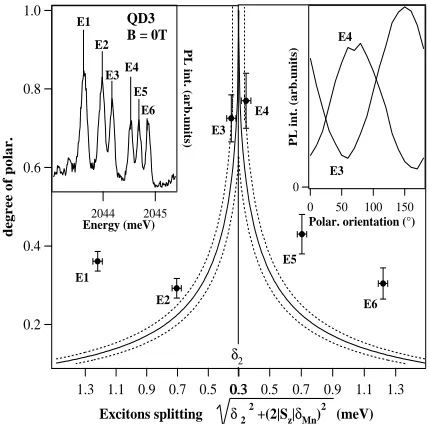
FIG. 3: Measured degree of linear polarization of emission lines E1-E6 for QD3 in zero field, as a function of the split-ting between the|Jz=±1, Sz>states, compared to theoret-ical behavior (full curves ; dotted curves show the uncertainty range corresponding to the imprecision inδ2). The left inset labels the emission lines. The right inset shows the PL inten-sity of the lines E3 and E4 (Sz=±1/2), as a function of the linear polarizer orientation.
ory also explains the linear polarization that we observe in zero magnetic field. When anisotropic electron-hole exchange interaction is included, the eigenstates of the X-Mn system are of the form [5, 8] :
|+>|Sz>= (cosθ|+1>+sinθ| −1>)|Sz>,
| −>|Sz>= (cosθ| −1>−sinθ|+1>)|Sz>, (2)
where tan2θ = δ2/(2 | Sz | δM n). The mixing of the
bright states associated with a Mn spin stateSz is
con-trolled by the ratio of δ2 to the Mn induced splitting 2 |Sz |δM n. The emission lines have partial linear
po-larization along two orthogonal directions corresponding to the principal axes of the anisotropic potential. Fig.3 compares measured and theoretical degree of polarization
for QD3. The data are in qualitative agreement with the theoretical curve. In particular, central lines E3 and E4, associated with Sz = ±1/2, are almost completely
po-larized. The expected decrease with increase of ∆E(Sz)
is reproduced qualitatively especially for the three upper energy lines E4, E5 and E6. For the lower energy lines, the degree of polarization could be influenced by the non radiative states (Jz =±2) which lie in their energy range.
2046
FIG. 4: (color online). (a) Intensity map of magnetic field dependence of the emission spectrum of asymmetric Mn-doped dot QD3, for circular polarization σ+ and σ−. (b) Optical transitions obtained from the diagonalization of the spin+Zeeman+diamagnetism Hamiltonian in the subspace of the 24 heavy-hole exciton and Mn spin components; Line thickness and color scale forσ+,σ−are proportional to ab-solute value of the projection of the exciton state on theJz= +1,−1 exciton respectively(green=low intensity, blue=high intensity). The two transitions which are forbidden at all magnetic fields (|Jz=±2, Sz=∓5/2>) are not plotted.
ex-citon shift up in energy whereas the Jz = −1
transi-tions shift down (see Fig.2). The anisotropic part of the electron-hole exchange interaction mixes successively theJz =±1 exciton states associated withSz =−1/2,
then with Sz = −3/2 and finally with Sz = −5/2 at
successively higher B. For QD3, these anticrossings are observed successively at 2.5, 7 and 11T. To understand
2039
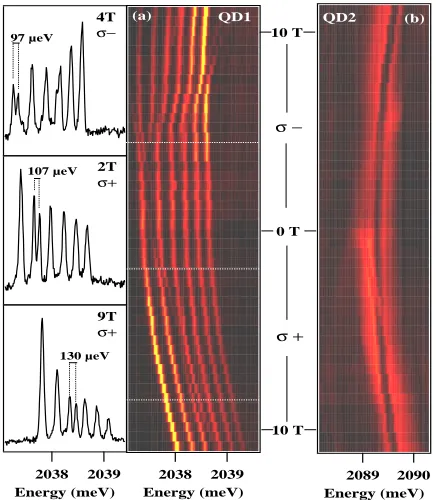
FIG. 5: (color online). Magnetic field dependence of the emis-sion of QD1 and QD2. (a)Exciton strongly coupled with a sin-gle manganese atom, in a quasi-symmetric dot . Anticrossings discussed in the text are illustrated by the spectra in the left insets. (b)Exciton less strongly coupled with a manganese atom, in a symmetric dot .
fully the rich magnetic behavior of dots like QD3, we cal-culated the optical transitions under magnetic field by diagonalizing the complete Hamiltonian of the electron-heavy hole-Mn system (including the exchange, Zeeman and diamagnetism Hamiltonians). Calculated transitions are presented in Fig.4(b). The fitted Land´e factors of the electron (ge = −1.1), the hole (gh = 0.3) and the
Mn atom (gM n = 2.0), the splitting between Jz = ±1
and Jz = ±2 excitons (= 1meV) and the diamagnetic
factor (γ= 2.45µeV.T−2) agree well with previous work
[5, 6, 12]. Parameters δ2 and δM n were adjusted to fit
the zero field data, as explained earlier.
Comparison between calculation and data explains most of the details of the magneto-optic proper-ties of QD3. In particular, around 7T, the cen-tral gap is perturbed in both circular polarizations. In σ−, this is due to anticrossings induced by the mixing of |sez = 1/2, jhz=−3/2, Sz> states and
| −1/2,−3/2, Sz+ 1> states by the electron-Mn
ex-change, [6], i.e. corresponding to simultaneous spin-flips
of electron and manganese spins. In σ+ polarization, Fig.4(b) shows that the line of second lowest energy crosses the central gap as an essentially non-radiative transition. This implies a mixing of| −1/2,3/2,−3/2>
and | −1/2,−3/2,−1/2>. This is a second order mix-ing involvmix-ing both mixmix-ing of | −1/2,−3/2,−1/2> and |1/2,−3/2,−3/2> by the e-Mn exchange and mixing of | −1/2,3/2,−3/2> and |1/2,−3/2,−3/2> by the anisotropic e-h exchange ; that is, the e-Mn exchange induces a mixing of states mediated by the anisotropy-induced coupling.
We now consider the field dependence of the two ex-treme cases illustrated by QD1 and QD2. For QD2 (Fig.5(b)), where δ2/δM n=2.3, the field dependence is
mainly the quadratic variation of the central gap. At
B = 11T, the Zeeman splitting has nevertheless sepa-rated the ±1 excitons and the circular polarization is almost completely restored (Fig.1(b)). The perturbation of the central gap around 4T inσ−polarization can be attributed, as for QD3, to the mediating electron-hole exchange.
QD1 presents weak anticrossings (see insets in Fig.5(a)) that are not explained by the simple model of a Mn-doped symmetric QD. Comparing with calculations we can attribute these anticrossings to a slight anisotropy, too small to be revealed by the presence of a clear central gap at zero field: the perturbation occurring from 5 to 9T inσ+ polarization corresponds to a mixing between bright states associated with Mn spin projection−1/2, and represents a residue of the central gap discussed ex-tensively above. The other anticrossings involve bright (Jz = ±1) and dark (Jz = ±2) states and are due to
second order electron-Mn exchange interaction mediated by the anisotropic e-h exchange interaction, as seen more clearly in the strongly anisotropic QDs.
In summary, we demonstrate that the position of a sin-gle Mn atom in a QD is not the only parameter that has to be controlled in order to resolve the Mn spin states. Another geometric parameter must be considered: the asymmetry of the dot. The interplay between these two parameters has important consequences for the QD op-tical properties. The Mn-exciton exchange interaction tends to separate the bright exciton states, whereas the anisotropic part of the electron-hole exchange interaction tends to couple them and to hide the Mn spin splitting. The wealth of data obtained gives a unified picture of the effects of dot asymmetry on the fine structure and polarization properties of optical transitions in single Mn-doped QDs. This allows us to determine the conditions required to tune the magnetic QD states in order to con-trol and manipulate individual localized spins by single carriers.
∗
Electronic address: [email protected] [1] B.E. Kaneet al., Nature393, 133 (1998). [2] D. Losset al., Phys. Rev. A57,120 (1998). [3] M. Bayeret al., Phys. Rev. Lett.82, 1748 (1999). [4] V.D. Kulakovskiiet al., Phys. Rev. Lett.82, 1780 (1999). [5] L. Besombeset al., Phys. Rev. Lett.85, 425 (2000); id.
J. Crystal Growth214, 742 (2000).
[6] L. Besombes et al., Phys. Rev. Lett.93, 207403 (2004). [7] F. Tinjodet al., Appl. Phys. Lett82, 4340 (2003). [8] E.L. Ivchenko, Phys. Stat. Sol. (a) 164, 487 (1997). [9] G.E. Pikuset al., Sov. Phys. JETP33, 108 (1971). [10] A.K. Bhattacharjee et al., Phys. Rev. B 68, 045303
(2003).