Rock’s
Mineral Control on Groundwater Quality
in Jakarta Groundwater Basin
T. Listyani R.A.
Geological Engineering Department STTNAS Yogyakarta Email:[email protected]
Abstract
Jakarta Groundwater Basin is a Quaternary basin which is located between latitude 6o0’ –6o39’S and
longitude 106o35’ –107o05’E where 0o is measured from Greenwich. There are many rocks and
variability groundwater quality in the research area support to know about the influence of mineralogical characteristics of rocks to groundwater quality.Analysis and evaluation have been done based on field and laboratory data and supported by secondary data primarily from geology and hydrogeology. Collecting data taken by rocks and groundwater sampling from several drilling wells in the field, then analyzed by petrography, XRD and also chemical of groundwater. Result of this analysis shows that groundwater quality in the research area is influence by mineralogical content of
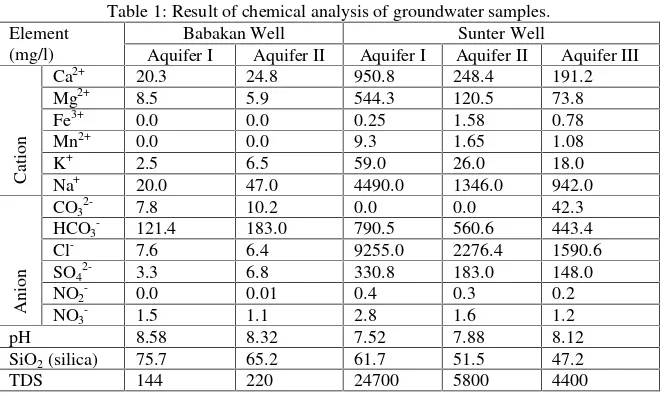
rock. Groundwater composition is dominated by Na+ranges in 20–4490 ppm, Ca2+20.3–950.8
ppm, HCO3- 121.4 – 790.5 ppm and Cl- 6.4-9255 ppm. Most of dominant soluble element in
groundwater interpreted derived from weathering of silicate minerals. The sedimentary rocks in the research basin involved in groundwater quality, but it was controlled by geology and hydrogeology condition beside stability factor of each mineral.
Key words: hydrochemistry, mineralogy, groundwater, Quaternary basin.
1.
Introduction
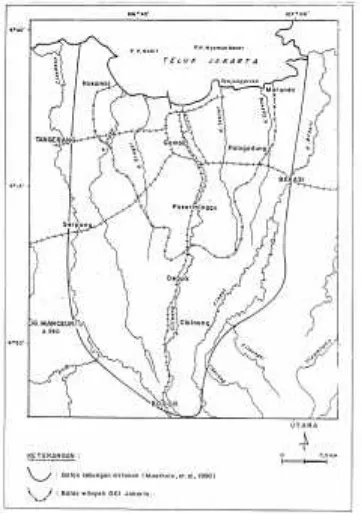
Geographically, the research area included in latitude 6o0 '- 6o39' S and longitude 106o35' -107o05' E, and regionally, including the Geological Map of Jakarta and the Thousand Islands Sheet,
Figure 1. Location map of research area (Maathuis dkk., 1996).
Karawang Sheet and Bogor Sheet, with the scale of 1: 100,000 (Figure 1). The research area is the Quaternary basin with variable lithologic constituents.
Studies conducted in this basin associated with groundwater quality issues. The quality of groundwater is essential examined, in addition to problems of quantity. The quality of groundwater in densely populated areas such as Jakarta and its surroundings is often a serious problem in daily life. Therefore, the study of the quality of groundwater in Jakarta Groundwater Basin needs to be done, for example in relation to the mineral content of the rocks that compose the basin.
One of factors that determines the quality of groundwater is a rock in its path. This study is purposed as groundwater hydrochemistry studies in order to determine the extent to which the rock may affect the quality of groundwater in the basin.
2.
Method
Two groundwater samples taken in Babakan well represented groundwater on shallow and deep aquifer in the southern part of the basin, while groundwater samples representednorth area taken from Sunter wells as much as three samples, each representing a shallow, medium and deep aquifer zone. The primary data of groundwater samplesadjusted with regional groundwater flow which is generally running from south to north so that both locations of two boreholes are expected to show the process that occur in the groundwater flow. Secondary data such as XRD, well log and petrographic rocks analyzed in order to complete this study. All primary data took in 1997.
3.
Regional Geology
The research areas included in the Coastal Plain physiographic region of Jakarta, Bogor Anticlinorium and Quaternary volcanic according to Van Bemmelen (1949). Jakarta Groundwater Basin is a Quaternary sedimentary basin which have a thickness of up to 250 m and deposited in a marine, delta and fluvial environments (Maathuiset al., 1996). The upper part of the Quaternary sediments composed of Upper Pleistocene alluvial fan sediments exposed in the southern part of the basin, while in the north composed of Holocene marine and non marine sediments. Rocks constituent of
groundwater aquifers are generally Quaternary sediment in the form of young volcano debris rocks, river and beach sediments, unconformablylocated over the Tertiary rocks that restrict Jakarta Groundwater Basin (Disbang DKI Jakarta and LPM-ITB, 1997a).
Quaternary sediment boundary in Jakarta Groundwater Basin in three dimensions is not clear. Data from Disbang Jakarta and LPM-ITB (1997c) showed the Tertiary rocks at a depth of 69.5 in Situ Babakan. Based on geological maps and bore well data it seen that base limit of Quaternary sediment is uneven but it looks like horst and grabenfrom Bogor to Depok which deeper to the north-northeast (Disbang Jakarta and LPM-ITB, 1997b).
Aquifer system division of Jakarta Groundwater Basin generally refers to Soekardi (1982, in Soekardi, 1986) as follows.
1. Free aquifer group (Aquifer I) at 0–40
m depth.
2. Upper confined aquifer group (Aquifer II) at 40–140 m depth.
3. Middle aquifer group (Aquifer III) at 140–250 m depth.
This aquifer grouping were done based on marine facies clay layers which divide the three aquifer systems. Hydrogeological section the basin is shown at Figure 2.
Figure 2. Hydrogeological profile of Jakarta Artois Basin (Soekardi dan PurboHadiwidjojo, 1975, in Soekardi, 1986).
4.
Result and Discussion
4.1. Chemical Constituent of Groundwater
Groundwater from Babakan Well represents fresh water in the beginning phase of
Bandung in order to know its major element constituents (Table 1).
Table 1: Result of chemical analysis of groundwater samples. Element
(mg/l)
Babakan Well Sunter Well
Aquifer I Aquifer II Aquifer I Aquifer II Aquifer III
Ca
ti
o
n
Ca2+ 20.3 24.8 950.8 248.4 191.2
Mg2+ 8.5 5.9 544.3 120.5 73.8
Fe3+ 0.0 0.0 0.25 1.58 0.78
Mn2+ 0.0 0.0 9.3 1.65 1.08
K+ 2.5 6.5 59.0 26.0 18.0
Na+ 20.0 47.0 4490.0 1346.0 942.0
A
121.4 183.0 790.5 560.6 443.4
Cl- 7.6 6.4 9255.0 2276.4 1590.6
SO42- 3.3 6.8 330.8 183.0 148.0
SiO2(silica) 75.7 65.2 61.7 51.5 47.2
TDS 144 220 24700 5800 4400
4.2. Mineral Composition of Rock
4.2.1. Megascopic Description of Mineral
The Quaternary sediments constituting Jakarta Groundwater Basin as shown in the lithologic log of the three boreholes (Babakan, Sunter and Tongkol) showed that the basin is composed of clastic sedimentary rocks, less compact to loose, with the structure of the massive, bedding, gradations or laminate. These rocks include sandstone, claystone, silt, marl, as well as several thin layers of limestone. The main constituent mineral composition of rocks are feldspar, mafic minerals and carbonate content.
Babakan well show Quaternary sediment dominated by black clay and fine - coarse sand, sometimes are tuffaceous. Layering thin marl and limestone containing fossils of foraminifera found at the bottom of the well log. The mineral content observed from coring are mafic minerals, carbonates, tuff, feldspar, opaque minerals and foraminifera fossils.
Sunter log show lithology that varies such as clay, sandy clay, silty sand and sand. This clay is gray to black, soft, sometimes containing shell fossils. Intercalation of tuff seen only as thin layer between the layers of sand.
Meanwhile, lithology logs of Tongkol well shows the variation of clay - silt and sand bedding alternating with variable thickness. Organic material and shells of animals are sometimes found in several rock layers. Coring in this well indicates mineral content of feldspar, chlorite, mafic minerals, clay minerals, quartz, tuff and shell fossils.
4.2.2. Result of Rock’sXRD Analysis
XRD analysis of rock samples are shown in Table 2 below. Some types of clay minerals such as illite, montmorillonite and kaolinite consist of rocks in the study area.
Tabel 2. Mineral content of rocks samples from XRD analysis.
No Borehole Sample Mineral
1 Babakan BAA-1 - Montmorilonite
- Kaolinite - Illite
2 Sunter Str-1 - Gypsum
- Illite
Tkl-2 - Montmoriilonite - Gypsum
- Kaolinite - Quartz
4.2.3. Result of Petrography Analysis
The results of the petrographic analysis of some samples (Table 3) was used to determine the presence of minerals that can affect the quality
of groundwater in the study area. Rock samples from Babakan (BA) and Tongkol (TK) are expected to provide an overview of the mineralogy of rocks studied.
Tabel 3. Mineralogy of rocks data based on petrography analysis.
No Depth
BA-1 29.7 35 40 10 Quartz, carbonate mud,
opaque mineral
BA-6 40.6 25 15 10 15 20 15
BA-7 59.2 40 10 10 30 10 Quartz, hornblende,
sericite, chlorite
BA-9 72 98 Opaque mineral
TK-1 39 10 19 10 20 30 10 Biotite
TK-2 121.5 75 10 Chlorite, opaque mineral,
sericite
TK-3 153.5 30 20 20 10 Orthoclase, opaque
mineral, fossil, ferry
Jakarta Groundwater Basin composed of Quaternary sediment aquifers in the form of debris of young volcanic, fluvial and beachsediments. The rocks that built the study area are tuff, claystone, silt, several layers of carbonate rocks and sandstone were mostly still loose. The southern part of the study area is dominated by the deposition of alluvial fan that is influenced by volcanic sediments. In general facies of the aquifer in the study area aresiliciclasticsedimentary rocks that mainly composed by sandstones and tuffaceous rocks. The Qva sediment on Jakarta - Bogor regional geological maps consists of layered tuff and sandy tuff scattered in the south to the northern of researcharea. Fisher & Mullican (1997) concluded that the interaction of water -tuffaceous rocks on the main aquifer is the reaction of dissolution - precipitation because these rocks indicate chemically unstable phase.
Sulfateaquifers facies may occur in Sunter and Tongkolindicated by the gypsum mineralin the XRD analysis. Carbonate aquifers faciesonly found in Tertiary rocks outcropsof Klapanunggal and Bojongmanik Formations. Carbonate rocks in the Klapanunggal Formationconsists of corallimestone, intercalation of sandylimestone and marl, while
the Bojongmanik Formation has intercalation of limestones (Turkandiet al., 1992), According to Fisher and Mullican (1997) carbonates aquifers also have unstable chemical phase, so the reaction of dissolution is occur easily.
The content of the fine grains were analyzed by XRD showed that the aquifer studied had some type of clay minerals, namely montmorillonite, kaolinite and illite. These minerals have ion exchange capacity which influence on the type and quality of groundwater. For example, illite mineral can contribute Kelements in groundwater because of its large enough ion exchange capacity.
Based on petrographic analysis, themain mineral that consist rocks in the study area is plagioclase. This silicate mineral is easily weathered (Goldich, 1938, in Appelo & Postma, 1996) so that the dissolution of the rock is very influential in the high silica content in the groundwater.
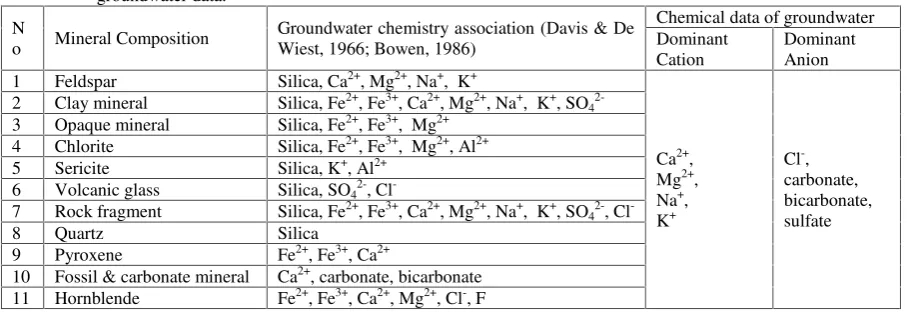
Table 4. Compilation of petrographic data and theoretical groundwater chemistry association with chemical groundwater data.
N
o Mineral Composition
Groundwater chemistry association (Davis & De Wiest, 1966; Bowen, 1986)
10 Fossil & carbonate mineral Ca2+, carbonate, bicarbonate
11 Hornblende Fe2+, Fe3+, Ca2+, Mg2+, Cl-, F
From the table above shows that the mineral constituent of rocks in the study area may play a role in influencing to the composition of groundwater. The table shows the possibilities of supply of chemical elements from the existing mineralogy. Furthermore, the elements / compounds present in groundwater is affected by the level of mineral solubility. Not all minerals can dissolve the elements contained in them.
Silica content in the groundwater supply is obtained from several minerals include feldspar, clay minerals, opaque minerals, chlorite, sericite, volcanic glass, quartz and rock fragments. The process of the dissolution of this mineral can be triggered by the weathering of silicate minerals. According to Appelo & Postma (1996) this weathering process can be explained as follows.
- For the weathering of silicate minerals, changes resulting in the chemistry of groundwater is less visible because of the dissolution of minerals silicate generally run very slowly. This is reflected in some of the examples of groundwater in Babakan and Sunter that showing the amount of content of silicate is not much different.
- Disappearance sequence of silicate minerals reflect differences in dissolution rate. In accordance with the Goldich sequence of weathering (1938, in Appelo & Postma, 1996), feldspar is more easily weathered than quartz, so that feldspar mineral is more possibly supply of silica in groundwater than quartz.
- Effect of silicate weathering on groundwater chemistry is mainly the addition of cations and silica.
- A high silica content in groundwater indicate the active degradation of silicic minerals.
Figure 3. Plotting of groundwater samples in Na silicate mineral stability area (Tardy, 1971, in Lloyd & Heathcote, 1985).
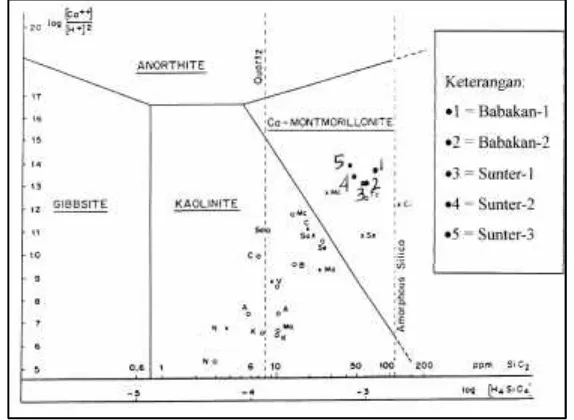
Figure 4. Groundwater samples plotting in anortite and their possibility of weathering to be gibbsite, kaolinite and Ca-montmorilonite (Tardy, 1971, in Appelo & Postma, 1996).
Dissolvedelements enrichmentin groundwater are also characterized by the amount of TDS. The number of TDS is also influenced by the supply of minerals from rocks. The more unstable or soluble mineralsthe greatervalue of TDS in groundwater. The soluble minerals in the area include feldspar and carbonate minerals. The otherv silicic minerals can support the chemical content of groundwater due to leaching that occurs in quite a long time.
During groundwater moves along the flow line from the recharge area (eg Babakan) to the discharge area (Sunter and vicinity), its chemistry changes as a result of various geochemical processes and the availability of the chemical elements in rocks in its path. Thus, the characteristics of the groundwater is heavily influenced by rock.
Volcanic rocks that built the study area aresilicic and volcaniclastic. Leaching in sedimentary rocks will affect the composition of the groundwater for their soluble component as described Matthess (1982) as follows.
a. Groundwater in sandstone.
Groundwater in these rocks TDS depending on the material. Low TDS can be caused by rainwater. Sandstone with soluble carbonate cement resulted in groundwater contain many elements of
Mg2+, Ca2+, Na+, SO42-dan Cl-. b. Groundwater in claystone.
encourage the absorption and ion exchange of Cl or SO42-salt previously
trapped during the deposition and tough it out because of the low flow velocity. In general, the groundwater in these rocks have big enough TDS and silica content and also big enough cation exchange.
Rock hydrogeological conditions in the study area showed permeable layers (sand / sandstone) which in some places is sealed by layers of clay / mudstone. Therefore, the groundwater in the study area is influenced by the ion exchange process that may occur in the clay layer. High TDS content in groundwater at Sunter may be influenced by a variety of rocks traversed during the flow from the groundwater recharge area to the discharge area. Carbonate rocks that consist the basin and Tertiary limestones exposed at the surface can also increase the TDS content of groundwater in Jakarta Groundwater Basin.
5.
Conclusion
Jakarta Groundwater Basin is a Quaternary basincomposed by marine, volcanic, beach and fluviatilsedimentary rocks. Some of the mineral content of the rocksare soluble easilyin groundwater as a result of the weathering process. The content of cations and anions in the groundwater is affected by the composition of the minerals that compose the rock. Elements that easily dissolve in groundwater will dominate the composition of the groundwater.
The number of elements Ca, Na and silica in the groundwater is affected by the weathering of silicate minerals eg feldspar/albite and anortite plagioclase and clay minerals which derived from Na-montmorillonite and Ca-montmorillonite. The number of elements dissolved in groundwater is also controlled by localgeological and geohydrologicalconditions.
Reference
Appelo, C.A.J. & Postma, D. (1996).
Geochemistry, Groundwater & Polution. A.A. Balkema. Netherland.
Disbang DKI Jakarta and LPM-ITB (1997a).Studi Karakteristik Struktur Geologi Sepanjang Lintasan Zonasi Subway. Final Report, unpublished.
Disbang DKI Jakarta and LPM-ITB (1997b).Studi Optimasi Penggunaan Airtanah Wilayah DKI Jakarta. Final Report, unpublished.
Fisher, R.S. & Mullican, W.F. (1997). Hydrochemical Evolution of Sodium Sulfate and Sodium Chloride Groundwater beneath
The Northern Chihuahuan Desert, Trans-Pecos, Texas, USA. Hydrogeology Journal. Vol 5, No. 2. Verlag Heinz Heise GmbH & Co KG. Germany.
Listyani, T. (2004). Pengaruh Karakteristik Kimiawi dan Mineralogi Batuan terhadap Kualitas Airtanah di Daerah Jakarta. Research Report. STTNAS, unpublished.
Maathuis, H., Young, R.N., Adi, S.,
Prawiradisastra, S. (1996). Development of Groundwater Management Strategic in Coastal Region of Jakarta, Indonesia. Final
Report. BPPT & IDRC, Jakarta.
Matthess, G. (1982). The Properties of Groundwater. John Wiley & Sons, Inc. New York.
Soekardi, P. (1986). Geological Aspect of The Aquifer System and The Groundwater Situation of The Jakarta Artesian Basin,
Seminar on Geological Mapping in The Urban Development, Economic and Social Commission for Asia and The Pacific. Bangkok.
Turkandi, T., Sidarto, Agustiyanto, D.A. and Purbo Hadiwidjojo, M.M. (1992).Geological Map of Jakarta and Kepulauan Seribu Quadrangle, Jawa. Scale 1 : 100.000. Geological Research and Development. Bandung.