Elektronika Organik
maulana.lecture.ub.ac.id
maulana.lecture.ub.ac.id
Transistor
Basic Structure of OFET
(a) metal-insulator-semiconductor FET (MISFET); (b) metal-semiconductor FET (MESFET);
Struktur dan Mekanisme OFET
Organic Transistors
OFET
1. Organic electrochemical transistors (OECTs)
2. Organic field effect transistors (OFETs)
3. Electrolyte-gated OFETs
1. Organic Electrochemical
Transistors (OECTs)
• Reversible oxidation and reduction switching
• Electrochemical devices uses both electrons
and ions as charge carriers
PEDOT
+PSS
-+ M
++ e
-PEDOT
0+ M
+PSS
-Conducting
Semi-conducting
Transparent
Deep blue colored
1.1.The dynamic configuration
Structure 1 (one area of conducting polymer)
• Reduction at the negatively biased side of
electrode
• oxidation at the positively biased side of electrode
• Dynamic behavior
-
V
+ M+red ox
M+
M+
-1.2 The bi-stable configuration
Structure 2 (two areas of conducting polymer)
• Reduction at the negatively biased electrode
• Oxidation at the positively biased electrode
• Bi-stable behavior
-
V
+ M+red ox
M+
M+
e- e
-PEDOT+PSS-+ M+ + e- PEDOT0 + M+PSS
Flexible substrates
A flexible organic
electrochemical transistor
The first transistor (1947)
1.3 The three-terminal transistor
Common ground
G VG
S D VD
Structure 2
Structure 1
Pinch-off
• Pinch-off due to the
decrease of charge
carriers at the drain side
of the channel
• Almost all resistance is
located within 100µm of
the channel edge
• Effect of structure 1
Potential
Absorption
Svensson et al. (2003) POLYTRONIC
-Chronoamperometric
response
Nafion
•
Cation conductor, mainly
protons.
•
Forms inverted micelle
clusters with sulphonic acid
groups on the inner surface
•
The micelles are joined
through canals.
•
Charge transport by cations
wandering between –SO
3-groups.
•
Ion conduction increases with
water content due to swelling and
dissociation of ions.
Humidity sensor
• Transducer part: EC-transistor
• Sensitive part: Nafion
G+
G -VG
S D
VD
semiconduct or
gat e
V
Gsour ce
dr ain
insulat or
V
Dconduct ing channel
– – – – – – – – – – – – – – – – – –
I
D2. Organic Field-Effect Transistors (OFETs)
+
-Structure of an Organic Thin Film Transistor
A FET is basically a capacitor, where one plate is constituted by the gate
electrode, and the other one by the semiconductor film. When a voltage
V
gis applied between source and gate, majority carriers accumulate at
the insulator-semiconductor interface, leading to the formation of a
conduction channel between source and drain.
2.1. Current-voltage characteristics
10-12
Gate voltage (V) Vd=-25 V
2.1.1. Transfer characteristic
OFF = No conduction channel
ON = conduction channel open
A potential signal V
gis transformed in a current signal I
d
2Sat urat ion
I
If Vd small, the charge is nearly constant over the channel and the drain current is : No analytical solution, unless the mobility is assumed to be constant.
If Vd > Vg, the channel is pinched-off:
-5 10-6
Drain voltage (V)
2.1.3. Output characteristic
Vg
Linear regime:
For a given Vg>0, the current provided by the conduction channel increases with Vd. The drain electrode inject the charge carriers passing through the channel, the
channel let pass as many charges the drain electrode injects.
Vg controls the doping level N in the conduction channel: large Vg large current Id
No conduction channel
G T
DW and L= channel width and length Ci= capacitance of the insulator layer
μ = field-effect mobility
-5 10-6
Drain voltage (V)
Out put charact erist ic
VgSaturation regime:
For a given Vg, when Vd=Vg, the electrical potential between drain and gate is zero. This destroys the capacitor created between the doped channel and the gate :
pinch off. The channel is then interrupted close to the drain.
2.1.4. How to get the field effect mobility?
G T
D iD
C
V
V
V
L
Z
I
Linear
1) If Vd small, the charge is nearly constant over the channel and the drain current is :
•The channel conductance gd can be expanded to first order:
2) A further step of the method consists of introducing a contact series resistance Rs, which leads to
2.2. Film morphology versus field-effect mobility
The mobility measured with a FET is characteristic for the whole film. It is thus
expected to depend on the quality of the organic film; especially the quality of
the first mono-layers deposited on the insulator
2.2.1. The distribution of charge in the channel
(from Poisson’s equation):
εs = permittivity of the organic
semiconductor
q = electron charge
Ci= capacitance (per unit area) of the insulator
The first molecular layer is important!
Dimitrakopoulos, Adv. Mater. 2002, 14, 99
The channel reduces to the first monolayer
The
organic
TFT
is
a
2D
device
Structural order in the first monolayer is
crucial
Monolayer thickness=
1.25 nm for tetracene
2.2.2. Grain size dependence mobility
Grain
(G) Grain boundary (GB)
Polycrystalline film
0 2000 4000 6000 8000 10000
M
Grain size (nm)
G
1cm
2/Vs
GB
0.01cm
2/Vs
L
GB
10nm
GB
Charge transport in polycrystalline media
divide the material into high (crystal grains) and low (grain boundaries) conductivity region.
As grains and grain boundaries are connected in series: Rtot=RG+RGB
R=ρL/S (ρ=resistivity)
for the same surface SG=SGB (active thickness in the FET), we can write ρL= ρGLG+ ρGBLGB
Conductivity σ= 1/ρ÷ pμe
2.3. Mobility and architecture evolution
Organic material can have a mobility larger than amorphous silicon
Saturation with oligoacene
maybe with another molecule, mobility will go higher…
Discotic liquid crystals
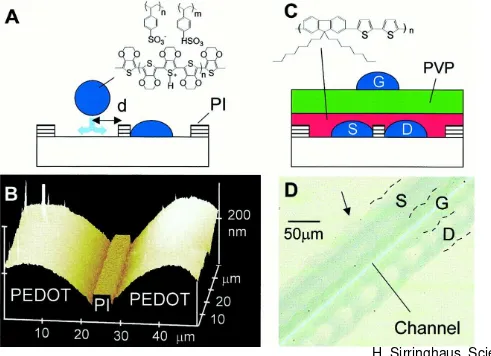
Fig. 1. (A) Schematic diagram of high-resolution IJP onto a prepatterned substrate. (B) AFM showing accurate alignment of inkjet-printed PEDOT/PSS source and drain electrodes separated by a repelling polyimide (PI) line with L= 5 µm. (C) Schematic diagram of the top-gate IJP TFT configuration with an F8T2 semiconducting layer (S, source; D, drain; and G, gate). (D) Optical micrograph of an IJP TFT (L= 5 µm). The image was taken under crossed polarizers so that the TFT channel appears bright blue because of the uniaxial monodomain alignment of the F8T2 polymer on top of rubbed polyimide. Unpolarized background illumination is used to make the contrast in the remaining areas visible, where the F8T2 film is in an isotropic multidomain configuration. The arrow indicates pronounced roughness of the unconfined PEDOT boundary.
Ink-jet Printed OFET’s
A) Transfer characteristics of an IJP TFT with F8T2 aligned uniaxially parallel to the current flow (L= 5 µm, W= 3000 µm)
measured under an N2 atmosphere. Subsequent measurements with increasing (solid symbols) and decreasing (open symbols) gate voltage are shown. (B) Scaling of the output characteristics of IJP F8T2 TFTs normalized by multiplying the drain current by the channel length (dashed lines with open symbols, L= 20 µm; solid lines with solid symbols, L= 5 µm). Subsequent
measurements with increasing (upward triangles) and decreasing (downward triangles) gate voltage are shown.
3. Electrolyte-gated OFETs
Low-cost plastic transistors
•1) For portable applications: compatible with printable
batteries (~1.5V)
Low voltage
• 2) For “one-use” applications: compatible with roll-to-roll
printing techniques
Robustness, printable electrodes, thicker layers
• 3) For logic applications:
Fast response, low capacitive currents
Electric double layer capacitors (EDLCs)
EDLC builds up at the electrodesResistive behavior
Electric double layer capacitor gated OFETs
1. Protons migrate to the gate and form an EDLC
2. Simultaneously, holes injection at Au/P3HT contact and
formation of an EDLC at the P3HT-polyanion interface
0.0 -0.2 -0.4 -0.6 -0.8 -1.0
0.0 0.2 0.4 0.6 0.8 1.0
500 501 502
0 5 10 15 20
Towards the mechanism
A. Field-effect
vs.
Electrochemistry
H+
OFET is ON
Immobile anions
D
S
OFET is OFF
Immobile anions
0 5 10 15 20
Towards the mechanism
A. Field-effect
vs.
Electrochemistry
V
G=0, but not
transistor is ON
Li+
ClO4
-Penetration of anions
S
0.0 -0.2 -0.4 -0.6 -0.8 -1.0
Laterally gated OFET
Hemispherical PE
D S
G
1.1 mm
Organic Electronics, Volume 15,
Issue 3, March 2014, Pages 646-653
Planar water gated organic field effect transistor
Organic Electronics, Volume 12,
Issue 11, November 2011,Pages
1815-1821
Fabrication Method
Organic Electronics,Volume 15, Issue 3,March 2014,Pages 646-653
Design and Fabrication
Organic Electronics, Volume 15, Issue 3, March 2014, Pages 646-653
Organic Electronics, Volume 12,
Issue 11,November 2011, Pages 1815-1821
Organic Electronics, Volume 13, Issue 4, April 2012, Pages 533-540
Transparent and flexible organic field-effect transistor for multi-modal sensing
Organic field-effect transistor and its photoresponse
Organic Electronics, Volume 15,
Issue 5, May 2014, Pages 1050-1055
Organic Electronics, Volume 14,
Issue 12, December 2013,Pages 3453-3459