The Glycemic Index and Organoleptic Test of
Pekawai
(Durio kutejensis
) ChipsLestari, O. A. and *Purwayantie, S.
Faculty of Agriculture, Tanjungpura University,Jl. A. Yani Pontianak, West Kalimantan 78124, Indonesia Email: [email protected]
Diterima 1 Oktober 2017/ Disetujui 10 November 2017
Abstract
Pekawai fruit (Durio kutejensis) is one of the durian species that grows wild in the forests of West Kalimantan. It is known by its yellow-golden orange flesh color. It does not have an unpleasant smell and has non sticky flesh, which makes it attractive and has potential to be healthy snacks such as fruit chips. This research was conducted to find out consumer preference by doing organoleptic and glicemic index test. The glycemic index test has been done by 10 volunteers and organoleptic test conducted using scoring and hedonic methods with 35 panelists. Data analyzed with descriptive method. The results showed that pekawai chips has low glycemic index (12) and were liked by the panelists. The results showed that pekawai fruit, the exotic local fruit from West Kalimantan has big potential to be developed as a snack, which has high economic value and safe to be consumed by diabetics.
Keywords: glycemic index, pekawai, fruit, chips
INTRODUCTION
There are 28-30 durian species in the world, where 20 species grows in Indonesia and 18 species found in Kalimantan. It has different names in different region. In West Kalimantan it is called
pekawai
,likul
in South Kalimantan,pampaken
in Central Kalimantan, andpulu
in Brunei.Pekawai
has unique characteristics. It has soft aroma, attractive yellow to golden orange flesh color, dried flesh texture, sweet taste and has ability long storage. This qualifications of this species gives potential to be developed for export (Santoso andPriyono, 2015). Another unique
qualifications of
pekawai
based on the results of research conducted by Arunget
al
. (2015), it extracts contains antioxidants which can be used for skin lightening. Research aboutpekawai
processed into chips using vacuum frying has been done by Purwayantie and Lestari (2016) which shows an increasing of nutrients value by more than 50%. For further research it is important to do organoleptic test and measurement of glycemic index value prior to the further development ofpekawai
chips. Organoleptic test is important as the first step to measure the level of consumer acceptance beforepekawai
chips enter themarket, while glycemic index value is needed as information for diabetics.
The glycemic index is a blood glucose response to the foods that containing carbohydrate on dose and time (Prijatmiko, 2007). The definition of glycemic index according to BPOM RI (2011) is the increasing rate of blood glucose levels after eating food that contains carbohydrates, the higher the GI, the higher the blood glucose levels. Information of glycemic index value is beneficial for patients with diabetes mellitus. According to The British Diabetics Association in Lestari (2009), diabetics are encouraged to consume at least 50% of the total intake of rice as foods that have a low glycemic index. The current data according to Ibrahim (2016), 20-22 million of the total population in Indonesia are diabetics, with 300-500 thousand of these diabetics are people from West Kalimantan.
MATERIALS AND METHODS
Materials
The research begins with making chips from
pekawai
with vacuum frying process, the continued with organoleptic tests and measuirng glycemic index. The main ingredient we used was ripepekawai
fruit. The other materials are vegetable oil; pp plastic (polypropylene) and aluminum foil packaging. The tools are vacuum fryer with 2 kg capacity, 1.5 kg capacity spinner, glucometer from easy touch brands (GCU), and other tools needed for organoleptic test. This research conducted from January until April 2016. The vacuum frying process has been done in CV. Firjatul Jaya in Rasau Jaya III, Kubu Raya and the Laboratory of Agricultural Technology, Faculty of Agriculture, Tanjungpura University.Methods
a. Producing
Pekawai
Chips (Purwayantie and Lestari, 2016)Pekawai
fruit skin and seeds are separated carefully so the fruit flesh is not damaged. The flesh is splitted intotwo parts and frozen for about 24 hours. Frozen
pekawai
fried using the vacuum fryer at 80-82˚C and pressed -76 cmHg, for 40 minutes. Friedpekawai
chips then drained using spinner for 15 minutes, then packed in plastic foil before the next test.b. Organoleptic test (Adawiyah
et al
., 2007)Organoleptic test was carried out by 35 panelists using a scoring method on two samples of chips, the
pekawai
chips and commercial jackfruit chips. The purpose of this organoleptic test was to determine the level of acceptance ofpekawai
chips comparedwith commercial jackfruit chips. Method used was scoring with scoring scale 1-5 (Table 1), preference level measured by hedonic scale from 1- 7, which score 1 was for strongly dislike, score 2 was for dislike, score 3 was for rather dislike, score 4 was for neutral, score 5 was for rather like, score 6 was for like, and score 7 was for strongly like.
Table 1. Organoleptic Attribute of
Pekawai
Chips Qualityc. Measurement of Glycemic Index (Lestari, 2009)
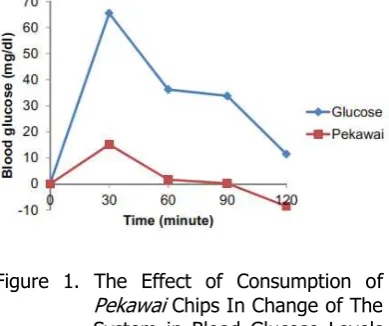
The glycemic index was measured from 10 fasted respondents for at least 10 hours and then blood glucose levels being checked and taken. Then 50 g pure glucose was added to the samples in a glass of water (200ml). Blood glucose levels were checked again after 30 minutes, the next blood glucose levels measured again at intervals of 60, 90, and 120 minutes. The test was repeated seven days later with the
pekawai
chips samples containing 50 g of carbohydrate (carbohydrate levels ofpekawai
chips 69.65%). The results of blood glucose measurement levels is shown in a graphic with time as abscissa (x) and blood glucose levels as ordinate (y). The glycemic index is determined based on comparison of the curve area between pekawai chips with pure glucose.d. Statistical Analysis
The resulting data were tabulated and analyzed descriptively
Quality Attribute
Score
1 2 3 4 5
Color Not yellow (another
yellow)
Light Yellow yellow Rather dark yellow Dark yellow
Aroma No Fruity Aroma
Weak Fruity Aroma
Proper Quantity Fruity aroma
Rather Strong Fruity Aroma
Strong Fruity Aroma Texture Not Crunchy Rather Crunchy Crunchy Very Crunchy Strongly
Crunchy
Taste Plain Less Sweet Sweet Very Sweet Strongly
RESULTS AND DISCUSSION comprehensive comparison chart of
pekawai
chips to produce glucose in glycemic index value are low; 12. Low glycemic index according to BPOM RI (2011) is less than 55. These results showed thatpekawai
chips are safe to be consumed for diabetics in terms of glycemic index.Figure 1. The Effect of Consumption of
Pekawai
Chips In Change of The System in Blood Glucose Levels Every 30 minutes fro 2 HoursGlycemic index value from Malaysian durian reported by Robert
et al
. (2008), showed it has low glycemic index; 49 than any other fruit whic is melon 55, papaya 58 and pineapple 82. Based on these researches, processingpekawai
into chips can lower the glycemic index value. The decline in the value of the glycemic index may be due to increasing fiber and fat levels of the chips. Reported by Purwayantie and Lestari (2016) reported that the fiber increase up to 2 times (5.55% to 11.20%) and the fat almost 4 times (2.55% to 9.77%) frompekawai
chips.This is supported by Astawan and Wresdiyati (2004) statement, the higher the consumption of food that contains fiber (guar gum and pectin) can lower blood glucose. Durian and pekawai are a similar fruits (one species of Durio) which contained antioxidant and beta-carotene
(Charoensiri
et al
. 2009; Arunget al
. 2015). Ketsa and Daengkanit (1999) reported that the levels of water soluble pectin and polygaracturonase and pectinesterase activity increased in ripe durian flesh than unripe durian. Both enzymes responsible for the pectin formation inside. Therefore, with similar chemical properties of the fruits, it is possible thatpekawai
chips also contained pectin. So that, the higher pectin level in chips increased the fibers. The other caused is due to the high fat content. According to Rimbawan and Siagian (2004), it slowing down the rate of gastric emptying process so the food digestion process in quality to commercial jackfruit chips (Table 2). It is based on findings from the attribute of value quality of both fruit chips has the same level of preference (6 likes). There are unique properties ofpekawai
chips from the findings based on the attributes of organoleptic test (color and aroma).Table 2. The Result of Scoring and Hedonic Test from
Pekawai
Chips and Commercial Jackfruit Chips QualityAttribu te
Pekawai
Chips Commercialresearch by Jiang
et al
. (1998), contain four main ccomponents, they are; 1, 1-diethoxyethane, ethyl 2-methylbutanoate, ethyl (Z) -4-decenoate and acetoin.The texture (crunchiness) and taste (sweetness) quality of both chips are same.
Pekawai
chips crunchy texture is caused by lower levels of water content. The study conducted by Sipahutar (2008), showed that the lower the levels of water content in fruit chips, the crunchier the products. The sweetness taste ofpekawai
fruit is the natural sweetness from ripe fruit, without sweeteners added. Other researchs show that the amount of sugar frompekawai
ranged from 11.7 to 18.95 % are higher than other durian species (2.10 to 14.5%). So that thepekawai
chips taste based on organoleptic test is sweeter (Belqis et al., 2016). The sweet taste of durian will be more increase due to it ripeness level cused by the highest of sucrose followed by glucose, fructose and maltose (Belgiset al
., 2016). Shaffiqet al
. (2013) explained too thatDurio kutejensis
have higher value of sucrose` 13%.Conclusion
This is the first report of glycemic index test out of fruit chips in Indonesia. The results of the research showed that the
pekawai
chips have low glycemic index value; 12. Consumer preference is 6 (Like). The advantage ofpekawai
chips are it has high value of consumer preference and low blood glucose so it has potential to be developed as snack for diabetics. Further studies are needed to determine pectin, amilosa, amilopectin and sugar profile with HPLC ofpekawai
flesh to support the chemicals of fiber fromDurio kutejensis
which has potential to become a healthy chips.References
Adawiyah DR, Waysima and Indrasti D. 2007. Guidance of Sensory Evaluation Practice. Faculty of Agricultural Technology, Institut Pertanian Bogor, Indonesia
Arung ET, Suwinarti W, Hendra M, Supomo, Irawan WK, Putri DCN, Eroglu HA, Kim Y, Shimizu K and Ishikawa H.
2015. Determination of
antioxidant and
anti-melanogenesis activities of indonesia lai,
Durio kutejensis
[Bombacaceae (Hassk Becc)] fruit extract. Tropical Journal of Pharmaceutical Research 14(1): 41-46.Astawan M and Wresdiyati. 2004. Healthy Diet with Fiber Foods. Tiga Serangkai, Solo, Indonesia.
Belgis M, Wijaya CH, Apriyantono A, Kusbiantoro B and Yuliana ND. 2016. Physicochemical differences and sensory profiling of siz lai (
durio kutejensis
) and four durian (Durio
zibethinus
) cultivarsindigenous indonesia.
International Food Research Journal 23(4): 1466-1473.
BPOM RI. 2011. The National Agency of Drug and Food Control. NO. HK.03.1.23.11.1.09909 Tahun 2011 about Supervision Claims in The Labeling and Advertising of Processed Food.
Charoensiri R, Kongkachuichai R, Suknicom S. and Sungpuuag P. 2009. Beta-carotene, lycopene and alpha-tocopherol contents of selected thai fruits. Food Chemistry 113: 202-207.
Ibrahim N. 2016. IDI: 300-500 Thousand of Peoples in West Kalimantan Suffer from Diabetic. Retrived on April 1,
2016 from Website:
http://thetanjungpuratimes.com/2
016/04/16/idi-300-500-ribu-warga-kalbar-menderita-diabetes/
Ketsa S and Daengkanit T. 1999. Firmness
and activities of
Lestari OA. 2009. Characterization of physicochemical and evaluation nutritional biological values of dried corn noodles subtituted with modified corn starches. Bogor, Indonesia: Agricultural Institute of Bogor, MSc thesis.
Prijatmiko D. 2007. The glicemix index from one hour postprandial staple food, rice, corn and potato. Cermin Dunia Kedokteran34: 285-288.
Purwayantie S. and Lestari OA. 2016. Pekawai fruit chips nutritional potentional, the exotic fruits from west kalimantan. In Zain Z, Bariyah N, and Astiani D. (Eds). Proceeding of National Seminar on Science and Technology Application, p. 379-383.
Pontianak: Tanjungpura
University, West Kalimantan, Indonesia
Rimbawan. and Siagian A. 2004. Glicemix Index of Food. Jakarta: Penebar Swadaya.
Robert DA, Ismail A, Winn T, Thomas and Wolever. 2008. glycemic index of common malaysian fruits. Asian Pacific Journal of Clinical Nutrition 17(1): 35-39.
Santoso PJ, and Priyono A. 2015. The potential and status development of the three durian family: lai, mandong, and keratungan. Iptek Hortikultura 11: 31-37.
Shaffiq SMA, Sidik BJ, Harah ZM, and Devi RS. 2013. Marketable wild fruits of sarawak, borneo: their mode of consumption, uses and sugar profiles. Indian Journal of Traditional Knowledge 12: 195-201.
Sipahutar SR. 2008. Humectant
Concentration Effect and Storage Time on Durian Seed (
Durio
zibethinus
Murr) Chips.Departement of Agricultural Technology, USU Repository, Indonesia