Antifungal Activity of Piper caninum against Pyricularia oryzae
Cav. the Cause of Rice Blast Disease on Rice
Ni Luh Suriani1 Dewa Ngurah Suprapta2* I Made Sudana2 I.G. Rai Maya Temaja2
1.Doctoral Program on Agricultural Science, School of Postgraduate, Udayana University, Jl. PB. Sudirman Denpasar Bali Indonesia
2.Laboratory of Biopesticide, Faculty of Agriculture Udayana University Jl. PB. Sudirman Denpasar, Bali Indonesia
*Corresponding author e-mail : [email protected]
Abstract
Rice blast caused by Pyricularia oryzae Cav.is one of important and destructive disease on rice in most areas where susceptible rice cultivars are grown. This study was done in order to find alternative measure to control the disease by using leaf extract of Piper caninum Blume. Antifungal activity of P. caninum against P. oryzae
was done under laboratory condition on potato dextrose agar (PDA) medium. Results of this study showed that the crude extract of P. caninum exhibited a very strong inhibitory activity against P. oryzae with diameter of inhibition zone by 44 mm. Minimum inhibitory concentration (MIC) of this extract was 0.5% (w/v). Treatment with leaf extract of P. caninum significantly (P<0.05) inhibited fungal radial growth, spores formation, and biomass formation.
The growth inhibition resulted from this extract is due to the lysis of fungal cells indicated by the zize of mycelia, in which the size of mycelia treated with extract is obviously smaller than that of control. It is necessary to purify and identify the substances in the leaf extract of P. caninum that responsible the most for the antifungal activity against P. oryzae. In addition, a field trial is necessary to be done to evaluate the effectiveness of the leaf extract of P. caninum to control rice blast disease under field condition.
Keywords : Piper caninum, rice blast disease, antifungal activity, cell lysis
1. Introduction
Rice blast disease caused by Pyricularia oryzae Cav. is one of important diseases on rice (IRRI, 2010). The disease can cause two symptoms viz. leaf blast and neck blast. The leaf blast is characterized by the white to gray green lesions or spots with darker borders produced on the leaf. The old lesions are elliptical or spindle-shaped and whitish to gray with necrotic border. The neck blast is characterized by the dark brown lesion on the basal of the panicle neck that make it cannot support the panicle. P. oryzae can infect the rice plant at various growth stage (Yolanda, 2013). Sometime the fungus can also infect the grain (Tebeest et al., 2007). In Indonesia, the blast disease is one of important factors that cause the rice yield losses. In 2011, the blast disease occurred in 2,208 ha of paddy field and increased to become 3,649 ha in 2012 with the yield losses varied from 50 to 90%, particularly on susceptible rice varieties (Nugroho et al., 2013).
It is difficult to control the blast disease, but the use of resistant varieties in rotation is done to anticipate a quickly appearance of the new race of P. oryzae (Utami, 2006). The appropriate dose of fertilizers such as N, P and K may reduce the incidence of rice blast disease (Suwandi et al., 2012). However, the use of synthetic chemical fungicides is commonly implemented by the farmers in Indonesia (Tandiabang, 2007). It has been known that the improper use of synthetic chemical fungicide have caused various adverse effects not only to the users but also to the environment (Suprapta, 2014).
The use of extracts of higher plants to control fungal diseases on agricultural crops have been reported by several researchers (Suprapta and Khalimi, 2012; Suprapta and Khalimi, 2009; Zain et al., 2012; Suprapta and Ohsawa, 2007; Arya et al., 2001). The use of plant extract as botanical fungicide is considered as environmentally friendly, but their use is still limited in Indonesia (Rahmawati and Corlina, 2009). Botanical pesticides containing active compounds such as phenol, saponin, alkaloid, quinone, xanthone that easily degraded in the environment (Suprapta, 2014), and when they are exposed to the sunlight they will not leave the residue in the environment (Thamrin et al., 2005). The extracts of Piper betle and Alpinia galanga have been tested to control the rice blast disease and could reduce the neck blast by 16% (Tandiabang, 2007). The extract of P. betle containing saponin, flavonoid and polyphenol, while the extract of A. galanga containing metoxycinamal, benzyl benzoate and anthorhizal (Tandiabang, 2007).
2. Methods 2.1. Extraction
The leaves of P.caninum Blume was collected from Senganan Village, Penebel District, Tabanan Regency, Bali
Indonesia. The leaves of number four to six from the tip were taken and washed with clean wáter to remove the surface contaminants. The leaves were chopped off into small size and air dried for three days under room temperature. The air dried leaves were then powdered using blender. The powder (100 g) was soaked in pro-analysis grade metanol (1,000 ml) for 72 h in the dark under room temperature. Filtration using Whatman No.1 filter paper was done to separate the debris and fíltrate. Extraction with the same procedure was repeated three times and all filtrates were combined and subjected to evaporation using vaccum rotary evaporator (Iwaki, Tokyo) at 40oC to obtain the crude extract. This crude extract was used for further test.
2.2. Level of antifungal activity and minimum inhibitory concentration test
The crude extract of P.caninum was tested for its antifungal activity against P. oryzae Cav. the cause of rice blast disease. Spore’s suspension of P. oryzae (200 l) was poured onto Petri dish and added with 10 ml of PDA (potato dextrose agar) medium and shaken horizontally gently to mix the spore’s suspension and the medium. Two diffusion wells were made on a Petri dish with cork borer (5 mm diam.). A 20 l crude extract of
P. caninum was put into the well. The formation of inhibition zone around the well was observed. The diameter of inhibition zone was used to determine the level of inhibitory activity. According to Ardiansyah (2005), when the diameter of inhibition zone ≥ 20 mm means the inhibitory activity is very strong, between 10–20 mm : strong, between 5-10 mm: intermediate, and < 5 mm: weak.
Determination of Minimum Inhibitory Concentration(MIC) was also done based on this method using
the crude extract at concentration (w/v): 0.0%, 0.1%, 0.2%, 0.3%, 0.4%, 0.5%, 0.6%, 0.7%, 0.8%, 0.9%, 1.0%, 2%, 3%, 4% and 5%.
2.3. Test for inhibitory activity against fungal radial growth
Five extract concentrations of P. caninumviz. 0%, 0.5%, 1.5%, 2.5%, and 3.5% (w/v) were tested for antifungal activity on radial growth of P. oryzae on PDA medium. The extract was put in the center of Petri dish and then was added with 10 ml melted PDA medium. The volume of the extract that was added into Petri dish was adjusted according to the concentration tested. Five Petri dishes were prepared for each concentration. The Petri dishes were shaken gently to allow the extract to distribute evenly in PDA medium. A mycelia plug (5 mm diam.) of P. oryzae taken from the edge of a 5-day old culture was put in the center of PDA. The cultures were incubated for seven days in the dark under room temperature. The diameter of fungal colony was measured every day (Astiti and Suprapta, 2012). The inhibitory activity to the radial growth was determined according to the following formula:
Where
IR= inhibitory activity against radial growth in percent.
DC = diameter of fungal colony without extract treatment (control). DT = diameter of fungal colony treated with extract.
2.4. Test for inhibitory activity against biomass formation
2.5. Test for inhibitory activity against spore’s formation
Spores of P. oryzae were harvested from cultures maintained on slant PDA using fine brush and sterile distilled water. The suspension was sieved through No.2 Whatman filter paper to separate the spores and mycelia or hypae. Potato dextrose broth medium (10 ml) was put into test tubes with various concentrations of extract of C. burmanniviz. 0% (control), 0.5%, 1.5%, 2.5%, and 3.5%(w/v). Five tubes were prepared for each concentration.
The cultures were incubated in the dark under room temperature (28+2oC) for five days. The number of spores
was counted using hemocytometer under light microscope. The inhibitory activity on spore’s formation was calculated according to the following formula (Astiti and Suprapta, 2012).
Where
IS = inhibitory activity against spore’s formation dc = spore’s density on control
dt = spore’s density with extract treatment
2.6. Ultra structural observation using Scanning Electron Microscope
The procedure developed by Kawuri et al. (2012) was done in this study. A 200 l spore suspension of P.
oryzae (1,3 x 10⁶ spores/ml) was mixed with melted PDA on a Petri dish. Two diffusion wells side by side were made on PDA medium using cork borer (5 mm diam.). Into respective well, 20 l of P. caninum extract at concentration 0.5% (w/v) was added. Diffusion well added with sterile distilled water was used as control. The cultures were incubated in the dark under room temperature for five days. The colonial plugs were taken from the edge of inhibition zone using cork borer to be used as specimens. The specimens were fixed in 2% glutaraldehyde in 0.1 M sodium cacodylate buffer (pH 7.2) at 4oC for 8 h and then at room temperature for 1 h. The fixed specimens were rinsed in sodium cacodylate buffer (pH 7.2). The specimens were post fixed in 1% osmium tetroxide in 0.1 M cacodylate buffer at room temperature for 5 h. Following post fixation, the specimens were rinsed in distilled water, and then, the specimens were dehydrated in a graded series of ethyl alcohol. After dehydration, specimens were freeze cutting using freeze cutting device (TF-2, Eiko, Japan). After cutting, specimens were replaced by t-butyl alcohol, and then vacuum freeze-drying (ID-2, Eiko, Japan). The dried specimens were mounted on stubs and coated with osmium tetroxide (OPC 60A, Filgen, Japan) and platinum (JUC-5000, JEOL, Japan). The coated specimens were observed with a SEM (JSM-6701F, JEOL, Japan) with 5 kV of acceleration voltage.
3. Results and Discussion
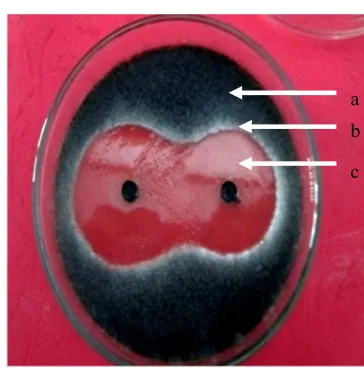
Extract of P. caninum Blume showed a very strong antifungal activity against P. oryzae on PDA medium as shown in Fig. 1. The diameter of inhibition zone surrounding the diffusion well was 44 mm (Fig.1), which is categorized into very strong according to Ardiansyah (2005). The minimum inhibitory concentration (MIC) of this extract was 0.5% (w/v). Other researcher proved that the dichloromethane extract of Desmos chinensis
could inhibit the spore formation and the growth of hypae of P. oryzae with MIC by 31.2 µg/ml (Maporn et al., 2013). In the present study we found that the leaf extract of P. caninum significantly (P<0.05) inhibited the diameter of fungal colony, spore density, and biomass formation as presented in Table 1. Treatment with extract of P. caninum at concentration 0.5% (w/v) inhibited the fungal growth by 11.83%, and treatment witf extract at concentration 3.5% inhibited the fungal growth by 36.7%. Similar inhibitory activity was shown against spore density, where treatment with extract at concentration 0.5% inhibited the spore density by 21.8%, where treatment with extract at concentration 3.5% inhibited the spore density by 95.8%. No biomass formation occurred on cultures treated with extract of P. caninum at concentration 2.5% and 3.5%. This data indicated that the biomass formation of P. ozryzae is the most sensitive stage against the extract of P. caninum. Several previous studies reported the antifungal activities of the plant extracts (Sena et al., 2013; Manjappa, 2013; Kamalakannan et al., 2001; Suprapta et al., 2001; Suprapta and Khalimi, 2009; Suprapta et al., 2005; Astiti and Suprapta, 2012).
Figure 1. Growth inhibition of leaf extract of P. caninum against P. oryzae on PDA medium. a. P. oryzae, b. Inhibition zone, c. Diffusion well filled with extract.
Sena et al. (2013) reported that the crude extract of Epicoccum sp. could inhibit the spores formation and mycelial growth of P. oryzae with inhibitory activity respectively by 42.52% and 97.7%. Ethanolic extract of chromoluena odorata L. inhibited the mycelia growth of P. oryzae at concentration 2.5% with inhibitory activity by 70,6% (Manjappa, 2013). The leaves extracts of Prosophis juliflora and Ziziphus jujuba could inhibit the growth of P. oryzae because they contain tannin and phenol (Kamalakannan et al., 2001). Rhizomal extract of Alpinia galanga and the leaf extract of Carica papaya showed a strong inhibitory activity against the growth of Ceratocystis sp. the cause of post harvest fruit rot disease on Salacca edulis (Suprapta et al., 2001). Rhizomal
extract of Alpinia galangal obviously inhibited the growth of Fusarium oxysporum on PDA medium (Suprapta
and Khalimi, 2009; Suprapta et al., 2005), while the leaf extract of Tectona grandis L.f. could inhibit five species of fungi viz. Arthrinium phaeospermum, Nigrospora sp., Aspergillus flavus, Acremonium butyri, and
Penicillium citrinum the cause of wood decay of Albizia falcataria (Astiti and Suprapta, 2012).
The leaf extract of Piper betle, the leaf extract of Psidium guajava, and rhizomal extract of Alpinia galanga, effectively suppressed the rice blast(neck blast) under field condition respectively 3.3%; 4.7%, and 2.7% (Plantus, 2010). The crude extract of P.betle leaf was also proven to inhibit the growth of colony of
Fusarium oxysporum f.sp.vanilla on PDA medium and inhibited the spore formation on potato dextrose broth medium (Suprapta dan Ohsawa, 2007). Salehan et al. (2013) reported that ethyl acetate extract of Cosmos caudatus could suppress the spore formation of Phytophthora palmivora, the cause of black pod disease of cocoa. Other antifungal study was done by Alu et al. (2013), and found that the leaf extract of Azadirachta indica effectively suppressed the growth of colony of Colletotrichum capsici the cause of anthracnose diase on chili pepper. Zetzer et al. (2004) reported that the leaf extract of P. caninum showed antimicrobial activity against Bacillus cereus, Staphylococcusaureus, and Streptococcus pneumonia.
According to Maj et al. (2004) P. caninum containing antimicrobial and antioxidant substances either in its leaf or stem. The leaf extract of this plant showed antimicrobial activity against Staphylococcus aureus,
Bacillus subtilis, Pseudomonas aeruginosa, Pseudomonas putida, Escherichia coli, Candida albicans, and
Aspergillus niger. The plants belong to the genus Piper in general containing substances such as evalonik acid, cinanamoyl amides, alkhyl amides, aristolaktam, flavones, dhidroflavone, dehidrochalcone, dehidroflavonoid (Maj et al., 2004). According to Tanjung (2013), the plant from Genus Piper showed antibacterial, antifungal, antioxidant, insecticidal, and allelopathic activities.
Tabel 1. Inhibitory activity of the leaf extract of P. caninium against the diameter of colony, spore density and biomass formation of P. Oryzae
Extract concentration (%, w/v
Diameter of colony (mm) Spore density
(spores/ml x 104)
Biomass (g/100 ml)
0 (Control) 8.60a* 23.80a 0,32a
0.5 7.60b(11.6%)** 18.6b (21.8%) 0.12b (62.5%)
a
b
showed that there was a difference of the surface and size of the mycelia of P. oryzae without and with treatment of extract of P. caninum as shown in Fig. 2. The size of mycelia with extract treatment was obviously smaller than that of mycelia without extract treatment (control). This condition is probably due to the lysis of mycelia cells caused by active substances in the leaf extract of P. caninum.
According to Maj et al. (2004) the antifungal activity of the leaf extract of P. caninum was resulted from a substance i.e. 4,5-dioxoaporphine alkaloid cepharadione A. Sena et al. (2013) reported that the crude extract of Epicoccum sp. could destroy the hypae and spore of Magnoporthe oryzae (P. oryzae) the cause of rice blast disease.
Figure 2. Photographs of mycelia of P. oryzae taken through scanning electron microscope (arrows) a. Control (mycelia without extract treatment). b. Mycelia with extract treatment. Bars = 5 m.
Observation through SEM showed that the size of hypae and spore were smaller when compared to control because of lysis of the cells. Several mode of actions may happened resulted from antifungal substances from plants such as the alteration of cell permeability, degradation of cell wall, inhibition of enzymatic activities in the fungal cells that in turn affected the cell membrane permeability (Semangun, 2006). This phenomenon occurred on the leaf extract of Piper beltle that contain essensial oil where 55% of them is phenol. This substance actively precipitated the protein which resulted in disintegration of fungal cell membrane. The surface tension of cell membrane is reduced and resulted in cell lysis. As a consequence, the growth of a fungus is suppressed (Rachmawati and Korlina, 2009). Present study revealed that the leaf extract of P. caninum showed a remarkable antifungal activity against P. oryzae through lysis of mycelial cells of P. oryzae, suggested that this extract potenally can be used as an alternative agent to control rice blast disease. The field research is needed to evaluate the effectiveness of the extract of P. caninum to control rice blast disease. Which of substances responsible for the antifungal activity against P. oryzae is still unclear. A further study to purify and indentify substances responsible for the antifungal activity is necessary to be done.
4. Conclusion
The leaf extract of P. caninum showed a very strong antifungal activity against P. oryzae, the cause rice blas
disease under in vitro condition on PDA medium. The mínimum inhibitory concentration (MIC) of this extract
was 0.5% (w/v). This extract significantly inhibited the growth of colony, spore density and biomass formation of P. oryzae. The growth inhibition resulted from this extract is due to the lysis of fungal cells indicated by the size of mycelia treated with extract was obviously smaller than that of control. It is necessary to purify and identify the substances in the leaf extract of P. caninum that responsible the most for the antifungal activity against P. oryzae.
Acknowledgement
Authors would like to express our great appreciation to Khamdan Khalimi of the Laboratory of Biopesticide, Faculty of Agriculture Udayana University for technical assistance during the study.
References
Ardiansyah, 2005. Daun beluntas sebagai bahan anti bakteri dan anti oksidan.[Cited on 27 October 2007]. Available from: http://www.berita_iptek.com
Astiti, N.P.A. and D.N. Suprapta. 2012. Antifungal Activity of Teak (Tectona grandis L.F) Leaf Extract Against b
a b
b
Arthrinium Phaeospermum (Corda)M.B. Ellis. The Cause of Wood Decay on Albizia falcataria
(L.)Fosberg. J.ISSAAS., 18 (1) :62-69.
Djunaedy, A. 2009. Biopestisida sebagai Pengendali Organisme Pengganggu Tanaman (OPT) yang Ramah Lingkungan. J.Embryo, 6(1):88-95.
Gomez, K.A. dan A.A. Gomez. 2007. ProsedurStatistik untuk Penelitian Pertanian. Edisi kedua: Penerbit Univeristas Indonesia (UI-Press).
Gouramanis, G.D., 1997. Biological and Chemical Control of Blast Deaseae (Pyricularia oryzae) in Northern Greece. J.Chataigner, 15(3): 61-68.
Hajano, J., M. Lodhi, M. Phatan, M.A. Khanzada, and G.R. Shah. 2012. In-Vitro Evaluation of Fungicides Plant
Extracts Bio- Control AgentsAgainst Rice Blast Phatogen Magnophorthe oryzae Couch. Pak. J. Bot.,
44(5): 1775-1778.
IRRI. 2010. Rice Blast. Rice Science For a Better World. (Disitir 10 Nopember 2013). Available frm : http://www.knowledgebank.irri.org.
Kamalakannan, A., V. Shanmugan, S. Suhendran, and R. Srinivasan. 2001. Antifungal Properties of plant extracts Against Pyriclaria oryzae, Rice Blast Phatogen. Indian Pytopath., 54(4):490-492.
Maj, S.H. Jones, R. Marshall, R.K. Johnson, and S.M. Hecht. 2004. A DNA-damaging oxoaporphine alkaloid
from Piper caninum. Departments of Chemistry and Biology.University of Virginia. USA.
Maporn, P., P. Pai, V. Petcharat,S. Chuenchit, S. Chakthong, Y. Yeharat, and P. Supayang. 2012. Desmos hinensis: A New Candidate as Natural Antifungicide to Control Vice Diseases. Industrial Crops and Products, 4 (2): 324-333.
Manjappa, K. 2013. Evaluation of Antifungal Properties of Eupatorium (Chromolaena odorata L.) Plant Exstract
AgainstPyricularia oryzaeCausing Blast Disease in Rice Crop. Asean Journal of Pharmaceutical Science and Technology 5(1) 79-81.
Nugroho, S., A. Estiati, D. Astuti, B. Rina, H. Lestari, and A. Situmorang. 2013. Perakitan Padi Transgenik Lokal Terhadap penyakit Tunggro dan Blas Menggunakan Pendekatan Over Ekspresi Faktor Transkripsi dan Gene Silencing. Lembaga Ilmu Pengetahuan Indonesia. Bogor Indonesia.
Plantus. 2010. Fungisida nabati Pengendali Penyakit Blas. (Cited on 17 June 2013). Available from:http//www.Situshijau.co.id.
Purnomo and R. Asmarayani. 2004. Hubungan Kekerabatan Jenis Piper Berdasarkan Morfologi dan Kandungan
Minyak Atsiri di Jogjakarta. Jurnal Biodiversitas, 6 (1): 12-16.
Rachmawati, D dan Korlina, E. 2009.Pemanfaatan Pestisida Nabati untuk Mengendalikan Organisme Pengganggu Tanaman. Depatemen Pertanian. Balai Pengkajian Teknologi Pertanian Jawa Timur.(Cited 2013 September 8). Available from:http// jatim. litbang. deptan.Go.id.
Semangun, H. 2006. Pengantar IlmuPenyakit Tumbuhan. Yogyakarta.Gadjah Mada University Prees.
Sena, A.P.A., A. Amanda, Chaibub, V.C.B. Marcio, Cortes, G.B. Siva, V.L.S. Loho, A.S. Prabu, M.C.C. Filippi, and L.G. Arauj. 2013. Increased Enzymatic Activity in Rice Leaf Blast Suppression by Crude Extract of Epicoccum sp. International Journal of Trop. Plant Pathol., 38 (5): 23-42.
Setzer, W.N., M.C. Setzer, R.B. Bates, P. Nakkiew, B.R. Jackes, L. Chen, M.B. Ferrin, and E.J. Meehan. 2004.
Antibacterial hydroxycinnamic esters from Piper caninum from Paluma, North Qeensland, Australia.
Salehan, N.M., S. Meon and I.S. Ismail. 2013.Antifungal Activity of Cosmos caudatus Extracts Aganst Seven Economically Important Plant Phatogens. International Journal of Agriculture and Biology, 15(51): 864-870.
Suprapta .D.N. and K. Khalimi. 2011. Induction of Plant Resistence Against Soybean Stunt Virus Using Some
Formulation of Pseudomonas Aeruginoza. J. ISSAAS., 17(1): 98-105.
Suprapta, D.N., M. Sudana, and N. Arya. 2001.Application of Plant Extracts to Control Ceratocystis Fruit Rot in Snake Fruit (Salacca edulis).J. ISSAAS., 7:10-16.
Suprapta, D.N., M. Sudarma, N. Arya, and K. Ohsawa. 2005. Plant Extracts to Control Wilt Desease in Banana Seedlings. J.ISSAAS., 11(2): 84-90.
Suprapta,D.N and K. Ohsawa. 2007. Fungicidal activity of Piper Betle extract against Fusarium Oxysporum f. sp. vanilla. J. ISSAAS., 13:40-46
Syakir, M. 2011. Status Penelitian Pestisida Nabati.Seminar Nasional Pesnas IV. Balitbang Pertanian. Jakarta. Tandiabang, J. and S. Pakki. 2007. Penyakit Blas (Pyricularia grisea) dan Strategi Pengendaliannya pada
Tanaman Padi.Prosiding Seminar Ilmiah PEI dan PFI.VVIII. Komda Sul-Sel.
Tanjung ,W.A.S. 2013. Obat Tradisional dan Metabolit Sekunder. Fakultas Biologi UGM. Yogyakarta.
Tawan,.C.S., I.P. Ipor, D.H. Pashihuddin, and Sani. 2002. A Brief account the wildpiper (piperaceae) of The
crecker ranga.Sabah. Asean Review of Biodiversity and Environmental Concervation (AEBEC)
July-September 2002.
Tebeest, D.O. and D. Michael. 2012. Rice Blast.The Plant Health Instructor.University of Arkansas.
Utami D., S. Mueljopawiro, A. Aswidinnor, I. Hanarida, and Reflinur. 2006. Pewarisan Ketahanan Penyakit Blas (Pyricularia grisea Sacc.) pada Persilangan Padi IR64 dengan Oryza rufipongon Griff. Jurnal Agrobiogen, 1(1):1.6.
Utami, D., A.D. Ambarwati, A. Apriana, A. Sisharmini, I. Hanurida, and S. Mueljopawiro. 2010. Keragaman Sifat Tahan Penyakit Blas dan Agronomi Populasi Silang Balik dan Haploid Ganda Turunan IR64 dan
Oryza rufipogon. Buletin Flasma Nutfah, 16(2): 90-95.