IDEA GROUP PUBLISHING
Policies and Actions in
Modern Integrated
Systems
Maria Grazia Fugini, Politecnico di Milano, Italy
Managing Editor: Amanda Appicello Development Editor: Michele Rossi Copy Editor: Alana Bubnis
Typesetter: Sara Reed
Cover Design: Lisa Tosheff Printed at: Yurchak Printing Inc.
Published in the United States of America by
Idea Group Publishing (an imprint of Idea Group Inc.) 701 E. Chocolate Avenue, Suite 200
Hershey PA 17033 Tel: 717-533-8845 Fax: 717-533-8661
E-mail: [email protected] Web site: http://www.idea-group.com and in the United Kingdom by
Idea Group Publishing (an imprint of Idea Group Inc.) 3 Henrietta Street
Covent Garden London WC2E 8LU Tel: 44 20 7240 0856 Fax: 44 20 7379 3313
Web site: http://www.eurospan.co.uk
Copyright © 2004 by Idea Group Inc. All rights reserved. No part of this book may be reproduced in any form or by any means, electronic or mechanical, including photocopy-ing, without written permission from the publisher.
Library of Congress Cataloging-in-Publication Data
Information security policies and actions in modern integrated systems / Mariagrazia Fugini, editor, Carlo Bellettini, editor.
p. cm.
ISBN 1-59140-186-0 (hardcover) -- ISBN 1-59140-291-3 (pbk.) -- ISBN 1-59140-187-9 (ebook)
1. Computer security. 2. Integrated circuits. I. Fugini, Mariagrazia, 1957- II. Bellettini, Carlo,
QA76.9.A25I541545 2004 005.8--dc22
2003022606 British Cataloguing in Publication Data
Policies and Actions in
Modern Integrated
Systems
Table of Contents
Preface ... vi
Section I: Cryptography Chapter I
Architectures for Advanced Cryptographic Systems ... 1
Guido Bertoni, Politecnico di Milano, Italy
Jorge Guajardo, Infineon Technologies AG, Germany Christof Paar, Ruhr Universität Bochum, Germany
Chapter II
Digital Certificates and Public-Key Infrastructures ... 6 4
Diana Berbecaru, Politecnico di Torino, Italy Corrado Derenale, Politecnico di Torino, Italy Antonio Lioy, Politecnico di Torino, Italy
Chapter III
Smart Card Applications and Systems: Market Trend and Impact on Other Technological Developments ... 9 8
Chapter IV
A Flexible Authorization Framework ... 149
Duminda Wijesekera, George Mason University, USA Sushil Jajodia, George Mason University, USA
Chapter V
Enforcing Privacy on the Semantic Web ... 177
Abdelmounaam Rezgui, Virginia Tech, USA Athman Bouguettaya, Virginia Tech, USA Zaki Malik, Virginia Tech, USA
Section III: Data Distribution and Dissemination on the Net Chapter VI
Secure Data Dissemination ... 198
Elisa Bertino, Università degli Studi di Milano, Italy Barbara Carminati, Università degli Studi di Milano, Italy Elena Ferrari, Università degli Studi dell’Insubria, Italy
Chapter VII
Multimedia Security and Digital Rights Management Technology .. 230
Eduardo Fernandez-Medina, Universidad de Castilla-La Mancha, Spain
Sabrina De Capitani di Vimercati, Università di Milano, Italy Ernesto Damiani, Università di Milano, Italy
Mario Piattini, Universidad de Castilla-La Mancha, Spain Pierangela Samarati, Università di Milano, Italy
Section IV: Service Oriented Computing Frameworks Chapter VIII
Data and Application Security for Distributed Application Hosting Services ... 273
Ping Lin, Arizona State University, USA
.NET ... 317
Eduardo B. Fernandez, Florida Atlantic University, USA Michael Thomsen, Florida Atlantic University, USA Minjie H. Fernandez, Florida Atlantic University, USA
Preface
We are witnessing a rapid growth of technological and business interest towards distributed computing environments, also named Global or Integrated Computing environments. The features of these environments include mobility, open-endedness, heterogeneity of data and applications, mobility of computing entities on a variety of devices, network systems, and logical and physical inter-connections channels. In these systems, various resources (applications, data and repositories, as well as user contexts scenarios) demand to be merged under common interoperability paradigms, possibly based on standards and com-mon policies, as well as on enabling technologies for interconnection, such as web Services, internetworking connection technologies, or distributed code and data management. Heterogeneity is a key factor in interconnection: the ability to manage it means the possibility to manage distributed and differently struc-tured and managed resources under unifying paradigms for computing resources and networks.
In this scenario of integrated environments, the ability to create and man-age large shared systems in a secure manner is an area that has received atten-tion in various ways, from formal research to practical approaches, methods, and products. A comprehensive, systems approach to security is required if security consolidation is to succeed. This book serves as a forum to describe security threats, technologies, methodologies and deployment in the area of systems integration. The book collects submissions from academia and industry presenting research and development on theoretical and practical aspects re-lated to designing, building and managing secure distributed systems.
BOOK AIMS
The basic aim of the volume is to state the point of recent achievements in the field of security related to the interconnection of computers and applica-tions through internetworking. In fact, the Internet is a worldwide collection of networks that are accessible by individual computing hosts in a variety of ways, including gateways, routers, dial-up connections, wireless networks and Internet service providers. In principle, the Internet is easily accessible to any person endowed with a computer and a network connection; individuals and organiza-tions worldwide can reach any point on the network without regard to national or geographic boundaries or time of day. However, along with the convenience and easy access to information, new risks for security of information and per-sonal data arise. First, the general risk is that valuable information will be lost, stolen, corrupted, or misused and that the computer systems, that is, its valuable data and applications, will be corrupted or damaged. It is well known and ac-cepted that information electronically managed and available on networked computers is vulnerable: intruders do not need to enter an office or a building, and may be located anywhere. They can steal or tamper information without touching a paper or a computing device, creating new or altered files, run their own programs, and, particularly, they can easily hide evidence of their unautho-rized activity, practically leaving no trace of their actions.
Concepts
Just to briefly review the basic security concepts, important to informa-tion on internetworking applicainforma-tions, we remind confidentiality, integrity, and availability. Concepts relating to information users are instead authentication, authorization, and non-repudiation.
When information is read or copied by someone not authorized to do so, the result is known as loss of confidentiality. For some types of information or organizations and companies, confidentiality is a very important attribute. Ex-amples include research data, medical and insurance records, new product speci-fications, and corporate investment strategies. In some locations, there may be a legal obligation to protect the privacy of individuals. This is particularly true for banks and loan companies; debt collectors; businesses that extend credit to their customers or issue credit cards; hospitals, medical doctors’ offices, and medical testing laboratories; individuals or agencies that offer services such as psychological counseling or drug treatment; and agencies that collect taxes.
Information can be erased or become inaccessible, resulting in loss of availability. This means that people who are authorized to get information can-not get what they need.
Availability is often the most important attribute in service-oriented busi-nesses that depend on information (e.g., airline schedules and online inventory systems). Availability of the network itself is important to anyone whose busi-ness or education relies on a network connection. When a user cannot get access to the network or specific services provided on the network, they expe-rience a denial of service.
To make information available to those who need it and who can be trusted with it, organizations use authentication and authorization. Authentication, which is the way to prove that a user is whom he/she claims to be, needs involved parties to provide a “proof.” This may involve something the user knows (such as a password), something the user has (such as a “smart card”), or something about the user that proves the person’s identity (such as a fingerprint). Autho-rization is the act of determining whether a particular user (or computer sys-tem) has the right to carry out a certain activity, such as reading a remote file or running a program. It is nowadays well accepted that authentication and autho-rization go hand in hand. Moreover, security is strong when the means of au-thentication cannot later be refuted — the user cannot later deny that he or she performed the activity. This is known as non-repudiation.
QUESTIONS
Finally, recent proposals suggest a peer-to-peer relation between the cli-ent and the server, where the server will be able to push some contcli-ent to clicli-ent(s). Will push technology invade individuals’ privacy and create a flooded Internet; or should it be regulated to become subscription based?
Will governments open the national boundaries and stop regulating the encryption technology as well as giving common rules and standards for de-signing lightweight security algorithms and trusted systems? Will it be possible to build Intranet/Extranets and Virtual Private Networks with full security? Finally, will the Internet and e-commerce rise to the expectation and flourish in the global village? The answers to these questions are yet to be seen.
SECURITY AS A BUSINESS PROBLEM
Information security is today also a business problem, besides a techno-logical problem. With the focus on information security in the media, and in legislatures around the world, organizations are facing complex requirements to comply with security and privacy standards and regulations. This is forcing the discussion of information security into boardrooms, as more executives and boards of directors understand their responsibility and accountability in infor-mation security governance. Current topics of discussion in the security field are driven mainly by the following issues:
• Focus on information security: The awareness of the challenges and issues to be faced in information security has grown. Through the media, government, cyber-attacks/crimes, and proliferation of vulnerabilities in products, information security continues to receive increased focus.
• Technology to protect information: As a result of successful attacks (such as Code Red and Nimda), the organizations have acknowledged that security products are not a complete solution to security problems, but rather security is a business and organizational problem.
• Standards, regulations and legislation: Companies and organizations have to face complex standards and regulations. Even within very spe-cific, vertical areas, such as banking services, the complexity to meet se-curity requirements is driven by the presence of different regulations (e.g., the U.S. Gramm-Leach-Biley Act of 1999 (GLBA), Basel Accords, Se-curities and Exchange Commission (SEC) requirements, U.S. Patriot Act). A complex set of requirements is emerging while organizations cross the international boundaries.
• Business partners demanding security: Organizations have to prove that they are managing data and applications in a secure way, that is, they are applying security to a level that can satisfy their business partners. This goes beyond discussing what security products are installed; this requires that organizations be able to communicate compliance and management practice of security. For example, in the U.S., the National Strategy to Secure Cyberspace released by the White House recommends that orga-nizations disclose their security audit and compliance status.
As a consequence, organizations can expect to see increased regulation, specifically in industry areas that are considered as critical, such as finance, transportation, communication, health care, energy, and utilities. Furthermore, regulatory requirements will come up from governments seeking to boost infor-mation security. Luckily, information security has turned into a well founded and defined profession, and many common security services will continue to be valuable and a real necessity — vulnerability management, secure commu-nications, penetration testing, policy design, intrusion detection — while others may be changing or evolving radically.
Currently, information security is turning from awareness into action in many corporate environments, building on what we have seen in the last de-cade. Boards of directors and executive management are paying closer atten-tion to their responsibilities in the protecatten-tion of their informaatten-tion assets. More-over, we are assisting at an increased focus on certification and accreditation with continuous assessment: as organizations face compliance obligations, or standards and best practices to manage information protection plans, we ob-serve a focus on the certification and accreditation of system security before production implementation. This will be followed by the development of a con-tinuous assessment process to manage risk and compliance with standards and regulations. For example, ISO17799 and BS7799 have become the de facto standards for defining (at a high level) an information security program/archi-tecture. Also, the Common Criteria product certification is more and more widely pursued and recognized: with the mandate that security products be Common Criteria certified in order to be purchased, at least by U.S. Department of Defense Agencies, a significant increase is obtained in the adoption of Com-mon Criteria certification.
INTEGRATION TECHNOLOGIES
• Authenticate users and applications in a distributed way;
• Selectively grant and revoke access rights to users of the distributed sys-tem;
• Encrypt data in an effective and yet efficient way both when data are transmitted and when data are stored;
• Treat in a confidential and privacy respectful way the large amount of structured and unstructured data present in various formats: database data, documents, web pages, links, and so on;
• Manage in a uniform way heterogeneous policies regarding data protec-tion;
• Preserve data from sophisticated attacks that exploit the presence of in-ter-networked databases and systems, such as Trojan Horses attacks, backdoors, distributed denial of service, or statistical inference.
Current trends in security technology go towards the improvement of existing security systems, based on new requirements and customer dissatis-faction. For example, signatures and vulnerability management, or Intrusion Detection Systems (IDS) are being redesigned and improved to decrease the number of “false positives” and improving reliability, while preparing for inte-gration of IDS systems with firewalls, crypto systems, authentication and au-thorization schemes and models, and security management tools. Also, security models in operating systems, in databases and in web-based systems are being improved by adding standardized ACLs, capability modes, and other security features.
Distributed and peer-to-peer systems, e.g., in service oriented tures, are starting to gain commercial acceptance; in the meanwhile, architec-tures for distributed services are emerging with reliable hosting, communication security, backups, secure computation, secure content management, and so on. With trends towards distribution, secure communications are increasingly rel-evant, since hijacking scenarios, or mis-authenticated agents and servers be-come possible. A key to securing distributed and cryptography-employing sys-tems will be the strong authentication of any message or data, by employing reliable Public Key exchanges and trusted cryptographic identification. Strong authentication may act as foundation for flexible and availability — assuring accounting and billing systems, such as service management, integrated with Quality of Service Standards on the IP level, in combination with wireless au-thentication.
lems to protect their data and application patrimony. Not the last are the prob-lems of industrial espionage, of citizens’ personal data discovery and of busi-ness and image losses due to attacks and to denial of service or discontinuity of services.
This book wants to put a head forward in the direction of integration of technologies tackling the use of new paradigms, such as web access, (wire-less) internetworking, web services, and service oriented computing. These have lead to the urgent need for companies, agencies, and administrations to endow their systems with security measures for physical, logical and organiza-tional security.
BOOK ORGANIZATION
Many research and development efforts worldwide are currently focused on providing stronger and more efficient cryptographic algorithms and infra-structures. Section I of this volume is devoted to presenting an overview of recent progresses of cryptography and of its usability, as well as advances in one technological area, the one of smart cards.
Mathematical progresses are presented and crypto applications are illus-trated, such as in digital signatures, digital certificates, secure data formats, secure communication protocols, time stamping, insurance of Trust, PKI Serv-ers and Wireless LAN certificates. Aspects of authentication mechanisms based on traditional passwords schemes and on truly complex systems, such as smart card based systems, biometrics authentication, and dedicated software systems are then presented. For networks, the basic of techniques remains cryptogra-phy, which is able to ensure a large set of security properties; the problem with cryptography lies in the need to produce more and more sophisticated encryp-tion algorithms and in the need to have manageable systems that reveal to be of treatable complexity in front of encryption/decryption cost and time. Hence the problems are to set up efficient cryptographic systems able to generate and handle crypto keys and certificates and to reach a corporate-level structure of cryptography such as PKI systems, requiring an acceptable effort by managers to operate all the aspects related to the presence of a cryptographic system.
Then, the market orientation of a vendor of security products is inserted, providing an insight on security challenges, on a particular, vertical application, i.e., smart cards, but also providing an interesting overview of the security mar-ket perspectives.
are presented with focus on Internet data and applications, such as Internet-based transactions, workflow systems, federated databases, and information exchange in the semantic web, where machines are regarded as “intelligent agents” able to process and make inferences on a large variety of data.
On federated and distributed system, data distribution and dissemination in the networks resources brings about problems of individual privacy, of selec-tive and dynamic authorization to access portions of the data and to deal with data in various formats, such as web-compliant, XML-based data and images, semantic web oriented information, and voice. Section IIIof this volume con-tains two articles dealing with confidentially and privacy respectful way the large amount of structured and unstructured data present in various formats: database data, documents, web pages, links, video and voice streams, images, and so on.
Subsequently, the book moves to new applications deployed on internetworked environments, tackling security problems in data and applica-tion distribuapplica-tion and web services frameworks based on peer-to-peer ments. Some interesting comparisons among distributed development environ-ments are provided, discussing enabling security technologies. Section IV of the book examines distributed application hosting services (DAHSs) and next offers an evaluation of claimed security features in some popular products ori-ented to web service management.
In more detail, the book sections have the following contents.
Section I: Cryptography and Technology
This first section of the book sets the basis for cryptography with some details on algorithms and on crypto-analysis techniques and tools.
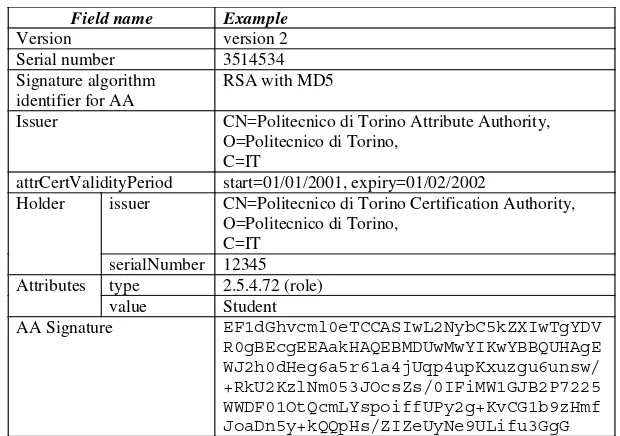
Chapter II by Berbecaru et al., “Digital Certificates and Public Key Infra-structures,” is an exhaustive overview of PKI basics, architectures, and appli-cations. Digital Certificates are signed objects containing a set of data bound together by a digital signature. Currently, Digital Certificates can be divided into three classes, based on the data they are bound to: identity certificates (often referred as public-key certificates, PKC) attribute certificates, and au-thorization certificates. The chapter explores the various possibilities of certifi-cate structures, standards and usages.
Chapter III by Maradan et al., “Smart Card Applications and Systems: Market Trend and Impact on Other Technological Developments,” tackles a theme that is strategic in all fields of security and for all types of organizations. The chapter evidences the new needs and requirements for this important au-thentication support. The diffusion of new communication technologies has pushed smart cards to a very urgent need of applications, although GSM has been the market driver of this authentication means. In this chapter, our will is to provide ideas and trails to explain what make the strengths of smart cards, exploring both technical security issues and market trends. At the same time, the chapter explores the state-of-the-art of hacking techniques, and reveals some counter measures that could redesign modern security platforms. The chapter illustrated the evolution of smart card platforms and their impact on integrated systems, focusing on content protection, e-commerce, and pay TV systems. It finally presents a case study: the e-content protection and Smartright proposal.
Section II: Authorization Frameworks
Chapter IV by Wijesekera et al., “A Flexible Authorization Framework,” gives advances in application areas, such as Internet-based transactions, coop-erating coalitions, and workflow systems, which have brought new challenges to access control. In order to meet the diverse needs of emerging applications, it has become necessary to support multiple access control policies in one secu-rity domain. This chapter describes an authorization framework, referred to as the Flexible Authorization Framework (FAF) that is capable of doing so. FAF is a logic-based framework in which authorizations are specified in terms of a locally stratified rule base. FAF allows permissions and prohibitions to be in-cluded in its specification. FAF specifications can be changed by deleting and inserting its rules. We also describe FAF’s latest additions, such as revoking granted permissions, provisional authorizations, and obligations.
per-formed in its life cycle using a common perception on the service behavior. Reputation attributes are assigned to services using five criteria defined in the chapter related to security (permeability, authentication-based disclosure of in-formation, correct delivery of data to authorized users, use of cryptography, and seniority seen as period of correct behavior). The architecture presented for a reputation management system sees a Reputation Manager, a set of Prob-ing Agents, and a set of Service Wrappers. The system is distributed to enable support of peer-to-peer applications. Examples are provided in the field of e-government applications.
Section III: Data Distribution and Dissemination on
the Net
web services) rely on the availability of XML-based markup and metadata in the multimedia flow in order to customize and add value to multimedia content distributed via the Net. In such a context, a number of security issues around multimedia data management need to be addressed. First of all, it is important to identify the parties allowed to use the multimedia resources, the rights avail-able to the parties, and the terms and conditions under which those rights may be executed; this is fulfilled by the Digital Rights Management (DRM) technol-ogy. Secondly, a new generation of security and privacy models and languages is needed, capable of expressing complex filtering conditions on a wide range of properties of multimedia data. In this chapter, the general problem of multi-media security is analyzed, summarizing the most important XML-based for-mats for representing multimedia data; a language for expressing access con-trol policies is presented and finally, the most important concepts of the DRM technology are discussed.
Section IV: Service Oriented Computing Frameworks
Chapter VIII by Lin et al., “Data and Application Security for Distributed Application Hosting Services,” considers web and Internet services and the emergence of enabling techniques, such as J2EE and .NET, which have led to a trend toward distributed application hosting services (DAHSs). Such hosting services, using rented Internet, computation power, and data storage space to clients are relatively a cheap and effective solution for achieving data and ser-vice availability, a balanced load on the servers, and increased scalability. How-ever, these DAHSs, implemented within the Internet environment, introduce many security concerns for the content and application owners. This chapter discusses security concerns for DAHSs, the available security technologies and protocols at different tiers in the Internet information management hierar-chy, and the open challenges.
The editors are thankful to partners in National and International projects dealing with security, such as the Demostene project for security in Public Administrations funded by Italian NRC, the MAIS (Multichannel Information Systems) Project funded by The Ministry of Education and Research, and to the WIDE and DEAFIN Projects funded by the UE.
Maria Grazia Fugini, Politecnico di Milano, Italy Carlo Bellettini, Politecnico di Milano, Italy
S
I:
Chapter I
Architectures for Advanced
Cryptographic Systems
Guido Bertoni, Politecnico di Milano, Italy
Jorge Guajardo, Infineon Technologies AG, Germany
Christof Paar, Ruhr Universität Bochum, Germany
ABSTRACT
reader a comprehensive understanding of innovative cryptosystems, their basic structure, alternative existing hardware architectures to implement them, and their performance requirements and characterizations. Emphasis will be made throughout on two important cases: the Advanced Encryption Standard and Elliptic Curve Cryptosystems.
INTRODUCTION
It is widely recognized that data security will play a central role in the design of future IT systems. Although the PC had been the major driver of the digital economy until a few years ago, recently there has been a shift towards IT applications realized as embedded systems, and it is expected that this trend will continue as we advance into the 21st century. In addition, many of those applications either rely heavily on security mechanisms, including security for wireless phones, faxes, wireless computing, pay-TV, and copy protection schemes for audio/video consumer products and digital cinemas, or they will require security mechanisms to protect data, communications and our privacy. Thus, it is a pressing need to implement security measures and, in particular, cryptographic algorithms on platforms that are part of embedded systems.
Traditionally, ASICs have been common components in the design of embedded systems by providing the high performance, low power dissipation, and lower price per unit cost that many systems require. Furthermore, ASIC implementations of cryptographic algorithms are more secure than software ones because they cannot be as easily read or modified by an outside attacker. Nevertheless, ASIC implementations suffer from several drawbacks. Among those we can mention: (i) higher development costs and longer design cycles and (ii) lack of flexibility with respect to algorithm and parameter switching in fielded devices. These drawbacks are especially prominent in security applications, which are designed using new security protocol paradigms. Many of the new security protocols decouple the choice of cryptographic algorithm from the design of the protocol. Users of the protocol negotiate, on the fly, the choice of algorithm to use for a particular secure session. Thus, it would be desirable for the devices that will support these applications not only to support a single cryptographic algorithm and protocol, but also to be “algorithm agile”; that is, able to select from a variety of algorithms. For example, IPSec (the security standard for the Internet) allows applications to choose from a list of different symmetric and asymmetric ciphers.
prototype embedded chips small enough to fit in the FPGA. In recent years, however, FPGA manufacturers have come closer to filling the performance gap between FPGAs and ASICs (Application Specific Integrated Circuit), enabling them not only to serve as fast prototyping tools, but also to become active players as components in embedded systems (Wong et al., 2002). The trend in both industry (see Altera Corporation, 2000; Altera Corporation, 2002a; Altera Corporation, 2002b; Chameleon Systems; Triscend Corporation; Xilinx Inc., 2002; Xilinx Inc., 2003) and academia (see Bondalapati & Prasanna, 2002; Hauser & Wawrzynek, 1997) is to develop chips which include either embedded components in them, such as memory, I/O controllers, and multiplier blocks, or both system reconfigurable components and programmable cores. The resulting processors/chips, which are not anymore a single part of an embedded system but rather can be used to develop the whole system, are known by various names ranging from hybrid architectures to Systems-on-Chip (SoC), Configurable System-on-Chip (CSoC), Reconfigurable Systems-on-Chip (RSoC), and Sys-tems on Programmable Chip (SoPC), among others (Bondalapati & Prasanna, 2002). Thus, FPGAs and, in particular, reconfigurable devices are also integral parts in embedded system design.
Chapter Organization
The remainder of this chapter is organized as follows. We begin with a brief introduction to cryptography and the mathematical background needed to understand the encryption schemes described in latter sections. We make emphasis on definitions and when appropriate give relevant examples and refer the reader to other bibliographical sources for the proofs of theorems that we might use. The next two major sections involve discussions of symmetric and asymmetric cryptosystems. In particular, we discuss DES and AES as prime examples of symmetric schemes and RSA and ECC for the asymmetric case, as these are the most widely deployed algorithms in practical applications. We end this chapter with a short overview of attacks against the presented cryptographic schemes and their implementations as well as possible countermeasures.
MATHEMATICAL BACKGROUND
This section should probably more appropriately be called “An Introduction to Finite Fields,” since these are, by far, the most widely used algebraic structure in the construction of cryptographic schemes. Examples include: the AES, the Diffie-Hellman key exchange protocol and those systems based on solving the difficulty of Discrete Logarithm (DL) problem, and elliptic curve cryptosystems. We refer the reader to Lidl and Niederreiter (1997) for a comprehensive treatment of finite fields.
Definition 1. Let S be a set. Then, the mapping from S×S to S is called a binary operation on S. In particular, a binary operation is a rule that assigns ordered pairs (s,t), with s,t∈S, to an element of S. Notice that under this definition the image of the mapping is required to be also in S. This is known as the closure property.
Groups
Definition 2. A group is a set G together with a binary operation * on the set, such that the following properties are satisfied:
(i) The group operation is associative. That is α*(β*γ) = (α*β)*γ, for all
α,β,γ∈G.
(ii) There is an element π∈G, called the identity element, such that π*α = α*π =
α for all α∈G.
(iii) For all α∈G, there is an element α-1∈G, such that α*α-1 = α-1*α = π. The
element α-1 is called the inverse of α. If the group also satisfies α*β = β*α
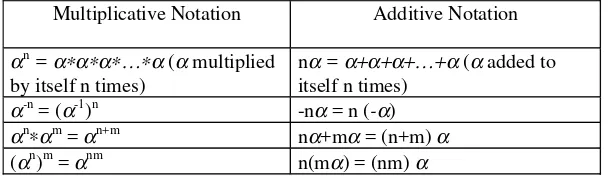
remainder of this chapter, we will only consider abelian groups unless we explicitly say something to the contrary. Note that we have used a multiplicative group notation for the group operation. If the group operation is written additively, then we talk about an additive group, the identity element is often associated with the zero (0) element, and the inverse element of α is written as –α. Notation conventions are shown in Table 1.
Example 1. (i) The set of integers Z forms an additive group with identity element 0. (ii) The set of reals R forms a group under the addition operation with identity element 0 and under the multiplication operation with identity element 1. (iii) The integers modulo m, denoted by Zm, form a group under addition modulo
m with identity element 0. Notice that the group Zm is not a group under multiplication modulo m, since not all its elements have multiplicative inverses.
Definition 3. A group G is finite if the number of elements in it is finite, i.e., if its order, denoted |G|, is finite.
Definition 4. For n ≥ 1, let φ(n) denote the number of integers in the range
[1,n] which are relatively prime (or co-prime) to n (i.e., an integer a is co-prime to n if gcd(a,n) = 1). The function φ(n) is called the Euler phi function or the
Euler totient function. The Euler phi function satisfies the following properties:
(i) If p is prime then φ(p) = p-1.
(ii) The Euler phi function is multiplicative. In other words, if gcd(p,q)=1, then
φ(pq) = φ(p) φ(q).
Table 1: Notation for common group operations, where α∈G and n and m are integers
Multiplicative Notation Additive Notation
Example 2. Let the set of integers modulo m which are co-prime to m be denoted by Z*
m. Then, the set Z *
m under the operation of multiplication modulo
m forms a group of order φ(m) with identity element 1. In particular, if m is prime then φ(m)= |Z*
m| = m-1.
Definition 5. A group G is cyclic if there is an element α∈G such that for each β∈G, there is an integer i such that β = αi. Such an element is called a
generator of G and we write G = <α>. The order of β ∈ G, denoted ord(β),
is defined to be the least positive integer t such that βt=π, where π is the identity
element in G.
Notice the difference between the order of an element α∈G (ord(α)) and the order of the group G (|G|).
Example 3. (i) The multiplicative group of integers modulo 11, Z* 11, is a cyclic group with generators 2, 23 = 8 mod 11, 27 = 7 mod 11, and 29 = 6 mod
11. Notice that the powers of two, which result in generators are co-prime to the order of Z*
11,i.e., 10. In fact, it can be shown that given a generator α∈Z *
m, β = αi mod m is also a generator if and only if gcd(i, φ(m)) = 1. (ii) The additive
group of integers modulo 6, Z6, has generators 1 and 5.
Rings and Fields
Definition 6. A ring, (R,+,*), is a set R together with two binary operations on R, arbitrarily denoted + (addition) and * (multiplication), which satisfy the following properties:
(i) (R,+) is an abelian group with identity element denoted by 0.
(ii) The operation * is associative, that is, α*(β*γ) = (α*β)*γ, for all α,β,γ ∈ R. (iii) There is a multiplicative identity element denoted by 1, with 0≠1,such that
for all a∈R, α*1 = 1*α = α.
(iv) The operation * is distributive over the + operation. In other words, α*(β+γ) = (α*β)+(α*γ) and (α+γ)* α= (β*α)+(γ*α) for all α,β,γ ∈ R.
If the operation * is also commutative, i.e., α*β = β*α, then the ring is said to be commutative.
Example 4. (i) The set of integers Z with the usual addition and multiplication operations is a commutative ring. Similarly, the set of rational numbers Q, the set of reals R, and the complex numbers C are all examples of commutative rings with the usual addition and multiplication operations. (ii) The set Zmof integers modulo m with modulo m addition and multiplication operations is a commutative ring.
A subset S of a field F which itself is a field with respect to the operations in F
is called a subfield of F. In this case F is said to be an extension field of S.
Definition 7 implies that a field F is a set on which two binary operations are defined, called addition and multiplication, and which contains two elements, 0
and 1, which satisfy 0≠1. In particular, (F,+,0) is an abelian group with additive identity 0 and (F*,*,1) is an abelian group under the multiplication operation with 1
as the multiplicative identity (F* is the set F without the element 0). The
operations of addition and multiplication are related to each other via the distributivity law, i.e., α*(β+γ) = (α*β)+(α*γ) and (β+γ) * α = (β*α)+(γ*α),
where the second property follows automatically from the fact that (F*,*,1) is
an abelian group under multiplication.
Example 5. (i) The set of integers Z with the usual addition and multiplication operations is not a field since not all its elements have multiplica-tive inverses. In fact only 1 and –1 have multiplicative inverses. (ii) The set of rational numbers Q, the set of reals R, and the complex numbers C are all examples of fields. (iii) The set Zm of integers modulo m with the modulo m
addition and multiplication operations is a field if and only if m is prime. For example, Z2, Z3, Z5, etc., are all fields.
Definition 8. The characteristic of a field is said to be 0 if 6447448 L
times m
1 1
1
1+ + + +
is never equal to 0 for any value of m ≥ 1. Otherwise, the characteristic of a field
is the least positive integer m such that 1 0
m
1 k
=
∑
= . It can be shown that if the
characteristic m of a field is not 0 then m is a prime.
Definition 8 implies that Z2, Z3, Z5, …, Zp where p is prime are fields of characteristic p. We notice in particular that they are fields with a finite number of elements and thus they have received the name of finite fields or Galois fields after its discoverer Evariste Galois, French mathematician of the 18th
century. The number of elements in the field is called the order of the field. Finally, it is worth mentioning that Zp, for p prime, are just but a few of the existing finite fields. To provide constructions for other finite fields we introduce the concept of polynomial rings.
Example 6. (i) If p is prime then we can find the inverse of any number
a modulo p via Fermat’s Little theorem which states that if gcd(a,p) = 1, (this is always true if p is prime and a<p) then ap-1 = 1 mod p and therefore it follows
can be found as 35 = 243 ≡ 5 mod 7. A quick check verifies our assertion: 3*5
= 15 ≡ 1 mod 7. (iii) A second way to find the inverse of an integer modulo p is to use the extended Euclidean algorithm which guarantees that we can find integers u and v such that a*v + p*u = d = gcd(a,p). It follows that if gcd(a,p) = 1, then we can find the inverse of a modulo p as a*v + p*u = 1⇒ a*v ≡ 1
mod p ⇒ a-1≡ v mod p.
Polynomial Rings
Definition 9. If R is a commutative ring, then a polynomial in the indeterminate x over R isan expression of the form:
A(x) = an xn + a
of A(x), denoted by deg(A(x)). The coefficient an is called the leading coefficient of A(x). If an = 1 then A(x) is said to be a monic polynomial. If A(x) = a0 then the polynomial is a constant polynomial and has degree 0 whereas if A(x) = 0
(i.e., all coefficients of A(x) are equal to 0), then A(x) is called the zero polynomial and for mathematical convenience is said to have degree -∞.
Example 7. Two polynomials
∑
is realized in the familiar way as:(
)
Example 8. The product of two polynomials
∑
=
and addition and multiplication of coefficients is performed in R.
Definition 10. Let R be commutative ring. Then the set of polynomials over R with addition and multiplication of polynomials defined as in Example 6 is called a polynomial ring and we denoted by R[x]. Notice the difference in notation between the set of all polynomials over R, together with the operations of addition and multiplication of polynomials, denoted by R[x] (square brackets) and one element of R[x], say A(x), which we denote also with capital letters but round parenthesis. In the remainder of this work we will only consider polynomial rings F[x] defined over F, where F is a field.
Elements of F[x] share many properties with the integers. Thus, it is possible to talk about divisibility of a polynomial by other polynomial. In particular, a polynomial B(x) ∈ F[x] is said to divide another polynomial B(x) ∈ F[x] if there exists a polynomial C(x) ∈ F[x] such that A(x) = B(x) * C(x). Thus, we say that B(x) is a divisor of A(x) or that A(x) is a multiple of B(x), or that A(x)
is divisible by B(x). The idea of divisibility leads to a division algorithm for polynomials. In fact, we can prove that for any B(x) ≠ 0 in F[x], and for any
A(x)∈F[x], we can find polynomials Q(x) and R(x) such that A(x) = Q(x) * B(x) + R(x) where deg(R(x)) < deg(B(x)) and Q(x) and R(x) are unique.
Definition 11. A polynomial P(x) ∈ F[x] is said to be irreducible over F
if P(x) has positive degree and writing P(x) = B(x)*C(x) implies that either B(x)
or C(x) is a constant polynomial. Otherwise P(x) is said to be reducible. Much in the same way as with the integers, we say that if A(x),B(x) ∈ F[x], then A(x) is said to be congruent to B(x) modulo T(x) if T(x) divides A(x) – B(x), written T(x)|(A(x)-B(x)). The congruency relation is denoted as A(x) ≡ B(x) mod
T(x). For a fixed polynomial T(x), the equivalence class of a polynomial
A(x)∈ F[x] is the set of all polynomials in F[x] congruent to A(x) modulo T(x). It can be shown that the relation of congruency modulo T(x) partitions F[x] into equivalence classes. In particular, we can find a unique representative for each equivalence class as follows. From the division algorithm for polynomials we know that given any two polynomials A(x) and T(x) we can find unique
polynomials Q(x) and R(x) where deg(R(x)) <deg(T(x)). Hence, every polyno-mial A(x) is congruent modulo T(x) to a unique polynomial R(x) of degree less than T(x). Thus, we choose the unique polynomial R(x) to be the unique representative for equivalence class of polynomials containing A(x). We denote by F[x]/(T(x)) the set of equivalence classes of polynomials in F[x] of degree less than m = deg(T(x)). It turns out that F[x]/(T(x)) is a commutative ring and if T(x) is irreducible over F, then F[x]/(T(x)) is a field.
Construction of Finite Fields
GF(p
m)
In previous sections, we saw that Zp, for p prime, was an example of a finite field (also called Galois field GF(p)) with p elements where addition and multiplication were the standard addition and multiplication modulo p operations and inversion could be achieved via Fermat’s Little theorem or using the extended Euclidean algorithm for integers. In this section, we construct the remaining finite fields.
together with addition and multiplication defined as follows. Let A(α),B(α) ∈
GF(pm), with
∑
the result of multiplying A(α) by B(α) via standard polynomial multiplication as
described in Example 8. Thus, C(α)is a polynomial of degree 2m-1. Then, we
define C(α) to beC(α)modulo P(x), i.e., C(α)≡ C(α)mod P(x). Notice that
C(α) can be found since the division algorithm guarantees that we can write
)
together with addition and multiplication as defined in Definition 13. The Galois field GF(24) is of characteristic 2 and has order 24 = 16, in other words, it has
16 elements.
To add α3+1 and α3+α2+1 we simply perform polynomial addition and
(α3+α2+1) = α2. Similarly, (α3+1) multiplied by (α3+α2+1) is obtained as
(α3+1)*(α3+α2+1) = α6+α5+α3+α3+α2+1≡ α3+α2+α+1 mod P(α).
Notice that GF(24)* in other words GF(24) minus the zero element, is a
cyclic group of order 15 generated by α, thus we can write GF(24)* = <α>.
We end this section with some basic facts about finite fields.
(i) (Existence and uniqueness of finite fields) If F is a finite field then F
contains pm elements for some prime p and positive integer m≥1. For every
Table 2: Representation of elements of GF(24)
As a 4-tuple As a polynomial As a power of α
0000 0 0
0001 1 α15≡1
0010 α α
0011 α+1 α4
0100 α2 α2
0101 α2+1 α8
0110 α2+α α5
0111 α2+α+1 α10
1000 α3 α3
1001 α3+1 α14
1010 α3+α α9
1011 α3+α+1 α7
1100 α3+α2 α6
1101 α3+α2+1 α13
1110 α3+α2+α α11
prime power pm, there is a unique, up to isomorphism, finite field of order
pm. The finite field is denoted as GF(pm). Informally speaking, two finite
fields are isomorphic if they are structurally the same, although the representation of their field elements may be different.
(ii) If GF(q) is a finite field of order q=pm, p a prime, then the characteristic
of GF(q) is p. In addition, GF(q) contains a copy of GF(p) as a subfield. Hence GF(q) can be viewed as an extension of GF(p) of degree m. (iii) Let GF(q) a finite field of order q = pm, then every subfield of GF(q) has
order pn for some positive divisor n of m. Conversely, if n is a positive divisor
of m, then there is exactly one subfield of GF(q) of order pn. An element
A∈ GF(q) is in the subfield GF(pn) if and only if Apn = A. The non-zero
elements of GF(q) form a group under multiplication called the multiplica-tive group of GF(q), denoted GF(q)*. In fact GF(q)* is a cyclic group of
order q-1. Thus, Aq = A for all A∈GF(q). A generator of GF(q)* is called
a primitive element of GF(q).
(iv) Let A∈GF(q), with q=pm, then the multiplicative inverse of A can be
computed as A-1= Aq-2. Alternatively, one can use the extended Euclidean
algorithm for polynomials to find polynomials S(α) and T(α) such that
S(α)A(α) + T(α)P(α) = 1, where P(x) is an irreducible polynomial of degree m over GF(p). Then, A-1= S(α).
(v) If A,B∈GF(q) is a finite field of characteristic p, then
(
)
t t t p p pB A B
A+ = + for
all t ≥ 0.
CRYPTOGRAPHY AND ITS
IMPLEMENTATION
Cryptography involves the study of mathematical techniques that allow the practitioner to achieve or provide the following objectives or services (Menezes et al., 1997):
• Confidentiality is a service used to keep the content of information accessible to only those authorized to have it. This service includes both protection of all user data transmitted between two points over a period of time as well as protection of traffic flow from analysis.
can be provided with or without recovery, the first option being the more attractive alternative.
• Authentication is a service that is concerned with assuring that the origin of a message is correctly identified. That is, information delivered over a channel should be authenticated as to the origin, date of origin, data content, time sent, etc. For these reasons this service is subdivided into two major classes: entity authentication and data origin authentication. Notice that the second class of authentication implicitly provides data integrity.
• Non-repudiation is a service that prevents both the sender and the receiver of a transmission from denying previous commitments or actions.
These security services are provided by using cryptographic algorithms. There are two major classes of algorithms in cryptography: Private-key or symmetric-key algorithms and Public-key algorithms. The next two sections will describe them in detail.
Symmetric-Key Algorithms
Private-key or symmetric-key algorithms are algorithms in which the encryption and decryption key is the same, or where the decryption key can easily be calculated from the encryption key and vice versa. The main function of these algorithms, which are also called secret-key algorithms, is encryption of data, often at high speeds. Private-key algorithms require the sender and the receiver to agree on the key prior to the communication taking place. The security of private-key algorithms rests on the key; divulging the key means that anyone can encrypt and decrypt messages. Therefore, as long as the commu-nication needs to remain secret, the key must remain secret.
be processed one symbol at a time because of lack of equipment memory or limited buffering. In this chapter, we are only concerned with block ciphers, thus, stream ciphers are treated no longer.
It is important to point out that the trend in modern symmetric-key cipher design has been to optimize the algorithms for both efficient software and hardware implementation, in contrast to DES which was designed with hardware implementations in mind. These design criteria are evident if one looks at the performance of the AES on different platforms. The internal AES operations can be broken down into 8-bit operations, which is important because many cryptographic applications run on smart cards, which are traditionally based on 8-bit CPUs. Furthermore, one can combine certain steps to get a suitable performance in the case of 32-bit platforms. At the same time, AES implemen-tations can easily achieve speeds in the Gbits/sec range when implemented on hardware platforms such as ASICs or FPGAs. Finally, notice that one of the major issues with symmetric-key systems is the need to find an efficient method to agree on and exchange the secret keys securely (Menezes et al., 1997). This is known as the key distribution problem. Diffie & Hellman (1976) proposed a new concept that would revolutionize cryptography as it was known at the time. This new concept was called public-key cryptography.
Public-Key Algorithms
Public-key (PK) cryptography is based on the idea of separating the key used to encrypt a message from the one used to decrypt it. Anyone that wants to send a message to party A can encrypt that message using A’s public key but only A can decrypt the message using his/her private key. In implementing a public-key cryptosystem, it is understood that A’s private key should be kept secret at all times. Furthermore, even though A’s public key is publicly available to everyone, including A’s adversaries, it is impossible for anyone, except A, to derive the private key (or at least to do so in any reasonable amount of time). In general, one can divide practical public-key algorithms into three families:
• Algorithms based on the integer factorization problem: given a positive integer n, find its prime factorization. RSA (Rivest et al., 1978), the most widely used public-key encryption algorithm, is based on the difficulty of solving this problem.
• Algorithms based on the discrete logarithm problem in finite fields: given α,β∈GF(q), find x such that β=αx. The Diffie-Hellman key exchange
protocol is based on this problem as well as many other protocols, including the Digital Signature Algorithm (DSA).
recent family of practical public-key algorithms, but are rapidly gaining acceptance. Notice that they have become part of standards such as the ANSI X9.62-1998, the FIPS 186-2 Digital Signature Standard, which includes ECDSA, and the IEEE P1363 Standard for Public-Key Cryptog-raphy. Due to their reduced processing needs, elliptic curves are especially attractive for embedded applications.
Despite the differences between these mathematical problems, all three algorithm families have something in common: they all perform complex opera-tions on very large numbers, typically 1024-2048 bits in length for systems based on the integer factorization problem, i.e., RSA, and discrete logarithm problem in finite fields or 160-256 bits in length for elliptic curve based systems. Notice that the most common operation performed in public-key schemes is modular exponentiation, i.e., the operation αx mod n, or point multiplication in the case of
elliptic curves, i.e., computing kP by adding P to itself k times. Performing such an exponentiation (or point multiplication) with 1024-bit long operands (or 160-bit operands) is extremely computationally intensive and thus, it requires a careful selection of methods that take advantage of the characteristics of the underlying cryptographic scheme.
Public-key cryptosystems solve in a very elegant way the key distribution problem of symmetric-key schemes. However, PK systems have a major disadvantage when compared to private-key schemes. As stated above, public-key algorithms are very arithmetic intensive and,if not properly implemented or if the underlying processor has a poor integer arithmetic performance, this can lead to poor system performance. Even when properly implemented, all PK schemes proposed to date are several orders of magnitude slower than the best-known private-key schemes. Hence, in practice, cryptographic systems are a mixture of symmetric-key and public-key cryptosystems. Usually, a public-key algorithm is chosen for key establishment and authentication through digital signatures, and then a symmetric-key algorithm is chosen to encrypt communi-cations and data transfers, achieving in this way high throughput rates.
BLOCK CIPHER IMPLEMENTATION
the same time, in most cases there is no known practical attack that can be performed with complexity better than that of an exhaustive search. In addition, they can be easily implemented in both software and hardware, and they admit different implementation choices; for instance, different algorithmic versions allowing a cost/performance trade-off (code size versus time latency in soft-ware, silicon area versus time latency/throughput in hardware).
Symmetric ciphers can be modeled according to a layered structure. At the bottom of the model are the operations directly performed on the data elements (bits, bytes or words): these include Galois Field operations, such as addition, multiplication, and inversion of field elements as well as bit permutations. The set of operations used by the encryption algorithm is organized in a macro-function called the round transformation, or simply the round, which depends on the specific cryptographic algorithm and, hence, it will be explained later for the cases of DES and AES in detail. The round transformation is the building block used to implement the two basic services necessary in the cryptosystem, encryption and decryption of data, and one additional internal service, usually called key schedule, which is dedicated to processing the secret key. A block cipher encrypts data in blocks of fixed size. Thus, in order to process messages that exceed the block length, so-called modes of operation are introduced. Generally the size of the input/output data block is 64 or 128 bits. Some algorithms use or admit larger data blocks, but most modern block ciphers (for example all AES candidates) have a block length of 128 bits. The block size is mainly driven by security requirements but also complexity of implementation and performance. For example, in a software implementation, data blocks to be processed larger than 128 bits would require the allocation of too many processor registers.
The number of rounds in a block cipher varies greatly and depends on the cipher’s design criteria and on what the designers considered an appropriate security level. For example, DES has 16 rounds, the AES accepts 10, 12, and 14 rounds depending on the key size, and Serpent had 32 encryption rounds. From the number of rounds, it is possible to obtain a range of values for the throughput of the system. For example, in hardware implementations, if a dedicated functional unit able to execute a round in one clock cycle is available and the designer has enough area resources, it is possible to instantiate all rounds of the cipher by means of as many functional units as necessary and pipeline the system, thus achieving throughputs in the order of gigabits per second. In the case of software implementations on general purpose CPUs, most encryption algorithms process the input data block in hundreds or thousands of clock cycles, thus reaching only throughputs in the order of megabits bits per second.
Figure 1: Generic symmetric cipher algorithm as a layered model
M ode s o f O per ation
Ba s ic D ata O p era tio ns R ou nds
E nc ry ption , D ec ryp tio n an d K ey s ch ed ule
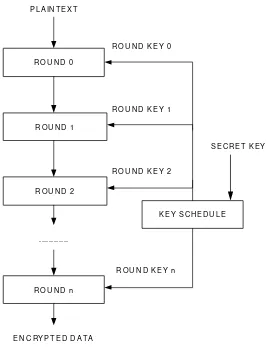
Figure 2: General structure of a block cipher algorithm
R O U ND 0
R O U ND 1
R O U ND 2
R O U ND n
K E Y S CH E DU L E P L A IN T E X T
R O U N D K E Y 0
R O U N D K E Y 1
R O U N D K E Y 2
R O U N D K E Y n
E N C RY P T E D D A T A
S E CR E T K EY
iteratively to the input data. As mentioned previously, this macro-function is called the round transformation. Thus, the structure of a block cipher algorithm can be viewed as a for loop: at the beginning the input of the algorithm is the plaintext, which is subsequently processed by the loop body, i.e., the round. The number of rounds applied to transform (encrypt or decrypt) the input data block is fixed and it is a constant of the algorithm (actually most modern algorithms admit two or more choices, which are chosen according to the desired security level). It is important to point out that the internal operations that make up the round should exhibit certain characteristics. In particular, at least one of the internal transformations should be dependent on the secret key and at least one of the internal transformations should be highly non-linear. We refer to Schneier (1996) for more details regarding the design of block cipher algorithms. In order to increase the security level of the algorithm, the secret key is not used as it is in every round; rather, it is transformed. The processing of the secret key is called key schedule or key expansion. The data blocks extracted or derived from the secret key and then used by the rounds are called round keys or sub-keys.
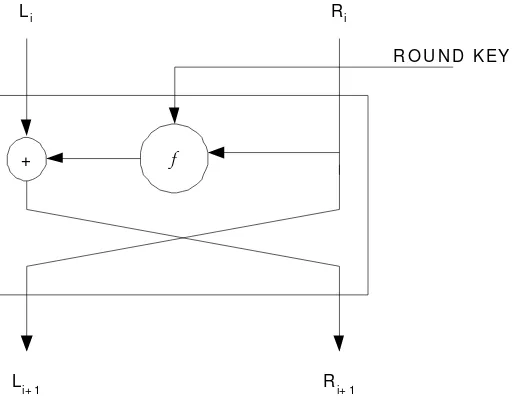
One of the most common structures used in the design of block cipher algorithms is the Feistel network. The architecture of a Feistel network is depicted in Figure 3. The input block is divided into two halves, called left and right half or part. A round processes the right part of the input block through a non-linear function involving the round key, and the output of the non-linear function is then added to the left part. The result of the addition becomes the right
Figure 3: The structure of a round organized as a Feistel network
Li Ri
f
+
Li+ 1 Ri+ 1
part of the next round, while the left part of the next round is the right part of the previous round, which was left unprocessed.
A relevant property of this cipher design is that the f-function should be non-invertible, even though the round itself is invertible due to its inner structure. In fact, it is possible to calculate Li and Ri starting from Li+1 and Ri+1 provided that the round key is available.
Some important block ciphers designed as Feistel networks are: DES, MISTY/Kasumy, (proposed in 3GPP), FEAL, GOST (the USSR DES), and Blowfish. The Feistel network is not the only possible architecture for designing a symmetric block cipher algorithm. For example, the Substitution Permutation Network (SPN) is another structure commonly used in modern block cipher design. The Advanced Encryption Standard (AES), which will be presented later, is precisely an SPN cipher algorithm. Usually SPN are based on the iterative application of a round primitive as well. Similarly to Feistel network-based ciphers, the secret key is not directly used, rather a key schedule algorithm is performed to derive the round keys, which are used directly in the encryption and decryption processes.
The general structure of a block cipher algorithm is therefore organized as a repetition of a single macro-function, the round, thus allowing for different implementation options. For instance, one can implement the round structure once and reuse it. This implementation strategy yields a benefit in terms of cost reduction. To reach a high performance in hardware, it is possible to instantiate all the rounds requested by the algorithm and pipeline them, thus reaching an extremely high throughput, as it is required in modern high-end network servers, capable of supporting thousands of simultaneous encrypted network channels. This strategy is performed at the additional cost of extra circuit area. So far we have seen basic design principles used to build block ciphers. In the next paragraph, we will look at how to process data whose size is larger than the input block of the algorithm.
The simplest way to use a block cipher algorithm consists in dividing the plaintext bit sequence into blocks, each block of the same size as the size of the algorithm’s input data block and then encrypt the obtained blocks in succession. This mode of operation is the simplest one and it is referred to as the Electronic Code Book (ECB). ECB is quite simple but it may expose the encryption process to some weaknesses. If for instance there are two identical plaintext blocks, then they are mapped to identical cipher text blocks if the same key is used. This observation can be used to mount an attack which can possibly recover the encryption key.
current plaintext block. Such a procedure yields a randomization of the blocks being encrypted. For the first block an initial vector (IV) is used, which is a random data block; clearly, it is necessary to exchange the IV between the two parties before starting the whole encryption process.
Notice that if the size of the plaintext is not a multiple of the block size, the plaintext is padded. The simplest way is to append as many bits as required to reach the closest bit size multiple of the block size. Other padding techniques exist as well, see Chapter 9 in Menezes et al. (1997).
Another mode of operation of interest in applications requiring fast encryp-tion rates and high security is the “counter mode.” As in CBC, an Initial Vector (IV) is necessary. The IV is encrypted directly and added to the first block of plaintext. The IV is then incremented by one (the initialization vector is simply a counter, thus the name counter mode), encrypted again and added to the second block of plaintext, and so on for all plaintext blocks (from time to time the IV can be reinitialized). The counter mode method has been recently included in the IPSec specification. It is particularly interesting because it makes possible to prepare a stream of “encrypted noise” to be added in advance to the plaintext for improving security. A second interesting feature of the counter mode is that the decryption process does not require the presence of a dedicated decryption unit (or of a decryption procedure in the case of a software implementation): to decrypt the encrypted text it suffices to know the IV, encrypt it and subtract it from the encrypted text (which again is a bit-wise XOR operation), thus recovering the original plaintext. This property is particularly interesting for low cost CPUs, where decryption may happen to be slower in comparison with encryption.
The new encryption standard AES includes several other modes of opera-tion. For more details we refer to NIST (2001c). Some of these modes of operation are particularly interesting since they combine the possibility to encrypt the plaintext and to compute a Message Authentication Code (MAC). The MAC
Figure 4: ECB mode of operation
Ek P0
C0
Ek P1
C1
Ek P2
C2
Ek Pn