SYMBOLIC POLITICS AND THE ACEHNESE
ETHNIC WAR IN INDONESIA
TESIS
Diajukan sebagai salah satu syarat guna memperoleh gelar Magister Ilmu Politik
pada Program Pascasarjana Universitas Diponegoro
Oleh:
KHAIRU ROOJIQIEN SOBANDI NIM. D4B006054
PROGRAM STUDI MAGISTER ILMU POLITIK
PROGRAM PASCA SARJANA
ii Sertifikat
Yang bertanda tangan dibawah ini saya, Khairu Roojiqien Sobandi menyatakan bahwa tesis yang saya ajukan ini adalah hasil karya saya sendiri yang belum pernah disampaikan untuk mendapatkan gelar pada program Magister Ilmu Politik ini ataupun pada program lainnya. Karya ini adalah milik saya, karena itu pertanggungjawabannya sepenuhnya berada di pundak saya.
iii
PENGESAHAN TESIS
Yang bertanda tangan dibawah ini menyatakan bahwa tesis berjudul:
SYMBOLIC POLITICS AND THE ACEHNESE ETHNIC
WAR IN INDONESIA
Yang disusun oleh Khairu roojiqien Sobandi, NIM D4B006054 telah dipertahankan di depan Dewan Penguji pada tanggal 23 Januari 2009 dan dinyatakan telah memenuhi
syarat untuk diterima.
Ketua Penguji
Drs. Purwoko, MS
Anggota Penguji Lain
1. Drs. Priyatno Harsasto, MA
2. Drs. Teguh Yuwono, M. Pol Admin
Sekretaris Penguji
Drs. Tricahyo Utomo, MA
Semarang, 23 Januari 2009
Program Pascasarjana Universitas Diponegoro Program Studi Magister Ilmu Politik
Ketua Program
iv Acknowledgment and dedication
This thesis research has grown out around of nine months literature review of
symbolic politics and the Acehnese ethnic war in Indonesia. It has been written in partial
fulfillment of the requirement for the double degree program of Master of Arts (Political
Science) in the Faculty of Arts and Sciences, University of Wyoming, United States of
America (USA) and Diponegoro University, Indonesia. This research was funded as a
part of my scholarship from The Indonesian government in cooperation with the
Department of Political Science of University of Wyoming, USA.
I am deeply indebted to Professor Stephanie Anderson (chairperson), Prof. Maggi
Murdock, and Prof. Gracie Lawson-Borders, my committees. They have thought me the
importance of analytical rigor and critical thinking. They have been instrumental in
helping to shape the direction of my research, clarifying and organizing ideas, especially
during the writing-up period. They have always been very attentive and helpful, and
tireless editor of my work. They guidance and support have decisively determined the
completion of this work.
It is to Professor Thomas Seitz, Purwoko, Tri Cahyo, Budi Setiyono, Teguh
Yuwono, and Priyatno Harsasto the cooperation initiators between Diponegoro
University, Indonesia and the University of Wyoming, USA; I express my gratitude for
all their efforts in bridging the two institutions on a brilliant educational collaboration for
the first time.
Living in Laramie, was made pleasant and comfortable through friendship and
v Gulam Manar, Ed Clark, Jeff and his family, Anne Spear, Josh King, Malynda
Green-Wallace, Courtney Burns, Ahadjon Abdurahmonov, and Amelia McLaughlin.
My great thanks are addressed to those who helped in administrative matters and
thought me during my coursework. I would like to mention among others, Patricia Flores
and Jamie Le Jambre.
For the entire period of my studies at UWYO, I have received financial support
through a scholarship from Indonesian embassy. To Education attaché and Indonesian
embassy in US, especially Enda Wulandari, and Esti Rahayu, I express my thanks and
gratitude.
It is to my big family that I owe my greatest debt, and it is to them that this thesis
is dedicated. Only they know how much their emotional support has meant to me. They
have made this entire endeavor seem worthwhile.
Semarang, January 2009
vi Abstract
The ethnic war in Aceh territory killed 13.000 to 50.000 of people and it remains
problematic, especially in the 1950s, 1970s, and the end of 1990s. This thesis explores
whether the symbolic politics theory of ethnic war, which was originally designed to
explain conflict in the post-Communist societies of Eastern Europe, is also successful for
explaining ethnic war and the subsequent peace in areas like Aceh where traditional
social structures continued to exist. Facts support the hypotheses of symbolist theory. On
the first two cases, myths justifying hostility were strong on both sides of the Acehnese
and the Javanese Indonesian national government, the result of decades of conflict
between Javanese national authorities and the Acehnese societies in Aceh territory.
Ethnic fears, opportunity reasons, hostile feelings, chauvinist mobilization by ethnic
elites, and security dilemma dynamics were also taken into account on the Acehnese
ethnic conflict. On the other hand, the symbolist theory is also effective for explaining
ethnic subsequent peace in the reform period (1998-recent). Hostile myths and fears did
present, but the violence did not emerge because both elites chose not to let the conflict
continues. The opportunity to mobilize for both elites did not present and therefore
hostile mass conflict did not escalate. Recognizing this unique conflict involves
identifying the patterns of their attachment to the traditional social structures, the
vii Abstraksi
Konflik ethnis di wilayah Aceh telah membunuh 13.000 sampai 50.000 orang dan
tetap problematic, terutama pada tahun 1950an, 1970an, dan pada akhir tahun 1990an.
Tesis ini menganalisis apakah teori simbolik politik dalam konflik atau perang etnis, yang
pada awalnya dirancang untuk menjelaskan perang etnis dalam masyarakat post-Komunis
di Eropa Timur, juga sukses menjelaskan perang etnis dan perdamaian di daerah-daerah
seperti Aceh yang struktur sosial tradisionalnya tetap ada. Fakta-fakta menunjukkan
terbuktinya hipotesis teori simbolis. Dalam dua studi kasus pertama, mitos yang
menjustifikasi permusuhan sangat kuat pada kedua belah pihak antara orang Aceh dan
pemerintah Jawa Indonesia, hasil dari beberapa decade konflik antara otoritas nasional
Jawa dan masyarakat Aceh di wilayah Aceh. Ketakutan etnis, alasan kesempatan,
perasaan permusuhan, mobilisasi cauvinis oleh para elit etnis, dan dinamika dilemma
keamanan juga turut berkontribusi dalam menjelaskan konflik etnis Aceh. Pada sisi lain,
teori sombolis juga efektif untuk menjelaskan perdamaian sesudah perang pada periode
reformasi (1998-sekarang). Mitos permusuhan dan ketakutan memang terlihat, tapi
kekerasan tidak terjadi karena elit dari kedua belah pihak memilih untuk tidak
membiarkan konflik tidak berlanjut. Kesempatan utk memobilisasi bagi elit dari kedua
belah pihak tidak terlihat dan oleh karena itu konflik permusuhan massa tidak tereskalasi.
Mengenali keunikan konflik ini mencakup pengidentifikasian pola-pola keterkaitan
viii Table of Contents
Pages
Title page i
Thesis Originality page (Pernyataan Keaslian Tesis) ii
Approval Thesis Page (Pengesahan Tesis) ii
Acknowledgement and Dedication (Persembahan) iv
Abstract vi
Abstraksi vii
List of Tables xii
List of Figures xiii
1. Introduction 1
A. Introduction 1
B. The importance of the thesis 7
C. Arguments (Thesis statement) 7
D. Methodology and data collection 8
E. Hypothesis 9
F. The plan of the thesis 14
2. Literature review 15
A. Introduction 15
B. Interpretations of the ethnic conflict 17
C. Rational choice theory 19
a. Strengths of rational choice theory 24
ix c. Inapplicability of rational choice theory to the Acehnese conflicts 28
D. Psychological approaches 30
a. Strengths of psychological approaches 32
b. Weakness of psychological approaches 33
c. Inapplicability of psychological approaches to the Acehnese conflicts 35
E. Symbolic politics theory 37
a. Strengths of symbolic politics theory 39
b. Weakness of symbolic politics theory 42
c. Applicability of symbolic politics theory to the Acehnese conflicts 44
F. Conclusion 45
3. Indonesia and the Acehnese rebellions 48
A. Introduction 48
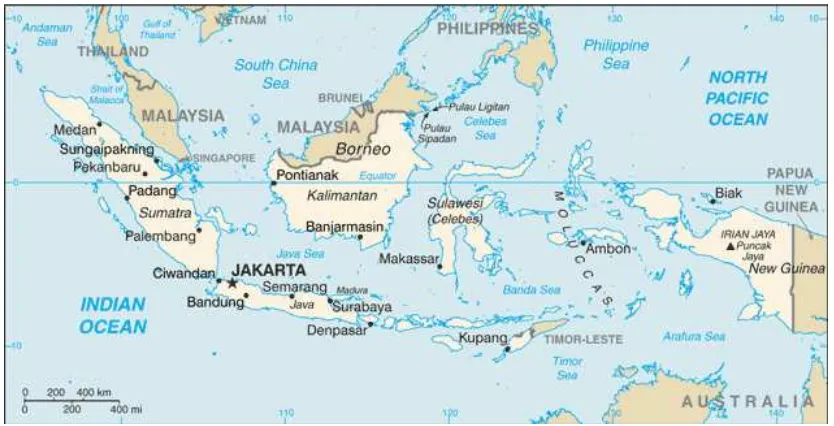
B. Geography and ethnicity in Indonesia 48
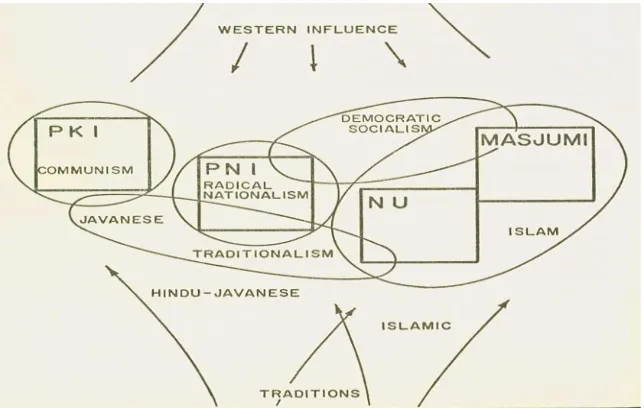
C. The politics and ideology in Indonesia 51
D. Ideological debate between the Islamic and secular nationalist groups 54
E. The Origins of the Acehnese rebellions 58
a. The Darul Islam movement under Daud Bereueh leadership 59
b. Free Aceh Movement under Soeharto’s regime of the New Order era
(1969-1998) 61
c. Free Aceh Movement in reformation era (1998 - now) 67
F. Conclusion 71
4. The Acehnese conflicts under Soekarno’s period 74
x
B. Myths justifying hostility 75
C. Fears of extinction 84
D. Opportunity to mobilization 89
E. Mass hostility 92
F. Hostile mobilization (The process of mobilization for war) 96
G. Conclusion 103
5. The Acehnese conflicts under Soeharto’s period (The New Order era) 106
A. Introduction 106
B. Myths justifying hostility 107
C. Fears of extinction 113
D. Opportunity to mobilization 117
E. Mass hostility 119
F. Hostile mobilization (The process of mobilization for war) 122
G. Conclusion 129
6. The Acehnese subsequent peace after 1998 reform period 132
A. Introduction 132
B. Myths justifying hostility 134
C. Fears of extinction 137
D. Opportunity to mobilization 142
E. Chauvinist mobilization and the clashes 146
xi
7. Conclusion 153
A. Introduction 153
B. Assessment of the symbolic politics theory on the Acehnese conflicts 153
a. Assessment of the theory on the Acehnese conflict under
Soekarno period 153
b. Assessment of the theory on the Acehnese conflict under
Soeharto period 156
c. The Acehnese subsequent peace after the 1998 reform period 159
C. Strengths and weaknesses of the symbolic politics theory 162
a. Strengths of the symbolic politics theory 162
b. Weaknesses of the symbolic politics theory 164
D. Implications 166
xii List of tables
Table 3.1 Major Parties in Indonesian and Recent Parliamentary Elections Result
(Percent of Vote) 56
xiii List of Figures
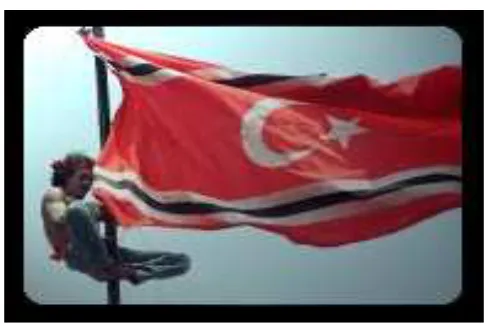
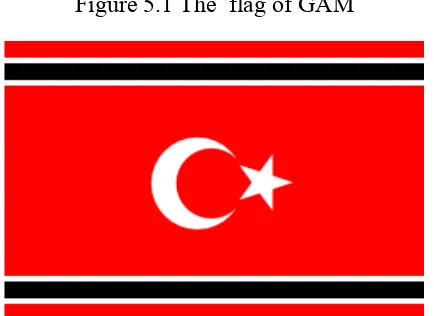
Figure 1.1 The GAM’s flag as the fighters’ symbol of freedom and independent 6
Figure 2.1 A fighter risking his life securing the GAM’s flag 35
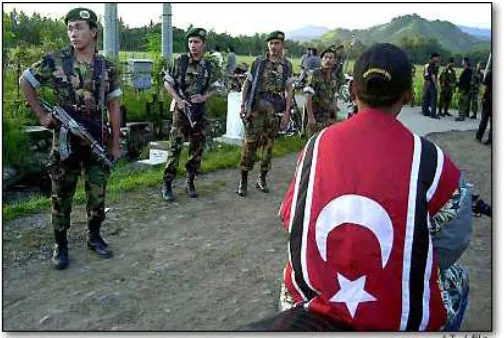
Figure 2.2 The GAM’s supporter provoke the emotions of the Indonesian military 36
Figure 3.1 The map of Indonesia 50
Figure 3.2 The Political map in Indonesia in 1955 55
Figure 5.1 The flag of GAM 109
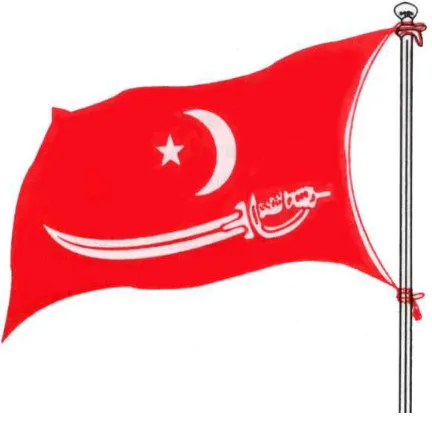
Figure 5.2 The flag of the Aceh government Kingdom (1511-1530) 110
1 CHAPTER 1:
INTRODUCTION
A. Introduction
After the Indonesian independence in 1945, Acehnese experienced an ethnic
conflict whose savagery replayed some of the worst horrors of the Dutch colonial era.
The Javanese Indonesian government and their military forces swept the Acehnese
rebellions under the Daud Bereueh leadership in 1953 and the Free Aceh Movement
(GAM, Gerakan Aceh Merdeka) under Hasan di Tiro leadership from 1976 to the 1998
reform period. More than four thousands Acehnese died during the Daud Bereueh
rebellion in 1953, and more than fifty thousands Acehnese were killed between 1976 and
1998 - reform period.1 KontraS (Komisi untuk Orang Hilang dan Tindak Kekerasan,
Commission for Missing People and Violent Actions), an Indonesian Non-Governmental
Organization (NGO), reported that since 1953 to the 1998 reform era, the Indonesian
government and their military have murdered, tortured and victimized the Acehnese in
order to terrorize the Acehnese population.2
These horrible events cry out for an explanation. What motivated both the
Acehnese and the Javanese Indonesian leaders or the politicians of nations to organize
torture, rape, terror, and even murder a large portion of their country’s inhabitants? What
1
Michael Runnner and Zoe Chafe, “Beyond Disasters: Creating Opportunities for Peace,” edited by Lisa Mastny, World Watch Report (Worldwatch Institute, 2007), 21.
2 KontraS, Aceh,Damai dengan Keadilan? Mengungkap Kekerasan Masa Lalu (Aceh, Peace with Justice?
2 motivated their followers to sink to such brutality aimed against their near neighbors
ethnic group? One could explain these events as the result of hatreds, manipulative
leaders, economic rivalry and so on. These arguments should be combined to explain
why ethnic conflict or war occurred and to explain why ethnic conflict does not happen.
In this case, I would combine the rational choice and the psychological approaches, as
noted above, by using the symbolic politics theory on the Acehnese ethnic conflicts and
the subsequent peace.
This research draws on the symbolic politics theory to examine three case studies
of the Acehnese ethnic conflicts that include: the Aceh rebellion in 1953, Aceh rebellion
under the Soeharto’s New Order period from 1969 to 1998, and the Aceh rebellion
in1998 reform period. I will focus on these three case studies because the Acehnese
separatist group’s existence continued under several different regimes in Indonesia. This
research specifically analyzes the myths, fears, opportunities, mass hostility, and the
hostile mobilization in determining ethnic conflict or war between the Acehnese and the
Javanese Indonesian central government under several different regimes.
In 1953, Aceh’ leaders, especially Daud Beureuh, was disappointed with the
national Indonesian government, and thus they revolted as a part of the Darul Islam
(Abode of Islam) movement in a struggle to create an Indonesian Islamic state.3 In 1976,
Hasan di Tiro returned from the United States to form Gerakan Aceh Merdeka (Free
Aceh Movement or well known as GAM) and for the second time the Acehnese declared
3 C. Van Dijk, Rebellion Under the Banner of Islam: The Darul Islam in Indonesia (Leiden, Netherland:
3 its intention to have their independence. Thus in 1989, this rebellion resulted in a cruel
counterinsurgency operation that caused thousands of civilian casualties.4
The last event, but not least significant, was in late 1998, in which the student
movement protested and called for a referendum on independence similar to the 1999
referendum in East Timor. Negotiation between national Indonesian government and
GAM continued and gave the special autonomy status. On May 2003, the peace process
broke down because the military emergency status was affirmed and the Indonesian
military launched large-scale offensives actions and so the war continues.5 However, the
sudden tsunamis that came into Aceh territory and destroyed most of the area formed a
new situation on Aceh. GAM and the Indonesian government produced a new negotiation
pace of with the assistance of Marti Ahtisaari, the peace noble prizewinner in 2008.
Negotiation in 2006 resulted in an ethnic peace by giving the Acehnese a
“self-government” position within Indonesia. Therefore, the three case studies above related to
the nations and nationalism of a group or a creation of nations and the nationalism
emotions.
Anderson put forward the concept of the “imagined political community” that
refers to the creation of nations and nationality.6 His work derived from the Marxist
tradition; yet, Anderson, goes beyond political economic view and moves toward a
cultural view in a way that nation and nationalism are constructed as cultural heritage. He
6 Bennedict Anderson, Imagined Communities: Reflections on the Origin and Spread of Nationalism,
4 argues that a nation is a modern cultural artifact that arose in the eighteenth century.7
Furthermore, he gives his definition for nation that is “an imagined political community –
and imagined as both inherently limited and sovereign.” Anderson continues to explain
that the nation is imagined in a way that members will never know, meet, or even hear
each other, but he said that “in the minds of each lives the image of their communion.”8
Anderson then recognizes that a nation is limited and has flexible boundaries.
On the Aceh conflicts case, the effort to re-emerge as an Aceh nation was
constructed by the Aceh leaders. In this sense, Daud Bereueh imagined an Indonesian
Islamic Community or nation-state and Hasan di Tiro imagined a pure Aceh nation like
the glory of an Acehnese Kingdom in the 16th and the 17th centuries.
Daud Bereueh uses Islam as the chosen symbol that could unite Aceh, even a
whole ex-East Indies territory and its community. His motivation to create an Islamic
nation is due to his own cultural roots as a strong believer of Islam and because most of
the ex-East Indies people were Muslim. It makes sense that Bereueh imagined a unity of
an Islamic community (ummah) under a nation. Therefore, he convinced his group and
justified any attempt to defend the idea of Aceh nation based on Islamic value as a holy
purpose in the name of God. However, Soekarno, the first Indonesian president and a
Javanese, challenged this effort by creating a more secular-nationalist nation of
“Indonesia” that covers all the territory of ex-East Indies based on Pancasila regardless
of religion, original region, or ethnicity. Both leaders had manipulated their followers to
defend their personal and cultural feeling of belonging to their own nation. The Clash of
7
Ibid. 13.
8
5 imagined communities between the Acehnese and the Indonesian government was
unavoidable. The Acehnese attachment to Islam and Islamic nation was taken for granted,
and thus they were willing to hate, kill and even die for the idea of the imagined Islamic
nation.
In line with Daud Brereueh, Hasan di Tiro also manipulated the Acehnese
personal and cultural feeling for an independent Aceh. His imagined community was an
independent Aceh separated from Indonesia that was dominated by the Javanese ethnic
group. He glorifies the Aceh Kingdom before the Aceh War in 1873. He convinced the
Acehnese because he was the heir of the Acehnese hero and Islamic scholar (the ulama),
Cik di Tiro. He combined the idea of an independent Aceh nation based on ethnicity and
Islam values. This idea was also taken for granted by the Acehnese because the Acehnese
followed their traditional leader (the Sultan and the ulama) of Hasan di Tiro as their loyal
client to the patron (the Sultan and Ulama). The formation of GAM by Hasan di Tiro, as
an heir of Acehnese Sultan and ulama, is a fact that the Acehnese have taken for granted
the idea of an Aceh nation to set them free from the neo-colonial Indonesia. Another
example is the GAM’s flag as a symbol of the Acehnese pride as a nation who pursued
6 Figures 1.1 The GAM’s flag as the fighters’ symbol of freedom and independent
Source: http://www.achehtimes.com/photos/gam/gam01/widowsdefend.htm (retrieved at March 20, 2008).
Soeharto, the Indonesian second president, who was a Javanese, crushed the idea
of Aceh separation as an independent Aceh. He used Pancasila (a secular state
foundation) as a symbol of Indonesian state to justify his action to crush Hasan Tiro and
GAM. The leaders from both sides manipulated their intra-group and provoked them to
take for granted the idea of nation or the creation of new nation. Hence, the followers
who were attached and devoted themselves to the cultural myth and symbols like the flag
or contending flag were willing to die for their nation’s flag. In this sense, conflict was
unavoidable.
In sum, the Acehnese ethnic conflict is about the politics of myth of a nation and
ideological symbol of ethnic movement. The Acehnese rebellion from 1953 to the 1998
reform period in Indonesia is based on the dynamic of the myth and symbol of nation and
triggered the Acehnese ethnic conflicts. The elite actors from both ethnic groups evoked
7 from both sides played key role in triggering and ending the ethnic conflicts in Aceh.
B. The Importance of the thesis
It is important to analyze the pattern of the Acehnese conflict using the symbolic
politics theory because this theory can explain most of the ethnic conflicts and peace
cases. In this context, this research contributes towards filling in the rational choice and
the psychological approach’s gaps by providing three case studies of the ethnic conflicts
and peace. The focus is on the symbolic politics framework applied to Aceh, rather than
on a comprehensive analysis of Aceh. Thus, this research’s analysis is different from
previous work in its framing of the Aceh situation as a symbolic politics issue to
determine how well this case studies, based on literature review, shows the effectiveness
of the symbolic politics theory on the Acehnese ethnic rebellion in Indonesia.
C. Arguments (Thesis statement)
The Acehnese ethnic war in Indonesia broadens the explanation of power of the
symbolic politics theory in Southeast Asian counties as applied in Eastern Europe and
Africa. Symbolic politics theory was designed to analyze the ethnic wars in Eastern
Europe. Stuart J. Kaufman9 popularizes the theory in this area to give explanation of the
roots of the ethnic wars. He began to develop his theory in Africa to explain the ethnic
wars in Rwanda and Sudan. His theory negated the rational choice theorists that explain
the ethnic wars in Africa. Furthermore, he picked Philippines as a case study of the
Southeast Asian countries. Symbolic politics theory is successful as an explanation for
the ethnic wars even when the traditional social structure is still kept by the ethnic
9 See Stuart J. Kaufman, Modern Hatreds: The Symbolic Politics of Ethnic War (Ithaca, NY: Cornell
8 groups. Therefore, the Acehnese ethnic war in Indonesia is a valuable case study that can
be explained by explain symbolic politics theory in the sense that Acehnese ethnic war
has similarities with ethnic wars in the southern Philippines, which still keep their
traditional social structures, the sultanate and the Islamic scholars (the ulama).
D. Methodology and data collection
The results of this research are based on literature studies. The literature used
consists of books, articles and internet sites. All references are secondary sources. Hence,
I use triangulation data to give an unbiased and balanced approached to certain issues. A
literature study is a form of qualitative method that has been criticized for being less
representative and atypical.10 Furthermore, it has been argued that qualitative methods
produce un-replicable results and thus no generalization can be made from the findings.11
Naturally the interpretations drawn from the literature studies are subjective and another
person confronted the same material may not draw the same conclusions. However, the
main usage of qualitative studies is to provide a foundation for future studies using a
quantitative method of research from which generalizations can be made and any findings
are possible to be validated.
The aim of this research is to test symbolic politics theory on the three cases of
the Acehnese ethnic conflicts and peace process under different regimes in Indonesia. As
noted above, the three cases are the Darul Islam movement in 1953, the GAM movement
in 1976, and the GAM on the reform 1998 period. I focus on the dynamic of the symbolic
10
David Marsh and Gerry Stoker, Theory and Methods in Political Science (Hampshire Palgrave, Houndmills, Basingstoke, 1995), 141.
11
9 politics theory by examining myths, fears, opportunities, hostile feelings, and hostile
mobilization (hypotheses) on these three cases. These particular indicators are the matters
that I will focus on the literature studies.
E. Hypothesis
I focus on the essential conditions for ethnic conflict or war of the symbolic
politics theory through myths, fears, opportunity, hostile feelings, and hostile
mobilization on the three cases as mentioned above. The first indicator is the myth
justifying hostility (S1). The myth-symbols complex becomes one of the key aspects that
are aggravating hostility through chauvinism or warrior (leader) ethos, which they believe
that their own group is greater and better than others. The myths can be re-portrayed by
elites to create such hostile conditions. Using the myth-symbol complex that is already
familiar, the elite uses and propagates these myths as a way to gain justification. For
instance, a myth of Perang Sabil (Holy War) was used as a means to fight in the name of
Islamic religion against the colonialists. This myth has been exaggerated to justify the
hostile situation and mobilize the ethnic war. The myths should present the perspective
from one group that justifies the interest of ethnic domination and the other ethnic group
who opposes it.
The next condition is the existence of ethnic fear (S2), where the ethnic group
fears their existence is at risk. This condition creates an unfriendly environment for the
other groups. These fears are inflated by emotions and feelings concerning who are
members of the groups and who are not. These psychological developments justify the
strength of ethnic fear to provoke ethnic mobilization and violence. Here, the
10 offended by the other groups. Stuart Kaufman argues that historically, one of the groups
has been dominated and been the victim of the other group’s domination, and thus this
condition trigger fears of ethnic group extinction. At the same time, it creates the feelings
of revenge.12 Furthermore, he argues that the myth of domination plays important role in
creating the fears of the dominated group. Once fears exist in a group, it justifies any
violence in the name of self-defense. Such fears and threats facilitate ethnic group
mobilization and defense of themselves, even though they are the ones who aggressively
create the war.
Another condition is the opportunity to mobilize the ethnic group (S3). Ethnic war
will occur if freedom for the ethnic group to mobilize is present with no state’s
repression. State policies and political suppression is the strategy that can control the
ethnic elites to mobilize the group and prevent the ethnic wars. Thus, if the policies and
political repression are weakened then it will open a political freedom for the ethnic elites
and such space can intensify ethnic violence. On the other hand, the leaders of the state
who wanted to begin ethnic conflict have more opportunity to mobilize the apparatuses
because they control the power. Here, ethnic war will happen if both sides gain the
opportunity to manage and supply the groups with weapons and thus they need the area
as the control center.
The symbolic politics theory holds that if the three preconditions—hostile myths,
ethnic fears, and opportunity to mobilization—are present ethnic conflicts results if they
lead to rising mass hostility by leaders making extreme symbolic appeals between
12 Stuart J. Kaufman, Modern Hatreds: The Symbolic Politics of Ethnic War (Ithaca, NY: Cornell
11 groups. Mass hostility (S4) arises because of the hostile emotions. Roger Peterson
identified the hostile emotions—fear, hatred (ancient hatred), and resentment—that play
important role in conflict.13
Fear arises when one group considers the rivalry group as a threat for them.
Hence the collapse of the political center eliminates institutional constraints and will
produce an anarchy situation. Under this condition, fear would be increased as well as the
desire for security. Fear also arises when political elite manipulates fear for their own
ends. On the political competition situations between elite’s ethnic groups, one group
creates fear, and possibly a security dilemma, as an effective mobilization strategy
against the other. Peterson point out “Fear assumes that when the perception of threat
becomes the primary concern, then the most threatening ethnic group becomes the most
likely target of attack.”14 The next hostile emotion is hatred. Hatred or hate also plays a
significant role in creating mass emotions like hostility. Ethnic hatred is a rivalry between
conflicting ethnic groups; the antagonism is focused on purported innate characteristics
of the opposing group.15 The third hostile emotion is resentment. Resentment is the
intense feeling that status relations are unjust combined with the belief that something
can be done about it.16 Resentment is also instrumental in that it alerts and compels the
individual to take action toward a pressing concern. Resentment is a political sense of
subordination. For example, a transmigration program from the Javanese Indonesian
13 Roger D. Petersen, Understanding Ethnic Violence: Fear, Hatred and Resentment in Twentieth-Century
Eastern Europe (Cambridge, MA: Cambridge University Press, 2002).
14 Ibid. 75.
15
Ibid. 63.
16
12 government that sends Javanese people to Aceh is considered an act of political
subordination of the Acehnese minority ethnic group. The transmigration creates such
resentment from the Acehnese toward the Javanese side as land grabbers. Therefore,
these three indicators of mass hostility will lead to hostile mobilization of ethnic conflict.
There are two processes of hostile mobilization (S5) for ethnic conflict or war,
which are the mass-led conflict and the elite-led conflict.17 Mass-led conflict occurs
initially beginning with the existence of opportunity and some galvanizing events. In
these cases, myth hostile and fears are already significant, and a large numbers of fanatics
are present or in other words, nationalism is the central value of dissident politics. There
is no single path of mass-led conflict follow to ethnic war. It could be a popular
chauvinism, when the group mobilizing first is the majority. While for the other cases,
the masses involved on the unorganized violence that create security dilemma and the
leader create such chauvinist policies toward the minority. This pattern is a typical for
repressed minorities.
The elite-led conflict process begins with the leaders motivated by ideological
issues and the opportunism to mobilize their group for ethnic war in pursuit of their own
goals. The elite actors use mass media as a propaganda device to manipulate ethnic
symbols and provoke ethnic hostility, identifying the rivalry groups with enemies from
group mythology and highlighting the threats they pose. Ancient disasters can be recast
as current threats and violent methods can be promoted as the only alternative to group
tragedy. The power of the elite actors is the key element to determine the existence of
17 Stuart J. Kaufman, Modern Hatreds: The Symbolic Politics of Ethnic War (Ithaca, NY: Cornell
13 war or negotiations. And if war is the chosen one, then usually the leaders put their blame
on the rival group. The leaders usually demonize the rivalry groups for their own goals.
Violent provocations by the extremist group begin with the cycle of violence by
radicalizing opinion and creating symbols for future use. If the rival group responds in
kind, a security dilemma spiral fed by violent propaganda takes off.
At this view, I argue that symbolic politics theory should be tested to explain
broader cases, especially in Southeast Asia because it will give broader explanatory
power of the theory. Thus, based on this research background, symbolic politics theory
becomes the model to be tested in the Acehnese ethnic war and the subsequent peace.
Seeing these required conditions of ethnic war, I will test the symbolic politics
hypothesis based on the following issues:
a. Myths justifying hostility must be present on at least one side in Indonesia, and
probably on both (S1).
b. Fears of group extinction must be present on at least one side in Indonesia, and
possibly on both (S2).
c. The opportunity to mobilize and fight must be present for both sides in Indonesia
(S3).
d. There must be evidence of hostile attitudes between the Acehnese and Indonesian
government (S4).
e. The Acehnese and Indonesian government must have mobilized around mutually
incompatible political programs aimed at political dominance, at least in Aceh
territory, as a result of the manipulation by leaders or counter-elites of ethnic
14 F. The plan of the thesis
For this research, I begin with chapter two by laying out the contending theories
of the ethnic conflicts such as the rational choice and the psychological approach, the
strengths and weaknesses, and the inapplicability of these theories to the Acehnese
conflicts. Furthermore, I explain the details of the symbolic politics theory of ethnic
conflict or war, explaining how the passionate politics of ethnic symbolism can lead to
war and why it so often does not, the strengths and weaknesses, and the applicability of
this theory to the Acehnese conflicts.
The main parts of this thesis research that follows is a series of case studies that
explain how these ideas illuminate the causes of ethnic wars in Aceh in several different
regimes. In the chapter three, I explain the political dynamic in Indonesia since 1945. In
this chapter, I explain the contexts of the politics in Indonesia and how these political
situations related to the Acehnese rebellions. I begin with the elite-led conflicts of the
Acehnese rebellion in 1953 under Daud Bereueh leadership and in 1976 to 1998 period
under Hasan di Tiro leadership in chapter four and chapter five, respectively. Chapter six
considers the peace subsequent after the 1998 reform period a peace process that is also
an elite-led process. Chapter seven sums up the lessons learned, especially the assessment
of the symbolic politics theory on the Acehnese conflicts. After the assessment, I
15 CHAPTER 2:
LITERATURE REVIEW
A. Introduction
This chapter focuses on theoretical tracking of the motivation, process, and the
result of the ethnic conflict. This theoretical tracking is significance in order to get a
better understanding of why and how ethnic conflict is happening in Aceh. The
mainstream theory in explaining ethnic conflict is rational choice theory and another
theory is the psychological approach. However, these theory could not explain
comprehensively the ethnic conflict and thus, a more comprehensive conceptual theory in
understanding the motivation of ethnic conflict or war is that the symbolic politics theory.
The symbolic politics theory is more comprehensive in analyzing ethnic conflict
or war because the symbolic politics theory is a combination of the adequate explanation
of the rational choice and the psychological theory. If we only utilize the rational choice
theory, which means that the explanation for Aceh was that, the violence was a product
of the security dilemma. However, that would, in turn, mean that we’d see the political
agenda and choices of the elites or politicians that involved in this conflicts, and we don’t
see any political action based on the emotional or ideological expressions. For example,
on the Acehnese ethnic conflicts, we would see the self-interest of the Javanese
Indonesian government such as the transmigration program for the Javanese to Aceh
territory, and at the same time we would not recognize that transmigration program is a
symbol of the Javanese domination over the Acehnese demographically. Hence, the
16 On the other hand, if we adopt Psychological approach on the Acehnese ethnic
conflicts then we would see the tools or devices that could trigger conflict. For example,
flag or contending flag signed a superiority from a nation over the other nation and even
negative feelings toward the other ethnic group. The GAM’s flag aimed to shows their
existence and superiority over the Javanese Indonesian government and even more the
GAM’s flag as a justification of their hostile feelings toward the neo-colonial Javanese
Indonesian people. However, we could not see the myths and symbols that produce
hatred lead to conflict because the recent leaders or elites to lead to ethnic conflict should
activate those myths and symbols.
While, if we use the symbolic politics theory on the Acehnese ethnic conflict then
we would see the elites’ political agenda and choices that involved in this conflicts and
myths or symbols as devices for the elites that produce hostile situations and thus, the
elite actors activates the myths and symbols as their devices to create hatred that certainly
lead to ethnic conflict. It means that the symbolic politics theory combines both theory of
rationalist and psychological approach on the ethnic conflicts. For example, the Hasan di
Tiro had a political agenda to break away Aceh from Indonesia and thus, he use the
GAM’s flag as his device to create a symbol of the Acehnese freedom or nationalism
ideology that lead to ethnic conflict with the Javanese Indonesian government.
I will discuss the three contending theories of ethnic conflict or war, which are the
rational choice, the psychological, and the symbolic politics theory by explaining the
main arguments, the strong and weaknesses, and the inapplicability or the applicability of
these theories to the Acehnese conflicts. In this research, I will use the symbolic politics
17 than the rational choice and the psychological approaches. The symbolic politics theory
succeeds in examining the ethnic conflict in Aceh by explaining the political agenda and
choices of the elites or politicians that involved in this conflicts, which is the main
arguments of the rational choice theory, and the actors’ strategy and devices to trigger
conflicts, which is the argument of the psychological approach. It implies that is the
symbolic politics theory succeeds to recognize the motivations, the strategy, and the
devices of the actors to activate an ethnic conflict or war because without recognizing
these aspects, the ethnic conflict or war will never been occur.
B. Interpretations of the ethnic conflict
Three major different views have dominated the interpretation of ethnic war or
conflict. One is the rational choice theory, which focuses on the self-interest foundation
for ethnic group formations. The elites gain power through mobilization of certain ethnic
groups to pursue the elites’ goals. Thus, ethnic war is the result of the competing
economic group interests. As shown in works by Ted Robert Gurr (1970), Robert H.
Bates (1983; 1998; 2000), Ernest Gellner (1997), Benedict Anderson (1983; in
Hutchinson, J. & Smith, A. (Eds.), 1994; 1998), Dennis Chong (2000), Ravi Bhavnani
(2006), James Fearon and David Laitin (1996), Barbara F. Walter (2004), and David
Lake and Donald Rothchild (1996).
The second major view is the psychological approach, which emphasizes
superiority, prejudice, and negative feelings toward the other ethnic groups. Stuart J.
18 primordialists, constructivists, and symbolist’s theories.18 A prominent constructivist
theorist of ethnicity is Anthony D. Smith, who focuses on the importance of a
“myth-symbol complex”.19 The next theorist is Roger Peterson, who emphasizes that emotions
can effectively motivate ethnic violence.20 George. E. Marcus, who analyzes the role of
emotion in politics, supports this view.21 In the same sense, Daniel Bar-Tal, et al., argue
that collective emotional elements are constructed, preserved and moreover, they
resolved conflicts.22
The third type of interpretation is the symbolic politics theory, which originally
derived from Murray Edelman’s conception of myths and symbols.23 Stuart J. Kaufman,
who explains that ethnic wars are the result of politics of myths and symbols,
prominently represents the theory. The assumption is that ethnic myths and symbols exist
and bound their ethnic group. An ethnic war will occur when ethnic myths mitigate
See Anthony D. Smith, “The Origins of Nations.” In Nationalism, edited by Hutchinson, J. & Smith, A. (London: Oxford University Press, 1994). Anthony D. Smith, Nationalism and Modernism (New York: Routledge, 1998). Anthony D. Smith, Myths and Memories of the Nation (London: Oxford University Press, 1999). See also Anthony D. Smith, The Antiquity of Nations (Cambridge, UK: Polity Press, 2004).
20 See Roger D. Petersen, Understanding Ethnic Violence: Fear, Hatred and Resentment in
Twentieth-Century Eastern Europe (Cambridge, MA: Cambridge University Press, 2002).
21 See G. E. Marcus, “Emotion in Politics.” Annual Review of Political Science 3 (2000): 221–250.
22 Daniel Bar-Tal, Eran Halperin, and Joseph D. De Rivera. “Collective Emotions in Conflict Situations:
Societal Implications.” Journal of Social Issues 63, no. 2 (2007): 441-460.
23 Murray Edelman, Politics as Symbolic Action: Mass Arousal and Quiescence (Chicago, IL: Markham
19 opportunity to mobilize. Thus, if both groups use politics that intend to dominate other
ethnic group, then ethnic war will come up as a consequence.24
C. Rational choice theory
The origins of the rational choice theory are derived from the instrumentalist
approach. A classical theorist of the rational choice on ethnic conflicts is Ted Robert
Gurr.25 In general explanation, he explains that his book describes political violence, a
phenomenon that includes all collective violence within a political society against the
political system that involves competing political groups and the incumbent with their
policies.
For Gurr, the fundamental and prior rebellion problem has to do with the social
and psychological forces that cause men to rebel. The central idea of psychology is that if
an individual senses a large gap between what he gets and what he deserves, he will
become angry. Given the opportunity, he will rebel. When many people sense such a gap
simultaneously, rebellions occur. Such a starting point leads quickly to consideration of
relative deprivation, justifications for political violence, dissident coercive control, and
regime coercive control as determinants of the likelihood and magnitude of political
violence. In his book, Gurr stated that the concept of relative deprivation is the key to
24 Stuart J. Kaufman, Modern Hatreds: The Symbolic Politics of Ethnic War (Ithaca, NY: Cornell
University Press, 2001). Stuart J. Kaufman, “Symbolic Politics or Rational Choice? Testing Theories of Extreme Ethnic Violence.” International Security 30, no. 4 (2006a): 45-86. Stuart J. Kaufman, Satoshi Machida, and Yu Wang. “Symbolic Politics and Ethnic Conflict in Malaysia and the Philippines.” International Studies Association Annual Meeting, San Diego, California, 2006b. See also Stuart J. Kaufman, “Symbolic Politics and Ethnic War in the Philippines.” International Studies Association Annual Meeting, Chicago, IL, 2007.
25
20 explaining why men rebel. Gurr suggests that, “Relative deprivation, defined as perceived
discrepancy between value expectations and value capabilities is sufficiently general to
comprise or be related to most of the general ‘preconditions of revolution’ identified in
order theoretical analyses.”26
In addition, Gurr suggests that the tactical use and threatened use of political
violence are characteristic of participants and leaders who perceive a potential for
alleviating deprivation within the existing political system. “But if dissidents believe their
objectives can be obtained only by transforming the system, they are likely to use
terroristic tactics to publicize their existence and objectives, and to widen popular support
by providing symbolic models for aggression and by demonstrating the regime’s
incapacity to provide protection, hoping ultimately to overthrow it.” 27
Another classical work of the rationalist is Robert Bates, who argues that
modernization motivates development and social change in a way that ethnic groups
integrate because there is a rational calculation in competing with each other to gain
limited goods that benefit them.28 In fact, in his first work, Bates concludes that the
ethnic conflict in Africa was fundamentally caused by the state that distributed economic
26 Ibid. 37.
27
Ibid. 212.
28 See Robert Bates, “Modernization, Ethnic Competition, and the Rationality of Politics in Contemporary
21 goods in a frame of patron-client networks.29 The elites take their privileges in an ethnic
group in relation to the other ethnic groups to mobilize the members of the group to
pursue the elites’ self-interests. The elites acknowledge that ethnic groups, as an
institution, are effective instrument for them to pursue their self-interests. Moreover, the
elites use ethnic groups because they know that it is easier for them to mobilize the
intra-ethnic group because the elites can use a common language.
Furthermore, in his second work, Bates argues that ethnic groups could alter the
formation of human capital, and thus variety of the ethnic group does not always mean
political violence. Nevertheless, he acknowledges that it could be on the opposite side,
where ethnic diversity could motivate political violence in a sense that members of
certain ethnic groups are keen to take risks to make conflicts with the other groups with
the expectation to gain more benefits, even though they realize that it could only gain
losses.30 Here, Ernest Gellner claims that industrialization and its high degree of mobility
could create a high culture. Thus, a nation of an ethnic group is a creation of man as the
result of industrialization. Furthermore, he explains that socioeconomic conditions,
organization traditions, and ideological features can motivate ethnic groups or conflicts
among nations.31 Therefore, the conflicts won’t happen if socioeconomic conditions,
29
Robert Bates, “Modernization, Ethnic Competition, and the Rationality of Politics in Contemporary Africa.” In State Versus Ethnic Claims: African Policy Dilemmas, edited by Rothchild, D., & Olorunsola V. A. (Boulder, Colorado: Westview Press, Inc., 1983), 163-165.
30 Robert Bates, “Ethnicity and Development in Africa: A Reappraisal.” The American Economic Review
90, no. 2 (2000): 131-134.
31
22 organization traditions, and ideological features are modernized. For example, he point
out that Islamic fundamentalism is a condition that could lead to conflicts.
Another Rationalist is Dennis Chong, who argues that rational choice theory
exists in every individual’s decision-making, and he also calculates that “individual
calculations of self-interest weigh social pressures and incentives alongside more tangible
material factors.” He also states “current interests are contingent on past decisions.” 32
Chong explains how rational choice incentives and social influences connect and
influence each other. He intends to combine the sociological and rational choice analyses,
values, norms, and symbols in politics. His main argument is that norms and values are
very crucial to understanding political choice; however, the norms and values have to
develop. However, he does not explain the interests of an individual or a community.
Interests don’t always mean material interests, and at this point, he cannot explain why a
group of people had conflict with another group. An ethnic group could have a war
because of non-material interests. Another scholar of rational choice theory is Ravi
Bhavnani. He used an agent-based model of within-group interaction to explain an ethnic
war in Rwanda. This model grasp the phenomena of Hutu ethnic group mobilize coercive
behavior through the formation of Hutu ethnic group norms to trigger ethnic wars with
other ethnic groups. In this sense, the Hutu used their norms to evoke ethnic wars.33
32
See Dennis Chong, Rational Lives: Norms and Values in Politics and Society (Chicago, IL: The University of Chicago Press, 2000), 12-14.
33 See Ravi Bhavnani, “Ethnic norms and Interethnic Violence: Accounting for Mass Participation in the
23 Norms as collective decision of group become a interest rationale. The
self-interest can be consistent with group identification and action in the name of a group.
Therefore logically, norms are ethnic identity. Identities are about how individuals relate
to one another. The relationship is between individuals through norms as members of
groups, for example family or ethnic kin. Material interests, for instance basic survival
and economic benefits, dominate these structures. Then, norm as institution create
constraints and opportunities for certain behaviors. In institutions, decisions and actions
are rational.
James Fearon and David Laitin put forward a cooperation equilibrium theory.
This theory explains the escalation of conflict and spiral of the security dilemma to the
point of violence that is in no one’s obvious self-interest. Conflicts are said to escalate as
rational individuals take steps to defend themselves. In doing so, they threaten the
security of others, creating a security dilemma.34 Even when individuals and groups don’t
see each other’s arming as a threat, arming of insurgency groups in Aceh has tense the
attention and wrath of the Indonesian military. Fearon and Laitin analyze why groups,
when presented with an escalating security dilemma, cooperate instead of raise arms in
self-interested defense. Here, the explanation of equilibrium theory can answer the
question, which is spiral equilibrium and in-group policing equilibrium. Spiral
equilibrium theorizes that as others see a situation spiraling toward violence, they
cooperate in a self-interested way with one another and conflicting parties in order to
34 See James D. Fearon, and David D. Laitin. “Explaining Interethnic Cooperation.” American Political
24 lower tensions. The in-group policing equilibrium theorizes that groups ignore the
offenses of others, assuming their own ethnic group will sanction them.
In line with Fearon and Laitin, Barbara F. Walter essentially argues that cost and
benefit calculation is used in making any kind of agreement. Furthermore, ethnic war will
happen if one ethnic group refuses to agree because the cost is more than the benefits.
Thus, it is impossible to achieve an agreement when ethnic groups in conflict meet
face-to-face because the cost of tolerance to the other group is higher than the benefit in
achieving agreement.35 Here, the security dilemma is the explanation of rationality to
such attitudes as genocide. David Lake and Donald Rothchild develop on analysis of
security dilemma from James Fearon to emphasize that ethnic war arises mainly because
information failures and troubles of commitment prevent competing groups from getting
a negotiated agreement that all would prefer.36 However, an ethnic conflict or settlement
is not always based on the costs and benefits calculation, because people often use myths
and symbols to demonize and dominate other groups, which can lead to conflicts.
a. Strengths of rational choice theory
Rational choice theories can explain that extreme ethnic violence (war and
genocide) is the result of the actor’s utility-maximizing strategy. For example, Fearon
stated that the cases of Sudan's civil war and Rwanda's genocide claimed that the
rationalist models are proven because the genocide can be understood as resulting from
35
Barbara F. Walter, “The Critical Barrier to Civil War Settlement.” International Organization 51, no. 3 (1997): 335-364.
36 David A. Lake and Donald Rothchild, “Containing Fear: The Origins and Management of Ethnic
25 information failures, commitment problems, or rational power-conserving elite
strategies.37 Hence, rational choice theory assumes that ethnic conflict is the result of an
actor’s rational activity of widespread interests such as prosperity, power, and security.
David A. Lake and Donald Rothchild stated that rationalist rationale is essentially taken
from the instrumentalist conception of what ethnic identity is: "The instrumentalist
approach . . . understands ethnicity as a tool used by individuals, groups, or elites to
obtain some larger, typically material end .... [Ethnicity] is primarily a label . . . that is
used for political advantage." 38 Ethnic war, in this logic, is the result of the rational
pursuit of individual and group self-interest. Two different types of ethnic conflict reveal
how this process works: One type emphasizes that ethnic conflict arises depending the
elite motivations; the second type places the security dilemma at the center of the process
by which a rational clash leads to war.
Ethnic conflict based on rational choice theory is fundamentally caused by
motivations of the actors who utilize their power in an ethnic group to mobilize the
group’s members secure the actors’ self interests. The elites recognize ethnic groups as an
effective institution for them to pursue their self-interests and they understand that it is
easier for them to mobilize the intra-ethnic group because the elites can use a communal
language. This type of rational theory analyzes that masses do not want violence but
elites do. Leaders who are concerned about losing power provoke ethnic conflict in order
to change the agenda toward issues that support their staying in power. The mass
37
James D. Fearon, "Rationalist Explanations for War," International Organization 49, no. 3 (1995): 379-414.
38David A. Lake and Donald Rothchild, eds., The International Spread of Ethnic Conflict: Fear, Diffusion,
26 recognize the violence, so even if they are unsure about which side provoked it, they can
rationally intensify their fear that the other group might be harmful. Consequently, the
mass may rationally support policies that provoke conflict, war or even genocide,
calculating that the costs of violence are lower than the costs of facing vulnerable
violence. At this point, rational choice theory can explain the self-interest of actors as
maximizers of group potential.
Another explanation of the conflict process is found in Fearon’s work about
international conflict that states that uncertainty and security dilemma can create conflict.
Fearon’s work explains how conflict arises because of misinformation or propaganda.
Uncertainty is a key concept in explaining misinformation because uncertainty create and
often overestimate about the rival group’s resentment and thus, uncertainty can lead to
conflict in response.39 Moreover, Lake and Rothchild explain that the conflicted ethnic
groups are uncertain about the result of conflict and thus the group calculating to be the
loser may not understand how to avoid conflict by compromising beforehand.40
The next explanation from Russell Hardin (1995) about conflict is the existence of
security dilemma. Security dilemma arises because of no certainty of trustable
commitment between groups. It is very possible that in the future one group may break
the commitment to another group. Thus, military action often provokes a security
39
James D. Fearon, "Rationalist Explanations for War," International Organization 49, no. 3 (1995): 379-414.
40 David A. Lake and Donald Rothchild, "Containing Fear: The Origins and Management of Ethnic
27 dilemma.41 Therefore, this situation creates a motivation for conflict, even that with
deadliest violence. A powerful explanation of rational choice theory is an application of
the security dilemma in relations with ethnic conflict. This application is presented by
Barry R. Posen, "The Security Dilemma and Ethnic Conflict," to show that security
dilemma is a key factor in the rational choice theory or in the realist model of
international relations theory. The security dilemma model explains the disintegration of
Yugoslavia and interactions between Russia and Ukraine, to illustrating the theory’s
utility and articulation.42
b. Weaknesses of rational choice theory
Rationalist theory is exclusively based on a rational calculation and material
interest. This limited focus of the roots of ethnic conflict, specifically a rational
calculation and material or economical interest are completely the key factors of the
competition of the groups that chase these interests and calculations. Here, the rational
choice theory ignores the non-rational (myth and symbols) calculation and non-material
interests in favor of an ethnic competition that could very possibly lead to an ethnic
conflict or war.
Ethnic conflict or war is not based merely on the rational calculation and
economical interests, but also on the myths and symbols that are manipulated by the
elites that utilize emotions to mobilize groups. It is essential to note that the Acehnese
ethnic wars continue regardless of the form of national government power in control.
41 Russell Hardin, One for All: The Logic of Group Conflict (Princeton, N.J.: Princeton University Press,
1995).
42
28 Thus, the rational choice theory could not exactly explain the Acehnese ethnic wars in
Indonesia. One could use the symbolic politics theory to analyze how the Acehnese
ethnic wars began, interpret the nature and development of the conflicts, and predict the
future of the Acehnese ethnic wars.
Fearon and Laitin remark that nonviolent and cooperative interactions are more
universal than violence between groups. Collaborative alliances are one form of
cooperative relations and thus may be more expected than not. Yet, they do not base their
assumption of cooperation on groups’ shared criticism and objectives. Instead, the
dynamics of spiral equilibrium point to the minority groups’ fear of increased violence by
central government as a starting point. This fear then compels minorities to cooperate,
which may take the shape of signing ceasefires with the government as a means to
minimize tensions. It also may compel them to form alliances with one another in an
attempt to formally influence the actions of neighboring ethnic armies.43 However, the
fact that conflict still exists is proof that collaborative alliances between ethnic groups are
vulnerable. This vulnerability arises because ethnic groups have their myths that are
exaggerated as a device to fight against the other groups, such as warrior ethos.
c. Inapplicability of rational choice theory to the Acehnese conflicts
Concerning the argument from Anderson of imagined political community;
rational choice theory is inapplicable because Indonesia as a single “imagined political
community” has failed because of the extreme differences on cultural feeling of
43 James D. Fearon, and David D. Laitin. “Explaining Interethnic Cooperation.” American Political
29 belonging to a nation. The Acehnese and West Papuan ethnic groups, for example, have
distinct histories from the rest of Indonesia ethnicity. Specifically, Anthony Reid (2004)
argues that the Acehnese have a significant different cultural historical background from
the larger Indonesian groups. The Aceh’s economic, politics, and culture were more
related to the Indian Ocean and the Malayan Peninsula and not closely related to the Java
Sea, which was owned by the Javanese ethnic group until the late-nineteenth century.44
The Acehnese have a different sense of nation, and thus since Indonesia gained
independence in August 17, 1945, the Acehnese wanted to build their own nation.45
As stated by the rational choice theory, ethnic conflict or war is merely based on
rational calculation and economical interests. Moreover, Fearon and Laitin argue that the
interactions between ethnic groups are nonviolent and cooperative.46 However, in fact,
the ethnic conflict or war also could arise because of the myths and symbols that are
utilized to manipulate the ethnic group by the elites, politicians or leaders who exploit
emotions to mobilize the ethnic groups. Nevertheless, ethnic conflict still exists
regardless of the resources competitions or rational calculation, for example, the myth of
warrior ethos in the Acehnese ethnic group. By enacting the myths of warrior ethos in
group defense, religious dignity, and self-sacrifice for the ethnic groups, the actors will
receive honor from their groups as heroes or sabilillah, those who died in the name of
God and the Acehnese ethnic group. Another significant example is the independent of
44
Anthony Reid,“War, Peace and the Burden of History in Aceh,” Asian Ethnicity 5, no. 3 (2004): 301.
45
Edward Aspinall, "From Islamism to Nationalism in Aceh, Indonesia" Nations and Nationalism 14, no. 2 (2007), 249-251.
46 James D. Fearon, and David D. Laitin. “Explaining Interethnic Cooperation.” American Political
30 the Acehnese would be considered merely as a strategy in pursuing the Acehnese elites’
self-interests and thus, the rationalist theorist could not account an ideological reason in
pursuing Acehnese independent from the Indonesian state. Therefore, pure rationalist
theory is incomprehensive in analyzing the Acehnese war against the Javanese
Indonesian side.
D. Psychological approaches
Psychological approaches deal with power over other ethnic groups, prejudice,
and negative feelings about the other group. A prominent constructivist theorist of
ethnicity is Anthony D. Smith, who focuses on the importance of a myth-symbol
complex to explain who a group’s members are, its nations and history, or the meaning of
being a member of an ethnic group.47 The myth-symbol complex is the fusion of myths,
memories, values, and symbols. Here, the status of group symbols to control the
existence, status, and group’s security furthermore, it is the reason why people of certain
ethnic groups are eager to fight and even die for it. The people are even devoted to their
leaders who manipulate those symbols for the leader’s self-interests. Nationalism is
supported by the sacred ethnicity in a way that a nation is like a religion that needs to be
worshiped. For example, Free Aceh Movement (GAM) has its own flag, theology about
Islam and mythical history such as the Hikayat Perang Sabil (HPS) or the holy war, and
in return the people get a sense of strength as a nation. GAM used the HPS lyrics in order
47