© 509
Colonization Capability of
Trichoderma viride
(T1sk) on several banana cultivar roots and its effect against development of Fusarium Wilt disease and plant growthNurbailis, Martinius, Adriansyah, H. ABSTRACT
Fusarium wilt desease caused by Fusarium oxysporum f.sp. cubence (Foc) one the important desease on banana around the world. The purpose of this research was to recognize surface and endophytic colonization capability of Trichoderma viride (T1sk) on several banana cultivar roots and its effect against Fusarium wilt disease and increasing banana seedling growth. The experiment was divided into 2 parts that were colonization effect against Fusarium wilt disease development and colonization capability of T. viride (T1sk) on roots of several banana cultivars. The parameters observed were: 1) surface and endophytic colonization capability of T. viride (T1sk) on various banana seedling roots
, 2)
incubation period, 3) percentage of symptomatic leaves,
4) increase of leaves amount, 5) increase of plant height, 6) Stem circle and 7) dry weight of banana seedling biomass. The result showed that highest surface colonization capability of T. viride (T1sk) found in Barangan and Kepok cultivars and endophyte colonization found in Kepok cultivar. The surface colonization capability of T viride (T1sk) on the roots of Barangan and kepok reached 93, 33% and the ability of being endophyte 43, 33% and 38, 33% could reduce Fusarium wilt disease on banana seedling and increase seedling growth.MS History: 15.09.2016 (Received)-30.10.2016 (Revised)- 2.11.2016 (Accepted)
Key words: Fusarium oxysporum f. Sp. cubense, Trichoderma viride, surface colonization, endophytic colonization.
Citation: Nurbailis, Martinius, Adriansyah, H. 2016. Colonisation capability of Trichoderma viride (T1sk) on several banana cultivar roots and its effect against development of Fusarium Wilt disease and plant growth. Journal of Biopesticides, 9 (2): 196-203.
INTRODUCTION
Fusarium wilt desease or Panama desease is one of the desease that reducing banana production in the world and the pathogen were diverse in all banana growth around the world ( Gang et al., 2013; Bastidas et al., 2014). The pathogen is difficult to control because it can form chlamydospores that be able to survive more than 30 years in the soil, attacking all stages of plant growth, infects the injury lateral roots and then developed in the xylem tissues of plants, and has several physiological races (Ploetz, 1990; Gang et al., 2013; Ordenez et al., 2016). Several common control methods were conducted to control this disease: the use of healthy seedlings derived from tissue culture, eradication, cassava rotation, treatment with endophytes and antagonists microbe, soil amandment and,
fungicide (Buddenhagen, 2009; Garg et al., 2015). Fungi in the genus Trichoderma have been known for their ability to act as biocontrol agents against plant pathogens (Harman, 2006; Barari, 2016; Pusvapavathi et al., 2016).
Sundaramoorty and Balabaskar (2013) revealed that T. harzianum (ANR-1) isolate was found to effectively inhibit the radial mycelial growth of F. oxysporum f.sp. Lycopersici (53%) and under greenhouse conditions, the application of T. harzianum (ANR-1) exhibited the least disease incidence by 15.33% and showed a significant stimulatory effect on tomato growth. Chaves et al. (2016) reported Among 22 isolates from healthy root of gross Michel of banana plant in Turrialba indicated that there were 4 isolates most effective for suppressing of Fusarium wilt disease on banana under green house condition and all isolates that identified as T. asperrelum.
One of the obstacles in utilization of Trichoderma as biological control of plant diseases is the lack of Trichoderma capability to colonize roots. Trichoderma is saprofit fungus living in rhizosphere plants, it can colonize and grow on plant root system, so as to increase growth and protect the roots from pathogenic infection (Harman et al., 2004) Trichoderma spp. that is able to promote plant growth and provide protection against infections must be able to colonize plant roots. Colonization involves an ability to recognize and adhere to roots, penetrate the plant, and withstand toxic metabolites produced by the plant in response to invasion (Viterbo and Chet, 2006). Application of Trichoderma spp. to the banana seedling root before planting indicated that treatment with liquid culture of T. viride and T. koningii could increase the activity of chitinase enzyme on banana seedling root and also made the seedling resistance to Fusarium oxysporum f.sp. cubense (Nurbailis, et al., 2016). Trichoderma isolates were endophytic on pepper root caused plant resistance to Phytophthora capsici and made the plant to be strong (Bae et al., 2011). According to Cornejo et al (2014) application of T. virens (TV.29.8) and T.atroviride (IMI 2060040) promote the plant growth in both normal and saline condition showed by the increase of lateral root and root hairs of Arabidopsis seedling and enhance the plant IAA level as well as the antioxidant and
197 osmo protective status of plant under salt stress.
Yedidia et al. (1999), some strains of Trichoderma are able to colonize and endophytic on cucumber seedlings root tissue, hence, increased activity of compound resistance to roots and leaves of plant. According to Ozbay and Newman (2004) the colonization of T. harzianum strain T95 at the root of tomato seedlings lead to an increase in the growth of the seedlings resulting in strongger seedlings. Nurbailis et al. (2008) reported that T. viride (T1sk) derived from banana rhizosphere is potential in suppressing the growth of F. oxysporum f.sp. cubense in vitro and in planta.
Bananas consist of various cultivars, among others Kepok, Cavendis, Barangan, King and Ambon. The banana root system is a complex structure and function to absorb water and soil nutrients, to support the establishment of the plant. Lateral roots are the roots that actually contact with the ground and have an important function in the absorption of nutrients and water (Blomme et al., 1999). It is estimated that root structure on each cultivar will affect the ability of Trichoderma colonization on the root system and therefore contributes to the development of Fusarium wilt disease and plant growth). The hypothesis of this research was the ability of Trichoderma spp. to colonize some banana cultivar gave the different response to the development of Fusarium wilt disease and the growth of banana seedling. Based on problems mentioned above, we conducted an experiment to record the colonization capability of Trichoderma viride (T1sk) at some banana cultivars and also evaluated its effect against Fusarium wilt disease and Plant growth. Further, we recognized surface and endophytic colonization capability of T. viride (T1sk) on several banana cultivar roots and its effect against Fusarium wilt disease and increasing banana seedling growth.
MATERIALS AND METHODS Experimental design
© 509
of T. viride on banana seedlings roots, and 2) the effects of colonization on the development of Fusarium wilt disease. Both of these experiments using a Randomized Block Design (RBD) which consists of 3 treatments and 6 replications. Experiment consists of two sub-units. The treatment are as follows: A = Kepok cultivar, B = Barangan cultivar, C = Cavendish cultivar, Data were analyzed by analysis of variance and a further test with Duncan's New Multiple Range Test (DNMRT) at 5% significance level.
Propagation of T. viride isolate
Trichoderma viride collected from the Laboratory of Phytopathology Department of Plant Protection Faculty of Acriculture, Andalas University. T. viride (T1sk) stored on agar slant, then reisolated, after pure cultures were obtained then reproduced on a petri dish that already contains the Potato Dextrosa Agar (PDA) medium, and incubated for 6-days at 260C.
Preparation of Fusarium oxysporum f.sp cubense
Fusarium oxysporum f. sp cubense (Foc) fungus obtained from the above mentioned institution. It was re-isolated using the PDA medium and incubated for 10-days and then propagated in rice medium (Maimunah 1999). Provision conidia suspension of T. viride
(T1sk)
Isolates of T. viride was propagated on a petri dish in a PDA medium and incubated for 6- days until conidia formed. Subsequently conidia were removed by adding 10 ml of sterile distilled water and 0.05% Tween 80 as a spreader in a petri dish. Conidia removed from media by using a soft brush. Conidia suspension concentration was calculated by haemocytometer. The concentration used for the treatment is 108 conidia / ml suspension. The basis of the concentration was the introduction test.
Preparation of media plant
Soil used for research was ultisol type obtained from experimental garden at the depth of 0-20 cm from the above mentioned institution. Further, soil mixed with the manure of cow’s waste with the ratio (3: 1 v/v). Then the soil and manure was kept into
198 the oven (Korea, Model, WOF-105. By Daihan Scientyfic Co.LTD) to be sterilized for 30-minutes at 1500C temperature. Removed from the oven, cooled at room temperature, the mixture of soil and manure were put into polybag each weighting 5 kg. Preparation of bananas seedlings and treatment with T. viride (T1sk)
Tissue culture banana seedlings (Kepok, Barangan and Cavendish) used were obtained from Tropical Fruit Research Institute, Aripan, Solok, West Sumatera, Indonesia and were acclimatized for 2 months. The seedlings were then adapted in Greenhouse of the above mentioned institution for 1 week before being treated. Banana seedlings and roots were removed and washed with the distillated water and thoroughly wind dried. After that the root was applied to the of T. viride suspension. Application technique was by soaking the roots of banana seedlings in a suspension of T. viride for 30 min. Banana seedlings that had been treated, then planted in sterile soil in polythene bags and placed in the greenhouse. Inoculation of F. oxysporum f. sp. cubense
Inoculation Foc is done when plants is 14 days old after transplanting by making a hole around the seedling depth of 5 cm with a distance of 3 cm from the base of banana seedlings. After that, Foc in the rice medium introduced into the hole as much as 10 grams per seedling, then backfilled with soil.
Maintenance and observations
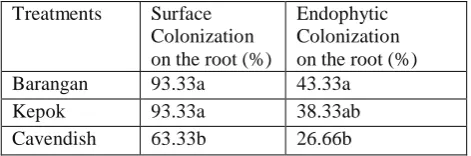
Treatments Surface Colonization on the root (%)
Endophytic Colonization on the root (%) Barangan 93.33a 43.33a Kepok 93.33a 38.33ab Cavendish 63.33b 26.66b pieces of roots grow minimum one colony of
T. viride (Ozbay and Newman, 2004).
The existance of endophytic T. viride in roots tissue
The existence of endophytic T. viride in the epidermal tissue and cortex was observed under microscope. Observation of endophytic capability was started in 1 week old of plants until 8 weeks after planting with the interval time of 14-days. Endophytic observations were conducted in such manner, plant was unloaded carefully, roots washed under running water, then cut into 2-cm pieces. Root pieces that will be used to determine infection of T. viride put in a 200 mL beaker already containing 10% KOH solution, then the roots of banana seedlings thinly sliced with a knife, then heated on the stove electricity for 5-10- minutes. 10% KOH solution discarded. Roots washed with HCl 1% for 3 minutes. HCl discarded and then the roots stained with Lactophenol Trypan Blue. Roots in the paint solution are heated to Lactophenol solution. Lactophenol solution also plays excessive melt paint, and as a preservative root that has been colored to a certain time. The roots that have been painted were placed on glass objects and observed under a microscope. (Giovanetti and Mosse, 1980)
Parameters observed: effects of colonization on the development of Fusarium Wilt
Incubation period: Observation begins 3 days after Foc inoculation untill 7-week old plants after planting. The percentages of symptomatic leaves were observed by counting the number of symptomatic leaves on each plant. Observations began one week after Foc inoculation untill 7-weeks after planting with an interval of 7 days. The percentage of symptomatic leaves calculated using formula as follow:
Where
Pd = the percentage of symptomatic leaves Di = number of symptomatic leaves per seedling
D = the number of leaves per seedling
199 Parameters observed of increasing banana seedling growth
Number of leaves (pieces): leaf number was calculated after 1 week old plants after planting, by counting the number of leaves per treatment until the end of the observation. Increase number of leaves is the number of late leaves - number of early leaf. Plant height (cm), observations of plant height carried out once a week by measuring plant from root collar to the top point of growing. Plant height was measured after 1 week to 7 weeks after planting. Circumference / diameter of the stem (cm), observations of stem diameter were measured after the plant was 1 week to 7 weeks after planting, with 7-days intervals. Banana dry weight (g)
Observations were made at the end of the observation at the time of 45-day-old plants. Plants were cut to pieces then wrapped with paper and then weighed. Dry weight was recorded in oven by heating at a temperature of 65 oC for 2 x 24 hrs. Then, it was weighed. RESULTS AND DISCUSSION
Surface and endophytic colonization capability of Trichoderma viride (T1sk) on the banana seedling root
Based on the analysis of variance, the percentage of colonization capability of T. viride (T1sk) on the banana seedling root was not significant (p<0.05) between Barangan and Kepok but significantly (p<0.05) different with Cavendish. Endophytic capability of T viride on each banana cultivars showed significantly (p<0.05) different results. Endophytic capability of T. viride was not significant (p<0.05) different between Barangan with Kepok but significantly (p<0.05) different between barangan with cavendish (Table 1).
Table 1. Surface and endophytic colonization
© 509
The highest surface and endophytic colonization capability of T. viride (T1sk) found in Barangan and Kepok. It is thought related to the complex root structure. Based on observation of roots of seedlings found that Barangan and Kepok have lateral roots that more spread than Cavendish. It can provide space for T. viride (T1sk) to colonize the roots. High colonization of T. viride (T1sk) on roots of banana seedlings will be able to block the pathogen contacting the roots. The T. viride grew on the root had the mycelium that spread all the surface of the root so the surface of roots were covered by the mycelium and the conidia of T. viride. When the Foc contacted to the root it was difficult to germinate and
200 Barangan (93.33 and 43.33) and kepok (93.33 and 38.33).
a b
h
grew because the space had been covered by c h d h T. viride. According to Harman (2004)
Trichoderma could grow on plant root system which increasing the growth of plant and gave the protection to the roots from pathogenic infection. Surface and Endophytic colonization capability of T. viride (T1sk) on banana seedling root is shown in figure 1 and 2.
a
b
Tv-T1sk
Fig.1. Surface colonization of T. viride ((T1sk) on Banana seedling root after 75 days planting that had been transfered to Potato Dextrosa Agar Medium : a. part of root, b. T. viride (T1sk) colony.
Colonization effects of Trichoderma viride
on various cultivars of banana against fusarium wilt disease
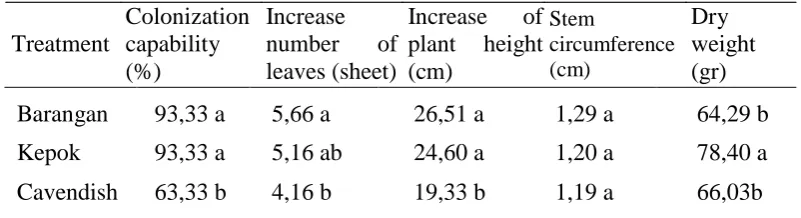
Colonization effects of Trichoderma viride on development of Fusarium wilt against various types of bananas can be seen in Table 2. The highest surface and endophytic colonization capability of T viride (T1sk) found in
Fig.2. Endophytic colonization of Trichoderma viride (T1sk) on the banana seedling root after 75 days planting : a- control (no endophytic), b- endophytic on Kepok cultivar), c- endophytic on Cavendish cultivar, d- endophytic on Barangan cultivar, h = hifa T. viride (T1sk).
201 Table 2. Surface and endophytic colonization capability effects of Trichoderma viride (T1sk)
against development of Fusarium wilt disease on banana seedling
Treatment Colonization
Trichoderma spp. could be protection against infections of plant pathogens must be able to colonize plant roots as surface and endophytic colonization. Yedidia et al. (1999) reported that Trichoderma colonized surface and endophytic of cucumber showed that increasing activity of compound resistance in the roots and leaves of plant. According to Nurbailis et al. (2016) treatment of Trichoderma spp. on the banana seedling root before planting indicated increasing the
activity of citinase enzyme in the root tissue that caused induce resistance of seedling against Foc.
Effects of surface and endophytic colonization capability of T. viride (T1sk) on banana seedling root to the plant growth Effects of surface and endophytic colonization capability of T. viride (T1sk) on 3 cultivars of banana seedling roots to plant growth can be seen with the high increase in the number of leaves, plant height, stem circumference at three banana cultivars (Table 3).
Table 3. Effect of surface and endophytic colonization capability of T. viride (T1sk) on banana seedling roots to plant growth seedlings making the seedlings stronger. Bae et al. (2011) reported that Trichoderma isolates were endophytic on pepper root caused delayed infection of Phytophthora capsici and made the plant strong. According to Cornejo et al. (2014) application of T.
virens (TV.29.8) and T. atroviride (IMI 2060040) promote the plant growth by increasing of lateral root and root hairs of Arabidopsis seedling. These fungi might enhance the plant IAA level.
The highest Surface and endophytic colonization capability of T. viride (T1sk) found in Barangan and Kepok, reached 93.33% and endophytic capability of 43.33% and 38.33%, could reduce Fusarium wilt disease on banana and promote plant growth. REFERENCES
© 509
Cercetari Agronomice in Maldova, 165: 91- 98.
Bastidas, F.G. and Ordenez, N., Konkol, J., Al- Qasim, M., Naser, Z. and Abdelwali, M. 2014. First report of Fusarium oxysporum f.sp. cubence tropical race 4 associated with panama disease of banana outside southeast Asia. Plant Disease, 98: 694.
Bae, H., Roberts, D.P.,., Sublim, H., Strem, M. D., Chulpark, S., Ming Ryu, C., Menick, R.L. and Bayley,B.A. 2011. Endophytic trichoderma isolates from tropical environment delay disease onset and induce resistance against Phytophthora capsici in hot pepper using multiple mechanisms. Molecular Plant-Microbe Interaction, 24: 336-351.
Blaszczyk, L., Popiel, D., Chelkowski,J., Koczyk, G., Samuel, G. J., Eralsty, K.S. and Siwulski, M. 2011. Species diversity of Trichoderma in Poland. Journal of Applied Genetica, 52: 233-243.
Blomme, G., Draye, X., Rufykiri, G., Delerck, S., De Waele, D., Tenkuouano, A. and swennen, R. 1999. Progress in understanding the roots of Musa sp. networking banana and plantain. Annual Report 1999. France. IPGRI INIBAB. P. 14
– 19 .
Buddenhagen, I. 2009. Understanding strain diversity in Fusarium oxysporum f. sp. cubense and history of introduction of tropical race 4 to better manage banana production. Acta Horticulturae, 828: 193 – 204.
Cornejo, H.A.C., Rodriquezs, L.M., Cuevas, R.A. and Bucio, J.L . 2014. Trichoderma spp. improve growth of Arabidopsis seedling under salt stress through enhance root development, Osmolite production and Na+ elimination through root exudates. Molecular Plant-Microbe Interaction, 27: 503-514.
Chaves, N.P., Staver, C. and Dita, M.A. 2016. Potential of Richoderma asperrelum for biocontrol of Fusarium wilt in banana. Acta Horticultarae (ISHS), 1114: 261-266. Gang G., Bizun, Weihong, M., Xiaofen, L.,
Xiaolin, Y. Chaohua., Z., Jianhong M., Huicai Z, . 2013. Biocontrol of Fusarium
202 Wilt of banana key: Influence factor and Strategies. African Journal of Microbiology Research, 7: 4835-4843.
Garg, S.B., Shekhawat, U.K.S. and Ganaphathi, T.R. 2015. Fusarium wilt of banana; biology, epidemiology and management. International Journal of Pest Management, 61: 250-263.
Giovanetti, W. and Mosse, N.B. 1980. Evaluation of techniques for measuring visicular-arbuscular mychorhiza in infective in roots. New Phytopathology, 64: 489- 500.
Harman, G.E. 2006. Overview of mechanism and used of Trichoderma spp. Phytopathology, 96: 190-194.
Harman, G.E., Howell, C.R., Viterbo, A., Chet, I. and Lorito, M. 2004. Trichoderma species- opportuninistic, avirulent plant symbionts. Nature Review/microbiology, 2. Howell, C. R. 2003. Mechanisms employed by Trichoderma species in the biological control of plant diseases: The history and evolution of current concepts. Plant Disease, 87: 4-10.
Maimunah, K. 1999. Evaluasi resistensi lima kultivar pisang (M. paradisica) terhadap tiga macam isolate dan differnsiasi isolat Fusarium oxysporum f. sp. cubense sebagai penyebab penyakit layu. Tesis Program Pascasarjana, IPB.
Nurbailis, Mardinus, Nasir, N. Dharma, A. and Habazar,T. 2008. Penapisan Trichoderma spp dari Rizosfir pisang untuk menekan pertumbuhan Fusarium oxysporum f.sp. cubense in vitro. Journal of Manggaro, 9:16-21.
Nurbailis, Mardinus, Nasir, N., Dharma, A. and Habazar, T. 2016. The chitinase activity in banana seedling that induce by Trichoderma spp. As resistance responce to Fusarium oxysporum f, sp. cubense. International Journal on Advance Science Engineering and Imformation Tehnology, 6: 356-360.
Ordenez, N., Bastidas, F.G., Leghari, H.B., Akkary, M.Y., Harfouche, E.N., Al Anwar, B.N. and Kema, G.H.J. 2016. First report of Fusarium oxysporum f. sp. cubense tropical race 4 causing panama disease in Cavendish bananas in Pakistan and Libanon. Plant Disease, 100: 209.
Ploetz, R.C. 1990. Vascular wilt disease ; panama desease of bananas. in fusarium wilt of banana. APS Press, St Paul.
Pushvapavathi, Y., Dash, S.N., Madhavi, N. and Deepika, D. 2016. Biological control
203 Yedidia, I., Benhamou, N. and Chet, I. 1999. Induction of defense responses in cucumber plants (Cucumis sativus, L.) by the biocontrol agents Trichoderma harzianum. Applied Environment and Microbiology, 65: 1061-1070.
Viterbo, A. and Chet, I. 2006. TasHyd1, a new hydrophobin gene from the biocontrol agent Trichoderma asperellum is involved in plant root colonization. Molecular Plant Pathology, 7: 249–258.
of Fusarium wilts disease of banana with emphasis on Trichoderma spp and Pseudomonas spp. Plant Archives, 16: 51- 59.
Sundaramoorthy, S. and Balabaskar, P. 2013. Biocontrol efficacy of Trichoderma spp against wilt of tomato caused by Fusarium oxysporum f. sp. Lycopersici. Journal of Applied Biology and Biotechnology, 1: 36– 40.
Nurbailis*, Martinius, and Adriansyah, H. Department of Plant Protection, Faculty of Agriculture, Andalas University, Limau Manis Campus, Padang 25163.
*Correspondent author Tel. No. : 0751-72701 Fax N. :0751-72702