The earliest applications of chemical processes
were concerned with extraction and working of
metals and manufacture of pottery.
These arts were carried out without any theoritical
backgroud, but often with considerable skill.
Before the finding of metals, usually their
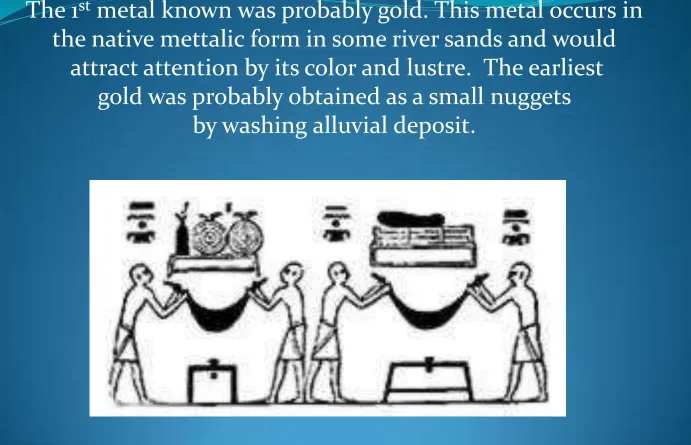
The 1st metal known was probably gold. This metal occurs in
the native mettalic form in some river sands and would attract attention by its color and lustre. The earliest
gold was probably obtained as a small nuggets by washing alluvial deposit.
Fig 2. Sumerian copper statuette (3300 BC)
The next metal known was probably copper and some think it was known even before gold in Egypt. The Egyptian copper
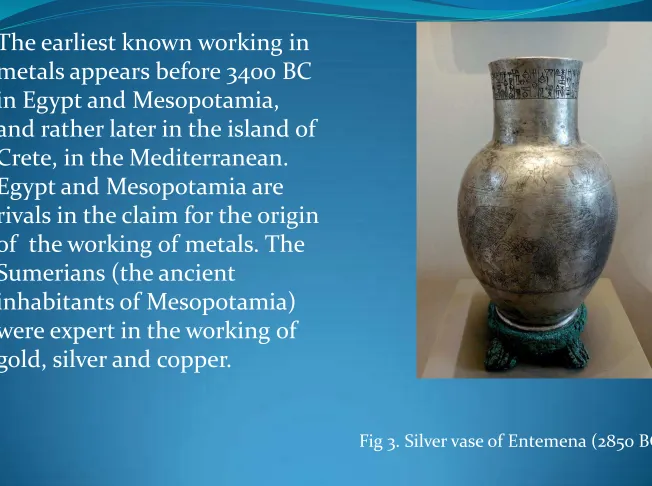
Fig 3. Silver vase of Entemena (2850 BC) The earliest known working in
metals appears before 3400 BC in Egypt and Mesopotamia,
and rather later in the island of Crete, in the Mediterranean. Egypt and Mesopotamia are
rivals in the claim for the origin of the working of metals. The Sumerians (the ancient
Gold and copper also occurs in the island of Crete, which was the centre of an old civilization known as the Minoan. The Cretans probably learnt the use of metal frop Egypt, with which the were in relation from the earliest times.
A great advance in metal working was the invention of bronze, an alloy of copper and tin. The earliest Egyptian bronze is dating to about 3000 BC.
The big question : Where did the tin came from?
(nowadays, there are no tin mines in both of Egypt and Mesopotamia)
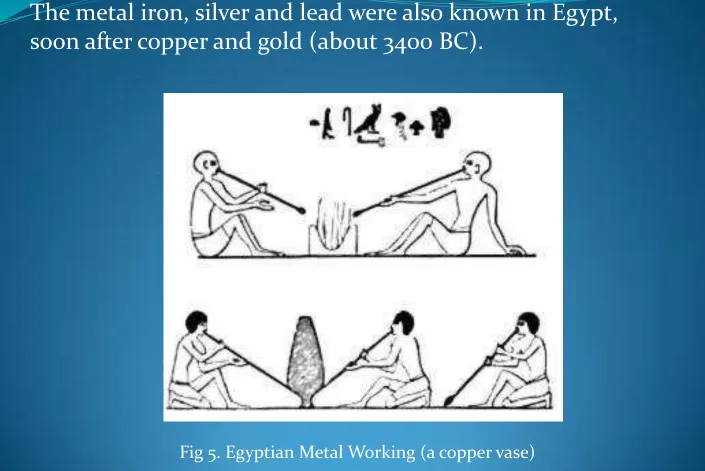
Fig 5. Egyptian Metal Working (a copper vase)
The early iron was very scarce and was probably (since it contains nickel) obtained from meteorites.
Iron tools were found in the pyramid of Cheops (2900 BC) and do not contain nickel. Iron was used sparingly in Egypt about 2000 BC, which come from the Land of the Hitties, in Asia Minor, around the Black Sea. The Hittites
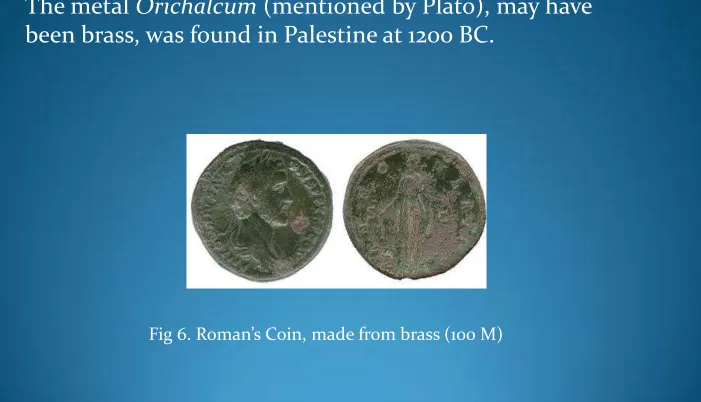
The metal Orichalcum (mentioned by Plato), may have been brass, was found in Palestine at 12oo BC.
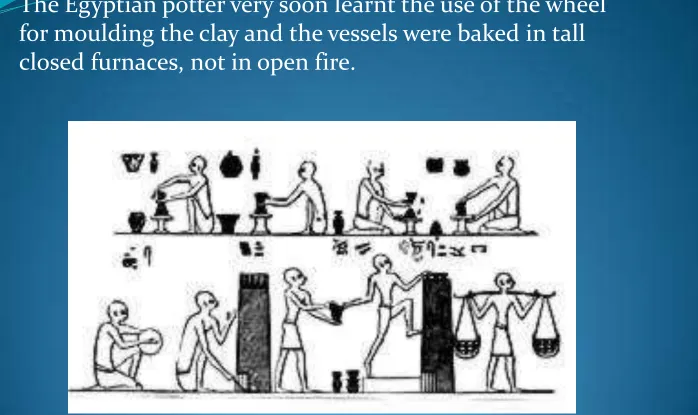
Fig 7. Egyptian making pottery with furnace
The manufacture of glass on the large scale apparently bagan in Egypt about 1370 BC. The alkali (natron, sodium carbonate found in Egyptian lakes near Alexandria) was melted with crushed quartz in crucibles.
A deep blue color Egyptian blue was made in Egypt by
heating silica with malachite and lime in the temperature range 830 – 90o oC.
The name of elements stoicheia) was first used by Plato (427 – 347 BC), who assumed that things are produced
from a formless primary matter, perhaps just space, taking
on forms .
Aristotle (384 – 322 BC) developed the view that all
substances were made of a primary matter, called hulé”.
Aristotle defined an element or simple body as one of
those bodies into which other bodies can be decomposed and which itself is not capable of being divided into
FIRE
Aristotle took as the fundamental properties of matter. By combining these in pairs, he obtained what are called
Aristotle’s idea :
1. Early idea of transmutation
2. He distinguished between mechanical mixture and
solution and chemical change with complete change of properties.
3. Mercury as silver water chutos arguros)
4. He says that the vapour from sea water evaporated in a vessel condenses as a fresh water on the cool lid and (wrongly) that wine would give water in a similar way (DISTILLATION)
The first clear expression of the idea of an element occurs in the teachings of the Greek philosophers.
1. Thales (640 – 546 BC) supposed that all things were formed of water;
2. Anaxinemes (560 – 500 BC) of air; 3. Herakleitos (536 – 470 BC) of fire;
4. Empedokles (490 – 430 BC) introduced the ideas of
four roots of things: fire, air, water, earth; and two
CHEMICAL KNOWLEDGE OF CLASICAL PERIOD
Theophrastos (315 BC) describing some chemical operations, e.g. manufacture of white lead (Greek,
psimuthion).
lead is placed in an earthen vessel over sharp vinegar
and after it has aquired some thickness of a kind of rust, which it commonly does in about ten days, they open the vessels nad scrape it off. They then place the lead
over the vinegar again, repeating over and over again the same process of scraping it till it is wholly gone. What has been scraped off they then beat to powder and boil (with water) for a long time and what at last settles to
Pliny describes the preparation of mercury :
They put minium cinnabar from Spain in an earthen
vessel well luted over with clay, upon which there is set a pan of iron, and the same covered over the head with
another pot, well cemented. Under the earthen pot a good fire is made and kept continually blown. And thus by circulation there will appear a dew or sweat in the
upper most vessel, proceeding from the vapours set free. When this is wiped off it will be as liquid as water but in
THE CHEMICAL PAPIRY (Leyden papyrus)
A collection of Egyptian recipes discovered in 1928 in a tomb at Thebes in Egypt. The papyrus is writen in Greek at a date probably round 300 M.
One powders up gold and lead into a powder as fine as flour, parts of
lead for 1 of gold and having mixed them, works them up with gum. One covers a copper ring with the mixture; then heats. One repeats several times until the object has taken the color. It is difficult to detect the fraud, since the touchstone gives the mark of true gold. The heat
THE CHEMICAL PAPIRY (stockholm papyrus)
Mix together and put into a pot 2 grams of malachite, 2 grams of
azurite, 130 cc of the urine of a young boy and 180 cc of solution of ox-gall. Put into the pot all the twenty-four pieces of stone, each weighing of 27 grams. Put the lid on the pot and lute it around with clay. Heat for six hours over a gentle fire of olive
wood. When you see the lid has
ALEXANDRIA
It was a modern city in Egypt which was founded by Alexander the Great at the mouth of the Nile river in 331 BC. This city had a mixed popultion of native Egyptian, Greeks, Syrian, and Jews, but was essentially Greek in culture. It contained a temple of the god Serapis, two Libraries and Museum (or university?).
The name of chemistry first occur in Alexandria in 96 M, the
Emperor Diocleitian. There was a book, which had the title chëmeia .
The contents of this book were making (imitating) gold and silver.
The word appears in the Greek autors who report this as χη ία in a
Greek manuscript now at St. Mark’s in Venice, from a work by Zosomos
Illustrations of Chemical Apparatus (Zosimos)
A, B, C, F : distillation (Ambix /Alembic)
The lower part is called lopas and the upper phiale
χη ία or chëmeia probably meant the Egyptian art
and never had the meaning of a black art applied to
magic.
The work of Zosimos contains interesting descriptions and illustrations of chemical apparatus and experiments, but also some mystical matter.
The important feature of Alexandrian treatises was
transmutations . The process was to be effected by
changing the color , e.g. Copper turned white by arsenic.
The transmutting agent was latter called by the Arabs
aliksir elixir .
Another things to note is that Zosimos distinguishes
between what he calls bodies , by which he usually means metals, and spirits , by which he understands the vapours