ISSN- 0975 1556
Research Article
Synthesis and Molecular Docking Study of
4-Chlorophenylquinazoline-4-[3h]-One Derivatives as COX-2 Inhibitor
Tutuk Budiati
*, Suko Hardjono, Melanny Ika Sulistyowaty
Pharmaceutical Chemistry Department, Faculty of Pharmacy, Universitas Airlangga
Available Online: 25th December, 2016
ABSTRACT
According to data from the World Health Organization in 2014, cancer was the second biggest cause of death after heart disease. Several attempts have been made to produce the anticancer drug candidate. Modification of molecules against cancer drugs have been done so they became more effective and efficient. One mechanism of action of cancer drugs is to inhibit COX-2. Quinazolinone derivative compounds has anticancer activity, so this study synthesized some phenylquinazolinone derivatives. Virtual screening was carried out through docking the design compounds into the binding site of COX-2 enzyme (PDB code 3LN1) to predict if these compounds had analogous binding mode to the COX-2 inhibitor. Results obtained in the form of bond energy, indicated by the value of RS. Novel of phenylquinazolinone (4a-h) have been synthesized using anthranilic acid as starting material in three steps reaction. The purity of synthesized compounds was tested by TLC and m.p. data. The structures of the synthesized compound were identified using UV, IR and 1H-NMR spectra. The small RS value indicated a molecular bond that was stable and
predictable had high activity. The smallest RS value was -122.54 kcal / mol and synthesized ranged between 70-85%.
Keyword: molecular docking, synthesis, phenylquinazolinone, cyclooxygenase-2.
INTRODUCTION
Cancer is one of the major causes of death in the world, the second after cardiovascular disease. According to the WHO (2014), breast cancer became the most common cancer in women1. This fact makes many researchers in
the world try to design a new effective anticancer drug. Breast cancer is a multi-factorial disease caused by epigenetic changes and genetic mutations that occur in genes directly involved in the process of cell division and programmed cell death2.
Non-steroidal anti-inflammatory drugs (NSAIDs) appear to reduce the risk of developing cancer. One mechanism through which NSAIDs act to reduce carcinogenesis is to inhibit the activity of cyclooxy-genase-2 (COX-2), an enzyme that is over-expressed in various cancer tissue. Over-expression of COX-2 increases cell proliferation and inhibits apoptosis. Several attempts have been made to produce the anticancer drug candidate. Modification of molecules against cancer drugs have been done so they became more effective and efficient. One mechanism of action of cancer drugs is to inhibit COX-2. Quinazolinone derivative compounds have anticancer activity, Compounds containing the 4[3H]-quinazolinone ring system posses various biological activities3. Some
2,3-diaryl-4[3H]-quinazolinone derivatives exhibit COX-2 inhibitory and anti-inflammatory activities4,5. The
majority of COX-2 inhibitors are diaryl heterocycles. The heterocycle part could be a five- or six membered ring, a quinazoline ring, or as a acyclic form (Fig. 1: a, b, c). The precence of para-sulfonamides or para-sulfonylmethanes
on one of the aryl ring was found to be essential for optimum COX-2 selectivity and inhibitory potency6. On
the other aryl ring, no specific substituents were needed. So, in this study, we will synthesize some 4-chlorophenylquinazoline-4-[3H]-ones (Fig. 1d), followed by molecular docking and in silico studies that were carried out in an attempt to evaluate the drug candidature as COX-2 inhibitor.
MATERIAL AND METHODS Chemistry.
General Procedures
All solvents, chemicals, and reagents were obtained commercially and used without purification. Purity test of the products was performed by the TLC methods on silica gel 60 F254 plates (Merck). Spot detection was performed with UV 254 nm. Melting points were measured with an Electrothermal melting point apparatus without correction. Infrared (IR) spectra were recorded in KBr pellet on a FTIR spectrophotometer (Jasco FT-IR 5300). 1H-NMR spectra were recorded on a JEOL NMR
500 spectrometer, using TMS as internal standard.
Synthesis of 4-chlorophenylquinazoline-4-[3h]-one derivatives
The title compounds 4a-h was synthesized stepwise by the method summarized in Scheme 1.
Synthesis of 2-(4-chlorophenyl)-4H-3,1-benzo-xazin-4-one (2).
in pyridine (30 ml) and the reaction mixture was stirred at room temperature for 1 h. The reaction mixture was poured onto cold water and filtered off through a Buchner funnel. The solid product was washed with cold 10% Na2CO3 solution. The solid obtained was filtered, wash
several times with water and crystallized from aceton-water.
Synthesis of 3-amino-2-(4-chlorophenyl)quina-zolin-4(3H)-one(3).
A mixture of 2-(4-chlorophenyl)-4H-3,1-benzoxazin-4-one(2) (0.01mol) and hydrazine hydrate (0.02mol) in
ethanol (50ml) was heated under reflux for 3 h. The separated solid was filtered, washed with water and crystallized with ethanol.
Synthesis of
(E)-3-(benzylideneamino)-2-(4-chlorophenyl)quinazolin-4(3H)-one derivatives (4a-h)
3-amino-2-(4-chlorophenyl)quinazolin-4(3H)-one (3), benzaldehyde or their derivatives (0.015mol) and 2 drops HCl in ethanol (30ml) were mixed and stirred at room temperature for 1 h. The reaction mixture was poured onto cold water and filtered off through a Buchner funnel. The solid product was washed with cold 10% Na2CO3
Figure 1: The similarity of some compounds that act as COX-2 inhibitor.
Scheme 1: Synthesis of 4-chlorophenylquinazoline-4-[3H]-ones Reagents and conditions: (i) 4-chlorobenzoyl chloride, pyridine, r.t., 1 h.
(ii) hydrazine hydrate, ethanol, reflux, 3h. (iii) benzaldehydes, HCl, ethanol, r.t., 1h.
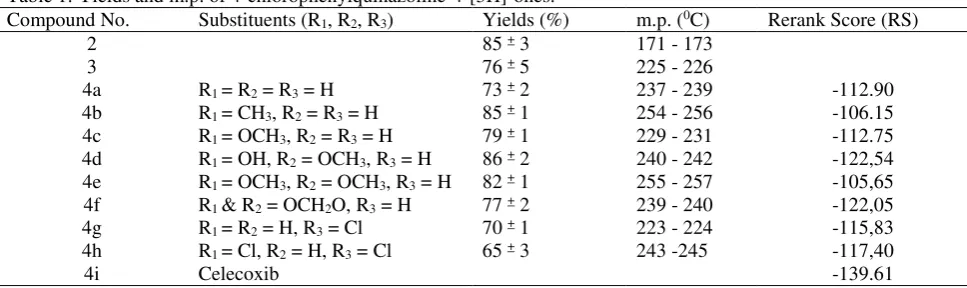
Table 1: Yields and m.p. of 4-chlorophenylquinazoline-4-[3H]-ones.
Compound No. Substituents (R1, R2, R3) Yields (%) m.p. (0C) Rerank Score (RS)
2 85 + 3 171 - 173
3 76 + 5 225 - 226
4a R1 = R2 = R3 = H 73 + 2 237 - 239 -112.90
4b R1 = CH3, R2 = R3 = H 85 + 1 254 - 256 -106.15
4c R1 = OCH3, R2 = R3 = H 79 + 1 229 - 231 -112.75
4d R1 = OH, R2 = OCH3, R3 = H 86 + 2 240 - 242 -122,54
4e R1 = OCH3, R2 = OCH3, R3 = H 82 + 1 255 - 257 -105,65
4f R1 & R2 = OCH2O, R3 = H 77 + 2 239 - 240 -122,05
4g R1 = R2 = H, R3 = Cl 70 + 1 223 - 224 -115,83
4h R1 = Cl, R2 = H, R3 = Cl 65 + 3 243 -245 -117,40
solution. The separated solid was filtered, washed with water and crystallized with ethanol.
Molecular Docking Study
To estimate the anticancer activity of derivatives of some 4-chlorophenyl-quinazoline-4-[3H]-ones, molecular docking was performed using Molegro Virtual Docker (MVD) Ver.5.5. We used receptor cyclooxygenase-2 or COX-2, (PDB code: 3LN1) as the target protein. 3LN1 is a receptor model of celecoxib inhibitor, with the ligand code: S58_701. The most stable chemical conformation of the target compounds was determined. The active conformation of 3LN1 and S58_701 was selected for the preparation step. Cavity was detected to select the pocket binding site (active site of the enzyme). The target compounds (4a-h) and celecoxib, were then docked on to the protein, on the same cavity. The results, concluded which conformation produced the lowest energy state when bound to the target protein, were shown as rerank score (RS).
RESULT AND DISCUSSION Chemistry
In the present work, an attempt has been made to undertake the synthesis of some 4-chlorophenyl-quinazoline-4-[3H]-ones through a multi step process. For this purpose, the required 2-(4-chlorophenyl)-4H-3,1-benzoxazin-4-one (2) was prepared by cyclisation reaction between anthranilic acid 1 and 4-chlorobenzoyl
chloride at room temperature using pyridine as a solvent and also a base. Formation of the product was confirmed by a sharp band at 1768 cm-1 due to the presence of
carbonyl group along with a peak at 1249 cm-1 for C-O
stretching in IR spectra. In the 1H-NMR spectra showed
eight protons of the two benzenoid rings appear as multiplet peak at 7.51 – 8.20 ppm. Benzoxazine (2) was converted to 3-amino-2-(4-chlorophenyl)quinazolin-4(3H)-one (3) by its nucleophilicsubstitution reaction with hydrazine hydrate in ethanol under reflux condition for 3 hours. Insertion of nitrogen in the ring was characterized by disappearance of band at 1249 cm-1 of
C-O and shift of carbonyl band from 1768 to 1662 cm-1.
Appearance of new peaks near 3299 and 3209 cm-1 for
N-H stretching also helped in assigning structure of (3). In the 1H-NMR spectra showed eight protons at 7.26 – 8.27
ppm (multiplet), and a broad singlet peak of two protons of NH2 at 4,46 – 4.92 ppm. When (3) was treated with
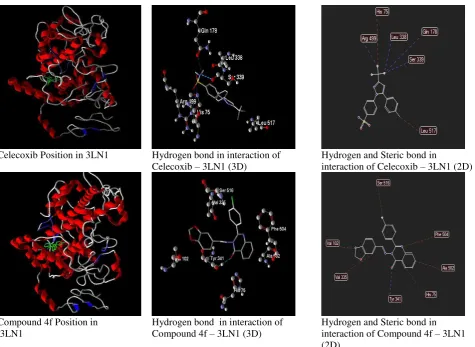
different benzaldehydes using HCl as catalyst in ethanol and stirred at room temperature for 1 h, the reaction goes by its condensation afforded corresponding arylidenes derivatives (4a-h) in quantitative yields. The existence of donor-electron groups in the para position of benzaldehydes will facilitate modthe reaction so that the yield is high. On the other hand, electron-withdrawing group, such as Clsubstituent, will complicate the reaction. Substituent in the ortho position will decrease the reaction yield (Table 1). The formation of 4a was Celecoxib Position in 3LN1 Hydrogen bond in interaction of
Celecoxib – 3LN1 (3D)
Hydrogen and Steric bond in
interaction of Celecoxib – 3LN1 (2D)
Compound 4f Position in 3LN1
Hydrogen bond in interaction of Compound 4f – 3LN1 (3D)
Hydrogen and Steric bond in interaction of Compound 4f – 3LN1 (2D)
proved bythe existence of the benzilidene group; it was identified from NMR spectra, ie there is one proton signal at 11.92 (s, 1H) (compound 6a) or 11.55 (s, 1H) (compound 6b) which is a proton from = C-H. Lactam ring-6 remains from the IR spectra in the wave number of 1657 (6a) or 1671 cm-1 (6b).
Molecular Docking Study Result
The molecular docking study of tested compounds with receptor 3LN1 is shown in Table 1. Rerank score (RS) is a parameter which strictly determines potential activity of drug-receptor. It is also a logarithmic cumulative energy between drug-receptor interaction by hydrogen, electronic, and steric bond interaction. The smaller rerank score shows the smaller amount of energy required in forming drug-receptor interaction that give an assumption the drug is more suitable to occupying active site of the receptor. Therefore, compound which has the lower rerank score than the ligand, to be estimated has stronger
activity than the ligand’s. Table 2 showed the rerank
A brownish yellow crystalline powder was obtained, yield 85%; mp. 171 - 1730C; UV-Vis (EtOH), nm: 288 A white crystalline powder was obtained, yield 76%; mp. 224 - 2260C; UV-Vis (EtOH), nm.: 240; 274 and 304. IR
3045, 2949, 1670, 1633, 1440, 1278, 1023, 751. 1H-NMR
(DMSO-d6), /ppm: 6.81 – 8.57 (multiplet), 11H; 11.93
(singlet), 1H; 3.85 (singlet), 3H; 9.56 (singlet), 1H.
(E)-2-(4-chlorophenyl)-3-(3,4-dimethoxybenzylideneamino)quinazolin-4(3H)-one(4e).
white voluminous powder; yield 82%; mp. 255 - 2560C;
UV-Vis (EtOH), nm.: 249 and 330. IR (KBr) vmax, cm-1:
3025, 2919, 1679, 1636, 1447, 1268, 1020, 746. 1H-NMR
(DMSO-d6), /ppm: 6.98 – 8.55 (multiplet), 11H; 11.94
3061, 2901, 1643, 1522, 1438, 1313, 1020, 739. 1H-NMR
(DMSO-d6), /ppm: 6.95 – 8.57 (multiplet), 11H; 11.97
(singlet), 1H; 6.10 (singlet), 2H.
(E)-3-(2-chlorobenzylideneamino)-2-(4-chlorophenylquinazoline-4-[3H]-ones, with the range of 65% to 86% yields. From in silico study data the smallest RS value was -122.54 kcal/mol. The molecular docking study signified that the compounds can act as COX-2 inhibitor. The generated pharmacophore could further be
used to design and develop new drugs.
ACKNOWLEDGMENTS
Part of this research were funded by Ministry of Research, Technology and Higher Education of the Republic of Indonesia through PUPT scheme fiscal year 2016. We are grateful to Prof. Dr. Siswandono, Apt., MS. from the Faculty of Pharmacy, Universitas Airlangga the one who has the Molegro 5.5 program license.
REFERENCES
1. American Cancer Society. Cancer Facts and Figures 2015. Atlanta: American Cancer Society.
3. Connolly, DJ; Cusack, D; O’Sulivan, TP; Guiry, P., 2005, Synthesis of quinazolinones and quinazolines.
Tetrahedron, 61, 10153-10202.
4. Hitkari, A; Bhalla, M; Saxena, AK; Verma, M; Gupta, MP; Shanker, K., 1995, Substituted quinazolinones and their anti-inflammatory activity. Boll. Chim. Farm., 134, 609-615.
5. Yadav, MR; Shirude, ST; Parmar, A; Bataraman, R; Giridhar, R., 2006, Synthesis and anti-inflammatory activity of 2,3-diaryl-4[3H]-quinazolinones. Chem. Het. Compd.. 42.
6. Kurumbail, RG; Stevens, AM; Gierse, JK; McDonald, JJ; Stegeman, RA; Pak, JY; Gildehaus, D; Miyashiro, JM; Pening, TD; Seibert, K; Isakson, PC; Stallings, WC., 1996, Structural basis for selective inhibition of cyclooxygenase-2 by anti-inflammatory agents.
Nature, 384, 644-648.
7. Sporn MB & Suh N. 2000. Chemo-prevention of Cancer.Carcinogenesis 21(3), pp. 525-530.
8. Thornalley, PJ. 2002. Isothiocyanates: mechanism of cancer chemopreventive action. Anti Cancer Drug
13(4), pp. 331-338.
9. Michaux C., de Leval X, Fabien J, Dogne JM, Pirotte B, Francois D. 2006. Structure based pharmacophore
of COX-2, selective inhibitors and identification of original lead compounds from 3D data base searching method. Eur. J. of Med. Chem. 41, pp. 1446-1455. 10.Lipinski, C.A.; Lombardo, L.; Dominy, B.W.; Feeney,
P.J.,2001, Experimental and computational approaches to estimate solubility and permeability in drug discovery and development settings. Adv. Drug Deliv. Rev., 46, 3–26.
11.Hayun, Hudiyono S., Hanafi M., Yanuar A., 2012, Synthesis and COX-2 Inhibitory Activity of 4-[(E )-2- (4-Oxo-3-phenyl-3,4-dihydroquinazolin-2yl)ethenyl]-benzene-1-sulfonamide and Its Analogs.
Pharmaceuticals, 5, 1282-1290.
12.Abdel Gawad, N.M.; Georgey, H.H.; Youssef, R.M.; El-Sayed, N.A., 2010, Synthesis and antitumor activity of some 2,3-disubstituted quinazolin-4(3H )-ones and 4, 6 disubsti-tuted-1,2,3,4-tetrahydro-quinazolin-2H-ones. Eur. J. Med. Chem., 45, 6058– 6067.