i
A THESIS
In Partial Fulfilment of the Requirements
For Master’s De
gree in Linguistics
Maria Christiani Sugiarto
13020212420021
FACULTY OF HUMANITIES
DIPONEGORO UNIVERSITY
ii
DEBATES 2014
Submitted by
Maria Christiani Sugiarto 13020212420021
Approved on August 24th, 2015 by
Advisor,
Dr. Suharno, M.Ed. NIP. 195205081983031001
Master’s Program in Linguistics Head,
iii
DEBATES 2014
Submitted by
Maria Christiani Sugiarto 13020212420021
Approved by
Strata II Journal Examination Committee Master Degree in Linguistics
On August 31th, 2015
Chairman
Dr. Suharno, M. Ed. ______________________________
First Member
Dr. Deli Nirmala, M. Hum. ______________________________
Second Member
Dr. Agus Subiyanto, M.A ______________________________
Third Member
iv
knowledge and belief, this study contains no material previously published or written by another person or material which to a substantial extent has been accepted for the award of any other degree or diploma of a university or other institutes of higher learning, except where due acknowledgement is made in the text of the thesis.
Semarang, 12 August 2015
v
spirit so this thesis on “The Structures of Argument in Indonesia Presidential
Debates 2014” came to a completion. I would like to thank some people who have
contributed to the completion of this research report.
The deepest gratitude and appreciation are addressed to Dr. Suharno, M.Ed., my advisor who has given me continuous guidance, helpful correction, moral support, advice and suggestion, without which it is doubtful that this thesis came into completion. My deepest thanks also go to the following:
1. Dr. Agus Subiyanto, M.A., the Head of Postgraduate Program in Linguistics of Diponegoro University, and Dr. Deli Nirmala, M.Hum., the Secretary of Master Program in Linguistics of Diponegoro University, who always supported me mentally and morally as well as encouraged me to finish my thesis. A question about my thesis progress meant a lot to me.
2. All lecturers of Undergraduate and Postgraduate Program of Linguistics, Diponegoro University Semarang who kindly shared their knowledge especially Drs. Hendarto Supatra, S.U., J. Herudjadti Purwoko, Ph.D. and Dr. Nurhayati, M.Hum. for their valuable inputs relating to my thesis.
vi
University for the encouragement and support, especially Ebeb aka Habiba, Mirijaneha aka Almira, Mb Dika, Mas Faqih, Mas Ancha, Cimol aka Tohom, Ucup aka Yusuf, Bulet aka Nana, Qaqa Woeri, Qaqa Dian, Bundar aka Wiwik, Qaqa Cici, Ika Swieke and many other friends who I cannot mention one by one. Thank you for the time, joke and knowledge we shared together.
The writer realizes that this thesis is still far from perfect. I, therefore, will be glad to accept any constructive criticism and recommendation to make this thesis better. Finally, I do hope this thesis will contribute something useful to the reader who wishes to learn how to make a well-formed argument.
Semarang, 12 August 2015
vii
Maria Christiani Sugiarto [email protected]
Abstract
President is a person whom people can rely on to lead the country. In Indonesia, presidential debates are quite new to start as a medium to campaign, yet it is powerful. In 2014, the presidential debates even were more appealing as there were only two candidates. Therefore, this research deals with the structures of arguments used by Jokowi and Prabowo in presidential debates 2014. I utilized the model of argumentation by Toulmin (2003) in order to get the result of this qualitative research. The results show that Jokowi and Prabowo both produced varied structures.From the first debate to the last debate, the completeness of the structures increased. Prabowo has shown better argument structure in “Pembangunan Demokrasi, Pemerintahan yang Bersih dan Kepastian Hukum” and “Politik International dan Ketahanan Nasional”, while Jokowi is more superior in“Pembangunan Ekonomi dan Kesejahteraan Sosial” and “Pangan, Energi dan Lingkungan”. Those results were based on the occurence of the strong structures Prabowo and Jokowi utilized in the debates.
viii
Maria Christiani Sugiarto [email protected]
Abstrak
Presiden adalah seorang yang dapat diandalkan untuk memimpin negeri ini. Di Indonesia, debat presiden cukup baru sebagai media untuk berkampanye, tetapi efek debat itu sangat kuat. Pada tahun 2014, debat presiden bahkan lebih menarik karena hanya terdapat dua kandidat. Oleh karena itu, penelitian ini mencakup struktur argumen yang digunakan oleh Jokowi dan Prabowo dalam debat presiden tahun 2014. Saya memanfaatkan model argumentasi Toulmin (2003) untuk mendapatkan hasil penelitian kualitatif ini. Hasil penelitian menunjukkan bahwa Jokowi dan Prabowo membuat struktur yang bervariasi. Dari debat pertama ke debat terakhir, kelengkapan struktur cenderung semakin lengkap. Dengan melihat struktur, Prabowo menunjukkan struktur argumen yang lebih baik di "Politik Internasional dan Keamanan Nasional" dan "Pengembangan Demokrasi, Pemerintahan yang Baik dan Negara Hukum", sementara Jokowi lebih unggul dalam debat "Pembangunan Ekonomi dan Kesejahteraan Sosial" dan dalam debat "Pangan, Energi dan Lingkungan ". Hasil tersebut berdasarkan pada frekuensi dari struktur kuat yang Prabowo dan Jokowi gunakan dalam debat.
ix
LETTER OF APPROVAL……….………ii
VALIDATION………..……….iii
CERTIFICATE OF ORIGINALITY………...iv
ACKNOWLEDGEMENT………..v
ABSTRACT……….vii
TABLE OF CONTENT………ix
LIST OF TABLES………...xii
LIST OF FIGURES……….xiii
CHAPTER I INTRODUCTION……….…………..………...1
1.1.Background of the Study……….……...1
1.2.Problem Formulation…..……….…...5
1.3 Objective of the Study….………...5
1.4 Scope of the Study ………….………...………...6
1.5 Limitation of the Study………...…..6
1.6 Significance of the Study…...7
1.7 Definition of Key Terms………...………8
CHAPTER II REVIEW OF RELATED LITERATURE ………...10
2.1. Previous Study………...………...…..10
2.2. Theoritical Framework………..……….12
2.2.1 Discourse Analysis ………..………12
2.2.2 Political Discourse………..………..13
2.2.3 Rhetoric…………...………..…………...14
x
2.2.5 Argument………... 19
2.2.6 Types of Reasoning ………...23
2.2.7 Toulmin’s Model of Argumentation……….…….24
CHAPTER III RESEARCH METHOD………..……....…………..….36
3.1.Types of Research ………..….….…36
3.2.Data Collection ………...………..………..…36
3.3.Method of Data Analysis ………..…………...38
CHAPTER IV FINDINGS AND DISCUSSION………...…..………..…40
4.1The Structures of President Candidates’ Utterances…………...…………...40
4.1.1 Jokowi’s Argument Structures ………..45
4.1.1.1 Claim-Ground ………...…………...………...45
4.1.12 Qualifier-Claim-Ground………...………... 47
4.1.1.3 Claim-Ground-Warrant………...………....51
4.1.1.4 Qualifier-Claim-Ground-Warrant ……….…….54
4.1.1.5 Claim-Ground-Rebuttal………...56 4.1.1.6 Qualifier-Claim-Ground-Rebuttal………...58
4.1.1.7 Qualifier-Claim-Ground-Warrant-Rebuttal……….60
4.1.1.8 Claim-Ground-Warrant-Backing……….……61
4.1.1.9 Qualifier-Claim-Ground-Warrant-Backing ………62
4.1.1.10 Claim-Ground-(Warrant)-Backing ………...64
4.1.1.11 Claim-Rebuttal ………..………65
4.1.1.12 Qualifier-Claim-Rebuttal ………..66
xi
4.1.2.4 Qualifier-Claim-Ground-Warrant………....72
4.1.2.5 Claim-Ground-Rebuttal………..……….75
4.1.2.6 Qualifier-Claim-Ground-Rebuttal …….………..………..…….75
4.1.2.7 Claim-Ground-Warrant-Backing ……….……….…….76
4.1.2.8 Claim-Ground–(Warrant)-Backing……….……78
4.1.2.9 Claim-Rebuttal……….…...80
4.1.2.10 Qualifier-Claim-Rebuttal ……….…81
4.2 The Characteristics of Jokowi and Prabowo in Argumenting Based on Toulmin’s Model………....81
CHAPTER V CONCLUSIONS AND SUGGESTIONS ………..…84
5.1. Conclusions ……….………...84
5.2. Suggestions ………..……….…….86
References………….………...88
xii
TABLE TITLE PAGE
2.1 Toulmin Model and Syllogism 25
3.1 The Debate List of Presidential Debate 35
3.2 Summary of the Characteristics of Elements of Toulmin’s Model
37
3.4 Sample of Analysis Display 38
xiii
LIST OF FIGURES
FIGURE TITLE PAGE
2.1 Rhetoric Triangle 16
2.2 A Text Typology 21
2.3 Types of Argumentation 22
2.4 Expanded Toulmin’s Model of Argumentation 25 2.5 Example of Toulmin’s Model of Argumentation 30 2.6 Application of Toulmin’s Model of Argumentation in
Indonesian
CHAPTER I
INTRODUCTION
1.1 Background of the Study
Presidential elections have never been as appealing as the 2014 Presidential Elections. Prior to the election on 9th of July 2014, there had been 6 presidents leading Indonesia. At the time the former President, Susilo Bambang Yudoyono and the Vice President, Budiono had almost finished their work period by that date. Tracing back to the past, Indonesia mostly had a military personnel as presidential candidates. Nevertheless, the 2014 president election was different since one of the candidates was a civil servant. Jokowi was a former Mayor of Solo and Governor of Jakarta and Prabowo was a former Lieutenant General before he became one of the presidential candidates. Yet, both are business men who have different experiences in leadership.
As the freedom of media and the democracy of Indonesia has become more open, the campaign can now be presented in almost all forms of media, newspapers, magazines and TV programmes. TV stations even have opened up an access to citizens by allowing candidates to promote themselves. Schroeder states that presidential debates have become an essential campaign part for the party as a result of television and politics’ unification (2000: 9). The fact that only two groups stood
those debates that Joko Widodo was sworn as Indonesia’s 7th president for the
period of 2014-2019, the discussion about the debates are still remarkable. It makes a meaningful point since it can let people be more sensitive to their arguments. As the most efficient and powerful campaign, 5 times of debates that involved the president and vice president candidates were great source in deciding the most potential candidate.
Presidential debates have no persistent models to follow and no exact rule to define the best format in debates as long as the debate aims to discuss better solutions in the way people think and do. The United States of America started to use presidential debate back in 1960. Starting from the first time till the last Presidential debate (2012), The United States have made several changes to the format of their presidential debates. It is a way far apart compared to Indonesia which has only ever had 2 Presidential debate periods. The current debates in 2014, nonetheless, were engaging to follow as the candidates were already well-known.
The underestimated future of Indonesia is in the hands of citizens. However, the role of president never can be underestimated from the successful path of a nation. The speech of a leader candidate from this nation is deemed important to be watched as it more or less can reflect personalities, intellegency as well as the grand scheme to make changes to Indonesia in the future. As Schroeder points out that:
No amount of TV makeup can change the way a man’s eyes move, or the way his lips are drawn under surges of animus or temper.When the camera burrows into a man’s face, the fact that some wrinkles may be covered up by pancake makeup is not so important as the visibility of the emotions that come to the surface. The strength of the TV debates derives less from what is hidden than from what is impossible to conceal (2000: 203).
For these reasons, I believe that this topic is very intriguing when analyzed, as someone’s speech in debate also cannot be concealed by those hidden aspects on
TV as his or her true emotion and intention is the ones captured by the audiences.
Previous research which analyzed debates has been carried out. The first research employed the theory of Pragmadialectic as the researcher wanted to find the result of the debate by analyzing the interaction of the debaters. However, Indonesia Presidential Debate 2014 had no clear opposition between the candidates. Therefore, I utilize Toulmin’s model of argumentation which examines the
structure of the arguments. The theory of Toulmin was employed to analyze arguments in Majalah TEMPO by Winahyu (2011). Even though this thesis’ data is in the form of spoken discourse in debates, it is suitable and even it has higher difficulty in analyzing.
By utilizing Toulmin’s theory, I tried to find models of arguments. The
formal criteria of mathematical logic (Hitchcock & Verheij, 2006: 1). In a conversation, discussion and debate, for instance, need theory improvements so that it can be analyzed. As Jarvie (1976:313) contend that Toulmin’s model is requisited to mediate between logic and rationality. In the field of law, for instance, to decide a court result it is not as easy as how logic is utilized because the result of the court does not fully logic matter. It is also rule-following. Rule itself is diverse depending on what matters it is on. Therefore, it neglects a decision universally. Logic needs to develop because knowlede does so.
Toulmin’s argumentation model is a fresh air for the study of argumentation. According to Van Dijk, Toulmin’s argumentation model (1958) is
the best in reconstructing arguments in detail (1985:165). It makes a great contribution for researchers who want to analyze everyday argument and to diminish sceptical conclusion that formal reasoning has. Aristotle was the one who started formal reasoning, syllogism. Formal reasoning only perfectly defines argument in mathematics, laws and medical field. This classical formal reasoning is valued to not be flexible in breaking everyday arguments down such as discussion, debate. It is strict. For example, predictions for disaster mitigation cannot be considered as a perfect example of logic application since the premisses are taken from the past and present, while the predictions refer to the future. To evaluate everyday arguments which are so random and can be unorganized at a time, it is unsuitably analyzed with formal logic as it tends to see things sceptically.
the important traditional problem of defeating the sceptic. (Jarvie, 1976: 315)
Hence, this thesis examines how the argument structures by the presidential candidates in Indonesia Presidential Debates in 2014. Furthermore, it will also reveal the characteristics of the candidates in argumenting based on Toulmin’s
theory.
1.2Problem Formulations
This research aims to reveal the answers to the questions below in Indonesia Presidential Debate 2014:
1. How do the presidential candidates formulate their arguments?
2. What are the characteristics of Jokowi’s arguments and Prabowo’s arguments?
1.3Objectives of the Study
This thesis exposes some points regarding to the problem formulation listed as follows:
1. To find out the argument structure of the president candidates in presidential debates and the linguistic features based on Toulmin’s argumentation model elements.
2. To reveal the characteristics of presidential candidates’ arguments.
1.4 Scope of the Study
Discourse Analysis and Argumentation Studies. It covers the argument structures analyzed by using Toulmin’s model of argumentation in the 1st debate, the 2nd
debate, the 3rd debate and the 5th debate of Indonesia Presidential Debate 2014. The result of this research is supported by Aristotle’s appeals. Nonetheless, it is only to
describe how far the findings of this research can contribute to the result of the 2014’s president election.
1.5 Limitation of the Study
This research only addresses the president candidates’ utterances during the
debates. Moreover, it only describes the model of arguments by Toulmin that exist in debate. Toulmin’s argumentation model has a focus on how the arguments are
structured. Hence, the focus of this thesis is on the structures of the arguments, not to the logics of arguments such as syllogism. Furthermore, I analyzed the main arguments which are the core of the topic. The analysis of the arguments is not about the unity of the whole arguments, but it is about the completion of each argument. Last but not least, the research will reveal the characteristicss in two president candidates’ arguments. This research, of course, still leaves open further
opportunities for future researchers to build new findings upon it.
1.6Significance of the Study
of books or research to be used as reference. Thus, the theoretical advantages that this thesis have are as follows:
1. It provides more classification and linguistic features for researchers interested in applying Toulmin’s model of argumentation to analyze data in Bahasa
Indonesia.
2. It contributes the way in analyzing Toulmin’s model which cannot be done only by finding the linguistic features, but also the other characteristic such as the function of each element.
3. It gives explanation how arguments are structured in order to win over people.
Besides, the practical contributions that I hope the readers will gain are listed below:
1. It can gives more sensitivity in assessing better argument by applying argumentation model of Toulmin because it is applicable. Not only will the art of persuasion be captured, but how good the claimants structure their arguments.
2. It can help people to understand how to produce arguments easily by bearing in mind the concept of strong structured argument which contains qualifier, claim, ground, warrant, backing and rebuttal.
1.7Definitions of Key Terms
1. Argument: “The term “argument” is used in a special sense, referring to the giving of reasons to support or criticize a claim that is questionable, or open to doubt. To say something is a successful argument in this sense means that it gives a good reason, or several reasons, to support or criticize a claim”
(Walton, 2006: 1).
2. Argumentation: “The term argumentation will be used to refer to the whole activity of making claims, challenging them, backing them up by producing reasons, criticizing those reasons, rebutting those criticisms, and so on”
(Toulmin, Rieke, Jannik, 1984:14)
3. Rhetoric: “Rhetoric is the counterpart of Dialectic. Both alike are concerned with such things as come, more or less, within the general ken of all men and belong to no definite science. Accordingly, all men make use, more or less, of both; for to a certain extent, all men attempt to discuss statements and to maintain them, to defend themselves and to attack others. Ordinary people do this either at random or through practice and from acquired habit. Both ways being possible, the subject can plainly be handled systematically, for it is possible to inquire the reason why some speakers succeed through practice and others spontaneously; and every one will at once agree that such an inquiry is the function of an art” (Aristotle, 2013:3).
forms of argument. A good argumentative essayist is not necessarily a good debater. A man who can write and memorize and deliver a good argumentative address is not necessarily a good debater. The latter must have all the skill of the former, and in addition he must know how to conduct his case on the platform. He must know the rules of the game, and must be able to meet the many situations in offense and defense as they arise in the contest” (O’Neil,
CHAPTER 2
REVIEW OF LITERATURE
2.1Previous Studies
I am interested in investigating the study of arguments that president candidates used in Indonesia Presidential Debates in 2014 as I have already read some references which inspired me to hold research in this topic. In 2014, Indonesian citizens had to vote for the best candidates to be president and vice president. The 2014 President Election was very captivating to follow as there were only two different groups of presidential candidates. I myself as the researcher was also enthusiastic to follow the debate so I could contribute my choice to Indonesian future. Hence, I am eager to seek out the findings of those debates as this thesis’ data.
There is some research related to argumentation. The first research is “Wacana Debat Argumentasi dalam Java Overland Varsities English Debate
(JOVED) 2011 (Kajian Pragma-dialektika)”. Nasihah (2012) found the result of
types of speech act in the arguments: assertive, commisive and directive. These three have the role in the steps of conveying arguments which are confrontation, opening and conclusion. In my research, however, the role of moderators in the Indonesia Presidential Debate 2014 were quite strong which means the interactions were mostly controlled by the moderators. Besides, my focus in this research is on the structures of arguments.
The theory of Toulmin has been applied to analyze arguments in TEMPO magazine with the title “Argumen dalam teks Opini Majalah TEMPO”(Winahyu, 2011). The researcher analyzed 8 opinion texts in Tempo Magazine. She used Toulmin’s model of argument modified with Ramage and Bean’s theory. Moreover,
to analyze the unity of the arguments, she used cohesion. She found that all Toulmin’s argumentative elements which are claim, data, warrant, backing, rebuttal
and qualifier could be found in the texts. She also found that the eight opinion texts that she used as data are all argumentative since it has opening, content and closing, and the writers have an intention to make the readers agree with the writers’
arguments. Even though that research is in the form of written discourse, it has the same theory which is Toulmin’s model of argument.
The third study is by Hidayati (2009). In her research, she employed Toulmin’s model to see whether it could benefit students in writing argumentative
However, this research utilizes Toulmin’s model of argumentation in the
form of spoken discourse. Debate is classified as a dialog spoken discourse. Compared to those reasearch earlier, the complexity level in analyzing dialog is higher since it is two-way argumenting and the speakers talk spontaneously. The present study, however, also aims to reveal which candidate has the better structures in each debate and their characteristics in forming powerful argument structures.
2.2Theoritical Framework 2.2.1 Discourse Analysis
The scope of Discourse Analysis, a branch of linguistic analysis which attracts not only linguists but also non linguists, is very large. A word can be defined as a discourse because it has context. Nonetheless, groups of sentences cannot be defined as discourse if they do not have context, unity, coherence and cohesion.
The study of language viewed communicatively and/or of communication viewed linguistically. Any more detailed spelling out of such a definition typically involves reference to concepts of language in use, language above or beyond the sentence, language as meaning in interaction, and language in situational and cultural context.
In the sub-subjects of discourse analysis, there are some apparent subjects that are essential and frequently get attentions such as political discourse and also rhetoric.
2.2.2 Political Discourse
Discourse Analysis can be complex and it is not surprising that among the types of discourse there may be a gray area where there may appear to be no gap between the two types of discourse apart. As with any legal discourse, politics and criminals who have parts that are not integral, the content or substance of the discourse should be able to be separated and described in relative terms. Mulyana (2005: 57) says that the political area is seen as an area that is not true, cunning or tactical. This provided an opportunity formation of specific terms in the area. Schiffrin (2001:411) states that political discourse is analysed not only from its political side but also from the linguistic side. Politicians will make information up or twist information while using the media. They will say what the public will want to hear in order to be elected. They set their words to tug and play with people’ emotions.
concepts, terms and expressions, which constitute a way of talking about or writing about a particular issue, thus framing the way people understand and act with respect to that issue". Furthermore, Chilton also defines political discourse as a language use where the users intend to apply certain words or structure to associate with certain political behaviour (2004:201).
In politics, any aspect in public performances is essential. Politics and language cannot be separated as language supports political development. Not only physical appearance and emotionally drive, politicians are required to pay attention to every detail in conversing. From phonological aspect, lexical choice, to the structure of argument, politicians must be aware that if they do not converse in utilizing language, politicians might not be considered succesful. Using pronounce, for instance ‘we’, is a powerful approach to reach out to and feel close.
Schiffrin (2001:411) states that there is a difficulty in balancing linguistic analysis and political analysis although the elements of that discourse remain constant such as language role, language structure and the manipulation in using one of those to get political purpose.
2.2.3 Rhetoric
definition of rhetoric has changed following the development of people and ideology. According to Aristotle in Perelman, rhetoric is a technique to persuade people by using emotion, speaker personality and argument (1970: 272). Its definition completed by Cicero in Perelman (1970: 273) in which he stated that the aims that are owned by an orator are to ‘instruct, to move and to please’.
Rhetoric, for instance, is defined quite different in pre-modern era and modern era. According to Aristotle in Booth (2004:4), ‘‘Rhetoric is the counterpart of dialectic. It is the faculty of discovering in any particular case all of the available means of persuasion.’’. While rhetoric is defined in modern era has experienced a change. Rhetoric definitions have broaden its area. In the modern era, rhetoric is defined as ‘‘the art of discovering warrantable beliefs and improving those beliefs in shared discourse . . . the art of probing what we believe we ought to believe, rather than proving what is true according to abstract methods’’ (Booth, 2004: 7).
Rhetoric is defined as the art of speaking well, which is used in the process of human communication. The art of talking does not mean to speak fluently without a clear way of thinking and devoid of content, but rather an ability to speak clearly, solid and full of expression. Black contends that the structure and style of speech is actually the focus of classical theory (2005: 4). Cicero in Perelman mentions that there are 5 types considering the art of argumention which are inventio, dispotio, elocutio, memoria and pronunciatio (1970: 274).
demostratium. Genus deliberatium has a function to what will happen if a policy carried out. Genus ludicium focuses on a decison made by courts. It connects to what happened in the past. While genus demostratium’s function is to show complement or sacrilege by showing good and bad sides. Depending on the taxis there are 5 stages which are exordium which act as the introduction, narratio which is used to support an argument, confirmatio which is often in the form of analogy, refutio which is also called as counterargument and conclusion.
2.2.4 Aristotle’s Appeals
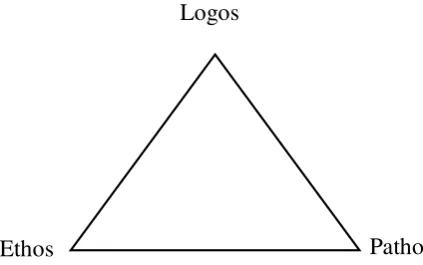
To attract people, rhetoric must contain three criteria, logos, pathos and ethos in constructing appealing speech. Audiences need all three sides of the rhetoric triangle so they have no doubt about the credibility of the communicator , the logic of the arguments and the common sense. It also makes people feel understood as a human being, not just as an object to be persuaded. Logos contains logic proof by using argument. Pathos attracts people’ attention by showing emotion. Ethos is
related to good will, intelligence and character of the orator.
Ethos
Logos
The connections among those three angles are interrelated. If the three angles are exist in a speech, the aims of the speech can be received easily. When a speaker only consider pathos which uses the speaker’s emotion without his or her credibility, he or she may not be trusted. However, if the speaker only focuses on logos without using pathos, the speech will not sound good as well. It will be better if all of the three completing each other to reach the desired goal.
2.2.4.1 Logical appeal
Logical aspect in argument comes from fact, theories and inferences. To make a logical argument, using evidences, reasons and examples to prove or to support a claim have a strong effect to people’ minds. According to Dietsch (2003:245), an
evidence is known as reliable if it comes from primary sources, statistics, established truth, expert opinion and personal experience. When we get the evidence first hand, we call it as primary resource which means the documents are more credible because it does not need to pass the second person. Statistics also can reflect the logical side of argument as long as it comes from reputable statistic institution. Scientific, geographical and historical truths are rarely to be debated. Expert opinion which is qualified can also be a strong support to a claim . Last but not least, a claim can be completed through personal experiences in which the people are involved in the event.
Derived from the word ‘ethic’, this appeal deals with a set of moral values for an
individual or a group of society. Ethical appeal exists in order to evoke the listener to do what is right or wrong, good or bad. An ethical argument needs to suit the listeners’ needs and rights. It is forbidden to use arguments to deceive people for
bad aims. For example, a social event speaker evokes the visitors to give their money to help poor families. However, he takes the money for his own sake.
A good speaker must use evidences and reasons and keep the arguments logical so there is no fallacy and excessive emotional appeals. To be successful in taking speakers’ appeals, we can discuss and give statements back to hinder objections and making goodwill (Clouse, 2004:393).
By employing ethical appeal, the speaker intends to change the mind of the listener by arising certain value or moral in the stand point (Knefel, 1991:272). Ethical appeal comes from the moral character of the speaker.Listeneres are easier to be persuaded as they believe in the sincerity and ethical convictions of the speaker. The speaker may influence the listeners to do what their heart tell them to do. Knefel (1991:273) gives an example where the use of pepticide should be paid attention as there is no attention relating to it. Here the speaker gives his concern and show his ethical appeal.
2.2.4.3. Emotional appeal
is not strong enough to influence the listeners’mind, the completion of at least two
appeals is better (Clouse, 2004:392). Nevertheless, if they are used excessively, they decrease the strength of motivating that was intended to have.
The listeners’ needs and values are the aim of emotional appeal. When
humans feel attracted, they can be easily persuaded. Moreover, emotional appeal creates a push to do something because people need a powerful and irresistible effect (McCrimmon. 1984:338). He also believes that examples are the most effective in influencing. It is true that when humans visualize, it makes it real and very strong in their mind by giving a narration and description. Knefel (1991: 72) mentions that emotional appeal influence the listeners’mind by stirring their feeling strongly.
2.2.5 Argument
Choesin (2004:49-61) asserts that every argument contains a message for the listeners. It means there are three aspects that need to be considered, which are the claimant, the listeners and argument itself. These aspects connect to each other forming a rhetoric triangle which consists of ethos, pathos and logos.
People who are interested in arguments will also be interested in identifiying the quality of arguments. Arguments can be identified as bad or good arguments and sound or unsound reasonings. There must be qualifications in indentifying the qualities of arguments according to experts such as Rogerian and Toulmin’s model
One form of rhetoric is called argument. Argumenting does not mean squabble. Many people are misled by the term argument and argumentation. Some people used it intercheangably. In fact, these terms are different in meaning. Toulmin et al (1978) states that “An argument, in the sense of a train of reasoning, is the sequence of interlinked claims and reasons that, between them, establish the content and force of the position for which a particular speaker is arguing”. If people
have a different point from another, he or she will argue in order to let people understand their logical thinking.Below are the examples of an argument and non-argument:
1. When globalization happens, people will be stressful. (This statement cannot be identified as an argument as it has no evidence)
2. After Indonesia voted for their President, on 22 October 2014 the new president was elected. Even though there were some objections from the opposition party, the grand judge decided not to take any action (This is indeed a chronological of events that happend, but this statement is not an argument as it has neither conclusion nor premises)
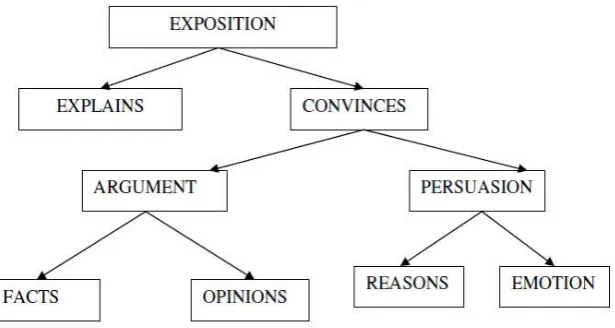
3. Are you able to sleep? (This is merely a question which has no argument) To make the explanation more obvious, the diagram below shows how an argument sits among the other types of text. Even though ‘explain’, ‘argument’ and
‘persuasion’ are under the word ‘exposition’, the difference is the function. Argument and persuasion, indeed, under ‘convince’. They do have the same
(Art Foster, 2003:291) Figure 2.2 a Text Typology
The same root word, argumentation also often makes misunderstanding. Argumentation is the overall activitity where people challenge one’s argument and
one defends one’s logical reasoning. It means argumentation involve not only the
claimant, but also the interogaters. Stone and Garisson explained that argument is used to influence others’ mind to agree with the speaker’s mind (1916:1).
Moreover, O’Neil, Paylock & Scales also confirm that “argumentation is the art of
influencing others, through the medium of reasoned discourse, to believe or act as we wish them to believe or act” (1917:1).
Arguments come with a specific purpose. O’Neil et al (1917:254-255) pointed out that almost all of argumentation has a tendency to put away people’
feelings such as objections, anxiety and hesitancy which make the proposition cannot be accepted with ease. Argument functions to influence someone’s thought.
usually classified as one of the four forms of composition—narration, description, exposition, argumentation” (1917: 10). Arguments are various depending on their
content.
Classified by its focus, Hirch (1989:3) divides the argumentation model into 2 main types. These argumentation model types are demostrative argumentation, non-demostrative argumentation which consist of 2 sub-types: rhetorical argumentation and dialectical argumentation. These types of argumentation are related conceptually in terms of types and subtypes as illustrated in figure 2.3.
Figure 2.3 Types of Argumentation
According to Perelman, dialectic relates to the technique in argumenting to find one decision, while rhetoric focuses on the impact of the speech to the audiences (1970: 283). It can be said that rhetoric leaves the thought to the third party.
Argumentation
Demostrative
Non-Demonstrative
2.2.6 Types of Reasoning
Formal reasoning is a type of reasoning which focus on forms which have certain criteria to define a valid argument. The arguments in formal reasoning consist of premises and conclusion. The premises may support or even prove the conclusion. When the premises are correct, the conclusion will be considered correct. Even though the conclusion migh not seem true in real life, it is acceptable in formal reasoning. True premises entail true conclusion. In informal reasoning, the form of formal reasoning is still used. Nevertheless, the difference is the focus on other elements of reasoning rather than only form. It is mostly found in everyday argument.
In the matter of the function of premises to the conclusion, there are 2 different types of argument. Those are inductive and deductive. When people say:
“Socrates, Plato, and Alcibiades were mortal;
Socrates, Plato, and Alcibiades represent mankind; Therefore, all men are mortal.”
The conclusion of its argument is supported by the premises so that is called inductive reasoning. While, the argument below represent a proof for the conclusion which is called deductive reasoning.
“All men are mortal; Socrates is a man;
Therefore, Socrates is mortal.” (Stones and Garisson, 1916: 100)
2.2.7 Toulmin’s Model of Argumentation
Besides Toulmin, there have been many scholars who have attempted to propose an effective way in breaking up arguments. They were Plato, Perelman, Kuhn and Rogerian. However, Toulmin was the author of the famous argument around 1960 and 1970 whose work is still used widely. Toulmin explains how argument occurs in the natural process of everyday argument which he wrote in his book entitled ‘The Use of Argument’. Toulmin in Renkema (2004: 203) affirms that the most
important aspect in arguments is how the arguments are structured, not the form of logic. This argumentation model is a reaction to the models of formal logic. Syllogism, nevertheless, only explains simple arguments not the complex ones. Toulmin avers that the former argumentation model is not applicable in analyzing human thought which is very dynamic (Hart, 1990:138).
In the main, Toulmin’s argument model is classified into two triads. The
first triad consists of claims, grounds, and warrants. The second triad consists of backings, rebuttals and qualifiers. The first triad is the heart of argument. Common arguments consists of that triad. Nonetheless, claims, grounds and warrants are three essential categories in forming a valid argument. Toulmin states that claims are strengthened by either ground or facts (2003: 90). These three most important aspects in Toulmin’s theory resemble major premise, minor premise and
Table 2.1 Toulmin Model and Syllogism
(Exracted from Toulmin, 2003) Nevertheless, Toulmin’s model of argument is not a theoretical argument
which is in line with syllogism. In fact, Toulmin’s model of argument is used as
practical arguments which are suitable for analyzing daily argument. When people argue in daily life, their arguments do not only consist of three elements such as major, minor premises and conclusion, but also they possibly make complex arguments. Below is the expanded model of argument by Toulmin.
Figure 2.4. Expanded Toulmin’s Model of Argumentation
2.2.7.1 Claim
Claim is the stand point of argument. It is a statement that the claimant wants others to accept. It needs to be arguable, not ambiguous, confronting with value, belief, or communicant attitude. Govier (2010:5-6) uses conclusion indicators to identify
Claim Conclusion
Ground Minor Premise
claim such as “so”, “therefore”, “then”, and “consequently”. Factual claim argues about what exists, what causes something else, or what the future will bring. Value claim deals with the rightness, the goodness, or the worth of a thing. Finally, policy claim argues over action or proposal for change. The example of claim is if a person tries to convince a listener that he is a British citizen, the claim would be “I am a
British citizen”. Claims which represent conclusions may occur more than one time.
The claim of an argument is, by Björk and Räisänen (2003: 84), defined as the statement or assertion about an issue that one wishes to convince someone to accept something as being true. The linguistic markers of claim are ‘therefore’, ‘hence’,
‘so’, ‘consequently’, ‘which means that’, ‘which proves that’. However, this thesis
deals with the data in Indonesian Language. Conjunctions ‘jadi’, ‘oleh karena itu’, or‘karena itu’, ‘dengan demikian’, ‘simpulannya’ are used as the conclusion
indicators which mean also claim indicators.
2.2.7.2 Ground
needs to be stated explicitly not implicitly. The indicators of ground in English are ‘because’, ‘as shown by’, ‘given that’, ‘seeing that’, ‘as indicated by’, ‘considering
that’.
2.2.7.3 Warrant
Mentioning the ground behind the claim, however, is not enough. Warrant is needed to complete the first triad. Simply, warrant is a reasoning link between claim and ground. It is the turning point where the element of ground needs to be established. It can also be identified as general statement, inference or assumption that can be accepted to be true (Toulmin, 1958:98). The forms of warrant are various depending on the field of argument being said since warrants are typically widely accepted as truth as they can apply to an extensive range of circumstances since warrants serve as an underlying connection between the claim and ground.Hitchcock and Verheij (2006: 2) state that “warrants can be defended by appeal to a system of taxonomic
classification, to a statute, to statistics from a census, and so forth”. Toulmin mentions “Data such as D entitle one to draw conclusions, or make claims, such as
C’, alternatively ‘Given data D, one may take it that C” (2003:91).The connection
Next, sign warrant which connects the evidence as a sign, clue, or symptom of the claim. Third, authority warrant connects the evidence to authoritative sources in support of the claim. Analogy Warrant connects the evidence to the claim using analogies of similar relevant situations, events, or precedents. Causality warrant which connects the evidence as being caused by or the result of the claim. The last is principle warrant which connects the evidence to the claim as an application of a broader, relevant principle. Besides closely connected to qualifier, warrants are also connected to backings and rebuttals.
2.2.7.4 Backing
To give support to a warrant, backing is used. After mentioning warrants in the argument, people may ask “Why do you think that?” (Toulmin, 2003:96). The answer to that question is called backing. Backing supports a warrant by propping up the reason given and by giving the warrant authority and to show that the warrant is valid and relevance. By adding backing in support to warrant, it gives a legitimation to warrant. Backings can be in the forms of facts, information, observation, interview and theories of experts.
2.2.7.5 Qualifier
To find out about the quality of the argument, qualifiers are employed to show the strength or limitation of a claim. Qualifiers can be in the form of a word or a phrase such as “certainly”, “presumably”, “possibly”, “probably”, “impossible”, “never”
qualifiers. ‘Perlu’, ‘pasti’, ‘tentu saja’, ‘harus’ shows certainty, while ‘agaknya’,
‘kiranya’, ‘rupanya’, ‘kemungkinannya’, ‘sejauh bukti yang ada’, ’sangat
mungkin’, ‘mungkin’, ‘masuk akal’. The claim “I am definitely a British citizen” has a greater degree of force than the claim “I am a British citizen, presumably.”
2.2.7.6 Rebuttal
In delivering arguments, there must be a weak point that other people may have different view towards a claim. They may ask “but how could you say...” The way
to make it stronger is by adding a condition where the listeners may argue. Words such as “if”, “if.., so...”, “unless” and “except” sign that rebuttals are about to be conveyed. In Indonesian language, the word signs which identify rebuttal are ‘kecuali’, ‘jika’, ‘jika...., maka....’. The rebuttal is exemplified as follows, “A man
born in Bermuda will legally be a British citizen, unless he has betrayed Britain and has become a spy of another”. Nevertheless, rebuttals are used to oppose and
review. Rebuttals may bring claims which may not be true by giving counterarguments. Rebuttals influence the claim by indicating circumstances by setting aside the role of warrants.
Figure 2.5. Example of Toulmin’s Model of Argumentation
“Harry is a British subject’ acts as the claim of that argument, while“Harry
was born in Bermuda” is classified as ground of that argument. Because of those
two, a statement “ a man born in Bermuda will generally be a British subject is an
inference. It is generated that every person who was born in Bermuda is a British subject. So, for example, If Harry was born in Bermuda, he is a British subject. It can be said that warrants are like a general relation which can be made between ground and claim. To make it more applicable, it can be written as if “someone”
was born in Bermuda, “someone” is a British subject (2006:98). The qualifier of
that argument is presumably. Rebuttal is showed by this statement” unless both his parents were aliens”. Besides, backing is manifesteded by a statement “on account
of the following atitudes and other legal provisions”. Below is the example of
argument in Bahasa Indonesia.
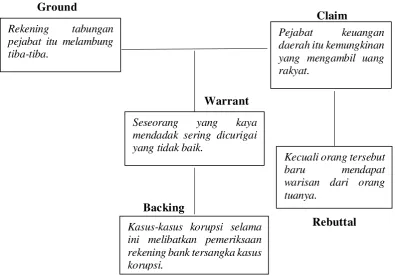
yang tidak-tidak. Kasus-kasus korupsi selama ini melibatkan pemeriksaan rekening bank tersangka kasus korupsi. Kecuali orang tersebut baru mendapat warisan dari orang tuanya.
Figure 2.6 Application of Toulmin’s Model of Argumentation in Indonesian
The claimant makes an assertion that the financial officer might have taken government money. What is the proof for this assertion? Ground answers this question through research data of demonstration and dispersion of the assertion. How does the ground support the claim? It can be found in warrant where it contains a general inference as well as connection between claim and ground which is said that those people who suddenly come into money are often suspected. How can the claimant say that warrant? By answering that, the claimant exposes backing which contains evidence to make a warrant authorized. In this example, the claimant mentions the result of research in a connection to the corruption cases in the past
that always correlated with large lump sums being deposited. Some may ask can whether we can be really sure or not about this claim. If not, then what is the condition? In this scenario rebuttals will answer this question. When the claimant mentions a rebuttal, he or she knows that the claim may be refuted and he or she will mention one or more condition where the claim is not strong enough to support the claim. In this case, the claimant made a valid argument by stating the condition that the money was from a legacy he inherited.
2.2.9 Indonesia Presidential Debate
The word ‘debate’ can evoke strong images and is widely used and expressed in
debate competitions which are usually held for high schoolers. The general definition of debate in KBBI is “Debat adalah pembahasan atau pertukaran pendapat mengenai suatu hal dengan saling memberi alasan untuk
mempertahankan pendapat masing-masing” (2002: 242). Debate is a dialog
discourse which competes arguments in order to change someone’s thought.
In the election period, many countries have used debates as form of campaign. Debate, however, does not have an absolute debate format. In Presidential debates which are usually shown on TV, the format of a debate is quite different. Freely & Steinberg (2009) state that, people are faced with debate as natural result of a democratic era. People are free to express their opinions.
from a moderator covering specific areas. In segment four, the candidates were given the opportunity to ask question to their respective opponent. In segment five, the two presidential candiates had further opportunites to ask and to respond to each others questions and answers. In the sixth and final segment the candidates were given time to give their closing statements.
Debates functions help to reach goals in private companies and even government institutions. Not knowing or understanding these can however make citizens feel ignorant and ill informed before casting their vote in choosing a President. Moreover, knowing or not knowing how to follow, or even more, to understand debate can cause issues in the minds of citizens who have the democratic rights to choose who they wish to govern. By educating citizens in debate, it is hoped that they can contribute something according to their views (2009: 29-30).“A debate is human drama at its rawest: the obvious drama between the participants onstage but also the more subtle and complex drama that unfolds between presidential contenders and the citizens passing judgment on them”
CHAPTER 3
RESEARCH METHOD
3.1 Type of Research
In this thesis, I employed qualitative-descriptive method. Qualitative research is required to take place in a natural setting. It means no planned instruction in taking the data. Moreover, qualitative research tends to look for a holistic view of a phenomenon. Darlington and Dorothy (2002) suggest that qualitative research is especially relevant in obtaining culturally specific information about the value, opinion, behavior, and social context of particular populations. This kind of research tends to look for a holistic view of a phenomenon.
3.2 Data Collection
Table 3.1. The Debate List of Presidential Debate
No Theme The Participants
1 “Pembangunan Demokrasi, Pemerintahan yang Bersih dan Kepastian Hukum” broadcasted on 9th June 2014 on SCTV, Indosiar and TV One
Prabowo-Hatta and Jokowi-JK
2 “Pembangunan Ekonomi dan Kesejahteraan Sosial” on 15th June 2014 on Metro TV dan Bloomberg TV
Prabowo Subianto and Joko Widodo
3 “Politik Internasional dan Ketahanan
Nasional” on 22nd June 2014 on TV One and ANTV.
Prabowo Subianto and Joko Widodo
4 “Pembangunan Sumber Daya Manusia dan
Iptek” on 29th June 2014 on RCTI, MNCTV dan Global TV
Hatta Rajasa and Jusuf Kalla
5 “Pangan, Energi, Lingkungan” on TVRI dan Kompas TV on 5th July 2014
Prabowo-Hatta and Jokowi-JK
The reason why I chose 4 debates was because I only analyzed president candidates’ utterances. In the 4th debate, the participants were only between the vice
president candidates only. I also employed purposive sampling in selecting the data because analyzing spoken discourse is very complicated and I would need to choose which ones were the core of the answers of the question asked. I also collected additional information through library research to enrich the points of views about politics, argument and debate.
3.3 Method of Data Analysis
research is qualitative research. Therefore, the instrument of this research is the researcher (Moleong, 1989). The researchers have the authority to interprete data in order to collect their findings. Besides, I also applied referential method to classify functional characteristics of each element and distributional method to refer to the linguistics features that each element has (Sudaryanto, 1993). After classifiying the argument structure, I, then analyzed the different argument models used by the candidates. Below are the steps I used to collect and analyze the data:
1. I downloaded 5 Presidential debates 2014 from www.youtube.com. I, then watched all these debates of Presidential 2014 on Youtube. Next, I transcribed all debates.
2. I read and checked all the transcripts. I decided to use 4 debates out of 5 debates as I only wanted to analyze the president candidates who played the largest role in the debates.
3. The first stage is to discover the basic structures. Before categorizing, I listed a categorization to identify the elements of Toulmin’s argumentation model by
looking into the linguistic markers such as words, phrases, and clauses that signs elements of Toulmin’s argumentation model being told. However, looking at the linguistic markers are not enough. It is needed to examine the other characteristics of each idea unit. In the matters of physical characteristics, it is helpful to refer to linguistic markers to identify the element. Nevertheless, the functional characteristics that those elements have define them stronger than the linguistics features.
Features Elements -The linguistic indicators are such as ‘kemungkinan’,
‘mungkin’, ‘pasti’, ‘pastinya’, ‘agaknya’, ‘kiranya, terbatas pada bukti’, ‘perlu’, ‘biasanya’, ‘tentu saja’ -It signs and functions to show the degree of certainty or possibility.
Qualifier
-Linguistic indicators: ‘oleh karena itu’,’ jadi’,
‘ maka dari itu’, ‘saya kira’, ‘saya pikir’, ‘saya percaya’, ‘harus’, ‘sebaiknya’, ‘sebagai
konsekuensi’, ‘singkatnya’, ‘dapat disimpulkan’.
-It is the answer of the question: what do you want to prove?
-It is argumentative because it shows position or opinion so it needs further supports to be accepted. -It is the core of each argument
-It can be classified as one of these types of claim factual claim of fact, claim of value, claim of policy
Claim
-It has linguistic indicators: ‘karena’, ‘oleh karena’, ‘sehingga’, ‘untuk’, ‘agar’, ‘buktinya’, ‘contohnya’. -It is the answer of the question: what is the proof? Why do you think that?
-It functions as support of a claim.
-It is in the form of statiscal data, narratives, testimonies, causal reasons and facts.
Ground
-It has linguistic indicators: jika...,maka... -It is the answer of the questions: What is the relationship of ground to claim? Or what is the assumption?
-It functions as a connection bridge of ground to claim.
-It is in the form of a general inference, general principle, principle of a particular field amd assumption.
Warrant
-It is answerable for question: is the warrant true?can you support the warrant?
-It functions to support warrant. -It strengthens warrant
-It is in the form of observation, data, historical facts, or experts’ opinion.
Backing
-The linguistic indicators such as: ‘asal’, ‘asalkan’,
‘kecuali’, ‘kalau’, ‘jika’.
-It functions to to point out the weakness of claim being told which has already been noticed by the claimant.
-It is answerable to a question: are you really sure your claim will be 100% correct in any condition?
-It can be conditions or exception which decrease the authority of warrant.
(Extracted from Toulmin, Rieke & Janik, 1978)
4. First element to find is claim of each argument. The next step is finding grounds of the claim, warrant, backing and qualifier of that particular argument. 5. Afterwards, I put into a table in order to categorize the claim, ground, warrant,
backing, rebuttal and qualifier. The table is divided into 2 columns. The left column is the utterances and the right column is the classifications.
Table 3.3. Sample of Analysis Display
D1S2J President Candidates’ Utterance The Elements of
Toulmin’s Argumentation
Model
Kemungkinan Qualifier (Q)
Pejabat keuangan daerah itu kemungkinan yang mengambil uang rakyat.
Claim (C)
Rekening tabungan pejabat itu melambung tiba-tiba.
Ground (G)
Seseorang yang kaya mendadak sering dicurigai yang tidak-tidak.
Warrant (W)
Kasus-kasus korupsi selama ini melibatkan pemeriksaan rekening bank tersangka kasus korupsi.
Backing (B)
Kecuali orang tersebut baru mendapat warisan dari orang tuanya.
6. I, then put information code from which I took the parts of utterances on the right below each table. D stands for debate. S stands for segment. J is Jokowi. P is Prabowo.
For instance: D1S2J means it is taken from debate 1 segment 2 and the speaker is Jokowi.
CHAPTER IV
FINDINGS AND DISCUSSION
This chapter presents the result of study conducted by analyzing Indonesia Presidential Debate 2014 using Toulmin’s theory. This thesis deals with the
argument structures of the president candidates in Presidential Debates of 2014 and how they structured their arguments. Moreover, this research was conducted to know the characteristics of their argument structures.
4.1 The Structures of President Candidates’ Arguments
In gaining the results, I looked at segment by segment in the matters of the function of each segment and then I classified the elements of Toulmin’s model of argumentation based on the linguistic features and the references of each element. However, to classify the elements, it is impossible to look only at the linguistic features of each element’s marker since people in spontaneous talks often make false starts or they change the topics to another topic even though they have signed they were about to conclude things, they can easily give an evidence after a conclusive conjunction.
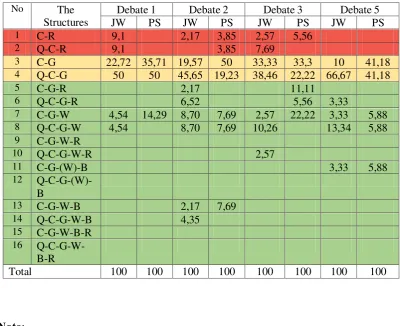
obligatory element to be considered as an argument. It means those structures are considered weak structure. Both Jokowi and Prabowo applied those structures in debate 3 and debate 4. Nevertheless, in the last debate they were no longer using those weak structures. The common structures defined as argument are represented by number 3 and 4 in the table, while stronger structures are represented by number 5- number 16. The 2 strongest structures which are C-G-W-B-R and Q-C-G-W-B-R were not utilized by either Jokowi or Prabowo. The result of this research was gained from the green areas (number 5-number 16) as they are considered as stronger structure of Toulmin’s model. From that green area, it can be seen that
Jokowi has more better structured arguments in the 2nd and 5th debate, whereas Prabowo formed stronger structure in the 1st and the 3rd debate.
In the first debate “Pembangunan Demokrasi, Pemerintahan yang Bersih
dan Negara Hukum”, Jokowi employed 6 different structures which are C-G,
Q-C-G, C-G-W, Q-C-G-W, Q-C-R and C-R structures, while Prabowo used 3 structures which are C-G, Q-C-G and C-G-W. In the table of structures in the first debate, both Jokowi and Prabowo have the same percentage in employing the structure of Q-C-G which is 50 %. Nevertheless, Prabowo only utilized C-G-W and Jokowi used C-G-W and Q-C-G-W. Even though, Jokowi had more varied structures, Prabowo was superior in this debate as the percentage of arguments in the green areas is higher than those of Jokowi. Overall, they already used a combination of first triad argument and second triad argument.
as second level argument. Based on the percentage, Prabowo has a greater percentage in using C-G which is 12,99% higher than Jokowi has in using C-G. In employing C-G-W, Prabowo’s percentage is 9,75% higher than those of Jokowi. However, Prabowo did not employ C-R, Q-C-R, and Q-C-G-W. It means that Jokowi used more varied structures in“Pembangunan Demokrasi, Pemerintahan yang Bersih dan Negara Hukum” than Prabowo did.
Table 4.1. Summary of the Argument Structures in Percentage
No The
Structures
Debate 1 Debate 2 Debate 3 Debate 5
JW PS JW PS JW PS JW PS
1 C-R 9,1 2,17 3,85 2,57 5,56
2 Q-C-R 9,1 3,85 7,69
3 C-G 22,72 35,71 19,57 50 33,33 33,3 10 41,18
4 Q-C-G 50 50 45,65 19,23 38,46 22,22 66,67 41,18
5 C-G-R 2,17 11,11
6 Q-C-G-R 6,52 5,56 3,33
7 C-G-W 4,54 14,29 8,70 7,69 2,57 22,22 3,33 5,88
8 Q-C-G-W 4,54 8,70 7,69 10,26 13,34 5,88
9 C-G-W-R
10 Q-C-G-W-R 2,57
11 C-G-(W)-B 3,33 5,88
12 Q-C-G-(W)-B
13 C-G-W-B 2,17 7,69
14 Q-C-G-W-B 4,35
15 C-G-W-B-R
16
Q-C-G-W-B-R
Total 100 100 100 100 100 100 100 100
Note:
JW : Jokowi C : Claim Q : Qualifier PS : Prabowo G : Ground B : Backing
In “Pembangunan Ekonomi dan Kesejahteraan Sosial” which is the second debate, Jokowi conveyed his argument more sundry in the second debate than in the first debate since he utilized 9 structures, C-G, Q-C-G, R, Q-R, C-G-W, Q-C-G-C-G-W, C-G-W-B, Q-C-G-W-B, and C-R, whereas Prabowo utilized all structures of Jokowi’s arguments except C-G-R, G-R, G-W-B and
Q-C-R. He employed 5 types of argument structure which is less than what Jokowi applied.
Based on the percentage, Prabowo’ usage of C-G, C-G-W-B and C-R structures are 30,43%, 5,52 % and 1,68% higher than those of Jokowi. However, it cannot be the determination of a better argument as Jokowi had more structures in second level argument. He employed second level arguments which are C-G-W-B and Q-C-G-W-B. Adding second triads elements are considered stronger in structure than only applying first triad element. Both Prabowo and Jokowi made stronger argument structures in the second debate. Nevertheless, based on the percentage, Jokowi has greater percentage in using the complete structure of arguments based on Toulmin.
Under the theme “Politik International dan Ketahanan Nasional”, both Jokowi and Prabowo have more structures in conveying their arguments. It can be seen from the table above that there are 7 structures in Jokowi’s arguments and 6
To be recognized as an argument, Toulmin contends that it must contain a claim and at least one ground. The strength of arguments based on Toulmin’s
argumentation model lies on the completion of the structure. This time, Prabowo employed the second triad elements more than Jokowi. Although he only formed C-G-W-R as his second level argument, he has higher frequency which is 10 %. The structures of the first level, C-G, C-G-W, and C-G-R are in both Jokowi’s argument and Prabowo’s argument. They formed the first level more than the
second level. First triad of Toulmin’s model consists of claim, ground and warrant.
Prabowo has stronger argument than Jokowi has in this debate if I look at the structures. It can be said that Prabowo has more supports for his claims under this theme.
In the theme of “Pangan, Energi, Lingkungan”, Jokowi and Prabowo utilized
5 and 6 structures. Jokowi applied C-G, Q-C-G, C-G-W, Q-C-G-R, Q-C-G-W and C-G-B, while Prabowo used C-G, Q-C-G, C-G-W, Q-C-G-W, and C-G-B. Both of them employed the first level and second level arguments.
From the table, there is a new finding that Jokowi and Prabowo applied the structure of C-G-B for the first time. Jokowi’s warrant and Prabowo’s warrant in this case were not absent, but they were implicit. Globally, both Jokowi and Prabowo employed the first level argument the most in the fifth debate.
complete structures in the first debate and fourth debates. These results were formulated by assessing the completeness of the structures. Stronger arguments are the ones consisting more than common structures, C-G and Q-C-G. If the debater can provide more elements, it is considered that the person has good knowledge relating to the topic.
4.1.1 Jokowi’s Argument Structures
4.1.1.1 Claim-Ground
This part is taken from the 5th segment in 2nddebate under the theme “Pembangunan Ekonomi dan Kesejahteraan Sosial”. Jokowi gave his response towards Prabowo’s
claim in which he said that he would give 1 billion to villagers as his vision and mission during his campaign. Jokowi claimed that Prabowo vision and mission was not his own vision and mission. It was taken from UUD. It means that Prabowo’s
promise to the villagers were not merely his vision and mission. The word ‘artinya’
[it means] signs that Jokowi was about to make a claim. Jokowi mentioned his evidence that the budget is the same as the budget that will be distributed to villages based on the law. Moreover, Jokowi conveyed his argument by attacking the fact about Prabowo’s vision and mission. He, then, supported his argument to attack Prabowo by providing evidence that Prabowo’s vision and mission is not original.
Berarti artinya bukan satu miliar Pak Prabowo ya?Karena siapapun nanti presidennya, karena memang sudah merupakan undang-undang. Itu sudah secara otomatis anggaran sebesar 1,1, bisa 1,2, bisa 1.3 itu tetap akan mengucur ke desa.
[It means it is not 1 billion, is it Pak Prabowo? Because anyone becoming the next president, because it is indeed in the law, the