FOREST
112-124Haruni Krisnawati1,2 and Djoko Wahjono1
ABSTRACT
Post-logging silvicultural treatments are generally performed to improve yields of the remaining tree species by increasing their growth rate. In this study the efects of silvicultural treatment on the growth rates of commercial (dipterocarps and dipterocarps) as well as non-commercial tree species in a tropical forest in West Kalimantan were examined and were compared to a control treatment. Silvicultural treatment applied was liberation of future crop trees from lianas and neighbouring competing trees. Treatments were applied to six plots of 80 m x 80 m each. he plots comprised 64 quadrats of 10 m x 10 m to allow better control of measurements. he treatment and control plots were established 6 years ater logging. Efects were measured 2, 4 and 7 years ater treatment application. In all observation periods, the growth rates increased with silvicultural treatment. Overall, commercial dipterocarps, commercial non-dipterocarps and non-commercial tree species groups difered in response to silvicultural treatment. he growth rates of commercial tree species in plots that received silvicultural treatment were 62–97% higher than in the control plots. For non-commercial tree species, the increase of growth rates was 20–58%, compared to the control plots. hese results indicate that the application of silvicultural treatments ater logging could help improve the growth of the residual stands. hese provide quantitative information that silvicultural treatments in logged-over forest should be considered as a viable management option and may guide the choice of cutting cycle.
Keywords: liberation cutting, sustained yield, TPTI, stand growth, tropical trees
I. INTRODUCTION
A large proportion of Indonesia’s natural forests has been logged or has been designed as production forest. he condition of logged-over natural forests difers from that in unlogged (primary) forests. he density of residual trees, saplings and seedlings of commercial tree species in logged-over forest is oten low, especially if the forest has been subjected to heavy logging (Adjers et al., 1995). Selective logging operations oten damage more than 50% of the stand (Sist et al., 2003), which afect both forest structure and productivity (Pinard and Putz, 1996; Bertault and Sist, 1997; Okuda et al., 2003).
It is estimated that forest productivity has decreased in the logged-over tropical forests (Silva et al., 1995; Dauber et al., 2005; Keller et al., 2007). Several studies in the logged-over natural forests in Indonesia have reported that commercial trees grow at lower rates than assumed by Indonesian policy-makers when the currently designated cutting cycles were selected (Krisnawati and Wahjono, 1997; 2004; Nguyen-he et al., 1998;Suhendang, 1998). A commonly used silvicultural system to manage natural forests in Indonesia, the Indonesian Selective Cutting and Planting (TPTI) System, assumes post-logging growth in diameter of 1 cm yr-1 and deines a cutting cycle of 35 years with a minimum diameter cutting limit of 50 cm for all commercial timber species. With the new regulation system (the Ministry of Forestry Decree No. 11, 2009), all commercial trees above 40 cm in diameter can be felled with a 30-year cutting cycle, which may even increase the risk of depletion of residual stand due to damage created by logging and lower growth of remaining stand. Consequently, the yield (volume harvested) for the next planned harvest at the end of the second cycle may not recover the volume harvested during the irst commercial timber harvest.
One alternative to increase volume recovery is to provide improved growth conditions for future crop trees, including high light availability to tree crowns and freedom from lianas. Studies conducted in the tropics have shown that applying silvicultural treatment after logging to future crop trees, such as liberation from competing trees and understorey vegetation can afect signiicantly their growth rates (Dauber et al., 2005; Wadsworth and Zweede, 2006; Keller et al., 2007). In Indonesia, stand reinement ater logging through liberation cuttings has been prescribed under the TPTI System. However, implementation of this treatment in the ield (i.e. forest concession area) is widely questioned. In addition, evaluation based on the long-term measurements of stand growth resulted from the application of this practice have rarely been conducted.
he objective of this study were: (1) to analyze the efect of post-logging silvicultural treatment on growth rate of the remaining trees, and (2) to evaluate if trees belonging to commercial dipterocarps, commercial non-dipterocarps and non-commercial species groups respond diferently to liberation treatments such as liana cutting and girdling of competing trees.
II. MATERIALS AND METHODS
A. Study Site
from 23.4 to 33.7 oC. he altitude ranges from approximately 100 to 200 m above sea level. he topography is mostly undulating and rolling and only small part of the area is lat. he dominant soil type of the study site is red yellow podzolic or ultisols. Minor soil types include latosols. he soils are derived mainly from sedimentary rocks with a very small portion from volcanic materials. he forest stand of the study site is dominated by species of commercial timber group including Shorea sp., Litsea sp., Eugenia sp., Pometia sp., and Dracontomelon sp. Non-commercial timber species include Baccaurea sp. and Nephellium sp. he condition of natural regeneration in the study site is generally suicient in number and spreads evenly, particularly on the area of logging gaps.
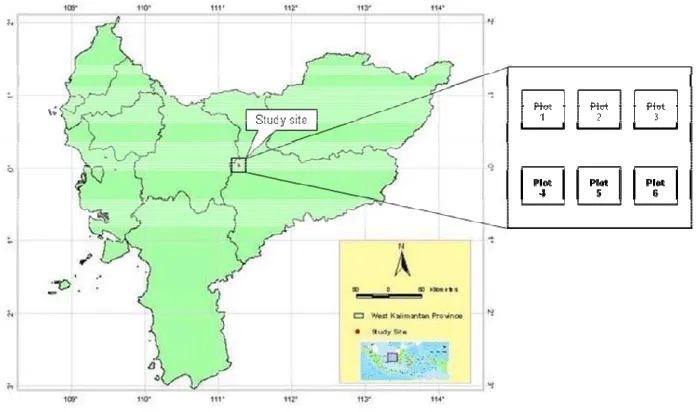
Figure 1
Figure 1. Map of the study site and location of the six experimental plots
B. Experimental Design
he study was carried out in six experimental plots of 80 m x 80 m each (Figure 1). Each plot comprised of 64 quadrats of 10 m x 10 m to allow a better control of measurements. Three plots were selected to receive silvicultural treatment while the remaining three as control plots. he experiment site was logged in 1991/1992 applying a selective cutting system with a minimum diameter cutting limit of 50 cm for commercial timber species. he plot installation and treatment application were conducted in October 1998 at approximately 6 years ater logging.
particularly done to the non-commercial trees of above 10 cm in diameter and poor in condition (e.g. broken, poorly formed, bent, squeezed, etc.), which interfere the growth of future crop trees. Future crop trees were selected from individuals of commercial species that are too small to be harvested in the irst cutting cycle (i.e. 20–49 cm in diameter), but they have good form and growth potential and are expected to be harvested in the future. Girdling of competing trees was done by removing the bark and cutting through the cambium with the notches spaced about ± 10 cm apart and 1 m from the base of the tree. he girdling was done to stop or slow the competing trees’ growth providing improved condition for future crop trees.
C. Measurement
D. Data Analysis
To evaluate treatment efects on growth rates of the remaining trees in three diferent species groups, a repeated-measures ANOVA was performed with growth rates (GR0-2, GR2-4, GR4-7) as dependent variables, and time, treatment and species group as factors. In this study, the growth rates were deined as mean annual increments in diameter which corresponds to the mean of the diference in diameter between two measurements scaled to one year. Trees with negative growth rates were discarded from the analysis.
To test if trees from diferent timber species groups (commercial dipterocarps, commercial non-dipterocarps and non-commercial) were affected differently by treatments, a one-way ANOVA was performed, followed by a Student-Newman-Keuls (SNK) test for post hoc treatment comparison. he diferences were considered signiicant at P < 0.05. All statistical analyses were done using the SAS/STAT program version 9.1 (SAS Institute Inc, 2005).
III. RESULTS AND DISCUSSION
Table 2. Average tree growth rates (cm yr-1) of commercial dipterocarps (CD),
commercial non-dipterocarps (CnD)and non-commercial (nC) species group calculated for each measurement period for both treatment and control plots
Growth Species group
All species
period CD CnD nC
Control plots
GR0-2 0.62±0.12 0.26±0.03 0.30±0.05 0.27±0.03 GR4-2 0.76±0.27 0.32±0.06 0.34±0.10 0.34±0.05 GR4-7 0.67±0.28 0.28±0.05 0.24±0.05 0.28±0.04 Average 0.68±0.13 0.29±0.03 0.29±0.04 0.29±0.02
Treatment plots
GR0-2 0.66±0.12 0.36±0.05 0.24±0.05 0.45±0.04 GR4-2 0.98±0.20 0.48±0.06 0.34±0.05 0.59±0.05 GR4-7 0.75±0.14 0.44±0.06 0.30±0.07 0.54±0.05 Average 0.80±0.10 0.43±0.03 0.29±0.03 0.53±0.03
Growth rate class (cm yr-1)
Fr
eq
ue
nc
y (
%
)
Figure 2. Frequencies of tree growth rates of all species during the seven-year observation period in control plots
Growth rate class (cm yr-1)
Fr
eq
ue
nc
y (
%
)
Figure 3. Frequencies of tree growth rates of all species during the seven-year observation period in treatment plots
either in the treatment plots or in the control plots declined, which was probably due to renewed competition.
Table 3. Results of a repeated-measures ANOVA with growth rate as the dependent variable, time as the within-subject variable, and treatment and species group as between subject ixed factors
Test of within-subject efects Test of between-subject efects
Factor F P Factor F P
Time 21.29 ** Treatment 22.63 **
Time x treatment 10.54 ** Species group 27.30 ** Time x species group 11.62 ** Treatment x species group 9.00 ** Time x treatment x species group 9.85 **
** signiicance levels: P < 0.01; N =2754
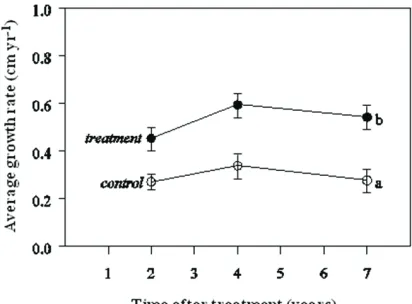
Figure 4. he efect of treatment on tree growth rates for all species. Diferent letters represent signiicant diferences over time
the genus of Shorea grew faster than the other genera. he heterogeneity of growth rates was even greater between species, as also reported by other studies (e.g. Primack et al., 1985; Manokaran and Koscummen, 1987; Appanah and Weinland, 1993).
Figure 5. he efect of species group on tree growth rate ater treatment application (CD: commercial dipterocarps, CnD: commercial non-dipterocarps, nC: non-commercial). Diferent letters represent signiicant diferences over time
post-logging silvicultural treatments is that the remaining trees experience better growing conditions ater treatment application than when logging operation alone is used (Peña-Claros et al., 2008).
In this study, the better growing conditions were persisted for at least 7 years ater treatment application, which were relected by higher growth rates over time in the treatment plots. he beneits of this treatment was expected to persist for several more years because, ater 7 years, the crown exposures might be greater and liana infestations might be lower than in the control plots. De Graaf et al. (1999) observed that the beneits of the silvicultural treatments applied in the Surinam rainforests persisted for only about 10 years. hey further recommended applying repeated treatments during the cutting cycle to maintain optimal growing conditions. However, Barreto et al. (1998) and Holmes et al. (2002) were doubtful whether tropical forest managers will be willing to apply additional treatments given their low proit margins and the diiculty in re-establishing access to previously harvested areas.
Although several other studies indicated that tree growth rates are low to secure sustained timber yields ater logging in tropical forests, at least using current cutting cycle lengths (Nguyen-he et al., 1998;Dauber et al., 2005; Keller et al., 2007), result of this study suggested that the application of silvicultural treatments ater logging could increase growth rates of the remaining trees. Other studies have also found similar indings (e.g. Nguyen-he et al., 1998; de Graaf et al., 1999; Wadsworth and Zweede, 2006). he positive efect of removing lianas and girdling competing trees on the growth rates of future crop trees observed in this study supports the idea that post-logging silvicultural treatments are necessary and efective (Dauber et al., 2005; Keller et al., 2007). hese results also provide quantitative information that silvicultural treatments in logged-over forest should be considered as a viable management option and may guide the choice of cutting cycle.
Applying silvicultural treatment ater logging would reduce the length of cutting cycle, compared to solely logged forests without additional silvicultural treatment that would require longer cutting cycles. Perhaps the most important consideration to achieving long-term sustainability of managed forests is securing suicient regeneration of timber tree species to maintain certain degree of genetic variability in targeted tree populations. A combination of silvicultural treatments that improve growth rate and regeneration of the full range of species being managed (not only just species belonging to certain group) would be necessary to apply. In that case the application of silvicultural treatments would need to account for spatial variability of the species.
IV. CONCLUSION
additional silvicultural treatment were about a half of the growth rates observed in the treatment plots. Growth rates of the remaining trees varied with treatment, time ater treatment application and species group.
he positive efect of removing lianas and girdling competing trees on the growth rates supports the idea that post-logging silvicultural treatments should be considered as a viable management option and may reduce the length of cutting cycle. It would be necessary to apply a combination of silvicultural treatments that improve growth rate while securing suicient regeneration of the full range of species to achieve the long-term sustainability of managed natural forests.
ACKNOWLEDGEMENTS
Funding for this research was provided by Forest and Nature Conservation Research and Development Centre, Forestry Research and Development Agency, Ministry of Forestry of Indonesia. hanks to Rinaldi Imanuddin for providing the map of the study site.
REFERENCES
Adjers, G., S. Hadengganan, J. Kuusipalo, J. Nuryanto and L. Vesa. 1995. Enrichment planting of dipterocarps in logged-over secondary forests – effect of width, direction and maintenance method of planting line on selected Shorea species. Forest Ecology and Management 73: 259–270.
Appanah. S. and G. Weinland. 1993. Planting quality timber trees in Peninsular Malaysia – a review. Malaysian Forest Record No. 38, Forest Research Institute Malaysia, Kuala Lumpur. 247p.
Barreto, P., P. Amaral, E. Vidal, and C. Uhl. 1998. Costs and benefits of forest management for timber production in eastern Amazonia. Forest Ecology and Management 108: 9–26.
Bertault, J.-G. and P. Sist. 1997. An experimental comparison of diferent harvesting intensities with reduced-impact and conventional logging in East Kalimantan, Indonesia. Forest Ecology and Management 94: 209–218.
Dauber, E., T.S. Fredericksen, and M. Peña-Claros. 2005. Sustainability of timber harvesting in Bolivian tropical forests. Forest Ecology and Management 124: 123–135.
Holmes, T.P., G.M. Blate, J.C. Zweede, R. Pereira, P. Barreto, F. Boltz, and R. Bauch. 2002. Financial and ecological indicators of reduced impact logging performance in the eastern Amazon. Forest Ecology and Management 163: 93–110.
Imanuddin, R. and D. Wahjono. 2005. he utilization of growth and yield data to support sustainable forest management in Indonesia. In: Priyadi, D., P. Gunarso, and M. Kanninen (Eds.), Permanent Sample Plots: more than just forest data. Proceedings of the International Workshop on Promoting Permanent Sample Plots in Asia and Paciic Region. Bogor, Indonesia, 3-5 August 2005. Pp. 87–94. Keller, M., G.P. Asner, G. Blate, J. McGlocklin, F. Merry, M. Peña-Claros, and J. Zweede.
2007. Timber production in selectively logged tropical forests in South America. Frontiers in Ecology and the Environment 5: 213–216.
Krisnawati, H. and D. Wahjono. 1997. Residual stand structure and diameter increment of swamp natural forest in Riau: a review (in Indonesian). Proceedings of the National Discussion on Swamp Forest Management and Expose on the Forestry Research Results in Sumatra. Medan, 18-19 September 1997. Pp. 55–68.
Krisnawati, H. and D. Wahjono. 2004. Stand diameter increment of logged-over natural forest in the Province of Jambi (in Indonesian with English abstract). Journal of Forest and Natural Conservation Research 2: 156–166.
Manokaran, N. and K.M. Kochummen. 1987. Recruitment, growth and mortality of tree species in a lowland dipterocarp forest in Peninsular Malaysia. Journal of Tropical Ecology 3: 315–330.
Nguyen-he, N., V. Favrichon, P. Sist, L. Houde, J-G. Bertault, and N. Fauvet. 1998. Growth and mortality patterns before and ater logging. In: Bertault, J-G and Kadir, K. (Eds.), Silvicultural research in a lowland mixed dipterocarp forest of East Kalimantan. Joint publication of CIRAD- forêt, FORDA and PT. INHUTANI I. Pp. 181–216.
Okuda, T., M. Suzuki, N. Adachi, E.S. Quah, N.A. Hussein and N. Manokaran. 2003. Efect of selective logging on canopy and stand structure and tree species composition in a lowland dipterocarp in Peninsular Malaysia. Forest Ecology and Management 175: 297–320.
Oliver, C.D. and B.C. Larson. 1996. Forest Stand Dynamics. McGraw-Hill, New York. 544p.
Peña-Claros, M., T.S. Fredericksen, A. Alarcón, G.M. Blate, U. Choque, C. Leaño, J.C. Licona, B. Mostacedo, W. Pariona, Z. Villegas and F.E. Putz. 2008. Beyond reduced-impact logging: silvicultural treatment to increase growth rates of tropical trees. Forest Ecology and Management 256: 1458–1467.
Primack, R.B., P. Ashton, P. Chai and H.S. Lee. 1985. Growth rates and population structure of Moraceae trees in Serawak. East Malaysia. Ecology 66: 577–588. SAS Institute Inc. 2005. SAS/ETS User’s Guide, Version 9.1. SAS Institute Inc, Cary,
NC. 2416p.
Silva, J.N.M., de Carvalho, J.O.P., Lopes, J do C.A., de Almeida, B.F., Costa, D.H.M., de Oliveira, L.C., Vanclay, J.K., and Skovsgaard, J.P. 1995. Growth and yield of a tropical rainforest in the Brazilian Amazon 13 years ater logging. Forest Ecology and Management 71: 267–274.
Sist, P., R. Fimbel, D. Sheil, R. Nasi and M.-H. Chevallier. 2003. Towards sustainable management of mixed dipterocarp forests of Southeast Asia: moving beyond minimum diameter cutting limits. Environmental Conservation 30: 364–374. Suhendang, E. 1998. Measuring diameter increment of meranti (Shorea spp.) at the
logged-over forest. Paper presented in the Stand Growth and Yield Discussion. Bogor, 8 April 1998 (in Indonesian).