Full length Research
I Made Jawi, I W. P. Sutirta Yasa, Dewa Ngurah Suprapta and Agung Nova Mahendra Antihypertensive
effect and eNOS expressions in nacl-induced hypertensive rats treated with purple sweet potato
Univers. J. Med. Dent. 2012 1(9): 102-107 Abstract Full text (PDF) size 491kb
Abdullah Seckin Ertugrul and Hacer Sahin
Relationship between furcation defects and periodontal disease
Univers. J. Med. Dent. 2012 1(9): 108-114 Abstract Full text (PDF) size 731kb
Ndie Elkenah Chubike
Student nurses and clinical supervisors perception of constraint to effective clinical performance
assessment
Univers. J. Med. Dent. 2012 1(8): 115-118 Abstract Full text (PDF) size 57kb
Universal Journal of Medicine and Dentistry(ISSN:2277-0992) Vol. 1(9) pp. 102-107, December, 2012 Available online http://www.universalresearchjournals.org/ujmd
Copyright © 2012 Transnational Research Journals
Full Length Research paper
Antihypertensive effect and eNOS expressions in
nacl-induced hypertensive rats treated with purple
sweet potato
I Made Jawi
1, I W. P. Sutirta Yasa
2, Dewa Ngurah Suprapta
3*, and Agung Nova Mahendra
11
Department of Pharmacology and 2Department of Clinical Pathology Faculty of Medicine Udayana University, Denpasar Bali Indonesia
3
Faculty of Agriculture Udayana University, Denpasar Bali Indonesia
Accepted 11 December, 2012
Anthocyanins can improve vascular endothelial function by increasing the bioavailability of nitric oxide (NO), a powerful vasodilator. Purple sweet potato (Ipomoea batatas L.) contains anthocyanins that act as antioxidants and are expected to preserve endothelial function by increasing endothelial nitric oxide synthase (eNOS) expression. To prove this hypothesis, a study was done on 24 adult male Wistar rats that were divided into 4 groups which consist of 6 rats for each group, with randomized control group pre- and post-test design. Hypertension in those rats was induced by the administration of high doses of NaCl. Rats of the control group were treated with NaCl for 14 days. Treatment groups were treated with NaCl and aqueous extract, ethanolic extract and syrup of purple sweet potato tuber, respectively, with a dose of 4 ml per day for 14 days. Blood pressure was measured every day with special sphygmomanometer, before treatment and during treatment. The eNOS expression of aortic endothelium was evaluated immunohistochemically using eNOS antibody. This study showed that there was a significant difference in blood pressure between the control group with treatment groups (p<0,05), in which the blood pressures of treatment groups were significantly lower than the control group. The increase of eNOS expression in rats treated with aqueous extract or ethanolic extract of purple sweet potato was significantly higher than that of the control group (p<0,05). These results suggested that the administration of aqueous or ethanolic extract of purple sweet potato tuber may lower blood pressure and increase the expression of eNOS in rats with NaCl-induced hypertension.
Key words: Purple sweet potato tuber, blood pressure, eNOS, hypertensive rats.
INTRODUCTION
Epidemiological studies found that consuming foods with high flavonoids content, such as vegetables, fruits and tubers, reduces the risk of having cardiovascular disease. Flavonoids found in fruits and vegetables, when consumed on daily basis, may protect the body from cardiovascular disease and several other chronic diseases (Knekt et al., 2002). Flavonoids can improve vascular endothelial function (Engler et al., 2004), via eNOS (endothelial nitric oxide synthase) expression regulation, thereby increasing the production of NO (nitric
*Corresponding author Email : [email protected], phone/fax : +62-361-255346
oxide). Nitric oxide per se is a powerful vasodilator (Erdman et al., 2007; Han et al., 2007; Morris, 2007).
Anthocyanin pigments is one of many important type of flavonoids that has been widely studied and showed beneficial effects in mammals cells such as antioxidative, antimutagenic, hepatoprotective and antihypertensive effects (Middleton et al., 2000; Lila, 2004; Broncel et al., 2007). Provision of anthocyanin-rich foods such as purple corn and red radish for 15 weeks, can lower blood pressure and heart rate (Shindo et al., 2007).
2004), and has been proven to posses antioxidant effects in blood and various organs in mice with oxidative stress and in hypercholesterolemia of rabbits (Jawi et al., 2008; Jawi and Budiasa, 2011 ). Ethanolic extract of purple sweet potato tuber could also decrease the malondialdehyde (MDA) level in livers of rats treated with alcohol chronically (Sutirta-Yasa et al., 2011). Aqueous extract of purple sweet potato tuber significantly decreased the blood pressure of hypertensive rats (Jawi and Sutirta-Yasa, 2011). Syrup of purple sweet potato has also been developed and has been shown to have antioxidative properties in mice (Jawi et al., 2008). This study was aimed on evaluating the antihypertensive effect and eNOS expression in NaCl-induced hypertensive rats treated with purple sweet potato.
MATERIALS AND METHODS
Preparation of the extract and syrup
Aqueous extract of purple sweet potato tuber was prepared by the following procedure: purple sweet potato tubers obtained from the farmers in the area of Tabanan, Bali, were washed with tap water and then peeled. The tuber was cut into small pieces (approximately 2 cm x 2 cm x 2 cm) and steamed for 1 hour. In the next step, the steamed tubers were mixed with distilled water and blended using a blender (1:2, w/v). The resulting fluid was filtrated using 3 layers of cheese cloth to obtain the filtrate. The filtrate was boiled for 30 minutes and kept under room temperature before use. The content of anthocyanin in this filtrate was 146 mg/ml.
Purple sweet potato syrup was prepared as described for the water extract with a final modification that included the addition of sugar into the filtrate (0.7:1, w/v) and then boiled for 1 hour and kept under room blender with 70% ethanol (1:2, w/v). Filtration using three layers of cheese cloth was done to obtain the filtrate. The filtrate was then evaporated using vaccum rotary evaporator to remove the ethanol. After the establishment of these steps, the extract was ready for further use. The content of anthocyanin in this filtrate was 119 mg/ml.
Animal and Experimental Design
Wistar male rats (150 – 200 g), 3-4 months old, were obtained from Animal House Facility of Gadjah Mada University, Yogyakarta, Indonesia, were used in this
Jawi et al. 103
study. The usage of these animals were approved by Institutional Animal Care and Use Committee of the Faculty of Medicine, Udayana University, Bali, Indonesia. A total of 24 Wistar rats were divided into 4 group (6 rats per group) as follows :
Group 1: The control group: consists of rats treated with NaCl at a dose of 2% of rat body weight/day for 2 weeks.
Group 2: The treatment 1 group: consists of rats treated with NaCl at a dose of 2% of rat body weight and 4 ml/day aqueous extract of purple sweet potato tuber for 2 weeks.
Group 3: The treatment 2 group: consists of rats treated with NaCl at a dose of 2% of rat body weight and 4 ml/day ethanolic extract of purple sweet potato tuber for 2 weeks
Group 4: The treatment 3 group: consists of the rats treated with NaCl at a dose of 2% of rat body weight and 4 ml/day purple sweet potato tuber syrup for 2 weeks.
All groups were maintained under standard laboratory conditions at temperature of 25 ± 2°C, 50 ± 15% relative humidity and normal photoperiod (12-hours light-dark cycle). Commercial pellet diet and water were provided ad libitum for those animals.
Blood Pressure Monitoring
Two weeks before treatment, all rats were subjected to systolic blood pressure measurement using tail-cuff plethysmography (sphygmomanometer S-2 Ser.N0 9208, Hugo Sachs Electronic, Germany). These data were used as pre-test data. The next measurements of the systolic blood pressure were done on the 2nd and the 4th day, continued by daily measurement until the 14th day.
The Evaluation of eNOS Expression
104. Univers. J. Med. Dent.
Figure 1. Comparison of blood pressure between 4 groups of rats
Table 1 Mean of blood pressure of rats from day 9 until day 14 of study
G. Day 9 Day 10 Day 11 Day 12 Day 13 Day 14
1. 148,1±8,4a 160,2±12,3a 177,2±8,5a 195,5±7,5a 208,1±8,3a 231,2±6,3a
2. 130,0±3,7b 132,0±4,1b 134,0±3,8b 134,8±3,5b 135,5±2,9b 138,4±3,6b 3. 119,4±8,3bc 119,7±8,5bc 120,5±8,4bc 121,2±7,9bc 122,1±8,0bc 123,0±8,0bc 4. 128,2±4,0b 131,0±4,2b 134,7±4,4b 138,1±3,8b 141,7±4,0b 146,7±4,3b
*Values are expressed as mean ± SD (n=6).
*Values followed by the same superscript letters within the same column are not significantly different according to least significance difference (LSD) at 5% level.
*G=Group. 1=Control Group, 2= Aqueous Extract Group, 3= Ethanolic Extract Group, 4=Syrup
Antibody-labeled specimens were rinsed with distilled water for 5 minutes and dehydrated (Rabbit ABC Staining System, Santa Cruz Biotech, Inc.).
The evaluation of eNOS expression was performed on light microscope (Olympus CX 41 and Olympus DP 12 camera, Phillippines). The range of eNOS expression were calculated in % area of observed field (5 fields of each slide).
Statistical Analysis
Statistical analysis was carried out using SPSS for Window, version17.0. The data were analyzed using analysis of variance (Oneway-ANOVA) and followed by least significance different (LSD) at 5% level.
RESULTS
The average pre-test blood pressure of the rats at control group, was 118.60 ± 6.05 mmHg. After administering high doses of NaCl per day for 14 days, the average blood pressure was 231 ± 6.92 mmHg. Treatments with extracts of purple sweet potato tubers significantly (p <0.05) reduced the blood pressure of the treatment group rats when compared to the control group (Figure 1).
Among the treatments, the ethanolic extract was superior to aqueous extract and syrup in reducing the blood pressure. (The result of mean blood pressure from day 9
– day 14 were presented in table 1)
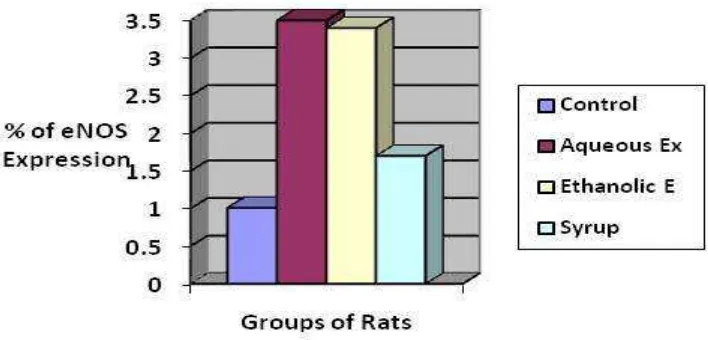
The average eNOS expression in the aortae of control group (1) was 1.01 ± 0.79 %. The expression of eNOS in the treatment groups (Group 2, 3 and 4) were : 3.5±1.63 %, 3.40±1.61%. and 1.70 ±1.50%, respectively. Aqueous and ethanolic extracts of purple sweet potato tubers significantly increased the expression of eNOS (p<0.05), however, treatment with syrup showed no significant increase in eNOS expression (p>0.05) when compared to the control group (Figure 2, Figure 3 and Table 2).
DISCUSSION
Jawi et al. 105
Figure 2. Comparison of eNOS expression between 4 groups of rats
Figure 3. Photomicrographs of eNOS expression in the aortae of 4 groups of rats (Olympus CX 41 and camera Olympus DP 12). The brown color in the circle indicated the eNOS expression. A. Control. B. Treatment with aqueous extract. C. Treatment with ethanolic extract. D. Treatment with purple sweet potato tuber syrup.
Table 2. Mean of eNOS expression
Group Mean of eNos Expression
Control Group 1,01±0,79a
Aqueous Extract 3,50± 1,63b Ethanolic Extract 3,48±1,61b
Syrup 1,70±1,50a
Mean followed by the same superscript letters are not significantly different according to least significance difference (LSD) at 5% level.
improving NO bioavailability (Mann, 2007). Blood pressure-lowering effect of purple sweet potato in rats treated with high doses of NaCl was possibly established
106. Univers. J. Med. Dent.
pressure has been widely studied. Oxidative stress or high level of reactive oxygen species(ROS), such as superoxide anions (O2.-),decrease bioavailability of nitric oxide (NO) within the vascular wall (Jung et al.,2003), so that the relaxation response of blood vessels decrease (Xu, 2004; Mann, 2007). Anti-oxidants that reduced superoxide anions can improve endothelial function so can decrease blood pressure in hypertensive models(Touyz and Schiffrin,2004). Giving antioxidants, especially antioxidants derived from plants such as anthocyanin which is one of the flavonoids, is very useful in treating this condition (Mann, 2007).
The results of present study are consistent with several previous studies, that polyphenols protect blood vessels endothelial function, so that smooth muscle of blood vessels can maintain stable blood pressure (Broncel et al.,2007). This is consistent with the results of several studies conducted in vitro and in vivo that providing isoflavone (a flavonoid) may lower systolic and diastolic blood pressure by increasing NO bioavailability, causing blood vessels dilatation (Mann, 2007). Similar result was obtained by Freedman et al. (2001), who found that purple grape extract could enhance the production of NO by platelets (Freedman et al.,2001). Cyanidin-3-glucoside, which is a typical anthocyanin pigment, could increase eNOS expression in arterial endothelial cells incubated for 8 hours (Xu, 2004). Shindo et al. (2007) showed that administration of anthocyanin-rich foods such as corn, and red radish for 15 weeks with the anthocyanin content of approximately 1% of the total diet, could lower the blood pressure and pulse rate compared with control (Shindo et al., 2007).
Anthocyanins are potent exogenous antioxidants in terms of their function as oxygen radical scavengers, so that it can be elaborated to mitigate oxidative stress and preserve endothelial function. Anthocyanins from various sources, as bioflavonoids, have different properties. Anthocyanin from chokeberry, bilberry and eldeberry had been shown in vitro to protect the endothelial cells that were exposed to ROS (Bell, 2006).
The results of our study support other results that extracts containing anthocyanins from various sources can reduce the blood pressure by maintaining the endothelial function through the increase of eNOS expression and subsequent NO bioavailability.
It can be concluded that aqueous extract, ethanolic extract and syrup of purple sweet potato tuber could lower systolic blood pressure significantly in rats with NaCl-induced hypertension. The ethanolic extract was superior to water extract and syrup in terms of lowering blood pressure in those rats. Aqueous and ethanolic extract of purple sweet potato increased the aortic endothelium eNOS expression significantly, which contribute to the antihypertensive effects observed in the rats.
ACKNOWLEDGEMENT
The authors extend their high appreciations to Research and Development Center of The Faculty of Medicine, Udayana University, for providing research grant to support this study in the year 2010.
REFERENCES
Broncel M, Kozirog-Kolacinska M, Andryskowski G, Duchnowizc P, Koter-Michalak M, Owczarczyk A, Chojnowska-jezierska J (2007). Effect of anthocyanins from Aronia melanocarpa on blood pressure, concentration of endothelin-1 and lipids in patients with metabolic syndrome. Pol.Merkur Lekarski. 23:116-119. Bell DR, Gochenaur K (2006). Direct vasoactive and
vasoprotective properties of anthocyanin rich extracts. J. Appl. Physiol. 100 (4): 1164-1170. Engler MB, Engler MM, Chen CY (2004). Flavonoid-Rich
Dark Chocolate Improves Endothelial Function and Increases Plasma Epicatechin Concentrations in Healthy Adults. J. Am. Colleg. of Nutri. 23: 197-204. Erdman JW, Balentine D, Arab L, Beecher G, Dwyer JT,
Folts J (2007). Flavonoids and Heart Health. J. Nutri. 137 : 718-723.
Freedman JE, Parker C, Li L, Perlman JA, Frei B, Ivanov V, Deak L R, Iafrati MD, Folts JD (2001). Select Flavonoids and Whole Juice From Purple Grapes Inhibit Platelet Function and Enhance Nitric Oxid. Circulation. 103: 2792-2798. blood and other organs on mice with maximal physical activity. Jurnal Veteriner 9 :65-72 (in Indonesian language).
Jawi IM, Budiasa K (2011). Extract of purple sweet potato reduced the total cholesterol and increased the total antioxidant in blood of rabbit. Jurnal Veteriner. 12 : 120-125.
Jawi IM, Sutirta-Yasa IWP 2011. Water Extract of Sweet Potato Tubers Reduced Blood Pressure of Hypertensive Rats Indduced by NaCl. Abstract International Conference on Biosciences and Biotechnology. P. 32.
Jung O, Marklund SL, Geiger H, Pedrazzini T, Busse R, Brandes RP 2003. Extracellular superoxide dismutase is a major determinant of nitric oxide bioavailability: in vivo and ex vivo evidence from ecSOD-deficient mice. Circ. Res. 3;93(7):622-9. Vitro Investigative Approach. J. Biomed. and Biotechnol. 5: 306-313
Middleton E, Kandaswami C, Theoharides CT (2000). The Effect of Plant Flavonoids on Mammalian Cells: Implications for Inflammation, Heart Disease, and Cancer. Pharmacol. Rev. 52: 673-751.
Morris BJ (2007). Climate not cultivars in the NO-ing of red wines. J. Hypert. 25 : 501-503.
Shindo M, Kasai T, Abe A, Kondo Y (2007). Effects Dietary Administration of Plant-Derived Anthocyanin-Rich Colors to Spontaneously Hypertensive Rats. J. Nutri. Sci. Vitaminol. 53:90-93.
Suprapta DN, Antara M, Arya N, Sudana M, Duniadji AS, Sudarma M (2004). Study on seedling preparation, cultivation and utilization of root crops as alternative food. Research Report. Faculty of Agriculture Udayana University, Bali (in Indonesian language).
Sutirta-Yasa IWP, Jawi IM, Ngurah I B, Subawa AAN (2011). Balinese Purple Sweet Potato on SGOT,SGPT and MDA level and Chronic Alcohol. Indon. J. Clin. Pathol. and Med. Lab. 17 : 151-154
Jawi et al. 107
Touyz RM, Schiffrin EL (2004). Reactive oxygen species in vascular biology: implications in hypertension. Histochem. Cell Biol. 122(4):339-52