commit to user
ANTECEDENTS OF LIKELIHOOD OF CHEATING
(Study on Undergraduate Student)
Submitted by:
Bagus Indrawan
F0207044
Bachelor Thesis
Submitted to Economic Faculty of Sebelas Maret University
to Fulfill one of the Requirements for Achieving
The Bachelor Degree of Management
FAKULTAS EKONOMI
UNIVERSITAS SEBELAS MARET
SURAKARTA
commit to user
MOTTO
Bersyukur dan Ikhlas
(Hymne HMI)
As above, so below
As within, so without
commit to user DEDICATION
commit to user ACKNOWLEDGEMENT
With deeply humble, my greatest gratitude to Allah SWT, the Grandest
and Almighty, the Most Gracious and the Most Merciful for giving me the chance,
and ability to perform this research and for all the change, He has given to the
writer until now. My greatest gratitude to Prophet Muhammad SAW for the
teaching and love that he has spread to the whole world, so the writer can
complete research entitled ANTECEDENTS OF LIKELIHOOD OF CHEATING
(Study on Undergraduate Student).
In the process of his research, the writer received support, contribution,
and assistance from many people. Thus, there are honorable people that are
important to the writer to whom he can only express his gratitude:
1. My beloved parents Liem Giok Djie and Zaenuri Anwar, Mom and Dad
thank you so much for every hard work and sacrifices you have done
for me, and for every prayer.
2. Dr. Wisnu Untoro, M.S., Dean of Economic Faculty of University of
Sebelas Maret.
3. Dr. Hunik Sri Runing S, M.Si., The Head of Management Department
of Economic Faculty of University of Sebelas Maret.
4. Dr. Budhi Haryanto, M.M., the thesis advisor for his patience,
guidance, and suggestions.
commit to user
writer as long as he study at Economic Faculty of University of Sebelas
Maret.
6. All of The Grand Family of Economic Faculty of University of Sebelas
Maret.
7. All respondents. Thank you for the cooperation.
8. And all who have assisted me to finalize this Bachelor Thesis.
The writer realizes that this thesis still has many mistakes and inaccuracies.
Therefore, he accepts gratefully every suggestions, criticisms andcomments from
those who concern to this thesis. Hopefully, this thesis will be able to give
contribution and be useful for the readers especially for those who are interested in
the similar research.
Surakarta, June 2012
commit to user
TABLE OF CONTENTS
TITLE ... i
ABSTRACT ... ii
ADVISOR APPROVAL ... iii
LEGALIZATION ... iv
MOTTO ... v
DEDICATION ... vi
ACKNOWLEDGMENT ... vii
TABLE OF CONTENT ... ix
LIST OF TABLES ... xi
TABLE OF FIGURES ... xii
CHAPTER I. INTRODUCTION A. Background ... 1
B. Research Problem ... 5
C. Research Purpose ... 10
D. Research Implication ... 10
E. Study Justification ... 12
CHAPTER II. THEORETICAL BACKGROUND AND HYPOTHESES DEVELOPMENT A. Study Position ... 14
commit to user
C. Theoretical Framework ... 30
CHAPTER III RESEARCH METHOD A. Study Scope ... 31
B. Data Collecting and Sampling Method ... 32
C. Operational Definition and Measurement Instrument ... 33
D. Data Analysis Method ... 37
CHAPTER IV FINDINGS AND DISCUSSIONS A. Descriptive Analysis ... 43
B. Research Instrument Analysis ... 44
C. Data Analysis ... 48
D. Hypotheses Testing and Discussions ... 55
E. Alternative Model Analysis ... 70
CHAPTER V CONCLUSION AND IMPLICATION A. Conclusion ... 74
B. Implication ... 77
C. Limitation ... 80
REFERENCES ... 82
commit to user LIST OF TABLES
Table Page
II.1. Study Position ... 15
III.1. Goodness of Fit Model Criteria ... 42
IV.1. Descriptive Statistics ... 44
IV.2. Validity Test ... 45
IV.3. Reliability Test Result ... 47
IV.4. Assessment of Normality ... 50
IV.5. Summary of Mahalanobis Distance Squared ... 52
IV.6. Goodness of Fit Test Result ... 53
IV.7. Goodness of Fit Test Result After Modified ... 54
IV.8. Regression Weights ... 55
commit to user TABLE OF FIGURES
Figure Page
II.1. Research Framework ... 30
IV.1. Partially Mediated Model (Initial) ... 57
IV.2. Direct-Effect-Only Model ... 72
commit to user
The purpose of this research is to examine the variables that influence likelihood of cheating. Specifically, this research wants to examine whether learner autonomy, lecturer support, intrinsic motivation, extrinsic motivation, amotivation, academic performance, prior cheating, and neutralization as considered important variables in forming the likelihood of cheating on undergraduate students.
A survey is conducted to collect the data by direct interviews with the means which are guided by questionnaire. This method is done to increase the seriousness in interpreting and filling the questionnaires, so it is expected to obtain accuracy in the data. In this research, the sample consists of 200 undergraduate students who have likelihood of cheating. Convenience sampling technique is a chosen method to make easier in getting the sample.
Reliability and validity test are conducted to make ascertain toward the quality of the data. Structural equation modeling is statistical method chosen to elaborate the relationships among variables. The result shows that learner autonomy and lecturer support have significant influence on intrinsic motivation, intrinsic motivation and amotivation have significant influence on academic performance, academic performance and prior cheating have also significant influence on neutralization, and neutralization has significant influence on likelihood of cheating. In mediation role, the fully-mediated-model is accepted as the final theoretical model.
In this research, both limitation and implication are also discussed in order to give insight toward theoretical, practical and further research aspects.
commit to user
CHAPTER I
INTRODUCTION
A. Background
Academic cheating is an interesting issue to be studied because prior
research indicated that cheating had become more prevalent and more increasing
(see Whitley, 1998; Crown and Spiller, 1998). It occurred on any school levels,
elementary school (Tas and Tekkaya, 2010), junior high school, senior high
school (Murdock et. al., 2008; Vinski and Tryon, 2009), college, and university
(McCabe et. al., 2001, Stone et. al., 2007; Stone et. al., 2009). From these
findings, it can be concluded that eliminating or at least diminishing student
cheating is necessary.
Applying previous researches findings to reduce academic cheating does
not probably reduce the number of cheating effectively because research
frameworks developed in prior studies only describe phenomenon on its research
settings. Hence, the findings cannot be applied on different settings appropriately
because of the difference of sample characteristics.1 Therefore, conducting study
to develop a framework that appropriate with research setting of Indonesia is
important.
1
commit to user
This study depends on 9 variables, they are: (1) learner autonomy, (2)
lecturer support, (3) intrinsic motivation, (4) extrinsic motivation, (5) amotivation,
(6) academic performance, (7) prior cheating, (8) neutralization, and (9) likelihood
of cheating. The variable selection is based on several prior studies that examine
those variables.2 The research framework is expected to predict likelihood of
cheating accurately. Each of variables examined in this study will be explained
below.
First, likelihood of cheating is defined as degree of inclination to cheat on
the future (Smith et. al., 2009). In other words, likelihood of cheating is how
someone is likely or unlikely to cheat on the future. This is an important construct
to be examined because it will predict future cheating behavior. Thus, if formation
process of this variable is recognized, it will help marketers in cheating
prevention.
Second, the variable that examined in this study is neutralization. It
represents the rationalization and justification for unethical behavior as a
deflection from self-disapproval or disapproval from others (Sykes and Matza,
1957). This variable is important to be examined because it influenced likelihood
of cheating. Study conducted by Rettinger and Jordan, (2005) and Davy et. al.
(2007) proposed neutralization had positive effect to likelihood of cheating. It
2
commit to user
makes sense because someone who has neutralized guilt feeling of cheating will
be likely to cheat.
Third, prior cheating is defined as perceived frequency of cheating that has
been done before (Davy, et. al., 2009). This study examines prior cheating as
cheating predictor variable because it can become a good predictor of likelihood
of cheating. Harding et. al. (2007) found that someone who cheat on school will
more likely to cheat on university. Therefore, it can be concluded that prior
cheating have positive relationship with likelihood of cheating. Prior cheating is
also proposed have positive relationship with neutralization because someone who
usually cheats will be easier rationalizing cheating than someone who seldom
cheats (see Davy et. al., 2007).
Fourth, the variable that examined is academic performance. In this
context, it is defined as how someone perceives his or her competence and
compares it to his or her classmates (see Davy et. al., 2007). This variable can
influence cheating constructs because student who perceives his or her ability is
adequate to accomplish tasks and test satisfyingly will perceive that cheating is
unnecessary to do; thus, the student will not cheat. Prior research found that
academic performance has negative correlation with neutralization, and likelihood
of cheating (see Davy et. al., 2007; Davy, et. al., 2009; Smith et. al., 2009).
Fifth, amotivation is a condition of people that lack intention to behave
and relatively absence of motivation (Deci et. al., 1991). In that condition, they
are unable to regulate themselves and do not have sense of causality of their
commit to user
important to be examined because it enhances cheating behavior. Literature
review indicated that amotivation is positively correlated with neutralization, and
likelihood of cheating, and it negatively correlated with academic performance
(Davy et. al., 2009; Smith et. al., 2009).
Sixth, extrinsic motivation is a type of motivation that driven by external
rewards (Deci et. al., 1991; Deci and Ryan, 2000). This study uses external
regulation and introjected regulation as extrinsic motivation construct because
they are tend to externally driven motivation according to motivation continuum.3
This variable is important to be examined because it has influence on cheating
framework. In Davy et. al. (2007) and Smith et. al. (2009), extrinsic motivation
was proposed negatively correlated with academic performance and positively
correlated with neutralization, and likelihood of cheating.
Seventh, intrinsic motivation is defined as internal driving force to engage
to behavior because of pleasure and satisfaction derived from it (Deci et. al.,
1991). This variable has important role on research framework because it
influence on academic performance and cheating behavior. Davy, et. al., (2009)
and Smith et. al., (2009) proposed that intrinsic motivation positively correlated
with academic performance and negatively correlated with neutralization, and
likelihood of cheating.
3
commit to user
Eighth, lecturer support as caring and attention that is given by lecturers so
the students feel lecturers are involved with them, know and care them (Klem and
Connell, 2004). Soenens and Vansteenkiste (2005), found that teacher support
influence student self-determination. Because the most self-determined motivation
is intrinsic motivation (Deci and Ryan, 2000), it can be concluded that teacher
support is positively correlated with intrinsic motivation. It also supported by
Kuvaas (2009) that found supervisor support positively correlated with intrinsic
motivation.
Ninth, learner autonomy was defined as freedom to make important
decisions for themselves that given by lecturer to student in learning process (eg.
scheduling independently), which is examined from student perspective (Hassan
and Rahman, 2010) Prior research found that autonomy positively correlated with
intrinsic motivation (Soenens and Vansteenkiste, 2005; Kuvaas, 2009). Because
the context of this study is academic cheating, the autonomy that studied here is
learner autonomy.
Based on relationship between variables explained before, the following
are problem identifications of this study.
B. Research Problem
To conduct a good research, problem identification is an important phase.
A research cannot be conducted well if the problems are not formulated definitely
(Sekaran and Bougie, 2009). Hence, this subchapter explains how research
commit to user
First problem examined in this study is the relationship between
neutralization and likelihood of cheating. Literature review indicated that
neutralization influenced likelihood of cheating; the higher the neutralization, the
higher the likelihood of cheating4. This variable influenced likelihood of cheating
because someone who has neutralized guilt feeling of cheating will be likely to
cheat. Thus, the first problem is:
Does neutralization influence likelihood of cheating?
The second problem is the relationship between prior cheating and
likelihood of cheating. Prior research indicated that prior cheating positively
influences likelihood of cheating; the higher the prior cheating, the higher the
likelihood of cheating (Davy et. al., 2007; Smith et. al., 2009). Thus, the second
problem is:
Does prior cheating influence likelihood of cheating?
In the relation with neutralization, prior cheating has positive relationship
with neutralization; the higher the prior cheating, the higher the neutralization
(Davy et. al., 2007; Smith et. al., 2009). Thus, the third problem is:
Does prior cheating influence neutralization?
4
See Rettinger and Jordan, (2005), Davy et. al. (2007), Davy, et. al. (2009), and Smith et. al.
commit to user
Another variable that is predicted has relationship with cheating behavior
is academic performance. Academic performance has negative influence on
likelihood of cheating. Students who perceive their academic performance is good
will not cheat because they feel able in completing tasks and test. It is supported
with prior research that found academic performance has negative relationship
with likelihood of cheating (see Davy et. al., 2007; Davy, et. al., 2009). Thus, the
fourth problem is:
Does academic performance influence likelihood of cheating?
Because academic performance negatively influences likelihood of
cheating, students who have high academic performance will be less likely to
cheat so they have smaller needs to neutralize their behavior. Hence, academic
performance also influences neutralization; the higher the academic performance,
the lower the neutralization (Smith et. al., 2009). Thus, the fifth problem is:
Does academic performance influence neutralization?
Next problem is related to amotivation because students who are on the
amotivation state will be likely to cheat on exams or tasks. When amotivated
students face exams or tasks they will feel externally controlled (Deci et. al.,
1991). They feel externally controlled because they lack of value on behavior
(Standage et. al., 2005). In order to free from external control, they will do
anything to complete the exams or tasks, although it is cheating. Because they
commit to user
correlated with likelihood of cheating and neutralization, and it negatively
correlated with academic performance (Davy et. al., 2009; Smith et. al., 2009).
Thus, the sixth to eighth problems are:
Does amotivation influence likelihood of cheating?
Does amotivation influence neutralization?
Does amotivation influence academic performance?
There are several problems related to externally driven motivation.
Extrinsic motivation is positively correlated with likelihood of cheating and
neutralization, and it negatively correlated with academic performance (Davy et.
al., 2007; Smith et. al., 2009). It is reasonable because student who is motivated
by external reward (such as: graduation, score) will do any efforts to get it,
include cheating. Thus, the ninth to eleventh problems are:
Does extrinsic motivation influence likelihood of cheating?
Does extrinsic motivation influence neutralization?
Does extrinsic motivation influence academic performance?
Next problem is related to intrinsic motivation. Intrinsically motivated
students are not likely to cheat because they enjoy learning (Deci et. al., 1991). If
students get pleasure in learning experience, they will learn lessons well and not
need to cheat. Hence, intrinsic motivation positively correlated with academic
commit to user
neutralization (Davy et. al., 2007; Smith et. al., 2009). Thus, the twelfth to
fourteenth problems are:
Does intrinsic motivation influence likelihood of cheating?
Does intrinsic motivation influence neutralization?
Does intrinsic motivation influence academic performance?
There are two variables that are supposed to influence intrinsic motivation;
they are lecturer support and learner autonomy. First, lecturer support has
relationship with intrinsic motivation. Soenens and Vansteenkiste (2005) found
that teacher support enhance student self-determination. It can be concluded that
lecturer support is positively correlated with intrinsic motivation because the most
self-determined motivation is intrinsic motivation (Deci and Ryan, 2000). Thus,
the fifteenth problem is:
Does lecturer support influence intrinsic motivation?
Second, learner autonomy influences intrinsic motivation. Prior research
found that autonomy has relationship with intrinsic motivation; the higher the
learner autonomy, the higher the intrinsic motivation (Soenens and Vansteenkiste,
2005; Kuvaas, 2009). Thus, the sixteenth problem is:
commit to user
C. Research Purpose
The purpose of this study is to predict the formation process of likelihood
of cheating. The findings are expected to predict the variables that influencing
likelihood of cheating. Conceptual framework developed is based on frameworks
from prior researches on academic cheating context. Framework feasibility on
predicting likelihood of cheating is analyzed based on goodness-of-fit criteria.
Therefore, the proposed model can be used as a good predictor toward university
students cheating behavior in Indonesia.
Specifically, this study is aimed to examine the influences of antecedent
variables of likelihood of cheating. The influences can be grouped into five
categories. First, it examines the influence of neutralization on likelihood of
cheating. Second, it examines the influence of prior cheating on neutralization and
likelihood of cheating. Third, it examines the influence of academic performance
on neutralization, and likelihood of cheating. Fourth, it examines the influence of
motivation variables (intrinsic motivation, extrinsic motivation, and amotivation)
on academic performance, neutralization, and likelihood of cheating. Fifth, it
examines the influence of learner autonomy and lecturer support on intrinsic
motivation.
D. Research Implication
There are several implications of the study that perhaps has relevance with
the study purpose, such as: theoretical benefit, benefit for future research, and
commit to user
First, research framework that is constructed in this study is planned to be
tested through rigorous procedure. The reason of this treatment is to get high
accuracy of its prediction so this study is scientifically accountable. Therefore,
these study results have high validity, so it can be developed on different setting.
Second, conceptual framework that is developed in this study has
uniqueness compared to prior research. Research method developed in this study
uses Indonesian consumer behavior background. The framework resulted from
this study possibly become alternative framework that can be used to explain
likelihood of cheating phenomenon in Indonesia. It can provide different
perspective in other study in academic cheating context. Hence, it is possible to
use this study as reference in designing research method in the future.
Besides theoretical benefit, there is benefit for future research. Here is the
explanation.
Research method of this study is designed on limited scope. This limitation
is supposed to have impact in applying the findings of this research because the
framework that is developed here only describes phenomenon on this research
setting. This limitation indicates future research is necessary to generalize this
study on wider context in order to enhance its external validity.
Besides theoretical benefit and benefit for future research, there is practical
benefit of this research. Here is the explanation.
Framework that is developed in this research has purpose to reveal the
formation process of likelihood of cheating on undergraduate student. The
commit to user
marketers of education about efforts that can be applied to reduce cheating.
Through this study, they are expected to understand factors that are supposed to
reduce likelihood of cheating.
E. Study Justification
Study justification consist of five aspects, they are: research issue
selection, research object, research approach, analyzing method selection, and
framework generalization principle. Here are the explanations of study
justifications.
This study appoints academic cheating as research issue. It is designed to
build understanding about academic cheating and to provide empirical
considerations to solve it. Specifically, this study will develop understanding in
constructing and selecting which stimulus that can be used to reduce likelihood of
cheating.
Object of this research is students that have likelihood of cheating. This
research is limited on undergraduate students because of considering homogeneity
of sample that analyzed. This treatment has purpose to give research boundary so
that the influence of external factors that is not proposed can be reduced.
Therefore, framework that is analyzed in this research can explain the occurred
phenomenon (robust model).
This research depends on cognitive psychological approach that is relies
on cognitive-affective-conative components to understand formation process of
commit to user
framework that accurately predict likelihood of cheating on undergraduate
students. It is possible because likelihood of cheating is dependent variable that
still in intention range that include in behavioral aspect that will be actualized
soon.
Structural equation modeling (SEM) is selected as analyzing method. SEM
is statistic method that supposed to have ability to answer research problems
identified. By using this analysis tools, there is possibility for testing complex
relationships among several variables simultaneously. The analysis conducted to
get whole description about entire framework because SEM can test structural and
measurement frameworks.
This study follows framework generalization principle because research
method of this study has limited scope characteristic. Thus, the framework that is
examined only can be generalized on its setting and object that is studied. To
generalize this study on different settings, it needs to pay attention to demographic
profile of respondents. If this consideration is not taken, there will be misleading
in understanding research findings so the marketing strategy formulated will not
commit to user
CHAPTER II
THEORETICAL BACKGROUND AND
HYPOTHESIS FORMULATION
This chapter provides theoretical background on this study in formulating
hypothesis. Hypothesis formulations need theoretical bases to achieve a
scientifically accountable research. Thus, this chapter is arranged into three
aspects, they are: (1) study position, (2) variables discussions, and (3) theoretical
framework. The details of each aspect will be explained below.
A. Study Position
There were various researches about academic cheating that have
been conducted before. This study can be compared to previous studies from
two aspects, by variables that are examined and by statistical tools that is
used. Table II.1 provides comparison of variables identified from previous
studies and variables constructed for this study.
Based on variable examined, this study takes likelihood of cheating
as dependent variable. This variable is adopted from research conducted by
Davy et. al. (2007), Davy et. al. (2009), and Smith et. al. (2009). Moreover,
this study also uses eight variables that adopted from literature review.
Neutralization adopted from Rettinger and Jordan (2005) and Davy et. al.
(2007). Prior cheating and academic performance adopted from Davy et. al.
commit to user
from Smith et. al. (2009). Learner autonomy adopted from Kuvaas (2009).
And, lecturer support adopted from Soenens and Vansteenkiste (2005).
Table II.1
SEM - Extrinsic Motivation -Intrinsic Motivation
SEM - Intrinsic Motivation - External-Identified
commit to user
Neutralization, academic performance, prior cheating, intrinsic
motivation, extrinsic motivation, amotivation, lecturer support and learner
autonomy are selected because based on literature review, they are considered
important in influencing likelihood of cheating. Also, these variables can be
influenced directly by marketers because these variables are within reach of
organizations (colleges or universities).
In contrary, autonomy-support parents is not examined in this study.
Measuring this variable needs to interview the students and their parents (see
Grolnick and Ryan, 1989; Klem and Connell, 2004). This method will bring
this research outside of its scope because parents’ involvement will extend
the research object.
Religion is another variable that probably have influence in cheating.
Prior research indicates that religion has influence on cheating moderated by
course content (see Rettinger and Jordan, 2005). Examining religion in
Indonesia will extend the scope of the research because Indonesia admits six
religions formally. In order to attain the focus in research discussions,
however, religion is also not observed in this research.
Technology is often presumed as cause of cheating because
advancement of technology makes cheating easier. Prior research indicates
that college students had misused the technology to cheat (see Etter et. al.,
2006). However, the finding does not give enough argument to propose that
commit to user
(2007), the role technology is only facilitate students to cheat, it is not the
cause of cheating. These findings indicate that technology is not relevant to
be posited as an antecedent of likelihood of cheating.
There are other variables that are presumed to give contribution in
likelihood of cheating, they are: complicated bureaucracy, lack of procedures
to give sanctions, and minimum law enforcements (see Burke et. al., 2007).
These variables were posited to predict the actual cheating behavior.
However, these variables are not examined in this study because there is lack
of supporting theories to put these variables as predictor of likelihood of
cheating. Also, instruments to measure these variables do not find in literature
review. Thus, it is not possible to examine these variables in this research.
Related to statistical tools used, this study uses Structural Equation
Modeling as statistical analysis tool. This method is used to analyze the
structural relationship among variables. It can recognize the relationship
among examined variables simultaneously.
Based on study position explained before, the following explanations
are discussions of variables and hypothesis development of this study.
B. Discussions of Variables and Hypothesis Formulation
This sub-chapter discusses definitions of and relationship among
observed variables. The discussions are important in order to have same
commit to user 1. Likelihood of Cheating
Likelihood of cheating is variable that represent the probability of
cheating that may be done (Davy et. al., 2007). Likelihood of cheating is
how someone is likely or unlikely to cheat on the future. This is an
important construct to be examined because it will be positioned as future
cheating predictor. Thus, if formation process of this variable is
recognized, it will help marketers on cheating prevention.
2. Neutralization
This variable is important to build the framework of academic
cheating predictor. It provides main influence on likelihood of cheating as
dependent variable. In literature review, neutralization defined as the
rationalizations and justifications for unethical behavior used to deflect
self-disapproval or disapproval from others after violating an accepted
social norm (see Sykes and Matza, 1957). Neutralization is used as tool to
justify dishonest behavior. Through the rationalization, students feel
permitted to cheat. Thus, neutralization was proposed to have positive
relationship with likelihood of cheating.
On another literature review, neutralization was conceptualized as
neutralizing attitudes construct (see Rettinger and Jordan, 2005). It was
commit to user
neutralizes the dissonance feelings associated to cheating. Thus, it was
proposed as predictor of cheating.
About the relationship of neutralization with cheating constructs,
Rettinger and Kramer (2009) had rather different statement compared
explanation before. In this study, neutralization was not considered a
sufficient cause of cheating, but it would facilitate the influence of other
factors, such as: situational and motivational influences. However, it still
supports that neutralization have positive influence on likelihood of
cheating.
This study uses concept of neutralization that used in Sykes and
Matza (1957), the rationalizations and justifications for unethical behavior
used to deflect self-disapproval or disapproval from others after violating
an accepted social norm. Because cheating is one form of unethical
behavior, it is reasonable to say that neutralization has positive relationship
with likelihood of cheating; the higher the neutralization, the higher the
likelihood of cheating (Davy et. al., 2007; Smith et. al., 2009). Thus, the
first hypothesis formulated is:
H1: Neutralization has positive influence on likelihood of cheating
3. Prior Cheating
In Harding et. al. (2007), prior cheating was defined as frequency
and number of cheating that was engaged by students. It uses an
commit to user
past cheating behavior affected cheating behavior that partially mediated
by intention.
In another research, Davy, et. al. (2009) defined prior cheating as
perceived frequency of cheating that has been done before. It is indicated
that prior cheating had positive relationship with likelihood of cheating. It
influenced likelihood of cheating because student who had cheating habit
would be more likely to cheat on the future.
This study takes the definition given by Davy et. al., (2009). Prior
cheating is proposed to have positive relationship with likelihood of
cheating; the higher the prior cheating, the higher the likelihood of
cheating. Thus, the second hypothesis formulated is:
H2: Prior cheating has positive influence on likelihood of cheating
Prior cheating also had relationship with neutralization because
students who report their prior cheating have greater need to neutralize it
(Davy et. al., 2009). So that, the higher the prior cheating, the higher the
neutralization. Thus, the third hypothesis formulated is:
H3: Prior cheating has positive influence on neutralization
4. Academic Performance
Academic performance it is defined as how someone perceived his
own academic competence (see Davy et. al., 2007). It is proposed to have
commit to user
good academic performance will cheat less than who have bad academic
performance. It was supported by prior research that found academic
performance has negative relationship with likelihood of cheating (see
Davy, et. al., 2009; Smith et. al., 2009). Thus, the fourth hypothesis
formulated is:
H4: Academic performance has negative influence on likelihood of
cheating
Because academic performance negatively influences likelihood of
cheating, students who have high academic performance will likely not
cheat. Because they do not cheat, they do not need to neutralize their
behavior. Hence, academic performance also influences neutralization; the
higher the academic performance, the lower the neutralization (Smith et.
al., 2009). Thus, the fifth hypothesis formulated is:
H5: Academic performance has negative influence on neutralization
5. Motivation
This study uses motivation construct that based on
self-determination theory (SDT) because it addressed the issue of energization
of behavior. It means, SDT not only concerned on what but also why
certain goals are desired (Deci et. al.,1991). Hence, this theory is hoped
commit to user
According to SDT, motivation described as a continuum. The least
motivated is amotivation, at the middle is extrinsic motivation, and the
most motivated is intrinsic motivation. Through the continuum, extrinsic
motivation was divided as four type of motivation. From
the-least-motivated to the-most-the-least-motivated extrinsic motivation they were:
external-regulation, introjected-external-regulation, identified-external-regulation, and
integrated-regulation (Deci and Ryan, 2000). Here is the explanation of each type of
extrinsic motivation.
First, external-regulation is a type of motivation appeared because
of specific external contingencies. This behavior is aimed to attain a
desired consequence such as tangible rewards or to avoid a threatened
punishment. Hence, in motivation continuum, external-regulation is
considered as externally regulated extrinsic motivation.
Second, introjected-regulation is a type of motivation performed to
avoid guilt or anxiety or to attain ego enhancements. Although internally
driven, introjected behaviors still have an external cause to occur. Thus, in
motivation continuum, introjected-regulation is considered as extrinsic
motivation that somewhat externally regulated.
Third, identified-regulation is a type of motivation performed when
someone recognize and accept the underlying value of a behavior. The
behaviors caused by identified-regulation were more volitional although
commit to user
identified-regulation is considered as somewhat internally regulated
extrinsic motivation.
Fourth, integrated-regulation is a type of motivation performed
when someone identifying the importance of behaviors and integrating
those identifications with other aspects of the self, such as values and
identity. Hence, in motivation continuum, integrated-regulation is
considered as internally regulated extrinsic motivation.
Motivation construct examined in this study is amotivation,
extrinsic motivation, and intrinsic motivation. Here is further explanation
of each motivation construct.
a. Amotivation
Amotivation is a condition of people that lack intention to
behave and relatively absence of motivation (Deci et. al., 1991). When
amotivated students face exams or tasks they will feel externally
controlled because they lack of value on behavior. To free from feeling
externally controlled, they will do anything to complete the exams or
tasks, although it is cheating. Because they cheat, they need to
neutralize their behavior. Thus, amotivation was positively correlated
with likelihood of cheating and neutralization, and it was negatively
correlated with academic performance.
This study takes the definition of amotivation provided by Deci
commit to user
behave and relatively absence of motivation. Amotivation is proposed
to have positive relationship with likelihood of cheating and
neutralization, and has negative relationship with academic
performance (Davy et. al., 2009). Thus, the sixth to eighth hypotheses
formulated are:
H6: Amotivation has positive influence on likelihood of cheating
H7: Amotivation has positive influence on neutralization
H8: Amotivation has negative influence on academic performance
b. Extrinsic Motivation.
Extrinsic motivation is motivation that exists caused by external
stimulus (Deci et. al., 1991). It is a type of motivation that more
internally regulated than amotivation but do not fully internalized like
intrinsic motivation. Extrinsic motivation examined here is
external-regulation and introjected-external-regulation because according to motivation
continuum their regulations are external and somewhat external
respectively. This variable is positively correlated with likelihood of
cheating and neutralization, and it negatively correlated with academic
performance. It is reasonable because student who motivated by
external reward (such as: graduation, score) will do any efforts to get it,
include cheating.
This study takes the definition of extrinsic motivation provided
commit to user
caused by external stimulus. Extrinsic motivation is proposed to have
positive relationship with likelihood of cheating and neutralization, and
has negative relationship with academic performance (Davy et. al.,
2007). Thus, the ninth to eleventh hypotheses formulated are:
H9: Extrinsic motivation has positive influence on likelihood of
cheating
H10:Extrinsic motivation has positive influence on neutralization
H11:Extrinsic motivation has negative influence on academic
performance
c. Intrinsic Motivation.
Intrinsic motivation is defined as internal driving force to
engage to behavior because of pleasure and satisfaction derived from it
(Deci et. al., 1991). Intrinsically motivated students are not likely to
cheat because they enjoy learning. If student enjoy learning they will
learn lessons well and not need to cheat. Hence, intrinsic motivation
positively correlated with academic performance, and negatively
correlated with likelihood of cheating and neutralization.
According to Vallerand et. al. (1992), intrinsic motivation is
divided into three types. They are intrinsic motivation to know, intrinsic
motivation to accomplish, and intrinsic motivation to experience
stimulation. The following is the explanation of each type of intrinsic
commit to user
Intrinsic-motivation-to-know is defined as the internal driving of
performing an activity for the pleasure and the satisfaction that
experienced while learning, exploring, or trying to understand
something new. Intrinsic-motivation-to-accomplish is defined as the
internal driving of engaging in activity for the pleasure and the
satisfaction experienced when one attempts to accomplish or create
something. Intrinsic-motivation-to-experience-stimulation is defined as
the internal driving that operative when someone engages in an activity
in order to experience stimulating sensations.
This study takes the definition of intrinsic motivation provided
by Deci et. al. (1991), internal driving force to engage to behavior
because of pleasure and satisfaction derived from it. In the type of
intrinsic motivation, this study examined intrinsic motivation as a
whole construct because the intrinsic motivation are considered have
relation each other. Intrinsic motivation is proposed to have positive
relationship with likelihood of cheating and neutralization, and has
negative relationship with academic performance (Smith et. al., 2009).
Furthermore, Noels et. al. (1999) said that students, who are
intrinsically motivated, feel that they are doing an activity because they
have chosen to do so voluntarily and because the activity represents a
challenge to their existing competencies and requires them to use their
creative capabilities. This kind of motivation is considered to be highly
commit to user
linked solely to the individual’s positive feelings while performing the
task. Thus, the twelfth to fourteenth hypotheses formulated are:
H12:Intrinsic motivation has positive influence on likelihood of
cheating
H13:Intrinsic motivation has positive influence on neutralization
H14:Intrinsic motivation has negative influence on academic
performance
6. Autonomy and Support in Lecturer-Student Relationship
Autonomy and support are important factors to enhance intrinsic
motivation because they suffice the three innate psychological needs:
competence, autonomy, and relatedness (Ryan and Deci, 2000). In
learning process, it is important to suffice the needs of the students to
enhance their intrinsic motivation. Lecturers hold the important role in
providing autonomy and support to the students.
a. Lecturer Support
Klem and Connell (2004) defined lecturer support as caring and
attention that is given by lecturers so the students feel lecturers are
involved with them, know and care them. It was said that students with
caring and supportive interpersonal relationships in school report more
satisfaction toward school. The satisfaction toward activities is related
commit to user
stimulation. Thus, lecturer support has positive relationship with
intrinsic motivation.
Soenens and Vansteenkiste (2005) explains lecturer support as
supports examined from student perspective that given by lecturer to
student in learning process. Lecturer support has relationship with
intrinsic motivation. There is a finding that teacher supports enhance
student self-determination. Because the most self-determined
motivation is intrinsic motivation, it can be concluded that lecturer
support is positively correlated with intrinsic motivation.
This research takes stand on lecturer support definition given by
Klem and Connell (2004). Lecturer support is proposed to have positive
relationship with intrinsic motivation; the higher the lecturer support,
the higher the intrinsic motivation. Thus, the fifteenth hypothesis
formulated is:
H15:Lecturer support has positive influence on intrinsic motivation
b. Learner Autonomy
Hassan and Rahman (2010), described the learner autonomy as
freedom to make important decisions for themselves that given by
lecturer to student in learning process (eg. scheduling independently),
which is examined from student perspective. Soenens and
Vansteenkiste (2005) found that autonomy had positive relationship
commit to user
activities, they were become less regulated; in other words, their
intrinsic motivation are enhanced.
In Little (2004), learner autonomy was defined as one’s ability
to responsible of their own learning process. Although Little (2004)
provided different definition, the relationship of learner autonomy and
intrinsic motivation is similar, learner autonomy has positive
relationship with intrinsic motivation. As a result, autonomous learners
draw on their intrinsic motivation when they accept responsibility for
their own learning and commit themselves to develop the skills of
self-management in learning.
This research uses definition of learner autonomy that used on
Hassan and Rahman (2010). In the relationship with intrinsic
motivation, learner autonomy has positive relationship with intrinsic
motivation; the higher the learner autonomy, the higher the intrinsic
motivation. Thus, the sixteenth hypothesis formulated is:
H16:Learner autonomy has positive influence on intrinsic
commit to user
C. Theoretical Framework
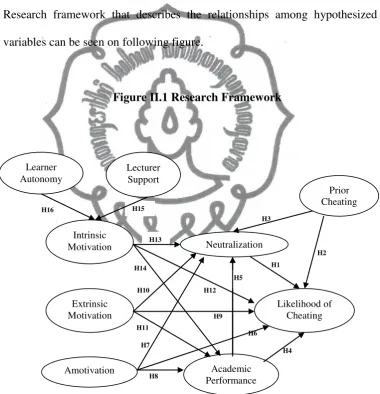
Based on sixteen hypotheses formulated, the relationships among
concepted variables can be arranged in a theoretical framework. The
framework describes the formation process of likelihood of cheating.
Research framework that describes the relationships among hypothesized
variables can be seen on following figure.
commit to user
CHAPTER III
RESEARCH METHOD
The purpose of this chapter is to give a valid and reliable basis in research
process to reach accountability on study result from methodology and testing
procedure aspects. It is important because the data are based on respondents
perception that is collected by research instrument probably have impact on the
accuracy of information. The information collected from respondents can be
incorrect because of measures inadequacy. The data must be tested to provide
assurance in validity and reliability so the information provided can be trusted on
methodological aspects.
To attain research accountability, four topics will be explained here, they
are: study scope, sampling technique and data collecting method, operational
definition and measurement instrument, and data analysis method. Each topic will
be explained below.
A. Study Scope
Based on study purpose, this study is included to basic research that
intends to generate a body of knowledge from an understanding of phenomenon.
Based on explanation level, this study is included tocausal research that explains
the relationships between variables that is categorized as independent and
dependent variable. The causal relationships between variables is based on
commit to user
This research will confirm the causal relationship between variables from
theoretical framework with empirical data, thus the study can give explanation,
comprehension, and prediction.
The data will be collected with cross-sectional method. It means the data is
collected through direct interview on one point event. Consequently, the
constructed model cannot accommodate the change of the phenomenon in the
future because of the time progression. Therefore, this study needs to be
generalized into different context by redesign the model into different research
settings.
In this study, the data is collected through survey guided by questionnaire.
This method is supposed to have impact on the bias perception caused by various
personal value and understanding. It needs reliability and validity tests to reduce
this problem.
Before collecting and analyzing data, it is necessary to define the target
population and sampling method. Imprecise definition of target population will
resulted in ineffective and misleading research. Target population and sampling
commit to user
B. Data Collecting and Sampling Method
Population of this study is students who have likelihood to cheat on the
future on their schooling process. The data is collected by using convenience
sampling method5.
The data are collected through direct interview guided by questionnaire
toward 200 respondents. This quota size is considered to represent the population.
Furthermore, it is also fulfilled with the minimum criteria of statistical tool that
was used in this study.
C. Operational Definition and Measurement Instrument
To collect good quality of data needs good measurement items because the
quality of instrument used determine the quality data gathered. Thus,
questionnaire used in this study are arranged based on previous studies. Here are
the details of operational definition and measurement items used.
1. Learner Autonomy
Learner autonomy was defined as freedom to make important decisions
for themselves that was given by lecturer to student in learning process (eg.
scheduling independently), which is examined from student perspective
(Hassan and Rahman, 2010). The indicators of this variable are taken from
5
commit to user
Standage et. al. (2005). They are measured by Likert scale that ranged from
1= strongly disagree to 5= strongly agree. The indicators are: “I am allowed
to: decide which lessons is learned, decide learning method, choice reference
book, decide time of unscheduled class, choice task material, decide
evaluation method, and decide class rule.
2. Lecturer Support
Lecturer support is defined as supports, which examined from student
perspective that was given by lecturer to student in learning process. The
indicators of this variable are taken from Standage et. al. (2005). They are
measured by Likert scale that ranged from 1= strongly disagree to 5= strongly
agree. The indicators of competence support are: Lecturers help me
understand the materials, encourage to discuss, encourage to study, make feel
confident, and encourage to study in groups.
3. Intrinsic Motivation
Intrinsic motivation is defined as internal driving force that moves
people to engage on certain behavior because of pleasure and satisfaction
derived from it (Deci et. al., 1991). The indicators of this variable are taken
from Smith et. al. (2009). They are measured by Likert scale that ranged from
1= strongly disagree to 5= strongly agree. The indicators are: studying
seriously, study with work hard, interested to educated formally, and
commit to user
4. Extrinsic Motivation
Extrinsic motivation is a type of motivation that was driven by external
rewards (Deci et. al., 1991; Deci and Ryan, 2000). The indicators of this
variable are taken from Smith et. al. (2009). They are measured by Likert
scale that ranged from 1= strongly disagree to 5= strongly agree. The
indicators are: opportunity of have a high-paying job, desire of have academic
degree, encouraged by parents.
5. Amotivation
Amotivation is a condition of people that is unable to regulate the self
and lack intention to behave because of absence of motivation to achieve
desired outcomes (Deci and Ryan, 2000). The indicators of this variable are
taken from Smith et. al. (2009). They are measured by Likert scale that
ranged from 1= strongly disagree to 5= strongly agree. The indicators are:
School is wasting time, school does not have any benefit, do not have reason
to school, and do not understand what is doing in school.
6. Academic Performance
Academic performance is defined as how someone perceived on his
own overall academic competence absolutely and how someone perceived on
his own academic competence compared to his classmates (see Davy et. al.,
commit to user
They are measured by Likert scale that ranged from 1= strongly disagree to
5= strongly agree. The indicators are: able to make academic papers,
participating in class discussions, can do writing exams.
7. Prior Cheating
Prior cheating is defined as self-perceived on frequency of cheating that
has been done before (Davy, et. al., 2009). The indicators of this variable are
taken from Smith et. al. (2009). They are measured by Likert scale that
ranged from 1= strongly disagree to 5= strongly agree. The indicators are:
exchanged answers, look at another student’s answer sheet, allowed another
student to look at own answer, gave answers to someone, and opened test
materials at exams.
8. Neutralization
Neutralization represents the rationalization and justification for
unethical behavior as a deflection from self-disapproval or disapproval from
others after violating an accepted social norm (see Sykes and Matza, 1957).
Measurement items of this variable are taken from Smith et.al. (2009). The
indicators are measured by Likert scale that ranged from 1= strongly disagree
to 5= strongly agree. The indicators are: grade points are reason to cheat,
didn’t study are reason to cheat, the course material was too hard are reason
to cheat, too much material was assigned are reason to cheat, useless course
commit to user
reason to cheat, friends request are reason to cheat, proctor is leaving are
reason to cheat.
9. Likelihood of Cheating
Likelihood of cheating is defined as students’ tendencies to cheat on the
future (Smith et. al., 2009). The indicators of this variable are taken from
Smith et. al. (2009). They are measured by semantic differential scale that
ranged from 1= strongly disagree to 7= strongly agree. The indicators are:
intent to cheat, probably cheat, willing to cheat, likely to cheat, committed to
cheat, certainly to cheat.
D. Data Analysis Method
Data analysis method consist of three aspects, there are: descriptive
analysis, statistical test, and structural model test. Each topic will be explained
below.
1. Descriptive Analysis
Descriptive analysis of sample is aimed to know the profile of
respondents that is used as background factor in this study. It is used to
generalize the result on population contact. To apply this study into different
background factor, it is needed to look on the demographic factor that can
commit to user
2. Statistical Test
Statistical test are first step for interpreting data. It is contained of two
tests, validity test and reliability test. The explanations of each point are
stated as follow.
a. Validity Test
Validity test is aimed to know the accuracy and precision of
measurement tool in measuring the variable. In validity test each indicators
are examined related to the relationship. So the indicators that have small
loading factor, which cannot explain the construct, are eliminated from
data analysis. In this study, validity test uses confirmatory factor analysis
processed by SPSS for Windows Version 16.0, when each question item
require loading factor higher than 0,40. Validity test is analyzed by
comparing the factor loading value in component matrix. The bigger value
of component question items, the bigger correlation of total score
constructs. This decision is based on significant rate > 0.40 (see Hair et.
al., 1998).
b. Reliability Test
In reliability test, consistency of indicators are tested, so the higher
correlation the higher consistency of the indicants. It is considered as a
relevant procedure to measure the instrument research. Reliability is
commit to user
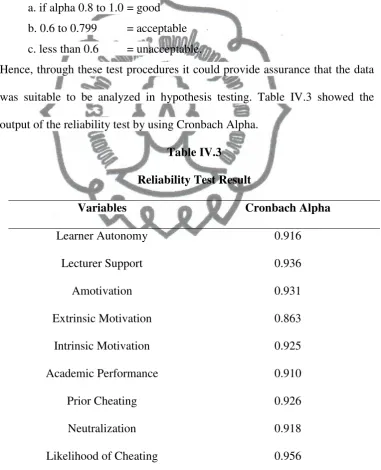
(Sekaran and Bougie, 2009). It is hoped that reliability procedure can
make assurance of data accuracy and feasibility when it is being tested by
another statistical analysis.
3. Structural Equation Modeling Analysis
Structural Equation Model Analysis is aimed to estimate the multiple
regression equation separately, but each has ties simultaneously or
concurrently. In this analysis it is possible there is more than one dependent
variable, and this variable becomes possible independent variables for the
other dependent variables.
In principle, the structural model aims to test the causative
relationship between variables, so if one of the variables changed, it will be
changed in other variables as well. In this study, data will be processed using
Analysis of Moment Structure software or AMOS version 18.
In this study, the statistical approach that is used to test the structural
model is Structural Equation Model (SEM), considered by previous study
measurement (Smith et. al., 2009). This approach will be used to test the
structural model to different groups simultaneously. The difference between
groups can be evaluated based on the goodness-of-fit model suggested on the
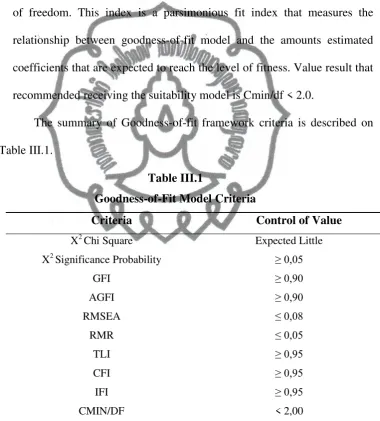
following criteria:
a. Chi-Square:
The purpose of this analysis is to develop and test a model that fits
commit to user
significance than 0.05 would indicate no significant difference between the
estimated covariance matrixes. Chi-square test is highly sensitive to the
very small sample or very big sample. Therefore, these tests need to be
equipped with the test equipment.
b. Goodness of Fit Index (GFI)
This index reflects the level of overall model fit, calculated from
the residual squares of the model that predicted compared to actual data.
The value result that approaching 1 implies that the model tested had
goodness of fit. The recommended value is GFI ≥ 0.90. The greater the
value of GFI, the better fit owned by the model.
c. Adjusted Goodness of Fit Index (AGFI)
This index is a development of GFI that adjusted for the ratio of the
degree of freedom model proposed by degree of freedom from the null
model (single construct model with all indicators of construct
measurement.) The recommended value is AGFI ≥ 0.90. The greater the
value of AGFI, the better fit owned by the model.
d. Root Mean Square Residual (RMR)
RMR is an index that describes as the average squared differences
between the residuals of the sample covariances and the residuals of the
commit to user
receive the fitness of a model.
e. Root Mean Square Error of Approximation (RMSEA)
RMSEA is an index used to measure the model fit chi square
statistic to replace the large number of samples. RMSEA values ≤ 0.08
indicate a good index to receive the fitness of a model.
f. Trucker Lewis Index (TLI)
TLI is an incremental fit index that compares the tested model with
the null model. Recommended acceptance of the value is the value of TLI
≥ 0.95.
g. Incremental Fit Index (IFI)
IFI is an incremental fit index. The size of this index is in range
from 0 to 1, and values result that approaching 1 indicates the model has a
good level of fitness models. The recommended value of receives is IFI ≥
0.95.
h. Comparative Fit Index (CFI)
CFI is also an incremental fit index. The size of this index is in
range from 0 to 1, and values result that approaching 1 indicates the model
has a good level of fitness models. This index is highly recommended to
commit to user
influenced by the complexity of the model. The recommended value of
receives is CFI ≥ 0.95.
i. Normed chi square (CMIN/DF)
Cmin/df is a measure of the value of chi-square divided by degree
of freedom. This index is a parsimonious fit index that measures the
relationship between goodness-of-fit model and the amounts estimated
coefficients that are expected to reach the level of fitness. Value result that
recommended receiving the suitability model is Cmin/df < 2.0.
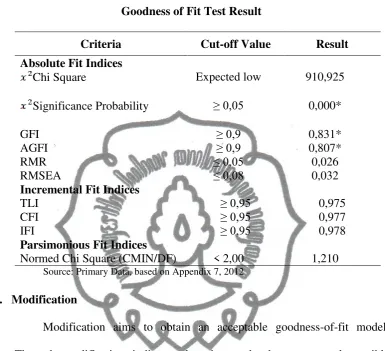
The summary of Goodness-of-fit framework criteria is described on
Table III.1.
Table III.1
Goodness-of-Fit Model Criteria
Criteria Control of Value
X2 Chi Square Expected Little
X2 Significance Probability ≥ 0,05
GFI ≥ 0,90
AGFI ≥ 0,90
RMSEA ≤ 0,08
RMR ≤ 0,05
TLI ≥ 0,95
CFI ≥ 0,95
IFI ≥ 0,95
CMIN/DF < 2,00
commit to user
CHAPTER IV
FINDINGS AND DISCUSSIONS
This chapter describes the process of data analysis and gives
comprehensive interpretation to the research findings. In order to reach greater
understanding through the findings, this chapter is arranged into five aspects:
descriptive analysis, research instrument analysis, structural equation modeling
analysis, hypothesis testing and discussions, and alternative model analysis. Here
are the explanations of each aspect.
A. Descriptive Analysis
First step of data analysis was descriptive analysis. This analysis was
conducted to understand the respondents’ characteristics. Of total 200
questionnaires were analyzed with SPSS version 16 and AMOS version 18. The
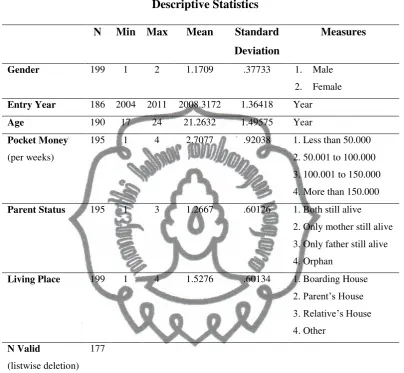
descriptive statistics was presented on Table IV.1.
Based on Table IV.1, it can be concluded that the majority of the
respondents were male (mean 1.17). Based on the age of respondents, most of the
respondents were 21 years old (mean 21.26), with the range of age from 17 to 24.
Based on the entry year, it had mean 2008.31, so it can be concluded that most of
the respondents enter to the university at the year of 2008. Pocket money had
mean value 2.70. It indicated that the majority of respondents have
100.000-150.000 IDR pocket money per weeks. Based on the parent status, the majority of
the respondents had both parents still alive (mean 1.26). Based on the living place,
commit to user
Source: Primary data processed by the writer, 2012
B. Research Instrument Analysis
1. Validity Test
Validity test is used to test the validity of the data. The data is
categorized to valid when the indicator can reveal the observed variable. This
test was conducted by using the validity test of Confirmatory Factor Analysis
(CFA) using SPSS for Windows version 16. In this test, every item must had
commit to user
Source: Primary Data, made base on Appendix 5, 2012
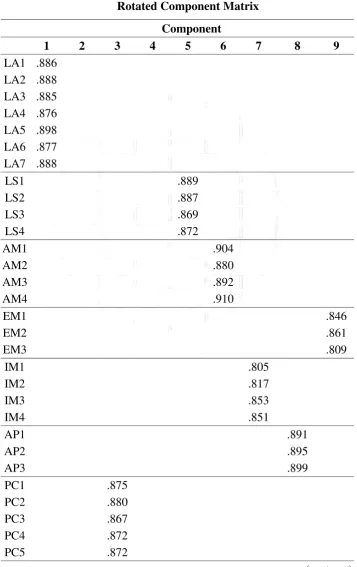
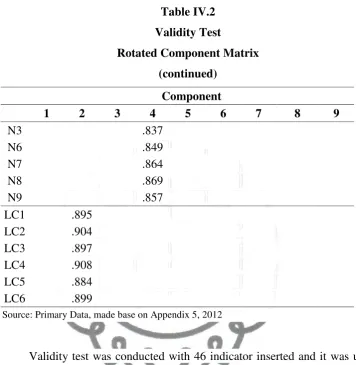
Validity test was conducted with 46 indicator inserted and it was used
Varimax rotation. The result showed that several items were not valid (see
Appendix 4). Hence, trial and error process was needed in order to find the
valid indicators. This process was conducted by eliminating high divergence
and low convergence items as least as possible and maintaining valid items as
much as possible. All items were categorized as valid when LS5, N1, N2, N4
and N5 were excluded from the analysis. The result that was showed the rest