P-ISSN: 1978-8118 E-ISSN: 2460-710X Lingua Cultura, 12(3), August 2018, 309-315
DOI: 10.21512/lc.v12i3.4233
FOREIGNIZATION AND DOMESTICATION
OF INDONESIAN CULTURAL TERMS IN THE NOVEL
GADIS PANTAI
TRANSLATED INTO ENGLISH
Gede Eka Putrawan
Department of Language and Arts Education, Faculty of Teacher Training and Education, the University of Lampung Jl. Prof. Dr. Ir. Sumantri Brojonegoro No.1, Gedong Meneng, Lampung 35145, Indonesia
Received: 28th December 2017 /Revised: 15th February 2018 /Accepted: 22nd February 2018
How to Cite: Putrawan, G. E. (2018). Foreignization and domestication of Indonesian cultural terms in the novel Gadis Pantai translated into English. Lingua Cultura, 12(3), 309-315.
https://doi.org/10.21512/lc.v12i3.4233
ABSTRACT
The research was aimed at investigating categories of Indonesian cultural terms translated into English, explaining techniques of applied translation, and analyzing foreignization and domestication ideologies applied in the translations of Indonesian cultural terms into English in the novel Gadis Pantai that was translated into The Girl from the Coast. This research was conducted through descriptive-qualitative approach. The data were collected through document analysis including content analysis and thematic analysis. The results show that there are five categories of cultural terms identified in the novel which are translated by using 16 techniques of translation, including the applications of single and double techniques of translation. In addition to foreignization and domestication ideologies of translation, it is also revealed that there is also partial foreignization and partial domestication ideologies of translation since some of the Indonesian identified cultural terms are translated through combinations of two different techniques of translation; combinations of source-language- and target-language-oriented techniques of translation. The most frequently-applied ideology of translation is domestication (82,20%), followed by foreignization (9,82%), as well as partial foreignization and partial domestication (7,98%).
Keywords: foreignization, domestication, cultural terms
INTRODUCTION
Vermeer in Sadiq (2015) has opposed the view that translation is just a matter of language for years. To him, it is a cross-cultural transfer that a translator should be
bicultural or even multicultural. One of the most difficult
problems in translating is found in the differences between cultures, the source language (SL) culture, and that of the target language (TL) because, as stated by Larson in Morina (2013), different cultures have different focuses.
The notion of ‘cultural term’ is very common in translation, especially in literary translation. Newmark in Widiatmi (2014), for example, states that culture refers to the way of life and its manifestations that are peculiar to a community that uses a particular language as its means of expression. He further states that cultural focus leads to translation problems since there is a cultural gap or distance, between the SL and that of the TL.
To cope with cultural terms, two basic ideologies of translation, domestication and foreignization should be applied. The ideologies are closely related to linguistic and cultural points of view. In the domesticating translation, a
translator attempts to produce a target language translation as naturally as possible. She/he tries to minimize the strangeness of the foreign text in the SL for TL readers
through a clear and fluent style of translation that the TL
readers feel like reading an original text, not a translated one. On the contrary, in foreignizing translation, a translator attempts to take the TL readers to the foreign culture of the SL and make them feel linguistic and cultural differences. Here, the TL readers can recognize that they are not reading an original text but that of translated.
In many books and articles, the terms domestication and foreignization are often considered ideologies, strategies, or methods of translation. When the translators believe that their translation is acceptable and correct, it means that domestication and foreignization are considered ideologies.
literal (linguistic transcodification), free (modification of
semiotic and communicative categories), and philological (academic or critical translation). Strategies are procedures (conscious or unconscious, verbal or nonverbal) used by the translator to solve problems that emerge when carrying out the translation process with a particular objective in mind. Translators use strategies for comprehension (e.g., to distinguish main and secondary ideas, establish conceptual relationships, and search for information) and for reformulation (e.g., paraphrase, retranslate, say out loud, avoid words that are close to the original).
Because strategies play an essential role in problem-solving, they are a central part of the sub-competencies that make up translation competence. Strategies open the
way to finding a suitable solution for a translation unit. The
solution will be materialized by using a particular technique. Therefore, strategies and techniques occupy different places in problem-solving; strategies refer to the parts of the process, techniques affect the result. This research focuses on domestication and foreignization as ideologies of translation viewed from the application of techniques of translation.
Venuti in Judickaite (2009) states that the domestication involves the ethnocentric reduction of the foreign text to (Anglo-American) target language cultural values. To make it more explicit, when a translated product becomes very transparent and easy to read, it is very likely that such translation is domesticated. As opposition to domesticating, the foreignizing translation should signify the difference of the foreign text, yet only by disrupting the cultural codes that prevail in the target language. Considering this quote, the ‘cultural codes’ of the TL should
be sacrificed in order to make the readers of a translated text
feel the taste of foreignness.
Hatim and Mason in Aslani and Salmani (2014) have stated that ideology encompasses the tacit assumptions, beliefs, and value systems which are shared collectively by social groups. They make a distinction between ‘the ideology of translating’ and ‘the translation of ideology’. The former refers to the basic orientation chosen by the translator operating, within a social and cultural context (the choice, for example between Venuti’s domesticating and foreignizing translation), while the latter refers to the extent to which translators intervene in the transfer process, feeding their own knowledge and beliefs into processing a text.
Many pieces of research on cultural translation and ideologies of translation have been conducted. Jayantini (2010) has discussed the procedures of translation that are utilized by the translator in translating the technical terms from English into Indonesian. The characteristics of domestication and foreignization are applied to the translation of technical terms from English into Indonesian, and kinds of phenomena taking place in English-Indonesian technical translation in terms of procedures of translation and the characteristics of domestication and foreignization. To translate the English biosecurity-related terms into
Indonesian, five procedures of translation are applied by
the translator; they are borrowing, calque, literal translation, transposition, and adaptation. Out of 482 technical terms, 16 terms (3,31%) are translated through borrowing procedure, 190 terms (39,42%) through calque, 216 terms (44,81%) through literal translation, 13 terms (2,70%) through transposition, and 47 terms (9,75%) through adaptation. She has found that the translator always applies single techniques of translation in rendering a term.
In addition, Geng (2009) has discussed the analysis of the cultural phenomena in English in terms of words, idioms, and allusion. Through his research, he also tries to stimulate more concentration on the approaches to deal with the cultural phenomena in translating from English into Chinese. He states that domestication and foreignization should go along with and complement each other.
Newmark in Maasoum and Davtalab (2015) and
Amininadji (2016) have classified culture-specific terms into five categories which include: (1) Ecology which refers to particular cultural terms on flora, fauna, winds, plains,
and hills. (2) The material culture which is further sub-divided into sub-categories that refer to various types of national food, clothes, transport, houses, and towns. (3) The social culture which refers to cultural terms of work and leisure. (4) The social organization which refers to national organizations, customs, activities, procedures, and concepts (political, religious, and artistic). (5) Gestures and habits which refer to gestures and habits closely related to culture.
Molina and Albir (2002) have stated that the translation method, strategies, and techniques are essentially
different categories. They define technique of translation
which is based on two premises; (1) the need to distinguish between method, strategy, and technique; (2) the need for analysis and functional concept of translation techniques.
They further state that techniques of translation have five
basic characteristics; they affect the result of the translation,
they are classified by the comparison with the original, they
affect micro-units of text, they are by nature discursive and contextual, and they are functional. The word ‘technique’ itself refers to a way of doing an activity which needs skill and competence.
Therefore, the technique of translation can be defined
as the way used by translators in translating smaller units of language (words, phrases, or expressions) from the SL into the TL. Molina and Albir (2002) propose 18 techniques
of translation, which include adaptation, amplification,
borrowing, calque, compensation, description, discursive creation, established equivalent, generalization, linguistic
amplification, linguistic compression, literal translation,
modulation, particularization, reduction, substitution (linguistic, paralinguistic), transposition, variation.
As stated by Newmark, cultural focus leads to translation problems because of that so-called cultural gap or
distance between the SL and that of the TL. It can be defined
that translating a cultural term is not that easy. A translator,
therefore, should find the most appropriate technique of
translation and decide whether the term is foreignized or domesticated in the TL.
The focus of this research is on viewing foreignization and domestication, ideologies of translation that are applied in the translations of Indonesian cultural terms into English in terms of words, phrases, or expressions in the novel Gadis Pantai that is translated into The Girl from the Coast. In other words, this research is aimed at investigating categories of Indonesian cultural terms translated into English, explaining techniques of translation applied in the translations, and analyzing foreignization and domestication ideologies of translation applied in the translations of Indonesian cultural terms into English in the novel.
The novel Gadis Pantai is written by Pramoedya
Ananta Toer, one of the greatest writers in Indonesia, firstly published in 1962. He has more than 30 works of fiction and nonfiction that have been translated into more than 30
target language that the translator is expected to be able to render the SL text into his language, as natural as possible. It contains a lot of Indonesian cultural terms translated into English. Thus, it is considered representative as the data source for this research.
Through this research, readers are expected to have more theoretical and practical insight on cultural translation in terms of techniques of translation and ideologies of translation. Moreover, the readers are also expected to realize that culture is important to take into account when translating texts especially literary texts.
METHODS
This research is conducted through descriptive-qualitative approach. The data, Indonesian cultural terms, used in this research are taken from Toer’s work Gadis Pantai and its English version The Girl from the Coast. The data are collected through document analysis involving
skimming (superficial examination), reading (thorough
examination), and interpretation. This method consists of content analysis and thematic analysis. The former refers to the process of organizing information into categories related to the central questions of the research (Bowen, 2009), while the latter refers to a form of pattern recognition within the data, with emerging themes becoming the categories for analysis (Fereday & Muir-Cochrane in Bowen, 2009).
In addition, Leedy and Ormrod in Williams (2007) have stated that content analysis is a detailed and systematic examination of the contents of a particular body of materials. It is aimed at identifying patterns, themes, or biases. Williams (2007) further states that content analysis review forms of human communication including books,
newspapers, and films as well as other forms.
The data source in this research is repeatedly and
carefully read to find out information of cultural words,
phrases, or expressions in the SL text and their translations in the TL. The occurrences of the Indonesian cultural terms
are then classified in accordance with the categories of
culture as qualitative evidence. The translation techniques and ideologies applied in the translations of the Indonesian cultural terms are then analyzed descriptively.
RESULTS AND DISCUSSIONS
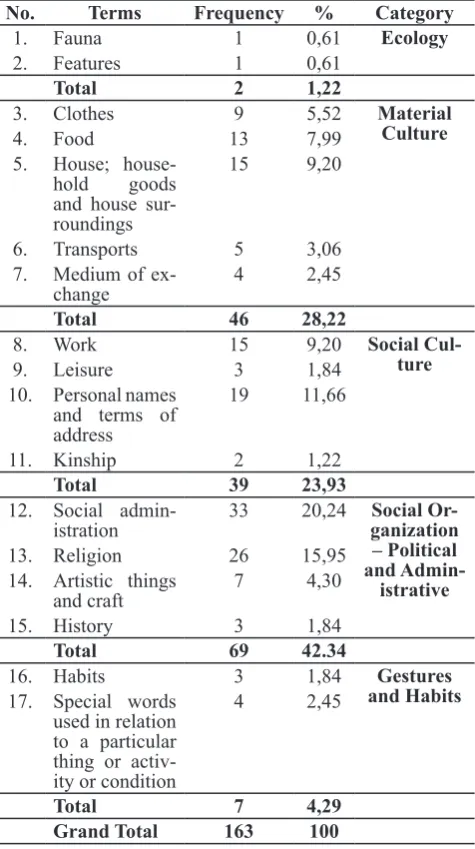
There are 163 Indonesian cultural terms are identified in the novel in five categories as proposed by Newmark in
Amininadji (2016) and Maasoum and Davtalab (2011). He
classifies culture-specific terms into five categories which include (1) Ecology (flora, fauna, winds, etc.); (2) material
culture (artifacts; food, clothes, houses and towns, transport); (3) social culture (work and leisure); (4) social organization (political and administrative, religious, artistic); (5) gestures and habits. Table 1 shows Indonesian cultural terms based on Newmark’s categories.
Then, the analyses of each category of cultural terms are made by presenting some examples considered as representative data. Only the interesting ones are prioritized to be presented. Some examples of the analyses can be seen in Table 2.
In the data 127 of Table 2, ketupat is translated into
‘packets of cooked rice’. Ketupat is made from rice that has been wrapped in woven young coconut leaves pouch and
boiled. As the rice cooks, the grains expand to fill the pouch
and the rice becomes compressed. Ketupat is very familiar in Indonesia, especially in Javanese and Balinese culture. Everyone in Indonesia knows what ketupat is. There are many varieties and shapes of ketupat, e.g., ketupat nasi – wrapped in a square shape and ketupat pulut – wrapped in a triangular. Since the culture of the target language does not have ketupat, the translator renders it into ‘packets of cooked rice’ even though it cannot represent the exact meaning of the ketupat itself.
In the data 114 of Table 3, kusir is translated into ‘driver’. Kusir is a person who controls a horse-drawn carriage, while the driver in the target language means
a person who drives a car. Based on the definitions, it is
clear that in source language culture the terms kusir is
very specific, while the driver is too general. Since target
language culture does not have a term which is exactly the same as the term kusir, the translator then renders it into the driver that is very acceptable to the target language readers.
Table 1 Indonesian Cultural Terms
No. Terms Frequency % Category
1. Fauna 1 0,61 Ecology
2. Features 1 0,61
Total 2 1,22
3. Clothes 9 5,52 Material
Culture
4. Food 13 7,99
5. House; house-hold goods and house sur-roundings
15 9,20
6. Transports 5 3,06
7. Medium of ex-change
4 2,45
Total 46 28,22
8. Work 15 9,20 Social
Cul-ture
9. Leisure 3 1,84
10. Personal names and terms of address
19 11,66
11. Kinship 2 1,22
Total 39 23,93
12. Social admin-istration
33 20,24 Social Or-ganization
– Political and Admin-istrative
13. Religion 26 15,95
14. Artistic things and craft
7 4,30
15. History 3 1,84
Total 69 42.34
16. Habits 3 1,84 Gestures
and Habits 17. Special words
used in relation to a particular thing or activ-ity or condition
4 2,45
Total 7 4,29
Table 2 The Example Data 127
Data SL TL
127 Cuma setahun sekali kegirangan dan kedamaian semacam ini terjadi: di waktu lebaran haji, dan seluruh
hari (Toer, 2003:170).
Such festivity and gaiety usually came but once a year, on the day of Pilgrim’s Homecoming, the tenth day of the twelfth month on the Moslem calendar, when the
families of the fishermen
gathered on the shore to
offer packets of cooked
rice to the gods of sea and
to pray for their blessings in return and that they not be bothered by the gods when doing their work (Toer, 2002:170).
Table 3 The Example Data 114
Data SL TL
114 “Kau pernah ke kampung nelayan, man?” Gadis Pantai bertanya pada kusir tanpa mengacuhkan kata-kata Mardinah (Toer, 2003:142).
The girl ignored the comment, focusing her attention on the driver instead: “Have you ever been
to a fishing village?”
(Toer, 2002:139).
Table 4 The Example Data 111
Data SL TL
111 “Sudah malam tidurlah, kalau tidak, kau tak perlu pergi besok. Aku khawatir kau masuk angin kelelahan.” (Toer, 2003:139).
“It’s late. Go to sleep. If you don’t get some sleep, you won’t be able to go tomorrow morning. You’re going to catch a chill.” (Toer, 2002:136).
In the data 111 of Table 4, the term masuk angin is translated into ‘catch a chill’. This term is very popular in Indonesia. Masuk angin can be literally defined as wind entering one’s body. It actually refers to slight cold, masuk means ‘to enter’, while angin means wind. When someone suffers from masuk angin, they believe that wind has made them sick. Masuk angin is a symptom of getting sick such as feeling dizzy and feeling sick inside the stomach. It is a term for feeling unwell. Staying awake all night long, lack of sleep, having windows open while driving a car, going outside on windy night or day without wearing a jacket, can make someone feel unwell and masuk angin.
There are many ways to draw out the wind from those who are suffering from masuk angin, including eating or drinking warm food and drinks, getting massaged, having traditional tonic, and kerokan. Kerokan is done by rubbing on oiled coin over back skin carefully and repeatedly until it becomes red. The purpose of kerokan is believed to allow the air from the stomach to come out by burping and farting. The burping and farting symbolize the wind trying to escape. Western culture does not have the term masuk
angin. In the West, people do not have masuk angin; they only have a runny nose, a headache, frequent sneezing, a fever, a cough, and they call them as ‘a cold’. They say they have ‘a cold’ when they suffer from one of the symptoms mentioned. It means that catch a chill or catch a cold is the best English equivalent to refer to masuk angin according to western culture. The translator has rendered the term masuk angin into catch a chill well so that it is culturally acceptable to target language readers.
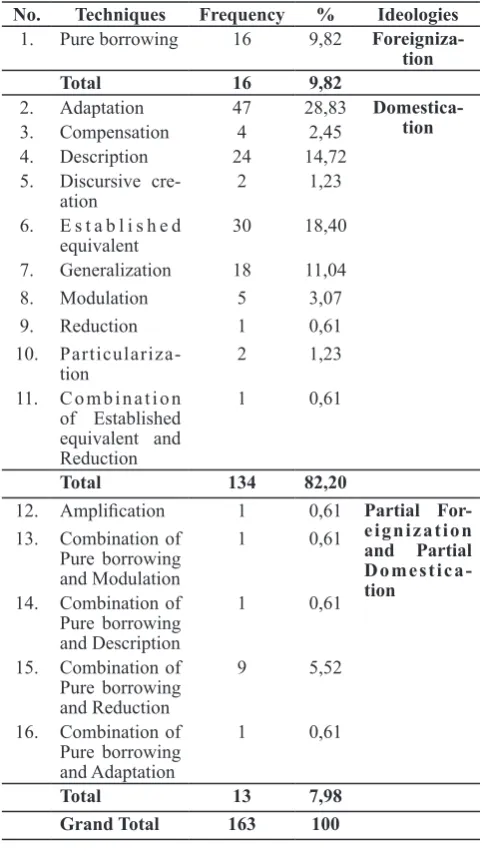
In addition to the categories of Indonesian cultural terms above, techniques of translation applied in the
translation of the cultural terms are also identified and
analyzed as presented in Table 5.
Table 5 Techniques and Ideologies of Translation
No. Techniques Frequency % Ideologies
1. Pure borrowing 16 9,82
Foreigniza-tion
Total 16 9,82
2. Adaptation 47 28,83
Domestica-tion
12. Amplification 1 0,61 Partial
For-e i g n i z a t i o n
The identified Indonesian cultural terms are
translated by using 16 techniques of translation in three ideologies which include foreignization, domestication, and partial domestication – partial foreignization ideologies of translation. Table 6 is the examples of the analyses of techniques and ideology of translation.
In the data 42 of Table 6, the translator does not make
technique of translation is applied since the term is unknown in the target language culture, this decision is not a wrong choice, and it is done due to cultural differences between Indonesian culture, especially Javanese, and English culture. In addition, by borrowing the cultural term above into the target language, it means that the translator tries to introduce Indonesian culture, especially Javanese, into the target language, English.
Table 6 The Example Data 42
Data SL TL
42 Mengapa bicara saja tidak berani, sedang ia suka memekik-menjerit Karto.. (Toer, 2003:41).
Why couldn’t she make herself open her
mouth? If she were at
home, she’d have no problem screaming at her pet chicken Kuntring or calling out for her playmates, or laughing along with Pak Karto. (Toer, 2002:35).
Table 7 The Example Data 111 and 119
Data SL TL
111 “Sudah malam tidurlah, kalau tidak, kau tak perlu pergi besok. Aku khawatir kau masuk angin kelelahan.” (Toer, 2003:139).
“It’s late. Go to sleep. If you don’t get some sleep, you won’t be able to go tomorrow morning. You’re going to catch a chill.” (Toer, 2002:136).
119 Dia dapat persen minum air gula-jawa (Toer, 2003:147).
He gets some molasses (Toer, 2002:145).
In the data 111 and 119 of Table 7, masuk angin is translated into catch a chill, gula-jawa into molasses by using adaptation technique of translation since target language culture does not have concepts which are exactly the same as the terms presented. The translator’s purpose in rendering those terms as shown in Table 7 through adaptation technique of translation is to make his translation sound more natural, so that target language readers have a similar strong feeling when reading the translated novel as source language readers do.
Table 8 The Example Data 74
Data SL TL
74 Ia tidur di bale kawani emak (Toer, 2003:83).
She had joined her mother on the sleeping platform (Toer, 2002:80).
In the data 74 of Table 8, the bale is translated into the sleeping platform by using compensation technique of translation. Bale is not only used for sleeping, but also for
sitting, meeting, and others. The translator adds the word ‘sleeping’ in the translation of bale into ‘sleeping platform’ with the purpose of introducing and emphasizing what the term bale is used for in the context of the situation.
Table 9 The Example Data 45
Data SL TL
In the data 45 of Table 9, the term pangestu is translated into thank you by the translator through discursive creation. Here, he produces a temporary equivalence which is totally unpredictable for the term pangestu by rendering it into thank you. Pangestu itself actually means blessing, good wishes, or prayers.
Table 10 The Example Data 96 and 120
Data SL TL 120 ..belum juga mereka
berpapasan dengan dokar
lainnya. Grobak pun tak ada mereka papasi (Toer, 2003:149).
..had yet to meet another vehicle, even an oxcart (Toer, 2002:148).
The terms ustad and dokar, in the data 96 and 120 in Table 10, are translated into teacher and vehicle through generalization technique of translation. Ustad refers to a male Muslim religious teacher who always attempts to improve behavior in line with Islamic thinking and usually teaches at an Islamic boarding school, while teacher means someone whose job is to teach in a school, the subjects they teach may be history, geography, English, etc. Here, it is clear the translator generalizes the term ustad into the teacher in the target language. Also, in translating dokar into the vehicle, the translator also applies generalization since there are many kinds of vehicles, such as the car, motorcycle, carriage, etc.
Table 11 The Example Data 46
Data SL TL
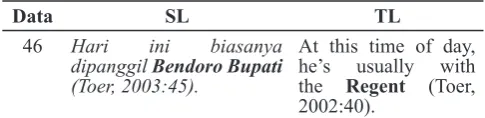
46 Hari ini biasanya
dipanggil Bendoro Bupati
item in the target language by deleting the term Bendoro, but on the other hand, he just translates the word Bupati through established equivalent technique into Regent.
In addition to SL-oriented and TL-oriented techniques of translation, some techniques of translation are also SL partially-oriented and TL partially-oriented techniques of translation. The SL oriented and TL
partially-oriented techniques of translation include amplification and
combinations of SL-oriented and TL-oriented techniques
of translation. Amplification is considered SL
partially-oriented technique of translation since it introduces details that are not formulated in the ST; information, explicative paraphrasing. For example is by adding bulan puasa kaum Muslim when translating a noun Ramadhan, so it becomes …Ramadhan, bulan puasa kaum Muslim,.. Footnotes are
also a type of amplification.
A cultural term is not merely translated by using a single technique of translation. It can also be translated by using more than one technique of translation through combinations of SL-oriented techniques of translation and that of TL-oriented. The combinations consist of two
different techniques of translation. Some of the identified
data in the novel Gadis Pantai are translated into TL, The Girl from the Coast, by using these combinations of techniques of translation. Table 12 is the examples of SL partially-oriented and TL partially-oriented techniques of translation analysis.
Table 12 The Example Data 29
Data SL TL
29 Ia berkopiah haji (Toer, 2003:31).
On his head was a kopiah, the kind of rimless hat she had seen worn by men who had made the pilgrimage to Mecca (Toer, 2002:25).
In the data 29 of Table 12, kopiah haji is translated into kopiah with some details. It means that the translator
applies the amplification technique of translation since he
introduces details that are not formulated in the source text by explicative paraphrasing. The details of the term kopiah haji in the source text are not formulated, while in the target text, the translator gives an explicative paraphrase ‘the kind of rimless hat she had seen worn by men who had made the pilgrimage to Mecca’. On the one hand, the term is partially oriented to the source language by retaining the term kopiah, on the other hand, it is also partially oriented to the target language through explicative paraphrasing.
Table 13 The Example Data 12
Data SL TL
12 ..sebuah pendopo
dengan tiga baris tiang putih (Toer, 2003:16).
A traditional pendopo-style structure, the roof of which was supported by three parallels rows of columns (Toer, 2002:9).
In the data 12 of Table 13, the term pendopo is translated into the traditional pendopo-style structure. The
translator applies description technique of translation in rendering the term, yet he also borrows the term pendopo itself. In this case, two different techniques of translation are applied, it is partially oriented to the source language by retaining the term pendopo (pure borrowing), and at the same time, it is also partially oriented to the target language through the application of description technique.
The findings of the applications of techniques of translation in this research are not in line with the findings
found by Jayantini (2010) who states that the translator always applies single techniques of translation in rendering a term. In this research, the translator applies not only single techniques of translation but also combinations of two different techniques of translation.
Based on the analysis of techniques of translation,
it can be identified that 9,82% of the cultural terms are
foreignized. It means that the target language readers can feel linguistic and cultural differences between Indonesian culture and that of English. In applying the foreignization ideology of translation, the translator only uses pure borrowing technique of translation in rendering some cultural terms from Indonesian into English. Through the application of foreignization ideology of translation, the translator has introduced the source language culture into that of the target.
The application of domestication ideology of translation is through some TL-oriented techniques of translation; they are adaptation, compensation, description, discursive creation, established equivalent, generalization, modulation, reduction, particularization, and the combination of established equivalent and reduction. In this research, 82,20% of the cultural terms are domesticated that is the most frequently-applied ideology of translation. It means that most of the cultural terms found are rendered as naturally as possible into the target language.
As Venuti in Judickaite, (2009) has stated that domestication involves the ethnocentric reduction of the foreign text (Indonesian cultural terms) to the target language (English) cultural values. When a translated
product becomes very fluent and easy to read, it can be
said that such translation is domesticated. 82,20% of the Indonesian cultural terms in this research are domesticated to make them more explicit in the target language.
A translator, usually, applies either foreignization or domestication ideology of translation in his/her translation through the applications of techniques of translation; TL-oriented and SL-oriented techniques of translation. However, in this research, the translator does not only apply two ideologies of translation but also applies partial foreignization and partial domestication ideology of
translation. It turns out that some cultural terms identified in
the novel Gadis Pantai and its translation The Girl from the Coast are partially foreignized and partially domesticated through the applications of combinations of two different techniques of translation; combinations of SL-oriented and TL-oriented techniques of translation.
It means that in translating the Indonesian cultural
terms identified in the novel, the translator applies not only
one technique of translation, but also several combinations
of two different techniques. Amplification technique is also
considered partial foreignization and partial domestication since it retains an SL cultural term in TL, and at the same time, introduces details that are not formulated in the SL through explicative paraphrasing.
partially domesticated into the target language, English. Partial foreignization and partial domestication are applied
through amplification technique of translation and some
combinations of two different techniques of translation
including amplification, the combination of pure borrowing
and modulation, the combination of pure borrowing and description, the combination of pure borrowing and reduction, and the combination of pure borrowing and adaptation.
It is in line with what is stated by Geng (2009) that domestication and foreignization should go along with and complement each other. Larson (in Morina, 2013) states that different cultures will have different focuses. When cultures
are similar, there is less difficulty in translating. This is
because both languages will probably have terms that are more or less equivalent for various aspects of the culture. When, however, the cultures are very different, especially
Indonesian and English, so it is often very difficult to find
equivalent lexical items.
CONCLUSIONS
There are 163 identified Indonesian cultural terms classified into five categories translated by using
16 techniques of translation in the novel Gadis Pantai and its translation The Girl from the Coast including the applications of single and double techniques of translation – SL-oriented technique of translation; TL-oriented techniques of translation; and SL partially-oriented and TL partially-oriented techniques of translation. After analyzing the techniques of translation, the analysis of the ideology of translation and the most frequently-applied ideology of translation could also be made. There are, in fact, two basic ideologies of translation, foreignization, and domestication. However, in this research, it is revealed that some Indonesian cultural terms are also partially foreignized (partial foreignization) and partially domesticated (partial domestication). It can also be concluded that the most frequently-applied ideology of translation is domestication (82,20%).
However, this research also has some limitations. Due to the nature of the research questions, it is based on the descriptive-qualitative approach in which the researcher is the only instrument for data collection. In addition, this research also focuses on ideologies of translation applied to the translations of cultural terms in a novel. The limitations point towards topics is to be addressed in the future. A few areas to investigate for future research include the use of other research instruments for data collection, e.g., interviews and questionnaires to describe the phenomena under investigation more deeply, and the use of other data sources including sensitive or religious texts.
REFERENCES
Amininadji, O. (2016). A study of culture specific items and translation strategies in Bahrām Beyzā’ī’s play “Marionettes”. Master’s Thesis. Montreal: Université de Montréal.
Aslani, M., & Salmani, B. (2015). Ideology and translation: A critical discourse analysis approach towards the representation of political news in translation. International Journal of Applied Linguistics
and English Literature, 4(3), 80–88. https://doi. org/10.7575/aiac.ijalel.v.4n.3p.80.
Bowen, G. A. (2009). Document analysis as a qualitative research method. Quality Research Journal, 9(2), 27–40. https://doi.org/10.3316/qrj0902027.
Geng, X. (2009). An analysis of the cultural phenomena in English and its translation. Asian Social Science, 5(12), 141–144.
Jayantini, I. G. A. S. R. (2010). Domestication and foreignization taking place in technical translation of the bilingual glossary of Biosecurity. Thesis. Denpasar: Udayana University.
Judickaitė, L. (2009). The notions of foreignization and domestication applied to film translation: Analysis
of subtitles in cartoon ‘Ratatouille’. Jaunųjų Mokslininkų darbai, 2(23), 36-43. Retrieved from http://su.lt/bylos/mokslo_leidiniai/jmd/09_02_23/ judickaite.pdf.
Maasoum, S. M. H., & Davtalab, H. (2011). An analysis
of culture-specific items in Persian translation of
‘Dubliners’ based on Newmark’ s model. Theory and Practice in Language Studies, 1(12), 1767-1779. Molina, L., & Albir, H. (2002). Translation techniques
revisited: A dynamic and functionalist approach. Meta, 47(4), 498–512. https://doi.org/10.7202/008033ar. Morina, M. M. (2013). Translation issues. Academic
Journal of Interdisciplinary Studies, 2(4), 163–171. https://doi.org/10.5901/ajis.2012.v2n4p163.
Sadiq, J. (2015). Negotiating translation studies: A leap from linguistic dynamics to cultural dynamics. Indian Scholar, 2(2), 13–21.
Toer, P. A. (1962). The Girl from the Coast. Translated by Willem Samuels. 2002. New York: Hyperion. Toer, P. A. (2003). Gadis pantai. Jakarta: Lentera Dipantara. Widiatmi, Y. D. (2014). Cultural words in English translation
of Ayu Utami’s Saman. The 3rd UNNES International Conference International Conference. Semarang, Indonesia. pp 846–857. Retrieved from http://eltlt. org/wp-content/uploads/2015/04/PROCEEDINGS-ELTLT-2014.pdf.