Robust Metric based Anomaly Detection in Kernel Feature Space
Bo Du
1,2, Liangpei Zhang
2, Huang Xin
21 School of Computer Science, Wuhan University
2 The State Key Laboratory of Information Engineering in
Surveying, Mapping, and Remote Sensing
Wuhan University, P.R. China.
Abstract: This thesis analyzes the anomalous measurement metric in high dimension feature
space, where it is supposed the Gaussian assumption for state-of-art mahanlanobis algorithms is
reasonable. The realization of the detector in high dimension feature space is by kernel trick.
Besides, the masking and swamping effect is further inhibited by an iterative approach in the
feature space. The proposed robust metric based anomaly detection presents promising
performance in hyperspectral remote sensing images: the separability between anomalies and
background is enlarged; background statistics is more concentrated, and immune to the
contamination by anomalies.
Keywords: anomaly detection, hyperspectral images, Manhanlobis distance
Introduction
Anomaly targets in hyperspectal images (HSI) refer to those deviating obviously from the other
background pixels, especially by means of the spectral feature [1]. Typical ones are the man-made
objects in nature scene, such as the vehicles in a grass field. State-of-arts methods mainly evaluate
it by exploiting the distance of an observing pixel to the background statistics center. So the key is
the background statistics, or the anomalous metric. RX and its variants take use of a Manhanlobis
distance from background statistics [2]. In spite of their effectiveness, they are proved to be
susceptible to the masking and swamping effect, due to the contaminated background statistics [3].
Multivariate outlier detection methods, focusing to alleviate this effect, figure out a more robust
metric by eliminating the probable background pixels or a contracting iteration procedure to
each iteration excluding the most anomalous samples until the rest samples unchanged. Then the
metric by the rest samples is believed to be immune to the anomalies, or a robust one. However,
the robust metric anomaly detection methods don’t take into consideration the nonlinear
relationship between different bands of the hyperspectral images. The Gaussian assumption of the
target present hypothesis and target absent hypothesis may not be valid either [5]. Besides, on the
boundary between background and anomaly it is very common to find the mixed pixels. So does it
when the size of anomaly is smaller than the images’ spatial resolution. The cases become much
worse when the pixels are seriously mixed, or the nonlinear mixed pixels. Kernel based anomaly
detectors, such as kernel-RX, have been developed to solve the above problem, while the metric in
high dimension feature space is not robust since the anomaly pixels may be contained in the
background gram matrix.
Fig. 1 The schematic flow sheet of our method. The black dots represent the background
pixels, and the red ones corresponding to the anomaly targets.
This thesis proposes a new anomaly detector by exploiting a robust metric in the kernelized
feature space. The idea is shown in Fig. 1, where vectored pixels in original feature space may not
be fit for Gaussian distribution, but it is the case for some high dimension feature space like the
middle picture with the counter corresponding to the Manhanlobis metric. But only with the
metric excluding the anomaly pixels can the real anomalous degree of the anomalies be presented,
shown in the last picture.
Robust Anomalous Metric in High Dimension Feature Space
Traditional target detection methods exploit the linear separablity between targets and
backgrounds signals [6]. Classic approaches include subspace model and linear mixture model [6].
measurement metric from background pixels, where the background pixels dataset is usually
contaminated since it is usually composed of all the pixels in the image [7]. Robust Mahanlobis
distance based methods construct an iterative procedure [4]. In each iteration the first and second
order statistics are computed to figure out the anomalous distance, then the pixels presenting
distance larger than a predefined threshold would be excluded and the statistics are updated by the
rest dataset. The iteration is done until the rest dataset wouldn’t change. The underlying idea is
that the contamination by anomalies can be gradually eliminated by a dataset shrinking procedure,
and the anomalies can be detected at the same time.
Hyperspectral images contain a large number of spectral bands. Though state-of-art methods
prove promising in separating anomalies from backgrounds, the nonlinear correlations between
different spectral bands are not considered. Different materials present spectrally absorption at
different spectral position, so that the nonlinear correlations are not evitable. Kernel based
anomaly detection methods have made great success, the typical ones are kernel-RX. Another
factor that needs further investigation is that the mixed manner of each pixel is much more
complex than linear mixture model. As the spatial resolution is limited, intimate mixture, instead
of linear mixture, is more widespread and reasonable [8]. In intimate mixtures, the photons are
interacting with all the materials simultaneously. In linear mixtures, the assumption was the
photons scattered off one material at a time. Since intimate mixtures have multiple different
materials in close relation to one another, the photons can bounce from one particle to another
causing different absorption and reflection effects. The result is mixing that cannot be well
captured by simple linear models [8]. Inspired by kernel-RX and robust anomaly detection
methods, we proposed the new robust one, with the detailed steps are presented as following:
Step 1: Since the gram matrix is usually N×N with N being the number of background pixels, it
is not possible to consider all the pixels at one time otherwise it would exceed the computing
capacity very easily. So a k-means clustering method is employed to segment the dataset into k
classes.
Step 2: For each clustered class, all the pixels are projected into the high feature space
( )
x
→
φ
x
, constituting a new dataset D. It is assumed thatStep 3: The statistics of these projected pixels from D are figured out, including mean
m
1
Step 4: Define the Manhalobis distance metric of each pixel in D by the mean and covariance.
The numerical expression of the anomaly detector in each iteration is given as:
( ( )) ( ( )
i i)
( ( )
i)
Td
φ
x
=
φ
x
−
m C
Φ Φφ
x
−
m
Φ (3)With the algebra computation as well as the kernelized trick, the distance can be done by dot
product of pixels in original low dimension feature space. By spectrum decomposition, the
background covariance matrix can be transferred into:
T
C
Φ= Λ
V
ΦV
Φ(4)
where
V
Φ andΛ
are the eigenvectors and eigenvalues matrix, respectively. It is proved thateach eigenvectors in the feature space can be expressed as the linear composition of the
centralized input samples in the feature space [5].
1
where
X
Φ is the composed of the kernelized input dataset samples andβ
jis the eigenvectorsof the centered kernel matrix (Gram matrix). Due to the physical structure in high dimension feature space and some formulas computation, all the eigenvectors with nonzero eigenvalues:
V
Φ=
X
Φβ
(6)By substitute and into , and some similar algebra computation, the final expression of the detector is:
1
( ( ))
i(
rT Tm)
T b(
rT mT)
d
φ
x
=
K
−
K
ΦK
)
−K
−
K
Φ (7)Step 5: Eliminate the pixel with the distance larger than a predefined threshold to update D.
Some adaptive thresholding approach can be used. For simplicity, a percentage of the number of
the samples is used. For example, the largest 1% samples can be excluded.
Step 6: Iterate Step 2. to Step 4. until the dataset D doesn’t change.
Step 7: After all the clustered classes are performed, the pixels excluded in each clustered class
are labeled as the anomaly targets.
Experiments and anslysis
Experiments on real-world hyperspectral images have been done to evaluate our proposed
method, including air-born hyperspectral remote sensing images and near scene hyperspectral
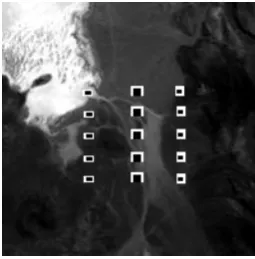
images. Five rows of panels distribute in the scene and considered as anomalies, shown in Fig.2 .
Several state of art methods are used as comparison ones. Our method iterates 5 times until the
results keep stable. Preliminary experiments results with AVIRIS hyperspectral images are shown
in Fig. 3. It is obvious that our proposed method did best among all the methods. Considering the
mixed boundary anomaly pixels, the performances of different methods for different kinds of
anomalies are also presented in Table I, which further reveal that the improvement of our method
is partly due to the superior performance on the transition boundary pixels.
Fig. 2. Target panels in the AVIRIS image. Fig. 3. Performances of different methods.
Table.1 Number of detected anomalies under minimized false alarms
Methods Proposed
Method
RX K-RX BACON
Number of Boundary
Conclusion
Combining the robust Manhanlobis anomaly detection methods and nonlinear mixture models,
a robust metric based anomaly detection method in kernel feature space is proposed. Experiments
reveal that the proposed method does provide a more reliable and robust metric for anomaly
detection from hyperspectral remote sensing images, especially for detecting the ones on resolved
pixels.
Reference
[1] B. Du and L. Zhang, “Random Selection based Anomaly Detector for Hyperspectral
Imagery,” IEEE Trans. Geosci. Remote Sens., vol. 49, no. 5, pp.1578 – 1589, 2011.
[2] I. S. Reed and X. Yu, “Adaptive multiple-band CFAR detection of an optical pattern with
unknown spectral distribution,” IEEE Trans. Acoust., Speech, Signal Process, vol. 38, no. 10,
pp.1760–1770, 1990.
[3] T. E. Smetek and K.W. Bauer, “A Comparison of Multivariate Outlier Detection Methods
for Finding Hyperspectral Anomalies,” Military Operations Research, vol. 13, no. 4, pp. 19–44,
2008.
[4] T. E. Smetek, “Hyperspectra Improved Anomaly Detection and Signature Matching
Methods,” Ph.D. dissertation, Air Univ., Ohio, 2007.
[5] H. Kwon and N. M. Nasrabadi, “Kernel RX-Algorithm: A Nonlinear Anomaly Detector for
Hyperspectral Imagery,” IEEE Transactions on Geoscience and Remote Sensing, vol. 43, no. 2,
pp. 388–397, 2005.
[6] D. Manolakis and G. Shaw, “Detection Algorithms for Hyperspectral Imaging Applications,”
IEEE Signal Processing Mag., vol. 19, no. 1, pp. 29–43, Jan. 2002.
[7] C.-I. Chang and S.-S. Chiang, “Anomaly Detection and Classification for Hyperspectral
Imagery,” IEEE Trans. Geosci. Remote Sens., vol. 40, no. 6, pp. 1314–1325, 2002.
[8] J. Plaza, P. Martinez, R. Perez, and A. Plaza, “Nonlinear neural network mixture models for
fractional abundance estimation in AVIRIS hyperspectral images,” in Proc. XIII JPL Airborne
[9] J. B. Broadwater and A. Banerjee, “A comparison of kernel functions for intimate mixture