A Grammar of Ts’ixa
(Kalahari Khoe)
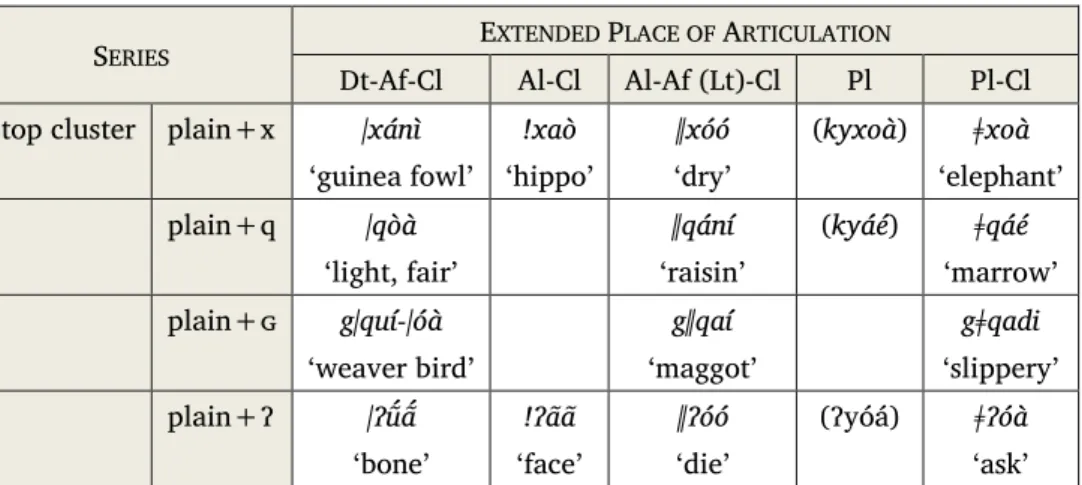
Ph.D.%Thesis,%Ins-tut%für%Afrikanis-k%
Anne$Maria)Fehn)
A Grammar of Ts’ixa
(Kalahari Khoe)
Inaugural-Dissertation
zur Erlangung des Doktorgrades der Philosophischen Fakultät der
Universität zu Köln im Fach Afrikanistik
vorgelegt von Anne-Maria Fehn
aus Naila (Bayern)
Erster Referent:
Prof. Dr. Anne Storch
Zweite Referentin:
PD Dr. Helma Pasch
Dritte Referentin:
Prof. Dr. Thomas Widlok
Abstract
Ts’ixa is an endangered language of northern Botswana. It belongs to the Kalahari branch of the Khoe-Kwadi language family and is nowadays spoken by a small community of 200 individuals residing in the village of Mababe, Ngamiland. The internal affiliation of Ts’ixa within Kalahari Khoe is not clear, as the language displays affinities to both the western Kalahari Khoe language Khwe and the eastern Kalahari Khoe language Shua.
The present work is the first attempt at providing a systematic description of Ts’ixa, based on phonological, morphological and syntactical features. Data from related Khoe languages, as well as from unrelated “Khoisan” languages of the Kx’a and Tuu families is used to locate Ts’ixa in both a genealogical and an areal framework. Findings suggest that Ts’ixa was shaped by a history of migration and contact between both related and unrelated languages, leading to a unique profile different from both Khwe and Shua, but with strong typological affinities to the Kalahari Basin as a linguistic area.
Zusammenfassung
Ts’ixa ist eine bedrohte Sprache aus dem Norden Botswanas. Es gehört dem Kalahari-Zweig der Khoe-Kwadi Sprachfamilie an und wird gegenwärtig von einer kleinen Sprechergemeinschaft, bestehend aus etwa 200 Individuen gesprochen, die alle in dem Dorf Mababe in Ngamiland leben. The Klassifikation von Ts’ixa innerhalb der Kalahari Khoe Gruppe ist unklar, da die Sprache Merkmale der West Kalahari Khoe Sprache Khwe und der Ost Kalahari Khoe Sprache Shua aufweist.
Die vorliegende Arbeit ist der erste Versuch einer systematischen Beschreibung des Ts’ixa, basierend auf phonologischen, morphologischen, und syntaktischen Merkmalen. Daten aus verwandten Khoe Sprachen, wie auch aus unverwandten “Khoisan” Sprachen der Kx’a und Tuu Familien werden herangezogen, um Ts’ixa in einem genealogischen, sowie in einem arealen Rahmen zu verorten. Die Ergebnisse legen nahe, dass Ts’ixa durch seine Migrations- und Kontaktgeschichte mit verwandten und unverwandten Sprachen geprägt wurde. Dies führte letztendlich zur Entstehung eines spezifischen Profils, das sich durchaus von den Nachbarsprachen Khwe und Shua unterscheidet, gleichsam jedoch starke typologische Affinität zum Kalahari Becken Sprachbund aufweist.
! ! ! ! ! ! ! ! ! ! ! ! ! ! ! ! !
This study was made possible by the Ministry of Youth Sport and Culture of the Government of Botswana who generously provided me with a research permit
Acknowledgements
This work would never have come to life without the help of my supervisor Bernd Heine. Apart from providing guidance, support and an amazing supply of useful literature, he also gifted me with his friendship and never-ending patience during lengthy phone calls in which I bombarded him with all sorts of questions. I also owe him for almost immediate replies whenever I sent him draft versions of the present work, and of course for his detailed and helpful comments.
I also wish to express my gratitude to Tom Güldemann for many a discussion as well as comments and criticism on various presentations and selected chapters of the present work. I also owe him for introducing me to framework of areal linguistics, and for including me in the extremely fruitful scientific environment of the Max Planck Institute for Evolutionary Anthropology, Leipzig.
Thanks are also due to William B. McGregor who invited me to the University of Aarhus, Denmark to discuss data from Ts’ixa and Shua. Our survey of the Khoe languages in northern Botswana significantly contributed to my attempts at putting data from Ts’ixa into perspective and remains in my memory as one of the most exciting, funniest field adventures I have ever been part of.
I also wish to express my gratitude to Rainer Vossen to whom I owe the opportunity to participate in two International Symposia on Khoisan Languages and Linguistics, held in Riezlern / Kleinwalsertal in 2011 and 2014. Professor Vossen also invited me to the University of Frankfurt where I got to participate in the stimulating atmosphere of the Colloquium of the Institute for African Studies. With his permission, I was able to visit the “Oswin Köhler Archiv” and dig up Professor Köhler’s notes on Ts’ixa, kindly supported by the keeper of the archive, Mr. Strohmeyer.
I am especially grateful to my friend Matthias Brenzinger from the University of Cape Town who introduced me to the fascinating field of Khoisan studies and encouraged me to visit Botswana for the first time in spring 2010. It was him who drew my attention to the Ts’ixa speech community in the first place, and he kindly helped me setting up fieldwork during my first work stay in February 2011. I also owe him for his readily supplied comparative data from various dialects of Khwe, as well as for introducing me to the ǁAni community of northwestern Botswana.
I thank Falko Berthold for being a wonderful friend (and cook!), for discussing many aspects of the present work, and for contributing to my survey of Khoe by collecting data from Shua and Kua.
Many of my teachers and colleagues kindly supplied me with comments on various parts of this study. I wish to thank Anne Storch, Helma Pasch, Gerrit Dimmendaal, Marilena Thanassoula, Gertrud Boden, Edward D. Elderkin, Christfried Naumann, Hirosi Nakagawa, Hitomi Ono, Linda Gerlach, Brigitte Pakendorf, Lee James Pratchett and Jeffrey Wills for their kind revisions and patient answers to my never-ending questions.
In October 2010, I was accepted into the a.r.t.e.s. Graduate School where I was granted a three-year scholarship. I am indebted to Andreas Speer and Artemis Klidis-Honecker for setting up such a welcoming and scientifically prosperous frame, to Claudia Riehl for her support and valuable comments during our class meetings,
and, last but not least, to my fellow “artists”, who shared with me the trials and
tribulations of writing a Ph.D. thesis. I am especially grateful a.r.t.e.s. brought me together with Susanne Mohr, who has not only become a dear colleague and companion during fieldwork, but also a close friend whose encouragement and
support has contributed significantly to this grammar. Finally, I’d like to thank
a.r.t.e.s. International for funding a trip to Cape Town in November 2010, which enabled me to scan E.O.J. Westphal’s fieldnotes, as well as fieldwork undertaken in
Botswana in March/April/May 2012. My fieldwork of 2011, lasting three months, was generously funded by the DAAD (Deutscher Akademischer Austauschdienst). In 2012, I became part of the EuroBABEL project “Kalahari Basin Area: a ‘Sprachbund’ on the verge of extinction” hosted at the Humboldt University of Berlin
in which I acted as a project coordinator. I would like to thank the Humboldt University and the project leader Tom Güldemann for generously sponsoring a final field trip, including a survey of northern Khoe undertaken in May / June 2013. My extensive fieldtrips to Mababe would not have been possible without the support provided by the University of Botswana (UB), especially by Prof. Dr. Herman Batibo from the Department of African Languages and Linguistics, and the Botswanan Government, who kindly granted me a Research Permit for the duration of my work in Botswana. Organisational support was also rendered by the Okavango Research Institute of the UB in Maun where I was allowed to access the library and archives. I am especially indebted to Mieke and Cornelis VanderPost, without whose hospitality and never-ceasing support my fieldwork would not have been possible at all.
Above anything else, I am indebted to the Ts’ixa language community of Mababe for
their hospitality, cooperation, creativity and patience. Kgosimontle Anxious Kebuelemang, the headman of Mababe, supported my work from the very beginning and always took great care for me to feel welcome and safe during my stays in
Mababe. I am grateful he introduced me to his brother, Tshiamo “Valco” Kebuelemang, who not only acted as my assistant, but also as a co-researcher, travelling companion, translator, and – more than anything – as a friend and brother. Tshiamo’s passion for his language and culture is what made my work possible, and I feel this study is as much his effort as it is mine. Thanks to Tshiamo, I was able to work with a broad range of people living in Mababe. Of those who worked with me, I am especially indebted to Kgalalelo Barutegi, Maxwell Kebuelemang, Politics Kebuelemang, Arnold Ketapilwe, Idea Newa, Ketapilwe Thabare, and Stephen Momparu, all of whom are veritable champions of their language.
Finally, I would like to thank my family and friends for supporting my work and offering encouragement and comfort whenever it was needed. Special thanks go to Jorge Rocha, who not only volunteered to check my references, but also fulfilled a longstanding dream by giving me the opportunity to finish this thesis by the sea.
Abbreviations I gender-number series I II gender-number series II 1 1st person 2 2nd person 3 3rd person A agent ABL ablative ACC accusative ADV adverbial AG agentive ALL allative ASSOC associative ATTR attributor BEN benefactive
C common gender or consonant CAUS causative
C.EXP counter expectation
CL clause CONJ conjunction COM comitative COMP complementizer COMPL completive CONJ conjunction COP copula DS different subject DAT dative DEM demonstrative DIM diminuitive DIR directive DISJ disjunction DIST distal DU dual DUR durative EMPH emphatic EXIST existential F feminine FREQ frequentative FUT future (posterior) GN geographical name ID identification marker IMP imperative INT intensification IPFV imperfective ITER iterative J juncture JVC juncture-verb construction LOC locative M masculine
MPO multipurpose oblique
N noun NEG negation NMZ nominaliser NOM nominative NP noun phrase O object OBL oblique OBLG obligation PASS passive PFV perfective PL plural PN personal name POSS possessive PRF perfect PRIV privative PROG progressive PST past
PST1 same day past (anterior) PST2 recent past (anterior)
PST3 remote/general past (anterior)
Q question QUOT quotative RCPR reciprocal REF referential REFL reflexive S subject SEQ sequential SG singular SS same subject STAT stative SUBJ subjunctive
SVC serial verb construction TAM tense-aspect-modality V verb or vowel
1 Background of the present study ... 1
1.1 Nomenclature ... 1
1.1.1 The term “Ts’ixa” ... 1
1.1.2 Terms of self-reference and ethnic diversity ... 2
1.2 Origins and historical distribuction ... 5
1.3 Previous research and classification ... 9
1.4 Typological characteristics ... 11
1.5 Language vitality assessment ... 13
1.6 The present study ... 13
2 Phonology ...17
2.1 Methodological framework ... 17
2.1.1 Previous research on Khoe phonology ... 17
2.1.2 Phoneme inventory and orthographic choices ... 18
2.1.3 Data collection and analysis ... 23
2.2 The phoneme inventory ... 25
2.2.1 Descriptive framework ... 25
2.2.2 The consonantal system ... 26
2.2.2.1 Non-click consonants ... 26 2.2.2.1.1 Stop segments ... 27 2.2.2.1.2 Stop clusters ... 28 2.2.2.1.3 Nasals ... 28 2.2.2.1.4 Pre-nasalised stops ... 29 2.2.2.1.5 Fricatives ... 30 2.2.2.1.6 Taps ... 30 2.2.2.1.7 Liquids... 31 2.2.2.1.8 Glides ... 31
2.2.2.2 The click consonants of Ts’ixa ... 31
2.2.2.2.1 Stop segments ... 33
2.2.2.2.2 Stop Clusters ... 33
2.2.2.3 Click replacement ... 35
2.2.2.3.1. Palatal click replacement ... 36
2.2.2.3.2. Alveolar click replacement ... 38
2.2.3 The vowels of Ts’ixa ... 38
2.2.3.1 Oral vowels ... 39
4.2.3.2 Nasal vowels ... 41
2.3. Phontactic structure ... 42
2.3.1 Structure of Ts’ixa lexical roots ... 43
2.3.3 Root structure of grammemes ... 44
2.3.4 Root structure of Ts’ixa ideophones ... 45
2.4 Tonology ... 46
2.4.1 Flip-Flop ... 46
2.4.2 Phrasal tonology ... 49
2.4.2.1 Nominal compounds ... 51
2.4.2.2 Juncture-verb constructions ... 51
2.4.2.3 Noun phrase level ... 52
2.4.2.4 Sentence level ... 52
2.4.3 The tonal behaviour of grammemes ... 53
3 The noun phrase ...59
3.1 The concept of “Person-Gender-Number” (PGN) and the personal pronouns .... 60
3.1.1 “Person-Gender-Number” (PGN) in Khoekhoe ... 60
3.1.2 Personal pronouns... 61
3.1.3 “Person-Gender-Number” (PGN) markers ... 63
3.2 Nominal gender marking ... 64
3.2.1 Gender assignment ... 65
3.2.2 Agreeing nominal modifiers ... 67
3.2.3 PGN marking vs. zero marking ... 68
3.2.3.1 Distribution of unmarked nominal referents ... 69
3.2.3.1.1 Generics ... 69
3.2.3.1.2 Unspecific count nouns ... 70
3.2.3.2 Unmarked head nouns in [+specific] modifying constructions ... 71
3.2.3.3 PGN-marking of nouns headed by a postposition ... 73
3.2.4 Status and grammaticalisation of PGNs ... 74
3.3 Nouns and their modifiers... 75
3.3.1 Strategies of nominal modification in Ts’ixa ... 75
3.3.1.1 Head-final modifying constructions ... 76
3.3.1.2 The attributor postposition ka ... 77
3.3.2 Adjectives ... 78
3.3.2.1 Semantic tasks of adjectives ... 78
3.3.2.2 Derived and non-derived adjectival modifiers... 80
3.3.2.2.1 Non-derived adjectives ... 80
3.3.2.2.2 Derived adjectives ... 82
3.3.2.2.2.1 Adjectives derived with the associative suffix -xà ... 82
3.3.2.2.2.2 Adjectival use of finite verbs ... 83
3.3.2.3 Predicative use of adjectives ... 84
3.3.2.3.1 Adjectives acting as copula complements ... 84
3.3.2.3.2 Adjectives as heads of intransitive predicates ... 85
3.3.2.4 Attributive use of adjectives ... 87
3.3.3 Numerals and other quantifiers ... 88
3.3.3.1 Numerals ... 88
3.3.3.1.1 Cardinal numerals ... 89
3.3.3.1.2 Ordinal numerals ... 91
3.3.3.1.3 Distributive numerals ... 92
3.3.3.1.4 Additional meanings of ǀúí‘one’ ... 92
3.3.3.1.4.1 Identity ... 92
3.3.3.1.4.2 Restrictive focus ... 93
3.3.3.1.4.3 ‘Alone’ ... 93
3.3.3.2 Non-numeral Quantifiers ... 94
3.3.3.2.1 thíyà‘many, plenty, a lot of’ ... 94
3.3.3.2.2 ʔíìyè‘all’ ... 95
3.3.4 Demonstratives ... 96
3.3.4.1 Morphology ... 96
3.3.4.2.1 Pronominal demonstratives ... 97
3.3.4.2.2 Adnominal demonstratives ... 98
3.3.4.3 The pragmatics of Ts’ixa demonstratives ...100
3.3.4.3.1 Exophoric uses ...101 3.3.4.3.2 Endophoric uses ...101 3.3.4.3.2.1 Anaphoric demonstratives ...102 3.3.4.3.2.2 Discourse-deictic demonstratives ...104 3.3.4.3.2.3 Recognitional demonstratives ...105 3.3.5 Interrogative ... 105 3.3.5.1 Non-derived interrogatives ...106 3.3.5.1.1 ‘what, which’ ...106 3.3.5.1.2 ‘who’ ...107 3.3.5.2 Derived interrogatives ...108 3.3.6 Relative clauses ... 109 3.3.6.1 Core arguments ...110 3.3.6.2 Oblique arguments ...111
3.3.6.3 Headless relative clauses...112
3.3.7 Possession ... 112
3.3.7.1 Strategy 1 (Juxtaposition: Possessor – Possessee) ...114
3.3.7.2 Strategy 2) (Possessor(=PGN) ka Possessee=PGN) ...116
3.3.7.3 Strategy 3) (Attribution: Possessor(=PGN) dí=PGN.HEAD Possessee ka) ...118
3.3.7.4 Independent possessors ...119 3.4 Nominal derivation ... 119 3.4.1 Derivative affixes ... 119 3.4.1.1 Vocative ...120 3.4.1.2 Associative ...120 3.4.1.3 Privative ...121
3.4.2 Nominal compounding and classifier-like suffixes ... 121
3.4.2.1 Nominal compounds ...121
3.4.2.2 Derivative suffixes and clitics of nominal origin ...122
3.4.2.2.1 The diminuitive suffix -ǀũ ∼ǀo ...123
3.4.2.2.2 Nomina Agentis with =khò(è) ...123
3.4.2.2.4 The (locational) nominalising clitic =ʔò ...125
3.4.2.2.5 Deriving locative referents from clauses with the clitic =xùà ...125
3.4.2.2.6 Deriving locative referents from clauses with the clitic = ũ ∼ = ò ...126
3.4.2.3 Male-female distinction ...127
3.5 Noun phrase coordination ... 128
3.5.1 Conjunctive coordination ... 128 3.5.3 Disjunctive coordination ... 130 4 Verbal morphology ... 132 4.1 Verb classes ... 132 4.1.1 Transitivity value ... 132 4.1.1.3 Intransitive ...133 4.1.1.4 Transitive ...133 4.1.1.5 Ambitransitive ...133
4.1.2 Lexical verb classes ... 134
4.1.3 Copula verbs ... 136
4.2 The juncture morpheme ... 136
4.2.1 The juncture and its allomorphs... 137
4.2.1.1 Distributional patterns of juncture allomorphs ...137
4.2.1.2 Interaction with “flip-flop” ...138
4.2.2 /nà/ as default juncture ... 139
4.3 The finite verb ... 140
4.3.1 Tense-Aspect-Modality ... 141 4.3.2.1 Imperfective ...142 4.3.2.2 Anterior / Perfect ...145 4.3.2.2.1 Near Past ...146 4.3.2.2.2 Anterior / Past ...147 4.3.2.3 Posterior / Future ...149 4.3.2.4 Subjunctive ...150 4.3.2.5 Narrative / Sequential ...151
4.3.2.6 Stative / Current relevance ...152
4.4 Verbal derivation... 153
4.4.1 Introduction ... 153
4.4.1.1 Derivative affixes in Khoe ...153
4.4.1.2 Verbal derivation in Ts’ixa ...154
4.4.2 Changing valency ... 156
4.4.2.1 Valency increasing extensions ...157
4.4.2.1.1 Causative ...157 4.4.2.1.1.1 -xu∼-xo ...158 4.4.2.1.1.2 -káxù / -kà ...159 4.4.2.1.1.3 Reduplication ...160 4.4.2.1.2 Benefactive ...161 4.4.2.1.3. Directive / Locative ...162
4.4.2.2 Valency decreasing extensions ...163
4.4.2.2.1 Passive ...163 4.4.2.2.2 Reflexive ...165 4.4.2.2.3 Reciprocal ...167 4.4.3 Aspect-changing derivations ... 170 4.4.3.1 Completive ...170 4.4.3.2 Durative ...171 4.4.3.3 Frequentative ...172 4.4.3.4 Iterative ...172 4.4.3.5 Intensive ...173
4.4.4 -kàà: Volition and proximative ‘be about to’ ... 174
4.4.5 Postpositions attaching to verbs ... 174
4.5 Juncture-verb constructions ... 175
4.5.1 Features of juncture-verb constructions ... 176
4.5.1.1 Distinguishing juncture-verb constructions from serial verb constructions ...176
4.5.1.2 Structural features of juncture-verb constructions ...177
4.5.2 Types of juncture-verb constructions ... 178
4.5.2.1 Manner ...180
4.5.2.1.1 Unrestricted manner ...180
4.5.2.1.2 Posture ...181
4.5.2.2.1 Unrestricted cause-effect...183
4.5.2.2.2 Endpoint posture ...183
4.5.2.2.3 Cognition...183
4.5.2.2.4 Switch-function with khudí‘to end’ ...185
4.5.2.3 Path ...185
4.5.2.3.1 Horizontal plane ...186
4.5.2.3.1.1 Intransitive: ‘to enter’ and ky’oà ‘to exit’ (vi) ...186
4.5.2.3.1.2 Transitive: ‘to insert’ and ’ à.xù‘to remove, take out’ (vt) ...186
4.5.2.3.2 Vertical plane ...188
4.5.2.4 Aspect ...189
4.5.2.4.1 Deictic: Itive and ventive ...189
4.5.2.4.2 Succeed ...190
5 The Adverbial Phrase ... 192
5.1 Adverbs ... 192
5.1.1 Non-derived adverbs ... 192
5.1.2 Adverbials derived with =sè ... 194
5.1.3 Locative adverbs ... 195
5.2 Adverbials not headed by postpositions ... 199
5.2.1 Bare noun phrases acting as adverbials of location and time ... 199
5.2.2 Adverbials derived with =xùà and = ũ ∼= ò ... 200
5.3 Postpositional phrases ... 201
5.3.1 The LOCATIVEʔà(‘in’, ‘at’) ... 202
5.3.2 The LOCATIVE / ABLATIVEngùà(‘in’, ‘at’, ‘from’) ... 203
5.3.3 The ALLATIVE / DATIVEʔò ... 203
5.3.4 The ADESSIVEǀxè ... 204
5.3.4.1 BENEFACTIVE / DATIVE ...205
5.3.4.2 ADESSIVE / ALLATIVE ...206
5.3.5 The LOCATIVEsìnà ... 207
5.3.6 The COMITATIVEǀxòà ... 208
5.3.7 The multipurpose oblique postposition ka ... 209
6 Grammatical relations ... 212
6.1 Clausal constituent order ... 213
6.1.1 Constituent order in intransitive clauses ... 214
6.1.2 Constituent order in transitive clauses ... 217
6.1.3 The syntactic position of oblique participants ... 221
6.1.4 Clausal constituent order – a summary ... 224
6.2. Morphological marking of core participants ... 225
6.2.1 Case-marking properties of PGN clitics ... 225
6.2.2 The ACCUSATIVE postposition ʔà ... 228
6.3 Semantically ditransitive constructions ... 232
7 Special clause types ... 235
7.1 Non-verbal predication ... 235
7.1.1 Nominal predication ... 235
7.1.2 Locational predication ... 239
7.1.2.1 Monovalent existential: ...239
7.1.2.2 Bivalent existential / locational: ...240
7.2 Predicative possession ... 243 7.3 Comparative constructions... 244 7.3.1 Equative / Similative ... 245 7.3.2 Comparison of inequality ... 247 7.3.2.1 Relative superlatives ...248 7.3.2.1.1 Locational comparatives ...248 7.3.2.1.2 Exceed comparatives...248 7.3.2.2 Absolute superlatives ...249
8 Clause linkage: Coordination and subordination ... 250
8.1 Coordination ... 251
8.1.1 Conjunction ... 251
8.1.1.1 Juxtaposition ...251
8.1.1.2 thì.ʔà~thà: Switch reference and discourse continuity ...252
8.1.1.3 The conjunctions ʔà and nà ...255
8.1.2 Disjunction ... 257
8.1.2.1 kànà ‘or’ ...257
8.1.2.2 xareé… rè xaré… rè xaré.kà ...258
8.2 Subordination ... 259
8.2.1 Complement clauses ... 260
8.2.1.1 Complement clauses with the complementiser tà ...261
8.2.1.2 Direct and indirect speech: ...262
8.2.1.2 Manner: ‘how to’ ...265
8.2.2 Causal clauses ... 266 8.2.3 Conditional clauses ... 268 8.2.3.1 Real conditions ...268 8.2.3.2 Irreal conditions ...269 8.2.4 Temporal clauses ... 270 8.2.4.1 ‘When’ ...270 8.2.4.2 ‘While’ ...272 8.2.4.3 ‘After’ ...273 8.2.4.4 ‘Before’ ...274 8.2.4.5 ‘since’ ...275 8.2.4.6 ‘until’ ...275 8.2.5 Purpose clauses ... 276
8.2.6 Concessive and adversative clauses ... 277
8.2.7 ‘Instead of’ ... 279 9 Interpersonal functions ... 281 9.1 Interrogative ... 281 9.1.1 Polar questions ... 281 9.1.1.1 yes / no questions ...281 9.1.1.2 Choice questions ...283 9.1.2 Content questions ... 284 9.1.3 Responses ... 286
9.1.3.1 Responses to polar questions ...286
9.1.3.2 Responses to choice and content questions ...286
10 Comparative outlook ... 290
10.1 Phonology ... 290
10.1.1 Phoneme inventory ... 291
10.1.2 Phonotactic structure ... 293
10.1.3 Tonal profile ... 293
10.1.4 Phonology as an indicator for the genealogical affiliation of Ts’ixa ... 294
10.2 Nominal modification ... 295
10.2.1 Relative clauses ... 295
10.2.1.1 Khwe ...296
10.2.1.2 Shua ...297
10.2.1.3 Gǀui ...298
10.2.1.4 Discussion: Relative constructions ...299
10.2.2 Adjectives ... 300
10.2.3 Demonstratives ... 302
10.2.3.1 Form and Function ...302
10.2.3.2 Syntax ...303 10.2.4 Interrogatives ... 304 10.2.5 Adnominal possession ... 304 10.2.5.1 Khwe ...305 10.2.5.1.1 Indefinite possessee ...305 10.2.5.1.2 Definite possessee ...305 10.2.5.2 Shua ...307
10.2.5.3 Other Kalahari Khoe languages ...308
10.2.5.4 Discussion ...308
10.2.6 Kx’a influence on nominal modification in Ts’ixa... 309
10.3 Grammatical relations ... 312
10.3.1 PGN marking ... 313
10.3.2 The ACCUSATIVE postposition ʔà ... 316
10.3.2.1 Khwe ...317
10.3.2.2 Shua ...318
10.3.2.3 Gǀui ...319
10.3.3 Ditransitive verbs ... 320
10.3.3.1 Khwe ...320
3.3.5.3.2 Shua ...322
10.3.3.3 Kx’a ...323
10.3.3.4 Summary ...324
10.3.4 Some concluding remarks on genealogical affiliation and contact ... 325
10.4 Lexicon ... 326
10.5 Overview of non-linguistic evidence ... 331
10.5.1 Links between Ts’ixa and ǁAni ... 332
10.5.2 Links between Ts’ixa and Ju ... 333
10.5.3 Links between Ts’ixa and Bantu ... 335
10.5.4 Molecular anthropological evidence ... 336
References ... 337
Appendix: Texts ... 350
The hyena and the zebras ... 350
1 Background of the present study
The present study intends to provide a linguistic description of Ts’ixa, a
highly endangered Khoisan1 language of northern Botswana. Ts’ixa belongs to the Kalahari Khoe branch of the Khoe-Kwadi language family (cf. Güldemann & Vossen 2000; Vossen, ed. 2013) and has been classified as a dialect of the Eastern Kalahari Khoe language Shua (Köhler 1971, 1975, 1981a; Vossen 1997).
The Ts’ixa speech community comprises about 200 speakers who reside in
the small village of Mababe, located on the eastern fringe of the Okavango Delta. They constitute a foraging society and belong to the ethnically diverse
grouping commonly referred to as “San”, “Bushmen” or “Basarwa”. Although
they no longer subside on hunting and gathering, they neither practice agriculture nor pastoralism and still reside close to their traditional hunting grounds.
1.1 Nomenclature
1.1.1 The term “Ts’ixa”
Ts’ixa as a name for the language and speech community only became known
to a wider Africanist public when Köhler (e.g., 1962, 1971) started using it after his survey of the Khoe languages undertaken during the 1950s. Vossen
(1997), a student of Köhler’s, proceeds to use Ts’ixa, but notes that the speakers do not use it as a term of self-reference. While there appears to be
some controversy with regards to the actual origin of “Ts’ixa”, it seems
possible that the term emerged among the Buga of the neighbouring village Khwai (cf. Map 2 below). In Buga, as in other dialects of Khwe, ts’íí-xà
‘buttock-ASSOC’ translates as ‘with/having buttocks’. While ts’íí, in modern
Ts’ixa, is a derogative term for the female reproductive organ, people are well
aware of its meaning in Khwe and usually take this particular etymology as a
compliment to the beauty of Ts’ixa women. It has also been suggested that the term denotes what the anthropologist H.-J. Heinz (n.d.) described as
1 In this work, “Khoisan” is understood as a cover term for the non-Bantu, non-Cushitic click
languages of southern and eastern Africa (cf. Güldemann 2014 for a thorough discussion). It does not imply a genealogical unit in the sense of Greenberg (1963).
“more marked Bush features”, i.e., a perceived resemblance to the
phenotypical features commonly associated with the “San” of the Central Kalahari, rather than with those of the Okavango Delta (see also §10.5.2).
Other etymologies proposed include a Bantu term for ‘loincloth’, and the
expression tsé-xà ‘ours’, which is used as a term for ‘friend’ by some Eastern
Kalahari Khoe speaking groups (cf., e.g., Westphal’s Ganade, n.d.a, field notes). However, most speakers pronounce Ts’ixa with a clearly audible ejective, suggesting that the Buga etymology is at least partly true.
The residents of Mababe accept Ts’ixa and agreed to its use in the present
study during a community workshop held in 2011. Still, the more common term of self-reference is Xuukhoe ‘people left behind’, a rather broad ethnonym roughly equalling “San”, which is also in use among Botswanan
Khwe-speakers.2
1.1.2 Terms of self-reference and ethnic diversity
The Ts’ixa language is sometimes referred to as Handakhoedam ‘language of the Handa’, which is also the term found in Westphal’s (1971) study. However, while most speakers of Ts’ixa agree that the group referred to as
Handakhoe ‘people of the planes’ are the “owners” of the language, they only
make up a small part of the total speech community. Other speakers consider themselves to be Hiiyookhoe ‘people of the forest’, and yet others use Danisito refer to their ethnic affiliation.
It should be noted that Vossen (1997) refers to one dialect of Shua recorded
in Mababe as “Danisi”. During a survey undertaken in 2013, W.B. McGregor
and the present author found “Danisi” to be the most widespread term of self-reference among speakers of Shua dialects, encompassing a rather wide range of dialectal variation. The term Shua, since Köhler (1971, 1975, 1981a) commonly used to refer to the dialect cluster, is the name of a river in the Nata area and appears to be restricted to Eastern Kalahari Khoe speakers living in its immediate neighbourhood. In general, the dialectal variation present amongst speakers who refer to themselves as Shua seems negligible, compared to the variation found amongst speakers who consider themselves to be “Danisi”. It therefore seems reasonable to assume that the “Danisi” of
Mababe are simply people who trace their origins to groups further east,
rather than (former) speakers of one particular dialect of Shua. Vossen’s (1997) “Danisi”, while quite distinct from his Ts’ixa data, still appears to be in line with the idiolectal variation found in the village. Nevertheless, it is not disputed here that the idiolect of his informant, Mr. Pekenene Mosesane, displays features of Shua dialects spoken to the east of Mababe, particularly the variety spoken at Pandamatenga. In the present sample, the majority of
speakers of Ts’ixa referring to themselves as “Danisi” obviously had no
working knowledge of any Shua dialect and failed to produce or understand previously identified lexical isoglosses. It is therefore suggested here that
“Danisi”, in Mababe, is a term referring to a speaker’s not so distant ethnic
origin and heritage, but not a linguistic label.
Much the same applies to Hiiyookhoe, which, according to the present
author’s consultants, is a slightly more specific term to refer to the Khoe-speaking residents of the area east of modern-day Savuti. One of the villagers identifying himself as Hiiyookhoe claimed that at some point in the past, Hiiyookhoe and Handakhoe met and eventually came to settle in Mababe together. He believed that at this point, the Handakhoe were exerting dominance over the Hiiyookhoe, who consequently came to adopt their language. Nowadays, the Hiiyookhoe of Mababe do not display any specific idiolectal features that would link them to groups further east. The term of self-reference itself is not helpful either, as ‘people of the bush’ is a quite common way to refer to people via their habitats (compare also Dornan’s
(1917) Hiechware < hii-tshoa-re ‘forest-person-PL’). It is therefore impossible to state with any degree of certainty whether the Hiiyookhoe actually abandoned their ethnic language / dialect in favour of Ts’ixa, and, if yes,
4 Map 1: G eo grap hica l locat ion of M aba be , incl ud in g th e vil lag e’s eth no -lin gui sti c e nvir onm ent an d p op ula tio n m ak eup
As should have become apparent from the above discussion, what is here referred to
as “Ts’ixa” is not an ethnically homogenous group. Although it appears that the people now residing together in Mababe have been interacting for a rather long time, they not only remember, but insist on their ethnic diversity. However, their geographical and linguistic origins are often matters of speculation, rather than of actually retained knowledge. Table 1 summarises the tentative findings obtained through interviews with more than 30 individuals, recorded between 2011 and 2013 in Mababe.
Table 1:Ethnic composition of the Ts’ixa speech community
GEOGRAPHIC ORIGINS ORIGINAL LANGUAGE
Handakhoe Mababe depression, Savuti Ts’ixa (=Handa)
Hiiyookhoe ?Area east of Savuti Unkown
Danisi “From the east”, more generally from Shua-speaking areas Shua (dialect unknown)
1.2 Origins and historical distribuction
Most speakers of Ts’ixa agree that their language originated among those villagers referring to themselves as Handakhoe. As the name ‘people of the planes’ already
suggests, their homelands lie in the Mababe depression northeast of the present settlement. Neither Handakhoe nor Ts’ixa are listed in the older literature on San
cultures and languages, but it is clear from travelling accounts of the 19th century that the depression was indeed home to foraging groups:
Towards the end of June I reached some large vleys that are situated near the northern
end of the large open plain known to hunters as the Mababi flat. […] I soon had a lot of
Bushmen and their families camped round my waggon all eager for meat; and as I found them most anxious and willing to show me game, and they carried in all the meat I wanted for myself, I gave them a very liberal supply for themselves. (Selous 1907: 141)
In due course we reached the famous Mababe Flats […] As there were many Bushmen
villages hereabouts, and as we were dependent upon them for guides, it was necessary to feed them all, and they got through an immense amount of meat. I doubt if they had
ever had such a good time since Selous’ visit. (Williams 1913: 352)
It is evident from Selous’ account that the people he encountered spoke a Khoe
language:
The Masarwa [San] in the Mababi undoubtedly spoke the same language as those living
only a couple of days’ journey farther north, with whom I heard my boy John [a Korana]
talking in 1874, and these latter, according to John, spoke the same language as the Bushmen living in the Limpopo valley near the mouth of the Shashi. Farther west, I have
listened to Tinkarn conversing not only with the Masarwa of the Mababi, but also with Bushmen living on the Botletlie river, and in many places in the desert between there and Shoshong, and also with some of these people living on the Limpopo. Tinkarn told me that he had learned the language of the Bushmen when he was a child, and I always thought that he spoke to all of them in the same language, not in a number of dialects. At any rate, he was perfectly fluent with all of them. (Selous 1907: 335-6)
While it seems puzzling that Selous’ companion apparently thought the Handakhoe
spoke the same language found with people further north in the Limpopo valley, this shall not concern us here. What seems important for the discussion of the
Handakhoe’s geographical origins is the presence of Khoe-speaking groups in the Mababe depression since at least the middle of the 19th century, thus substantiating the Handakhoe’s claim to be the original dwellers of the area to the northeast of the present settlement. Incidentally, this renders them the westernmost of the groups making up the population of modern-day Mababe (cf. Map 1). Unlike Danisi and Hiiyookhoe, the Handakhoe consider Handakhoedam or Ts’ixa to be their ethnic
language. This is also reflected in Westphal’s (1971) classification, which refers to
Ts’ixa as “Handa”.
The history of the Ts’ixa as a group, and how they came to live together in their present form and social makeup, is difficult to grasp. When, in 1967, the Chobe
National Park was established, the Ts’ixa had already been using Mababe and places
in its immediate neighbourhood as semi-permanent settlements. However, with the
park’s establishment, they were effectively cut off from the various places they used to return to for hunting and gathering. Village elders still remember a wide range of place names, most of them associated with waterholes between modern-day Moremi Game Reserve in the west, and Savuti in the northeast (cf. Map 2). Despite the claims made above about the origins of Hiiyookhoe and Danisi, the data recorded does not include any reference to places east of Savuti. Indeed, places remembered by Shua speakers at Nata and Pandamatenga were not recognised by Ts’ixa speakers
and vice versa, shedding doubts on a more profound interaction between the Ts’ixa
and their eastern neighbours in the recent past. Table 2 below provides a list of
Table 2: Geographical names referring to places between modern-day Mababe and Savuti
PLACE NAME
TRANSLATION
(AS GIVEN BY
SOURCE)
ORIGIN APPROXIMATE GEOGRAPHICAL
LOCATION
gǀóò-xà none given < Khoe ?
(-xà‘with’, ‘ASSOC’)
group of hills in Chobe National Park
ǀxósóro-xà none given < Khoe ?
(-xà‘with’, ‘ASSOC’)
place to the northeast of Mababe, near Savuti
ǂʔ -!óò ‘elder brother’ < Juǀ’hoan !ó‘elder brother’ (Dickens
1994: 315) ?
hill near modern-day Savuti
!hódò none given < Ts’ixa !hóó‘to lash’ ? place on the eastern fringe of the Moremi Game Reserve which holds water in the dry season
xu -!xaù none given < Juǀ’hoan !xòm‘river’ (Dickens
1994: 320), !xàò‘hippopotamus’ (Dickens 1994: 319, also Ts’ixa) ?
place near Savuti (?)
ǁ -kù-tshàà ‘whisper to
e.o.-water’
Ts’ixa pond to the southeast of Mababe
nǁg r -tshàà ‘sand-water’ Ts’ixa pond to the northeast of Mababe, about 30
kilometres from the village
nǁṹdzò
nǁṹ-tsòò
nǂṹ-tsòò
none given < Juǀ’hoan zó‘honey’ (Dickens 1994:
95), nǁó‘eat hungrily, gobble’
(Dickens 1994: 257) or nǁòq‘place, territory’ (Dickens 1994: 258) ? <Ts’ixa tsóò‘magic’, possibly a
reinterpretation
place in Chobe National Park where an abundance of honey and fruit could be gathered ky’ rò-ìì/ ky’ rò -tshàà ‘buffalo thorn-tree’, ‘buffalo thorn-water’
Ts’ixa pond to the south of Mababe, on the road to Maun
djobé-ré-xà ‘a place with cows’
< Shua djobé‘cow’, ré‘PL’, -xà‘ASSOC’ hunting camp near Mababe, on the fringes of the depression
g -kù-tshàà ‘throw at e.o.
-water’
Ts’ixa pond in Chobe National
Park
kóbá-tshàà ‘Yeyi-water’ Ts’ixa old name of Savuti
kurumatsángà none given < Bantu (Kalanga) ? place to the northeast of Mababe
ngyúú-ǀàà ‘black-bush’ Ts’ixa pond in the Mababe
situngú none given < Bantu ? former settlement some kilometres to the east of modern-day Mababe
seǀíbí none given < Bantu ? (possibly a
reinterpreta-tion of a “Khoisan”-word)
former settlement only few kilometres north of modern-day Mababe
t -ǀàrà ‘get up-refuse’ Ts’ixa pond near Savuti, said to be unreachable
xa -tshàà
‘lionesses
-water’
Ts’ixa pond near Mababe, on the way to
While some of these place names, like g -kù-tshàà ‘throw at e.o.-water’ or ngyúú-ǀàà ‘black bush’ are easily identifiable as originating from Ts’ixa or at least a closely related Khoe language, others, like ǂ -!óò or !hódò are etymologically opaque. Speakers usually fail to translate them, or state that these names are from a different language. The fact that people are using some of them without actually understanding their meaning is also mirrored in the variation found in their pronunciation. nǁṹdzò, nǁṹ-tsòò and nǂṹ-tsòò are all variants of one and the same place name, given by different speakers.
When taken together, the places frequented by the Ts’ixa all border on what is nowadays known as Magwikwe Sandridge, a wide, sandy area with little vegetation
and wildlife. The Ts’ixa would therefore have moved between the Savuti marshes
Map 2: Approximate location of some of the temporary settlements and camps remembered by
present speakers of Ts’ixa (in italics)
During a 2013 survey of Khoe languages spoken in northern Botswana, no other group was found laying claims on, or at least making reference to the same area. It
may therefore be assumed that the Ts’ixa of Mababe are indeed all that remains of
the Khoe speakers Selous (1907; see above) and others encountered in what is now the western part of Chobe National Park. The question whether the Hiiyookhoe and Danisi nowadays residing in the village were a long-term part of this network, or rather constitute a more recent migration from further east cannot be answered convincingly at this point.
1.3 Previous research and classification
Greenberg (1963) assumed a genealogical unit “Southern African Khoisan”; this
view has been heavily challenged in recent years (see Güldemann 2014 for an exhaustive discussion) and most specialists now assume the existence of three
independent language phylae: Khoe (cf. Vossen 1997), Kx’a (cf. Heine & Honken
2010) and Tuu (cf. Güldemann 2005). Güldemann (2004, 2008) and Güldemann and Elderkin (2010) provide further evidence for a genealogical link between Khoe and the extinct Angolan language Kwadi, leading to the assumption of a Khoe-Kwadi language family of which Ts’ixa is a part.
To this date, no in-depth study of Ts’ixa has been undertaken. Classifictions of the Khoe language family, including Ts’ixa, were made by Köhler (1971, 1975, 1981a), Westphal (1963, 1971) and Vossen (1997), based on data collected during their respective surveys. The classification commonly accepted is the one made by Vossen (1997) who based his study on a thorough historical-comparative assessment of the languages in question. According to his findings, Ts’ixa is a member of the Shua
dialect cluster that has been influenced by the Buga dialect of Khwe (cf. also Vossen 2011). He thereby perpetuates the findings of Köhler, but contradicts Westphal who
– at least from a synchronic point of view –classifies Ts’ixa as a dialect of Khwe.3 Table 3:Previous classifications of Ts’ixa
WESTPHAL (1963,1971) KÖHLER (1971/75) VOSSEN (1997) SHUA (Tshu-Khwe northern-central; 1.22) SHUA SHUA Gǁoro Nǁoo ʃua ǁʔaiye Danisi(-n) Tshuma (?) ǁoree ǀhaise Tʃidi Mahura (1.23 a Deti) Shuákhoe ǁʔAyé Dánísa Tshúmakhoe ǁKoréèkhoe ǀXaíse T t Húra Tetí Ts’íxakhoe Borekhoe Danisi ǀXaise Cara (?) Deti Ts’ixa
3 “[...] originally of the northcentral [Shua] group, according to their history and according to
KXOE (Tshu-Khwe north-western; 1.24) KXOE KXOE Handá Gǁani Buka Xũ Galikwe (?) Go kwe (?) Garikwe ǁKanikxoe Bogákxoe Búmakxoe Kxoé ǁAni Buga Kxoe ǀ Anda
Güldemann (2014: 27), based on the data collected by the present author, suggests
to treat Ts’ixa as a language in its own right and addresses its problematic position between East and West Kalahari Khoe. His suggestion is adopted in the classification given below.
Figure 1:Genealogical position of Ts’ixa within the Khoe-Kwadi family (based on Güldemann & Vossen 2000; Güldemann 2014)
The limited amount of research done on dialectal variation within both Shua and
Khwe makes it difficult to provide a more definite statement on the language’s historical ties. Nevertheless, preliminary findings based on the present author’s own
comparative work suggest a tentative link to ǁAni and hence the Khwe cluster and Kalahari Khoe West; this is discussed in more depth in §10 of this study.
1.4 Typological characteristics
Güldemann and Vossen (2000) and Güldemann (1998a, 2014: 17) identify a typological split between Khoe-Kwadi on the one, and the two Non-Khoe phylae
Kalahari Khoe West East
Khoe-Kwadi
Khoe
Khoekhoe KhweNaro Gǁana Ts’ixa Shua Tshwa
Gǀui Gǁana Naro Ts’ao ?ǂHaba West Caprivi ǁAni Buga ?Buma Nata Danisi Deti Ganadi CireCire Tshwao ?Kua
Kwadi
Kx’a and Tuu on the other hand. Although Ts’ixa clearly aligns with other Khoe -Kwadi languages in such pivotal matters as transitive word order, prepositional vs. postpositional phrases and head position in the noun phrase, it also displays a limited amount of features or feature variation that may be ascribed to contact with a Non-Khoe language. Ts’ixa – like, e.g., Gǀui (Traill & Nakagawa 2000) and Khoekhoe (Güldemann 2002, 2006) – therefore constitutes a good example for
linguistic convergence within the Kalahari Basin Area ‘Sprachbund’ (see also
Güldemann & Fehn, forthc.). In the list of typological characteristics given below, features not found in Khoe but in the Kx’a and Tuu families are marked by *.
Ts’ixa has a comparatively large phoneme inventory, featuring four distinctive click influxes.
The preferred phonotactic patterns in lexical root formation are C(C)V1V2, C(C)VN and C(C)1V1C1V2.
Strong segments like clicks, ejectives and clusters are restricted to C(C)1. Ts’ixa is a tone language, distinguishing three tone levels high (H), mid (M)
and low (L).
Ts’ixa is a gender marking language.
Ts’ixa uses a set of clitics, the so-called person-gender-number (PGN) markers which attach to nouns and noun phrases. They function as specific articles, case markers and plural markers.
Ts’ixa makes use of postpositions.
Noun phrases display head-final constituent order (however, the head may be preposed *).
Ts’ixa makes use of a rich suffixing morphology in verb derivation.
Ts’ixa has a special type of complex predicate, here called juncture-verb construction (JVC).
Transitive clauses commonly display AOV constituent order (evidence from narrative texts however suggests a AOV~AVO * variation which can only partly be explained by pragmatic considerations).
Ts’ixa displays accusative alignment in transitive clauses.
Ts’ixa displays non-semantic participant flagging by using a postposition ka to mark a wide range of oblique participants.*
Ts’ixa does not have ditransitive verbs. In semantically ditransitive
constructions, one participant is always treated as oblique.*
1.5 Language vitality assessment
At present, competent speakers number less than 200. Most adults use Ts’ixa as an
everyday language, although the language most commonly employed to address
children is Tswana, Botswana’s national language. Due to this fact, alongside the use
of Tswana and English as instructional languages at school, most children only
retain a passive knowledge of Ts’ixa.
Even though villagers perceive Ts’ixa as their ethnic language, there is considerable
idiolectal variation amongst its speakers. While some of it may be explained by
speakers’ differing ethnic and linguistic backgrounds, signs of phonological depletion
between generations (e.g., palatal click replacement, loss of ejective clicks) may be ascribed to a creeping loss of the language.
The latter goes hand in hand with loss of traditional concepts, including communication strategies (Fehn 2012a) and naming patterns (Fehn 2012b).
1.6 The present study
This work intends to provide a description of Ts’ixa, encompassing the language’s
phonology and morphosyntax. It is based on data collected during fieldwork undertaken between 2011 and 2013 in northeastern Botswana, with a research permit kindly granted by the Government of Botswana. The research was funded by the a.r.t.e.s. graduate school of the University of Cologne, the German Academic Exchange Service (DAAD) and the Humboldt University of Berlin. Research stays lasted from two to three months during which the present author lived with the speech community in Mababe, Khwai and Maun. The corpus collected during fieldwork encompasses elicited data as well as texts and word lists. It was recorded with a wide range of male and female speakers between 15 and 80 years of age. The major amount of elicited data was recorded, discussed and transcribed with the speakers named in Table 4 below, with English serving as meta language. All speakers contributing to the present research are bilingual in Tswana and have some knowledge of the Buga dialect of Khwe.
Table 4: Research assistants with whom data was elicited, transcribed and discussed
NAME SEX AGE
(IN 2013)
ETHNIC GROUP
(CF. TABLE 1 ABOVE)
Tshiamo Kebuelemang Male 38 Danisi Maxwell Kebuelemang Male 36 Danisi Politics Kebuelemang Male 40 Danisi Kgalalelo Barutegi female 27 Danisi
Arnold Ketapilwe Male 20s Handa / Danisi Steven Momparu Male 30s ?
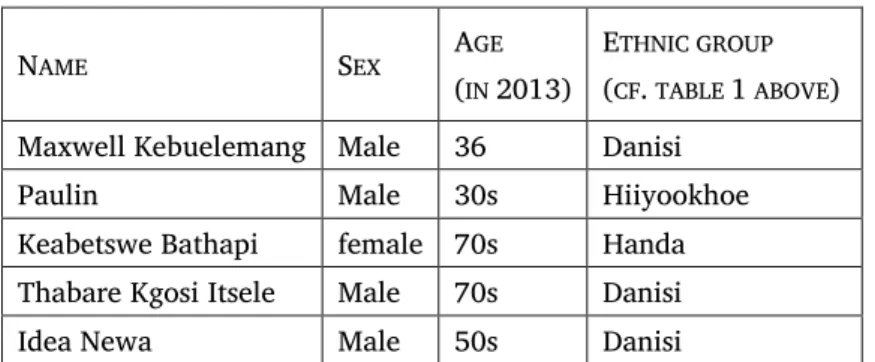
Texts from which examples were taken have been collected with the following speakers:
Table 5: Speakers who provided textual data used in this study
NAME SEX AGE
(IN 2013)
ETHNIC GROUP
(CF. TABLE 1 ABOVE)
Maxwell Kebuelemang Male 36 Danisi
Paulin Male 30s Hiiyookhoe
Keabetswe Bathapi female 70s Handa Thabare Kgosi Itsele Male 70s Danisi
Idea Newa Male 50s Danisi
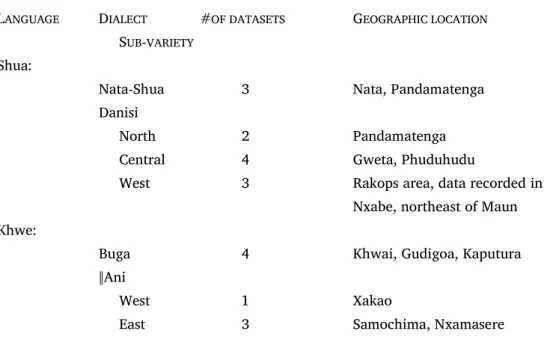
Tshiamo and Maxwell Kebuelemang further accompanied the present author and W.B. McGregor on a survey of Khoe languages spoken in northern Botswana in May/ June 2013 and conducted interviews with speakers of various Shua and Khwe varieties. The data corpus used for the comparative analysis comprises word lists and some grammatical elicitation. Sampled locations (cf. also Map 1) and languages are summarised in Table 6.
Table 6: Datasets recorded during a survey in May 2013 (McGregor & Fehn, field notes)
LANGUAGE DIALECT #OF DATASETS GEOGRAPHIC LOCATION
SUB-VARIETY
Shua:
Nata-Shua 3 Nata, Pandamatenga
Danisi
North 2 Pandamatenga
Central 4 Gweta, Phuduhudu
West 3 Rakops area, data recorded in
Nxabe, northeast of Maun
Khwe:
Buga 4 Khwai, Gudigoa, Kaputura
ǁAni
West 1 Xakao
East 3 Samochima, Nxamasere
When deemed relevant, Westphal’s (n.d.b.) fieldnotes and recordings of Ts’ixa and
other Kalahari Khoe varieties were consulted. Most of them have been made available online by the Archives of the University of Cape Town and can be accessed at http://uctscholar.uct.ac.za/.
The theoretical framework used for this study is what Dixon (1997: 128-135) terms
“Basic Linguistic Theory”. This approach is widely used in language documentation
and focuses on the necessity to describe each language in its own terms. Apart from
Dixon’s own writings, a wide array of typological literature has been consulted. Nevertheless, the functional categories adopted sometimes fall short to cover linguistic realities and hence necessitate a considerable amount of cross-referencing between chapters. They have still been kept up to facilitate cross-linguistic comparison, especially with regard to the still poorly understood linguistic relationships within the Khoe language family.
As the short duration of the project severely limited the amount of data that could be collected and transcribed, some questions arising during the analysis could not be answered satisfactorily; these instances have been noted in the text. The present author is also aware that this work lacks a comprehensible description of the
language’s information-structural properties, i.e., the encoding of topic and focus. While both phenomena are referred to in various chapters of the study, in particular with regard to constituent order variation (§6.1), more research would be needed to offer a more satisfying insight.
As the genealogical affiliation of Ts’ixa within the Kalahari Khoe group is still under
discussion, the descriptive part is supplemented by a restricted comparative over-view (§10.1-4), covering phonology, nominal modification, the encoding of grammatical relations and the lexicon. Although the chapter is by no means exhaustive, it hopefully conveys that the classification of Ts’ixa as a dialect of Shua should be reconsidered. It is further meant to contribute to the ongoing research on
convergence phenomena in the Kalahari Basin, with Ts’ixa displaying possible traces of a Kx’a substrate no longer spoken in the area. The study concludes with a brief assessment of clues provided by oral histories (§10.5.1-3) and data from molecular anthropological research undertaken within the framework of the multidisciplinary
2 Phonology
The present chapter describes distinctive characteristics of the phonological
structure of Ts’ixa. After presenting the methodological framework in §2.1, §2.2 will
introduce the phoneme inventory of Ts’ixa, describing vowels as well as click and non-click consonants. §2.3 will give an overview of the language’s phonotactic
structure, and §2.4. will provide a very preliminary overview of Ts’ixa tonology. 2.1 Methodological framework
This section will provide a short introduction to previous studies on the phonology
of Ts’ixa and the Khoe languages (§2.1.1) before dealing with orthographic choices (§2.1.2) and addressing questions concerning the collection and analysis of the data this study is based on (§2.1.3).
2.1.1 Previous research on Khoe phonology
Although research on the Khoe family has intensified in recent years, there are only a few in-depth treatments of the phonological properties of individual languages. The majority of existing work focuses on Khoekhoe (Beach 1938, Haacke 1999), and the only Kalahari Khoe language which has been subject of a thorough phonological analysis is Gǀui (Nakagawa 2006). Nevertheless, several aspects of Khwe phonology have been described by Köhler (1981b), Elderkin (1986) and Kilian-Hatz (2008), and there is a short treatment of the ǁAni variety by Vossen (1986).
A comparative phonological analysis of all known Khoe languages –including Ts’ixa – is included in Vossen’s (1997) historical-comparative work, which also served as a basis for the present study. Reconstruction based on comparative evidence, especially focusing on the Western Kalahari Khoe branch of the Khoe languages, features prominently in the ongoing work of Elderkin (2008, 2014a), and was part of recent studies undertaken by Honken (2012, ms.).
Selected aspects of Khoe phonology were subject to a number of articles (e.g., Traill 1986a, Traill & Vossen 1997), which will be referenced whenever relevant to
phenomena observed in Ts’ixa.
My analysis further considers approaches to cross-Khoisan phonology, especially by Güldemann (2001) and Nakagawa (2006).
18 2.1 .2 Phon em e i nv en to ry a nd o rth og ra ph ic choi ce s To fac ilitate co mparat ive us e of th e data, th e co nsonan t ch art be low us es th e orth og ra ph y su gg es ted b y Nak ag awa (2 00 6) in hi s cro ss -Kho isan co nsonan t ch art. No te th at th e voi ced uvu la r stop / ɢ / has b een put into b rac kets as it sh oul d exi st for reasons of symmetry, b ut o nly featured in th re e lexeme s, o ne o f w hic h appea red to be kn ow n to on e spe ak er on ly . Tab le 7 : Co nson an t c har t , us in g N ak agawa ’s (20 06 ) o rtho grap hy S ER IES E XTEN DED P LACE OF A RTI CU LAT ION Lb Dt Dt -Af Dt -Af -Cl Al -Cl Al -Af (L t)-Cl Pl Pl -Cl Vl Uv Gl St op se gm ent s plai n p t ts ǀ ! ǁ (c) ǂ k q ʔ voice d b d dz gǀ g! gǁ ( ɟ ) gǂ g ( ɢ ?) voice less ejec tive t’ ts ’ ǀ’ ǁ’ (c’ ) ǂ’ k’ voice less as pir at ed t h ts h ǀ h ! h ǁ h (c h ) ǂ h k h St op clus ter plai n+x tx ts x ǀ x !x ǁ x (cx) ǂ x plai n+q ǀ q ǁ q (qy) ǂ q plai n+ ɢ ǀɢ ǁɢ ǂɢ plai n+ ʔ ǀʔ ! ʔ ǁʔ ( ʔ y) ǂʔ Nasa l voice d m n ŋǀ ŋǁ ( ɲ ) ŋǂ ŋ Pr e-na salise d mb nd ŋǀ g n!g ŋǁg ( ɲɟ ) ŋǂ g ŋg Fr ica tive voice less s x h Tap or Fl ap ( ɾ ) Glide s w j (A bb rev iatio ns us ed : L b=lab ial , D t=d ent al , D t-Af= den tal aff ric ate , D t-Af -Cl= den tal aff ric ate clic k, Al -Cl=alv eo lar cli ck , A l-Af (Lt )-Cl= alv eo lar af fri cat e la teral clic k, P l=p alatal, P l-C l=p alat al clic k, Cl=v el ar , U v=uv ular, Gl=glo ttal )
The orthography adopted in this grammar is based on the Applied Community Orthography4 in use among both Ts’ixa and Khwe speech communities (cf. Schladt 2000 for Khwe). It largely follows the conventions adhered to by Kilian-Hatz (e.g., 2003, 2008) for Khwe, with two noteworthy exceptions: (1) voicing is noted by <g> before, rather than after the click; this change was necessitated by the need to distinguish a voiced uvular click accompaniment, which, to my knowledge, is not found in Khwe; (2) the glottal stop is written <ʔ>, rather than <’>, as Ts’ixa features
ejective clicks which need to be distinguished from clusters with a glottal stop accompaniment. The same consonant chart as above, but using the applied orthography, is given below. Note that no orthographical convention for the voiced
uvular stop has been decided upon, as it is not commonly featured in Ts’ixa lexical
roots.
4 An applied community orthography does not necessarily adhere to phonemic or phonetic realities. The
orthography decided upon by the Khwe Speech Community and later adopted by the Ts’ixa is practical in the sense that it enables the speakers to communicate in written form, using their own language. All orthographic choices were made or approved of by the Ts’ixa Language Committee, which was formed during a community workshop held in April 2011.
20 Tab le 8 : Co nson an t c har t, wr itten in the or tho grap hy (cf. Kilian -H atz 20 03 , 2 00 8 fo r Kh we ) us ed in this gr am m ar S ER IES E XTEN DED P LACE OF A RTI CU LAT ION Lb Dt Dt -Af Dt -Af -Cl Al -Cl Al -Af (L t)-Cl Pl Pl -Cl Vl Uv Gl St op se gm ent s plai n p t ts ǀ ! ǁ (k y) ǂ k q ʔ voice d b d dz gǀ g! gǁ (g y) ǂ g g (gq ) voice less ejec tive t’ ts ’ ǀ’ ǁ’ ky’ k’ voice less as pir at ed th ts h ǀ h !h ǁ h (k yh ) ǂ h kh St op clus ter plai n+x tx ts x ǀ x !x ǁ x (k yx ) ǂ x plai n+q ǀ q ǁ q (qy) ǂ q plai n+ ɢ gǀ q gǁq gǂ q plai n+ ʔ ǀʔ ! ʔ ǁʔ ( ʔ y) ǂʔ Nasa l voice d m n nǀ nǁ (n y) nǂ ŋ Pr e-na salise d mb nd nǀ g nǁg (n dy) nǂ g ng Fr ica tive voice less s x h Tap or Fl ap (r ) Glide s w y
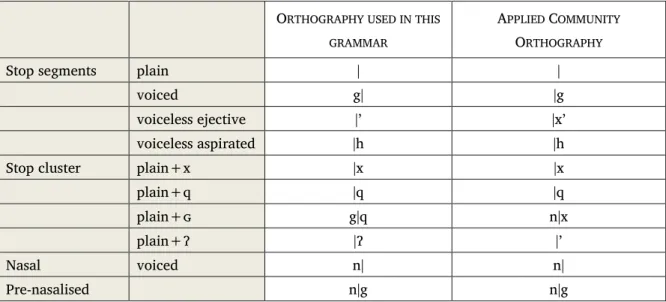
The orthography used in this grammar diverts from the Applied Community Orthography in three regards. The first concerns clicks with a glottal stop accompaniment /ǀʔ/ and ejective clicks /ǀ’/:5 As the similarities between both languages, as well as wide-spread bilingualism enable Ts’ixa-speakers to read Khwe
written material (including a Bible translation), the Ts’ixa Language Committee
decided to disregard phonetic realities and adopt the applied orthography for Khwe,
i.e., write <ǀ’> for /ǀʔ/, and <ǀx’>for /ǀ’/, even though it is not entirely clear yet
whether the latter is actually a cluster or a complex click in Ts’ixa. Second, the voicing for the voiced uvular click accompaniment /gǀq/ is generally realised as nasalisation, followed by what is perceived by the speakers as similar to a velar fricative /x/, rather than a voiced uvular stop /gq/. Hence, what is written <gǀq> in this grammar to meet phonemic requirements is written <nǀx> by the
community. It is due to this choice that the Khwe orthography is also adhered to with regards to the voicing of clicks, which is noted by <g> after, rather than
before the click, i.e., <ǀg>. The orthography used in this grammar and the Applied Community Orthography are contrasted in Table 9.
Table 9: Click accompaniments as represented in the orthography used in this grammar and the Applied Community Orthography, exemplified by the dental click and its accompaniments
ORTHOGRAPHY USED IN THIS
GRAMMAR
APPLIED COMMUNITY
ORTHOGRAPHY
Stop segments plain ǀ ǀ
voiced gǀ ǀg
voiceless ejective ǀ’ ǀx’
voiceless aspirated ǀh ǀh
Stop cluster plain+x ǀx ǀx
plain+q ǀq ǀq
plain+ɢ gǀq nǀx
plain+ʔ ǀʔ ǀ’
Nasal voiced nǀ nǀ
Pre-nasalised nǀg nǀg
Speakers of Ts’ixa distinguish between five different vowel phonemes, with [ε]
constituting a variant of /e/ which different speakers use in different environments, depending on their idiolectal affiliation (see §2.1.3 below). The orthography used in this grammar matches the orthography used by both Nakagawa (2006) and Kilian-Hatz (e.g., 2003, 2008)6.
Table 10: Oral vowel phonemes
FRONT CENTRAL BACK
HIGH i u
MID-CLOSED e o
MID-OPEN (ε)
LOW a
There are two phonation types: Oral and nasal. In this grammar, nasal vowels are written with a tilde7, cf. Table 11.
6 Note that neither Kilian-Hatz (e.g., 2003, 2008) nor the Ts’ixa community write the word-initial
glottal stop. Though its appearance is mostly predictable, I have chosen to include it to highlight its state as a regular phonemic consonant.
7 Note that some orthographic conventions suggested for Khoisan languages (e.g., Güldemann 1998b;
Heine 1999 for ǁAni; Naumann, forthcoming) note nasalisation by the letter <n> following the
vowel. Whenever examples from works adhering to this convention are cited, the orthography was adapted to match the one used in this grammar.
Table 11: Nasal vowel phonemes
ũ
In addition to the monophthongs noted above, Ts’ixa has nine oral and four nasal diphthongs (or vowel sequences) which will be treated in more detail in §2.2.3.
Ts’ixa is a tone language and has three phonemic tone levels, which are marked as
follows:
á HIGH
a MID
à LOW
The Applied Community Orthography does not mark tones, as their notation does not contribute to a better understanding of a written text for the speakers themselves.
2.1.3 Data collection and analysis
The data this phonological overview is based on was recorded with male and female
speakers of Ts’ixa in Mababe, northeastern Botswana between 2011 and 2013. The research assistants involved came from different age groups and are representative of three idiolect groups distinguishable in the village. The data this chapter is based on was primarily provided by six speakers which represent the idiolect groups given in Table 12.
Table 12: Idiolect groups in Mababe, according to phonological features
A B C
Palatal click retention The palatal click is retained in more than 20% of the lexemes included in a 50-item word list
The palatal click is retained in less than 20% of the lexemes included in a 50-item word list (most retentions concern [ǂʔ]
and [ǂq])
The palatal click is only retained in a small number of fossilised forms, or not retained at all
ejective click [ǀ’] ∼(affricate )velar
ejective click cluster
[ǀk(x)’]
All forms featuring [ǀx’] in Khwe are realised with weak affrication or delayed ejection
The cluster [ǀx’] in Khwe
corresponds to a complex
click [ǀ’]
A subset of forms displaying [ǀx’] in Khwe are realised with weak affrication or delayed ejection
Affrication of the velar
ejective kʼ (>kxʼ)
Few lexemes, e.g., [kxʼu ] ‘to talk’ or [kxʼoó]
‘to eat meat’; irregular and idiosyncratic
Not found
Lenition of velar fricative [x] to glottal fricative [h]
Not found Found with some lexemes, no clear pattern
word-medial /x/ is always realised as [h]; the lenition also affects [x] as part of stop clusters, i.e., /ǀx/ is realised as [ǀh], /tsx/ is realised as [ǀh], etc.
[e] ~ [ɛ] [ɛ] as reflex of diphthongs [ae] or [ai]; [e] ~ [ɛ] disambiguation also in other lexemes, but no minimal pair
[ɛ] is preferred in most instances, possibly following the Tswana pattern
[ɛ] as reflex of diphthongs [ae] or [ai]; [e] is preferred after voiceless stops [t, p, k] and after the voiceless alveolar fricative [s]
Tables 7 and 8 above present a maximal phoneme inventory for Ts’ixa, with all
phonemic distinctions only made by a small number of Group A-speakers. A maximum of palatal click retention can be seen in the datasets collected by Westphal (n.d.b) and Vossen (1997), both of which display more than 70% retentions.8
The following sections will introduce all phonemic consonants found in modern
Ts’ixa, but refer to variation whenever deemed necessary.
8 In Westphal’s (n.d.b) data (263 item wordlist plus recordings), I counted 15 lexemes with a palatal
onset, 3 of which featured a non-click consonant (corresponding to 80% retentions). Vossen’s (1997) sample included 31 items with a palatal onset, including 9 with non-click consonants (corresponding to 71% retentions).




![Table 19: [+click] stop segments](https://thumb-ap.123doks.com/thumbv2/123dok/1700126.2604647/54.892.113.717.529.776/table-click-stop-segments.webp)