C
HARACTERISTICS
OF
N
ORTH
A
MERICAN
M
EAT
AND
B
ONE
M
EAL
R
ELEVANT
TO
THE
D
EVELOPMENT
OF
N
ON-
F
EED
A
PPLICATIONS
R. A. Garcia, K. A. Rosentrater, R. A. Flores
ABSTRACT. Unmarketable animal tissues are typically processed by rendering plants, which transform them into meat and bone meal (MBM) or similar products. MBM’s traditional use as animal feed has become increasingly threatened, but MBM has potential for non-feed applications. Development of new products and processes is hindered by lack of reliable data on many of MBM’s chemical and physical properties. MBM samples, as well as data on raw material and process, were collected from 19 rendering facilities in the United States and Canada. A large majority of the raw material was tissue from cattle, swine, and poultry. All facilities surveyed practiced continuous dry rendering; 89% of the facilities use continuous cookers and 11% use falling film evaporators. MBM is high in protein (44.6-62.8%, mfb), but this protein is poorly soluble; at pH 7 solubility ranged from 2.20% to 7.22%. Among all samples, the particles’ median geometric mean diameter was 387 mm, and the size
distribution was broad. The median density of MBM particles was 1.41 (g/mL); median density of MBM in bulk ranged from 0.50 g/mL when loose-filled to 0.68 g/mL when packed. pH values of the samples ranged from 5.89 to 7.19, and samples containing the most cattle tissue had the highest pH. Thermal diffusivity and thermal conductivity values for both loose-filled and packed MBM are reported, as well as CIE L*a*b* color values.
Keywords. Bio-based product, Biomass, Byproduct, Characterization, Meat and bone meal, Rendering, Feedstock, Non-feed
applications, Materials handling, Physical properties, Protein solubility.
ince the second half of the 19th century, rendering
plants have processed the majority of the unmarket-able tissues from slaughtered farm animals (Schoeff, 1985; Burnham, 1996). The rendering process adds value to this material by dehydrating and stabilizing it against degradation and by fractionating it into two primary product streams: a purified fat stream and a stream high in protein and ash. The protein and ash stream is transformed into a com-modity commonly known as ‘meat and bone meal’ (MBM; variations on this name can indicate specific raw materials, for example ‘poultry meal’ or ‘porcine meat and bone meal,’ or proximate composition, for example ‘meat meal’ when the phosphorus content is less than a specified concentration) (Association of American Feed Control Officials, 2002; Na-tional Renderers Association, 2003).
Submitted for review in November 2005 as manuscript number FPE 6173; approved for publication by the Food & Process Engineering Institute Division of ASABE in June 2006.
Mention of trade names or commercial products in this article is solely for the purpose of providing specific information and does not imply recommendation or endorsement by the USDA.
The authors are Rafael A. Garcia, ASABE Member Engineer,
Chemical Engineer, USDA-ARS, Eastern Regional Research Center, Fats, Oils and Animal Coproducts Research Unit, Wyndmoor, Pennsylvania;
Kurt A. Rosentrater, ASABE MemberEngineer, Agricultural Engineer, USDA-ARS, Northern Grain Insects Research Laboratory, Crop and Entomology Research Unit, Brookings, South Dakota; and Rolando A. Flores, ASABE Member Engineer, Agricultural Engineer, USDA-ARS, Eastern Regional Research Center, Crop Conversion Science and Engineering Research Unit, Wyndmoor, Pennsylvania. Corresponding author: Rafael A. Garcia, ERRC, 600 E. Mermaid Ln., Wyndmoor, PA 19038; phone: 215-836-3743; fax: 215-233-6795; e-mail: [email protected].
The rendering industry produces large quantities of MBM. In 2004, U.S. renderers produced 2.1 million metric tons of bovine, porcine, or mixed species MBM (Swisher, 2005) while in 2000, Canadian renderers produced 432,000 metric tons (Canadian Food Inspection Agency, 2002). Prior to the United Kingdom’s outbreak of bovine spongiform encepha-lopathy (BSE) in the 1980s, almost all MBM was utilized as a high protein ingredient in animal feed. Today, most countries do not allow MBM containing any amount of ruminant tissue to be fed to ruminant animals. In the United States, MBM with ruminant tissue is used in feed for non-ruminant farm animals (especially poultry and swine), companion animals, and aquaculture species, which, with the exception of cats, have never been shown to contract BSE under normal circumstances (Matthews and Cooke, 2003; Oidtmann et al., 2003). In the European Union, MBM is banned from the feed of any animals that may become human food (Taylor and Woodgate, 2003). In the EU, MBM is now primarily either incinerated or used for its energy content in operations such as cement plants (Heilemann, 2002; Struck-mann et al., 2004), or used as an ingredient in pet food.
While MBM’s feed use has become increasingly re-stricted, growing attention has focused on the development of new, non-feed applications. Investigators have demon-strated MBM’s utility as an agent to control plant pathogens (Lazarovits et al., 1999), as a nitrogen source for the fermentative production of bio-based materials (Koller et al., 2005), as the primary ingredient in an adhesive (Park et al., 2000), as fuel for fluidized bed combustors (McDonnell et al., 2001), and as a main ingredient in a hard plastic material (Garcia et al., 2004). These and other applications have potential commercial value, but with the exception of fuel uses, most have only been implemented on a laboratory or demonstration scale.
The design of manufacturing processes utilizing unfamil-iar materials is simplified when data are available on the normal range of critical properties (Day et al., 1993; Rosentrater et al., 1999). MBM has been well characterized in terms of its nutritional properties (Lueking et al., 1996; Johnson and Parsons, 1997; Parsons et al., 1997; Bureau et al., 2000; Hua et al., 2005) and several reports have described significant variability in these properties (Hege-dus, 1984; Hendriks et al., 2002). It has been shown, however, that MBM from a single renderer is considerably more consistent (Kirby et al., 1993; Kirstein, 2003). Some renderers or protein blenders supply MBM with tightly controlled ash and protein contents by blending MBM from different sources (National Renderers Association, 2003). While many of the properties previously reported are very specific to animal nutrition (e.g., protein efficiency ratio, digestible energy, pepsin N digestibility), other properties including the proximate composition, gross energy (also known as ‘gross calorific value’ or ‘higher heating value’), and amino acid profile could be useful in the design of non-feed applications.
Other types of information, of major importance in the design of new products and processes, are not readily available. For example, there is little industry-wide informa-tion on the raw material used to produce MBM, the cooking treatment used, or geographic availability. Data on properties relevant to materials handling and product formulation is similarly scare. One recent study (Yang et al., 2005) emphasized the importance of properties such as material density and particle size distribution to the evaluation of biomass fuels; reliable data on such properties in MBM are not to be found in the scientific literature. The present study addresses these gaps in the current knowledge by gathering processing information and MBM samples from renderers across the United States and Canada. MBM characteristics, including particle size, density, thermal properties, proxi-mate composition, protein solubility, pH, and color are investigated, as are potential correlations between these properties, and the raw materials and processes used to manufacture them.
M
ATERIALS ANDM
ETHODSGEOGRAPHIC INFORMATION
U.S. rendering facilities were identified and located by analysis of public inspection records (FDA Center for Veterinary Medicine, 2005); these records were created by the Food and Drug Administration’s Center for Veterinary Medicine by inspecting renderers, feed mills, ruminant feeders, protein blenders, pet food manufacturers, pet food salvagers, animal feed distributors and transporters, rumi-nant feeders, and other operations to determine compliance with BSE/ruminant feed regulations (FDA, 2003). Similar records for Canadian facilities were not available; many were located through the membership directory of the National Renderer ’s Association (Alexandria, Va.), which claims that its membership represents more than 98% of the rendering capacity in both Canada and the United States (Anonymous, 2005). Data obtained from these sources were augmented and corroborated through analysis of government reports, indus-trial contacts and literature (Sparks Companies Inc., 1997;
Canadian Food Inspection Agency, 2002; Pearl, 2005; United States Government Accountability Office, 2005).
MBM SAMPLESAND QUESTIONNAIRES
Through the Fats and Proteins Research Foundation (FPRF, Bloomington, Ill.) requests were made to 22 U.S. and Canadian rendering facilities to submit 10 lb of unblended (i.e., single batch) MBM. Sample providers were also asked to complete a detailed questionnaire (see Appendix) con-cerning the specifics of their rendering process, and the raw material they were processing on that day. Samples and questionnaires were assigned serial identification numbers by an intermediary at FPRF, and transferred to the researchers without revealing the source of any particular sample.
Individual MBM particles vary widely in size and composition, and the particle types have a strong tendency to spontaneously segregate, so care was required to obtain small, representative samples for analysis. Submitted sam-ples of MBM were thoroughly homogenized and split into sub-samples by repeated cone and quartering. Sub-samples were re-homogenized prior to being analyzed.
PARTICLE SIZE ANALYSIS
Particle size distribution was determined by mixing samples with 1% (w/w) Zeofree 5162 (Huber Engineered Materials, Atlanta, Ga.) anti-caking agent and then classify-ing the particles with a standard series of sieves accordclassify-ing to ASTM D 1921-01 (ASTM International, 2001). Geometric mean diameter and geometric standard deviation of the particle size distributions were calculated using standard equations according to method ASAE S319.3 (ASAE Stan-dards, 2003a).
DENSITY
Loose bulk density of each sample was determined in triplicate using standard method AACC 55-10 (American Association of Cereal Chemists, 1995b), which involved pouring MBM into a cup of known volume and determining the mass. Performing the test exactly as described in the standard, however, resulted in the funnel above the test cup becoming clogged with MBM. To avoid this, MBM was added to the funnel in two smaller batches. The diameter of cup was large enough that the MBM filled the cup without ‘bridging’ or leaving any large air spaces.
Tapped bulk density of each sample type was determined in at least triplicate using an Autotap (Quantachrome Instruments, Boynton Beach, Fla.) set to deliver 3000 taps to each sample. These data were used to compute the Hausner ratio, the ratio of a material’s tapped bulk density to its loose bulk density (Grey and Beddow, 1969), for each sample.
Apparent material density, which is the average density of individual particles including closed pores, was determined using a helium pycnometer (AccuPyc 1330, Micromeritics, Norcross, Ga.). Before testing, samples were dehydrated to a constant mass, at 70°C, under approximately 100-kPa
(gauge) vacuum. Three sub-samples from each sample were obtained, and the density of each of these sub-samples was determined three times and averaged.
THERMAL PROPERTIES
(Seedburo Equipment Co., Chicago, Ill.). Compacted sam-ples were produced by tapping on the laboratory bench by hand 20 times in a consistent manner. Thermal conductivity and diffusivity were determined, on both loose-filled as well as compacted samples, with a thermal properties meter (KD2, Decagon Devices, Pullman, Wash.), which utilized the line heat-source probe, maximum slope technique (Baghe-Khandan et al., 1981; Wang and Hayakawa, 1993).
PROXIMATE ANALYSIS
Lipid content was determined by Soxhlet extraction with hexane according to ASTM D 3495-83 (ASTM International, 1994). Moisture content determinations were performed by dehydrating 2-g samples at 70°C, under approximately
100-kPa (gauge) vacuum, to constant mass, which typically took 24 h. The relatively low drying temperature in both the lipid and moisture analyses was chosen to minimize error due to vaporization of free fatty acids. Ash determination was performed by overnight incineration of 2-g samples in ceramic crucibles in a 600°C muffle furnace.
Nitrogen content in samples was determined using an automated analyzer (model FP-2000, Leco Corporation, St. Joseph, Mich.). Because the sample size used in this analysis was only 50 mg, 5-g samples were finely milled in a freezer mill (model 6800, Spex Centiprep Inc., Metuchen, N.J.) and homogenized before drawing out sub-samples for nitrogen determination. A nitrogen to protein conversion factor of 6.45 was calculated based on recently published amino acid analyses of 12 North American MBM samples (Adedokun and Adeola, 2005). The computation of this conversion factor assumes that half the measured quantities glutamic acid and aspartic acid represent glutamine and asparagine residues that have deamidated during hydrolysis.
Three to five repetitions of each proximate composition analysis were performed.
PROTEIN SOLUBILITY
Protein solubility was determined using a well-validated and widely-used method developed for commodity proteins such as soy protein concentrate or spray dried whey (Morr et al., 1985). Under carefully defined conditions 500 mg of sample protein were stirred in a solution of 0.1 M NaCl for 1 h, at pH 7. After centrifugation, the dissolved protein concentration was determined; the bicinchoninic acid assay (Walker, 1996) was used rather than the recommended biuret assay. The percent solubility was calculated as the mass of protein dissolved, divided by the mass of protein in the original sample. Duplicate analyses were performed on each sample.
pH
The methodology used for pH determination was adapted from standard methods for pH in flour and meat (American Association of Cereal Chemists, 1995a; Food Safety and Inspection Service, 1993). Briefly, 5-g sample material was stirred into 50 mL of ultrapure water that had recently been boiled to eliminate dissolved CO2. The solid material was
allowed to settle momentarily and then the pH was measured using a calibrated pH meter. Triplicate analyses were performed on each sample.
COLOR ANALYSIS
Images of MBM samples were produced by photograph-ing them in a controlled and standardized manner. Specifical-ly, duplicate samples were prepared by filling large Petri dishes (150 × 15 mm) with MBM and smoothing the surface with a straightedge. Photographs were taken with a Nikon D-70 camera, 60-mm lens, 1/60 sec F8 aperture, under studio lighting. A test shoot was performed to establish in-camera white balance. The resulting 16-bit TIFF images were analyzed using Photoshop CS (Adobe Systems Inc., San Jose, Calif.). A template layer superimposed on each image specified five color sampling locations, arranged in a cross pattern; at each location, a 5 × 5 pixel color sample was measured and the CIE L*a*b* color space coordinates were recorded.
R
ESULTS ANDD
ISCUSSIONGEOGRAPHIC DISTRIBUTIONOFTHE RENDERING INDUSTRY
There are approximately 250 rendering facilities operat-ing in the United States and 32 operatoperat-ing in Canada. Geographic data shows that rendering facilities are not distributed homogeneously (fig. 1). The states of Texas, Nebraska, California, and Illinois contain 28% of all the rendering plants in the United States. The data available on Canadian facilities is less complete; of the 19 facilities specifically identified, 68% were in the provinces of Ontario, Alberta, or Quebec.
GENERAL SURVEY RESULTS
The 22 requests sent out resulted in submission of 19 MBM samples accompanied by completed questionnaires (86.4% response rate). Although samples were submitted anonymously, evidence gleaned from return addresses and questionnaires indicated that the samples originated in at least 12 different cities, geographically dispersed across the United States. Not all respondents answered all questions on the questionnaire, so not all the following results are based on the same number of data points. One of the MBM samples submitted was actually a material known as ‘crax’ or ‘cracklings,’ material which has not gone through the final operations of milling and screening to produce finished MBM; this sample was not subjected to the laboratory analysis but the questionnaire data associated with it was used.
RAW MATERIAL
Figure 1. Geographic distribution of U.S. rendering facilities. Alaska, Hawaii, and Puerto Rico not to scale. Arrows indicate location of facilities that are difficult to see on the map.
0 10 20 30 40 50 60 70 80 90
cattle pork poultry other
aquatic animals elk, deer
horse
sheep, dog, cat
% plants processing at least some
average % of mixture
Figure 2. Types of animals in renderer’s raw material (n = 19).
The absence of ovine material is consistent with a National Renderer ’s Association policy against the inclusion of sheep material; since the collection of the samples in the present study, this policy has been rescinded (Malone, 2005).
Twelve out of 19 respondents reported that the majority of their raw material consisted the remains of meat animal carcasses (excluding most of the hair, hoof, horn, blood, and contents of the gastrointestinal tract) after they had been harvested for their high value tissues at a slaughterhouse (fig. 3). Ten out of 19 renderers used as least some material from dead stock (animals that died before slaughter); 5 of 19 renderers had dead stock as at least 10% of their raw material. None of the renderers reported using any dead stock from
0 10 20 30 40 50 60 70 80 90 100
a b c d e f g
% plants processing at least some
average % of mixture
Figure 3. Sources of renderer’s raw material (n = 19). (a) slaughterhouse bones and offal, (b) dead stock, (c) meat products past ‘sell−by’ date, (d) DAF system skimmings, (e) hide fleshings, (f) hide or hide trim, (g) restau-rant or foodservice (n = 19).
PROCESSING METHODS
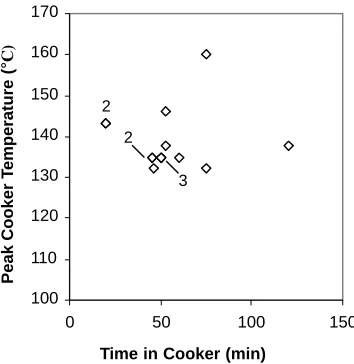
All facilities surveyed practiced continuous dry render-ing; 16 of 18 facilities use continuous cookers and 2 of 18 use falling film evaporators. These results are consistent with reports that alternative processes, such as batch dry render-ing, wet rendering and solvent extraction, are currently rare in the United States and Canada (Bisplinghoff, 1995; Prokop, 1996; Auvermann et al., 2004). The data reveal that material from different facilities has been subjected to very different time-temperature treatments (fig. 4).
PARTICLE SIZE DISTRIBUTION
MBM particle sizes are widely distributed both within and between samples. Computed geometric mean diameter for individual samples were all within the range 256 to 800 mm, with a median of 387 mm. Within individual samples, two distinct patterns of particle size distribution were qualitative-ly observed, which correlated well with calculated values for log normal geometric standard deviation. Eight of the 18 samples had clear peaks in their distribution profiles, as typified in figure 5a, and standard deviations of less than 70% of their mean diameter; the remaining samples displayed much flatter distribution profiles, as typified by figure 5b,
100 110 120 130 140 150 160 170
0 50 100 150
Time in Cooker (min)
Peak
Cooker T
emperature
(
5
C
)
2
2
3
Figure 4. Reported heat treatment received by raw material in the render-ing process (n = 15). Data points labeled with numbers represent multiple overlapping points.
figure 5b, and standard deviations of greater than 70% of their mean diameter. The questionnaire on rendering process specifics did not request any information on the final stages of the rendering process where crax is screened and milled into finished MBM. Anecdotal evidence, however, suggests that the flatter distribution profiles may originate at plants where screens have been removed from the normal finishing operation; the screens tend to become blinded with fatty residue and some operators consider them an unnecessary nuisance (Hamilton, 2005).
DENSITY
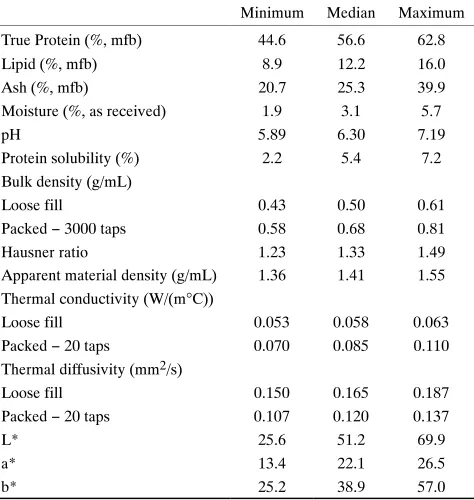
Bulk MBM consolidates significantly when disturbed (table 1); the median loose fill bulk density was 0.50 g/mL, while after extensive tapping the median bulk density increased to 0.68 g/mL. Strong positive correlations (α <
0.001) were found between ash content and both bulk and material densities. These correlations are consistent with earlier observations (Mendez and Dale, 1998) that rendered bone particles are denser that rendered soft tissue particles.
The Hausner ratio of a particulate material is known to correlate well with the material’s fluidization behavior (Geldart et al., 1984). Of the MBM samples tested, 11% had Hausner ratios indicating that they would behave as easy to fluidize Group A powders (Hausner ratio > 1.4), 5% as difficult to fluidize Group C powders (HR < 1.25), and the remaining 84% as transitional Group AC powders.
THERMAL PROPERTIES
Thermal conductivity and diffusivity at 22.5 (±0.3)°C were determined for MBM samples at both low and high bulk densities (table 1). The thermal conductivities of samples at their lowest stable bulk density all fell in a tight range, 0.05 to 0.06 W/(m°C); after compacting the samples with 20 standard taps, the conductivities increased and covered a larger range, 0.07 to 0.11 W/(m°C). These results are
consistent with previous reports of the thermal conductivity of powders increasing along with bulk density (MacCarthy, 1985; Muramatsu et al., 2005).
The thermal diffusivities the samples at low density fell in the range 0.150 to 0.187 mm2/s, while at high density they fell
in the range 0.107 to 0.137 mm2/s.
0 10 20 30 40 50 60 70 80 90 100
100 1000 10000
Sieve Opening (mm) Cumulative percent coarser Differential mass retained
0 10 20 30 40 50 60 70 80 90 100
100 1000 10000
Sieve Opening (mm)
Mass %
b) a)
Table 1. Observed range of values for several of MBM’s physical and chemical properties (n = 18).
Minimum Median Maximum
True Protein (%, mfb) 44.6 56.6 62.8
Lipid (%, mfb) 8.9 12.2 16.0
Ash (%, mfb) 20.7 25.3 39.9
Moisture (%, as received) 1.9 3.1 5.7
pH 5.89 6.30 7.19
Protein solubility (%) 2.2 5.4 7.2 Bulk density (g/mL)
Loose fill 0.43 0.50 0.61
Packed − 3000 taps 0.58 0.68 0.81
Hausner ratio 1.23 1.33 1.49
Apparent material density (g/mL) 1.36 1.41 1.55 Thermal conductivity (W/(m°C))
Loose fill 0.053 0.058 0.063
Packed − 20 taps 0.070 0.085 0.110 Thermal diffusivity (mm2/s)
Loose fill 0.150 0.165 0.187
Packed − 20 taps 0.107 0.120 0.137
L* 25.6 51.2 69.9
a* 13.4 22.1 26.5
b* 25.2 38.9 57.0
PROXIMATE ANALYSIS
The proximate composition of the MBM samples studied varied substantially from source to source (table 1), consis-tent with the findings of previous studies. The use of unblended MBM in the present research exaggerates the variability of MBM’s proximate composition. It is standard practice for renderers to blend batches of MBM in order achieve a specified proximate composition (Anonymous, 2003; Kirstein, 2003).
The percentage of cattle tissue in the raw material had a significant positive correlation (α = 0.023) with the ash
content of the finished MBM. No other correlations between raw material species and proximate composition were observed.
PROTEIN SOLUBILITY
The samples’ protein solubility at pH 7 ranged from 2.20% to 7.22% with a median value of 5.35%. These results indicate that MBM protein is much less soluble than commodity proteins such as soy protein isolate, whey protein concentrate or sodium caseinate (Morr et al., 1985). Earlier research has consistently found that MBM processed at lower temperatures has greater amino acid bioavailability (Kondos and McClymont, 1972; Batterham et al., 1986; Johnson et al., 1998; Wang and Parsons, 1998). This phenomenon apparent-ly is not due to greater protein solubility; the present study found no correlation between processing parameters such as ‘peak cooker temperature’ and protein solubility (fig. 6).
pH
pH values of the samples ranged from 5.89 to 7.19 with a median value of 6.30. The samples with the four highest pH values were the samples with the four highest concentrations of cattle tissue.
0 1 2 3 4 5 6 7 8
120 130 140 150 160 170
Peak Cooker Temperature (5C)
Protein Solubility (%)
Figure 6. Peak temperature applied to raw material in the rendering pro-cess versus the solubility of the resulting MBM protein at pH 7 (n = 15). COLOR
All 18 samples of MBM received could be described as brown or tan, but significant color differences between samples are easily observable (table 1); in appearance the samples ranged from dark brown (similar to coffee grounds) to tan (similar to pale beach sand).
C
ONCLUSIONSData from the present research should assist engineers in evaluating whether MBM could be used in their product or process. This work has shown that differences in raw material and rendering processes result in considerable variation in the physical properties of the MBM produced. Any process designed to utilize MBM will have to accommodate this variation.
Misconceptions about the raw material composition may have prevented MBM’s past utilization in non-feed applica-tions. The survey results of this show that very little, if any, MBM is made from material such as euthanized pets, road kill, or zoo animals. The geographic study shows that MBM is produced in close proximity to most major manufacturing centers.
There are still significant hurdles to the adoption of MBM as a feedstock for bio-based products. Many potential applications are ruled out by the potential for prion contamination of the material. It should be noted, however, that BSE has been diagnosed in a total of four Canadian-born cows (Canadian Food Inspection Agency, 2005) and one U.S.-born cow (Animal and Plant Health Inspection Service 2005); no cases have been found in Mexico (OIE, 2005). Thus, the chances of BSE contamination in North American MBM are extremely limited (Cohen et al., 2003).
ACKNOWLEDGEMENTS
R
EFERENCESAdedokun, S. A., and L. Adeola. 2005. Metabolizable energy value of meat and bone meal for pigs. J. Anim. Sci. 83(11):
2519-2526.
American Association of Cereal Chemists. 1995a. AACC method 02-52 hydrogen-ion activity (pH) - electrometric method. In
Approved Methods of the American Association of Cereal Chemists. St. Paul, Minn.: AACC.
American Association of Cereal Chemists. 1995b. AACC method 55-10: Test weight per bushel. In Approved Methods of the American Association of Cereal Chemists. St. Paul, Minn.: American Association of Cereal Chemists.
ASAE Standards, 50th ed. 2003a. S319.3. Method of determining and expressing fineness of feed materials by sieving. St. Joseph, Mich.: ASAE.
ASAE Standards, 50th ed. 2003b. S358.2. Moisture measurement—forages. St. Joseph, Mich.: ASAE.
Animal and Plant Health Inspection Service. 2005. USDA Texas BSE investigation—final epidemiology report, United States Department of Agriculture.
Anonymous. 2003. Finishing and blending rendered animal proteins. National By-Products Technical Bulletin 1-5.
Anonymous. 2005. Expanded feed controls in Canada not justified.
Render (April): 54-55.
Association of American Feed Control Officials. 2002. Feed terms & ingredient definitions. In Official publication: Association of American Feed Control Officials, 210-327.
ASTM Standards. 1994. D 3495-83. Standard test method for hexane extraction of leather. West Conshohocken, Pa.: ASTM..
ASTM Standards. 2001. D 1921-01. standard test methods for particle size (sieve analysis) of plastic materials. West Conshohocken, Pa.: ASTM International.
Auvermann, B., A. Kalbasi, and A. Ahmed. 2004. Rendering. In
Carcass Disposal: A Comprehensive Review: National Agricultural Biosecurity Center Consortium. USDA APHIS Cooperative Agreement Project, Carcass Disposal Working Group, 1-76. Washington, D.C.: USDA APHIS.
Baghe-Khandan, M., S. Y. Choi, and M. R. Okos. 1981. Improved line heat source thermal conductivity probe. J. Food Sci. 46(5): 1430-1432.
Batterham, E. S., R. E. Darnell, L. S. Herbert, and E. J. Major. 1986. Effect of pressure and temperature on the availability of lysine in meat and bone meal as determined by slope-ratio assays with growing pigs, rats and chicks and by chemical techniques. Brit. J. Nutr. 55(2): 441-453.
Bisplinghoff, F. 1995. Cooking primer. Render (Oct.): 10-12, 14. Bureau, D. P., A. M. Harris, D. J. Bevan, L. A. Simmons, P. A.
Azevedo, and C. Y. Cho. 2000. Feather meals and meat and bone meals from different regions as protein sources in rainbow trout (oncorhynchus mykiss) diets. Aquaculture 181(3/4): 281-291.
Burnham, F. A. 1996. The rendering industry: A historical perspective. In The Original Recyclers, Alexandria, Va.: National Renderers Association.
Canadian Food Inspection Agency. 2002. Risk assessment on bovine spongiform encephalopathy in cattle in Canada part a: Evaluation of risk factors. Ottawa, Ontario, Canada: Canadian Food Inspection Agency.
Canadian Food Inspection Agency. 2005. Technical overview of BSE in Canada - March 2005. Ottawa, Ontario, Canada: Canadian Food Inspection Agency.
Cohen, J. T., K. Duggar, G. M. Gray, S. Kreindel, H. Abdelrahman, T. HabteMariam, D. Oryang and B. Tameru. 2003. Evaluation of the potential for bovine spongiform encephalopathy in the United States, Harvard Center for Risk Analysis - Harvard School of Public Health Center for Computational Epidemiology - College of Veterinary Medicine - Tuskegee University. Cambridge, Mass.: Harvard University.
Day, M., J. Graham, R. Lachmansingh, and E. Chen. 1993. Characterization of auto shredder residue - A Canadian perspective. Resour. Conserv. Recy. 9(4): 255-279. FDA. 2003. Compliance program guidance manual
7371.009-BSE/ruminant feed ban inspections, Food and Drug Administration: 1-75. Washington, D.C.: FDA.
FDA Center for Veterinary Medicine. 2005. BSE/ruminant feed inspections firms inventory. Available at
http://www.accessdata3.fda.gov/BSEInspect/. Accessed on 1 February 2005.
Food Safety and Inspection Service. 1993. Phm - determination of pH of meat. In Analytical Chemistry Laboratory Guidebook: Food Chemistry. Washington, D.C.: FSIS.
Garcia, R. A., C. I. Onwulata and R. D. Ashby. 2004.
Water-plasticization of extruded material made from meat and bone meal and sodium caseinate. J. Ag. Food Chem. 52(12): 3776-3779.
Geldart, D., N. Harnby and A. C. Wong. 1984. Fluidization of cohesive solids. Powder Tech. 37: 25-37.
Grey, R. O. and J. K. Beddow. 1969. On the Hausner ratio and its relationship to some properties of metal powders. Powder Tech.
2(6): 323-326.
Hamilton, C. R. Director of Research Nutritional Services, Darling International Inc. Personal communication. 23 May 2005. Hegedus, M. 1984. Nutritive value of slaughter byproduct meals.
Acta Vet. Hung. 32(3-4): 105-116.
Heilemann, M. 2002. Disposal of animal byproducts, perished and slaughtered animals (in german). Deut. Tierarztl. Woch. 109(8): 354-357.
Hendriks, W. H., C. A. Butts, D. V. Thomas, K. A. C. James, P. C. A. Morel, and M. W. A. Verstegen. 2002. Nutritional quality and variation of meat and bone meal. Asian Austral. J. Anim. 15(10): 1507-1516.
Hua, K., L. Liu, and D. P. Bureau. 2005. Determination of phosphorus fractions in animal protein ingredients. J. Agric. Food Chem. 53(5): 1571-1574.
Johnson, M. L., and C. M. Parsons. 1997. Effects of raw material source, ash content, and assay length on protein efficiency ratio and net protein values for animal protein meals. Poultry Sci.
76(12): 1722-1727.
Johnson, M. L., C. M. Parsons, G. C. Fahey Jr., N. R. Merchen, and C. G. Aldrich. 1998. Effects of species raw material source, ash content, and processing temperature on amino acid digestibility of animal by-product meals by cecectomized roosters and ileally cannulated dogs. J. Anim. Sci. 76(4): 1112-1122.
Kirby, S. R., G. M. Pesti, and J. H. Dorfman. 1993. An
investigation of the distribution of the protein content of samples of corn, meat and bone meal, and soybean meal. Poultry Sci.
72(12): 2294-2298.
Kirstein, D. D. 2003. Purchasing guidelines for meat & bone meal.
Proc. for the Midwest Poultry Federation Pre-Show Nutrition Symposium, St. Paul, Minn.: Midwest Poultry Federation. Koller, M., R. Bona, G. Braunegg, C. Hermann, P. Horvat, M.
Kroutil, J. Martinz, J. Neto, L. Pereira, and P. Varila. 2005. Production of polyhydroxyalkanoates from agricultural waste and surplus materials. Biomacromolecules 6(2): 561-565. Kondos, A. C., and G. L. McClymont. 1972. Nutritional evaluation
of meat meals for poultry: Effect of processing temperature on total and biologically available amino acids. Aust. J. Agr. Res.
23(5): 913-922.
Lazarovits, G., K. L. Conn, and J. Potter. 1999. Reduction of potato scab, verticillium wilt, and nematodes by soymeal and meat and bone meal in two Ontario potato fields. Can. J. Plant Path.
21(4): 345-353.
Lueking, D. D., N. R. Merchen, J. K. Drackley, M. F. Hutjens, A. Bach, and M. D. Stern. 1996. Variation in composition and in situ and in vitro digestion of meat and bone meals. J. Anim. Sci.
MacCarthy, D. A. 1985. Effect of temperature and bulk density on thermal conductivity of spray-dried whole milk powder. J. Food Eng. 4: 249-263.
Malone, J. 2005. NRA rescinds sheep material policy. ASI Weekly
Centennial, Colo. 13 May 2005. Available at
http://sheepusa.harnesstheweb.com/index.phtml?page=site/news _details&nav_id=5aec9bc9e07ba5a8212547347a12a6c0&nav_ parent_id=b5c47fcb9ea6074045896cb43c9ec87c&archive_id=b 5c47fcb9ea6074045896cb43c9ec87c
Matthews, D., and B. C. Cooke. 2003. The potential for transmissible spongiform encephalopathies in non ruminant livestock and fish. Rev. Sci. Tech. OIE 22(1): 283-296.
McDonnell, K., J. Desmond, J. J. Leahy, R. Howard-Hildige, and S. Ward. 2001. Behaviour of meat and bonemeal/peat pellets in a bench scale fluidised bed combustor. Energy 26(1): 81-90. Mendez, A., and N. Dale. 1998. Rapid assay to estimate calcium
and phosphorus in meat and bone meal. J. Appl. Poult. Res.
7(3): 309-312.
Morr, C. V., B. German, J. E. Kinsella, J. M. Regenstein, J. P. Vanburen, A. Kilara, B. A. Lewis, and M. E. Mangino. 1985. A collaborative study to develop a standardized food protein solubility procedure. J. Food Sci. 50(6): 1715-1718. Muramatsu, Y., T. Kasai, and A. Tagawa. 2005. Effective thermal
conductivity of rice flour and whole and skim milk powder. J. Food Sci. 70(4): E279-E287.
Myers, M. J., D. E. Farrell, D. N. Heller, and H. F. Yancy. 2004. Development of a polymerase chain reaction-based method to identify species-specific components in dog food. Am. J. Vet. Res. 65(1): 99-103.
National Renderers Association. 2003. Pocket Information Manual: A Buyer’s Guide to Rendered Products. Alexandria, Va.: National Renderers Association.
Oidtmann, B., R. Hoffmann, M. Baier, and B. Oidtmann. 2003. Detection of prion protein in fish - how likely are transmissible spongiform encephalopathies in fish? Archiv fur Lebens.
54(5-6): 141-145.
OIE. 2005. Number of reported cases of bovine spongiform encephalopathy (BSE) in farmed cattle worldwide. Available at http://www.oie.int/eng/info/en_esbmonde.htm. Accessed on 28 September 2005.
Park, S. K., D. H. Bae, and N. S. Hettiarachchy. 2000. Protein concentrate and adhesives from meat and bone meal. J. Am. Oil Chem. Soc. 77(11): 1223-1227.
Parsons, C. M., F. Castanon, and Y. Han. 1997. Protein and amino acid quality of meat and bone meal. Poultry Sci. 76: 361-368. Pearl, G. G. 2005. Technical Director, Fats and Proteins Research
Foundation, Inc. Personal communication. 7 March 2005. Prokop, W. H. 1996. Technological and environmental impacts on
the rendering industry. In The Original Recyclers, 23-52. Alexandria, Va.: National Renderers Association.
Rosentrater, K. A., R. A. Flores, T. L. Richard, and C. J. Bern. 1999. Physical and nutritional properties of corn masa by-product streams. Applied Engineering in Agriculture 15(5): 515-523. Schoeff, R. W. 1985. History of the formula feed industry. In Feed
Manufacturing Technology III, 2-8. Arlington, Va.: American Feed Industry Association.
Sparks Companies Inc. 1997. The economic impact of proposed ruminant protein regulations. Render (April): 40, 42-45, 51, 54. Struckmann, P., H.-J. Dieckmann, J. Brandenstein, and M. Ochlast.
2004. Co-combustion of secondary fuels - prevention or reduction of operating problems. VGB PowerTech 84(1): 72-76. Swisher, K. 2005. Market report 2004. Render (April): 10-16. Taylor, D. M., and S. L. Woodgate. 2003. Rendering practices and
inactivation of transmissible spongiform encephalopathy agents.
Rev. Sci. Tech. OIE 22(1): 297-310.
United States Government Accountability Office. 2005.
Gao-05-101 mad cow disease: FDA’s management of the feed ban has improved, but oversight weaknesses continue to limit program effectiveness. Washington, D.C.
Walker, J. M. 1996. The bicinchoninic acid (BCA) assay for protein quantitation. In The Protein Protocols Handbook, 11-14. Totowa, N.J.: Humana Press.
Wang, J., and K. I. Hayakawa. 1993. Maximum slope method for evaluating thermal conductivity probe data. J. Food Sci. 58(6): 1340-1345.
Wang, X., and C. M. Parsons. 1998. Effect of raw material source, processing systems, and processing temperature on amino acid digestibility of meat and bone meals. Poultry Sci. 77(6): 834-841.
Yang, Y. B., C. Ryu, A. Khor, N. E. Yates, V. N. Sharifi, and J. Swithenbank. 2005. Effect of fuel properties on biomass combustion. Part II. Modeling approach--identification of the controlling factors. Fuel 84(16): 2116-2130.
A
PPENDIXQuestionnaire given to renderers
When answering these questions, just consider the raw material that was rendered today to produce the MBM sample you are providing. Don’t consider anything that went into separate processes (feathers−> feather meal; restaurant grease−> recycled restaurant grease).
The animal species in our raw material today is approximately: (your best estimate – based on amount of material, not based on number of animals)
___% cattle [ ____% bone _____% offal _____% wh ole animal] ___% pork [ ____% bone _____% offal _____% whole animal] ___% sheep [ ____% bone _____% offal _____% whole animal] ___% turkey [ ____% bone _____% offal _____% whole animal] ___% chicken [ ____% bone _____% offal _____% whole animal] ___% deer, elk [ ____% bone _____% offal _____% whole animal] ___% horse [ ____% bone _____% offal _____% whole animal] ___% dog, cat or other pet [ ____% bone _____% offal _____% whole animal] ___% fish [ ____% bone _____% offal _____% whole animal] ___% other [ ____% bone _____% offal _____% whole animal] (if other, what?___________________________________________)
Of this raw material, what % is: (your best estimate) ____ % Dissolved air floatation grease and solids
____ % Hide fleshings; species %____; ____: ____ ____ % Hides and trim; species %____; ____: ____ ____ % out-dated meat products; species %____; ____: ____ ____ % restaurant or food service waste
____ % dead stock
If there is dead stock in your material, where did it come from?
____% farm/ranch ____% dairy ____% feedlot ____% veterinarian ____% horse owners ____% zoo ____% wildlife managers ____% hunters ____% roadkill ____% other (if so, what? _______________)
Is your rendering process continuous, batch, or falling-film evaporator? If other, please describe.
Is your rendering process dry (the steam does not come in direct contact with the raw material)?
How long does the raw material remain in the cooker? (specify average or minimum residence time)
What is the peak temperature of the material in the cooker?_______ Exit temperature?________
What date was this MBM sample produced on? Do you add anything to the MBM (for example to dilute excess protein)?