EXPORTABLE VEGETABLES PRODUCED IN INDONESIA
By
Nurpilihan Bafdal
Carmencita Tjahjadi
Seok-In Hong
Dongman Kim
Debby Sumanti Moody
Totok Pujianto
Joint Research Between :
Padjadjaran University
And
Korean Food Research Institute
I. INTRODUCTION
Post-harvest handling of agricultural produce became very crucial for Indonesia since the economic crises of 1998. During this period the Indonesian agricultural sector proved to possess greater ability to survive and endure than many other sectors. Consequently improvement of quality of exportable produce, including vegetables, has become a priority of concern in order to extent marketing opportunities.
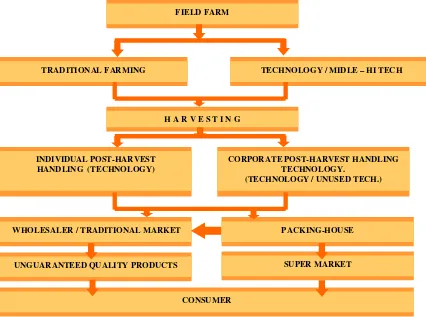
In Indonesia fresh handling of vegetables is still carried out by traditional methods, without hardly any sorting or grading prior to marketing. Therefore, post-harvest loss reduction of vegetables, both quantity and quality loss, must begin at the farm level. Although quality of fresh produce can not be improved by post-harvest handling, however it is necessary for extending shelf-life. Figure 1 below shows the current status in traditional farming and traditional post-harvest handling systems in Indonesia.
Figure 1. The Current Status in Traditional Farming and Traditional Post-Harvest Handling System in Indonesia
H A R V E S T I N G
INDIVIDUAL POST-HARVEST HANDLING (TECHNOLOGY)
WHOLESALER / TRADITIONAL MARKET
FIELD FARM
UNGUARANTEED QUALITY PRODUCTS
CORPORATE POST-HARVEST HANDLING TECHNOLOGY.
(TECHNOLOGY / UNUSED TECH.)
CONSUMER
TRADITIONAL FARMING TECHNOLOGY / MIDLE – HI TECH
PACKING-HOUSE
Hartulistiyoso (2003) mentioned four reasons why post-harvest handling should be carried out at the farm level, respectively a) Vegetable farmers are mostly small-land holders (0.2 – 0.5 ha) with limited investment abilities, b) All farm-work is done manually with simple tools, c) Sanitary and food-safety conditions at packing stations are poor, and d) Produce management is also poor.
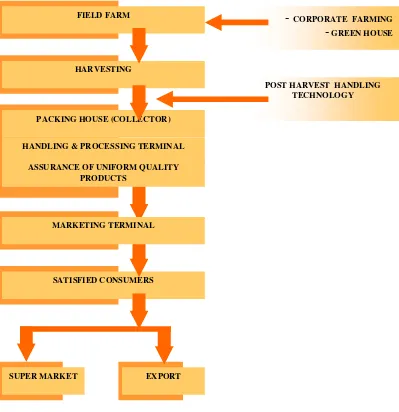
In Indonesia the development of quantity and quality of production in order to obtain high added value, require the application of post-harvest technology. Figure 2 shows the expected development of the production and post-harvest handling systems.
Figure 2. The Expected Development of the Production and Post-Harvest Handling Systems
FIELD FARM
HARVESTING
PACKING HOUSE (COLLECTOR)
HANDLING & PROCESSING TERMINAL ASSURANCE OF UNIFORM QUALITY
PRODUCTS
SATISFIED CONSUMERS
SUPER MARKET EXPORT
POST HARVEST HANDLING TECHNOLOGY
-
CORPORATE FARMING-
GREEN HOUSEIntroducing appropriate post-harvest technology at the farm level require research on a) Storage stability at ambient and low temperatures and b) Packing and packing methods of produce. For the moment research will be carried out on broccoli and white cabbage since broccoli is the most highly priced cole-crop in Indonesia although it is not extensively grown, while white cabbage is the most extensively grown vegetable on Java as well as the outer islands.
II. LITERATURE REVIEW
2.1 Brassica Vegetables: White Cabbage and Broccoli
Brassica vegetables belong to the class Dicotyledonae, the family Cruciferae and most belong to the genus Brassica. White Cabbage (Brassica oleracea gp. capitata) and Chinese Cabbage (Brassica chinensis or Brassica pekinensis) are the most extensively grown in Indonesia, but are sold at relatively lower price. Cauliflower (Brassica oleraceae gp. botrytis) on the other hand are not cultivated extensively but are sold at
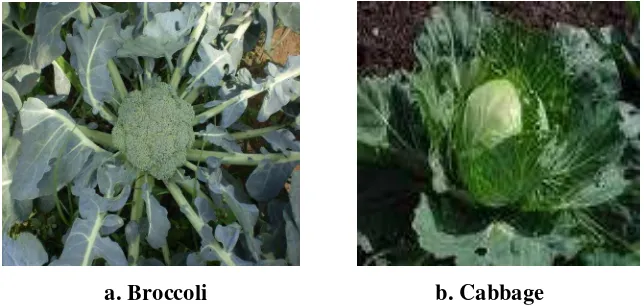
higher prices. The appearance of these cole crops are presented in Figure 3. Table 1 presents the total harvested area and production of these vegetables in West-Java in 2004.
a. Broccoli b. Cabbage
Table 1. Harvested Area, Production and Yield of Four Cruciferous Vegetables in West Java-2004
Harvested Area Production Yield (Ton/Ha) Kind of
Source: BPS. 2005. Survei Pertanian (Produksi Tanaman Sayuran dan Buah – buahan).
Pracaya (2003) classified white cabbage cultivated in Indonesia into the three following groups: a) Roundhead, b) Flathead and c) Conical type of head. The roundhead type is the most preferred type due to its good sensory characteristics.
Broccoli is cultivated for its curd, which should be dark green in color (Rukmana, 1994). The curd has a diameter of 5 – 25 cm depending on soil conditions and variety. Three cultivars are grown extensively, respectively Green King (553), Green King No.2 (559) and Green Valiant.
Nutritionally, most cruciferous vegetables are low in calories, fat and carbohydrates, but are rich sources of protein. They contain all the essential amino acids, particularly the sulphur – containing amino acids. All cruciferous vegetables are also excellent sources of minerals such as calcium, iron, magnesium, sodium, potassium, and phosphorus, and most of these minerals are in the available form (Salunkhe and Desai, 1984). Table 2 present the proximate composition, vitamin and mineral content of white cabbage and broccoli.
Table 2. Proximate Composition, Vitamin and Mineral Contents of Cabbage and Broccoli Proximate Composition Vitamin Content Mineral Content*) Vegetable Water
In Indonesia white cabbage is consumed fresh or cooked because of its good sensory characteristics (Soedibyo, 1978), white cabbage is sold as whole white cabbage head, baby cabbage (outer leaves removed until a small head of 6 – 8 cm diameter remaining) and white cabbage shoots (keciwis). Fermented white cabbage such as sauerkraut and pickles, are not popular products. Broccoli is generally consumed cooked as part of various vegetable dishes.
2.2 Grades and Standards
2.2.1 Cabbage
a. Quality criteria
White cabbage head should be greenish in color, firm and heavy for its size. When rubbed against each other the heads should squeak, indicating crispness. Bloom on leaves is desirable. Inner leaves should be tightly packed and very light green in color depending on the cultivars (Ryall and Lipton, 1972).
According to Namdevco (2006) the minimum standards and requirements of the cabbage is as follows: (a) whole, intact, sound, firm and fresh without bruises, cracks or other forms of injury, (b) clean and practically free from visible foreign material, (c) free from foreign taste and smell, (d) practically free from pests and/or damage caused by pest and diseases and (e) free from abnormal external moisture.
The stem should be cut above the lowest pair of leaves. The other fully expanded leaves should remain firmly attached to the stem and the cut surface of the stem should be smooth.
The development and condition of the cabbage must be such to enable them to withstand transport and handling, and to arrive in a satisfactory condition at the place of destination.
b. Grades
According to Namdevco (2006), there are two classes of headed cabbage:
Class 1: Cabbage must be of good quality. They must possess major varietal characteristics. The following defects are allowed provided they do not affect the general appearance, quality, keeping quality and presentation.
1) Small cracks in the outer leaves.
2) Slight bruising and light trimming of the outer leaves
Tolerance: 10% by number or weight of headed cabbage not satisfying the requirement of the class but meeting the requirement of class II or exceptionally coming within the tolerance of that class.
Class II: This class include cabbage which do not qualify for inclusion in class I but satisfy the minimum requirement specified above. The following defects are allowed provided they do not affect the general appearance, quality and keeping quality.
1) crack in the outer leaves 2) outer leaves may be removed
3) larger bruises and the outer leaves may be more extensively trimmed, and 4) less compact heads
Tolerance: 10% by number or weight of cabbage satisfying neither the requirement as regard uniformity and size, provided that no head is less than 300g in the case of early cabbage and 400g in the case of later maturing cabbages.
Pudjo et al., (1994) classified cabbage grades also into Grade 1 and Grade 2. Grade 1 should be all of the same variety, of even size, firm, greenish-white in color, fresh, free of dirt, no blemishes, and has a 1 cm stalk. Grade 2 should have similar characteristics, but maybe less firm.
c. Sizing
Namdevco (2006) reported size is determined by weight. Thus it must not be less than 350 g per head for early cabbage and 500 g per head for later maturing cabbages. Sizing is compulsory for cabbage presented in packages. In that case the weight of the heaviest head in any one package must not be more than double the weight of the lightest head. When the weight of the heaviest head is equal to or less than 2 kg, the difference between the heaviest and lightest head may be up to 1 kg.
Pudjo et al., (1994) reported 3 types of size grades for white cabbage, respectively less than 500 g (small), 500 – 1600 g (medium) and more than 1600 g (large). Hurst (1996) classified white cabbage size in the USA into minimum size i.e. 450 g (1 lbs) and maximum size 1800 g (4 lbs).
2.2.2 Broccoli
a. Quality Criteria
Heads of broccoli must be entirely green and all flower buds must be completely closed to be desirable. A purplish cast to the surface is not at all objectionable. However, yellowing or wilting is highly objectionable and indicates poor handling practices somewhere in market channels. Generally the large central heads are more desirable than the side shoots (Ryall and Lipton, 1972).
Rukmana (1994) mentioned quality factors for broccoli consist of curd density, greenness, absence of blemishes, and curd diameter.
b. Size Grades
Broccoli is graded into 4 size – grades, respectively: a. Grade 1 : 30 cm curd diameter
2.3 Post-harvest Handling of Fresh Produce
Fresh fruits and vegetables continue to function metabolically after harvest and therefore they are subjected to physiological and pathological deterioration. Post-harvest handling has a decisive effect on the extent of post-harvest losses, the final quality, and the market value of the crops (Kim, 2006).
The quality of the product can not be improved by post-harvest handling, but is necessary for extending shelf-life. Post-harvest handling covers the time span from product harvesting in the farm field until it reaches the urban consumer through the market (Tjahjadi, 2006).
The two main objectives of applying post-harvest technology to harvested fruits and vegetables are to maintain quality (appearance, texture, flavor, nutritive value and safety) and to reduce losses between harvest and consumption. Shelf-life of the fresh produce is defined as the period from harvest to consumption that a food product remains safe and wholesome. Shelf-life is affected by natural properties of fresh produce as well as various external factors. Appropriate post-harvest technology can minimize moisture loss, slow down respiration rate and inhibit development of decay-causing pathogens. In other words, wilting, re-growth, ripening, senescence and decay can be postponed. Post-harvest technologies which greatly influence the level of post-harvest losses and the quality of produce include grading, packaging, pre-cooling, storage and transportation. Some products also require one or more of the following treatments: trimming, cleaning, curing, disease or insect control, waxing, and ripening (Kim, 2006).
2.3.1 Grading
various capacities are used in packinghouses. Round or nearly round fruits are often sized according to their diameter, using automated chain or roller sizers or hand carried ring sizers. An inefficient sizing operation can also cause significant injuries.
2.3.2 Packaging
There are two very different types of packaging. The first is when produce is packed in containers for transportation and whole-sale. The second is when produce is packed into small retail units. Ideal containers for packing fruits and vegetables should have the following attributes: (a) they are easy to handle, (b) provide good protection from mechanical damage, have adequate ventilation, and are convenient for merchandising (i.e., they can easily carry printed information and advertising about the product etc.) and (c) they should also be inexpensive, and easily degradable or recyclable.
2.3.3 Pre-cooling
Good temperature management is the most effective way to reduce post-harvest losses and preserve the quality of fruits and vegetables. Product harvested from hot fields often carry field heat and have high rates of respiration. Rapid removal of field heat by pre-cooling is so effective in quality preservation and is the procedure is widely used for highly perishable fruits and vegetables. Currently used pre-cooling methods include room cooling, forced-air cooling, water cooling, vacuum cooling, and package icing. Temperature which are low, but not low enough to cause chilling injury, slow down physiological activity and hence the rates of senescence of the products. Low temperatures also reduce microbial growth rates and consequently the rate of decay.
2.3.4 Storage
polymeric films. Ethylene may be scrubbed for products responsive to it, regardless of the storage system used. A good control of temperature, humidity and atmospheric composition maximizes the storage life-span of a product.
2.3.5 Transportation
Inland transportation of horticultural crops is usually by rail-way or truck. Overseas transportation is by sea or by air. A limited amount of high-valued produce is sometimes transported overland by air. The basic requirement for conditions during transportation are similar to those needed for storage, including proper control of temperature and humidity and adequate ventilation (except in the case of MA). In addition, the produce should be immobilized by proper packaging and stacking to avoid excessive movement or vibration. Vibration and impact during transportation may cause severe bruising or other types of mechanical injury.
2.4 Post-Harvest Handling of Cabbage and Broccoli
2.4.1 Cabbage
Asgar (2006) stated that harvesting and post-harvest handling of cabbage should be done with great care. Mechanical damage, such as cuts and bruises, causes blackspots and a bad appearance.
Post-harvest handling of cabbage, according to Namdevco (2006) and the North Carolina Extension Service (2006) should be as follows:
a. Harvest at the right maturity stage, when heads are firm and compact and the outer leaves turn downwards.
storage space than immature cabbage because the heads of the mature crop are dense (Agblor and Waterer, 2001).
b. Cut the stem above the two lowest leaves.
Field workers have a major influence on quality. They should be made aware of the importance of good sanitation practices, be properly instructed in selecting for maturity, and be cautioned against handling cabbage roughly. An experienced picker should be able to determine the level of maturity quickly and consistently by feel and by the size of the head. The head is harvested by bending it to one side and cutting it with either a Russel knife or a common butcher knife. Harvesting knives should be sharpened frequently to reduce effort and lessen picker fatigue. The head should not be removed by snapping or twisting it since this practice damages the head and results in inconsistent stalk length and trim. Broken stalks are also more susceptible to decay.
The stalk should be cut flat and as close to the head as possible, yet long enough to retain two to four wrapper leaves acting as cushions during handling and may be desired in certain markets. Yellowed, damaged, or diseased wrapper leaves should be removed, however. Heads with insect damage and other defect should be discarded. c. Place the harvested cabbage in clean field crates of 20 – 25 kg capacity, or in boxes,
wagons, and bags.
In the USA, cabbages are generally packed in 50 pound fiberboard cartons, 50 to 60 pound wire-bound crates, or mesh bags. The industry has been slowly abandoning the mesh bag in favor of cartons or crates because bags offer only minimal protection from rough handling.
d. Place field crates in a cool area while awaiting transport to the pack-house
Harvested produce should always be removed from direct sunlight and transported to the packing shed as soon as possible. Cabbage is particularly susceptible to wilting and other damage from high temperature. When there is a delay of more than an hour or two between harvest and packing, a water drench or spray arrangement can help prevent dehydration and overheating.
e. Transport produce to the pack-house
f. Carefully unpack cabbage from the field crates
g. Trim the outer leaves leaving 2 – 3 outer leaves for protection of the head h. Pack cabbages in fiber board boxes
In Indonesia, cabbage are harvested at 3 – 4 months of age, when heads are already firm. Harvesting is best done during the day between 09.00 a.m – 15.30 p.m when the weather is clear (Pracaya, 2003).
Post-harvest handling of cabbage in Indonesia should be practiced with the three following factors in mind (Pracaya, 2003):
1. Sorting
Cabbage heads should be sorted according to size, weight and firmness. Quality criteria for cabbage is presented in Table 3.
Table 3. Quality Criteria of White Cabbage in Indonesia
No Quality Criteria Grade 1 Grade 2
Cabbage should be stored at 0 0C, RH 90%. In such condition cabbage can be stored for 8 months.
3. Packaging
For long distance transportation carton boxes with enough holes and a capacity of 36 heads per box should be used. For short distances, bamboo containers with holes is sufficient.
2.4.2 Broccoli
Broccoli should be harvested when the curd is firm/compact, has attained maximum size and the flowers has not opened yet. Harvesting time is 50 – 60 days after planting depending on cultivar (Rukmana, 1994).
Post-harvest handling of broccoli consists of sorting, packaging and storage. Sorting criteria for curd diameter is larger than 30 cm for Grade 1, 25 – 30 cm for Grade 2, 20 – 25 cm for Grade 3 and 15 – 20 cm for Grade 4.
Curds are wrapped in polyethylene film and packed in wooden crates (field boxes) of 25 – 30 kg capacity. Storage conditions should be dark, 4.4 0C, RH 85 – 90%. In such conditions broccoli can be stored for 14 – 28 days (Rukmana, 1994).
2.5 Storage of Cabbage and Broccoli
Storage of fresh fruits and vegetables including cabbage and broccoli, prolongs their usefulness and in some cases improves their quality, it also checks market glut, provides wide selection of fruits and vegetables throughout the year, helps in orderly marketing, increases financial gain to the producers and preserves the quality of the living product. The principal aim of storage is to control the rate of transpiration and respiration, diseases infection, and preserve the commodity in its most useable form for consumers (Pantastico et al., 1975).
Storage life may be prolonged by proper control of post-harvest diseases, regulation of the atmosphere, chemical treatments, irradiation, and refrigeration. To date, refrigeration is the only known economical method for long-term storage of fresh fruits and vegetables; all the other methods of regulating ripening and deterioration are at best only supplemental to low temperature. Storage temperature is also the most important environmental factor affecting the senescence of fruits and vegetables, because it regulates the rate of physiological and biochemical processes (Pantastico et al., 1975).
Quality of vegetables during storage are affected by transpiration and respiration rates.
a. Transpiration
Water loss through transpiration is the major cause of deterioration of fresh horticultural products during storage. It causes shrinkage, shriveling, weight loss, an unattractive appearance and loss of vitamin C (Tranggono and Sutardi, 1990).
protective coating and keeping the refrigerant as close as possible to the desired air temperature could also reduce weight loss (Pantastico, et al., 1975). According to Tranggono and Sutardi (1990), moisture loss in fresh commodities are influenced by surface area, natural wax coating and mechanical injury.
Brassica vegetables should be stored at RH higher than 90%. Although the RH of air increases when air is cooled, it is still necessary to check that the RH in a cool room is satisfactory. In low temperature cool rooms, (e.g. 10C), water is continually being lost during defrost cycles. This is because the water, which comes from the air and from the vegetables and which freezes on the evaporator coil, is melted and drained out of the cool room.
Minimising water loss from a cool room and the vegetables can be done by using a large evaporator coil to keep defrosting to a minimum. A large coil allows a low temperature differential (TD) of around 3 0C to be maintained between the cool room air returning to the evaporator and the refrigerant within the evaporator coil, thereby minimising icing up.
Moisture can be added to the cool room air in a variety of ways including wetting down the floor and hanging wet Hessian ‘curtains’. Water can also be added by using humidifiers, wetting containers and by sprinkling products with water.
Rapid air movement over exposed perishables can sweep water molecules away from the vegetables resulting in higher rates of water loss. Controlling air circulation in the cool room and using protective covers over the products could solve the problems (Tan, 2005).
b. Respiration
are dependent on temperature changes within the physiological temperature range. Therefore, temperature is the most important factor that influences respiration rate and also the deterioration rate of fresh produce. If fruits and vegetables are held just above their freezing point, there will be a great reduction in respiration and thus the maximum storage-life can be obtained (Kim, 2006).
Freshly harvested top quality Brassica vegetables should be cooled rapidly to below 2
0
C and stored between 0 0C to 2 0C. Pre-cooling and storage at low temperature slow down the physiological and biochemical processes associated with deterioration and decay. Low temperatures also reduce water loss through transpiration and delay the growth of microorganisms which causes rot. An increase in the temperature of 10 0C can increase the rate of deterioration and decay by two to three times. Cooling to remove field heat to less than 2 0C should start within four hours after harvesting. The most common and effective pre-cooling method for Brassica vegetables is forced-air cooling to cool vegetables within two to six hours. This technique draws cool forced-air through the product in ventilated containers, bins, crates, or packages, usually on pallets, and rapidly lowers the temperature of the produce. The main advantages of forced-air cooling is that it is simple to use and can be accommodated into grading/packaging/storage systems easily.
Hydro-cooling is another effective method. It cools the produce with chilled chlorinated water (temperature 0.5 0C; chlorine 100 to 300 ppm; pH 7.3 to 7.6) but is more difficult to carry out compared to forced-air cooling as more sophisticated equipment is needed. With broccoli, ice crushed or as flakes is sometimes used by growers to remove field heat quickly but there is a danger the ice may injure the florets (Tan, 2005).
Ideally pre-cooling and storage temperature of cabbage should be done at 0 0C, 90 – 95% RH. However, the recommended storage and transit temperature is 0 – 4 0C. Shelf-life of cabbage at various storage temperature and RH is as follows (Tan, 2005):
The ideal pre-cooling and storage temperature of broccoli should be carried out at 0 0C, 95 – 100% RH. The recommended storage and transit temperature is 0 – 2 0C. The shelf-life of broccoli at various storage temperature and RH is as follows (Tan, 2005):
a. 0 0C, 90 – 95% RH, air storage without plastic liner : 1 – 2 weeks b. 0 0C, 90 – 95% RH, polystyrene box with ice : 3 – 4 weeks c. 0 0C, 90 – 95% RH, waxed carton with plastic liner : 4 weeks
d. 4 0C, 80 – 90% RH : 2 – 6 weeks
e. 20 0C, 60 – 70% RH : 1 – 2 days
The shelf-life of broccoli is usually terminated by yellowing which detracts from consumer acceptability. High temperature, low humidity and the presence of ethylene gas accelerate yellowing (Tan, 2005).
Putting ice on top of broccoli in a polystyrene box will be beneficial if temperature and humidity control are poor. Ice is frequently used on broccoli for local markets and for export by air freight. Polystyrene boxes with ice topping are more expensive than waxed cartons with plastic liners. When temperature can be maintained effectively there is no need to use this method which has its disadvantages. When ice melts during storage and transportation the melted water will aid the development of microbial infections, and rot the produce (Tan, 2005).
2.6 Packaging of Cabbage and Broccoli
Improvements in packaging have contributed greatly to more efficient marketing of fruits and vegetables. Packaging requirements vary widely, depending on the commodity to be packaged and on the conditions which the produce will meet from the farm or the packer to the consumer (Hardenburg, 1975).
Packaging benefits may be summarized as follows (Hardenburg, 1975): 1) serves as an efficient handling unit
2) serves as an convenient warehouse or home storage unit 3) protects quality and reduce waste:
a. protects from mechanical damage b. protects against moisture loss c. may provide beneficial MA d. provides clean or sanitary products e. may prevent pilferage
4) provides service and sales motivation 5) reduces case of transport and marketing 6) facilities use of new modes of transportation
Wills et al., (1981) summarized the expected wide range of requirements of modern packaging for fresh produce as follows:
1. The packages must have sufficient mechanical strength to protect the contents during handling, during transport, and while stacked.
2. The material of construction must not contain chemicals which could transfer to the produce and be toxic to it or to man.
3. The package must meet handling and marketing requirements in terms of weight, size, and shape. The current trend is to reduce the many sizes and shapes of packages by standardization essential for economical operation.
4. The packages should allow rapid cooling of the contents. Furthermore, the permeability of plastic films to respiratory gases might also be important.
5. The mechanical strength should be largely unaffected by its moisture content when wet or at high humidities. The package might be required to exclude water from the produce, or to prevent dehydration of the produce.
6. The security of the package or its ease of opening and closing might be important in some marketing situations.
7. The package might be required to either exclude light or to be transparent. 8. The package might be required to aid retail presentation
9. The package might need to be designed for ease of disposal, re-use, or recycling 10.The cost of the package in relation to the value and the required extent of
Containers and packages for fresh produce may be classified as follows (Hardenburg, 1975):
a) Harvesting or field containers b) Shipping containers
c) Consumer retail packages
Harvesting or field containers are of many types depending on the crop, the region, and availability of materials. Picking bags of canvas, burlap, or mesh, hampers and baskets of woven veneer or bamboo are widely used. Metal pails with canvas bottoms for unloading are sometimes used for fruits and vegetables. The filled picking or harvesting container are then unloaded into larger field boxes or pallet bins. However for crops such as cabbage, cauliflower and celery, produce are often left in the harvesting containers and are then loaded into trucks by tossing.
Shipping containers are containers designed for shipping and handling; which require engineered, containers to protect the produce from bruising, vibration and the weight of other stacked containers. The ideal pack consist of a tight-fill without a bulge in a lidded container having sufficient stacking strength to protect the contents under all handling conditions. Any shipping container should be designed to meet the specific requirements of the particular fruit or vegetable. In more developed countries shipping are only used once while in less developed countries baskets and boxes are returned or sold and receive multiple uses (Hardenburg, 1975).
Ryall and Lipton (1972), stated that burlap, mesh and paper bags provide little protection from impact or pressure, while nailed wooden boxes or wire bound boxes with reinforced ends have sufficient rigidity to provide protection from impact and unless packed with excessive bulges, can stack to any practical height without exerting harmful pressure on the product. Fiberboard boxes fall somewhere between bags and wooden boxes for product protection.
packed in polyethylene bags of 35 kg weight. Cauliflower leaves are left to cover the curd as natural protective packaging material and sometimes are also over-wrapped with newspaper before being packed in stackable plastic containers or bamboo baskets. Broccoli are cleaned of leaves and wrapped in newspaper or often leaves are left on to reduce damage during transportation. Finally it is packed in plastic containers for supermarkets or bamboo baskets, or polyethylene bags and nets for whole-sale markets (Tjahjadi, 2006).
In the USA cabbage is generally packed in 50 lb fiberboard cartons, 50- to 60-lb wire-bound crates or mesh-bags. The industry has been slowly abandoning the mesh bag in favor of cartons or crates because bags offer only minimal protection from rough handling. Lining of storage containers with perforated polyethylene reduces wilting and trimming loss. Perforation allows better air movement during cooling. The storage/shelf-life of cabbage is greatly influenced by cultivars/varieties. Carton and crates are also easier to palletize. A recent market innovation is the shipping of cabbage in heavy fiberboard bulk pallet bin holding 500, 700, or 1,000 pounds. Some specialty cabbages (such as red, Savoy, and Chinese types) are packed in 25-, 30-, or 40-pounds cartons, depending upon market preference. Uniformity and the count per carton are important; 18 to 22 heads per 50-pounds carton is customary (Boyette et al., 2006).
Consumer or retail packages are either bag packs, tray packs or sleeve packs (Hong, 2006)
1. Bag Packs
packing density as a result of the voids between individual items of produce inside a bag, and the voids between the bags themselves.
2. Tray Packs
Tray packs comprise a lower rigid tray with a transparent plastic film over-wrap to contain the produce. Trays are generally fabricated either from white pigmented PP or PVC or from foamed EPS. The over-wrap film must be tight to immobilize the produce end keep it apart or snug against each other to prevent collisions and bouncing during handling and transportation. This has led to the use of either shrinkable or stretch films, the former typically made from PVC and the latter from LDPE. Although each type has advantages and disadvantages, the latter now tend to be preferred to the former.
3. Sleeve Packs
These have been developed in attempts to combine the low cost of bags with the protective qualities and sales appeal of tray packs. They can be made from shrinkable film, regular net-stocking or expended-(foamed)-plastic netting, and the latter possessing excellent cushioning properties. Sleeve packs can be manufactured to contain from one to as many as tens of fruit. Those holding a number of fruit are essentially tray packs without the tray. The main advantages of sleeve packs are that they immobilize the produce at a fraction of the cost of tray packs, and the produce can be observed from all sides without damage to the fruit.
In Indonesia, cabbage and broccoli are only sold in local markets without any wrapping or packaging. Those for supermarkets are generally shrink-wrapped. Baby cabbage and cabbage shoots are tray packed.
2.7 Market Disorders of Cabbage and Broccoli
III. MATERIALS AND METHOD
The experiment was carried out at the Food Process Engineering and the Post-Harvest Technology Laboratories of the Faculty of Agriculture Industrial Technology of The Padjadjaran University at Jatinangor from December 2006 up to January 2007.
Broccoli (Brassica oleracea L. gp. Italica) harvested 2 months after planting, and possessing curds of 15 cm diameter, dark green in color and compact was used for the experiment. The cabbage samples (Brassica oleracea L. gp. capitata) were harvested 4 months after planting, possessing a round compact, dense head, light green in color. The packaging materials were low density polyethylene bags, polyprylene net, and carton boxes. Other materials used were filter paper and water.
Equipments used for the experiment were stainless steel knives, O-Hauss balance, analytical balance, hairhygrometer, thermometer plastic, bag sealer, and a digital camera (Olympus).
A descriptive experimental method and regression analyses consisting of 2 variables (dependent and independent) were employed. The treatments were:
A : without packaging, stored at ambient temperature (27 0C ± 2 0C) B : without packaging, stored in cold storage (5 0C ± 1 0C)
C : packed in LDPE bag, stored at ambient temperature (27 0C ± 2 0C) D : packed in LDPE bag, stored in cold storage (5 0C ± 1 0C)
E : packed in polypropylene net bag, stored at ambient temperature (27 0C ± 2 0C) F : packed in polypropylene net bag, stored in cold storage (5 0C ± 1 0C)
G : packed in carton box, stored at ambient temperature (27 0C ± 2 0C) H : packed in carton box, stored in cold storage (5 0C ± 1 0C)
The variables observed were sensory description using a sensory scoring standard, degree of decay (percentage of decay), weight loss i.e. 2 weeks for broccoli and 4 weeks for white cabbage (Muchtadi, 1997), and surface colour score based on CIE colour measurement (Yam and Papadakis, 2004).
curd colour, percentage of discoloration of curd surface either due to yellowing or disease (grey or black discoloration). Five pictures were chosen and assigned sensory scores ranging from 1 (Excellent) to 5 (Not fit for sale). The sensory scoring standard for white cabbage was prepared by storing sound heads (about equal in size and weight, and free of physical damage) at ambient temperature (27 0C ± 2 0C) for 28 days. Observation of samples were done at 2 day intervals, producing 14 photographs. Consequently 5 pictures were selected and assigned sensory scores ranging from 1 (Excellent) to 5 (Not fit for sale).
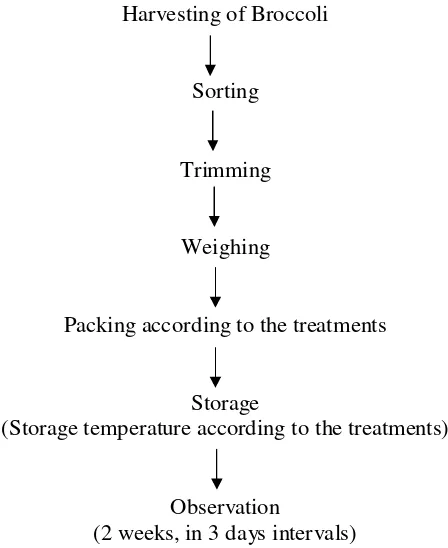
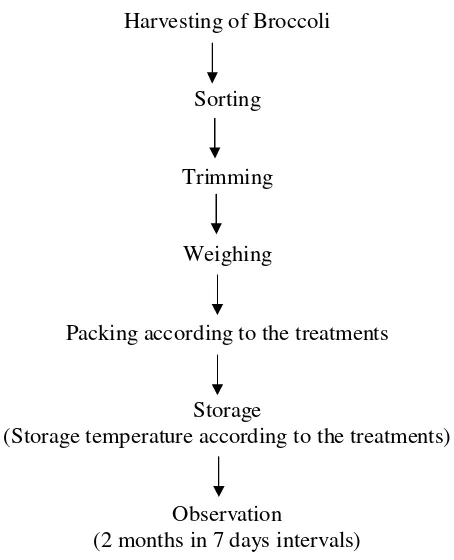
The packaging and storage temperature experiment on broccoli and cabbage were done as follows: samples were sorted, trimmed and weighed. Each type of container was filled with 3 samples. The PE bags were divided into 3 sections by using a bag-sealer, and in each compartment 1 sample was placed. Subsequently samples were stored at ambient temperature or in the cold storage room according to the treatments allotted. Broccoli was observed every 3 days for 2 weeks, while cabbage was observed at weekly intervals for 2 months. Experimental process for broccoli and white cabbage packaging and storage are presented in Figure 4 and Figure 5.
Harvesting of Broccoli
Sorting
Trimming
Weighing
Packing according to the treatments
Storage
(Storage temperature according to the treatments)
Observation
(2 weeks, in 3 days intervals)
Harvesting of Broccoli
Sorting
Trimming
Weighing
Packing according to the treatments
Storage
(Storage temperature according to the treatments)
Observation
(2 months in 7 days intervals)
IV. RESULT AND DISCUSSION
4.1 Broccoli
4.1.1 Sensory Scoring Standard for Broccoli
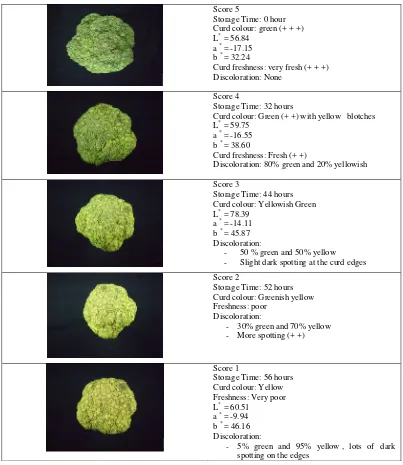
The sensory scoring standard for broccoli stored at ambient temperature (27 0C ± 2 0C) for 56 hours is presented in Figure 6.
Score 5
Curd colour: Green (+ +) with yellow blotches L* = 59.75
a * = -16.55 b * = 38.60
Curd freshness: Fresh (+ +)
Discoloration: 80% green and 20% yellowish
Score 3 - Slight dark spotting at the curd edges
Score 2
4.1.2 Changes in Sensory Scores of Broccoli during Storage at Ambient Temperature and Cold Storage
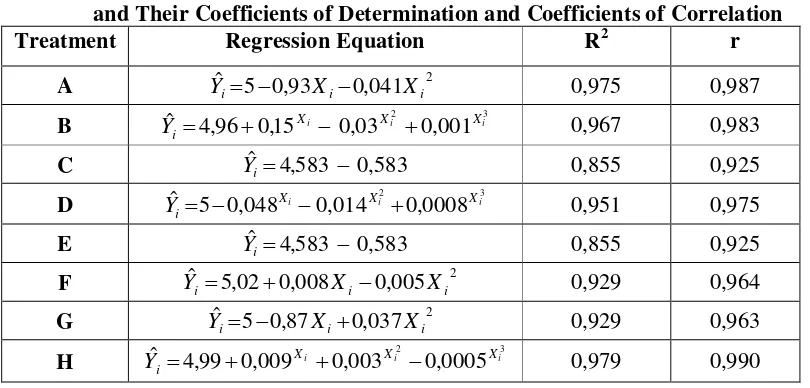
Regression Curves between sensory scores and storage time for the packing and storage temperature treatments are shown in Figure 7, while the regression equations coefficients of determination and coefficients of correlation are presented in Table 4.
D
Figure 7. Regression Curves of Sensory Scores of Broccoli and Storage Time
Table 4. Regression Equations of Sensory Scores of Broccoli against Storage Time and Their Coefficients of Determination and Coefficients of Correlation
Treatment Regression Equation R2 r
A Yˆi50,93Xi0,041Xi2 0,975 0,987 showing equations fit very well.
storage. Sample D was packed in a sealed LDPE bag and stored at 5 0C ± 1 0C, so that besides the low storage temperature, inside the sealed bag a modified atmosphere (high CO2, low O2) might have developed.
Treatment A C E G, which were stored at ambient temperature, reached a sensory score of 2 after 3 days i.e. not acceptable anymore to be displayed for sale. Tan (2005) reported that shelf-life of broccoli at 20 0C and 60 – 70% RH is only 1 – 2 days while at 4 0C shelf life is 2 – 6 weeks. In conclusion, packaging treatments respectively without packaging, LDPE bag, propylene-net-bag and carton box, without refrigeration, can not prolong shelf-life of broccoli if not stored at low temperature.
Treatment B, D, F and H, which were stored at 5 0C, still attained sensory scores ranging from 4 to 5 after 15 days, showing low temperature storage irrespective of packaging, was able to keep the broccoli samples in excellent condition. Treatment D as previously discussed gave the best results, probably due to the modified atmosphere generated within the sealed LDPE bag. Up to 6 days storage hardly any difference in sensory scores was observed, showing all 4 packaging treatments were equally good.
4.1.3 Weight Loss of Broccoli
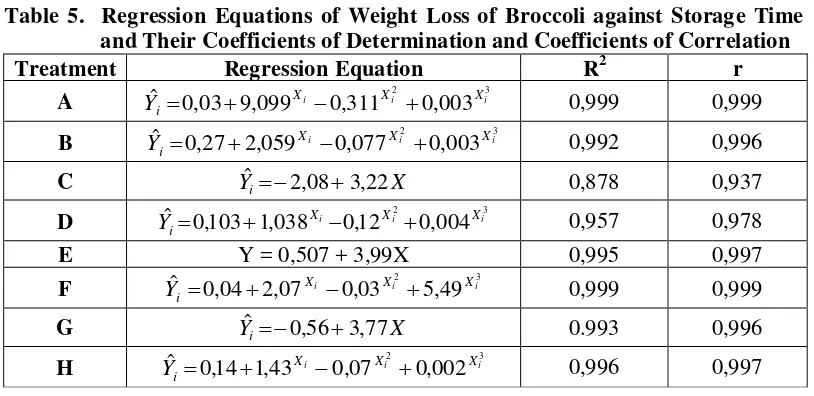
Results of Regression analyses showed there is a very close relationship between weight loss and storage time in all treatments.
A
Figure 8. Regression Curves of Weight Loss of Broccoli against Storage Time
Table 5. Regression Equations of Weight Loss of Broccoli against Storage Time and Their Coefficients of Determination and Coefficients of Correlation
Treatment Regression Equation R2 r
A ˆ 0,03 9,099Xi 0,311Xi2 0,003Xi3
At 5 0C ± 1 0C weight loss of treatments F (PP-net bag) and B (without packaging) are highest and the curves near overlaps each other; percentage of weight loss after 15 days storage was about 20%. Samples packed in carton boxes (H) had a weight loss of about 10% after the 15 day storage, while those packed in LDPE (D) produced the lowest weight loss i.e. about 2% after the 15 day storage.
Protection of the packaging materials against weight loss was quit significant, PP net-bag equals no packaging, while the carton-box gave intermediate values of weight loss (10% weight loss in 2 weeks), while the LDPE bag gave the best protection (2% weight loss in 2 weeks). The no packaging and net-bag probably provides too much air movement during storage, causing larger losses. As Boyette (2006) said, mesh bags are now abandoned due to the minimal protection it provides against rough handling and the larger wilting losses. The carton box is light-weight and provides sufficient protection, while the LDPE bag provides good protection against moisture losses, is also light-weight but it does not give sufficient protection against rough handling.
4.1.4 Curd Colour
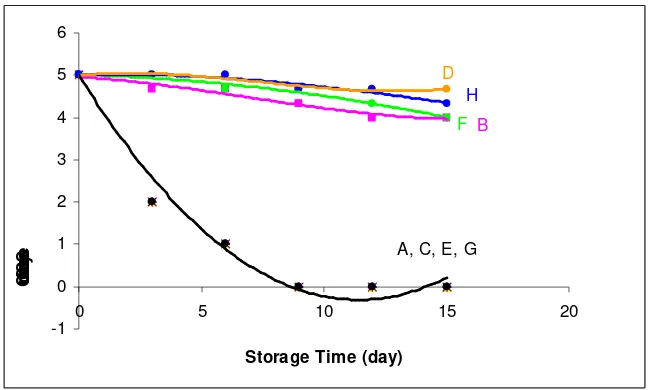
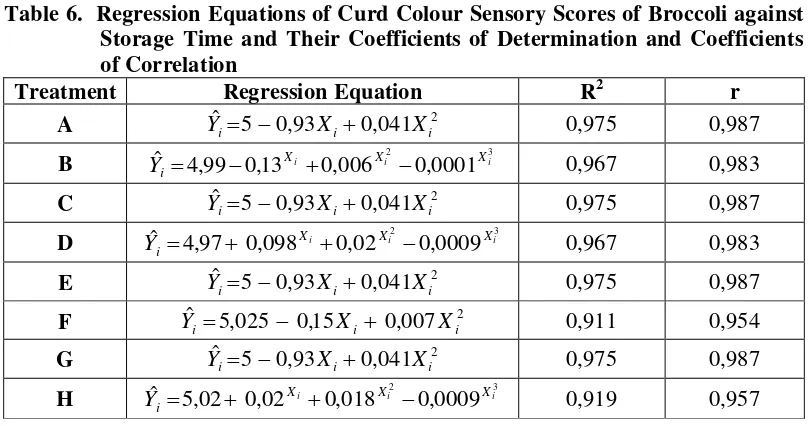
Curd colour was evaluated using the same sensory standard as presented in Figure 6 Regression curves between curd colour sensory scores against storage time are presented in Figure 9 and Table 6. R2 for the samples stored at ambient temperature and in cold storage ranged from 0.911 to 0.975 showing a very good fit.
Table 6. Regression Equations of Curd Colour Sensory Scores of Broccoli against Storage Time and Their Coefficients of Determination and Coefficients of Correlation
Treatment Regression Equation R2 r
A Yˆi50,93Xi0,041Xi2 0,975 0,987
B ˆ 4,99 0,13Xi 0,006Xi2 0,0001X3i
i
Y 0,967 0,983
C Yˆi50,93Xi0,041Xi2 0,975 0,987 D ˆ 4,97 0,098Xi 0,02Xi2 0,0009Xi3
i
Y 0,967 0,983
E Yˆi50,93Xi0,041Xi2 0,975 0,987
F Yˆi 5,025 0,15Xi 0,007Xi2 0,911 0,954
G Yˆi50,93Xi0,041Xi2 0,975 0,987 H ˆ 5,02 0,02Xi 0,018Xi2 0,0009Xi3
i
Y 0,919 0,957
Curds stored at 5 0C ± 2 0C still obtained colour scores between 4 and 5 after the 15 day storage irrespective of the packaging material. Among the 4 packaging materials, during the course of the 15 day storage, LDPE bag (D) was best, followed by H (carton box), treatment B and F gave similar results up to day 12. Curds stored at ambient temperature reached a score of 2 within 3 days of storage irrespective of type of packaging.
Thus, low temperature storage is more important in preserving colour of curd than packaging as is also reported by Thompson and Kelly (1957) vide Salunkhe and Desai (1984). Colour change starts when flowers begin to open and turn yellow (Salunkhe and Desai, 1984), this occurs within 3 days at room temperature. Yellowing it self is related to ethylene production by the broccoli, although refrigeration could reduce ethylene production considerably. Treatment D was best, partly because of the modified atmosphere generation within the LDPE bag.
4.1.5 Curd Decay
A
Figure 10. Regression Curves of Curd Decay Scores of Broccoli against Storage Time
Table 7. Regression Equations of Curd Decay Scores of Broccoli against Storage Time and Their Coefficients of Determination and Coefficients of Correlation
Treatment Regression Equation R2 r
A Yˆi 0,04 0,126Xi 0,019Xi2 0,891 0,944 except for treatment A, thus showing less suitable fit.
Cold storage (treatment B, D, F, H) did not show mold growth at all during the 15 day storage, either on curds stored without packaging or in the various types of packages. This shows that mold growth is more affected by storage temperature than packaging.
4.2 Cabbage
4.2.1 Sensory Score Standard of Cabbage
Score : 5
Discoloration and Decay : None
Score : 4
Storage Time : 6 days
Colour : Pale Greenish White
L* = 69.18
Discoloration and Decay : None
Score : 3
Discoloration and Decay : Some black spots (5%)
but no soft rot
Discoloration and Decay : More black spots (50%)
and soft rot (20%)
Score : 1
Storage Time : 28 days
Colour : White dull with severe
opaque blots
Discoloration and Decay : Large number of black spots (70%) and very much softrot (50%)
4.2.2 Change in Sensory Scores of Cabbage Stored at Ambient Temperature and Cold Storage
Change in sensory scores of cabbage stored at ambient temperature (27 0C ± 2 0C) and cold storage (5 0C ± 1 0C) are presented as regression curves in Figure 12, while regression equations, and their respective coefficients of determination and correlation are shown in Table 8.
Figure 12. Regression Curves of Sensory Scores against Storage Time of Cabbage Stored at Ambient Temperature and 5 0C
Table 8. Regression Equations, Coefficients of Determination and Correlation of Sensory Scores of Cabbage against Storage Time
Treatment Regression Equation R2 r
Cabbage stored at ambient temperature (A, C, E, G) have lower sensory scores than those stored at 5 0C. As reported by Tan (2006) top quality Brassica vegetables should be cooled rapidly to below 2 0C and stored between 0 0C to 2 0C, since it slows down both physiological and biochemical processes associated with deterioration and decay, reduce water loss through transpiration and delay the growth of microorganisms which cause rot.
Type of container did not affect sensory scores significantly when stored in cold storage (treatments B, F, H, and D). After 14 days storage these treatments have still very high sensory scores i.e. close to score 5 (excellent), revealing that in cold storage, type of packaging is of less importance in maintaining quality of cabbage.
However, in storage at ambient temperature type of package greatly affects sensory scores of the commodity. Treatments G (carton box) gave the best results, followed by treatments A and E (no packaging and PP-net), while treatment C (LDPE-bag) was the worst. The results were probably related to the protective effect of the container against mechanical damage and the ability to maintain proper RH (above 90%) within the container.
The carton container is rigid, so that movement of cabbage heads within the package is quit limited. The carton box also allows some gas exchange with the environment, but restricts air movement over the commodity. The LDPE-bag does not provide sufficient protection against mechanical injury of the cabbage due to its pliable mature and also tend to keep moisture within the package, causing RH to increase to dew point, which then causes increase in rate of deterioration and decay.
4.2.3 Colour Sensory Score of Cabbage Head Surface
DC
Figure 13. Regression Curves of Sensory Colour Scores of Cabbage Head Surface against Storage Time
Table 9. Regression Equations for Colour Sensory Score of Cabbage Head Surface, against Storage Time, Coefficients of Determination and Coefficients of Correlation
Traetment Regression Equation R2 r
A ˆ 5 0,785Xi 0,101Xi2 0,004Xi3
R2 values of treatment D, F and H were all above 0.80, showing a good fit, but all other treatments had R2 values less than 0.80, showing fit is poor.
Treatments C, D, F, H (stored at 50C) and treatments A and B (ambient temperature) were able to retain surface colour best i.e. between 3 – 5. The cold was able to inhibit decay (Figure 15), while surface colour is greatly influenced by percentage of decay.
Data obtained in ambient temperature consistent with expectations. Treatments E (PP-net, 27 0C) and G (carton, 27 0C) gave the lowest surface colour score, although treatments A (No packing, 27 0C) and C (LDPE, 27 0C) were able to maintain high scores after 14 days storage. This might be related to low quality incoming material since the experiment was carried out during the middle of the rainy season, so that harvest is usually very susceptible to contamination with rot microorganisms.
4.2.4 Weight Loss of Cabbage Heads
Regression curves for weight loss of cabbage heads against storage time is presented are Figure 14, while regression equations, coefficients of determination and correlation in Table 10.
Figure 14. Regression Curves of Cabbage Weight Loss against Storage Time
Table 10. Regression Equations of Cabbage Weight Loss against Storage Time
Treatment Regression Equation R2 r
All regression equations possessed R-values higher than 0.938, showing a very good fit. Weight loss of samples stored at ambient temperature (27 0C ± 2 0C) were higher than those stored in cold storage (5 0C ± 2 0C), respectively 10 – 12% weight loss as compared to 3 – 6%. Differences among packaging treatments were relatively small.
4.2.5 Decay Scores of Cabbage Heads
Regression curves of cabbage heads decay scores against storage time are presented in Figure 15, while regression equations and their respective coefficients of determination and correlation in Table 11.
C
Figure 15. Regression Curves of Cabbage Head Decay against Storage Time
Table 11. Regression Equations, Coefficients of Determination and Correlation of Decay Scores against Storage Time for Cabbage Heads
Treatment Regression Equation R2 r
Decay scores in ambient temperature storage (A, C, E, G) are higher than those stored at 5 0C. The latter did not show any decay at all in the 14 day storage time-span. As previously stated low temperature storage delays growth of microorganisms causing rot (Tan, 2005), most often Botrytis spp and Sclertonia spp (Ablor and Waterer, 2001).
Packaging seemed to influence decay score significantly, at room temperature, treatments A, E and G gave decay score about 1, while treatment C had a decay score of 7. This was probably related to the ability of No packaging, PP-net and carton box to create a RH around the commodity inconducive for mold growth. As stated mold growth requires a RH of about 95%.
V. CONCLUSION
1. Low storage temperature in broccoli storage is more important than type of packaging in maintaining sensory characteristics of the curd and reducing weight loss as well as decay scores.
2. LDPE bag was best for cold storage of broccoli curds.
3. In cabbage storage, low temperature gave better retention of sensory characteristics and reduces weight loss as well as decay scores, but for head surface colour the results were inconsistent.
LITERATURE REFERENCES
Aglor, S. and Waterer, D. 2001. Cabbage; Post-Harvest, Handling and Storage. Department of Plant Sciences, University of Saskatchewan, Kota Saskatchewan, Canada.
Boyette, M.D., sanders, D.C. and Estes, E.A. 2006. Post-Harvest Cooling and Handling of Cabbage and Leafy Greens. Cooperative Extension Service, North Carolina State University. ///E:/Internet-Files/New-postharvest/AG-413-5%20Postharvest%.
BPS. 2005. Survei Pertanian (Produksi Tanaman Sayuran dan Buah-Buahan). BPS. Jakarta.
Hong, I.S. 2006. Packaging Technology for Fresh Product. Paper Presented at the One Day International Seminar Post-Harvest Losses of Cole Crops (Brassica vegetables) Causes and Solutions November, 6th, 2006. Bandung, Indonesia.
Hardenberg, R.E. 1975. Principles of Packaging, hal 449 – 472. In Pantastico, E.B. (ed). Post-Harvest Physiology Handling and Utilization of Tropical and Subtropical Fruits and Vegetables AVI Publishing Co., Wesport, Connecticut.
Kim, D. 2006. Post-Harvest Technology in Korea. Paper Presented at the One Day International Seminar Post-Harvest Losses of Cole Crops (Brassica vegetables) Causes and Solutions November, 6th, 2006. Bandung, Indonesia.
Namdevco. 2006. Cabbage Post-Harvest Fact Sheet CommNett Caribbean Limited. Accessed on September, 21th, 2006.
Pudjo T., Mulyoto., Sri K., Sri S., Imam H., Puji Y., Anita A., Junaria I., Yanuardi dan Gunawan H. 1994. Vandemekum Pascapanen. Direktorat Bina Produksi Hortikultura. Jakarta.
Pracaya, 2003. Kol Alias Kubis. Penebar Swadaya, Jakarta.
Ryall, A.L. and Lipton, W.J. 1971. Handling, Transportation and Storage of Fruits and Vegetables. Vol.1. Vegetables and Melon. AVI Publishing Co., Wesport, Connecticut.
Rukmana, R., 1994. Budidaya Kubis Bunga dan Broccoli. Penerbit Kanisius, Yogyakarta.
Salunkhe, D.K. and Desai, B.B. 1984. Post-Harvest Biotechnology of Vegetables. Vol. I. CRC Press, Boca Raton, FA.
Tan, S.C. 2005. Post-harvest Handling of Brassica Vegetables Departement Agriculture Western – Australia. www. Agric.wa.gov.au. Accesed on September, 9th, 2006.
Tjahjadi, C. 2006. Post-Harvest Handling of Cole Crops (crucifers) in West Java. Paper Presented at the One Day International Seminar Post-Harvest Losses of Cole Crops (Brassica vegetables) Causes and Solutions November, 6th, 2006. Bandung, Indonesia.