SUGGESTION STRATEGIES USED BY THE MAIN CHARACTERS IN
THE CHRONICLES OF NARNIA: THE LION, THE WITCH, AND THE
WARDROBE MOVIE
THESIS
Submitted as Partial Fulfillment of the Requirements for the Sarjana Degree of English Department Faculty of Arts and Humanities State Islamic University
Sunan Ampel Surabaya
By:
Roistina Warih Suciyanti Reg. Number: A73213128
ENGLISH DEPARTMENT
FACULTY OF ARTS AND HUMANITIES
ABSTRACT
Suciyanti, Roistina Warih. 2017. Suggestion Strategies used by The Main Characters in The Chronicles of Narnia: The Lion, The Witch, and The Wardrobe movie. Thesis. English Department, Faculty of Arts and Humanities, State Islamic University Sunan Ampel Surabaya
The Advisor : Dr. A. Dzo’ul Milal, M.pd
Key Terms : Suggestions, Suggestion Strategy, Main Characters, The Chronicles of Narnia: The Lion, The Witch, and The Wardrobe movie
Suggestions is an expression that the speaker wants the hearer to perform an action which is possibly beneficial to his/her (the hearer). The objective of suggestions is benefit to the hearer. This research aims to describe kinds of suggestion strategies which are used by the main characters in The Chronicles of Narnia: The Lion, The Witch, and The Wardrobe movie and to describe similarities and differences between man (Peter and Edmund) and woman (Susan and Lucy) main characters in making suggestions. This research uses qualitative content analysis.
Qualitative content analysis discusses deeply about meanings, themes, or categories in which may be connect with other factors in a social reality. Here, the researcher collects the data from the utterances of the main characters. The steps to collect the data are preparing the data, selecting the data, collecting the data, and coding.
INTISARI
Suciyanti, Roistina Warih. 2017. Suggestion Strategy used by The Main Characters in The Chronicles of Narnia: The Lion, The Witch, and The Wardrobe movie. Skripsi. Prodi Sastra Inggris, Fakultas Seni dan Humaniora. UIN Sunan Ampel Surabaya.
Pembimbing : Dr. A. Dzo’ul Milal, M.pd
Kata Kunci : Suggestions, Suggestion Strategy, Main Characters, The Chronicles of Narnia: The Lion, The Witch, and The Wardrobe movie
Saran adalah suatu ungkapan yang mana pembicara ingin pendengar melakukan sesuatu yang bisa jadi bermanfaat untuk dirinya. Pemberian saran ini memiliki tujuan untuk memberikan keuntungan kepada para pendengarnya. Penelitian ini bertujuan untuk meneliti macam-macam strategi saran yang digunakan oleh para pemeran utama dalam film The Chronicles of Narnia: The Lion, The Witch, and The Wardrobe dan untuk membahas tentang persamaan dan perbedaan strategi saran yang digunakan oleh pemain utama laki-laki (Peter dan Edmund) dan pemain utama wanita (Susan dan Lucy). Peneliti menggunakan metode qualitatif analisis isi.
Qualitatif analisis isi membahas lebih mendalam tentang maksud, tema, atau kategori yang mungkin berhubungan dengan faktor-faktor lain dalam kehidupan sosial. Peneliti disini mengumpulkan data dari ungkapan para pemeran utama. Langkah-langkah untuk mengumpulkan data yaitu menyiapkan data, memilih data, mengumpulkan data dan memberikan kode.
Setelah menganalisis data, peneliti menemukan bahwa pemeran utama (Peter, Susan, Emund, dan Lucy) menggunkan enam strategi saran yaitu, strategi imperative, negative imperative, specific formulae (Interrogative forms), Possibility/probability, Conditionals, dan Hints. Sementara, pemeran utama laki- laki (Peter dan Edmund) dan perempuan (Susan dan Lucy) memiliki persamaan dan perbedaan dalam membuat saran. Terdapat empat persamaan dalam membuat saran adalah strategi imperative, negative imperative, specific formulae (Interrogative forms), dan Hints. Kemudian, perbedaannya adalah strategi Possibility/probability, dan Conditionals. Hal ini dipengaruhi oleh gender, umur, dan hubungan antara
TABLE OF CONTENTS
INSIDE COVER ...i
INSIDE TITLE ...ii
DECLARATIONS ...iii
MOTTO ...iv
DEDICATION ...v
ADVISOR’S APPROVAL SHEET ...vi
EXAMINER’S APPROVAL SHEET ...vii
ACKNOWLEDGEMENTS ...viii
ABSTRACT ...x
INTISARI ...ix
TABLE OF CONTENTS ...xii
CHAPTER I INTRODUCTION ...1
1.1Background of Study ...1
1.2Research Questions. ...4
1.3Research Objective ...4
1.4Significance of Study ...5
1.5Scope and Limitation ...5
1.6Definition of Key terms ...6
2.1 Theoretical Framework ...7
2.1.1 Sociolinguistics ...7
2.1.2 Language and Gender ...8
2.1.3 Speech Acts ...10
2.1.4 The Kinds of Speech act ...12
2.1.5 Directives ...13
2.1.6 Suggestion Acts ...13
2.1.7 Suggestion Strategy ...15
2.1.8 The Chronicles of Narnia: The Lion, The Witch, and The Wardrobe movie ...19
2.2 Previous Study ...20
CHAPTER III RESEARCH METHOD ...23
3.1 Research Design ...23
3.2 Data Collection ...25
3.2.1 Data and Data Source ...25
3.2.2 Instrument ...25
3.2.3 Technique of Data Collection ...26
3.3 Technique of Data Analysis ...29
CHAPTER IV FINDINGS AND DISCUSSION ...33
4.2 Similarities and Differences of men (Peter and Edmund) and women (Susan and Lucy) main characters in The Chronicles of Narnia: The Lion,
The Witch, and The Wardrobe movie ...54
CHAPTER V CONCLUSIONS AND SUGGESTIONS ...59
5.1 Conclusions ...59
5.2 Suggestions ...60
REFERENCES ...64
CHAPTER I INTRODUCTION
This chapter is related with fundamental idea of this study. This chapter consists of six points of introduction. Those are background of study, research problems, objective of study, significance of study, scope and limitation, and definition of key terms.
1.1Background of Study
Suggestion is a speech act which is included into directive act. Directive act itself is useful to make the hearer to do something (an activity or an action) from what the speaker said. The objective of suggestion is benefit to the hearer (Martinez-Flor, 2005). According to Farnia, et.al (2014), making suggestion means proposing an idea about what the speaker should do or how the speaker should behave. It means that suggestion will make the hearer knows what the better choice for them to do something. It can be concluded that suggestion is an expression which gives choices to the hearer to perform an action which is possibly beneficial for them. Therefore, this research focuses on suggestion speech act.
2
the student in writing instructor in student conference. Another research is about the influence of L1 suggestion pattern of Iranian Learner of English at different proficiency level and gender (Ahmadi, Kargar, & Rostampour (2014)).
Suggestion is also used in TV commercial either as the message of some advertisements to influence the viewer to buy a product (e.g Schmidt, Shimura, Wang, Jeong (1990)) or linguistic forms and strategies which are used in commercial (e.g Ohata (2004)). Then, other journal article explained the production of suggestion in workplace (Santos & Silva (2008)).
Language generally is used to communicate each other in a society. Language usually also influenced by socials factors, one of it is gender. Gender refers to the different of man and woman character based on social, culture, status, and their role in the society. Gender shows that man language and woman language is different. While, based on Pishgadham and Sharafadini’s journal, gender can
influence in producing of suggestions. Here, the researcher also uses social factor, gender to know man and woman in making suggestion.
In this present study, the researcher uses The Chronicles of Narnia: The Lion, The Witch, and The Wardrobe movie. The main character is Peter, Susan, Edmund, and Lucy. There are two female main characters (Susan and Lucy) and two male main characters (Peter and Edmund). This movie was released on December 9, 2005. This movie is based on a novel with the same title written by C.S. Lewis. This movie tells about the traveling of four siblings in a magical world of Narnia through a wardrobe in Professor Koike’s house. Narnia is a
3
named Jadis that called herself as the Queen of Narnia but actually she is not the Queen. They have some problems with Jadis or the white witch and must fight with Jadis’s army to rescue their brother Edmund and to safe Narnia.
The researcher gives some reasons why analyze suggestions in The Chronicles of Narnia: The Lion, The Witch, and The Wardrobe movie. Firstly, Suggestion is usually used in our daily interaction. Suggestion will make someone understand what she/he should do and how she/he behave. As the objective of suggestions, suggestion will benefit for the hearer (she/he). Secondly, the researcher is interested in analyzing this movie because there is no researcher analyzed about suggestion acts in The Chronicles of Narnia: The Lion, The Witch, and The Wardrobe movie. Thirdly, many researchers analyzed conversations from dramatic movie not from fantasy movie like The Chronicles of Narnia: The Lion, The Witch, and The Wardrobe movie. Fourthly, this movie is a series movie and this is the first series. So, this movie will be more easy to be understood. Fifthly, the researcher chooses the main characters (Peter, Susan, Edmund, and Lucy) as the object of this study because they are the main character in this movie and always appear in the beginning until the end of the movie. Lastly, there are many suggestions showed by the main characters in this movie within different situation, setting and topic so that it is so important to be analyzed.
4
movie. This research uses suggestion strategy by Martinez Flor (2005). This strategy is so complete and fit to be used in this study. There are eleven strategies which were grouped into three main forms. Those are direct suggestions (performative verb, noun of suggestion, imperative, negative imperative), conventionalized suggestions (specific formulae, possibility or probability, should, need, conditional), and indirect suggestions (impersonal and hints).
1.2Research Problems
This Research was done to answer the problems formulated in the following questions:
1.2.1 What are kinds of suggestion act expressed by the main characters (Peter, Susan, Edmund, and Lucy) in The Chronicles of Narnia: The Lion, The Witch, and The Wardrobe movie?
1.2.2 What are similarities and differences between men (Peter and Edmund) and women (Susan and Lucy) main characters in making suggestion?
1.3Research Objective
The following is the purpose of the research based on statement of problems above:
5
1.3.2 To describe the similarities and differences between men (Peter and Edward) and women (Susan and Lucy) main characters in making suggestion.
1.4Significance of The Study
This research aims to understand men and women main characters in making suggestion in The Chronicles of Narnia: The Lion, The Witch, and The Wardrobe movie. The researcher hopes this study useful to linguistic learners in expressing their suggestion. This research is also to give more information and to improve their understanding about making suggestion by male and female. Then, this research also can be a reference for the reader, especially to English Department, Faculty of Arts and Humanities, State Islamic University of Sunan Ampel Surabaya, who wants to study and analyze about suggestion acts.
1.5Scope and Limitation
6
strategies. The researcher classifies suggestion act from the utterances of main characters by using this theory. There are eleven strategies of suggestion act which are grouped into three main types including direct, conventionalized forms, and indirect. This is because the researcher assumes that Martinez-Flor’s strategies are more specific and proper to be used in analyzing this movie. The description thus may be different to what the characters mean or the script’s writer
means. The researcher only watches the movie and does not tangle with the movie.
1.6Definition of Key Terms
Suggestion is an expression that the hearer performs an action which is possibly beneficial to the hearer (Martinez-Flor, 2005)
Suggestion strategies are the ways to utter a suggestion to other people (Martinez-Flor, 2005)
Main Character is the character that has important role and always appear in each event in the story (Nurgiyantoro, 1995: 79).
CHAPTER II
REVIEW OF RELATED LITERATURE
In this chapter, the researcher presents two important points, theoretical framework and related studies. Theoretical framework consists of all the theories which are relevant with this research. Then, related study shows previous study about suggestion acts.
2.1 Theoretical Framework 2.1.1 Sociolinguistics
Language has a social function. It can be established and maintain social relationships. People communicate using language in everyday life. They use language differently in many different ways in a social situation. Language usually is useful to express someone feeling, someone thought or someone opinion. So, language has important role in a society and useful for communication. So if we talk about language in relationship with society, it is included a study which is called sociolinguistics.
Sociolinguistics is from the word ‘socio’ and ‘linguistics’. ‘Socio’ is same with the word ‘social’ that means related to society. Whereas, ‘linguistics’ means
the study about language or the study that focuses on language as its object either the elements of language and the relation between the elements (Dimyathi, 4:2014).
8
related to social factors as well as why people speak differently in different social situation and focus with identifying the social function of language and how the way to express social meaning (Holmes, 1992:1; Dimyathi, 2014:4). This means that language cannot be separated by the society and has important role in society. When people was doing interaction with other people, social factor will appear. Social factor is factors that appear when we are doing communication with other people. This factors may be will important prove in describing and analyzing all kinds of interaction. There are four social factors that were described by Holmes included participants, setting, topic, and function. The factors were discussed, as bellow: (Holmes, 1992:12)
- The participants are the people who contribute into the conversation. This factor is related to “who is speaking and who are they speaking to”.
- The setting is where they as the participant doing the conversation. The setting means the place. For example: school, home, work, etc. - The topic is related to what the participants speak. It can be, for
example; they talk about education, politics, etc.
- The function is related to the reason or the goal of the conversation. It can be to inform something, to produce something, and so on (Holmes, 1992:12)
9
participants, setting, topic, and function). Besides, they also should pay attention to some variables that may appear, for example: age, economic, education, gender, and so on, which will make someone’s speech and the way to express
their speech is different and people will also understand about their conversation. For example: someone does interaction with other people who have same education, they will understand each other what they are talking about.
2.1.2 Language and Gender
Language is a tool to communicate with other people. Language usually is influenced by social aspects of the user, such as ages, domain, and so on. Gender also can influence language of its user.
Language has two variations in gender that usually is called man’s
language and woman’s language. Gender is something that people cannot avoid. It
also separates around us and have differences in some aspects. Biologically, man and woman is different. Woman have more fat and less muscle than man. Then, they also mature more rapidly and live longer than man. This biological aspect generally has already known because people can look their selves.
In sociolinguistics, there are relationship between language and gender. Gender has some differences in language use (Holmes, 7:1995; Wardaugh, 316: 2006; Dimyathi, 155:2014). There is an expression “why do woman and man
10
making connecting. Woman wants to establish a close connection and focuses on interdependence between people. While man is more focus on independence and objectivity. This means that man is more independence and focus on hierarchy relationship. This explanation describes that there are psychological differences in language use by man and woman.
Differences in language use by man and woman are also influenced by their socialization. In many societies, boys and girls have different socialization’s
pattern. This causes they have different way in using and interpreting language. Boys and girls operate in single-sex peer group. This condition makes them have different interaction. Boy tends to be more competitive and control-oriented, while girl tends to more cooperative and focus on relative closeness.
Holmes also said that as the powerless member of subordinate group, woman possible polite in their language use than man. Woman as subordinate group tends to emphasize in the values and attitudes in their language use to distinguish them with man. This explanation shows gender-based differences in linguistic behavior to differential power in society.
11
2.1.3 Speech Act
Speech act is the fundamental idea which was designed by an American philosopher, Austin, in the last 1930s (Huang, 2006:1004). In 1960, he was death and his ideas were developed, structured, and progressive by John R. Searle or more known as Searle. Searle is also an American philosopher and one of Austin’s students in Oxford (Huang, 2006:1001). Both of them, Austin and Searle described about the action in someone speech but they have different focus. Austin focused on how speakers understand their purposes in speaking. Whereas, Searle focused on how the hearer respond to utterance (Wardhaugh, 2006:289).
Speech acts are ‘verbal action happening in the world’ (Mey, 2001:95). It
means that when the speaker utters a speech, they will send meaning, message and information to make the hearer do what the speaker wants. All people do not construct speech including grammatical structure and words, but they also will show actions in their speech, called speech act. So speech act is verbal action that people will do an action or activity to realization the speech.
Yule also adds that speech act can be used to describe some action such as, requesting, commanding, questioning, or informing. Speech act theory tries to explain how speaker use language to achieve future actions and how hearers understand intended meaning form what is said (Altikriti, 2011). To understand someone utterance, there are three steps which have constructed by Austin (1962) (Kreidler, 1998:181)
Locutionary act is what the speaker said (it refers to the production of
12
Illocutionary act is what the speaker means to communicate with the
hearer, for example: command, promise, complaint, and so on. Perlocutionary act is the effect of locutionary act for the hearer.
Sumarsono (324:2014), gives an example about locution, illocution, and perlocution. For instance, someone comes to her friend’s house. She says to her
friend, “your house is very clean”. The locution of that utterance is the condition
of house that is clean. Based on locution, the illocution is compliments whether the house is really clean. Otherwise, the utterance will be mocks weather the house actually is dirty. The illocution is complements, it will make the hearer happy and will be saying thank you. Whereas, the illocution is mocks, it will make the hearer being shy or angry. Then, they will say sorry. This expression is perlocution that show the hearer act toward the speaker utterance.
2.1.4 The Kinds of Speech Act
Searle (1969) was divided speech act into five classifications (Huang, 2006:1004). Those are:
Declarations (or declaratives) is the act that shows the effect of words
13
Representatives (or assertive) is the speech act which express the speaker’s belief. It is including statements of fact, assertions,
conclusions, and descriptions. For example: The earth is flat.
Expressives is the expression which shows the speaker “a
psychological attitude” or feeling such as joy, sorrows, and like/dislike. It is including apologizing, blaming, congratulating, praising, and thanking. For example: Well done, Elizabeth!
Directives is the speech act that represent an attempt by the speaker to make the hearer to do something. It expresses the speaker’s desire or
wish for the hearer to fulfill it. It occurs on advices, commands, orders, questions, and requests. For example: put the cake in the oven.
Commisssives is the speech act that the speaker will be doing
something in the future of action. It usually occurs on offers, pledges, promises, refusals, and threats. This type usually uses words such as ‘agree’, ‘ask’, ‘offer’, ‘refuse’, and ‘swear’ (Kreidler, 1998:192) For
example: I’ll never buy you another computer game.
2.1.4.1 Directive Acts
14
word’ (by the hearer). Commands, orders, requests, and suggestions are
directives. For example:
- Could you lend me a pen, please? - Don’t touch that (Yule, 1996: 54)
2.1.5 Suggestion Act
People usually use suggestion in their daily interaction. People sometimes encounter situation where they give or receive suggestions. For example: people suggest their friend to try a new shop in town, teachers suggest their students on how to study, and so on.
Suggestion is a speech act which is the group of directive act in which the speaker’ purpose is to make the hearer to do some future of actions (Martinez
-Flor, 2005). Martinez-Flor also said that the objective of suggestion is benefit to the hearer. It means that the hearer will get advantage from the speaker’s
suggestion; the hearer will do what they think it is the better choice for them. There are three components when the speaker making a suggestion to the hearer (Jiang, 2006):
- The speaker will mention an idea, potential plan or action for the hearer to consider.
15
- The speaker believes that the action is the better choice or is needed by the hearer and they will do it (Jiang, 2006).
According to Kreidler (1998:90), A suggests is the expression of the speaker opinion to give the hearer choices (the hearer should or should not). The hearer has full decision to choose whether they agree or do not agree with the speaker. If they agree with the speaker suggestion they will do what the speaker said, but if they do not agree with the speaker they will not do what the speaker said. Through speech act, people can understand about the advantage of action. The objective of suggestion act is the benefit to the hearer (Martinez-Flor, 2005). For example:
- I advise you to be prompt; I warn you not to be late
- We suggest you (should) pay more attention to what you are doing (Kreidler, 1998:190).
2.1.6 Suggestion Strategies
The linguistic structure was used for making suggestion acts provided by Martinez-Flor (2005). In this study, the researcher uses Martinez-Flor strategy. She believes that there are three ways to express suggestion, direct, conventionalized and indirect. The explanation will be described as bellow:
16
direct suggestion. Those are Performative Verbs, Noun of Suggestion, Imperative and Negative Imperative.
Performative verbs are clearly associated with direct speech act. Martinez-Flor said that some researchers (Wardhaugh 1985; Koike 1994; Koester 2002) performative verbs do not use in each communication in everyday life because this strategy is regarded as very direct. This formula is usually used in formal situation. Then, Jiang (2006) also give an opinion in his journal, as he said:
“The performance of direct speech act through the use of performative verbs and their corresponding nouns (e.g suggestion, advice, proposal, and recommendation) in the corpus did not happen in study group, but it did appear 11 times in office hours. Performative verbs are used in suggestions more frequently from the higher-status to the lower-status interlocutor on more serious topics, or things the speaker strongly believes the hearer should do.”
Based on those explanation, performative verbs strategy is only used in certain situation and discussed about crucial topic. Here, it will give authorities to the speaker that she/he believes toward what she/he (the speaker) said will be done by the hearer. The result of suggestion sound using this strategy is more formal and forceful. This formula usually emphasizes to some verb that they possible will do something, as using suggest, recommend, advice and so on. For instance, People said, I suggest that you….or I advise you to….
The usage of noun to show a suggestion will be direct. In this case, the hearer directly express her/his suggestions with saying “My suggestion to you is…..”. This is noun of suggestions strategy (Martinez-Flor, 2005).
17
literal pragmatic force, as in try using this computer (imperative) or don’t try to use this computer (negative imperative) (Martinez-Flor, 2005).
The second type is conventionalized forms. This strategy is not as direct as the first type and makes the hearer to understand the speaker’s purposes behind
the suggestion. There are five types in this strategy. Those are specific formulae (interrogative form), possibility/probability, should, need, and conditional (Martinez-Flor, 2005).
Specific formulae or interrogative form is one of strategy to make a suggestion. This strategy utilizes interrogative forms to perform suggestions. For instance, “Why don’t you phone this person?” or “What about making this
choice?” (Martinez-Flor, 2005).
The expressions of possibility or probability is a part of conventionalized forms. This implies the use of modal verbs to express suggestions. such as, you can…, you could…, you may…, you might…. (Martinez-Flor, 2005).
Need and should strategy is also conventionalized form to perform suggestions. it is also in form of verb. The verbs also can indicate suggestions. for example, you should…, you need to…. (Martinez-Flor, 2005).
Another construction associated with suggestions is conditionals. Martinez-Flor as cited in Koike (1996:264) said that conditional is as “an irrealis clause in declarative form”. Jiang (2006) said:
18
The last, indirect is the speaker is not clearly uttering what she/he means. This strategy indirectly pointed to the indicator. It makes the hearer infer what exactly the speaker intention in her/his suggestion. There are two kind of indirect strategy. Those are impersonal and hint (Martinez-Flor, 2005).
Impersonal strategy is a way of expressing indirect suggestions, for instance in a sentence “it would be helpful if you could find his telephone number”
(Martinez-Flor, 2005). Then, the last strategy is the use of hints. It is a strategy of expressing suggestions using most indirect type of comment. For example: “I’ve
This movie is adapted from a novel written by C.S Lewis and has the same name with the movie. This movie is the first series of three series. The three series are The Lion, The Witch, and The Wardrobe, The Prince of Caspian, and The
Conditional If I were you, I would …
20
(https://en.m.wikipedia.org/wiki/The_Chronicles_of_Narnia:_The_Lion,_the_Wit ch_and_the_Wardrobe ).
This movie tells about four siblings from Pevensie family. They are Peter, Susan, Edmund, and Lucy. They must be evacuated to Professor Koike’s house while the war is happening. Professor Koike has a big and huge house. There is a wardrobe in one of spare room in the house. The wardrobe becomes the only way to connect between the real world and a magical world named Narnia. Narnia always snowy but never Christmas. There is a white witch there, named Jadis. She says that she is Narnia’s Queen but actually she is not. They meet some problems
there. They must rescue their brother, Edmund from Jadis or the white witch. Besides, they also must protect Narnia from Jadis and her army.
This movie was successful in 2005 and was sold more than $745 million worldwide. This movie also got positive response. It can be proven from a reward from Critics’ choice movie awards for this movie in family movie category.
Besides, this movie has got many appreciations in 2005 such as, best anthropomorphic motion picture from Ursa Major Award., Best Motion Picture
from Satellite Award and so on
(https://en.m.wikipedia.org/wiki/The_Chronicles_of_Narnia:_The_Lion,_the_Wit ch_and_the_Wardrobe ).
2.1.8 Previous Study
21
(Student of State Islamic University Surabaya) (2015). Next, some journals were written by Pishgadham and Sharafadini (2011) and Hedari-Syahreza (2013). The following is explanation of the references.
Firstly, a thesis was written by Hardianti (2015) entitled Suggestion act used by the main character in ‘Confession of Shopaholic’ Movie. She explored
about kinds of suggestion act and the way of main characters in expressing their suggestion act. Three main characters have chosen, Rebecca Bloomwood, Luke Brandon and Suze. Her thesis used descriptive qualitative method and also used a theory by Martinez-Flor (2005). The findings indicated that the main characters used three main strategies, direct (imperative and negative imperative), conventionalized (specific formulae, possibility/probability, need and should, and conditional), and indirect (impersonal and hints).
22
Thirdly, another journal, entitled A Sociolinguistic and Cross-cultural investigation into the speech act of Suggestion, was written by Heidari-Syahreza (2013). This journal investigated the production of suggestion acts by Iranian EFL Learner in their L2 (English) in comparison with American’s group and Iranian’s
group making suggestions in their L1. He collected the data through written DCT and role-play cards. The participants are ninety students who were grouped into three groups (two groups of Iranian and one group of America). He distributed written DCT and coded the responses into Li’s theory (2010). He found that
American group is more use speaker and hearer perspective, direct, and redresive action. While, Iranian group is more use speaker and hearer perspective, non-conventional, and without redresive action. This is differences because there is the influence of topic and solidarity/power relationship between interlocutors.
CHAPTER III RESEARCH METHOD
This chapter discussed about the method that was used by the writer in this study. The method of this study was explained in some points. Those are Research Design, Data and Data Source, Research Instrument, Techniques of Data Collection, and Techniques of Data Analysis.
3.1 Research Design
This research analyzed kinds of suggestion acts used by the main characters and the similarities and differences suggestion speech act which was used by men and women main characters in The Chronicles of Narnia: The Lion, The Witch, and The Wardrobe movie. This research took the data from the utterances of main characters in movie script that contained suggestion speech act. Here, the researcher adopted qualitative content analysis for this study.
Elo & Kyngäs (2007) (as cited in Cole (1988)) described content analysis as a method of investigating “non-verbal, verbal or visual communication message”. Content analysis can be analyzed widely area, as said by Neuendorf,
(1:2002):
“It includes the careful examination of human interactions; the analysis of character portrayals in TV commercials, films, and novels; the computer-driven of investigation of word usage in news releases and political dialogs; and so on.”
24
narrative and form of films, TV programs, and the editorial and advertising content of newspapers and magazines. It can be concluded that content analysis was a way of analysis spoken, written, or mess media in form of transcript of text in human interaction as well as interviews or group discussion, social research in a novel, film, and other, and thus editorial and advertising content in mess media.
Then, this research adopted qualitative approach to analyze this study. According to Zhang and Wildemuth (2009),
“Qualitative context analysis emphasizes an integrated view of speech/texts and their specific contexts. Qualitative content analysis goes beyond merely counting words or extracting objective content from text to examine meanings, themes, and categories that may be manifest or latent in a particular text. It allows researchers to understand social reality in a subjective but scientific manner”
This means that qualitative content analysis was related to understanding of ‘speech/text and their specific context’. It is not only ‘counting words’ or
describing ‘objective content’ in the text, but also to study meaning, themes, and
categories that may be served explicitly and implicitly in a certain text. By learning text and the specific context, it makes the researcher understand about the social reality that may appear in text and the researcher could explain it using their understanding based on systematic manner. They also said that Qualitative content analysis discussed the meaning in a particular text with anthropology, qualitative sociology, psychology. So, this indicated that qualitative content analysis discussed deeply about meanings, themes, or categories in which may be connected with other factors in a social reality.
25
utterances in a movie and the researcher needs to describe and interpret male and female utterances. The data was presented using description and interpretation. According to Zhang and Wildemuth (2009), Describing the data would give the reader information or explanation about suggestion act which was expressed by the main character and thus the researcher also interpreted the data. Interpreting data was an explanation from the researcher based on her understanding theoretically.
3.2Data Collection
3.2.1 Data and Data Source
The data of this research was taken from the utterances of Peter, Susan, Edward, and Lucy as the main character. Peter and Edward are as male character and Susan and Lucy are as female character. The utterances are in form of sentence. The researcher only collected the utterances including suggestion speech acts.
26
in PDF version. So, the researcher perforce to copy the script into Microsoft Word but without changes anything; the content was still same with in its website.
3.2.2 Data Instrument
The main instrument of this research was the writer herself. It is because the writer collected and analyzed the data herself. The data were collected from The Chronicles of Narnia: The Lion, The Witch, and The Wardrobe script movie. It was from utterances of the main characters (Peter, Susan, Edmund, and Lucy). Then, some supporting tools were also used such as computer, papers, pen, etc.
3.2.3 Technique of Data Collection
In this study, the writer used script movie to collect the data. The researcher used some ways of collecting the data. Firstly, the researcher searched the script movie from internet, because the data source of this research was taken from script movie. Then, the researcher carefully and frequently read the whole script. This was useful to find and understand suggestion speech act expressed by the main characters.
27
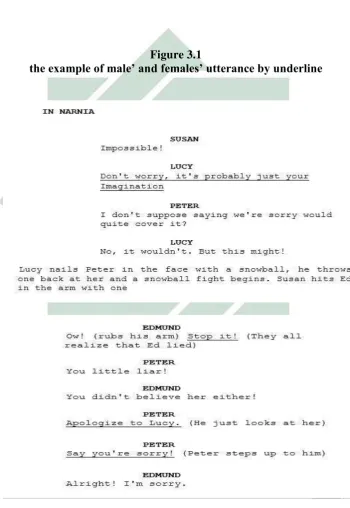
suggestion utterance and woman suggestion utterance. The following was an example the writer collecting the data:
Figure 3.1
28
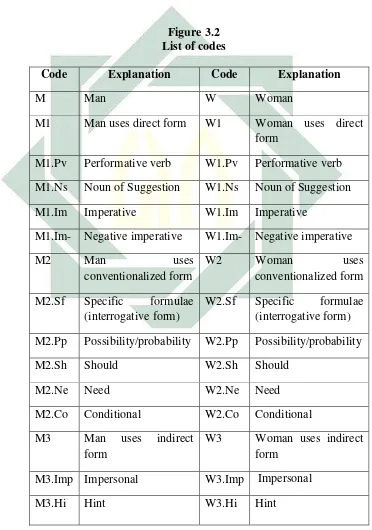
Thirdly, after all the data collected, the researcher gave coding to identify selected data. The researcher utilized abbreviations to ease her classify suggestion strategy. The researcher made list of code to identification data. List of code was as bellow:
Figure 3.2 List of codes
Code Explanation Code Explanation
M Man W Woman
M1 Man uses direct form W1 Woman uses direct form
M1.Pv Performative verb W1.Pv Performative verb M1.Ns Noun of Suggestion W1.Ns Noun of Suggestion M1.Im Imperative W1.Im Imperative
M1.Im- Negative imperative W1.Im- Negative imperative
M2 Man uses M2.Pp Possibility/probability W2.Pp Possibility/probability
M2.Sh Should W2.Sh Should
M2.Ne Need W2.Ne Need
M2.Co Conditional W2.Co Conditional M3 Man uses indirect
form
W3 Woman uses indirect form
M3.Imp Impersonal W3.Imp Impersonal
29
Figure 3.3 The example of coding
3.3Technique of Data Analysis
30
researcher classified the main character’s utterances contained suggestion speech
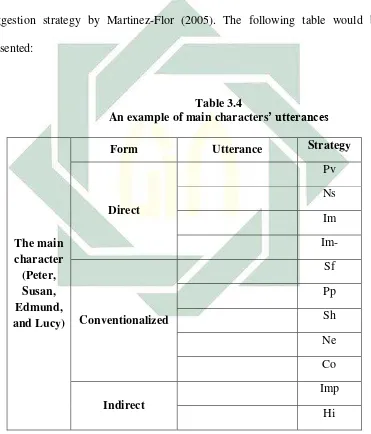
act. This was useful to distinguish kinds of suggestion used by the main characters and also to ease researcher in describing. This was conducted to answer research question number one that was to know kinds of suggestion used by the main characters. In this phase, the researcher used table to ease her to classify it into suggestion strategy by Martinez-Flor (2005). The following table would be presented:
Table 3.4
An example of main characters’ utterances
The main
Form Utterance Strategy
Direct
Secondly, the researcher classified males and females’ utterances included
31
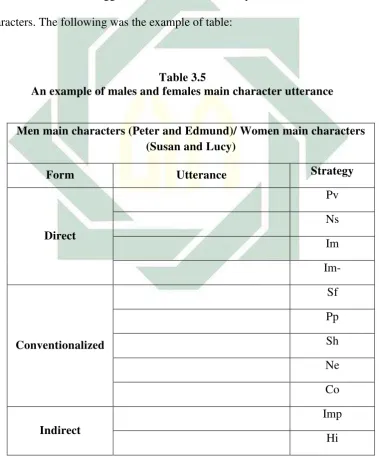
female. Besides, this way was conducted to answer research question number two that was to know similarities and differences of suggestion speech act used by male and female main characters. The researcher used two tables that consist of the utterances of man and woman main character. It was to distinguish men’s utterances and women’s utterances. Then, the researcher also described the whole
data that contained suggestion utterances used by male and female main characters. The following was the example of table:
Table 3.5
An example of males and females main character utterance
Men main characters (Peter and Edmund)/ Women main characters (Susan and Lucy)
Form Utterance Strategy
32
The researcher would describe research problem number two about the similarities and differences of suggesting strategy used by man and woman main characters. Then, this is for the information that the researcher would use some tables to know the data as the explanation above. The researcher would only show the table 3.4 (table of suggestion strategy used by main characters) and the table 3.5 (two tables for knowing the expression of men and women main character’s
CHAPTER IV
FINDINGS AND DISCUSSION
After the data was collected and analyzed, the data will be discussed in this chapter. Here, the researcher analyzed some data and discuss the suggestion acts. This part is to answer the research question in this study, about the types of suggestion strategy which is used by the main characters (Peter, Susan, Edward, and Lucy) and the similarities and differences suggestion strategy by men and women main character. This chapter is divided into some subchapters.
4.1. Findings of suggestion strategies used by the Main Characters (Peter, Susan, Edmund, and Lucy)
This section shows types of suggestion strategy which is used by the main characters, Peter, Susan, Edward, and Lucy. After analyzing the suggesting utterances from the script movie, the researcher found 43 (forty-three) utterances pointing to suggestion strategy. The researcher thus identified the data in suggesting strategy by Martinez-Flor (2005).
34
4.1 The table of the types of suggestion strategy
Main
2. Isn’t time you were in bed? 3. But weren’t you wondering 8. Is there nothing we can do about
Mr. Tumnus?
9. But, what about Mr. Tumnus? 10.What do you Suggest?
2. Well, we haven’t actually been here very long
Hints (Hi)
4.1.1 Direct Suggestion
36
4.1.1.1 Imperative
Imperative is one of strategy in making suggestion. This strategy involves direct form in which the speaker clearly states what she/he means. The hearer obviously understands the speaker’s intention. The researcher finds the conversation that relates to use Imperative strategy.
Data 1
This conversation happened in Pevensie’s house. There are two
participants in the conversation, Edmund and Peter. The topic is Peter do not want Edmund to do something that can harm him.
37
back to the house. He wants to take his father’s photo. Peter follows him and
commands him to go to outside.
There are two imperative utterances. First, Edmund says to Peter “wait,
dad!”. This means that Edmund wants Peter to wait for a while. Second, Peter
says to Edmund “Come on Idiot…..”. Here, Peter uses the word Idiot in his imperative utterance. It sounds rude. This shows that they are very close and it does not make Edward to be rancor.
Data 2
The conversation above takes place in Narnia. There are two participants in the conversation above, Peter and Edmund. The topic of dialog is Peter suggest to Edward to say sorry for Lucy.
38
the window. They hear Mrs. Macready’s sound because the noisiness that they
made. They hide inside the wardrobe connecting to Narnia. Peter and Susan do not believe what they see; what Lucy said is real. Then, they play snowball. Peter asks Edward to apologize to Lucy. Edward gives some reasons but Peter insists Edward to apologize to Lucy. Then, Edward want to do that.
In that dialog, there is some suggestion acts. Peter said two suggestions that has same purpose to Edward. The first sentence he says “Apologize to Lucy” (M1.Im). Peter suggest to Edward with direct form namely imperative strategy. Peter clearly said what he means, but this does not make Edward want to do what he said. He thus says “Say you’re sorry!” (M1.Im) to Edward. It still uses direct form with applying imperative strategy. When Peter says the second sentence, there is stressing and high intonation. This makes Edward want to say sorry toward Lucy.
39
The participants of data 3 are three people, Peter, Lucy and Edmund. The dialog takes place in Professor Koike’s house when Lucy return from Narnia. The
topic is Peter suggests to his brother and sisters that he will start to find them. When they are playing hide and seek in Professor Koike’s house, Lucy
return from Narnia. She thinks that she has gone a long time. Peter has just finished counting and has not even look around to find them. Lucy suddenly came out and yelled. Edward tries to stop her but she does not care. Then, Peter finds them, Edward and Lucy.
There are two sentence that indicates how their way to make suggestions on data 3, one of it uses imperative strategy. It can be seen on the bold sentence
“…. ready or not here I come” (M1.Im). This sentence is said by Peter to all his
siblings. He says The sentence means that Peter suggest his siblings to be ready because he will start to look for them. Peter uses imperative strategy to express his suggestions.
40
The dialog above happened in one of the room in professor Koike’s house.
There are three participants there, Susan, Peter, and Lucy. The topic of their conversation is Susan wants Lucy to stop talking about other world into the wardrobe.
After Lucy tells about the existence of other world into the wardrobe, her sister and brothers see the wardrobe. There is no wood there. It is only the wardrobe consist of full coats. Her siblings do not believe what she talked about and thought that she was imagining. She refuses her siblings statement.
The data 4 shows one of way which is used by the main characters to express their suggestions. It is uttered by Susan to Lucy. Susan utters “that’s
enough” (W1.Im) to express her suggestions. The sentence means Susan suggests to Lucy not to talk about Narnia again because it is only her imagination and there is no other world into the wardrobe. Susan’s utter is imperative strategy. The
41
Data 5
In data 5, the conversation takes place in Narnia. The participants are five, Susan, Edmund, Peter, Mr. Beaver, and Lucy. The topic is Lucy suggest to her siblings to be carefully the trees.
They meet Mr. Beaver in Narnia. He informs to them that Tumnus has arrested by the White Witch and wants the siblings follow him to go to his house. Susan and Edmund are hesitantly to follow him because he is a beaver that should not be saying like human. Peter believes him and wants to know about the faun. Mr. Beaver wants them hurry to follow him because there may some spies. Then, Lucy suggests to follow what Mr. Beaver said.
42
is talked by Lucy to Peter. She says “He means the trees” (W1. Im-). This sentence is imperative strategy. That means the wood is a dangerous place because some trees can be an informant for the White witch so they must to go someplace.
4.1.1.2 Negative Imperative
Negative Imperative strategy includes direct forms. The strategy was also found by the researcher in this study. The following data is negative imperative strategy.
43
This dialog happened in Aslan’s Camp in the morning. There are five
participants in dialog above, Aslan, Edmund, Susan, Lucy and Peter. The topic of dialog is peter suggest to Edmund to live in the camp and not to go anywhere where he does not know the place.
In Aslan’s camp, Peter, Susan and Lucy see Aslan and Edmund talking on
the rock. Aslan aware that his siblings are seeing them talking with and thus commands Edmund to meet his brother and sisters. They are very happy because Edmund safe and they can see Edmund again. Lucy hugs Edward and Susan asks about his condition. Edward said that he is so tired. Peter suggest to Edmund to get rest in the camp for a while and does not want Edmund to do something else. Peter wants Edmund still live in the camp and not to go to anywhere. This is because Peter does not want Edmund get some problems that are caused by his behavior.
From the utterances above, there are two suggestion strategies. One of utterance indicates negative imperative. The utterance is said by Peter toward Edmund. It can be seen in the bold sentence “…and Edmund try not to wander
44
Data 7
The dialog happened in Narnia. The dialog is between three participants. They are Susan, Lucy, and Peter. The topic of dialog above is the magical world Narnia is real.
This dialog happened because there is a noisiness that makes Mrs. Macready angry and try to look around. Here, they try to hide from Mrs. Macready enter to the wardrobe. They enter to the wardrobe and find other world inside the wardrobe. They are so shocked and do not believe it, especially for Susan and Peter. Lucy tries to calm down her sister and brother. Peter wants to apologize to Lucy but he thinks may Lucy cannot easily pardon him.
45
4.1.2 Conventionalized
This is the second main type of suggestion strategy. This strategy is not as direct as the first type (direct suggestion) and makes the hearer to understand the speaker’s purposes behind the suggestion.
4.1.2.1 Specific Formulae (Interrogative form)
This data is about specific formulae strategy. This is conventionalized form in which the hearer still can understand the speaker’s intentions. This
strategy is in form of interrogative forms. The following data is one of specific formulae strategy (Interrogative form) that is found by the researcher in the script movie.
46
The conversation above takes place in Narnia. The participant of dialog above is Lucy and Edmund. So, there are two participants. The topic is Edmund suggest to Lucy to show the way return to home.
In the evening, Edmund follows Lucy who enters inside the wardrobe connecting with Narnia. He cannot find Lucy and meet the White Witch. When he meets the white witch, she gives a big expectation to Edmund. Jadis or the White Witch also says that she is Queen of Narnia. She gives what Edmund’s request
and wants Edmund to take his brother and sisters faced her.
Thus, Lucy appears and tells that she has just met Tumnus and he safe from White Witch. Lucy also tells about White Witch to Edmund. Edmund feel confuse. He also has just met with White Witch but she is very different to what Lucy told. Lucy ask if Edmund is fine. Edmund give a reason that he is chilled and want to go home. Then, he wants Lucy to show the way to return. Lucy shows to him.
47
Data 9
This dialog takes place in Narnia especially in Tumnus’s House. The
participant in the dialog above is Peter, Susan, and Lucy. The topic is Lucy wants to help Tumnus.
Lucy invites her siblings to go to Tumnus’s house. She looked a messy
Tumnus’s house; many furniture scattered on the floor and there is a letter from
someone. Peter reads the latter. It informs that Tumnus has been arrested because he against Jadis or The White Witch with protecting human. It makes Susan thinks that they must go. Lucy refuses it and wants to rescue Tumnus from the White Witch.
In the conversation above, Lucy says “You don’t get it do you? I’m the
48
to express her suggestions. The sentence is in form of interrogative form. She wants to the hearer (Peter) understand her. Lucy suggests to help Tumnus because Tumnus also ever helped her.
Data 10
Dialog above happened in the beaver’s house. There are four participants
in the conversation, Mrs. Beaver, Peter, Susan, and Lucy. The topic is Lucy’
desire to rescue Tumnus.
When they are in the beaver’s house, they are talking about Narnia and
49
four heroes is Peter, Susan, Edmund, and Lucy. They do not believe that they are a hero and think that the beavers have done wrong. Peter does not want this controversy continued, he decides to return to Professor Koike’s house. But Lucy
thinks about Tumnus and his safety. Peter said that they cannot do something and it is out of their strength.
Lucy uses indirect form with applying specific formulae strategy. The sentence uses interrogative sentence. This sentence is an interrogative with wh-Question. It can be seen in the bold sentence “But what about Mr. Tumnus?” (W2.Sf). That means Lucy suggest to think about Tumnus about what will happen to Tumnus if they leave and who will help him.
4.1.4 Possibility/Probability
50
Data 11
The conversation above takes place in Narnia. There are two participants in the dialog above. They are Tumnus and Lucy. The topic of dialog above is Lucy gives her handkerchief to Tumnus because he is so sad.
51
return in the first place they met. Tumnus is so sad and cries. Lucy give her kerchief to Tumnus and wants Tumnus bring it with his.
In the data 11, there are some way of woman main character to perform suggestion. One of it is possibility/probability. The utterance by Lucy toward Tumnus. She says “you need it more than I do” (W2.Pp). In this utterance, she uses different strategy. It is conventionalized form of possibility or probability strategy. That because this strategy employs the use of verb to give a suggestion. The sentences mean Lucy wants Tumnus collect her handkerchief because he is so sad and more need it than hers.
4.1.5 Conditionals
52
Data 12
The dialog above happened in other world inside the wardrobe or Narnia. The dialog is conversation between Lucy and Tumnus. So there are two participants, Lucy and Tumnus. The topic is the explanation of what Tumnus is.
When Lucy was hiding inside the wardrobe, she enters to the magical world, Narnia. She only sees trees and snow. She meets with Tumnus. They are very shocked. Tumnus drops his package and hides behind the tree. Lucy picks up the packages and gives it to him. Tumnus says that he does not want Lucy become scare. Lucy is very curious about what he is because Tumnus looks different.
53
4.1.3 Indirect
The speaker is not clearly uttering what she/he means. This strategy indirectly pointed to the indicator. It makes the hearer infer what exactly the speaker intention in her/his suggestion.
4.1.3.1 Hints Strategy
Hints strategy is the most indirect strategy to express suggestions. The speaker is not clearly stated her/his true intention. This makes the hearer thinks what the speaker really means.
54
The participants of the conversation above are three people, Susan, Peter, and Professor Koike. The topic is they were hard to believe about the existence of other world especially inside the wardrobe. The setting takes place in Professor Koike’s office.
Peter, Susan, and Professor Koike are talking in the Professor’s office.
They are talking about their younger sister Lucy who always says that there is a world inside the wardrobe. This makes professor so curious with the story. Peter and Susan think that professor believes Lucy’s story about Narnia. It does not make sense because it is impossible to have a world inside the wardrobe.
In the data 13, the underline sentence is indirect form of Hints strategy for expression of suggestions. It is used by Susan to suggest to Professor Koike. She says “Well, logically it couldn’t possibly be there!”. It means that Susan wants to Professor Koike aware that it does not make sense if there is a world into the wardrobe.
4.3 Similarities and differences of man and woman main character in The Chronicles of Narnia: The Lion, The Witch, and The Wardrobe movie
55
In this movie, the main characters use several variation strategies. There are forty-three utterances pointing to spoken suggestion which is used by the main characters, Peter, Susan, Edmund, and Lucy. Here, the researcher describes about types of suggestions which is applied by man (Peter and Edmund) and woman (Susan and Lucy) main characters.
The researcher finds the similarities and differences by man (Peter and Edmund) and woman (Susan and Lucy) main characters especially in making suggestion. They use four similarities strategies, imperative, negative imperative, and suggestion formulae (interrogative form), and hints strategy. Furthermore, they also use two differences strategy, possibility/probability, and conditional.
The first same strategy is imperative. They are either man (Peter and Edmund) or woman (Susan and Lucy) main character use this strategy. By comparing between man and woman main character, man main character (Peter and Edmund) prefer to use this strategy than other strategies. They use it because they want the hearer to do what the speaker said. Imperative is in form of direct and the hearer can understand what the speaker said easily.
Some imperative forms are different. They do not have indicator of imperative, but they actually are imperative based on the context. As an example word from data 4 “That’s enough”. It was said by Susan toward Lucy. This
56
Then, people who are close friends or intimates use more imperative (Holmes, 290:1995). Usually, the speaker uses the word like say the hearer name, say the hearer using fool, idiot, and so on. Those imperatives are almost consisting of rancor and caused no offences. It is like Peter said to Edmund, “Come on idiot….”. The imperative utterance like that may be able to make Edmund being
angry. Or “Come on Ed, sword hand up like Oreius showed us”. Peter calls
Edmund using his name Ed. That because they have close relation as elder brother and younger brother.
The second same strategy is negative imperative. This strategy is direct strategy. Although, both of the main characters, man (Peter and Edmund) and woman (Susan and Lucy) seldom use it. This strategy is most direct strategy of making suggestion (Martinez–Flor, 2005). So this is usually only used by
superordinate people to subordinate people.
The speaker sometimes uses the words that cannot identification as negative imperative but is actually is imperative. As Lucy said to Peter, “He
means the trees”. Lucy said with fully confident that her brothers and sister understand and correctly interpreting, so they will do something related to Lucy’s
utterance.
57
The researcher found that woman uses more variation specific formulae than man. Woman utilize some forms of interrogative form, for example wh-questions, yes-no questions, and tag questions. According to Holmes (1995), tag question is more used by woman than man. This is because woman uses tags based on polite function. Whereas, man uses tags to expression of uncertainty. It is like an example from data 9 that is said by Lucy to Peter. She says “You don’t
get it do you? I’m the human!!! He helped ME!”.
The last is hints strategy. This strategy is part of indirect form of suggestions. Here, the speaker is not clearly stated her/his true intention. This makes the hearer have two options and they have to conclude for what the speaker said. According to Martinez-Flor, hints strategy is the most indirect type of comment that can be used to make a suggestion.
The description above is about similarities of suggesting strategy which is used by man and woman main characters in that movie. Then, the researcher also explains differences of suggesting strategy that they used. The main characters, Man and woman main characters, always not use same strategy in making suggestion. They also use different strategy like using possibility/probability, and conditional. In this movie, possibility/probability and conditional are only used by woman main character, Susan and Lucy. Whereas, man main character never uses those strategies in making suggestion.
58
speaker means because the indicators of suggestion always appear in the utterance. Here, man (Peter and Edmund) main character is not use this strategy. This strategy only used by woman (Susan and Lucy) main character. It is caused by the relation between the interlocutors and age.
Conditionals strategy is conventionalized form of making suggestion that show the politeness of the speaker. Conditionals is used by Lucy to Tumnus or the Faun. The researcher assumes that the first, Lucy and Tumnus has different age, she also did not know who Tumnus is. It means that Tumnus is a stranger for Lucy and conversely. Second, Lucy does not live in Narnia and also not a Narnia society. This means that they did not have relation. So, she uses this strategy possibly to be polite.
59
CHAPTER V
CONCLUSIONS AND SUGGESTION
This chapter is the last chapter of this study. There are two points in this chapter, conclusions and suggestion. Conclusion is briefly explanation of the finding of this study. Then, suggestion explain about recommendation for further research that will examine about suggestions.
5.1 Conclusions
This study analyzes suggestion strategy in The Chronicles of Narnia: The Lion, The Witch, and The Wardrobe movie. There are four main characters, Peter, Susan, Edmund, and Lucy. Here, the researcher would like to give conclusion for two research questions of this study. Firstly, the kinds of suggestion acts applied by the main characters. Secondly, the similarities and differences of suggestion acts of men (Peter and Edmund) and women (Susan and Lucy) main characters.
61
Secondly, this is related to research question number two describing about the similarities and differences of suggestions used by men (Peter and Edmund) and women (Susan and Lucy) main characters. The researcher found four similarities of suggestion strategy that men (Peter and Edmund) and women (Susan and Lucy) used in making suggestion. The similarities are Imperative, Negative Imperative, Specific Formulae (Interrogative Form), and Hints strategy. While, there are two different suggestion strategies, included Possibility/Probability and Conditional, which were only used by woman (Susan and Lucy) main characters. These different strategies were caused by the relation between interlocutors, age and gender.
62
5.2 Suggestion
63
REFERENCES
Cole, F. L. 1998. Content Analysis: Process and Application. Clinical Nurse Sppecialist , 2(1). Pp. 53-57; In Elo, S. & Kyngäs, H. 2007. The Qualitative Content Analysis Process. Journal of Advanced Nursing. 62 (1). Pp 107-115.
Dimyathi, A. 2014. Sosiolinguistik. Surabaya: UIN Sunan Ampel Press.
Farnia, M, et.al. 2014. A Pragmatic Analysis of Speech Act of Suggestion among Iranian Native Speakers of Farsi. Journal of ELT and Applied Linguistics (JELTAL). Vol.2. No.2.
Hardianti, G. A. 2015. Suggesting Acts Used by The Main Character in
‘Confession of a Shopaholic’ Movie. Thesis. State Islamic University of
Surabaya.
Hidari-Shahreza, M.A. 2014. A Sociolinguistic and Cross-cultural Investigation into The Speech Act of Suggestion. International Journal of Culture and History. Vol.1, No.1.
Holmes, J. 1995. Women, Men, and Politeness.New York: Roudledge.
Holmes, J. 1992. An Introduction to Sociolinguistics. New York: Longman Publishing.
Jiang, X. 2006. Suggestions: What Should ESL Student Know?. System 34. Pp 36-54
Liu, Y. and Zhao, J. 2007. Suggestion in Teacher-Student Conferences. Arizona Working Paper in SLA &Teaching, 14. Pp.59-74.
Macnamara, J. Media Content Analysis: its Uses; Benefits, and Best Practice Methodology. Asia Pacific Public Relations Journal, 6(1). Pp 1-34. Martinez-Flor, A. 2005. A Theoretical Review of the Speech Act of Suggesting:
Towards a Taxonomy for its Use in FLT. Revista Alicantina de Estudios Ingles. Pp. 167-187.
Neuendorf, K.A. 2002. The Content Analysis Guidebook. Cleveland State University: Sage Publications.