ISBN 978-602-73769-3-9 613
AN APPROACH TO DEVELOP WRITING SKILL
THROUGH LISTENING
Setyo Prasiyanto Cahyono
Faculty of Humanities Dian Nuswantoro University Semarang Indonesia
Abstract
This research investigated how listening skill helps students to write a descriptive text well organized. Basically, listening and speaking always go together. However, the researcher tried to look for the best way for the students to write better and more fascinating. The participants of this research were obtained from the third semester students who took intermediate listening class by employing listening cycles proposed by Field (2009) to describe the steps of listening process and to motivate the students to learn to write a descriptive text by applying genre based approach. For the sake of the data collection, the researcher took five out of fifty eight students‘ writings purposively. The findings of the analysis reveal that most students produced their writings systematically and well organized in term of the schematic structure and linguistic features of description text. Moreover, they also drew a picture of a city map along with its direction to describe their writings in order to make their writings understandable.
Keywords - descriptive text, genre based approach, intermediate listening, listening cycles
Introduction
Listening is one of English skills that need a lot of practices. It is a basic skill of communication that needs much concentration. However, to be a good listener is not an easy way to do because it needs a lot of efforts and exercises. In learning English skills, it cannot be separated from one another such as listening and speaking or reading and writing.
In relation to this, learning writing also needs concentration since it relates to the way how we express ideas and messages into written form. For many English students, to start writing is very hard because sometimes they do not know to start their writing or they do not have idea of what they want to write. In this case, they need a guide to assist them. This research is trying to develop an alternative teaching writing through listening. By teaching listening, students can manage and develop their ideas into writing. Listening can be one of the alternative ways for students to enhance their writings because
during writing a text, students can take a note of the vocabularies or specific participant needed to develop their writings. At this point, this research tries to answer the question of ‗how listening enables the students to create a description text?
Listening plays an important role in communication (Gilakjani and Ahmadi, 2011). It means that listening can be a bridge for people to speak to one another. The total time spent on communicating proves that listening takes up 40-50%, speaking 25-30%, reading 11-16% and writing is the least with about 9% (Mendelsohn, 1994). Listening to their own writing and also their classmates enables students writers to cultivate their imaginative and detachment from their own writing (Clark, 2014).
614 ISBN 978-602-73769-3-9 linguistic features. Once they understand it,
they can create a systematic and well organized text.
Methodology
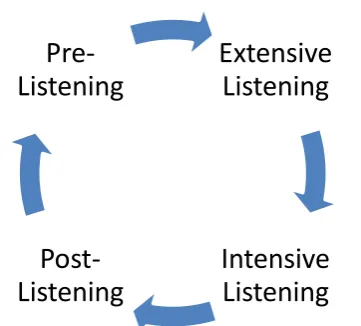
This research employs qualitative research design and was undertaken at Intermediate Listening classes at faculty of Humanities Dian Nuswantoro University. The curriculum of English skills at Faculty of Humanities Dian Nuswantoro University employed genre-based approach in which all the English skills are integrated to one another. The students were taught description as the theme of the material given at intermediate listening classes. At the same time, in other English skill subjects, e.g in Intermediate Writing, they also learned description text. Description is one of the genres that seeks to describe a particular person, place or thing (Hammond et.al, 1992:78). At first, students were given listening material and then discussed the material including the questions in pair or in group by asking students to take note the important of specific participants and vocabularies. In gaining the data, the students were asked to write a description text at the end of the listening class. Writing was the final report in every meeting at Intermediate Listening classes. There were 78 students and for the sake of data analysis, the researcher took 3 students‘ description writings as the samples of this research purposively. In analyzing the data, genre based approach was applied and systemic functional linguistics in term of schematic structure and linguistic feautures used in order to reveal students‘ description writing development. In addition, listening learning cycle developed by Field (2008) covers: pre-listening, extensive listening, intensive listening and post-listening was implemented to guide students to write a text after they listened to the audio given as described in the figure 1 below:
Figure 1. Listening Cycles (Field,2008)
Finding and Discussion
The findings of this research show that most students produce a systematic writing based on schematic structure and linguistic features of description text.
As it is mentioned in the previous, before the students write a description text, they involve in listening passage. During listening, students were given questions regarding to the audio they listened. In implementing the description genre in listening lecture, the researcher acted as the lecturer, applied listening cycles proposed by Field (2008) as follows:
1. Pre-Listening.
ISBN 978-602-73769-3-9 615 Furthermore, in pre-listening stage, a
lecturer gives motivation to students. Giving motivation to students is very important since it leads the students to understand what listening passage is likely to contain. Moreover, lecturer points out the schematic structure and linguistic features of description text.
2. Extensive Listening
This stage, lecturer gives some understanding questions referring to the topic of the discussion to build the students‘ awareness of the topic. The lecturer gives general questions regarding to ―direction‖ as the topic of the lecture, for example: how to get to the city center? or Where can I find the city hall?. Through these questions, lecturer guides students to understand detail of the topic and vocabularies related to ―direction‖. 3. Intensive Listening
In this stage, lecturer provides questions to scaffold students understanding about the material they learn in group. While listening, the students answer all the questions provided by their lecturer or the text book they used and discuss the result together. Besides that, lecturer plays the audio over and over in order to make the students understand and catch the whole meaning of the listening passages. Also, in this part, the students tend to be critical because they discuss some critical vocabularies as well as difficulty words (words which cannot be heard by students clearly). Likewise, the lecturer checks the answers made by the students. In this case, lecturer acts as a facilitator and helps the students to make a note of vocabularies or terms and expressions of direction before they start writing.
4. Post-Listening
The last stage is post-listening. At this stage, the students are working individually and reinforced them to find out the function of language the speakers used in their conversation or talks in term of useful expressions used by the
speakers such as asking direction, refusing, apologizing etc as well as linguistics features of description text such as the use of simple present tense, specific participants, being verbs, noun phrases and adjectives. At the end of this stage, the students are invited to write a description text individually with a chosen topic that is ―Dream Island‖. In writing a description text, the students are also encouraged to draw a map of a location they described to make it easier and understandable.
After the listening cycles were implemented in the process of teaching and learning intermediate listening, the students can write a description text systematically and well organized along with a picture. It can be seen in the figure of the student‘s description text below:
Before the student write his description text, he draws a map to help him write a text systematically. Besides that, this picture also helps the writer to write a description text well organized as it is described in the figure below:
616 ISBN 978-602-73769-3-9 As it is displayed in the figure above, the
student can produce a well organize text and systematically with a title ‗Silent Hill‘ based on the schematic structure and linguistic features of description text. It can be seen that in the beginning of his sentence, he writes ―I build my own ghost town as an amusement park, the biggest one ever in the
world‖. It can be classified as identification
because it starts with general ideas about what he will write. Then, the rest of his writing is identified as description because it tells the location, the distance and what we can find there, for example ‗the entrance of the gate to the park is quite far, it‘s about
25 kilometer‘.
Meanwhile, the linguistic features of the above text are indicated by the use of specific participant namely ―Silent Hill‖,
being verbs such as to be is, are, noun phrases e.g ghost town, amusement park, adjectives like curious and simple present tense such as build, go, come, is quite far, is
the scariest etc.
Here is another example of the student‘s description writing. The following writing also uses a similar concept with the previous one. He uses picture to help him to write better. The figure below is the map location of the student‘s imaginative island.
The above picture illustrates the student‘s imaginative dream island. He creates and draws a picture with his own imagination that leads him to write a description text systematically. He named his picture ‗Great
Fort‘ island. Therefore, the student can follow the schematic structure of description text in his writing. It can be seen in the beginning of his writing that he can produce ‗identification‘ as indicated by ―I
would like to describe about my dream
island above. It‘s name is Great For. This
country consists of six main places such as beach, airport, big house, big mountain,
harbour, and metropolitan city‖. Hence, he
makes ‗description‘ in the rest of his writing signified by employing some useful expressions of description text for example:
―I could live in a big house which is located
in small village‖, ―this island is surrounded
by sea‖ and also ―beautiful beach is located
in western of this island‖.
In addition, the student produces linguistic features in his writing and it can be found that there is specific participant which is specified by ―Great Fort‖. It describes the name of a place the student created. Furthermore, there are many being verbs indicated by to be is, and are. Another linguistic feature found is adjectives namely
big, small, modern, and beautiful. Besides
that, the student also employs simple present tense in his writing expressed by some verbs used e.g. consists of, draw, has,
and the use of to be: is, are.
Below is another example of the student‘s description writing along with a picture.
ISBN 978-602-73769-3-9 617 him easier and to guide him in writing the
description of the location he writes. Based on the student‘s writing above, he produces systematically schematic structure of description text. The beginning of his writing is specified as ‗identification‘ which is indicated by a sentence ―This is Star island, it is located at Java sea approximately 80 km from Jepara city nearby Karium Jawa island‖.
In addition, the rest is considered as the description because it contains the location of the island, what can we find there, what can we do there and etc.
Likewise, he also produces linguistic features which are expressed by specific participant like ―This is Star island. Also, being verbs to be such as: is and are,
adjectives like: beautiful, enjoy, and fun.
Besides that, the student also employs simple present tense in his writing which is shown by ‗it is located‘, people can go,
it is about, they go, and people visit.
Conclusion
After the implementation of listening cycles in students‘ writings, it can be summed up that listening can be one of the alternatives for teachers or lecturers to teach writing. In listening, students do not only hear to the audio given but also they can take note critical words as the base of writing a text. Moreover, through listening, it also enhances the students‘ knowledge to develop ideas in writing. It is suggested that combining English skills
to one another can be great contribution to our students because they can learn at least two English skills at the same time.
Bibliography
Christie, F. and Derewianka, B. (2008).
School Discourse. New York:
Continuum.
Derewianka,B. (1990). Exploring How Text Work. Newtown: PETA.
Field, J. (2008). Listening in the Language
Classroom. UK: Cambridge
University Press.
Gerot, L. & Wignell. (1995). Making Sense of Text. Sydney: Antipodean Educational Enterprises.
Gilakjani and Ahmadi. (2011). A Study of Factors Effecting EFL Learners‘ English Listening Comprehension and the Strategies for Improvement.
Journal of Language Teaching and Research, Vol.2, No.5, pp.977-988. Mendelsohn, D. J. (1994). Learning to listen:
A strategy-based approach for the second language learner. San Diego: Dominie Press.
Halliday, M. A. K., & Matthiessen, C. M. I. M. (2004). An introduction to
Functional Grammar (3rd ed.).
London: Edward Arnold.
Hammond, J., Burns, A., Joyce, H., Gerot, L. & Brosnan, D. (1992). English for
Social purposes: a Handbook for
Teachers of Adult Literacy. Sydney: