THE ANALYSIS OF STRUCTURE EXCHANGE IN PABUAT BORU CEREMONY ON MANDAILING CULTURE
A THESIS
Submitted to the English Department of UNIMED Medan In Partial as Fulfillment of the Requirement for
The Degree of Sarjana Sastra
BY
ALI MUIS DONGORAN
Registration Number 2102220001
ENGLISH AND LITERATURE DEPARTMENT
FACULTY OF LANGUAGES AND ARTS
DECLARATION
Except where appropriately acknowledged, this thesis is my own word, has been expressed in my own words and has not previously been submitted for assessment.
i
ABSTRACT
Dongoran, Ali Muis 2014. The Analysis of Structure Exchange In Pabuat Boru Ceremony on Mandailing Culture. A Thesis. Faculty of Languages and Arts. State University of Medan.
The thesis deal with the Structure of Conversation in Pabuat Boru Ceremony. The objective of the study was to find out the realization of the Structure conversation in Pabuat Boru ceremony and the dominant of structure exchange. This research was conducted by d qualitative method. The data of this study were conversation of Pabuat Boru ceremony. The data were taken by recording the conversation and transcribed then translated into English. The data were analyzed from three
session based on the Martin’s theory. They were Manyapai Boru ceremony (This party asked whether the girl had been in the King's House), Mangaririt Boru
ceremony (This party are expressed whether both of the family are suitable for a relationship) and Patobang Hata ceremony (Woo Ceremony and Granting Tuhor) (Nasution : 2005). The result showed that there were 89 moves. The results showed that the move found in the conversation were k1, k2, k1f, k2f, a1, a2, ch, cl, rcl, bch, cf, rcf. The dominant structure was k1 (primary knower) where primary knower has function to provide information to the hearer in the ceremony of this conversation. It means that both of the speaker was provide more information to the hearer.
ii
ACKNOWLEDGEMENT
First of all, the writer express her best gratitude to ALLAH SWT, for giving the writer blessing, endless love and mercy, especially in the process of accomplishing this Thesis. In accomplishing this Thesis, the writer was helped by so many beloved people and the writer would like to express her gratitude to:
Prof. Dr. Ibnu Hajar Damanik, M.Si. the Rector of State University of Medan.
Dr. Isda Pramuniati, M.Hum. the Dean of Faculty of Languages and Arts
Prof. Dr. Hj. Sumarsih, M.Pd. the Head of English and Literature Department.
Dra. Meisuri, M.A. the Head of Applied Linguistics Program.
Dr. Siti Aisyah Ginting M.Pd. her Thesis Adviser.
Drs. Elia Masa GIntings M.Hum., his Academic Adviser and her Reviewer,
Dra. Masitowarni SIregar M.E., as his Reviewers and all her beloved Lecturers in English and Literature Department.
Mam Eis, for his kind help in providing academic administrations to the writer.
His beloved family, his father, Solihun Dongoran, his mother, Masrobiah Ritonga, his uncle, Ma’rum Rambe, his grandparents, his brother, Iskandar Mubin and Madu Aman and also his beloved cousins, Ali atas. Thank you for the understanding and the big support in prayer, endless love, motivation and financial while accomplished this thesis. The writer loves them so much more than anything.
iv
CHAPTER I. INTRODUCTION ... 1
A. Background of the Study ... 1
4. Exchange System and Structure ... 14
C. Language and Social Context ... 20
1. Social Context ... 23
CHAPTER III. RESEARCH METHOD ... 30
v
B. Data and The Source of Data ... 30
C. The Instruments of Collecting Data ... 31
D. Technique for Data Collection ... 31
E. Technique for Data Analysis... 32
CHAPTER IV. DATA AND DATA ANALYSIS ... 33
A. Data and Source of Data ... 33
B. Data Analysis ... 33
C. Research Finding ... 37
CHAPTER V. CONCLUSIONS AND SUGGESTIONS ... 38
A. Conclusions ... 38
B. Suggestions ... 38
REFERENCES ... 40
vi
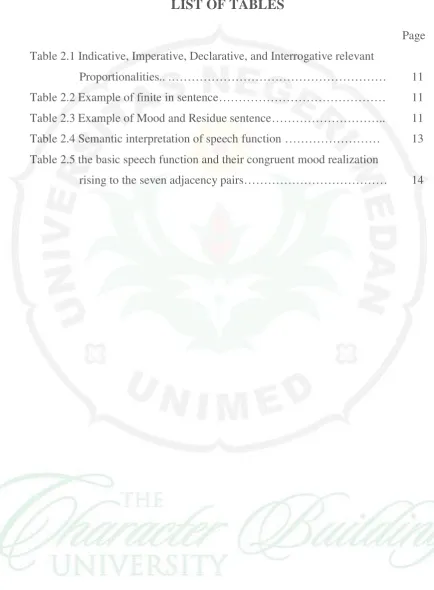
LIST OF TABLES
Page Table 2.1 Indicative, Imperative, Declarative, and Interrogative relevant
Proportionalities.. .……… 11
Table 2.2 Example of finite in sentence……… 11
Table 2.3 Example of Mood and Residue sentence……….. 11
Table 2.4 Semantic interpretation of speech function ……… 13
vii
THE LIST OF APPENDICES
Appendix A:The dialogue in Manyapai Boru Ceremony………..………42
Appendix B: Conversation in Mangaririt Boru ceremony……….78
1
CHAPTER I
INTRODUCTION
A. Background of the Study
Conversation is the most basic form of human activities to establish relationship each other. By doing the conversation, human can express their thoughts and feelings with each other and exchange information to fulfill their needs.
Effective conversation is determined by the elements of language itself and factors beyond the language called social context. Systemic Functional Linguistic (SFL) theory set of three strata of social context, from the highest and most abstract to the concrete include ideology, culture, and context of the situation. If the use of language is determined by the social context, the structure of the conversation is determined by the social context. Therefore, different situations and cultures will produce different structural conversation too.
Someone will use language to interact; they are doing the establishing a relationship between the person speaking now and the person who are probably
speak next. Afterword, the dialogue is ‘a process of exchange’ involving two
2
The fundamental purposes in any exchange are giving (and taking) or
demanding (and being given) a commodity of some kind. From the speaker’s
point of view in a verbal exchange, the commodity that the speaker may be giving or demanding is information. In such cases, the speaker makes a statement to give information, or asks a question to demand it and the listener receive (understands) the information that the speaker gives or provides the information demanded (answers the question). But sometimes the demanding of information or goods and services is not always done by the making the statement, it can be done by making order or question. It depends on the relationship between the addressee and the addresser. It means that, whether the addressee or the addresser must be focus on what will be done by them to exchange their experiences – giving and demanding information or goods and services because the exchange of commodity is closely related with the use of speech functions.
Speech function is a way someone delivers ideas in communication to make the listener understand the ideas well. The speaker and listener should also know how and when to use speech function in order to avoid misunderstanding between them. By using speech function well the listener can understand what the speaker means.
3
be observed by speaker are age, status and gender. The process itself involves an interaction which occurred between speaker (addresser) and listener (addressee). When speaker talk to one another, they transmit information. This information is very useful for their social interaction and for the improvement of their knowledge about the world.
Every culture has their own language with varieties conversation anyway. Like in Mamandailing for example, the conversation between traditional ceremony have a different. In their culture there are some events that are always followed by the traditional customary like entering the new home (marmasuk bagas); birth of a child (haroan anak); marriage and death. Those events divided in to two parts, ceremonies that categorize as happiness called Siriaon and ceremonies that categorize as sadness called Siluluton (Nasution, 2005:441). in the event of Siriaon ceremony there are some ceremonies such as wedding, entering a new house, birth of a child and giving name to the child. Whereas, the activities on Siluluton ceremony like death.
In Mandailing Culture marriage has many steps. One of the step is propose ceremony called Patobang Hata Ceremony. In this study research the writer will focus on the propose ceremony called which is an event officially that the groom making a proposal by giving dowry (tuhor) to the family of bride.
4
male bride (mora), in this case the conversation was opened by men (kaum ama) first and then followed by the women (kaum ina). After mora convey the intent and purpose of their arrival to Anak boru, and then the conversation was replied by Anak boru start from Kaum ama and ended by Kaum ina. While both of groom and bride are not allowed to express any words because it is up to each family. The short conversations were occurring can be seen below:
Kamu ama (mora) :Songonon mada ito, baenna rope hami tu son, parumaenku pe madunggodang ma songoni muse dohot anak ku, madung sakirona mattong hita parsada halai. Jadi onma sada alas an name baenna lalu hami tubagas munu on.
Kaum ina (mora) :Narohakku pe madung jelas ma nakin nadidokkon ni kaum ama hami pe mangihutkon ma
Kau Ama (Anak Boru): Matumbuk sajo ma da haroro munuon, hami pe madung sada tahi ma manikahkon boru nami on harano tong umur pe macukup songoni dohot hagiotan ni boru name on.
Kaum ina(Anak Boru): songinimada, natarhormat sudena kahanggi nai, mora name sasudena, hami tarmo ma tawaran munui , porcaya ma hami tu anak munuon mangoban boru name on hatirkisan ottu giccatniari, tarsongoni mada hata sian kami hitalanjutkon ma naron tu acara perkawinanna, butimada.
In the conversation above Kaum Ama (mora) is rising question, namely asking information, while Kaum ina (Mora) also asking the same question to
5
(primary knower, the move is responding to the question) and Kaum ina (Anak Boru) called k1f (primary knower follow-up, the move is responding to the additional response of k2f).
k2 Kamu ama (mora): Honorable our Anak Boru, the reason we come to your lovely nice house that we saw that your daughter has growth up and my son too. It means that it is the right times to merry them. their age and desire also support.
k1f Kaum ina(Anak Boru): Honorable all my Kahanggi, Mora, like what my husband said we receive your offer. We also believe that your son will bring my daughter to the bright future. That is I can tell you for this opportunity, we can continue to the marriage late on, thank you.
6
B. The Problem of the Study
Based on the background presented, the problem of the study was formulated as follow:
How was the structure conversation of propose ceremony (Pabuat Boru) in Mandainling Culture?
C. The Objective of the Study
Based on the problem of the study, the aim of this study is:
To know the structural conversation of propose ceremony (Pabuat Boru) in Mandainling Culture?
D. The Scope of the Study
As mentioned in the introduction of this writing that in mandailing marriage ceremony there are several steps, they start from mangaririt boru,
7
E. The Significant of the Study
Theoretically, this study was expected to be useful as a mean for:
1. this study will be useful for students who was interested in studying Structural Exchange in conversation,
2. giving contribution to the enrichment of knowledge of the university students who are interested in it,
3. to develop a structural conversation analysis of the speech function, especially the use of structural exchange on propose ceremony (Pabuat Boru) in Mandailing culture.
Meanwhile practically, this study will be useful for:
1. The researchers who want to know about structural exchange on propose ceremony (Pabuat Boru) in Mandailing culture.
38
CHAPTER V
CONCLUSIONS AND SUGGESTION
A. Conclusions
After analyzing the data, it can be concluded that there was 15 structure of conversation. In the conversation of Manyapai Boru ceremony session there was two structure exchanges. In the next session, the conversation in Mangaririt Boru ceremony has seventh exchange structure and in the last session called Patobang Hata ceremony was give six structure exchange. Those are k2, k1, k2f, k1f, a1, and a2. In this conversation, writer was also found the dynamic exchange they were ch, cl, rcl, cf, rcf and ch.
The result of the analysis show about the structure of conversation which used by the King of the ceremony is k1 (primary knower) where primary knower has function to provide information to the hearer in the ceremony of this conversation.
B. Suggestion
Based on the conclusions given, the following suggestions are needed to be considered in conducting the related research:
39
2) The writer suggests the researcher who want to research about Structure Exchange, Speech function and Mood use discourse analysis in observing to solve every language phenomenon in interaction.
40
REFERENCES
Adedimeji, M.A. and T.A. Alabi, 2003. “Basic Elements of English Grammar”. In
Obafemi, O. and S.T. Babatunde (Eds.) Studies and Discourse in English Language. Ilorin Haytee Press. pp. 71 – 86.
Adedimeji, M.A. 2004a. “Language in Guidance and Counselling: A Psychotherapy for Combating Anti-Social Behaviours in Nigeria”. Unpublished Module 6. Project. NUC-VIHEP. February.
Babajide, A.O. 2000. “Introduction”. In Babajide, A.O. (Ed.) Studies in English Language. Ibadan: Enicrownfit Publishers. pp. 1 – 4.
Birk, G.B and N.P. Birk. 1959. Understanding and Using English. 3rd ed. New York: The Odyssey Press.
Bloor, T. and Bloor, M. 2004. The Functional Analysis of English Second Edition. A Halliday Aproach. London: Oxford University Press Inc.
Boulton, M. 1960. The Anatomy of Language: Saying What We Mean. London, Henley and Boston: Routledge and Kegan Paul.
Butt, David. At. all. 1995. Using Functional Grammar. Sydney: Macquarie University.
Cook, G. and B. Seidlhofer (Ed.). 1995. Principle and Practice in Applied Linguistics. Oxford: Oxford University Press.
Cruse, D.A. 1990. “Language, Meaning and Sense: Semantics”. In Collinge, N.E.
(Ed.) An Encyclopedia of Language. London: Routledge.
Crystal, D. 1997. The Cambridge Encyclopedia of Language. 2nd ed. Cambridge: Cambridge University Press.
Eggins, S. 2004. An Introduction to Systemic Funtional Linguistics. London: Continuum International Publishing Group.
Ginting, Siti Aisah. 2013. Sistem Dan Struktur Percakapan Bahasa Karo di Berbagai Komunitas Penutur, Usulan Penelitian Fundamental 2013
Halliday, M.A.K. 2009. The Essential Halliday. London: Continuum International Publishing Group.
41
Hall, E.T., 1976. Beyond Culture. New York: Anchor Books/Doubleday.
Hofstede, G., 1980. Culture’s Consequences: International Differences in Work -related Values. London: Sage Publications.
Lawal, R.A. 2004. Meaning Without Mean-ness. The Seventy Fourth Inaugural Lecture. Ilorin: Library and Publication Committee, University of Ilorin. Mulholland, J., 1991. The Language of Negotiation. London: Routledge.
Nasution, Pandapotan 2005. Adat Budaya Mandailing Dalam Tantangan Zaman
FORKALA Prov. Sum. Utara.
Saragih, Amrin. 2006. Discourse Analysis: A Systemic Functional Approach. Medan: Unimed.
Trenholm, S. 1995. Thinking Through Communication: An Introduction to the Study of Human Communication. USA: Allyn and Bocon.
Webster’s Third New International Dictionary. 1961. New York: Merriam-Webster.
BIOGRAPHY
Ali Muis Dongoran was born on 07 May 2014. Some people call him Muis, and other calls him Ali. He has four brothers and no sister, he is the first son of Solihun Dongoran and Masrobuah Ritongan.
He was school in SD Hutatonga, Saipardolok Hole sub district for primary school in 1998. In 2004 he schooled in MTS Muhammadiyah 23 Sinunukan, Mandailing Natal Regency for his Junior High School. After that he finished his Senior High School in SMA Negeri 1 Sinunukan on 2010. Then, he continued his study to the University student. In 2014 he graduated from English Literature Department in State University of Medan.