Yogyakarta-Indonesia, 4-5
thDecember 2007
Chemical Engineering Department , Gadjah Mada University
14
THR
EGIONALS
YMPOSIUM ONC
HEMICALE
NGINEERING2007
ISBN
978-979-16978-0-4
The Study Of Steam Injection Flow Effects To
The Increasing of Boiler Temperature
A.
M.DJONI BUSTAN
a. B. MARDWITA
a
Departement of Chemical Engineering University of Sriwijaya, Indonesia aGraduate School University of Sriwijaya
a
Jalan Padang Selasa N0.524, Bukit Besar, Palembang 30139, Indonesia a
Telp: (0711)352132 – 354222 Fax : (0711) 317202 – 320310 a
E-mail : [email protected]
ABSTRACT
For many years people realized that the needs of energy is an expensive basic needed for human life, especially energy from fossil, such as crude oil, gas, and coal. At oil refinery factory or electrical generator unit, heat is the mostly dominant of utilization and oil refinery factory product price structure. A boiler is steam producer. Heat produced by the fuel combustion reaction will transfer through convection and radiation process to boiler feed water (BFW) until produce good steam with saturated quality or reach superheated steam. A dominant operation problem is uncomplete combustion process caused by uncomplete ratio of air–fuel. This problem caused by the addition of deposite or sealling inside and outside of tube fire heater. Sealing in the tube usually influences BFW quality that carried many impurities then sealed at the wall inside of the tube. Deposite sealed at ouside of tube formed by uncomplete combustion. Fired heater performance will be reduced because of carbon deposite. The point of this research is to study the effect of steam flow variation on burner and tubing to the increasing of heat and temperature also quality of steam as caused by steam reaction with haevy oil and air on burner and steam reaction with carbon on tubing happen for combustion on fired hater. This research use package boiler B&W series 1986 model which can be seen at oil refinery factory or steam power electrical generator unit at Indonesia. Two thermodynamics process that will be observed at this research are combustion process and heat transfer process, approximately convection is the dominant method at this heat transfer process. This package boiler has 50 kgs/hours steam production capacity, superheated steam qualified, maximum pressure 7 kgs/cms2 and maximum temperature 700 oC. Quantitatively, the heat efficiency which is corresponded to the temperature increasing caused by steam injection that can be achieved as 41.25% and the specific enthalphy is 12.07%.
Keywords : boiler, carbon deposite, fired heater, steam injection.
I. INTRODUCTION
One main problem that sometime found at fired heater can be categorized into three parts those are operations, maintenances, and uncomplete heat transfer [1]. Operation problem that always be the main is uncomplete combustion caused by uncomplete ratio between air and fuel so it will form the deposite or sealing outside and inside of the tubes of fired hetaer. The quality of heat transfer that transfered from the burning energy to the fluids will be low, all these things will caused the cost of maintenances and cost of operations higher to handle the carbon deposite on fired heater.
Yogyakarta-Indonesia, 4-5
thDecember 2007
Chemical Engineering Department , Gadjah Mada University
14
THR
EGIONALS
YMPOSIUM ONC
HEMICALE
NGINEERING2007
ISBN
978-979-16978-0-4
1999, Agustino Frigoli, Germining the Film of Fuel Deposited on the intake manifold of electro injector engines with controlled ingnition” to United Stated patent number US00059579A [5].
Crude oil can be categorized into three : paraffinic (CnH2n+2), aromatic (CnHn) dan napthenic/olefenic
(CnH2n) [6]. Because of dominant heavy oil that is used in Pertamina UP III Plaju is paraffinic, so the
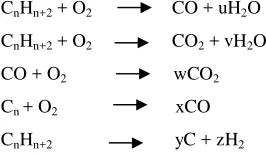
approximately of reaction mechanism of hydrocarbon compound with oxygen is shown by the following reactions :
CnHn+2 + O2 CO + uH2O (1)
CnHn+2 + O2 CO2 + vH2O (2)
CO + O2 wCO2 (3)
Cn + O2 xCO (4)
CnHn+2 yC + zH2 (5)
Every chains CnHm from fuel oil will react spontaneously with hydrocarbon and hydrogen, starting from C20H42
untill C20H42 on the following reaction can be identify the carbon deposite forming. This research offer an idea
to handling the deposite that can be do all the time with fired heater, it is steam injection system that towarded to the carbon deposite sticked on the wall outside of fired heater. This idea is based on that if steam shooted in hot condition and certain pressure to the carbon deposite. After steam injection system operated, the component that leave will reaact with H2O form the reaction below :
CnH2n+2 + H2O u CO + v H2 (6)
Uncomplete combustion caused by the deficit of oxygen supply as long as the reaction. The carbon deposite forming reaction :
CO + H2 C + H2O (7)
Carbon that formed is carbon deposit that must be reduced. This deposit will cover the surface of the tubes and make the heat transfer area smaller which will decrease the efficiency of boiler. Factors that influence the combustion results are temperature, turbulence, and time that known as “Three Ts of Combustion. Carbon and hydrogen that consist in the fuel if burned complete shown the reaction below
C + O2 CO2 + 14.100 Btu/lb of C (8)
2H2 + O2 2H2O + 61.100 Btu/lb of H2 (9)
This research use heavy fuel oil that consists of this fractions :
Table 1. Heavy Oil Fractions
Fractions Boiling Point (oC)
Atom Number C
Gasoline 30-210 5-12
Naphta 100-200 8-12
Kero & Jet Fuel 150-250 11-13
Diesel & Fuel Oil 160-400 13-17
Heavy Fuel Oil 315-540 20-45
II. RESEARCH METHOD
Yogyakarta-Indonesia, 4-5
thDecember 2007
Chemical Engineering Department , Gadjah Mada University
14
THThe combustion reaction is reaction that occured between fuel and oxygen, generally this reaction is took place spontaneously and exothermist. Using steam injection system on area burner and furnace can be reduce the problem. Two thermodynamics process will observe in this study are combustion pocess and heat transfer process where approximately the convection is the dominant method in this heat transfer process. To observe the deposite variable can use few alternatives such as observe the mass of flue gas from stack and deposite mass formed at combustion process using fuel references such as fuel gas, etc.
III. RESEARCH RESULT ANALYSIS
From the graphic shown below, the effect to the heat efficiency caused by the steam injection, corresponding to the increasing of air amount, effect of steam injection to the percentage of specific enthalphy increased from 1.67 till 6.67 litres per minutes. The increasing of specific enthalphy percentage caused by steam injection is 12.07%. The increasing of temperature takes place to all air flow variations but the best increasing of temperature happened up to steam injection at 6.67 litres/minutes with the averange of temperature 40 oC for steam injection 1.66 litres. Very high temperature increasing caused by heat addition as result of spontaneous reaction between carbon and steam at furnace area and also the reaction between fuel and steam at burner that causing the decreasing of carbon deposite forming in combustion chamber. So, the minimizing of carbon in combustion chamber will give good effect to the surface of tube that will increase the heat transfer. Quantitatively, the maximum temperature steam product can reached 565 oC that happened at burner, steam injection 6.67 litres/minutes and 8.33 litres/minutes. The increasing of temperature efficiency caused by the steam injection can reached 39.51%.
Yogyakarta-Indonesia, 4-5
thDecember 2007
Chemical Engineering Department , Gadjah Mada University
14
THR
EGIONALS
YMPOSIUM ONC
HEMICALE
NGINEERING2007
ISBN
978-979-16978-0-4
IV. CONCLUSIONS
The percentage of the increasing of heat in combustion chamber (furnace) after steam injection achieved 41.25% and the percentage of increasing of specific enthalphy 12.07%.
REFERENCES
[1] ASME Boiler and Pressure Vessel Committee, ASME Section-I, "Rules for Construction of Power Boiler", 1992 Edition, The American Society of Mechanical Engineers, New York, 1992.
[2] Smith C.B., "Energy Management Principles, Application Benefits Savings", Pergamon Press, 1981. [3] Babcock & Wilcox, "Steam, Its Generation and Use", 38th Edition, New York, USA.
[4] Agustin G.T., "Shreve’s Chemical Process Industries", Washington State University, Mc Graw Hill Book Company, 1975.
[5] Frigoli A., Livraghi G., Mioralli., “Process for Determining the Film Off Fuel Deposite on The Intake Manifold of Electroinjector Engines With Controlled Ignition”, US Patent, US005957993A, Sept 28th, 1999.
[6] William D. Mc Cain Jr, "The Properties of Petroleum Fluids", Second Edition, Penn Well Books, Tulsa, Oklahoma, 1990.