Quartz Crystal Resonator Parameter
Calculation Based on Impedance
Analyser Measurement Using GRG
Nonlinear Solver
Setyawan P. SaktiDepartment of Physics, Brawijaya University, Malang, Indonesia
Abstract— Quartz crystal resonator which is used as a basis for quartz crystal microbalance (QCM) sensor was modelled using many different approach. The well-known model was a four parameter model by modelling the resonator as a circuit composed from two capacitors, inductor and resistor. Those four parameters control the impedance and phase again frequency applied to the resonator. Electronically, one can measure the resonator complex impedance again frequency by using an impedance analyser. The resulting data were a set of frequency, real part, imaginary part, impedance value and phase of the resonator at a given frequency. Determination of the four parameters which represent the resonator model is trivial for QCM sensor analysis and application. Based on the model, the parameter value can be approximately calculated by knowing the series and parallel resonance. The values can be calculated by using a least mean square error of the impedance value between model and measured impedance. This work presents an approach to calculate the four parameters basic models. The results show that the parameter value can be calculated using an iterative procedure using a nonlinear optimization method. The iteration was done by keeping two independence parameters R0 and C0 as a constant value complementary. The nonlinear optimization was targeted to get a minimum difference between the calculated impedance and measured impedance.
Keywords— QCM Sensor, four parameter model, impedance measurement.
1
I
NTRODUCTIONQuartz crystal microbalance sensor (QCM) was built using AT-cut quartz crystal resonator. To be used as sensing elements, especially for chemical sensor or biosensor, on top of the resonator was coated with an additional coating layer or sensitive layer. To understand and investigate the properties of the additional layers, the behaviour of the sensor before any additional coating was needed to be known. In its original condition, where there was no additional coating and the resonator surface in contact with air, the behaviour of the quartz crystal resonator described the behaviour of the QCM sensor. To understand the behaviour of the sensor, some mathematical and electrical model has been proposed to model the resonator. The physical equation describes the resonator behaviour governs by a piezoelectric, Newton’s and Maxwell’s equations. Thus modelling in three dimensional was very difficult. For a resonator for QCM sensor in a form of thin disc, a one dimensional model can be used as an approximation for the resonator behaviour.
There were two well-known approaches to model the behaviour of a circular disc resonator. One is the distributed model or transmission line model [1], [2], [3] and the other was the lumped model. The lumped model was also known as Butterworth van Dyke (BVD) model [1], [4]. Based on the physical properties of the resonator, the BVD model used four parameters, i.e. two capacitor, one resistor and one inductor to model the resonator behaviour. Modified BVD model was also introduced to model the resonator [5]. Based on the model, a viscoelastic properties of the layer on top of the sensor can also be analysed using transfer matrix method [6]. The BVD model with additional parameters was also used as a basis for modelling the resonator contacting liquid medium [7], [8].
impedance value using impedance analyser. Using impedance analyser the measurement data at least consists of given frequency, impedance value and phase angle. In this work we shows that the determination of four parameters value of the resonator using BVD model can be obtained by optimizing the parameters value using nonlinear optimization.
2
T
HEORY ANDE
XPERIMENTALP
ROCEDURE2.1 Butterworth Van Dyke Model
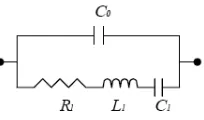
A quartz crystal resonator was made from a disc of quartz crystal cut at AT-cut angle and giving a two cylindrical electrode made of a thin metal shown in Figure 1. This two adjacent electrode made the resonator to have a behaviour as a capacitor. When an alternating electrical signal applied to the resonator, the piezoelectric properties of the resonator can be represented as a resonator circuit composed by a resistor, capacitor, and inductor. The BVD model for a resonator was shown in Figure 2. Where the C0, C1, R1 and L1
were the four parameters of the resonator.
Figure 2. BVD model of the quartz crystal resonator
The impedance between A and B was a parallel impedance between the impedance of the C0 and the
impedance of the series impedance of the R1, L1 and C1. The impedance of the upper arm (static arm) and
bottom arm (motional arm) can be written as:
Z0=
The total impedance (Z) of the resonator at given frequency between point A and B is:
Z = Z0Z1
Z0+Z1
(3)
For a given frequency we can calculate directly the value of the total impedance by using complex number calculation. Where the impedance can be written as:
Z = R + jX (4)
with R is the real part and X is the imaginary part of the impedance.
By substituting Z0 and Z1 using equation (1) and (2) we can rewrite equation (3) as:
In a condition where R1=0, parallel resonance at the frequency where the admittance of the resonator is
zero. This condition exists at a condition where X0+X1=0. The relationship of the parallel resonance and the
resonator parameter was written as:
Using equation (6), equation (7) can be written as:
ω
P=ω
S 1+ resulted data was usually in a set data consist of frequency, real and imaginary part of the impedance at given frequency, absolute impedance value and its corresponding phase. One can calculated the magnitude and phase using the real and imaginary part and vice versa. In this experiment we used the Bode-100 Vector Impedance Network Analyser from Micorn-Lab. Quartz crystal resonator used in this experiment was the AT-cut quartz crystal in HC49/U standard package purchased from Great Microtama Surabaya. According to the manufacturer, the resonator has been tuned at 10 MHz series resonance frequency and the maximum series resistance was 30 Ω. The resonator disc was 8.7 mm with silver electrode diameter closes to 5mm.2.3 Steps to calculate four parameters of the BVD Model
Based on the BVD model, one can calculate directly the absolute value and the phase of the impedance if the four parameters were known. Unfortunately, thus parameters cannot be measured directly. The only parameters which can be measured was the electrode diameter, which relates to C0, by a condition of zero
shunt capacitance of the resonator package. However, direct electrode diameter measurement gives us a big uncertainty compare to the accuracy and precision of electrical value measurement. The shunt capacitance of the resonator caused by resonator leads and package cannot be measured. It means that the calculated C0
based on the electrode diameter is only an approximate value.
Using network impedance analyser, one can measure the impedance and phase of the resonator (Z) at a given frequency. By changing the frequency from below the series resonance and above parallel resonance gives an impedance curve, which gives us an approximate impedance value near series resonance and near parallel resonance. he resonance frequency at series and parallel resonance can be found by interpolating the measured data at null phase, one at the transition from a negative phase to positive phase for the series resonance and from positive phase to negative phase for the parallel resonance. Both of the resonance frequency can be interpolated using one, two or three order polynomial. As the phase transition close to ”S” curve, approximation using polynomial order three was chosen. Figure 3 shows a typical phase and frequency relationship curve and cubic polynomial interpolation. One can calculate the resonant frequency at zero phase direct from the best fit polynomial coefficient. Based on this interpolation the value of ωS and
ωP has been found from measured data. At this point we already have a three approximate value of the
-90 -75 -60 -45 -30 -15 0 15 30 45 60 75 90
ω
Phase (O )
-90 -75 -60 -45 -30 -15 0 15 30 45 60 75 90
ω
Phase (O )
(a) (b)
Figure 3. Polynomial interpolation for frequency to phase;
(a) series resonance (b parallel resonance
-90 -75 -60 -45 -30 -15 0 15 30 45 60 75 90
|Z
|
(
Ω
)
Phase
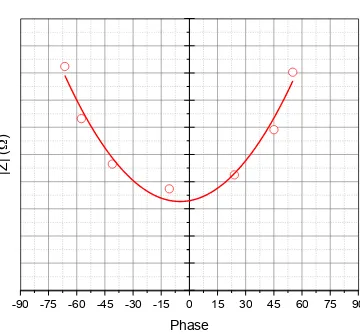
Figure 4. Impedance curve at series resonance for initial R1 value calculation
At series resonance, the impedance of the resonator is close to the value of R1. Therefore the resistive
parameter value, R1, can be approximately calculated using the impedance data close to the series
resonance. The first guess value of the R1 in this work was the minimum value from the interpolated
quadratic equation formed by impedance value again phase close to the zero phase at series resonance. Figure (4) shows a typical second order polynomial curve as a result of interpolated data.
Model values optimization can be done using nonlinear programming. In this condition, we have determined that there is four unknown variables whilst the objective of the function is to minimize the absolute difference between measured impedance and calculated impedance using model parameters R1, L1, C0 and C1. The nonlinear optimization was chosen as the best resonator behaviour described in equation
(5) is non linear. To solve this problem, optimization using Generalized Reduced Gradient (GRG) Nonlinear method which is available in Microsoft Excel was used. This method used GRG2 code developed by Lasdon and Waren [9]. The objective of the optimization was finding the best value for R1, L1, C0 and C1 which best
model the measured data.
3. Calculate the initial value of R1 using second orde polynomial interpolation of 8 data closest to the
series resonance
4. Calculated initial guess value for C0 series resonance frequency
5. Calculate sum of relative different from series resonance to parallel resonance (ZM: measured
impedance, ZC: Calculated impedance using BVD model)
6. Do using GRG Nonlinear Solver until minimum SE found:
a. Minimize SE by changing C0 and keeping R1 constant
b. Minimize SE by changing R1 and keeping C0 constant
The other possibility can be done by canging the sequence of GRG Nonlinear optimization on step 6 becomes:
6. Do using GRG Nonlinear Solver until minimum SE found:
a. Minimize SE by changing R1 and keeping C0 constant
b. Minimize SE by changing C0 and keeping R1 constant
3
R
ESULTS ANDD
ISCUSSIONWe used the above described scenario to calculate the BVD parameter’s value of the resonator. From our sample case, the initial BVD parameters value taken from measurement data followed by calculation scenario step 1 to 4 was R1 = 6.1301416 Ω, C0 = 4.6939777 pF, C1 = 0.0229395 pF, and L1 = 11.0236714 mH.
Using this initial guess value, GRG nonlinear optimization by minimizing relative different between measured impedance and calculated impedance at given frequency from minimum impedance to maximum impedance points. Tabel 1 shows the change in BVD parameters according to the scenario described above. We can see that the sum of relative different between calculated and measured impedance was constant at step 5. Based on this condition we got the final best value of the BVD paremeters. The parameters value was R1 = 7.4162625 Ω, C0 = 4.6115222 pF, C1 = 0.0225365 pF, and L1 = 11.2207780 mH. Slight
difference results were found by implementing alternative scenario of the GRG Nonlinear optimization. The result of the alternative scenario was listed in Table 2. The difference between the scenario is not significant. There was only 0.02 ppm different in R1 and 2 ppm different in C0, C1 and L1. For this work the first scenario
was used for rest of the work.
9.925 9.950 9.975 10.000 10.025 10.050 100
101
102
103
104
105
106
|Z
|
(
Ω
)
Frequency (MHz)
Measured |Z| Calculated |Z|
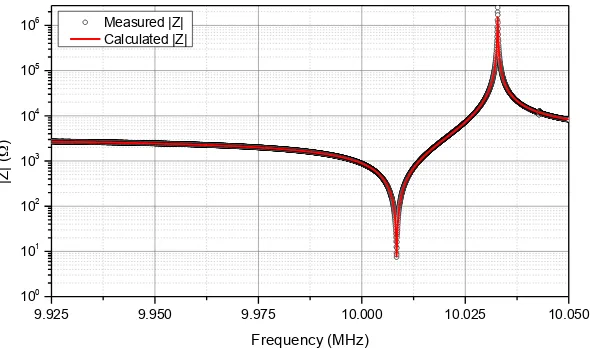
Figure 5. Impedance curve at series resonance
TABLE 1.BVD PARAMATER CHANGES RESULTED BY GRGNONLINEAR OPTIMIZATION USING FIRST SCENARIO
Step Condition R
1 (W) C0 (pF) C1 (pF) L1 (mH) S (D)
0 Initial guess (R1, C0, C1, L1) 6.1301416 4.6939777 0.0229395 11.0236714 17.6600412
1 Constant R1 6.1301416 4.6119541 0.0225386 11.2197273 6.6611161
2 Constant C0, C1, L1 7.4162709 4.6119541 0.0225386 11.2197273 6.3922058
3 Constant R1 7.4162709 4.6115222 0.0225365 11.2207780 6.3918131
4 Constant C0, C1, L1 7.4162625 4.6115222 0.0225365 11.2207780 6.3918127
5 Constant R1 7.4162625 4.6115222 0.0225365 11.2207780 6.3918127
Final Value 7.4162625 4.6115222 0.0225365 11.2207780
TABLE 2.BVD PARAMATER CHANGES RESULTED BY GRGNONLINEAR OPTIMIZATION USING SECOND SCENARIO
Step Condition R1 (W) C0 (pF) C1 (pF) L1 (mH) S (D)
0 Initial guess (R1, C0, C1, L1) 6.1301416 4.6939777 0.0229395 11.0236714 17.6600412
1 Constant C0, C1, L1 7.4177934 4.6939777 0.0229395 11.0236714 17.4302883
2 Constant R1 7.4177934 4.6115133 0.0225365 11.2207998 6.3918898
3 Constant C0, C1, L1 7.4162623 4.6115133 0.0225365 11.2207998 6.3918147
4 Content R1 7.4162623 4.6115133 0.0225365 11.2207998 6.3918147
5 Constant C0, C1, L1 7.4162623 4.6115133 0.0225365 11.2207998 6.3918147
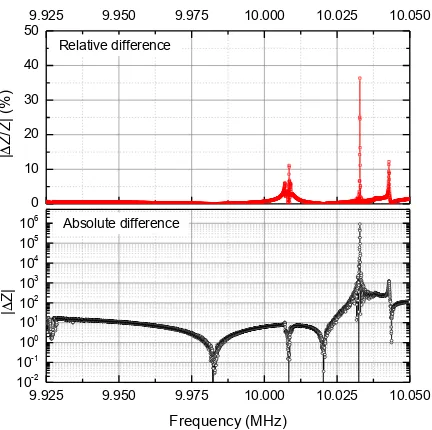
The difference between measured impedance and calculated one can be seen in Figure 6. It can be seen that in term of absolute difference, the biggest difference exists in an impedance value close to the parallel resonance. This magnitude can be understood well, as the absolute value of the impedance at parallel resonance is very big. In addition, it can be seen in Figure 5 that big impedance gradient exists at parallel resonance. Those a slight error in the frequency measurement by the impedance analyser will result in a significant difference in the measured impedance compared to the calculated one.
The relative difference between measured impedance and calculated impedance in Figure 6 shows that there are three peaks in the difference curve. We will focus to the first and second peaks difference. The first one was at series resonance and the second one was at the parallel resonance. The peaks after parallel resonance was caused by a non ideal fabrication the resonator.
9.925 9.950 9.975 10.000 10.025 10.050
Figure 6. Absolute and relative difference of the impedance value between measured data and calculated data
At impedance close to the series resonance, the relative difference of the impedance value was high for a few data although the absolute difference is small. This is caused by a small absolute value of the resonator impedance. High difference at series resonance impedance was only occurring for one or two points. This can be caused by the measurement error.
10.0070 10.0075 10.0080 10.0085 10.0090 10.0095
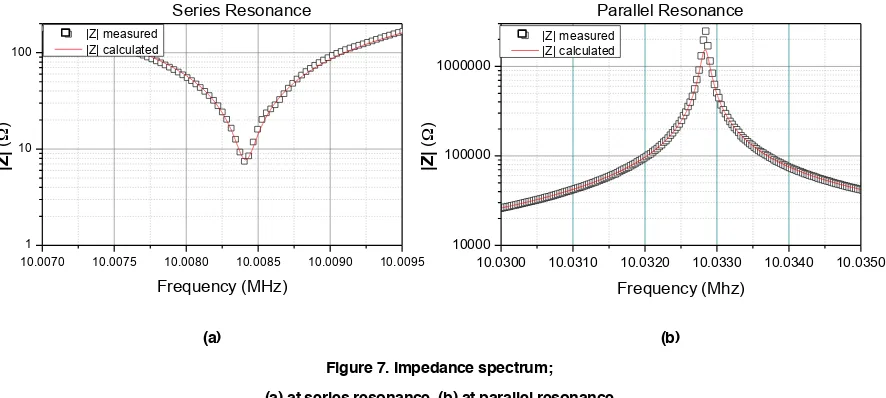
(a) at series resonance, (b) at parallel resonance
4
C
ONCLUSIONSThe scenario to calculate BVD parameters of a quartz crystal resonator using GRG nonlinear optimization has been successfully developed. Optimization criteria by minimizing the sum of the different between measured impedance and calculated impedance by varying the value of the four parameters, R1, L1, C0 and C1 has been shown. The initial guess value for parameters was calculated using the geometry value of
the electrode, an interpolated value of the series resonance frequency and parallel resonance frequency at zero phase. Initial guess value for the R1 was taken from the minimum impedance close to the series
resonance. The resulting four parameter’s value of the BVD shows a best fit to the measured data.
5
R
EFERENCES[1] J. Rosenbaum, “Bulk Acoustic Wave Theory and Devices”, Norwood: Artech House Inc., 1988.
[2] C. Filiâtre, G. Bardèche, and M. Valentin, “Transmission-Line Model for Immersed Quartz-Crystal Sensors”, Sensors Actuators A, vol. 44, no. 2, pp. 137–144, 1994.
[3] R. W. Cernosek, S. J. Martin, A. R. Hillman, and H. L. Bandey, “Comparison of Lumped-Element and Transmission-Line Models for Thickness-Shear-Mode Quartz Resonator Sensors”, in 1997 {IEEE} International Frequency Control Symposium, pp. 96–104, 1997. [4] S. J. Martin, V. E. Granstaff, and G. C. Frye, “Characterization of a Quartz Crystal Microbalance with Simultaneous Mass and Liquid
Loading”, Anal. Chem., vol. 63, pp. 2272–2281, 1991.
[5] J. D. Larson, P. D. Bradley, S. Wartenberg, and R. C. Ruby, “Modified Butterworth-Van Dyke Circuit for FBAR Resonators and Automated Measurement System”, in 2000 IEEE Ultrasonics Symposium, pp. 863–868, 2000.
[6] F. Li, J. H.C. Wang, and Q.M. Wang, “Thickness shear mode acoustic wave sensors for characterizing the viscoelastic properties of cell monolayer”, Sensors Actuators B Chem., vol. 128, no. 2, pp. 399–406, Jan. 2008.
[7] G. Kim, A. G. Rand, and S. V Letcher, “Impedance characterization of a piezoelectric immunosensor Part I!: Antibody coating and buffer solution”, vol. 18, pp. 83–89, 2003.
[8] L. Rodriguez-Pardo, J. Fariña, C. Gabrielli, H. Perrot, and R. Brendel, “Simulation of QCM sensors based on high stability classical oscillator configurations in damping media”, Sensors Actuators B Chem., vol. 123, no. 1, pp. 560–567, Apr. 2007.