DISTRIBUTION AND INCIDENCE LEAF DISEASES OF BANANA IN SEVERAL BANANA
PRODUCTION CENTERS IN NORTH SUMATRA, WEST SUMATRA
BENGKULU AND WEST JAVA
Sahlan and A. Soemargono
Indonesian Tropical Fruit Research Institute
Jl. Raya Solok-Aripan km 8, PO. Box 5, Solok West Sumatra, 27301 Corresponding athor Phone : +62-0755-20137 E-mail: [email protected]
Received : June 11, 2010/ Accepted: March 21, 2011
ABSTRACT
The research was aimed to determine the type, the distribution and the incidence of banana leaf diseases in several production centers in West Sumatra, Bengkulu, North Sumatra and West Java. Direct observations on banana orchards were conducted in some districts in Simalungun, Deli Serdang and Medan (North Sumatra), Tanah Datar, Limapuluh Kota, Agam, Pariaman and Pasaman (West Sumatra), Rejang Lebong and Kepahyang (Bengkulu), Sukabumi, Purwakarta and Subang (West Java) from November to December 2006. Two banana orchards were randomly selected in each district. Plant population at the selected orchard was at least 100 plants. From each sampled orchard, if banana population consisted of similar or only one variety, 10 plants were randomly chosen according to wind direction. Meanwhile, when the banana varieties were varied, five plants were randomly selected. The result showed that Black Sigatoka and Eumusae leaf spot were found in West Sumatra, Bengkulu and North Sumatra at severity level of between 15 % to 62.31%, whilst speckle disease was mainly found in North Sumatra and in parts of West Sumatra at severity level of between 72,72% to 100% and 15 to 30%, respectively. Banana varieties that were primarily attacked by leaf diseases were Cavendish, Telor, Barangan and Emas.
Keywords: bananas, black sigatoka, Eumusae, speckle, disease incidence and distribution
INTRODUCTION
As a commercial crop, banana plants are commonly damaged by pest and diseases. The main problem encountered by banana plants both at the level of smallholders and estates is the leaf diseases, especially Sigatoka leaf spot.
The most leaf spot diseases infecting banana crops around the world including Indonesia are Black Sigatoka caused by the fungus Mycosphaerella fijiensis Morelet, Yellow Sigatoka caused by the fungus Mycosphaerella musicola Leach ex Mulder, and Eumusae leaf spot caused by Mycosphaerella eumusae Crous et X. Mourichon (Carlier et al., 2000; Jones 2000; Crous and Mourichon, 2002).
Leaf spot diseases cause the early decease of the surface of infected banana leaves resulting in the reduction of total leaf area for photosynthesis process. If the environmental conditions are favourable for the development of this disease, then all the existing banana leaves will be infected. Because the leaf surface area for photosynthesis is drastically reduced, banana fingers produced on the infected plant do not normally develop and remain small and thin (Stover, 1972). If the rate of leaf spot disease is considerable severe, then the bunch and fruit size is reduced (Ramsey et al., 1990) and fruit ripens early denoted by the change of smell and flavour. Banana plants that are infected by leaf spot diseases before flowering will produce inferior quality fruit compared to banana plants that are infected after the ripening stage.
Mapping of the spread of leaf spot diseases indicated that the Yellow Sigatoka has spread throughout the banana-producing countries of the world (Stover and Simmond,
1987; Mourichon and Fullerton, 1990; Carlier et al., 1994) starting from an altitude of 0 to 1800 m above sea level (Merchant, 1989). In some countries, however, the presence of Yellow Sigatoka disease was gradually replaced by Black Sigatoka, as found in the countries of Latin America, Africa and Pacific islands. In Honduras, in less than three, years, Black Sigatoka successfully dominated the Yellow Sigatoka (Jones and Mourichon, 1993).
In Asia, the Black Sigatoka was found in China's Hainan island in 1980 and also in Canton in 1990 (Mourichon and Fullerton, 1990). Muharam and Subijanto (1991) reported that Black Sigatoka was usually found in the eastern part of Indonesia, while the Yellow Sigatoka was commonly occurred in the western part of Indonesia. Jones and Mourichon (1993) and Chuang and Jeger (1987) reported that Black Sigatoka had spread to Sumatra and other Asian countries like Bhutan, Vietnam, Philippines, Peninsular Malaysia, and Taiwan.
So far, information on the types of existing leaf diseases, their spread and production losses caused by the diseases in Indonesia are still limited. This study was aimed to determine types, distribution and incidence of leaf spot diseases on banana.
MATERIALS AND METHODS
Direct observations were conducted at banana orchards in different banana production centers in four provinces i.e. North Sumatra, West Sumatra, Bengkulu and West Java. Districts selected from each province were as follows: (a) Simalungun, Deli Serdang and Medan in North Sumatra, (b) Tanah Datar, Lima puluh koto, Agam, Pariaman and Pasaman in monoculture banana orchard. Two sampled banana orchards were randomly selected from each district. The selected orchard consisted of at least 100 banana plants. If banana plant population in the selected orchard consisted of only one banana variety, then 10 plants were chosen as samples to be observed. However, if plant population contained more than one
variety, only five plants were used as observed samples. Selection of the observed samples was based on wind direction.
Variables observed were disease incidence (presence or absence of affected banana plants), disease severity and infected species or banana varieties. Data were collected at each location and were averaged and analyzed. The severity of disease was cal-culated using the following formula (Carlier et al., 2002):
Σ n b
I = --- x 100 % (N-1)T
N = number of leaves observed
b = scale value of each category of infection N = total score used
T = total number of leaves observed
The value of the categorical scales: 0 = There is no spot on the leaf surface 1 = 1% of leaf surface infected 2 = 5% of leaf surface infected 3 = 15% of leaf surface infected 4 = 33% of leaf surface infected 5 = 50% of leaf surface infected 6 = >50% of leaf surface infected
Description of Disease Symptoms
a. Black Sigatoka
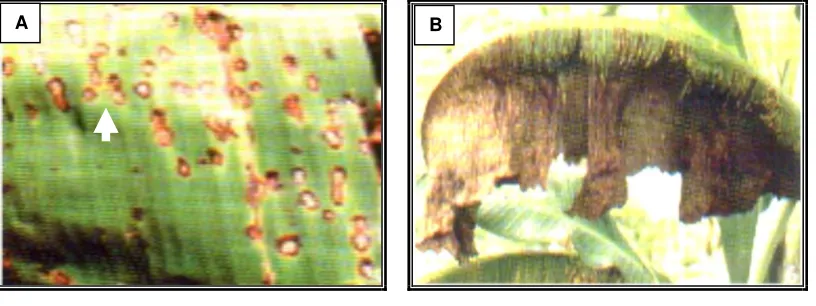
Symptoms of Black Sigatoka disease (BS) are generally similar to Yellow Sigatoka (YS) and somewhat difficult to distinguish. The first symptom of BS infection is the formation of 1-2 mm dark brown spots or small lines below the surface of an infected leaf. Eventually, these small lines expand and form yellowish necrotic wounds with grey light in the center (Figure 1A and B). Necrotic wounds will gradually be aggregated to form large wounds so that the leaves become dried and dead. Infection of BS on young leaves will be more severe and will cause the leaves to die more quickly (Stover, 1972 and 1980; Mourichon et al., 1997).
b. Eumusae leaf spot
in the edges. (Figure 2 A and B). In favorable conditions for the development of the disease, necrotic wounds will enlarge and join to form larger necrotic wounds where the brown spots surrounded by yellow edges are apparent. Grey patches then appear in these necrotic wounds (Carlier et al., 2000; Crous and Mourichon, 2002). Necrotic wounds will continuously join to form the wider wounds so it can deactivate these infected leaves.
c. Speckle Leaf spot disease
The first symptom of Speckle leaf disease is the occurrence of small spots with the size of
0.3 x 1.5 mm and pale brown on the surface of an infected leaf. These small spots will obviously be seen when viewed under sun light. These spots will gradually form a line that will join to develop necrotic wounds about 15 x 30 mm. Necrotic wounds will then stick together to form brownish yellow patches that will eventually turn into a dark brown-black (Figure 3 A and B). Finally, the necrotic wounds will be aggregated to form the wider wounds so that the leaves are dying.
Figure 1A. Symptom of Black Sigatoka. Figure 1 B. Symptom of Black Sigatoka on lower leaf surface (arrow)
Figure 2A. Early symptom of Eumusae leaf spot (arrow).
Figure 2 B. Advanced symptoms of Eumusae leaf spot
A B
RESULTS AND DISCUSSION
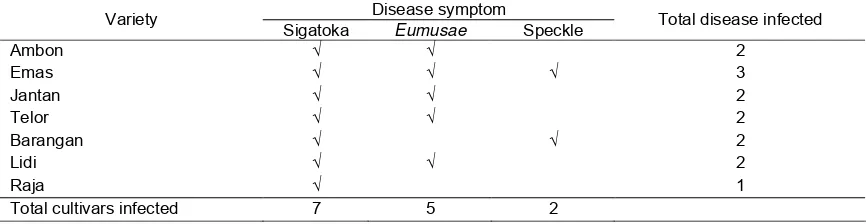
The result of the observations indicated that almost all types of leaf spot diseases found affected banana plants in five districts of Tanah Datar, Agam, Pasaman, and Pariaman districts in West Sumatra. Based on the symptoms, it was obvious that the leaf spot diseases were Black Sigatoka and Eumusae leaf spot. Both diseases were commonly found on banana plantation in the observed locations, especially in the group of banana plants
Symptoms of Black Sigatoka and Eumusae leaf spots were frequently found in Ambon/Cavendish, Emas, Lidi, Raja, Jantan, and Telor (Table 1). Meanwhile, on Emas, were found speckle leaf disease symptoms caused by Cladosporium musae Mason. Those symptoms were almost similar to Black Sigatoka symptoms. The speckle leaf disease was more common in the field with the disease intensity ranging from 15 to 30%.
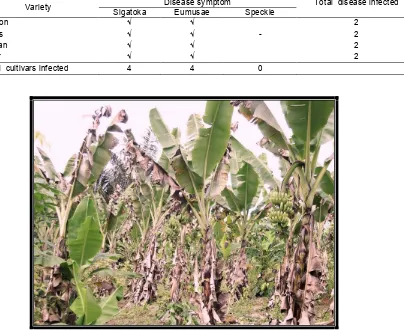
In the districts of Rejang Lebong and Kepahyang (Bengkulu), almost all types of leaf spot diseases found infected banana plants. The leaf spot diseases were Black Sigatoka and Eumusae leaf spot. The diseases were found in all locations observed, especially in the group of banana plants i.e. varieties of Ambon/Cavendish, Emas, Jantan and Telor (Table 2). Meanwhile, Emas was not found to be infected by Speckle disease caused by C. musae unlike that of West Sumatra.
Observations in three districts in West Java i.e. Sukabumi, Purwakarta and Subang indicated that there was no symptom similar to Sigatoka, Eumusae or Speckle found. This was denoted by the smooth leaves of banana plants of Muli, Ambon, Emas and Kapas varieties. The varieties are generally susceptible to Black Sigatoka disease. The phenomenon was not exactly known, so it needs to be re-observed in different time periods in the same location.
Figure 3A. Early symptom of leaf speckle spot Figure 3B. Advanced symptom of leaf speckle spot Table 1. Banana variety and leaf disease symptom found in five districts in West Sumatra province.
Disease symptom Variety
Sigatoka Eumusae Speckle Total disease infected
Ambon √ √ 2
Emas √ √ √ 3
Jantan √ √ 2
Telor √ √ 2
Barangan √ √ 2
Lidi √ √ 2
Raja √ 1
Total cultivars infected 7 5 2
Banana orchards in the province of North Sumatra were dominated by Barangan variety. The result of field observations showed that the intensity of Black Sigatoka disease in the districts of Simalungun district, Deli Serdang and Medan was 62.31%, 61.64% and 51.28%, respectively. This fact shows the high level of damage caused by the disease. In addition to Black Sigatoka symptoms, Speckle diseases were also found in Deli Serdang, Simalungun and Medan with disease severity between 72.72% to 100%. There was a striking difference between the symptom of Black Sigatoka and that of Speckle leaf disease on Barangan, namely the emergence of purple color on the leaves infected by Speckle leaf disease. Besides on Barangan, other leaf diseases were also found on Telor and Ambon varieties with
similar symptoms to Black Sigatoka. Disease severity caused by Black Sigatoka disease on Barangan is shown in Figure 4.
The Result of observations of leaf spot diseases in several provinces in Sumatra showed that the level of disease severity or disease incidence of both Black Sigatoka and Eumusae was still low. The lower levels of these infections were not caused by broad scale banana plantation using one banana cultivar. Multi-cropping banana varieties cultivated by farmers may indirectly suppress the domination of the infection of a type of leaf spot disease. In North Sumatra province, where farmers grow only one type of banana variety namely Barangan have proven the high level of both Black Sigatoka and Speckle leaf spot diseases.
Table 2. Banana cultivars and leaf disease symptom found in two districts in Bengkulu province Disease symptom
Variety
Sigatoka Eumusae Speckle
Total disease infected
Ambon √ √ 2
Emas √ √ - 2
Jantan √ √ 2
Telor √ √ 2
Total cultivars infected 4 4 0
Fact findings in the field in the three provinces showed that it was very difficult to obtain a relatively broad-scale banana orchard intensively which was planted with the same varieties. Small-scale banana orchards with various varieties were frequently found without proper maintenance. This condition caused that observational data of disease intensity as well as disease severity were varied. However, the observation of disease incidence was more prominent than the disease severity. Because disease severity is highly dependent on banana plant population and environmental factors, its magnitude will be very different from time to time. Chuang and Jeger (1987) state that the incidence of Black Sigatoka disease plays more important role as free variable than does the severity of the disease.
Previous publications mentioned that Emas (AA) was resistant to Black Sigatoka disease (Jones, 1993), but the results of this observation indicated that the banana variety could be infected by Black Sigatoka. This showed that there were the potential changes in banana resistance which were caused by environmental conditions or the occurrence of changes in virulence to Black Sigatoka disease.
The findings of Black Sigatoka disease in the province of Bengkulu, Black Sigatoka and Speckle leaf spot disease in West Sumatra and North Sumatra should be alerted. Cultivation of banana varieties such as Ambon, Barangan, and Emas will be increasingly difficult because those cultivars are more susceptible to the leaves spot diseases. Besides, the environmental conditions in the field are very appropriate for the growth of the disease. Environmental temperature for spore germination of the diseases generally ranges from 20 to 30OC. The optimum temperatures for germination and growth of Black Sigatoka production resulting from banana plantations cannot be guaranteed without control efforts to the disease. If the environmental conditions are suitable for the growth and the development of Sigatoka disease, then the banana leaves will be defoliated severely, and bananas fruits produced will be flat, smaller and become soft (Stover 1972). In addition, Black Sigatoka is more virulent and destructive and more difficult
to be controlled. Results of inoculation experiments and observations in the field showed that the spots of Black Sigatoka appeared 8-10 days faster than the spot of Yellow Sigatoka. Stover and Dickson (1976) reported that the epidemic of Black Sigatoka in Honduras occurred in 1973-1974 and in two years, it succeeded in replacing the Yellow Sigatoka disease. Besides, the Black Sigatoka is more vicious than the Yellow Sigatoka because it also infects the young leaves.
To guarantee the quality and quantity of bananas produced, Ramsey et al.(1990) stated that the heavy bunches of bananas that were harvested would increase logistically with the increasing number of leaves. Furthermore, it was stated that the banana crop at the harvest time had the number of healthy leaves less than 5 pieces, and the fruit would be lighter. Also, if the number of healthy leaves that existed at the time of harvests less than four pieces, the fruit would be ripe on the tree.
Regarding the size of losses due to Black Sigatoka leaf spot disease in particular, various attempts which have been done to control leaf spot disease comprise technical cultures including drainage improvement, weed control, removal/ reduction of tillers and plant spacing. Those techniques were intended to reduce or inhibit the spread of the disease. Meanwhile, proper fertilization can only help the plant recovery. Eradication of heavily infected diseases was highly recommended, but it was not often implemented. In the case of cutting off heavily infected leaves may reduce the source of disease inocula so that fungicide applications can be more effective.
Control of leaf spot diseases using resistant varieties so far is still an inapplicable control effort. Almost all banana varieties were susceptible to leaf spot diseases, particularly the Black Sigatoka disease. Stover (1972) reported that in the Ivory Coast the Cavendish banana varieties (AAA) and Gros Michel (AAA) were sensitive, while the banana varieties in groups of AB, AAB, and ABB, and of Musa sp., which produce seeds, are considered insensitive. However, a recent report stated that the symptoms of the banana leaf Speckle disease had been found on banana varieties of the AAB group in Cameron (Jones, 2000).
benzi-midazoles, tridemorph, triazole, propicona-zole, and flusilazole (Stover and Simmond, 1987; Stover 1989, Molina and Fabregar 2002, Pérez Vicente et al., 2002; Jones 2002). Due to heavy damage caused by leaf spot diseases, the banana plantation workers in Colombia sprayed 13-16 times a year (Perez Vicente et al., 2002), while in 2001 fungicide applications in the Philippines reached 38 times a year (Molina and Fabregar, 2002).
For banana farmers in Indonesia, the use of fungicides to control leaf spot diseases is not economically profitable for banana cultivation on a narrow area. Besides, spraying fungicides can cause health problems and environmental ecosystem disturbance (Vuylsteke and Ortiz 1995). Therefore, it is necessary to find an efficient spraying technique, such as low spray volume or scheduled spray time considering the level of the diseases infection.
CONCLUSIONS AND SUGGESTION
It was very difficult to find a relatively broad-scale banana plantation planted with the same varieties and intensively cultivated. Black Sigatoka and Eumusae leaf spot diseases, especially in the provinces of West Sumatra, Bengkulu and North Sumatra, infected banana orchards with infection rate of between 15 % to 62.31%.
Banana varieties of Ambon, Barangan, Emas and Telor were susceptible to Black Sigatoka disease. If the varieties are to be planted in relatively large scale orchards, the epidemiology of the disease has to be taken into account.
ACKNOWLEDGMENTS
We wish to express my deepest personal appreciation and sincere thank especially to Prof. Dr. Zainal Abidin bin Mior Ahmad and who may have contributed for his or her correction, assistance and critical review of the manuscript.
REFERENCES
Carlier, J., X.Mourichon, D.G.de-Leon, M.F. Zapater and M.H. Lebrun. 1994. DNA restriction fragment length polymorphisms in Mycosphaerella species that cause banana leaf spot diseases. Phyto-pathology. 84: 751-756.
Carlier, J., M.F. Zapater, F. Lapeyre, D.R. Jones and X. Mourichon. 2000. Septoria leaf spot of banana: A newly discovered diseased caused by Mycosphaerella Eumusae (Anamorph Setoria Eu-musae). Phytopathology. 90: 884-890. Carlier, J., D. D. Waele dan J. V. Escalant,
2002. Global evaluation of Musa germplasm for resistance to Fusarium wilt, Myco-spaherella leaf spot diseases and nematodes. In depth evaluation. INIBAP Technical Guidelines No.6. pp.63.
Chuang, T.Y. and M.J., Jeger. 1987. Predicting the rate development of black Sigatoka (Mycopshaerella fijiensis var. difformis) disease in Southern Taiwan. Phyto-pathology. 77: 1542-1547.
Crous P.W. and X. Mourichon, 2002. Myco-sphaerella Eumusae and its anamorph Pseudocercospora Eumusae spp. Nov.: causal agent of Eumusae leaf spot disease of banana. Sydowia 54: 35-43. Jacome, L.H. and W. Schuch. 1993. Effect of
temperature on growth and conidial production in vitro, and comparison of infection and aggressiveness in vivo among isolates of Mycosphaerella fijiensis var. difformis. Trop. Agric. Trinidad. 70(1): 51-59.
Jones, D.R. 1993. Evaluating banana and plantain for reaction to black leaf streak disease in the South Pacific. Trop. Agric. Trinidad. 70(1): 39-44.
Jones, D.R. 2000. Diseases of banana, abaca and enset. CABI Publishing. pp.544. Jones, D. R. 2002. The distribution and
importance of the Mycosphaerella leaf spot diseases of banana. In: Mycosphaerella leaf spot diseases of bananas: present status and outlook (L. Jacome, P. Lepoivre, D. Marin, R. Ortiz, R. Romero and J.V. Escalant, Eds.). Proceedings of the 2nd Inter-national workshop on Mycosphaerella leaf spot diseases held in San José, Costa Rica, 20-23 May 2002. p. 25-41.
Jones, D. R. and X. Mourichon. 1993. Black leaf streak/black Sigatoka disease. Musa Disease Fact Sheet No. 2. INIBAP. pp. 2.
Proceedings of an international workshop help at San Jose, Costa Rica. Montpellier, France. INIBAP. p. 50-55. Molina, A. B. and E. Fabregar. 2002.
Management of black leaf streak disease in tropical Asia. In: Mycosphaerella leaf spot diseases of bananas: present status and outlook (L. Jacome, P. Lepoivre, D. Marin, R. Ortiz, R. Romero and J.V. Escalant, Eds.). Proceedings of the 2nd Inter-national workshop on Mycosphaerella leaf spot diseases held in San José, Costa Rica, 20-23 May 2002. pp. 85-90.
Mourichon, X. and R.A., Fullerton. 1990. Geographical distribution of the two species Mycosphaerella musicolaLeach (Cercospora musae) and M. fijiensis Morelet (C. fijiensis), respectively agents of Sigatoka disease and black leaf streak disease in bananas and plantains. Fruits, 45: 213-218.
Mourichon, X,, J. Carlier and E. Fouré. 1997. Sigatoka leaf spot diseases [Black leaf streak disease (black Sigatoka) and Sigatoka disease (yellow Sigatoka)] Musa Disease Fact Sheet No.8. pp.4. Muharam, A. and Subijanto. 1991. Status of
banana diseases in Indonesia. In: Banana iseases in Asia and the Pacific (Valmayor, Umali, and Bejosano. Eds.). Proceedings of a Regional Technical Meeting on Diseases Affecting Banana and Plantain in Asia and the Pacific, Brisbane, Australia INIBAP Network For Asia and the Pacific. Philippines. p. 44-49.
Pérez Vicente, L. J.M. Alvarez dan M. Pérez, 2002. Economic impact and management of black leaf streak disease in Cuba. In: Mycosphaerella leaf spot diseases of bananas: present status and outlook (L. Jacome, P. Lepoivre, D. Marin, R. Ortiz, R. Romero
and J.V. Escalant, Eds.). Proceedings of the 2nd International workshop on Mycosphaerella leaf spot diseases held in San José, Costa Rica, 20-23 May 2002. p. 71-84.
Ramsey, M. D., J. W. Daniells and V. J. Anderson. 1990. Effects of Sigatoka Leaf Spot (Mycosphaerella musicola Leach) on Fruit Yields, Field ripening and greenlife of bananas in North Queensland. Scien-tiaHorticulturae, 41: 305-313.
Stover, R. H. 1972. Banana, Plantain and abaca disease. Commonwealth Mycol. Institute, Kew, Surrey, England. pp.316. Stover, R. H. and J.D. Dickson. 1976. Banana
leaf spot caused by Mycopshaerella musicola and M. fijiensis var. difformis: a comparison of the first Central American epidemics. FAO Plant Protection Bulletin. p.36-42.
Stover, R. H. 1980. Sigatoka leaf spots disease of bananas and plantains. Plant Disease. 64: 750-756.
Stover, R. H. and N.W. Simmond, N. 1987. Bananas. 3rd editions. Longman Scientific and Technical, New York. pp.468.
Stover, R. H. 1989. Sigatoka leaf spot: Thirty years of changing control strategies:1959-1989. In: Sigatoka leaf Spot diseases of bananas (Fullerton, R.A. and R.H. Stover, Eds.). Proceedings of an international workshop help at San Jose, Costa Rica.Montpellier, France. INIBAP. p. 66 - 74