IncIdence of HPV InfectIon In oral SquamouS cell
carcInoma and ItS aSSocIatIon wItH tHe PreSence of P53 &
c-myc mutatIon :
a caSe control Study In muwardI HoSPItal Surakarta
Adi Prayitno
1*, Mandojo Rukmo
2, Ambar Mudigdo
1, Dalono
1, Elyana Asnar
3, Retno Puji Rahayu
2,
Joko Agus Purwanto
4, Ni Nyoman Tri Puspaningsih
5, Kuntoro
6, Harjanto, Suhartono Taat Putra
31. Medical School of Sebelas Maret University, Surakarta 2. Dental School of Airlangga University, Surabaya 3. Medical School of Airlangga University, Surabaya 4. Farmacy School of Airlangga University, Surabaya;
5. Mathematic and Natural Science School of Airlangga University, Surabaya 6. Public Health School of Airlangga University, Surabaya
*Email: [email protected]
abstract
Introduction: Annual incidence rates for oral and pharyngeal cancer are estimated at 25 cases per 100,000 in developing countries. Human papilloma virus (HPV) was implicated in pathogenesis of Cancer. The mutations of p53 and c-myc are found 50% in cancer. objective: Aims of this research were to know the incidence of OSSC patient which realized HPV infection without p53 and c-myc gene mutation. materials and methods: Tissue biopsy frozen sections were taken from BOSC (Benign Oral Squamous Cell) and OSCC (Oral Squamous Cell Carcinoma) patients collected from Oral and Dental Departement of dr Muwardi Distric Hospital in Surakarta from January 2007 to January 2008. To
amplify L1-HPV gene for ixed the HPV stressor. To amplify p53 and c-myc genes, continued with SSCP (Single
Strand Conformational Polymorphisme) analysis and followed with measurement using densitometer, to see mutation
existence. The collected data were analyzed with Chi Square. results: BOSC patient identiied 23% with HPV infections
and OSCC patient identiied 73% with HPV infections. Hundred percent BOSC patient with HPV infection without
mutation in p53 gene and c-myc gene, 81% OSCC patient with HPV infection without mutation in p53 gene and 91 %
OSCC patient with HPV infection without mutation in c-myc gene. Chi Square analysis showed signiicant difference
between BOSC and OSCC patients with HPV infection without mutation in p53 and c-myc gene. conclusion: HPV is a factor for pathogenesis of OSCC.
abstrak
Pendahuluan: Insidensi Infeksi HPV pada karsinoma Sel Skuamosa oral dan Hubungannya dengan mutasi p53 dan c-myc: Penelitian kasus kontrol pada rumah Sakit muwardi. Rata-rata angka kejadian kanker rongga mulut dan pharyng di negara berkembang per tahun diperkirakan pada kisaran 25 kasus per 100.000 penduduk. Saat ini patogenesis kanker telah diketahui berhubungan dengan virus Human papilloma (HpV). Catatan lain bahwa mutasi pada gena p53 dan c-myc ditemukan pada 50% dari seluruh kejadian kanker. tujuan: Tujuan penelitian ini adalah untuk mengetahui kejadian pasien Kanker Sel Skuamous Rongga Mulut (KSSRM) dengan infeksi HpV tanpa mutasi gena p53 dan c-myc. Bahan dan cara: Jaringan biopsi frozen sections dari pasien Sel Skuamous Rongga Mulut Jinak (SSRMJ) dan Kanker Sel Skuamous Rongga Mulut (KSSRM) yang dikumpulkan dari Bagian Penyakit Gigi dan Mulut
RSUD dr Muwardi Surakarta mulai Januari 2007 hingga Januari 2008. Ampliikasi gena l1-HpV untuk mengetahui
keberadaan stressorHpV. Ampliikasi gena-gena p53 dan c-myc, dilanjutkan analisis Single Strand Comformational polymorphisme (SSCp) dan diikuti pengukuran menggunakan densitometer untuk melihat keberadaan mutasi. Data yang terkumpul dianalisa menggunakan Uji Chi Square. Hasil: Pasien SSRMJ teridentiikasi 23% terinfeksi HpV dan
pasien KSSRM teridentiikasi 73% terinfeksi HpV. Seratus persen pasien SSRMJ yang terinfeksi HPV tercatat tanpa
mutasi pada gena p53 dan c-myc, 81% pasien KSSRM yang terinfeksi HpV tercatat tanpa mutasi gena p53 dan 91 % pasien KSSRM yang terinfeksi HPV tercatat tanpa mutasi gena c-myc. Analisis uji Chi Square menunjukkan perbedaan
yang signiikan antara pasien SSRMJ dan KSSRM pada infeksi HpV tanpa mutasi gena p53 dan c-myc. kesimpulan:
HpV merupakan faktor untuk kejadian KSSRM.
Introduction
Update research found that cancer is widely perceived as a heterogeneous group of disorders with different biological properties, are caused by a series of clonally selected genetic changes in tumour-suppressor genes and oncogenes.1,2 However, recent data suggest that cancer has a common basis that is grounded in a polyclonal epigenetic disruption of progenitor cells, mediated by tumour-progenitor genes. Tumour cell heterogeneity is due in part to epigenetic variation in progenitor cells and epigenetic plasticity together with genetic lesions drives tumour progression. This crucial early role for epigenetic alterations in cancer is in addition to epigenetic alterations that can substitute for genetic variation later in tumour progression.2,3 Therefore, non-neoplastic but epigenetically disrupted might be a crucial target for cancer risk management.
Cause of cancer can divide into two groups: environmental cause and hereditary genetic cause. Cancer is primarily
an environmental disease, though genetics inluence the
risk of some cancers. Environmental factors include: environmental pollutants, diet and obesity, tobacco, infections, radiation, and lack of physical activity. These environmental factors cause or enhance abnormalities in the genetic of cells.3 The prevalence of oral cancer is increase in Africa. Annual incidence rates for oral and pharyngeal cancer are at 25 cases per 100,000 in developing countries. The urbanisation and increasing access to, and utilisation of tobacco in its various forms as well as alcohol, is to an increase in the incidence of oral cancer.4 Epidemiology of oral cancer are squamous cell represents 90% of oral cavity tumours, the incidence was increases with age (represent 3% of cancers in men and 2% of cancers in women).5 Factor that implicated as a potential cock and or promoter cancer were tobacco, alcohols, radiation of sunrise, ionization radiation, carcinogen related work, environment pollutant, medicines, nutrition and infectious agent. Another stressor is life in village, social-economic factor, age, genders and response immune mechanism. The followed factor is periodontal disease chronic, bed oral hygiene, diseases of tooth, sharp of set teeth, electrogalvanism and edentulism. Another researcher found that human papilloma virus (HPV), implicated in Oral Squamous Cell Carcinoma (OSCC) pathogenesis.3,6,7 Therefore,
if the pathogenesis of OSCC can’t be explained so the
morbidity and mortality can increase and lead to decrease the human resources.
The role of HPV, expression of E6 and E7 protein virus, expression of p53 and c-myc proteins host can explained by pathobiology examination8,9 in cell perception and cell response concept. The binding of E6 protein of
HPV with p53 proteins lead to decrease the apoptosis. The other hand binding of E7 proteins with pRb protein
lead to activate c-myc protein expression so be impact
in decreases the proliferation. The mutations of p53 and c-myc are not found.10,11,12 This concept gives a chance
to explain the increasing OSCC.
In the disease of high risk HPV infection explained the
viral genome integrates into the host genome which is the necessary event for the keratinocytes immortality. During this process of integration the circular form of viral genome breaks at the level of the E1 and E2 regions. Different studies have shown that the integrated part of the genome corresponds to E1, E6 and E7. The loss of E2 during this process of integration produces the loss of E6 and E7 control. Therefore, the sequences E6 and E7 are directly involved in the cellular cycle by inhibiting the normal functions of p53 and pRb. The p53 can provoke the arrest of cellular division and assure the time necessary for DNA repair. If damage can’t be repaired, p53 is able to induce the apoptosis and prevent the propagation of DNA damage in subsequent generations of cells. In the case of other types of tumours, p53 is usually mutated and acts as a real oncogene. In the case of HPV infection, E6 suppresses the properties of p53 gene product achieving the functional equivalent of the two hits required to knock out both alleles of a tumour suppressor gene. The mutations of p53 are normally not found. The E7 protein interacts with retinoblastoma protein (pRb), which is the crucial factor for the cellular cycle control. This interaction causes the release of the transcription factor E2F, which is now free to act and can stimulate the cellular division. E6 and E7 can cooperate with cellular oncoproteins like ras and myc which enables the virus to act at the level of growth factors and cellular and nuclear metabolism producing oncogenic cells. E6 and E7 can provoke directly DNA mutations of the host cell. This means that certain types of HPV are able to cause malignant lesions even without the action of other cofactors.13
materials and methods
Fourty frozen section BOSC tissue and iveteen frozen
section OSCC tissue patients collected from Oral and Dental Clinic of dr Muwardi Distric Hospital in Surakarta
from January 2007 to January 2008. Parrain blocks were
made from cutting I, which was subsequently stains
with Haematoxyline Eosine (HE) to ascertain the type
of neoplasm.
Cutting II was subjected to Deoxyribonucleic Acid
(DNA) isolation was made by Henk Schmits method with
some modiications. Cut up to 25 mgr of tissue into small
pieces, place in 1.5 ml a microfuge tube volume, and add
K stock solution, mix by vortexing, and incubate at 550 C overnight.14
The DNA isolation results were subjected to Polymerase
Chains Reaction (PCR) to amplify L1-HPV for ixed the
HPV stressor. Diagnose related HPV infections are made by Henk Schmits and/or Nigel McMillan and Nina Fowler
PCR-method with some modiications.14,15 Twenty ive
µl microfuge tube Ready To Go PCR Bead (Amersham
Pharmacia Biotech) mixed with 2 µl HPV consensus
primers (MY09: 5’GC(A/C)CAGGG(A/T)CATAA(C/T)AATGC3’ and MY11: 5’CGTCC(A/C)A(A/G)(A/G)GGA(A/T)ACTATC3’) (CYBERGENE AB) and 2 µl DNA template. PCR protocol
for both ampliications are 940 C for 50 seconds, 590 C for 50 seconds, 720 C for 50 seconds and 40 C soak. The
Ampliication of HPV-L-1 gene produced 450 bp long.
Other DNA isolation results were subjected to Polymerase Chains Reaction (PCR) to amplify p53 and c-myc gene and continued Single Strand Conformational Polymorphism (SSCP) analysis and followed with measurement using
densitometer to see mutation existence. To amplify of p53
and c-myc made by Henk Schmits and/or Nigel McMillan
and Nina Fowler PCR-method with some modiications.14,15
Twenty ive µl microfuge tube Ready To Go PCR Bead (Amersham Pharmacia Biotech) mixed with 2 µl p53 primer
(forward primer 5’TATCCTGAGTAGTGGTAATC3’ and backward primer 3’AAGTGAATCTGAGGCATAAC’) (Cybergene AB) and 2 µl sample DNA (template). The other hand twenty five µl microfuge tube Ready To Go PCR Bead (Amersham Pharmacia Biotech)
mixed with 2 µl c-myc primer (forward primer
5’CCGTCCCTGGCTCCCCTCCTG3’ and backward primer 3’GTATCGTCGCCCGCCCGTTGAAAC5’) (Cybergene AB) and 2 µl sample DNA (template). PCR
protocol for both ampliications are 940 C for 50 seconds, 590 C for 50 seconds, 720 C for 50 seconds and 40 C soak.
The Ampliication of p53 gene produced 216bp and c-myc
gene produced 347bp. Single Strand Conformational Polymorphism (SSCP) analysis followed with measurement using densitometer (Shimadzu CS 930, Dual Wave Length
Cromato Scanner) to see mutation existence.
results
The result of this research showed that nine patient from
40 patient BOSC identiied have HPV infections(9/40 =
23%). Eleven patient from 15 patient OSCC identiied
have HPV infections(11/15 = 73%) (Figure 1)
figure 1. Polymerase Chains Reaction (PCR) L1 – HPV
gene, ampliied 450 bp long.
Another result of this research showed that nine patient without mutation in p53 gene (9/9 = 100%) and 9 patient without mutation in c-myc gene (9/9 = 100%) after
SSCP analysis that conirm by densitometer against nine
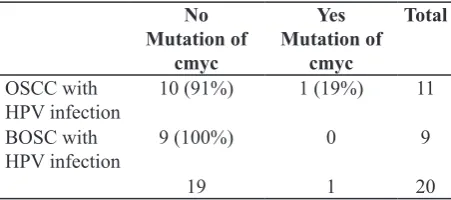
patient BOSC with HPV infection. The other hand, nine patient without mutation in p53 gene (9/11 = 81%) and 10 patient without mutation in c-myc gene (10/11 = 91%)
after SSCP analysis that conirm by densitometer against
eleven patient OSCC with HPV infection (Figure 2A, 2B, 2C and Figure 3A, 3B, 3C)
figure 2a. Polymerase Chains Reaction (PCR) of p53
gene, ampliied 216 bp long.
figure 2B. Single Strand Conformational Polymorphism (SSCP) Analysis of p53 gene
figure 2c. Measurement using densitometry to see
mutation existence from Strand Conformational
Polymorphism (SSCP) Analysis of p53 gene (have 2 pick – arrow)
figure 3a. Polymerase Chains Reaction (PCR) c-myc
gene, ampliied 347 bp long.
figure 3c. Measurement using densitometry to
see mutation existence from Strand Conformational
Polymorphism (SSCP) Analysis of c-myc gene (have 2 pick – arrow).
Chi Square analyze showed have signiicant differences
between BOSC and OSCC patients with HPV infection without mutation in p53 and c-myc gene (Table 1, 2, 3, 4)
table 1. result of the experiment in table 2X2 of p53 protein.
no mutation of p53
yes mutation of
p53
total
OSCC with HPV infection
9 (81%) 2 (19%) 11
BOSC with HPV infection
9 (100%) 0 9
18 2 20
table 2. chi Square data analysis of table 1.
k.b o e (o-e) (o-e)2 (o-e)2
e
k.1.b.1 9 9.9 -0.9 0.81 0.08 k.2.b.1 2 1.1 0.9 0.81 0.73 k.1.b.2 9 8.1 0.9 0.81 0.1 k.2.b.2 0 0.9 -0.9 0.81 0.9
X2 1.81
Xt (df = 1; p<0,01) 6.63
table 3. result of the experiment in table 2X2 of cmyc protein.
no mutation of
cmyc
yes mutation of
cmyc
total
OSCC with HPV infection
10 (91%) 1 (19%) 11
BOSC with HPV infection
9 (100%) 0 9
19 1 20
table 4. chi Square data analysis of table 3.
k.b o e (o-e) (o-e)2 (o-e)2
e
k.1.b.1 10 10.45 -0.45 0.2 0.01 k.2.b.1 1 0.55 0.45 0.2 0.36 k.1.b.2 9 8.55 0.45 0.2 0.02 k.2.b.2 0 0.45 -0.45 0.2 0.44
X2 0.83
Xt (df = 1; p<0,01) 6.63
discussion
Dental caries and periodontal disease are generally considered to be the major oral health problems around the world. In developing countries of Africa, these appear to be neither as common nor of the same order of severity as in the developed world. An epidemiological description of a given health problem usually includes its prevalence, severity (morbidity, mortality) and age-adjusted distribution in the population. Oral diseases
known to exist in each community must be assessed in
Types/head-and-neck. Cited 16/05/2012.
7. Morimoto RI. Regulation of the heat shock transcriptional response: cross talk between a family of heat shock factors, molecular chaperones, and negative regulators. Genes and Dev. 1998; 12:3788-96. 8. Colin RY and Welsh CJ. Stress Health and Disease.
http://www.cellscience.com/journal/journal.index.asp. Cited 26/10/2005.
9. Vogel EH, Castro ME, Solar PA and Soto FA. E n h a n c e m e n t o f P a v l o v i a n c o n d i t i o n e d
immunosuppression in rats. Acta Neurobiol Exp.
2007; 67:71-81.
10. Ray PK. Stress Genes and Species Survival. Moleculer and Cellular Biochemistry. Springer Netherlands. 1999; 196:117-23.
11. Putra ST. Psikoneuroimunologi. Graha Masyarakat Ilmiah Kedokteran (GRAMIK) Fakultas Kedokteran UNAIR Surabaya. 2005; p.1-15
12. Elizabeth Crown. Cell Stress Protein Linked to Breast Cancer. [email protected]. Cited 2007.
13. M. A. González Intxaurraga, R. Stankovic, R.
Sorli, G. Trevisan. HPV and carcinogenesis. Acta Dermatovenerologica. 2002; 11(3).
14. Schmits HL. Species Diagnostics Protocols: PCR and Other Nucleic Acid Methods. In: Clapp Humana JP, editor. Methods in Molecular Biology. Vol. 50. Press Inc., Totowa, NJ. 1996; p.109-126
15. Nigel MM, Nina F. Typing of HPV isolates by PCR: Molecular approach toward vaccine development for viral infection. Icro-Unesco Training Course, At Inter University Center for Biotecnology, Gajah Mada University, Yogyakarta, Indonesia; 1998; p.18-28. 16. Robert A. Ord, Nikolaos G. Nikitakis, and John J.
Sauk. Screening the Non-High Risk Oral Cancer Patient - Part 1. http://oralcancerfoundation.org/dental/ why_screening_works.htm. Cited 19/05/2012 17. WHO/AFRO. Oral Health Epidemiology. 2008. 18. Mehrotra R, Yadav S. Oral squamous cell carcinoma:
Etiology, pathogenesis and prognostic value of genomic alterations. Indian Journal of Cancer. 2006; 43:60-66.
19. Read, A. P.; Strachan, T. Cancer Genetics. Human molecular genetics 2. New York: Wiley; 1999. Chept.18.
20. Anand P, Kunnumakkara AB, Kunnumakara AB. Cancer is a preventable disease that requires major lifestyle changes. Pharm. Res. 2008; 25(9):2097–116. Cotterman R, Jin VX, Krig SR, Lemen JM, Wey A, Farnham PJ, Knoepfler PS. N-Myc regulates a widespread euchromatic program in the human genome partially independent of its role as a classical transcription factor. Cancer Res. 2008; 68(23):9654– 62.
could allow abnormal cells to proliferate, resulting in cancer. As many as 50% of all human tumors contain p53 mutants.18 And c-myc codes for a protein that binds to the DNA of other genes and is therefore a transcription factor. When a gene like myc is altered to cause cancer, the cancerous version of the gene is called an oncogene. The healthy version of the gene that it is derived from is called a proto-oncogene. Myc gene is located on chromosome 8 in humans and encodes for a transcription factor that is
believed to regulate expression of 15% of all genes.19,20 This means that in addition to its role as a classical transcription factor. Myc also regulate global chromatin structure by regulating histone acetylation both in gene-rich regions and at sites far from any known gene.21
conclusion
Virus Human papilloma (HPV) is a factor for pathogenesis of Oral Squamous Cell Carcinoma (OSCC).
acknowledgments
We thank to acknowledge Inter University Center (IUC) for Biotechnology of Gadjah Mada University Yogyakarta, Airlangga University Surabaya and Muwardi Distric Hospital Surakarta for his laboratory facilities. And Prof José Veríssimo Fernandes from Federal University of Rio Grande do Norte, Natal – Brazil for his correction and suggestion.
references
1. Samer AB, Michael AH, and Geza T. Squamous cell carcinoma of the oral tissue : A comprehensive review for oral healthcare providers. Contemp. Dent. Prac. 2005; 15:1-16.
2. Andrew PF, Rolf O, and Steven H. The epigenetic progenitor origin of human cancer. Nature Reviews Genetics. 2006; 7:21-33.
3. Kinzler, Kenneth W, Vogelstein, Bert. ‘Introduction’. In The genetic basis of human cancer. Revised ed. New York: McGraw-Hill, Medical Pub. Division; 2002. 4. Elizabeth A, Tara NR, Frannie RK, Chaterine H,
and Edward SP. Oral cancer knowledge, attitude and practices: A survey of dentist and primary care physicians in massachusetts. Am. Dent. Assoc. 2009; 140:461-7.
5. Cancer Research UK. Oral cancer - risk factors. http:// info.cancerresearchuk.org/cancerstats/types/oral/
riskfactors/index.htm. Cited 4/9/2009.