Concrete Waste as a Cement Replacement Material in
Concrete Blocks for Optimization of Thermal and Mechanical
Properties
M.S. Rosman1a, N.F. Abas2,a , M.A. Othuman Mydin3
1,2,3
School of Housing, Building and Planning, Universiti Sains Malaysia, 11800, Penang, Malaysia
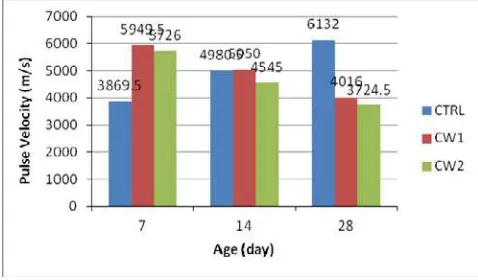
Abstract. The sustainability of the natural environment and eco-systems is of great importance. Waste generated from construction forces mankind to find new dumping grounds and at the same time, more natural resources are required for use as construction materials. In order to overcome this problem, this study was conducted to investigate the use of concrete waste in concrete blocks with a special focus on the thermal and mechanical properties of the resulting products. Three varieties of concrete mixtures were prepared, whereby they each contained different amounts of concrete waste of 0%, 5% and 15%, respectively. These mixtures were formed into cube specimens and were then analysed for data on their compressive strength, density and ultrasonic pulse. Thermal investigations were carried out on each admixture as well as on a control concrete block of model design. The thermal data results indicated that the 15% concrete waste mixture had the lowest temperature in comparison to the surrounding air. For density and compressive strength, the highest readings came from the control mixture at 2390 kg/m3 and 40.69 N/mm2, respectively, at 28 days. In terms of pulse velocity, the 5% concrete waste mixture indicated medium quality results of 4016 m/s.
1 Introduction
Concrete waste is generally found in construction waste, demolition waste, production waste and waste returned in ready-mix trucks. The reuse of concrete could help generate a reduction in landfill usage, less exploitation of natural resources and reduced transportation costs. There also exist beneficial reasons for improving the quality of materials which help to extend the life of recycled materials, especially in terms of reducing the greenhouse effect [1]. The manufacturing of concrete blocks has been subjected to the inclusion of waste materials following intensive research work in recent years. This research focuses on seeking alternative building materials to replace the main ingredients which are currently been used to manufacture concrete blocks. These blocks can be used as a partial or full replacement of either cement or aggregates [2]. By using waste, recycled and by-product materials in the by-production of concrete blocks, the problems of cost and resource availability can be overcome.
Furthermore, environmental pollution problems that arise from the manufacture of such materials can be minimized. Benefits also come in terms of reduced disposal costs. The production of concrete blocks as building materials for use in constructing walls has become important in developing countries. The most common criteria for concrete are high compressive strength as well as resistance
a
Corresponding author : [email protected] DOI: 10.1051/
C
Owned by the authors, published by EDP Sciences, 2014 ,
This is an Open Access article distributed under the terms of the Creative Commons Attribution License 4.0, which permits
to weather, impact and abrasion. In terms of design characteristics, concrete can be moulded into components of any shape and size. The size of concrete blocks is also adjustable and they require far less mortar than solid blocks, making the construction of walls easier and quicker. Furthermore, concrete can be used as ducts in walls when used for electrical and plumbing installation [3]. Another capability of concrete is that it is designed to resist temperatures of up to about 400ºC. However, one negative property of concrete is that it has low tensile strength.
For energy efficiency, it has become increasingly imperative to take thermal conductivity into consideration when constructing concrete walls. Designing buildings for maximum energy conservation has been receiving more and more attention due to the effects of global warming together with rising costs of construction. In Malaysia, air conditioners are commonly installed in commercial buildings to control the inside temperature and to counterbalance the heat produced by the people and electrical appliances inside the building. This equipment provides a relaxed working environment for personnel as well as comfort to residential areas in tropical countries [4]. Thermal comfort in Malaysia’s climate is based on a reasonable temperature inside a house of 25.5ºC to 28.5ºC (Jones et al. 1993). This heat is mostly caused by abundant sunshine which radiates for up to six hours each day [5]. This research will analyse the heat flows into a building designed for energy efficiency and examine materials affecting the performance of thermal comfort. Furthermore, it will also determine the potential of concrete waste for use as a sustainable, recycled material.
2 Materials
There are three basic processes in the manufacture of concrete blocks which are mixing, moulding and curing. The experiment was set up to analyse data pertaining to the manufacture of concrete blocks with concrete waste as a cement replacement.
2.1. Crushed Concrete
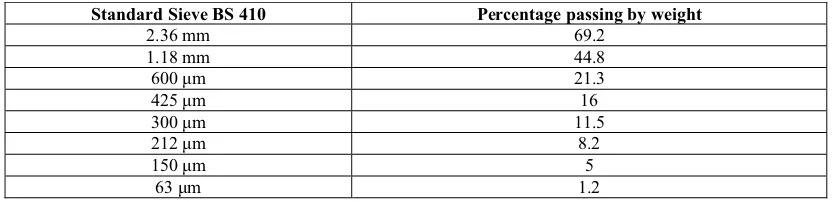
The type of C&D waste used came from old concrete (OC) that was collected after the demolition of old concrete structures and then crushed. All the properties of the recycled concrete were tested according to British standard methods. The grain size distribution of recycled concrete used in this study is presented in Table 1. The aggregates of +20mm in size were crushed in a small motorized crusher, and then again sieved through 20mm, 10mm and 4.75mm sieves. From the sizes below, 300 m was selected as a mixture for the replacement materials.
Table 1. Sieve analysis of recycled concrete
Standard Sieve BS 410 Percentage passing by weight
2.36 mm 69.2
waste admixture. In addition, six cube specimens were prepared with a size of 100mm x 100mm x 100mm (length x height x width) for each percentage of admixture to determine the density at the age of 7, 14 and 28 days during the curing process. Then, the mixture of the materials was produced using Ordinary Portland Cement (OPC), sand, course aggregate, waste concrete and water. The proportions of the concrete mixtures were prepared in three different mixes shown in Table 2. The amount of concrete waste added to each mixture to replace the cement was 0%, 5% and 15%, respectively.
Table 2. Mix proportion for all specimens
Concrete mix Cement
CW2 318.75 15 853.05 961.95 210.00
3.2 Manufacturing Process
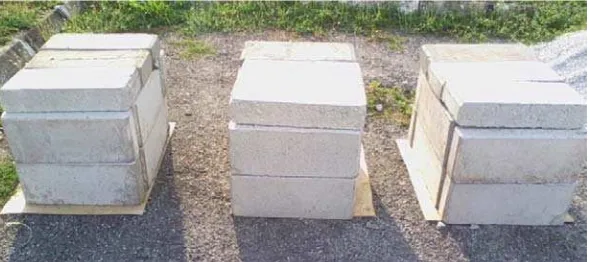
The materials used in dry form, such as concrete waste, Ordinary Portland Cement (OPC), course aggregate and sand, were mixed together for several minutes in a revolving–drum tilting mixer according to ASTM C 192. Then, a small amount of water was added to the mixer. The concrete mixing process continued for six to eight minutes. Afterwards, block moulds were prepared for concrete placement. Later, the concrete blocks were removed from the moulds and dried for 24 hours. After that, the concrete blocks were immersed in water to cure for a duration of 28 days. The cube specimens had to be cured for 7, 14 and 28 days, respectively. As the specimens were being cured, the concrete blocks were set up to form a model design for thermal properties as shown in Figure 1. Other specimens were put through laboratory tests to examine their mechanical properties.
Figure 1. Model design of concrete block made from concrete waste mixture
3.3 Testing
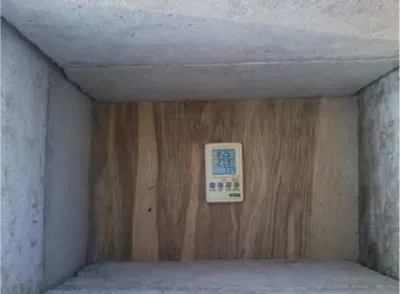
Figure 2. Temperature reading inside of concrete block model
4 Results and Discussion
4.1 Thermal Test
The results obtained for the average temperature of the three model designs during measurement hours varied according to the proportion of admixture. From Figure 3, it can be seen that the concrete block using model CW2 had a lower temperature, registering an average difference with the surrounding area of 3.06 ºC. This was due to the high content of concrete waste as 15% of the cement had been replaced with concrete waste. The CW1 specimen, containing 5% concrete waste mixture, was 0.3 ºC warmer than model CW2. The average difference in results for the CTRL model and CW1 was 0.2 ºC cooler than the surrounding area. As time passed from 4pm onwards, all of the models became cooler and the differences in temperature between them was reduced because the warming speed of the models was slower than that of the surrounding area. Thus, the rate and degree to which the inside air temperature of a building heats up depends on the ability of the concrete blocks to hold heat and slow down the process. As was proven in this experiment, the concrete with a higher proportion of concrete waste performed better in terms of trapping heat.
Fig. 3: Temperature changes of the models and surrounding area 8:00 to 20:00
4.2 Density Test
concrete waste had a higher density than specimen CW2. This was due to the high amount of concrete waste which replaced the original concrete, thereby having a strong influence on the density.
Fig. 2: Density of hardened concrete at 28 days
4.3 Compressive Strength
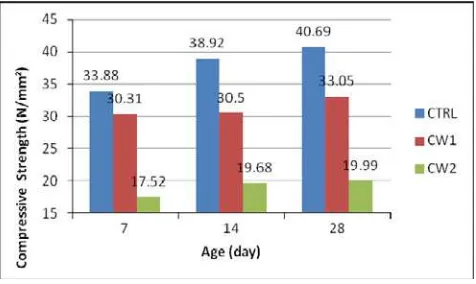
The strength of the concrete specimens was determined by testing for compressive strength as shown in Figure 3. In this study, the blocks containing concrete waste achieved lower values of compressive strength compared to the control mixture between the period of 7 to 28 days. The results showed that the compressive strength of CW2 was lower than the CTRL and CW1 at 7 days. The specimen consisting of 15% concrete waste achieved the lowest reading which was 17.52 N/mm2. At 14 days, the compressive strength of all the specimens had increased. The CTRL obtained the highest compressive strength which was 38.92 N/mm2. At 28 days of curing, the compressive strength of the CTRL had increased to 40.69 N/mm2. In contrast, CW1 and CW2 achieved relatively higher results for compressive strength with readings of 33.05 N/mm2 and 19.99 N/mm2, respectively. The high compressive strength was due to the lower water-cement ratio of the mix.
Fig. 3: Compressive strength – age relation for specimens
4.3 Ultra Pulse Velocity Test
were achieved at the age of 28 days of 4016 m/s and 3724.5 m/s for CW1 and CW2, respectively. Thus, it can be concluded that the specimens both had a standard defect.
Fig. 3: Pulse velocity – age relation for specimens
5 Conclusion
This research has thoroughly studied the potential of concrete waste for use in manufacturing concrete blocks. The main focus of the study was to observe the performance of concrete waste materials in terms of thermal and mechanical properties. The results indicated that the production of the concrete blocks mixed with concrete waste could be a profitable disposal alternative in the future. The thermal data showed that the mixture containing 15% concrete waste had the lowest temperature in regard to the average difference with the surrounding area by 3.06 ºC. The density and compressive strength tests indicated that the control mixture performed best with readings at 28 days of 2390 kg/m3 and 40.69 N/mm2, respectively. In terms of pulse velocity, medium quality results of 4016 m/s for the 5% concrete waste mixture were obtained. As a result, a low influence from air temperature on the concrete blocks reduces the need to use air conditioning which will directly help to save energy and money. Thus, the major factor for typical Malaysian houses is the amount of solar heat gain based on the number of storeys plus the direction of the building. From this research it was found that, after being exposed to direct solar radiation, the control concrete block mixture absorbed extreme amounts of heat energy while the concrete waste blocks were able to moderate heat gains and hold off temperature increases. This demonstrates the potentially great value of recycled concrete waste which is readily available nowadays. Furthermore, this method of concrete block production could be generally implemented in the construction industry as an environmentally friendly building material in the foreseeable future.
References
1. Howard Klee (2009), The Cement Sustainability Initiative, World Business Council for Sustainable Development – WBCSD, North America
2. K. S. Al-Jabri, A. W. Hago, R. Taha, A. S. Alnuaimi and A. H. Al-Saidy “Strength and Insulating Properties of Building Blocks Made from Waste Materials”, Journal of Materials in Civil Engineering, 2009, Vol.21, No. 5, page no: 191–197
4. Renga Rao Krishnamoorthy, Juvinia Augustine Zujip (2013), Thermal Conductivity and Microstructure of Concrete Using Recycle Glass as a Fine Aggregate Replacement, International Journal of Emerging Technology and Advanced Engineering, Volume 3, Issue 8, pp: 463-471 5. J.A. Tinker, S.H. Ibrahim, E. Ghisi (2004), An Evaluation of Thermal Comfort in Typical
Modern Low-Income Housing in Malaysia, ASHRAE Building, pp. 1-5
6. Ankit Nileshchandra Patel, Jayeshkumar Pitroda (2011), Stone Waste : Effective Replacement Of Cement For Establishing Green Concrete,International Journal of Innovative Technology and Exploring Engineering (IJITEE) Volume-2, Issue-5, (2013) page no: 24-27
7. Md. Safiuddin, Mohd Zamin Jumaat, M. A. Salam, M. S. Islam and R. Hashim (2010), Utilization of solid wastes in construction materials, International Journal of the Physical Sciences Vol. 5(13), pp. 1952-1963
8. K.S. Al-Jabri, A.W. Hago, A.S. Al-Nuaimi, A.H. Al-Saidy (2005), Concrete blocks for thermal insulation in hot climate, Cement and Concrete Research, Vol. 35, pp:1472 – 1479
9. Marios N. Soutsos, Kangkang Tang, Stephen G. Millarda (2011), Concrete building blocks made with recycled demolition aggregate, Construction and Building Materials, Vol. 25, pp: 726–735 10. Kook-Han Kim, Sang-Eun Jeonb, Jin-Keun Kimb, Sungchul Yangc (2003), An experimental