This paper has been presented at Sriwijaya University Learning and Education-International Conference 2014. Faculty of Teacher Training and Education, Sriwijaya University, Palembang, May 16—18, 2014.
A4-24
IMPROVING MATHEMATICS AND SCIENCE EDUCATION: A
DUTCH EXAMPLE
Maarten Dolk,
Freudenthal Institute, Utrecht University - The Netherlands
E-mail: [email protected]
Abstract
Indonesian students score in the bottom group in International tests for mathematics and science, like the “Program for International Student Assessment” test (known as Pisa). Of course, these results are worrying the Indonesian Government. In many countries, disappointing Pisa results combined with dissatisfaction by corporate leaders and employers with the skills of school leavers, and with an analysis of the needs of the future societies, has started a debate about education. This led policy makers into making decisions about future educational targetsand starting educational improvement initiatives. The goals of these initiatives are often to raise the countries position on the Pisa scale. Australia is an example of the impact of Pisa on educational policy. Australia’s government committed themselves to place Australia ‘in the top five countries internationally in reading, mathematics and science by 2025” (Commonwealth of Australia, 2013, p. 5).
Keywords:Mathematics, science, learning, dutch
SCHOOL SYSTEM IMPROVEMENT
The Pisa data tells us how a country measures up compared to other countries. The Pisa tests are “designed to assess to what extent students at the end of compulsory education, can apply their knowledge to real--‐life situations and be equipped for full participation in society” (OECD, 2014).
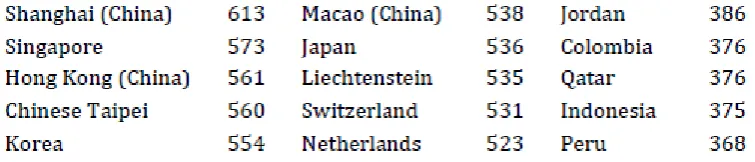
Mathematical literacy is defined as “an individual’s capacity to identify and understand the role that mathematics plays in the world, to make well--‐founded judgments and to use and engage with mathematics in ways that meet the needs of that individual’s life as a constructive, concerned and reflective citizen” (OECD, 2009, p. 14). Hence, Pisa is not assessing how well students learned the curriculum but how well the implemented curriculum prepared them for the future. Furthermore, Pisa looks at the organization of the school system and educational practices in different countries and investigates what ways are more effective and more helpful for students with disadvantage backgrounds. Indonesia scored in the bottom ranks in the Pisa test in 2003 and 2012. In 2012 the mean score for student performance in mathematics at 15 years was 375 for Indonesia, compared to 525 for the Netherlands, 554 for Korea and 561 for Hong Kong.
This paper has been presented at Sriwijaya University Learning and Education-International Conference 2014. Faculty of Teacher Training and Education, Sriwijaya University, Palembang, May 16—18, 2014.
A4-25
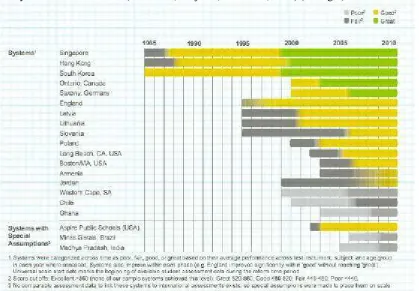
With Curriculum 2013 the government intends to boost Indonesian education. The M5 principles –Mengamati (Mengobservati), Menanya, Mencoba, Menalar dan Mencipta, and Menbentuk Jejaring–are intended to change the content and style of learning and teaching in schools and to make the learners ‘young scientists’. However, as experiences in other countries show, changing education is a long and winding journey. It does not happen in a few years, but successful reform has taken 10 or fewer years in some countries (Mourshed, Chijioke, & Barber , 2010) (see fig 2).
Figure 2: School systems on a continuum from poor to great and years needed for the improvement process (Mourshed, Chijioke, & Barber , 2010, p. 19)
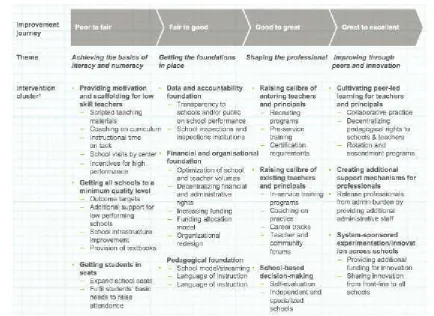
Moushed, Chijoke and Barber (2010) studied a series of school interventions representing a continuum of improvement from poor to fair to good to great. They show important steps in changing the educational system as a whole in the journey from poor to great (fig 3). In their study, Moushed ea (2010) notice six interventions that were common across all improvements initiatives: [1] Revising curriculum and standards; [2] Reviewing reward and remunerations structure; [3] Building technical skills of teachers and principals, often through group or cascaded training; [4] Assessing student learning; [5] Utilizing student data to guide delivery, and [6] Establishing policy documents and education laws. Of these initiatives, ‘curriculum (re)design’ and ‘teacher preparation towards building the skills that will redefine the roles of learners and teachers in the classroom’ are within the reach of colleges of education. The colleges of education can be a major force to help teacher, learners and the general public to think differently about learning.
LOOKING AT INDONESIAN EDUCATION THROUGH A DUTCH LENS
This paper has been presented at Sriwijaya University Learning and Education-International Conference 2014. Faculty of Teacher Training and Education, Sriwijaya University, Palembang, May 16—18, 2014.
A4-26
Figure 3 Whole system improvement interventions (Mourshed, Chijioke, & Barber , 2010, p. 28)
Most traditional Indonesian classrooms are set--‐up as a lecture hall. The teacher stands in the front of the class and the students are seated in rows facing the black board. The teaching style is dominated by ‘talk and chalk’ (Fauzan, Slettenhaar, & Plomp, 2002, p. 2). “For more than three decades a teaching--‐as--‐telling method influenced students’ attitudes. Students were expected to learn mathematics in passive ways and, but some hardly learned it at all. Many students became used to being spoon--‐fed by their teachers, and were rarely asked to think creatively or critically about what they were learning”(Sembiring, Hadi, & Dolk, 2008).
The mathematics instruction in Indonesia also can be characterized by progressive complexization: the teacher starts introducing easy cases where the algorithm is straightforward and slowly builds up to more and more complex situations as if each case is a new exception of the standard rule. This type of teaching will lead to all kinds of procedural misconceptions by children and desperate teachers trying to ‘solve’ each misconception.
27 31 391 301 3081
--‐ 13 --‐ 13 --‐ 127 --‐ 199 --‐ 1919
Figure 4 Subtractions in order of progressive complexity
This paper has been presented at Sriwijaya University Learning and Education-International Conference 2014. Faculty of Teacher Training and Education, Sriwijaya University, Palembang, May 16—18, 2014.
A4-27
order in which it is done for thousands of years; hence no one questions it any more. But it is not the right order to involve the students into becoming ‘Young Mathematicians’ (Fosnot & Dolk, 2001). The students might be doing mathematics in the sense of calculating and finding answers; they are not really doing any mathematical thinking: problem solving, reasoning, structuring, schematizing, discussing, improving, defending their ideas, justifying their thinking, reflecting, theorizing… Or as Freudenthal (1973) called it mathematizing the world. Not only the content seems to be problematic, also time--‐on--‐task is an issue. In most classes the teacher was working the whole hour, but the students worked just for a short period of time. In general, the students had to work on an easy task; the teacher walked around and answered individual questions. Most students are waiting for the teacher to tell them they are doing well or are waiting till the teacher assigns the next task to them. One of the possible interventions to improve mathematics education in Indonesian classes would imply to increase the ‘time--‐on--‐task’. By doubling the time students are working on mathematics, mathematics education can easily be improved. Involving students in challenging problems that can be solved at different levels of abstraction by stimulating students to use their prior mathematical knowledge and their knowledge of the world and that can lead into mathematical discussions can support the improvement of ‘time--‐on--‐task. To improve the time on task, the pedagogical foundation of education needs to be discussed and the role of the students and teachers in the class needs to be redefined. The PMRI project has been working on the improvement of the content of mathematics in primary schools (Sembiring, Hoogland, & Dolk, 2010). Landscape of learning (Fosnot &Dolk, 2001) describing the growth and development of students in terms of big ideas, strategies and models of mathematics support an overview of the curriculum that teachers need.
PROBLEM SOLVING AND MATHEMATIZING: A LOCAL ISSUE
I need your help! My entire family is coming over for
Thanksgiving dinner.
Here is the sign I saw in the supermarket: “Turkeys for sale. $1.25 per pound.”
The largest Turkey I could find was 24 pounds. With your partner, discuss how you could figure out how much will the turkey cost? How much will the turkey cost?
Figure 5 Turkey investigation (Dolk & Fosnot, 2005)
This paper has been presented at Sriwijaya University Learning and Education-International Conference 2014. Faculty of Teacher Training and Education, Sriwijaya University, Palembang, May 16—18, 2014.
A4-28
addition of the quarters and adding the dollars; making groups four quarters and adding the dollars; using ratio table; and realizing that 4 pounds is equivalent to 5 dollars, so 24 pounds is 6 times 5 dollars. Next, the teacher asks some of children to explain their work and have the students discuss the connection between the different solutions. The next day, she introduced a follow--‐up problem that allows the students to look at the same issue again: ‘I need to cook the Turkey. My cookbook says: cook a large bird for 15 minutes per pound. How long do I have to cook the Turkey in the oven?’ The problem is mathematically identical to the earlier problem. Both problems ask for 24 × ¼. However, for the children it is a new problem, as they are not aware of the similarities between both cases. The Turkey Problem worked well in classrooms in New York. However, this context turned out not to be meaningful in the Indonesian situation. Where it is ‘normal’ for American children that a Turkey is baked as a whole; many Indonesian children think that cooking a bird means cooking smaller pieces of that bird.
Ustadzhah wants to buy 12 kilograms of chicken. Each kilogram of chicken costs 25 thousand rupiahs. How much money will Ustadzah need to bring?
Figure 7 Adaptation of the Turkey Problem (Widjaja & Dolk, in press)
Wanty Widjaja and I adapted the problem to the Indonesian context and tried it in several classes. Discovering that the problem allowed children to mathematize, but that the redesigning of teachers interaction skills was still a big issue.
A family buys 25 kilograms of rice and eats ¾ of a kilo per day. How many days can the rice last?
Figure 6 Rice problem (Sutarto Hadi)
The Turkey problem inspired prof dr Sutarto Hadi into a Rice Problem. This problem as tried in classes in Yogyakarta allows children to investigate fractions and is an entry into the famous problem of ‘dividing by a fraction’.
FINAL REMARKS
This paper has been presented at Sriwijaya University Learning and Education-International Conference 2014. Faculty of Teacher Training and Education, Sriwijaya University, Palembang, May 16—18, 2014.
A4-29
REFERENCES
Commonwealth of Australia. (2013). National Plan for School Improvement. Retrieved May 5, 2014, from http://www.budget.gov.au/2013--‐14/content/glossy/gonski_policy/download/NPSI.pdf Dolk, M., & Fosnot, C. T. (2005). Turkey investigations, Grades 3--‐5: A context for multiplication
(CD--‐ROM). Portsmouth, NH: Heinemann.
Fauzan, A., Slettenhaar, D., & Plomp, T. (2002). Traditional Mathematics Education vs. Realistic Mathematics Education: Hoping for Changes. In P. Valero, & P. V. Skovsmose (Ed.),
Proceedings of the 3rd International Mathematics Education and Society Conference (pp. 1--‐4). Copenhagen: Centre for Research in Learning Mathematics.
Fosnot, C. T., & Dolk, M. (2001). Young Mathematicians at Work. Constructing Number Sense, Addition and Subtraction. Portsmouth, NH, USA: Heinemann.
Freudenthal, H. (1973). Mathematics as an educational task. Dordrecht, The Netherlands: D. Reidel Publishing Company.
Mourshed, M., Chijioke, C., & Barber , M. (2010). How the world’s most improved school systems
keep getting better . McKinsey & Company . McKinsey & Company .
OECD. (2014). About Pisa. Retrieved. May 5, 2014, from OECD: http://www.oecd.org/pisa/aboutpisa/ OECD. (2009). PISA 2009 Assessment Framework: Key Competencies in Reading, Mathematics and
Science. Paris: . Paris, Fr: OECD Publishing.
OECD. (2013). PISA 2012 Results in Focus. What 15--‐year--‐olds know and what they can do with what they know. Retrieved May 2, 2014, from http://www.oecd.org/pisa/keyfindings/pisa--‐2012--‐results--‐overview.pdf
Sembiring, R. K., Hadi, S., & Dolk, M. (2008). Reforming mathematics learning in Indonesian classrooms through RME. ZDM Mathematics Education (40), 927--‐939.
Sembiring, R., Hoogland, K., & Dolk, M. (2010). A decade of PMRI in Indonesia. Utrecht: APS International.
Widjaja, W., & Dolk, M. (in press). The use of videos and classroom artefacts in professional development of teachers and teacher educators in Indonesia. In N. Swee